One-Time Pad Encryption


     Presented By proidiot
            DC405
      December 19, 2008
What is OTP?
●
    One-Time Pad (OTP) is a very simple encryption
    algorithm based on modular arithmetic.
●
    Each key must be completely random and used only
    once.
●
    OTP is “perfectly secure” (a.k.a. “Shannon secure”)
    because the ciphertext provides provides no
    information about the plaintext other than the
    maximum possible size.
How Does OTP Work?
1. Truly random keys are transferred beforehand (often in bulk in the form
   of a “pad”).
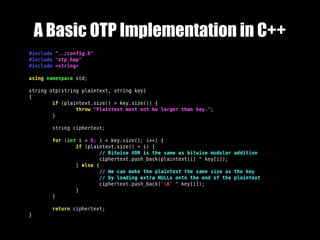
2. The sender creates the ciphertext by using modular arithmatic on the
   plaintext and key a character at a time in order to calculate the
   corresponding character in the ciphertext. (Inside computers, this is
   often accomplished by a bitwise XOR on the data.)
3.The sender immediately destroys his copy of the key, and then sends
  the ciphertext by any means to the receiver.
4. The receiver performs the same modular arithmetic with the ciphertext
   and key.
5.The receiver then destroys his copy of the key.
A Basic OTP Implementation in C++
Why Would I Want to Use OTP?
●
    OTP is one of the easiest encryption mechanisms to
    implement (in fact, people often do it by hand).
●
    If the keys are truly random, only used once,
    destroyed after use, and are transferred and kept in
    complete secrecy, then the ciphertext cannot be
    cracked (and thus “perfect secrecy” is achieved).
●
    If the above conditions are met, there is also
    perfect deniability.
...Then Why Do We Use Anything Else???
●
    In practice, it is usually easy for others to compromise the
    key during transfer, while it is being stored, after it has
    been improperly destroyed, or all of the above.
●
    True randomness in the key is almost impossible to
    achieve in practice.
●
    Keys can only be used once.
●
    Since there is no provision for message integrity, a man-
    in-the-middle could occur with neither party capable of
    knowing it.
“Shannon Secure”
●
    In 1949, Claude Shannon of Bell Labs published a proof
    that if the keys are used only once, are completely
    random, and kept secure, then OTP is perfectly secure.
●
    This caused the term “Shannon Secure” to be coined to
    refer to systems that can achieve perfect security in
    theory.
●
    It has also been proven that anything that is Shannon
    Secure must have single-use keys that are used only
    once.
Quantum Computing and OTP
●
    True randomness is difficult to achieve as even the very
    few non-quantum sources of true entropy are subject to
    strong bias resulting from measurement.
●
    Quantum mechanics, however, gives us entropy sources
    that are not subject to quite as much meausrement bias.
●
    Additionally, quantum entaglement would allow transfer
    of keys with perfect message integrity.
●
    Unfortunately, there is still no good way to secure the
    storage of the keys.
What Can We Learn from OTP?
●
    True randomness in encryption keys is vital.
●
    While one-time use is ideal, the closer to one-time
    use (such as time-sensitive keys) the better.
●
    While extremely complicated encryption algorithms
    aren't necessary for perfect security, algorithms
    that assist with the storage and transfer problems of
    OTP keys (such as public key mechanisms) can
    mean a huge step forward for practical security.
●
    Secure deletion of keys is also vital.
One-Time Pad Encryption

One-Time Pad Encryption

  • 1.
    One-Time Pad Encryption Presented By proidiot DC405 December 19, 2008
  • 2.
    What is OTP? ● One-Time Pad (OTP) is a very simple encryption algorithm based on modular arithmetic. ● Each key must be completely random and used only once. ● OTP is “perfectly secure” (a.k.a. “Shannon secure”) because the ciphertext provides provides no information about the plaintext other than the maximum possible size.
  • 3.
    How Does OTPWork? 1. Truly random keys are transferred beforehand (often in bulk in the form of a “pad”). 2. The sender creates the ciphertext by using modular arithmatic on the plaintext and key a character at a time in order to calculate the corresponding character in the ciphertext. (Inside computers, this is often accomplished by a bitwise XOR on the data.) 3.The sender immediately destroys his copy of the key, and then sends the ciphertext by any means to the receiver. 4. The receiver performs the same modular arithmetic with the ciphertext and key. 5.The receiver then destroys his copy of the key.
  • 4.
    A Basic OTPImplementation in C++
  • 5.
    Why Would IWant to Use OTP? ● OTP is one of the easiest encryption mechanisms to implement (in fact, people often do it by hand). ● If the keys are truly random, only used once, destroyed after use, and are transferred and kept in complete secrecy, then the ciphertext cannot be cracked (and thus “perfect secrecy” is achieved). ● If the above conditions are met, there is also perfect deniability.
  • 6.
    ...Then Why DoWe Use Anything Else??? ● In practice, it is usually easy for others to compromise the key during transfer, while it is being stored, after it has been improperly destroyed, or all of the above. ● True randomness in the key is almost impossible to achieve in practice. ● Keys can only be used once. ● Since there is no provision for message integrity, a man- in-the-middle could occur with neither party capable of knowing it.
  • 7.
    “Shannon Secure” ● In 1949, Claude Shannon of Bell Labs published a proof that if the keys are used only once, are completely random, and kept secure, then OTP is perfectly secure. ● This caused the term “Shannon Secure” to be coined to refer to systems that can achieve perfect security in theory. ● It has also been proven that anything that is Shannon Secure must have single-use keys that are used only once.
  • 8.
    Quantum Computing andOTP ● True randomness is difficult to achieve as even the very few non-quantum sources of true entropy are subject to strong bias resulting from measurement. ● Quantum mechanics, however, gives us entropy sources that are not subject to quite as much meausrement bias. ● Additionally, quantum entaglement would allow transfer of keys with perfect message integrity. ● Unfortunately, there is still no good way to secure the storage of the keys.
  • 9.
    What Can WeLearn from OTP? ● True randomness in encryption keys is vital. ● While one-time use is ideal, the closer to one-time use (such as time-sensitive keys) the better. ● While extremely complicated encryption algorithms aren't necessary for perfect security, algorithms that assist with the storage and transfer problems of OTP keys (such as public key mechanisms) can mean a huge step forward for practical security. ● Secure deletion of keys is also vital.