ONE TIME PASSWORD 
By 
Swetha Kogatam 
SJSU ID: 009439339
AGENDA 
 Introduction 
 Brief History of OTP systems 
 Benefits &Costs, 
 Categories of OTP 
 Methods of Generation 
• HOTP & TOTP 
 Methods of delivery 
 RFCs and standards 
 Attacks 
 OTP Development Libraries
What is a One-time Password? 
 A single-use password or series of codes used 
to authenticate a user over an untrusted 
communication channel 
• Complements a user password 
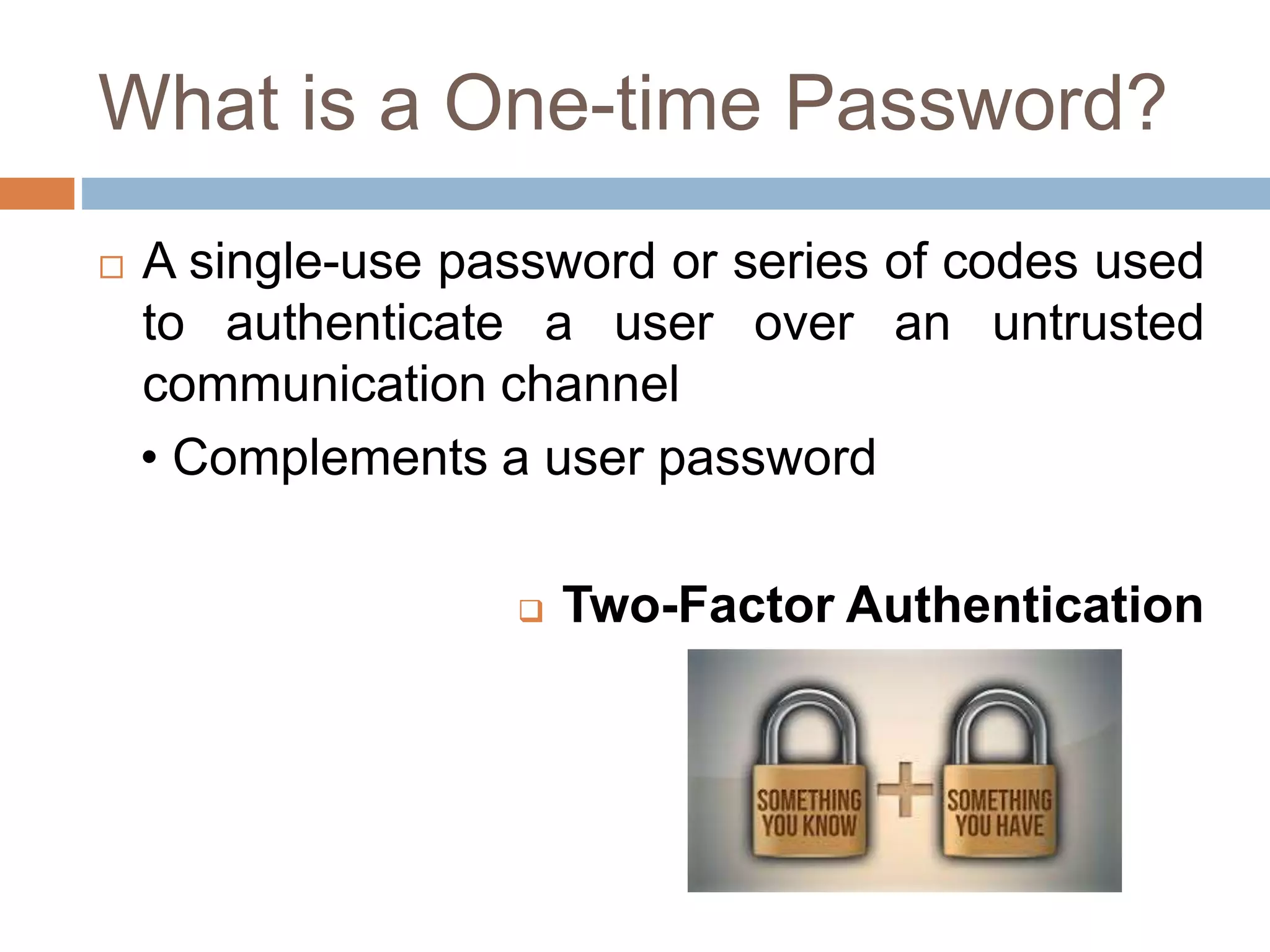
 Two-Factor Authentication
Brief & Probable History 
 Leslie Lamport wrote an article on chaining 
hashes for authentication (CACM 1981) 
 Bellcore developed S/Key based on the 
Lamport scheme (1994) 
 Hardware tokens are developed 
 OPIE was a more modern implementation and 
compatible with S/Key 
 OTPW developed
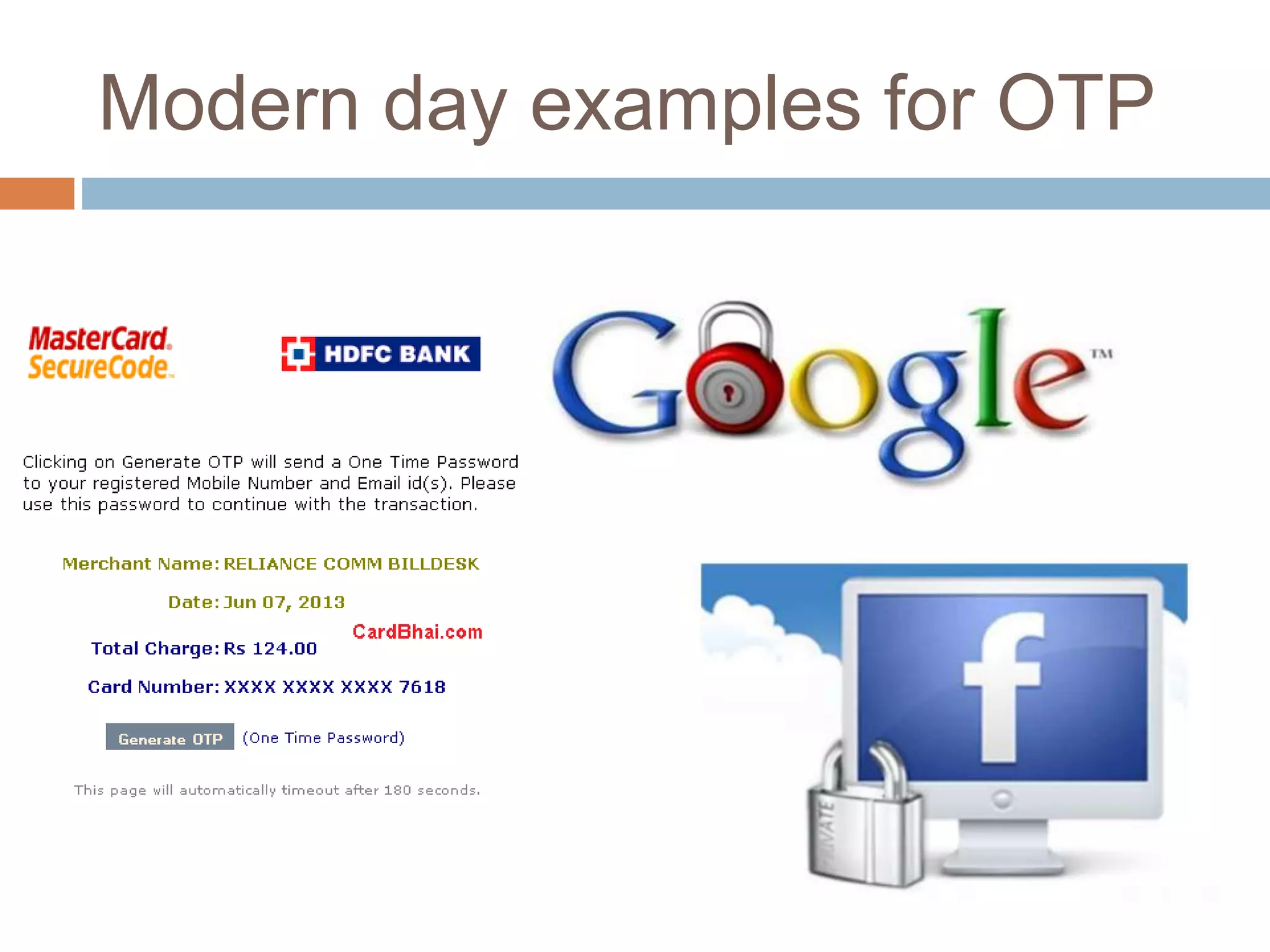
Modern day examples for OTP
Benefits of OTPs 
 Cost effective alternative for expensive digital 
certificates 
 Cannot be reused 
 Avoids expensive Hardware tokens 
 Can be time-limited 
 Can be used over untrusted communication 
paths 
• Telnet, web-based, serial terminals 
 Can use with a compromised user password 
 Multiple generation/delivery mechanisms
Costs 
 Difficult for human beings to memorize and 
require additional technology to work 
 Based on a shared secret 
 Software tools can be compromised 
 Attacks are still possible
Categories of OTPs 
 More often used two types of OTPs are 
1. Event Based - HMAC-based One-time 
Password (HOTP) 
2. Time Based - Time-based One time Password 
(TOTP) 
 Others include 
1. Challenge-based - User enters a key sent from 
server plus a password 
2. Proprietary – RSA SecureID
Methods of Generation - HOTP 
 HOTP (HMAC-based) 
• Computes a HMAC-SHA-1 and truncation to 
compute the HOTP value 
• HOTP(K,C) = Truncate(HMAC-SHA-1(K,C)) 
Where the Key (K), the Counter (C),
HOTP 
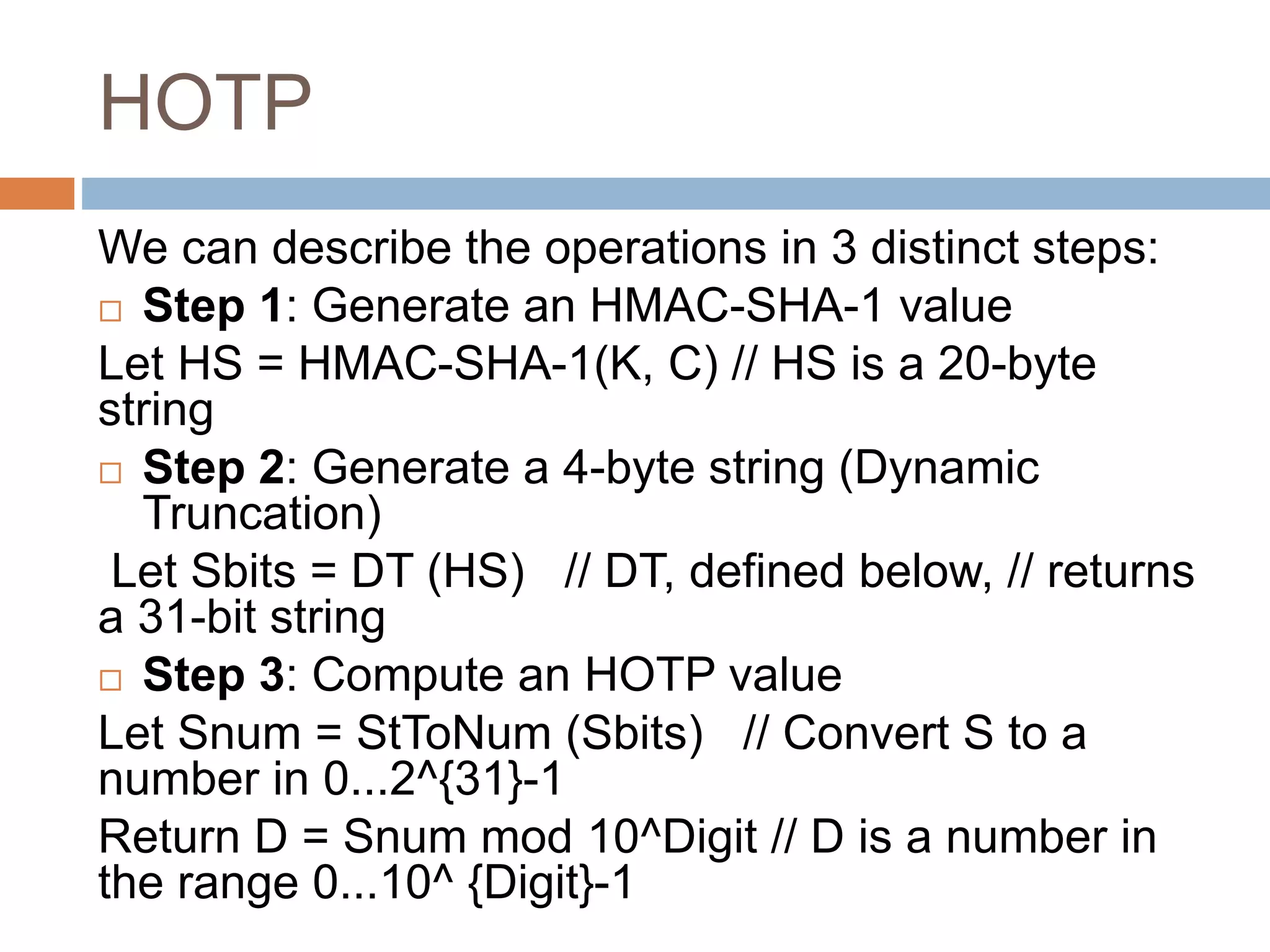
We can describe the operations in 3 distinct steps: 
 Step 1: Generate an HMAC-SHA-1 value 
Let HS = HMAC-SHA-1(K, C) // HS is a 20-byte 
string 
 Step 2: Generate a 4-byte string (Dynamic 
Truncation) 
Let Sbits = DT (HS) // DT, defined below, // returns 
a 31-bit string 
 Step 3: Compute an HOTP value 
Let Snum = StToNum (Sbits) // Convert S to a 
number in 0...2^{31}-1 
Return D = Snum mod 10^Digit // D is a number in 
the range 0...10^ {Digit}-1
TOTP 
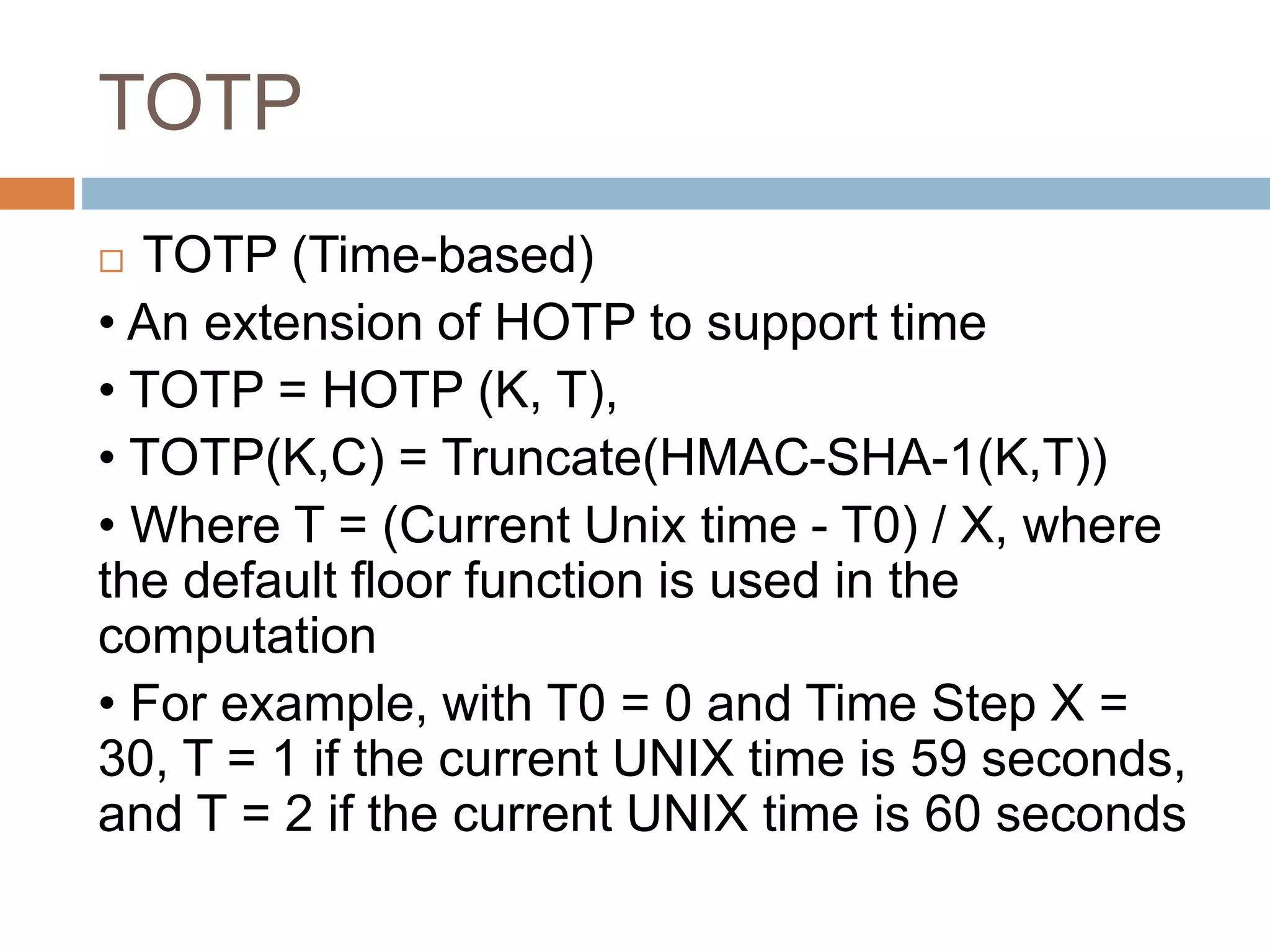
 TOTP (Time-based) 
• An extension of HOTP to support time 
• TOTP = HOTP (K, T), 
• TOTP(K,C) = Truncate(HMAC-SHA-1(K,T)) 
• Where T = (Current Unix time - T0) / X, where 
the default floor function is used in the 
computation 
• For example, with T0 = 0 and Time Step X = 
30, T = 1 if the current UNIX time is 59 seconds, 
and T = 2 if the current UNIX time is 60 seconds
Methods of Delivery 
 Software applications 
• Command line OTP calculators 
 Text messaging 
• Requests are made to send a code via SMS 
• Requests from SMS itself or out-of-band 
 Phone call 
• During the authentication process, you receive 
a phone call and enter a PIN
More Methods of Delivery 
 Paper 
• Lists of passwords or codes to use 
• Some systems use paper codes as a backup 
 Hardware token 
• Token has a rotating display of the current code 
• May have buttons for challenges 
 Mobile applications 
• The code is displayed exactly like a HW token 
• OTP calculators can work with counter-based OTP
RFCs and Standards 
 RFC 1760, The S/KEY One-Time Password 
System 
 RFC 2289, A One-time Password System 
 RFC 4226, HOTP: An HMAC-Based One-Time 
Password Algorithm 
 RFC 6238, TOTP: Time-based One-time 
Password Algorithm
Attacks on OTP 
 Man-in-the-Middle 
• Attacker captures and resends authentication 
data to legitimate server 
 Mobile based delivery for OTPs can be 
attacked 
 Paper based delivery for OTPs - theft
OTP Development Libraries 
 Java: javaotp 
 Ruby: ropt, ruby-otp 
 Python: POTP 
 PHP: OTPHP, multiOTP 
 C/C++: OpenOTP 
 Many more available
Questions
One Time Password  - A two factor authentication system

One Time Password - A two factor authentication system

  • 1.
    ONE TIME PASSWORD By Swetha Kogatam SJSU ID: 009439339
  • 2.
    AGENDA  Introduction  Brief History of OTP systems  Benefits &Costs,  Categories of OTP  Methods of Generation • HOTP & TOTP  Methods of delivery  RFCs and standards  Attacks  OTP Development Libraries
  • 3.
    What is aOne-time Password?  A single-use password or series of codes used to authenticate a user over an untrusted communication channel • Complements a user password  Two-Factor Authentication
  • 4.
    Brief & ProbableHistory  Leslie Lamport wrote an article on chaining hashes for authentication (CACM 1981)  Bellcore developed S/Key based on the Lamport scheme (1994)  Hardware tokens are developed  OPIE was a more modern implementation and compatible with S/Key  OTPW developed
  • 5.
  • 6.
    Benefits of OTPs  Cost effective alternative for expensive digital certificates  Cannot be reused  Avoids expensive Hardware tokens  Can be time-limited  Can be used over untrusted communication paths • Telnet, web-based, serial terminals  Can use with a compromised user password  Multiple generation/delivery mechanisms
  • 7.
    Costs  Difficultfor human beings to memorize and require additional technology to work  Based on a shared secret  Software tools can be compromised  Attacks are still possible
  • 8.
    Categories of OTPs  More often used two types of OTPs are 1. Event Based - HMAC-based One-time Password (HOTP) 2. Time Based - Time-based One time Password (TOTP)  Others include 1. Challenge-based - User enters a key sent from server plus a password 2. Proprietary – RSA SecureID
  • 9.
    Methods of Generation- HOTP  HOTP (HMAC-based) • Computes a HMAC-SHA-1 and truncation to compute the HOTP value • HOTP(K,C) = Truncate(HMAC-SHA-1(K,C)) Where the Key (K), the Counter (C),
  • 10.
    HOTP We candescribe the operations in 3 distinct steps:  Step 1: Generate an HMAC-SHA-1 value Let HS = HMAC-SHA-1(K, C) // HS is a 20-byte string  Step 2: Generate a 4-byte string (Dynamic Truncation) Let Sbits = DT (HS) // DT, defined below, // returns a 31-bit string  Step 3: Compute an HOTP value Let Snum = StToNum (Sbits) // Convert S to a number in 0...2^{31}-1 Return D = Snum mod 10^Digit // D is a number in the range 0...10^ {Digit}-1
  • 11.
    TOTP  TOTP(Time-based) • An extension of HOTP to support time • TOTP = HOTP (K, T), • TOTP(K,C) = Truncate(HMAC-SHA-1(K,T)) • Where T = (Current Unix time - T0) / X, where the default floor function is used in the computation • For example, with T0 = 0 and Time Step X = 30, T = 1 if the current UNIX time is 59 seconds, and T = 2 if the current UNIX time is 60 seconds
  • 12.
    Methods of Delivery  Software applications • Command line OTP calculators  Text messaging • Requests are made to send a code via SMS • Requests from SMS itself or out-of-band  Phone call • During the authentication process, you receive a phone call and enter a PIN
  • 13.
    More Methods ofDelivery  Paper • Lists of passwords or codes to use • Some systems use paper codes as a backup  Hardware token • Token has a rotating display of the current code • May have buttons for challenges  Mobile applications • The code is displayed exactly like a HW token • OTP calculators can work with counter-based OTP
  • 14.
    RFCs and Standards  RFC 1760, The S/KEY One-Time Password System  RFC 2289, A One-time Password System  RFC 4226, HOTP: An HMAC-Based One-Time Password Algorithm  RFC 6238, TOTP: Time-based One-time Password Algorithm
  • 15.
    Attacks on OTP  Man-in-the-Middle • Attacker captures and resends authentication data to legitimate server  Mobile based delivery for OTPs can be attacked  Paper based delivery for OTPs - theft
  • 16.
    OTP Development Libraries  Java: javaotp  Ruby: ropt, ruby-otp  Python: POTP  PHP: OTPHP, multiOTP  C/C++: OpenOTP  Many more available
  • 17.