TPS ToolsTPS Tools
TPS ToolsTPS Tools
 Bias f or A c t ion is a k e y t ool
 C r e at iv it y b e f or e C ap it al m u st alw ay s
b e ap p lie d : w e m u st aim f or t h e le ast
c ost c ou n t e r m e asu r e – “ m ak e y ou r ow n
b r ain sw e at !”
TPS ToolsTPS Tools
 5 S’s – Sor t ( se ir i) , Sim p lif y ( se it on ) ,
Sw e e p ( se iso) , St an d ar d ize ( se ik e t su )
an d Su st ain ( sh it su k e )
 Be f or e all t h is: S0 ( S ze r o) w h e r e y ou
j u st t h r ow ou t j u n k . To d o t h is, y ou
j u st look at w h at is ly in g ar ou n d – an y
it e m w h ic h c an b e c lassif ie d as j u n k
w it h ou t a se c on d look or w it h ou t
ask in g an y on e m u st b e t h r ow n ou t !
S1: SortS1: Sort
 Be f or e w e st ar t S1 , w e n e e d t o
d e f in e w h at t h e w or k is – on ly t h e n
c an w e k n ow w h at t o sor t !
 W e h av e t o ag r e e w h at w e ar e g oin g
t o m ak e in t h is ar e a. Th e n w e k n ow
w h at w e w ill n e e d .
 Look at t h e j ob c ar d / p r oc e ss sh e e t
an d f in d ou t w h at is r e q u ir e d t o d o
t h e w or k
S1: SortS1: Sort
 W it h t h e p e r son w h o w or k s t h e r e ,
t r u ly sor t ou t t h at w or k ar e a:
 J u n k – im m e d iat e d isp osal
 St u f f t h at I n e e d t o d o t h is w or k ( c alle d
f or in t h e w or k or d e r )
 St u f f t h at I d on ’t u se – d on ’t n e e d f or
t h e w or k in t h is ar e a – b u t n ot j u n k : u se
a Re d Tag t o id e n t if y it an d m ov e it t o a
h old in g ar e a som e w h e r e ( d on ’t t h r ow it
aw ay )
S1: SortS1: Sort
 Th e r e w ill b e it e m s w h ic h ar e n ot on t h e
j ob c ar d / p r oc e ss sh e e t ( e . g . a h am m e r )
b u t t h e op e r at or w ill say h e n e e d s it :
 U se t h e 5 W h y s on su c h it e m s
 Pu t t h e it e m on a To- Do List t o se e h ow y ou
c an e lim in at e t h e r e q u ir e m e n t
 A t t h e e n d of S1 , y ou w ill g e t sp ac e ,
e m p t y r ac k s, e m p t y d r aw e r s, e m p t y
c u p b oar d s: m ov e t h e se t oo t o t h e Re d Tag
ar e a: sp ac e is m ag n e t ic – it g e t s f ille d u p !
S1: SortS1: Sort
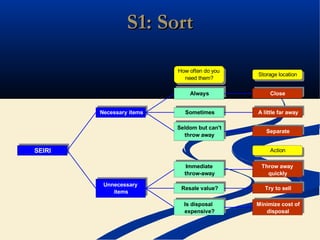
SEIRI
Unnecessary
items
Necessary items
How often do you
need them?
Is disposal
expensive?
Resale value?
Immediate
throw-away
Seldom but can't
throw away
Sometimes
Always
Storage location
Action
Minimize cost of
disposal
Try to sell
Throw away
quickly
Separate
A little far away
Close
S2: SimplifyS2: Simplify
 I n ow n e e d t o r e - lay ou t t h e ar e a: look
at t h in g s an d r e - ar r an g e t h e m
 I sh ou ld b e ab le t o ar r an g e t h in g s in a
sp h e r e so t h at I c an g e t w h at I w an t
b y r e ac h in g ou t w it h ou t m ov in g m y
f e e t .
 A r r an g e in or d e r of se q u e n c e t h at I n e e d
t h e m
 C olou r c od e b in s b y p r od u c t / p r oj e c t
( m ist ak e - p r oof in g )
 A r r an g e b y or d e r of j ob c ar d
 Poin t of u se st or ag e
S2: SimplifyS2: Simplify
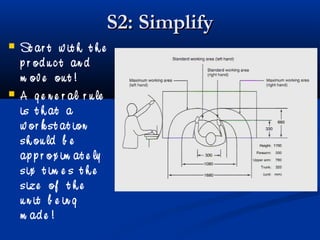
 St ar t w it h t h e
p r od u c t an d
m ov e ou t !
 A g e n e r al r u le
is t h at a
w or k st at ion
sh ou ld b e
ap p r ox im at e ly
six t im e s t h e
size of t h e
u n it b e in g
m ad e !
S3: SweepS3: Sweep
 I n e e d t o b e ab le t o look at t h e
w or k st at ion an d say Y ES! Th is is
w or k ab le w or k !
 Th e e n t ir e w or k st at ion sh ou ld b e m ad e
h ig h ly v isu al:
 Sh ad ow b oar d s
 In st r u c t ion s
 C olou r c od e d
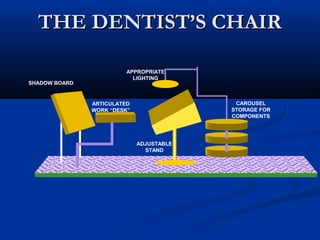
THE DENTIST’S CHAIRTHE DENTIST’S CHAIR
SHADOW BOARD
ARTICULATED
WORK “DESK”
APPROPRIATE
LIGHTING
CAROUSEL
STORAGE FOR
COMPONENTS
ADJUSTABLE
STAND
S4: StandardizeS4: Standardize
 St an d ar d izin g m e an s:
 U sin g t h e sam e t ools
 Doin g t h e w or k in t h e sam e w ay
 U sin g t h e sam e f ix t u r e s
 Tak in g p ar t s f r om t h e sam e b in s
 U sin g t h e sam e in st r u c t ion s
 N OT u sin g m y ow n p e r son al t oolb ox !
 St an d ar d ize d w or k in g ( n ot St an d ar d
W or k )
S4: StandardizeS4: Standardize
 M ov e t ools ou t of t oolb ox e s t o sh ad ow
b oar d s – if n e c e ssar y , in t h e e ar lie r
st ag e s, u se t r an sp ar e n t c ov e r s an d
loc k s
 If som e on e h as d e v e lop e d an d is u sin g a
sp e c ial t ool: r e sp e c t t h e d e v e lop m e n t ,
an d le v e r ag e f r om it so t h at e v e r y on e
c an u se it
 M ak e e v e r y t h in g t r an sp ar e n t ,
d oc u m e n t e d , v isu al
S5: SustainS5: Sustain
 A lso k n ow n as se lf - d isc ip lin e
 To e n f or c e t h e d isc ip lin e of 5 S, w e n e e d t o
c ar r y ou t au d it s
 Re c og n ize g ood 5 S
 LRT m e m b e r s c an st ar t d oin g t h e au d it s
 Id e ally sh ou ld b e se lf - au d it , t h e n au d it b y
t h e su p e r v isor of t h e ar e a say w e e k ly , t h e n
b y t h e m an ag e r / se n ior m an ag e r m on t h ly
an d b y t h e GM q u ar t e r ly
Video on 5-SVideo on 5-S
TPS ToolsTPS Tools
 Pu ll – d ow n st r e am ac t iv it ie s sig n al
t h e ir n e e d s t o u p st r e am ac t iv it ie s –
 w h at p ar t / m at e r ial is n e e d e d ,
 q u an t it y n e e d e d ,
 w h e n an d w h e r e it is n e e d e d .
Th e u p st r e am p r oc e ss d oe s n ot
p r od u c e an y t h in g u n t il t h e d ow n st r e am
p r oc e ss sig n als a n e e d
TPS ToolsTPS Tools
 M RS – M at e r ial Re p le n ish m e n t Sy st e m
– Te c h n iq u e s f or u sin g c ar d s, lig h t s,
h e ig h t s, g r id s, sq u ar e s, f lag s or ot h e r
v isu al m e an s of sig n allin g t h e n e e d f or
r e p le n ish m e n t of m at e r ials, p ar t s or
su p p lie s loc at e d at r e - su p p ly p oin t s.
TPS ToolsTPS Tools
 On e Pie c e – M ak in g an d m ov in g on e
p ie c e at a t im e t h r ou g h a se r ie s of
p r oc e ssin g st e p s as c on t in u ou sly as
p ossib le , w it h e ac h st e p m ak in g j u st
w h at is r e q u e st e d b y t h e n e x t st e p .
TPS ToolsTPS Tools
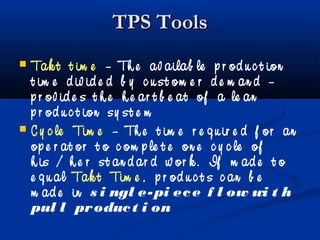
 Tak t t im e – Th e av ailab le p r od u c t ion
t im e d iv id e d b y c u st om e r d e m an d –
p r ov id e s t h e h e ar t b e at of a le an
p r od u c t ion sy st e m
 C y c le Tim e – Th e t im e r e q u ir e d f or an
op e r at or t o c om p le t e on e c y c le of
h is / h e r st an d ar d w or k . If m ad e t o
e q u al Tak t Tim e , p r od u c t s c an b e
m ad e in s i ngl e-pi ece f l ow wi t h
pul l product i on
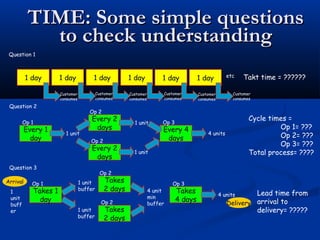
TIME: Some simple questionsTIME: Some simple questions
to check understandingto check understanding
1 day 1 day 1 day 1 day
Customer
consumes
Customer
consumes
Customer
consumes
Customer
consumes
1 day 1 day
Customer
consumes
Customer
consumes
Takt time = ??????
Question 1
etc
Every 1
day
Every 2
days
Every 2
days
Every 4
days
Cycle times =
Op 1= ???
Op 2= ???
Op 3= ???
Total process= ????
Question 2
Op 1
Op 2
1 unit
1 unit
1 unit
4 units
Op 2
Op 3
Takes 1
day
Takes
2 days
Takes
2 days
Takes
4 days
Lead time from
arrival to
delivery= ?????
Question 3
Op 1
Op 2
1 unit
buffer
4 units
Op 2
Op 3
1 unit
buffer
4 unit
min
buffer
1
unit
buff
er
Arrival
Delivery
TIME: Maybe not so simpleTIME: Maybe not so simple
questions !!!!questions !!!!
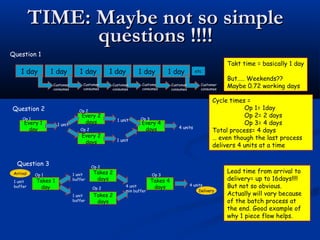
Takt time = basically 1 day
But….. Weekends??
Maybe 0.72 working days
1 day 1 day 1 day 1 day
Customer
consumes
Customer
consumes
Customer
consumes
Customer
consumes
1 day 1 day
Customer
consumes
Customer
consumes
Question 1
etc
Cycle times =
Op 1= 1day
Op 2= 2 days
Op 3= 4 days
Total process= 4 days
… even though the last process
delivers 4 units at a time
Every 1
day
Every 2
days
Every 2
days
Every 4
days
Question 2
Op 1
Op 2
1 unit
1 unit
1 unit
4 unitsOp 2
Op 3
Lead time from arrival to
delivery= up to 16days!!!!
But not so obvious.
Actually will vary because
of the batch process at
the end. Good example of
why 1 piece flow helps.
Takes 1
day
Takes 2
days
Takes 2
days
Takes 4
days
Question 3
Op 1
Op 2
1 unit
buffer
4 units
Op 2
Op 3
1 unit
buffer
4 unit
min buffer
1 unit
buffer
Arrival
Delivery
TIME: Lean helps keep theTIME: Lean helps keep the
answers simple!answers simple!
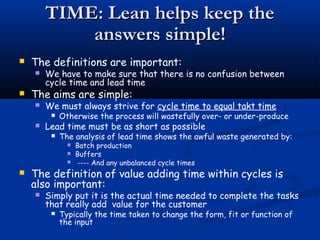
 The definitions are important:
 We have to make sure that there is no confusion between
cycle time and lead time
 The aims are simple:
 We must always strive for cycle time to equal takt time
 Otherwise the process will wastefully over- or under-produce
 Lead time must be as short as possible
 The analysis of lead time shows the awful waste generated by:
 Batch production
 Buffers
 ---- And any unbalanced cycle times
 The definition of value adding time within cycles is
also important:
 Simply put it is the actual time needed to complete the tasks
that really add value for the customer
 Typically the time taken to change the form, fit or function of
the input
Takt Time BalanceTakt Time Balance
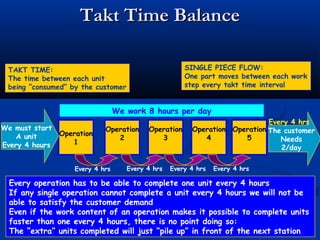
TAKT TIME:
The time between each unit
being “consumed” by the customer
Operation
1
Operation
2
Operation
3
Operation
4
Operation
5
We work 8 hours per day
Every 4 hrs Every 4 hrs Every 4 hrs Every 4 hrs
The customer
Needs
2/day
Every 4 hrs
Every operation has to be able to complete one unit every 4 hours
If any single operation cannot complete a unit every 4 hours we will not be
able to satisfy the customer demand
Even if the work content of an operation makes it possible to complete units
faster than one every 4 hours, there is no point doing so:
The “extra” units completed will just “pile up” in front of the next station
We must start
A unit
Every 4 hours
SINGLE PIECE FLOW:
One part moves between each work
step every takt time interval
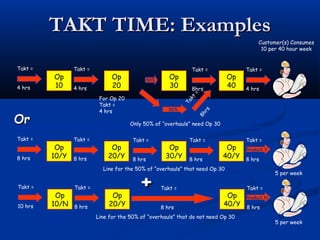
TAKT TIME: ExamplesTAKT TIME: Examples
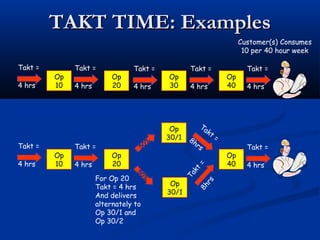
Op
10
Op
20
Op
30
Op
40
Customer(s) Consumes
10 per 40 hour week
Takt =
4 hrs
Takt =
4 hrs
Takt =
4 hrs
Takt =
4 hrs
Takt =
4 hrs
Op
10
Op
20
Op
30/1
Op
40
Takt =
4 hrs
Takt =
4 hrs
Takt =
4 hrs
50%
Takt
=8hrs
Op
30/1
50%
Takt =8hrs
For Op 20
Takt = 4 hrs
And delivers
alternately to
Op 30/1 and
Op 30/2
TAKT TIME: ExamplesTAKT TIME: Examples
Op
10
Op
20
Op
30
Op
40/a
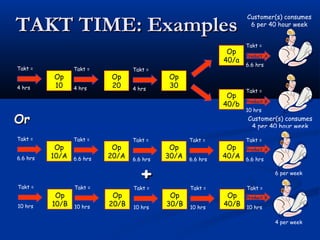
Customer(s) consumes
6 per 40 hour week
Product A
Takt =
6.6 hrs
Takt =
4 hrs
Takt =
4 hrs
Takt =
4 hrs
Op
40/b
Customer(s) consumes
4 per 40 hour week
Product B
Takt =
10 hrs
Op
10/A
Op
20/A
Op
30/A
Op
40/A
Takt =
6.6 hrs
Takt =
6.6 hrs
Takt =
6.6 hrs
Takt =
6.6 hrs
Takt =
6.6 hrs
Op
10/B
Op
20/B
Op
30/B
Op
40/B
Takt =
10 hrs
Takt =
10 hrs
Takt =
10 hrs
Takt =
10 hrs
Takt =
10 hrs
Product A
Product B
4 per week
6 per week
++
OrOr
TAKT TIME: ExamplesTAKT TIME: Examples
Op
10
Op
20
Op
30
Op
40
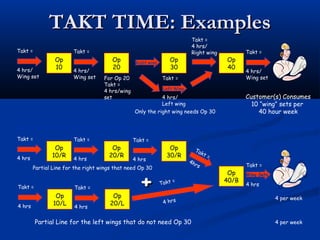
Customer(s) Consumes
10 “wing” sets per
40 hour week
Takt =
4 hrs/
Wing set
Takt =
4 hrs/
Wing set
Takt =
4 hrs/
Wing set
Left Wing
Takt =
4 hrs/
Left wing
Right wing
Takt =
4 hrs/
Right wing
For Op 20
Takt =
4 hrs/wing
set
Only the right wing needs Op 30
Op
10/R
Op
20/R
Op
30/R
Op
40/B
Takt =
4 hrs
Takt =
4 hrs
Takt =
4 hrs
Takt =
4 hrs
Takt =
4hrs
Op
10/L
Op
20/L
Takt =
4 hrs
Takt =
4 hrs
Takt =
4 hrs
Wing Sets
4 per week
4 per week
++
Partial Line for the right wings that need Op 30
Partial Line for the left wings that do not need Op 30
TAKT TIME: ExamplesTAKT TIME: Examples
Op
10
Op
20
Op
30
Op
40
Customer(s) Consumes
10 per 40 hour week
Takt =
4 hrs
Takt =
4 hrs
Takt =
4 hrs
50%
50%
For Op 20
Takt =
4 hrs
Takt
=
8hrs
Takt =
8hrs
Only 50% of “overhauls” need Op 30
Op
10/Y
Op
20/Y
Op
30/Y
Op
40/Y
Takt =
8 hrs
Takt =
8 hrs
Takt =
8 hrs
Takt =
8 hrs
Takt =
8 hrs
Op
10/N
Op
20/Y
Op
40/Y
Takt =
8 hrs
Takt =
8 hrs
Takt =
10 hrs
Takt =
8 hrs
Product Y
Product N
5 per week
5 per week
++
Line for the 50% of “overhauls” that need Op 30
Line for the 50% of “overhauls” that do not need Op 30
OrOr
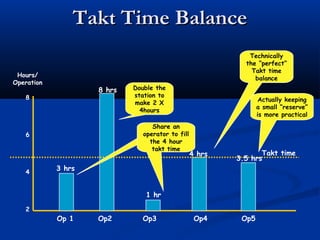
Takt Time BalanceTakt Time Balance
Hours/
Operation
8
6
4
2
Op 1 Op2 Op3 Op4 Op5
Takt time
3 hrs
1 hr
4 hrs
3.5 hrs
8 hrs Double the
station to
make 2 X
4hours
Technically
the “perfect”
Takt time
balance
Actually keeping
a small “reserve”
is more practical
Double the
station to
make 2 X
4hours
Share an
operator to fill
the 4 hour
takt time
TPS ToolsTPS Tools
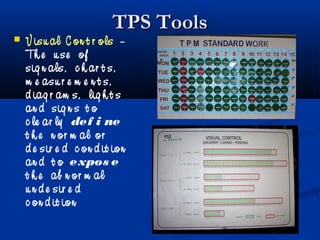
 V isu al C on t r ols –
Th e u se of
sig n als, c h ar t s,
m e asu r e m e n t s,
d iag r am s, lig h t s
an d sig n s t o
c le ar ly def i ne
t h e n or m al or
d e sir e d c on d it ion
an d t o expos e
t h e ab n or m al
u n d e sir e d
c on d it ion
TPS ToolsTPS Tools
 SM ED – A p r oc e ss of c h an g in g ov e r
p r od u c t ion e q u ip m e n t f r om on e p ar t
n u m b e r t o an ot h e r in as lit t le t im e as
p ossib le ( t im e le ss t h an 1 0 m in u t e s,
or sin g le - d ig it )
 Poin t of u se – A ll m at e r ial, t ools an d
in f or m at ion r e q u ir e d t o d o a j ob
sh ou ld b e at ar m s le n g t h t o t h e
e m p loy e e , w it h t h e m ost f r e q u e n t ly
u se d it e m s b e in g t h e c lose st .
TPS ToolsTPS Tools
 A d j u st m e n t Elim in at ion – A d j u st m e n t s
an d t r ial r u n s ac c ou n t f or 5 0 t o 7 0%
of in t e r n al se t u p t im e . Th e m ost
e f f e c t iv e m e t h od of ad j u st in g is Not
t o Adj us t .
 M ist ak e Pr oof in g – M e t h od s t h at h e lp
op e r at or s av oid m ist ak e s in t h e ir w or k
c au se d b y c h oosin g t h e w r on g p ar t ,
le av in g ou t a p ar t , in st allin g a p ar t
b ac k w ar d s, e t c . ( Pok a- y ok e )
TPS ToolsTPS Tools
 SW IP– St an d ar d W or k in Pr oc e ss –
Th e m in im u m n u m b e r of u n it s r e q u ir e d
t o m ak e t h e p r oc e ss f low an d su p p or t
t h e st an d ar d w or k .
 5 W h y ’s – Th e p r ac t ic e of ask in g w h y
r e p e at e d ly w h e n e v e r a p r ob le m is
e n c ou n t e r e d in or d e r t o g e t b e y on d
t h e ob v iou s sy m p t om s t o d isc ov e r t h e
r oot c au se .
Example of 5 WhysExample of 5 Whys
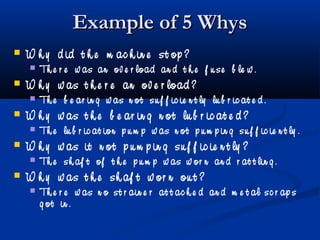
 W h y d id t h e m ac h in e st op ?
 Th e r e w as an ov e r load an d t h e f u se b le w .
 W h y w as t h e r e an ov e r load ?
 Th e b e ar in g w as n ot su f f ic ie n t ly lu b r ic at e d .
 W h y w as t h e b e ar in g n ot lu b r ic at e d ?
 Th e lu b r ic at ion p u m p w as n ot p u m p in g su f f ic ie n t ly .
 W h y w as it n ot p u m p in g su f f ic ie n t ly ?
 Th e sh af t of t h e p u m p w as w or n an d r at t lin g .
 W h y w as t h e sh af t w or n ou t ?
 Th e r e w as n o st r ain e r at t ac h e d an d m e t al sc r ap s
g ot in .
TPS ToolsTPS Tools
 Rig h t sizin g – Pr oc e ss e q u ip m e n t t h at is
h ig h ly c ap ab le , e asy t o m ain t ain ( an d
t h e r e f or e av ailab le t o p r od u c e w h e n e v e r
n e e d e d ) , q u ic k t o c h an g e ov e r , e asy t o
m ov e , an d d e sig n e d t o b e in st alle d in sm all
in c r e m e n t s of c ap ac it y t o f ac ilit at e c ap it al
an d lab ou r lin e ar it y . Ex am p le s: sm all
w ash in g m ac h in e s, h e at t r e at m e n t ov e n s,
an d p ain t b oot h s t h at c an b e p lac e d in
p r oc e ss se q u e n c e in c e lls t o f ac ilit at e
c on t in u ou s f low
TPS ToolsTPS Tools
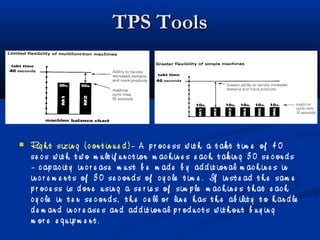
 Rig h t sizin g ( c on t in u e d ) – A p r oc e ss w it h a t ak t t im e of 4 0
se c s w it h t w o m u lt if u n c t ion m ac h in e s e ac h t ak in g 3 0 se c on d s
– c ap ac it y in c r e ase m u st b e m ad e b y ad d it ion al m ac h in e s in
in c r e m e n t s of 3 0 se c on d s of c y c le t im e . If in st e ad t h e sam e
p r oc e ss is d on e u sin g a se r ie s of sim p le m ac h in e s t h at e ac h
c y c le in t e n se c on d s, t h e c e ll or lin e h as t h e ab ilit y t o h an d le
d e m an d in c r e ase s an d ad d it ion al p r od u c t s w it h ou t b u y in g
m or e e q u ip m e n t .
TPS ToolsTPS Tools
 Ph y sic al Lay ou t – A m e an s of im p ac t in g
w or k f low an d p r od u c t iv it y t h r ou g h t h e
p h y sic al p lac e m e n t of m ac h in e r y or
f u r n it u r e . Pr od u c t ion m ac h in e r y sh ou ld b e
g r ou p e d in a c e llu lar ar r an g e m e n t b ase d
u p on p r od u c t ion r e q u ir e m e n t s, n ot p r oc e ss
t y p e . In an of f ic e , f u r n it u r e sh ou ld b e
ar r an g e d su c h t h at t h e r e is an e f f ic ie n t
f low of in f or m at ion or se r v ic e s r at h e r t h an
st r ic t ly d e f in e d d e p ar t m e n t s.
TPS ToolsTPS Tools
 J id ok a – Pr ov id in g m ac h in e s an d op e r at or s
t h e ab ilit y t o d e t e c t w h e n an ab n or m al
c on d it ion h as oc c u r r e d an d im m e d iat e ly st op
w or k . Th is le ad s t o im p r ov e m e n t s in t h e
p r oc e ss t h at b u ild - in q u alit y b y e lim in at in g
t h e r oot c au se s of d e f e c t s.
 M ak e it U g ly ! – W h e n w ast e oc c u r s, it m u st
N OT b e h id d e n . W ast e m u st b e e x p ose d
f or w h at it is – an op p or t u n it y t o w h ic h
c ou n t e r m e asu r e s c an b e id e n t if ie d an d
ap p lie d .
TPS ToolsTPS Tools
 Pr ob le m Solv in g – A f or m al c h ar t in g
p r oc e ss t o id e n t if y le an solu t ion s t o
m an u f ac t u r in g or ad m in ist r at iv e
p r oc e ss p r ob le m s.
 Lin e St op – Th e p r ac t ic e of st op p in g
p r od u c t ion or a p r oc e ss t o e x p ose a
w ast e or p r oc e ss f ailu r e , f or c e r e al-
t im e p r ob le m r e solu t ion , an d p r e v e n t
f u r t h e r p r oc e ssin g of d e f e c t iv e
m at e r ial or in f or m at ion .
TPS ToolsTPS Tools
 C u r t ain Op e r at ion – A m e t h od of
e m u lat in g c on t in u ou s f low p r od u c t ion
w it h a b at c h an d q u e u e m ac h in e . On
t h e j ou r n e y t o on e - p ie c e f low ,
c u r t ain s m ay b e n e c e ssar y .
Thank You!Thank You!
n r ao@ v sn l. c om

Tps tools

  • 1.
  • 2.
    TPS ToolsTPS Tools Bias f or A c t ion is a k e y t ool  C r e at iv it y b e f or e C ap it al m u st alw ay s b e ap p lie d : w e m u st aim f or t h e le ast c ost c ou n t e r m e asu r e – “ m ak e y ou r ow n b r ain sw e at !”
  • 3.
    TPS ToolsTPS Tools 5 S’s – Sor t ( se ir i) , Sim p lif y ( se it on ) , Sw e e p ( se iso) , St an d ar d ize ( se ik e t su ) an d Su st ain ( sh it su k e )  Be f or e all t h is: S0 ( S ze r o) w h e r e y ou j u st t h r ow ou t j u n k . To d o t h is, y ou j u st look at w h at is ly in g ar ou n d – an y it e m w h ic h c an b e c lassif ie d as j u n k w it h ou t a se c on d look or w it h ou t ask in g an y on e m u st b e t h r ow n ou t !
  • 4.
    S1: SortS1: Sort Be f or e w e st ar t S1 , w e n e e d t o d e f in e w h at t h e w or k is – on ly t h e n c an w e k n ow w h at t o sor t !  W e h av e t o ag r e e w h at w e ar e g oin g t o m ak e in t h is ar e a. Th e n w e k n ow w h at w e w ill n e e d .  Look at t h e j ob c ar d / p r oc e ss sh e e t an d f in d ou t w h at is r e q u ir e d t o d o t h e w or k
  • 5.
    S1: SortS1: Sort W it h t h e p e r son w h o w or k s t h e r e , t r u ly sor t ou t t h at w or k ar e a:  J u n k – im m e d iat e d isp osal  St u f f t h at I n e e d t o d o t h is w or k ( c alle d f or in t h e w or k or d e r )  St u f f t h at I d on ’t u se – d on ’t n e e d f or t h e w or k in t h is ar e a – b u t n ot j u n k : u se a Re d Tag t o id e n t if y it an d m ov e it t o a h old in g ar e a som e w h e r e ( d on ’t t h r ow it aw ay )
  • 6.
    S1: SortS1: Sort Th e r e w ill b e it e m s w h ic h ar e n ot on t h e j ob c ar d / p r oc e ss sh e e t ( e . g . a h am m e r ) b u t t h e op e r at or w ill say h e n e e d s it :  U se t h e 5 W h y s on su c h it e m s  Pu t t h e it e m on a To- Do List t o se e h ow y ou c an e lim in at e t h e r e q u ir e m e n t  A t t h e e n d of S1 , y ou w ill g e t sp ac e , e m p t y r ac k s, e m p t y d r aw e r s, e m p t y c u p b oar d s: m ov e t h e se t oo t o t h e Re d Tag ar e a: sp ac e is m ag n e t ic – it g e t s f ille d u p !
  • 7.
    S1: SortS1: Sort SEIRI Unnecessary items Necessaryitems How often do you need them? Is disposal expensive? Resale value? Immediate throw-away Seldom but can't throw away Sometimes Always Storage location Action Minimize cost of disposal Try to sell Throw away quickly Separate A little far away Close
  • 8.
    S2: SimplifyS2: Simplify I n ow n e e d t o r e - lay ou t t h e ar e a: look at t h in g s an d r e - ar r an g e t h e m  I sh ou ld b e ab le t o ar r an g e t h in g s in a sp h e r e so t h at I c an g e t w h at I w an t b y r e ac h in g ou t w it h ou t m ov in g m y f e e t .  A r r an g e in or d e r of se q u e n c e t h at I n e e d t h e m  C olou r c od e b in s b y p r od u c t / p r oj e c t ( m ist ak e - p r oof in g )  A r r an g e b y or d e r of j ob c ar d  Poin t of u se st or ag e
  • 9.
    S2: SimplifyS2: Simplify St ar t w it h t h e p r od u c t an d m ov e ou t !  A g e n e r al r u le is t h at a w or k st at ion sh ou ld b e ap p r ox im at e ly six t im e s t h e size of t h e u n it b e in g m ad e !
  • 10.
    S3: SweepS3: Sweep I n e e d t o b e ab le t o look at t h e w or k st at ion an d say Y ES! Th is is w or k ab le w or k !  Th e e n t ir e w or k st at ion sh ou ld b e m ad e h ig h ly v isu al:  Sh ad ow b oar d s  In st r u c t ion s  C olou r c od e d
  • 11.
    THE DENTIST’S CHAIRTHEDENTIST’S CHAIR SHADOW BOARD ARTICULATED WORK “DESK” APPROPRIATE LIGHTING CAROUSEL STORAGE FOR COMPONENTS ADJUSTABLE STAND
  • 12.
    S4: StandardizeS4: Standardize St an d ar d izin g m e an s:  U sin g t h e sam e t ools  Doin g t h e w or k in t h e sam e w ay  U sin g t h e sam e f ix t u r e s  Tak in g p ar t s f r om t h e sam e b in s  U sin g t h e sam e in st r u c t ion s  N OT u sin g m y ow n p e r son al t oolb ox !  St an d ar d ize d w or k in g ( n ot St an d ar d W or k )
  • 13.
    S4: StandardizeS4: Standardize M ov e t ools ou t of t oolb ox e s t o sh ad ow b oar d s – if n e c e ssar y , in t h e e ar lie r st ag e s, u se t r an sp ar e n t c ov e r s an d loc k s  If som e on e h as d e v e lop e d an d is u sin g a sp e c ial t ool: r e sp e c t t h e d e v e lop m e n t , an d le v e r ag e f r om it so t h at e v e r y on e c an u se it  M ak e e v e r y t h in g t r an sp ar e n t , d oc u m e n t e d , v isu al
  • 14.
    S5: SustainS5: Sustain A lso k n ow n as se lf - d isc ip lin e  To e n f or c e t h e d isc ip lin e of 5 S, w e n e e d t o c ar r y ou t au d it s  Re c og n ize g ood 5 S  LRT m e m b e r s c an st ar t d oin g t h e au d it s  Id e ally sh ou ld b e se lf - au d it , t h e n au d it b y t h e su p e r v isor of t h e ar e a say w e e k ly , t h e n b y t h e m an ag e r / se n ior m an ag e r m on t h ly an d b y t h e GM q u ar t e r ly
  • 15.
  • 16.
    TPS ToolsTPS Tools Pu ll – d ow n st r e am ac t iv it ie s sig n al t h e ir n e e d s t o u p st r e am ac t iv it ie s –  w h at p ar t / m at e r ial is n e e d e d ,  q u an t it y n e e d e d ,  w h e n an d w h e r e it is n e e d e d . Th e u p st r e am p r oc e ss d oe s n ot p r od u c e an y t h in g u n t il t h e d ow n st r e am p r oc e ss sig n als a n e e d
  • 17.
    TPS ToolsTPS Tools M RS – M at e r ial Re p le n ish m e n t Sy st e m – Te c h n iq u e s f or u sin g c ar d s, lig h t s, h e ig h t s, g r id s, sq u ar e s, f lag s or ot h e r v isu al m e an s of sig n allin g t h e n e e d f or r e p le n ish m e n t of m at e r ials, p ar t s or su p p lie s loc at e d at r e - su p p ly p oin t s.
  • 18.
    TPS ToolsTPS Tools On e Pie c e – M ak in g an d m ov in g on e p ie c e at a t im e t h r ou g h a se r ie s of p r oc e ssin g st e p s as c on t in u ou sly as p ossib le , w it h e ac h st e p m ak in g j u st w h at is r e q u e st e d b y t h e n e x t st e p .
  • 19.
    TPS ToolsTPS Tools Tak t t im e – Th e av ailab le p r od u c t ion t im e d iv id e d b y c u st om e r d e m an d – p r ov id e s t h e h e ar t b e at of a le an p r od u c t ion sy st e m  C y c le Tim e – Th e t im e r e q u ir e d f or an op e r at or t o c om p le t e on e c y c le of h is / h e r st an d ar d w or k . If m ad e t o e q u al Tak t Tim e , p r od u c t s c an b e m ad e in s i ngl e-pi ece f l ow wi t h pul l product i on
  • 20.
    TIME: Some simplequestionsTIME: Some simple questions to check understandingto check understanding 1 day 1 day 1 day 1 day Customer consumes Customer consumes Customer consumes Customer consumes 1 day 1 day Customer consumes Customer consumes Takt time = ?????? Question 1 etc Every 1 day Every 2 days Every 2 days Every 4 days Cycle times = Op 1= ??? Op 2= ??? Op 3= ??? Total process= ???? Question 2 Op 1 Op 2 1 unit 1 unit 1 unit 4 units Op 2 Op 3 Takes 1 day Takes 2 days Takes 2 days Takes 4 days Lead time from arrival to delivery= ????? Question 3 Op 1 Op 2 1 unit buffer 4 units Op 2 Op 3 1 unit buffer 4 unit min buffer 1 unit buff er Arrival Delivery
  • 21.
    TIME: Maybe notso simpleTIME: Maybe not so simple questions !!!!questions !!!! Takt time = basically 1 day But….. Weekends?? Maybe 0.72 working days 1 day 1 day 1 day 1 day Customer consumes Customer consumes Customer consumes Customer consumes 1 day 1 day Customer consumes Customer consumes Question 1 etc Cycle times = Op 1= 1day Op 2= 2 days Op 3= 4 days Total process= 4 days … even though the last process delivers 4 units at a time Every 1 day Every 2 days Every 2 days Every 4 days Question 2 Op 1 Op 2 1 unit 1 unit 1 unit 4 unitsOp 2 Op 3 Lead time from arrival to delivery= up to 16days!!!! But not so obvious. Actually will vary because of the batch process at the end. Good example of why 1 piece flow helps. Takes 1 day Takes 2 days Takes 2 days Takes 4 days Question 3 Op 1 Op 2 1 unit buffer 4 units Op 2 Op 3 1 unit buffer 4 unit min buffer 1 unit buffer Arrival Delivery
  • 22.
    TIME: Lean helpskeep theTIME: Lean helps keep the answers simple!answers simple!  The definitions are important:  We have to make sure that there is no confusion between cycle time and lead time  The aims are simple:  We must always strive for cycle time to equal takt time  Otherwise the process will wastefully over- or under-produce  Lead time must be as short as possible  The analysis of lead time shows the awful waste generated by:  Batch production  Buffers  ---- And any unbalanced cycle times  The definition of value adding time within cycles is also important:  Simply put it is the actual time needed to complete the tasks that really add value for the customer  Typically the time taken to change the form, fit or function of the input
  • 23.
    Takt Time BalanceTaktTime Balance TAKT TIME: The time between each unit being “consumed” by the customer Operation 1 Operation 2 Operation 3 Operation 4 Operation 5 We work 8 hours per day Every 4 hrs Every 4 hrs Every 4 hrs Every 4 hrs The customer Needs 2/day Every 4 hrs Every operation has to be able to complete one unit every 4 hours If any single operation cannot complete a unit every 4 hours we will not be able to satisfy the customer demand Even if the work content of an operation makes it possible to complete units faster than one every 4 hours, there is no point doing so: The “extra” units completed will just “pile up” in front of the next station We must start A unit Every 4 hours SINGLE PIECE FLOW: One part moves between each work step every takt time interval
  • 24.
    TAKT TIME: ExamplesTAKTTIME: Examples Op 10 Op 20 Op 30 Op 40 Customer(s) Consumes 10 per 40 hour week Takt = 4 hrs Takt = 4 hrs Takt = 4 hrs Takt = 4 hrs Takt = 4 hrs Op 10 Op 20 Op 30/1 Op 40 Takt = 4 hrs Takt = 4 hrs Takt = 4 hrs 50% Takt =8hrs Op 30/1 50% Takt =8hrs For Op 20 Takt = 4 hrs And delivers alternately to Op 30/1 and Op 30/2
  • 25.
    TAKT TIME: ExamplesTAKTTIME: Examples Op 10 Op 20 Op 30 Op 40/a Customer(s) consumes 6 per 40 hour week Product A Takt = 6.6 hrs Takt = 4 hrs Takt = 4 hrs Takt = 4 hrs Op 40/b Customer(s) consumes 4 per 40 hour week Product B Takt = 10 hrs Op 10/A Op 20/A Op 30/A Op 40/A Takt = 6.6 hrs Takt = 6.6 hrs Takt = 6.6 hrs Takt = 6.6 hrs Takt = 6.6 hrs Op 10/B Op 20/B Op 30/B Op 40/B Takt = 10 hrs Takt = 10 hrs Takt = 10 hrs Takt = 10 hrs Takt = 10 hrs Product A Product B 4 per week 6 per week ++ OrOr
  • 26.
    TAKT TIME: ExamplesTAKTTIME: Examples Op 10 Op 20 Op 30 Op 40 Customer(s) Consumes 10 “wing” sets per 40 hour week Takt = 4 hrs/ Wing set Takt = 4 hrs/ Wing set Takt = 4 hrs/ Wing set Left Wing Takt = 4 hrs/ Left wing Right wing Takt = 4 hrs/ Right wing For Op 20 Takt = 4 hrs/wing set Only the right wing needs Op 30 Op 10/R Op 20/R Op 30/R Op 40/B Takt = 4 hrs Takt = 4 hrs Takt = 4 hrs Takt = 4 hrs Takt = 4hrs Op 10/L Op 20/L Takt = 4 hrs Takt = 4 hrs Takt = 4 hrs Wing Sets 4 per week 4 per week ++ Partial Line for the right wings that need Op 30 Partial Line for the left wings that do not need Op 30
  • 27.
    TAKT TIME: ExamplesTAKTTIME: Examples Op 10 Op 20 Op 30 Op 40 Customer(s) Consumes 10 per 40 hour week Takt = 4 hrs Takt = 4 hrs Takt = 4 hrs 50% 50% For Op 20 Takt = 4 hrs Takt = 8hrs Takt = 8hrs Only 50% of “overhauls” need Op 30 Op 10/Y Op 20/Y Op 30/Y Op 40/Y Takt = 8 hrs Takt = 8 hrs Takt = 8 hrs Takt = 8 hrs Takt = 8 hrs Op 10/N Op 20/Y Op 40/Y Takt = 8 hrs Takt = 8 hrs Takt = 10 hrs Takt = 8 hrs Product Y Product N 5 per week 5 per week ++ Line for the 50% of “overhauls” that need Op 30 Line for the 50% of “overhauls” that do not need Op 30 OrOr
  • 28.
    Takt Time BalanceTaktTime Balance Hours/ Operation 8 6 4 2 Op 1 Op2 Op3 Op4 Op5 Takt time 3 hrs 1 hr 4 hrs 3.5 hrs 8 hrs Double the station to make 2 X 4hours Technically the “perfect” Takt time balance Actually keeping a small “reserve” is more practical Double the station to make 2 X 4hours Share an operator to fill the 4 hour takt time
  • 29.
    TPS ToolsTPS Tools V isu al C on t r ols – Th e u se of sig n als, c h ar t s, m e asu r e m e n t s, d iag r am s, lig h t s an d sig n s t o c le ar ly def i ne t h e n or m al or d e sir e d c on d it ion an d t o expos e t h e ab n or m al u n d e sir e d c on d it ion
  • 30.
    TPS ToolsTPS Tools SM ED – A p r oc e ss of c h an g in g ov e r p r od u c t ion e q u ip m e n t f r om on e p ar t n u m b e r t o an ot h e r in as lit t le t im e as p ossib le ( t im e le ss t h an 1 0 m in u t e s, or sin g le - d ig it )  Poin t of u se – A ll m at e r ial, t ools an d in f or m at ion r e q u ir e d t o d o a j ob sh ou ld b e at ar m s le n g t h t o t h e e m p loy e e , w it h t h e m ost f r e q u e n t ly u se d it e m s b e in g t h e c lose st .
  • 31.
    TPS ToolsTPS Tools A d j u st m e n t Elim in at ion – A d j u st m e n t s an d t r ial r u n s ac c ou n t f or 5 0 t o 7 0% of in t e r n al se t u p t im e . Th e m ost e f f e c t iv e m e t h od of ad j u st in g is Not t o Adj us t .  M ist ak e Pr oof in g – M e t h od s t h at h e lp op e r at or s av oid m ist ak e s in t h e ir w or k c au se d b y c h oosin g t h e w r on g p ar t , le av in g ou t a p ar t , in st allin g a p ar t b ac k w ar d s, e t c . ( Pok a- y ok e )
  • 32.
    TPS ToolsTPS Tools SW IP– St an d ar d W or k in Pr oc e ss – Th e m in im u m n u m b e r of u n it s r e q u ir e d t o m ak e t h e p r oc e ss f low an d su p p or t t h e st an d ar d w or k .  5 W h y ’s – Th e p r ac t ic e of ask in g w h y r e p e at e d ly w h e n e v e r a p r ob le m is e n c ou n t e r e d in or d e r t o g e t b e y on d t h e ob v iou s sy m p t om s t o d isc ov e r t h e r oot c au se .
  • 33.
    Example of 5WhysExample of 5 Whys  W h y d id t h e m ac h in e st op ?  Th e r e w as an ov e r load an d t h e f u se b le w .  W h y w as t h e r e an ov e r load ?  Th e b e ar in g w as n ot su f f ic ie n t ly lu b r ic at e d .  W h y w as t h e b e ar in g n ot lu b r ic at e d ?  Th e lu b r ic at ion p u m p w as n ot p u m p in g su f f ic ie n t ly .  W h y w as it n ot p u m p in g su f f ic ie n t ly ?  Th e sh af t of t h e p u m p w as w or n an d r at t lin g .  W h y w as t h e sh af t w or n ou t ?  Th e r e w as n o st r ain e r at t ac h e d an d m e t al sc r ap s g ot in .
  • 34.
    TPS ToolsTPS Tools Rig h t sizin g – Pr oc e ss e q u ip m e n t t h at is h ig h ly c ap ab le , e asy t o m ain t ain ( an d t h e r e f or e av ailab le t o p r od u c e w h e n e v e r n e e d e d ) , q u ic k t o c h an g e ov e r , e asy t o m ov e , an d d e sig n e d t o b e in st alle d in sm all in c r e m e n t s of c ap ac it y t o f ac ilit at e c ap it al an d lab ou r lin e ar it y . Ex am p le s: sm all w ash in g m ac h in e s, h e at t r e at m e n t ov e n s, an d p ain t b oot h s t h at c an b e p lac e d in p r oc e ss se q u e n c e in c e lls t o f ac ilit at e c on t in u ou s f low
  • 35.
    TPS ToolsTPS Tools Rig h t sizin g ( c on t in u e d ) – A p r oc e ss w it h a t ak t t im e of 4 0 se c s w it h t w o m u lt if u n c t ion m ac h in e s e ac h t ak in g 3 0 se c on d s – c ap ac it y in c r e ase m u st b e m ad e b y ad d it ion al m ac h in e s in in c r e m e n t s of 3 0 se c on d s of c y c le t im e . If in st e ad t h e sam e p r oc e ss is d on e u sin g a se r ie s of sim p le m ac h in e s t h at e ac h c y c le in t e n se c on d s, t h e c e ll or lin e h as t h e ab ilit y t o h an d le d e m an d in c r e ase s an d ad d it ion al p r od u c t s w it h ou t b u y in g m or e e q u ip m e n t .
  • 36.
    TPS ToolsTPS Tools Ph y sic al Lay ou t – A m e an s of im p ac t in g w or k f low an d p r od u c t iv it y t h r ou g h t h e p h y sic al p lac e m e n t of m ac h in e r y or f u r n it u r e . Pr od u c t ion m ac h in e r y sh ou ld b e g r ou p e d in a c e llu lar ar r an g e m e n t b ase d u p on p r od u c t ion r e q u ir e m e n t s, n ot p r oc e ss t y p e . In an of f ic e , f u r n it u r e sh ou ld b e ar r an g e d su c h t h at t h e r e is an e f f ic ie n t f low of in f or m at ion or se r v ic e s r at h e r t h an st r ic t ly d e f in e d d e p ar t m e n t s.
  • 37.
    TPS ToolsTPS Tools J id ok a – Pr ov id in g m ac h in e s an d op e r at or s t h e ab ilit y t o d e t e c t w h e n an ab n or m al c on d it ion h as oc c u r r e d an d im m e d iat e ly st op w or k . Th is le ad s t o im p r ov e m e n t s in t h e p r oc e ss t h at b u ild - in q u alit y b y e lim in at in g t h e r oot c au se s of d e f e c t s.  M ak e it U g ly ! – W h e n w ast e oc c u r s, it m u st N OT b e h id d e n . W ast e m u st b e e x p ose d f or w h at it is – an op p or t u n it y t o w h ic h c ou n t e r m e asu r e s c an b e id e n t if ie d an d ap p lie d .
  • 38.
    TPS ToolsTPS Tools Pr ob le m Solv in g – A f or m al c h ar t in g p r oc e ss t o id e n t if y le an solu t ion s t o m an u f ac t u r in g or ad m in ist r at iv e p r oc e ss p r ob le m s.  Lin e St op – Th e p r ac t ic e of st op p in g p r od u c t ion or a p r oc e ss t o e x p ose a w ast e or p r oc e ss f ailu r e , f or c e r e al- t im e p r ob le m r e solu t ion , an d p r e v e n t f u r t h e r p r oc e ssin g of d e f e c t iv e m at e r ial or in f or m at ion .
  • 39.
    TPS ToolsTPS Tools C u r t ain Op e r at ion – A m e t h od of e m u lat in g c on t in u ou s f low p r od u c t ion w it h a b at c h an d q u e u e m ac h in e . On t h e j ou r n e y t o on e - p ie c e f low , c u r t ain s m ay b e n e c e ssar y .
  • 40.
    Thank You!Thank You! nr ao@ v sn l. c om

Editor's Notes

  • #4 <number>
  • #17 <number>
  • #19 <number>
  • #20 <number>
  • #31 <number>
  • #32 <number>
  • #33 <number>
  • #34 <number>
  • #36 <number>
  • #37 <number>
  • #38 <number>
  • #39 <number>
  • #40 <number>
  • #41 <number>