
Genito-Urinary
Tumors
Episode Premiere
Genito-Urinary Tumors
1. Renal tumors.
2. Tumors of the ureter.
3. Bladder tumors.
4. Prostate tumors.
5. Testicular tumors.
1. Adenoma:
• Small (<3 cm.).
• Cortical.
• Solid.
Renal tumors
Benign
1. Oncocytoma (Benign Oxyphilic
Adenoma):
• Second most common benign renal tumor.
• 6th
-7th
Decades.
• Male:Female = 3-1
• Asymptomatic.
• 10% bilateral- 10% multiple.
• In less than 10% of cases, oncocytoma and
chromophobe RCC may coexist
Renal tumors
Pathology:
• Cortical.
• Solid mass with stellate scar in 33-54% of tumors .
• Vascular.
• Very rare calcifications.
Oncocytoma
A. Plain X-Ray:
• Normal.
• Soft tissue mass displacing renal shadow and
surrounding fat planes.
Oncocytoma
B. IVU:
• Normal.
• Soft tissue mass displacing
renal shadow and
surrounding fat planes.
Oncocytoma
C. US:
• Well-defined.
• Solid mass.
• Homogenous.
• Hypo- to isoechoic.
• Hyperechoic central scar.
Oncocytoma
D. CT:
• NECT scans, isoattenuating or
slightly hyperattenuating.
• A central hypoattenuating scar
observed in 33% of cases
Oncocytoma
1. CT:
• CECT scans, nephrographic phase, the mass
appears less attenuating than the renal
parenchyma
Oncocytoma
E. MRI:
• T1-weighted images:
• Pre: isointense to hypointense relative to the
renal cortex.
Oncocytoma
E. MRI:
• T1-weighted images:
• Post: Homogeneous enhancement, with a
nonenhancing central scar.
Oncocytoma
E. MRI:
• T2-weighted images:
• Isointense to slightly hyperintense or
hypointense.
• Spoke-wheel hypointense pattern.
Oncocytoma
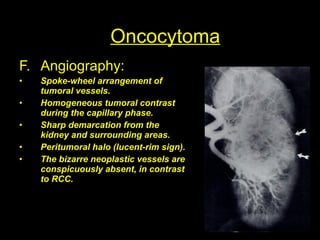
F. Angiography:
• Spoke-wheel arrangement of
tumoral vessels.
• Homogeneous tumoral contrast
during the capillary phase.
• Sharp demarcation from the
kidney and surrounding areas.
• Peritumoral halo (lucent-rim sign).
• The bizarre neoplastic vessels are
conspicuously absent, in contrast
to RCC.
Renal tumorsOncocytoma

Oncocytoma

  • 1.
  • 2.
    Genito-Urinary Tumors 1. Renaltumors. 2. Tumors of the ureter. 3. Bladder tumors. 4. Prostate tumors. 5. Testicular tumors.
  • 3.
    1. Adenoma: • Small(<3 cm.). • Cortical. • Solid. Renal tumors Benign
  • 4.
    1. Oncocytoma (BenignOxyphilic Adenoma): • Second most common benign renal tumor. • 6th -7th Decades. • Male:Female = 3-1 • Asymptomatic. • 10% bilateral- 10% multiple. • In less than 10% of cases, oncocytoma and chromophobe RCC may coexist Renal tumors
  • 5.
    Pathology: • Cortical. • Solidmass with stellate scar in 33-54% of tumors . • Vascular. • Very rare calcifications. Oncocytoma
  • 6.
    A. Plain X-Ray: •Normal. • Soft tissue mass displacing renal shadow and surrounding fat planes. Oncocytoma
  • 7.
    B. IVU: • Normal. •Soft tissue mass displacing renal shadow and surrounding fat planes. Oncocytoma
  • 8.
    C. US: • Well-defined. •Solid mass. • Homogenous. • Hypo- to isoechoic. • Hyperechoic central scar. Oncocytoma
  • 9.
    D. CT: • NECTscans, isoattenuating or slightly hyperattenuating. • A central hypoattenuating scar observed in 33% of cases Oncocytoma
  • 10.
    1. CT: • CECTscans, nephrographic phase, the mass appears less attenuating than the renal parenchyma Oncocytoma
  • 11.
    E. MRI: • T1-weightedimages: • Pre: isointense to hypointense relative to the renal cortex. Oncocytoma
  • 12.
    E. MRI: • T1-weightedimages: • Post: Homogeneous enhancement, with a nonenhancing central scar. Oncocytoma
  • 13.
    E. MRI: • T2-weightedimages: • Isointense to slightly hyperintense or hypointense. • Spoke-wheel hypointense pattern. Oncocytoma
  • 14.
    F. Angiography: • Spoke-wheelarrangement of tumoral vessels. • Homogeneous tumoral contrast during the capillary phase. • Sharp demarcation from the kidney and surrounding areas. • Peritumoral halo (lucent-rim sign). • The bizarre neoplastic vessels are conspicuously absent, in contrast to RCC. Renal tumorsOncocytoma