URINARY BLADDER
TUMORS
DR.N.MANJULA
ANATOMY
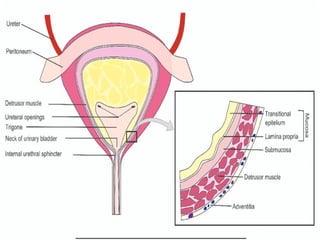
• The bladder is a hollow viscus organ.
• Shape of a four-sided inverted pyramid when empty.
• Rounded structure when distended.
• It is divided into the following portions:
• Superior surface - dome.
• Posterior surface - base.
• Two inferolateral surfaces.
• The trigone is located at the base of the bladder and is
continuous with the bladder neck, in which the
posterior and inferolateral walls converge to open into
the urethra.
HISTOLOGY
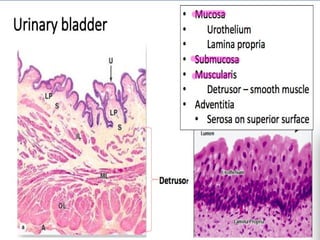
• The layers of the bladder are:
• mucosa - epithelium and lamina propria.
• muscularis propria and
• adventitia.
• The epithelium of the bladder is traditionally referred to
as transitional, but the preferred term is urothelium.
• It is generally six to seven cells thick in the contracted
bladder.
• But only two or three cells thick in the distended
bladder.
• Transitional epithelium has three layers: superficial,
intermediate and basal.
• The superficial layer is made up of single row of large
cells having abundant eosinophilic cytoplasm 
umbrella cells.
• The intermediate cells are cuboidal to low columnar,
oval nuclei with fine chromatin and nuclear grooves,
moderately abundant cytoplasm, and well-defined
margins.
• The basal layer is made up of a row of cuboidal cells
that lie on a thin continuous basal lamina.
TUMOR LIKE CONDITIONS
• The bladder epithelium is prone to wide range of
metaplastic changes, most of them are induced by
chronic inflammation.
INTESTINAL METAPLASIA
&
CYSTITIS GLANDULARIS
• Common with ureteral reimplantation, neurogenic
bladder, bladder exstrophy.
• Grossly, present as irregular lesions that are
cystoscopically confused with carcinoma.
• M/C trigone is affected.
• M/E, focal proliferation of the basal layer of the
urothelium, forms buds that later become solid
nodules - von Brunn nests or islands located within the
lamina propria.
• Some of these nodules develop a central cystic area
lined by urothelial like cells - cystitis cystica.
• When the luminal cells acquire a glandular
appearance - cystitis glandularis.
• When morphologic features similar to colonic
epithelium are present - intestinal (glandular, colonic)
metaplasia .
• Intestinal metaplasia is reactive for CDX2 and CK20,
whereas cystitis glandularis shows positivity for CK7.
CYSTITIS CYSTICA
• Superficial nests of urothelial mucosa with cystic
change in the background of chronic inflammation.
CYSTITIS GLANDULARIS
• Urothelial mucosal invaginations with luminal columnar
cells
CYSTITIS GLANDULARIS
• Nests of urothelial mucosa with luminal columnar cells.
NEPHROGENIC ADENOMA
(NEPHROGENIC METAPLASIA)
• It is a localized or diffuse metaplastic change of the
urothelium in response to chronic infection, calculi or
prolonged catheterization.
• Grossly, these lesions can be papillary, polypoid, or
sessile and 20% are multiple.
• M/E is heterogeneous with numerous architectural
patterns.
• Small tubular, papillary, sheet-like with clear
cytoplasm, fibromyxoid, and flat.
NEPHROGENIC ADENOMA
• Small tubules with hobnail cells.
• The lesional cells are low cuboidal and may have a
hobnail arrangement in tubules or on papillae.
• Immunohistochemically, they are positive for keratin 7
and PAX-8.
• Expression of racemase, GATA-3, HMW cytokeratin or
p63 may cause confusion with prostatic or urothelial
carcinoma.
• But NKX3.1 is negative in nephrogenic adenoma.
• D/D: clear cell adenocarcinoma and signet ring
adenocarcinoma.
POLYPOID CYSTITIS
• Benign process which may simulate a neoplasm
grossly.
• The typical site of involvement is the posterior wall
above the trigone, but sometimes entire bladder is
affected.
• Gross variants:
• Bullous cystitis, in which the elevations are broad and
rounded.
• Papillary cystitis, in which they are thin and filiform.
• It is often overdiagnosed as a low-grade papillary
urothelial neoplasm.
• The diagnosis is best made at low power.
• Edematous or fibrous stroma, broad-based, simple,
non-branching appearance of the fronds, and the
normal or reactive appearance of their lining
epithelium.
• Inflammation is scanty.
• The better known cause of polypoid cystitis is
catheterization of the bladder. ( 3 months)
• It has also been seen in association with radiation
therapy and malignant tumors.
WHO (2016)
Urothelial carcinoma
1. Infiltrating urothelial carcinoma
2. Urothelial carcinoma with divergent differentiation
I. With squamous differentiation
II. With glandular differentiation
III. With trophoblastic differentiation
3. Nested urothelial carcinoma (including large nested variant)
4. Microcystic urothelial carcinoma
5. Micropapillary urothelial carcinoma
6. Lymphoepithelioma-like urothelial carcinoma
7. Plasmacytoid / signet ring / diffuse urothelial carcinoma
8. Sarcomatoid urothelial carcinoma
9. Giant cell urothelial carcinoma
10. Poorly differentiated urothelial carcinoma
11. Lipid rich urothelial carcinoma
12. Clear cell (glycogen rich) urothelial carcinoma
Noninvasive urothelial lesions
1. Urothelial carcinoma in situ
2. Noninvasive papillary urothelial carcinoma, low grade
3. Noninvasive papillary urothelial carcinoma, high grade
4. Papillary urothelial neoplasm of low malignant potential
5. Urothelial papilloma
6. Inverted urothelial papilloma
7. Urothelial proliferation of uncertain malignant potential
8. Urothelial dysplasia
Squamous cell neoplasms
9. Pure squamous cell carcinoma
10. Verrucous carcinoma
11. Squamous cell papilloma
Glandular neoplasms
1. Adenocarcinoma, NOS
– Enteric
– Mucinous
– Mixed
2. Villous adenoma
Urachal carcinoma
Tumors of Müllerian type
3. Clear cell carcinoma
4. Endometrioid carcinoma
Neuroendocrine tumors
5. Small cell neuroendocrine carcinoma
6. Large cell neuroendocrine carcinoma
7. Well differentiated neuroendocrine tumor (WDNET)
8. Paraganglioma
Melanocytic tumors
1. Malignant melanoma
2. Nevus
3. Melanosis
Mesenchymal tumors
4. Rhabdomyosarcoma
5. Leiomyosarcoma
6. Angiosarcoma
7. Inflammatory myofibroblastic tumor (IMFT)
8. Perivascular epithelioid cell tumor (PEComa)
I. Benign
II. Malignant
9. Solitary fibrous tumor (SFT)
10. Leiomyoma
11. Hemangioma
12. Granular cell tumor
13. Neurofibroma
Urothelial tract hematopoietic and lymphoid tumors
Miscellaneous tumors
1. Carcinoma of Skene, Cowper and Littre glands
2. Metastatic tumors and tumors extending from other organs
3. Epithelial tumors of the upper urinary tract
4. Tumors arising in a bladder diverticulum
5. Urothelial tumors of the urethra
UROTHELIAL TUMORS
• INFILTRATING UROTHELIAL CARCINOMA:
• M/C malignant neoplasm of urinary tract.
• Defining histologic criteria is invasion beyond
basement membrane.
• Worldwide it is the seventh most common cancer.
ETIOLOGY
Environmental factors:
1. Smoking,
2. Aromatic amine exposure,
3. Arsenic exposure,
4. Schistosoma infection.
5. Radiotheraphy.
6. Congenital bladder exstrophy.
7. Lynch syndrome (Ad).
SIGNS AND SYMPTOMS
• Painless gross hematuria, followed by
urgency, nocturia, dysuria.
• Palpable suprapubic mass.
• Metastatic symptoms like weight loss,
bone pain.
• Sites of metastasis:
• Liver, lung, bone.
• GROSS:
• Unifocal or multifocal.
• Mostly polypoidal, sessile, ulceroinfilterative.
• MICROSCOPY:
• It is remarkable for diverse morphological manifestations.
• Architectural patters seen are:
• Variable sized nests with smooth borders, sheets,
trabeculae, cords, and single cells.
• In large nests tumor cells show stratification with
nuclei perpendicular to basement membrane and
maturation towards centre.
• Prominent mitosis.
• Pronounced desmoplasia in invasive tumors.
MICROSCOPY
• Nests and cords of neoplastic cells
• IHC:
• Uroplakin III
• GATA 3
• CK 7
• CK 20
Positive for CK20
(cytoplasmic)
CK7
(cytoplasmic)
GATA3 (nuclear)
UROTHELIAL CARCINOMA WITH
DIVERGENT DIFFERENTIATION
1. Squamous differentiation:
• Intercellular bridges, keratinization.
• It is the M/C differentiation.
• Expresses CK5 but not CK20.
2. Glandular differentiation:
• Gland formation within tumor.
• CDX2 and CD 20 positive.
3. Trophoblastic differentiation:
• Tumor cells resemble syncytiotrophoblast.
• Expression of beta HCG – higher grade and stage.
• Mullerian differentiation is rare.
• It manifests as clear cell adenocarcinoma.
4. Nested urothelial carcinoma:
• Cytologically bland variant.
• M/C in bladder with p63 expression.
• Disordered proliferation of crowded small nests beneath
the urothelium.
• Tubules, microcystic feature and large nests are also
seen.
• Myxoid to desmoplastic stroma.
NESTED UROTHELIAL CARCINOMA
• Low-power view showing closely packed, irregularly
spaced, glandular, and cystic urothelial nests.
• Overlying urothelium appears uninvolved
• Differentials of nested urothelial carcinoma:
1. Nephrogenic adenoma – tubules lined by single layer
of cuboidal cells.
2. von Brunn nests
• The confluence of multiple small nests and infiltrative
base helps to rule out florid proliferation of von Brunn
nests.
• Bland nests within muscularis is diagnostic of
carcinoma, not seen in von Brunn nests.
5. Microcystic urothelial carcinoma:
• Benign looking forms with high stage at presentation.
• Round to oval microcyts lined by bland epithelium.
• Cyts sometimes invade detrusor muscle.
• Express p63 and S100.
6. Micropapillary urothelial carcinoma:
• M > F, peak at sixth decade.
• Commonly present at high pathological stage.
• Small nests and aggregates surrounded by lacunae
resembles vascular invasion.
• It has peripherally oriented atypical nuclei.
• Cytoplasmic vacuoles with distortion of nuclear
contour – ring forms are seen.
• LVI is common.
7. Lymphoepithelioma like urothelial carcinoma:
• Resembles lymphoepithelioma of nasopharynx.
• M > F
• Tumor cells are seen in the background of
lymphocytes, plasma cells, histiocytes, occasional
eosinophils.
• . Pure lymphoepithelioma-like UC of ureter
8. Plasmacytoid differentiation:
• Tumor cells resemble plasma cells / monocytes.
• M/C presents with hematuria.
• Characteristically the tumor cells are present discohesively
in a loose or myxoid stroma.
• Majority of tumor exhibit loss of expression of E – cadherin
• High risk for peritoneal spread.
Plasmacytoid differentiation
9. Giant cell urothelial carcinoma:
• Aggressive carcinoma.
• Bizzare, pleomorphic giant tumor cells are seen.
• Atypical mitosis is common.
• Muscularis invasion is common.
• Extensive areas of necrosis is common.
10. Lipid rich urothelial carcinoma:
• Large lipoblast like cells with cytoplasmic vacuolations.
• Rare case usually present at high stage with poor
outcome.
11. Clear cell (glycogen rich) urothelial carcinoma:
• Tumor cells have glycogen rich cytoplasm.
12. Sarcomatoid urothelial carcinoma:
• Shows features of sarcoma.
• Common risk factors are cyclophosphamide and
radiation.
• Sarcomatoid component showing high grade pleomorphic
spindle cells.
13. Poorly differentiated tumors:
NON INVASIVE UROTHELIAL
LESIONS
• They form majority of primary bladder tumor at initial
diagnosis.
• Two types: papillary and flat.
• It is recommended that this classification be adopted
worldwide, as it provides following advantages :
1. Use of uniform terminology and definitions based on
cytological and architectural disorder.
2. Establishment of detailed criteria for various
preneoplastic conditions and tumour grades.
3. Elimination of the ambiguity in diagnostic categories.
4. Synchronization of terminology with cytology,
facilitating cytohistological correlation.
5. Inclusion of a category of papillary neoplasm (papillary
urothelial neoplasm of low malignant potential) that has a
negligible risk of progression although the potential for
recurrence requires some level of clinical follow-up.
6. Definition of a group of lesions (high grade) with a high
risk of progression that may be candidates for adjuvant
therapy.
UROTHELIAL CARCINOMA IN SITU
• Urothelial carcinoma in situ (CIS) is a flat urothelial
lesion of variable thickness, devoid of papillary
structures.
• On cystoscopy, involvement of the surface urothelium
is usually multifocal and sometimes diffuse.
• It is characterized by the presence of cells with large
pleomorphic and hyperchromatic nuclei with one or
more irregular nucleoli.
• There is loss of cell polarity and irregular nuclear
crowding.
UROTHELIAL CARCINOMA IN SITU
• The neoplastic cells need not occupy the entire
thickness of the urothelium.
• Presence of isolated malignant cells (pagetoid spread)
is sufficient to render a diagnosis of CIS.
• Because some tumours are discohesive, they tend to
shed neoplastic cells into the urine.
• In these cases, the urothelium may be entirely
denuded or may contain isolated highly atypical cells,
referred to as CLINGING CARCINOMA
• There is no evidence that immunohistochemistry can
differentiate CIS from urothelial dysplasia.
• Under normal circumstances, CK20 is limited to
umbrella cells, whereas CIS tends to have full-
thickness immunoreactivity.
• CD44 is present in the basal layer of normal
urothelium, but is usually lost in CIS.
• CIS can also exhibit a high rate of proliferation , as
measured by Ki-67.
• A significant number of patients with CIS respond to
intravesical instillation of BCG.
• Lack of response to intravesical therapy has been
associated with disease progression and is an
indication for early cystectomy.
NON-INVASIVE PAPILLARY
UROTHELIAL CARCINOMA
• The most common location is the lateral and posterior
walls of the urinary bladder.
• On cystoscopy, the lesions are exophytic, can be
either single or multiple.
• Non-invasive papillary urothelial carcinoma is defined
by thin fibrovascular cores covered by neoplastic
urothelium of variable thickness.
• WHO classification of papillary urothelial neoplasms
requires the evaluation at two levels.
• The cytological and architectural disorder at low and
medium magnification.
• Cytological disorder is defined as abnormalities in
nuclear size, shape, and chromatin.
• Architectural disorder is defined as abnormalities in
the orientation of the cells in relation to each other and
to the basement membrane of the papillae.
ASSESSMENT OF PAPILLARY
UROTHELIAL NEOPLASM
At medium magnification, the tumor patter gives a
predominant impression of
ORDER
of architectural and
cytological
features?
VARIATION
of architectural and
cytological features
readily seen?
NO YES
PUNLMP Urothelial
carcinoma,
low grade
DISORDER
of architectural and
cytological
features?
Urothelial
carcinoma,
high grade
LOW-GRADE PAPILLARY
UROTHELIAL CARCINOMA
• They have delicate papillae with extensive branching.
• At low magnification, they have a relatively orderly
appearance.
• At medium magnification some loss of polarity as well
as mild nuclear irregularity and pleomorphism is
evident.
• Transurethral resection – bladder - Low power -
noninvasive papillary urothelial carcinoma shows
fibrovascular cores lined by neoplastic urothelium.
HIGH-GRADE PAPILLARY
UROTHELIAL CARCINOMA
• In high-grade lesions, the papillae may be fused,
giving a solid appearance.
• Nuclear size variation, and irregularity are readily
apparent at low to intermediate magnification.
High grade noninvasive papillary urothelial carcinoma
demonstrating complex papillae (low power).
High power showing architectural disorder, loss of
polarity and nuclear pleomorphism in high grade papillary
carcinoma.
PAPILLARY UROTHELIAL NEOPLASM OF
LOW MALIGNANT POTENTIAL
PUNLMP
• Papillary urothelial tumour with minimal atypia.
• Present as single or multiple discrete exophytic
papillary lesions of variable size.
• At low power, papillary structures lined by urothelium
that appear thicker than normal urothelium.
• Otherwise there are no architectural abnormalities.
• Cytologically they have a monotonous appearance,
with cells being virtually identical to each other.
• Nuclei are slightly enlarged and more crowded relative
to normal urothelial nuclei.
• Nuclear grooves may be seen in these tumours.
UROTHELIAL PAPILLOMA
• M/C location is the trigone.
• Most papillomas are solitary and small.
• They have a simple hierarchical pattern of papillary
branching with minimal epithelial confluence between
papilla.
• The urothelial lining is not thickened.
• They show normal cytology.
• The urothelial cells are oriented linearly and
perpendicular to the basement membrane.
Low power view of a urothelial papilloma with discrete
papillary structures, hierarchical branching
INVERTED UROTHELIAL PAPILLOMA
• M/C site is the bladder neck.
• The tumour is a raised, pedunculated or polypoid
lesion with a smooth overlying surface.
• These tumours have a trabecular growth pattern,
sometimes with associated cystic change.
Major updates
• New / renamed entities:
• Poorly differentiated urothelial carcinoma - replaced
undifferentiated urothelial carcinoma encompassing
broad spectrum of poorly differentiated tumors .
• Removed entities:
• Lymphoma-like urothelial carcinoma (now part of
plasmacytoid urothelial carcinoma)
• Refined criteria :
• Divergent differentiation occurs in a background of
conventional urothelial carcinoma.
– Plasmacytoid urothelial carcinoma:
Morphologic criteria - plasmacytoid urothelial
carcinoma with signet ring cells not associated with
extracellular mucin production.
– Micropapillary urothelial carcinoma:
Diagnosis restricted to invasive component only
No specific threshold percentage to classify
Multiple nests in the same lacunar space
• Distinct molecular alterations in some of urothelial
carcinoma variants:
– Micropapillary urothelial carcinoma:
common HER2 / neu amplifications or mutations
– Plasmacytoid urothelial carcinoma: loss of E-
cadherin and CDH1 gene loss of function mutations
or methylation
– No significant association with Epstein-Barr virus
(EBV) or human papillomavirus (HPV) infection and
urothelial carcinoma development
• Prognostic implications of the urothelial carcinoma variants:
– Worse prognosis / more aggressive behavior associated
with micropapillary and plasmacytoid urothelial
carcinoma variants
– Uniformly poor prognosis for sarcomatoid, poorly
differentiated and giant cell urothelial carcinoma
– Nested variant, lipid rich and urothelial carcinoma with
divergent differentiation (squamous, glandular or
trophoblastic) are more likely to present with advanced
disease but when adjusted by stage had no survival
differences with respect to conventional urothelial
carcinoma
Histological variations and provisional entities of
urothelial carcinoma NOT included in the current
WHO classification
• Urothelial carcinoma, inverted growth (inverted papilloma-like)
• Pseudoangiosarcomatous (angiosarcoma-like) urothelial
carcinoma
• Urothelial carcinoma with myxoid stroma / chordoid features
• Urothelial carcinoma with rhabdoid features
• Urothelial carcinoma with unusual stromal reactions
– Pseudosarcomatous stroma
– Stromal osseous metaplasia
– Stromal cartilaginous metaplasia
– Osteoclast-like giant cells
– Prominent lymphoid infiltrate
• Urothelial carcinoma in specific clinical setting
– Urothelial carcinoma in augmentation cystoplasty
– Urothelial carcinoma in neurogenic bladder (spinal cord injury)
– Urothelial carcinoma in children and young adults
SUMMARY
REFERENCES
THANK YOU

URINARY BLADDER TUMORS .pptx

  • 1.
  • 2.
    ANATOMY • The bladderis a hollow viscus organ. • Shape of a four-sided inverted pyramid when empty. • Rounded structure when distended. • It is divided into the following portions: • Superior surface - dome. • Posterior surface - base. • Two inferolateral surfaces. • The trigone is located at the base of the bladder and is continuous with the bladder neck, in which the posterior and inferolateral walls converge to open into the urethra.
  • 4.
    HISTOLOGY • The layersof the bladder are: • mucosa - epithelium and lamina propria. • muscularis propria and • adventitia. • The epithelium of the bladder is traditionally referred to as transitional, but the preferred term is urothelium. • It is generally six to seven cells thick in the contracted bladder. • But only two or three cells thick in the distended bladder.
  • 6.
    • Transitional epitheliumhas three layers: superficial, intermediate and basal. • The superficial layer is made up of single row of large cells having abundant eosinophilic cytoplasm  umbrella cells. • The intermediate cells are cuboidal to low columnar, oval nuclei with fine chromatin and nuclear grooves, moderately abundant cytoplasm, and well-defined margins. • The basal layer is made up of a row of cuboidal cells that lie on a thin continuous basal lamina.
  • 8.
    TUMOR LIKE CONDITIONS •The bladder epithelium is prone to wide range of metaplastic changes, most of them are induced by chronic inflammation.
  • 9.
    INTESTINAL METAPLASIA & CYSTITIS GLANDULARIS •Common with ureteral reimplantation, neurogenic bladder, bladder exstrophy. • Grossly, present as irregular lesions that are cystoscopically confused with carcinoma. • M/C trigone is affected. • M/E, focal proliferation of the basal layer of the urothelium, forms buds that later become solid nodules - von Brunn nests or islands located within the lamina propria.
  • 11.
    • Some ofthese nodules develop a central cystic area lined by urothelial like cells - cystitis cystica. • When the luminal cells acquire a glandular appearance - cystitis glandularis. • When morphologic features similar to colonic epithelium are present - intestinal (glandular, colonic) metaplasia . • Intestinal metaplasia is reactive for CDX2 and CK20, whereas cystitis glandularis shows positivity for CK7.
  • 12.
    CYSTITIS CYSTICA • Superficialnests of urothelial mucosa with cystic change in the background of chronic inflammation.
  • 13.
    CYSTITIS GLANDULARIS • Urothelialmucosal invaginations with luminal columnar cells
  • 14.
    CYSTITIS GLANDULARIS • Nestsof urothelial mucosa with luminal columnar cells.
  • 15.
    NEPHROGENIC ADENOMA (NEPHROGENIC METAPLASIA) •It is a localized or diffuse metaplastic change of the urothelium in response to chronic infection, calculi or prolonged catheterization. • Grossly, these lesions can be papillary, polypoid, or sessile and 20% are multiple. • M/E is heterogeneous with numerous architectural patterns. • Small tubular, papillary, sheet-like with clear cytoplasm, fibromyxoid, and flat.
  • 16.
    NEPHROGENIC ADENOMA • Smalltubules with hobnail cells.
  • 17.
    • The lesionalcells are low cuboidal and may have a hobnail arrangement in tubules or on papillae. • Immunohistochemically, they are positive for keratin 7 and PAX-8. • Expression of racemase, GATA-3, HMW cytokeratin or p63 may cause confusion with prostatic or urothelial carcinoma. • But NKX3.1 is negative in nephrogenic adenoma. • D/D: clear cell adenocarcinoma and signet ring adenocarcinoma.
  • 18.
    POLYPOID CYSTITIS • Benignprocess which may simulate a neoplasm grossly. • The typical site of involvement is the posterior wall above the trigone, but sometimes entire bladder is affected. • Gross variants: • Bullous cystitis, in which the elevations are broad and rounded. • Papillary cystitis, in which they are thin and filiform. • It is often overdiagnosed as a low-grade papillary urothelial neoplasm.
  • 20.
    • The diagnosisis best made at low power. • Edematous or fibrous stroma, broad-based, simple, non-branching appearance of the fronds, and the normal or reactive appearance of their lining epithelium. • Inflammation is scanty. • The better known cause of polypoid cystitis is catheterization of the bladder. ( 3 months) • It has also been seen in association with radiation therapy and malignant tumors.
  • 21.
    WHO (2016) Urothelial carcinoma 1.Infiltrating urothelial carcinoma 2. Urothelial carcinoma with divergent differentiation I. With squamous differentiation II. With glandular differentiation III. With trophoblastic differentiation 3. Nested urothelial carcinoma (including large nested variant) 4. Microcystic urothelial carcinoma 5. Micropapillary urothelial carcinoma 6. Lymphoepithelioma-like urothelial carcinoma 7. Plasmacytoid / signet ring / diffuse urothelial carcinoma 8. Sarcomatoid urothelial carcinoma 9. Giant cell urothelial carcinoma 10. Poorly differentiated urothelial carcinoma 11. Lipid rich urothelial carcinoma 12. Clear cell (glycogen rich) urothelial carcinoma
  • 22.
    Noninvasive urothelial lesions 1.Urothelial carcinoma in situ 2. Noninvasive papillary urothelial carcinoma, low grade 3. Noninvasive papillary urothelial carcinoma, high grade 4. Papillary urothelial neoplasm of low malignant potential 5. Urothelial papilloma 6. Inverted urothelial papilloma 7. Urothelial proliferation of uncertain malignant potential 8. Urothelial dysplasia Squamous cell neoplasms 9. Pure squamous cell carcinoma 10. Verrucous carcinoma 11. Squamous cell papilloma
  • 23.
    Glandular neoplasms 1. Adenocarcinoma,NOS – Enteric – Mucinous – Mixed 2. Villous adenoma Urachal carcinoma Tumors of Müllerian type 3. Clear cell carcinoma 4. Endometrioid carcinoma Neuroendocrine tumors 5. Small cell neuroendocrine carcinoma 6. Large cell neuroendocrine carcinoma 7. Well differentiated neuroendocrine tumor (WDNET) 8. Paraganglioma
  • 24.
    Melanocytic tumors 1. Malignantmelanoma 2. Nevus 3. Melanosis Mesenchymal tumors 4. Rhabdomyosarcoma 5. Leiomyosarcoma 6. Angiosarcoma 7. Inflammatory myofibroblastic tumor (IMFT) 8. Perivascular epithelioid cell tumor (PEComa) I. Benign II. Malignant 9. Solitary fibrous tumor (SFT) 10. Leiomyoma 11. Hemangioma 12. Granular cell tumor 13. Neurofibroma
  • 25.
    Urothelial tract hematopoieticand lymphoid tumors Miscellaneous tumors 1. Carcinoma of Skene, Cowper and Littre glands 2. Metastatic tumors and tumors extending from other organs 3. Epithelial tumors of the upper urinary tract 4. Tumors arising in a bladder diverticulum 5. Urothelial tumors of the urethra
  • 26.
    UROTHELIAL TUMORS • INFILTRATINGUROTHELIAL CARCINOMA: • M/C malignant neoplasm of urinary tract. • Defining histologic criteria is invasion beyond basement membrane. • Worldwide it is the seventh most common cancer.
  • 27.
    ETIOLOGY Environmental factors: 1. Smoking, 2.Aromatic amine exposure, 3. Arsenic exposure, 4. Schistosoma infection. 5. Radiotheraphy. 6. Congenital bladder exstrophy. 7. Lynch syndrome (Ad).
  • 28.
    SIGNS AND SYMPTOMS •Painless gross hematuria, followed by urgency, nocturia, dysuria. • Palpable suprapubic mass. • Metastatic symptoms like weight loss, bone pain.
  • 29.
    • Sites ofmetastasis: • Liver, lung, bone. • GROSS: • Unifocal or multifocal. • Mostly polypoidal, sessile, ulceroinfilterative. • MICROSCOPY: • It is remarkable for diverse morphological manifestations.
  • 30.
    • Architectural pattersseen are: • Variable sized nests with smooth borders, sheets, trabeculae, cords, and single cells. • In large nests tumor cells show stratification with nuclei perpendicular to basement membrane and maturation towards centre. • Prominent mitosis. • Pronounced desmoplasia in invasive tumors.
  • 31.
    MICROSCOPY • Nests andcords of neoplastic cells
  • 32.
    • IHC: • UroplakinIII • GATA 3 • CK 7 • CK 20 Positive for CK20 (cytoplasmic) CK7 (cytoplasmic) GATA3 (nuclear)
  • 33.
    UROTHELIAL CARCINOMA WITH DIVERGENTDIFFERENTIATION 1. Squamous differentiation: • Intercellular bridges, keratinization. • It is the M/C differentiation. • Expresses CK5 but not CK20.
  • 34.
    2. Glandular differentiation: •Gland formation within tumor. • CDX2 and CD 20 positive.
  • 35.
    3. Trophoblastic differentiation: •Tumor cells resemble syncytiotrophoblast. • Expression of beta HCG – higher grade and stage. • Mullerian differentiation is rare. • It manifests as clear cell adenocarcinoma. 4. Nested urothelial carcinoma: • Cytologically bland variant. • M/C in bladder with p63 expression. • Disordered proliferation of crowded small nests beneath the urothelium. • Tubules, microcystic feature and large nests are also seen. • Myxoid to desmoplastic stroma.
  • 36.
    NESTED UROTHELIAL CARCINOMA •Low-power view showing closely packed, irregularly spaced, glandular, and cystic urothelial nests. • Overlying urothelium appears uninvolved
  • 37.
    • Differentials ofnested urothelial carcinoma: 1. Nephrogenic adenoma – tubules lined by single layer of cuboidal cells. 2. von Brunn nests • The confluence of multiple small nests and infiltrative base helps to rule out florid proliferation of von Brunn nests. • Bland nests within muscularis is diagnostic of carcinoma, not seen in von Brunn nests.
  • 38.
    5. Microcystic urothelialcarcinoma: • Benign looking forms with high stage at presentation. • Round to oval microcyts lined by bland epithelium. • Cyts sometimes invade detrusor muscle. • Express p63 and S100.
  • 39.
    6. Micropapillary urothelialcarcinoma: • M > F, peak at sixth decade. • Commonly present at high pathological stage. • Small nests and aggregates surrounded by lacunae resembles vascular invasion. • It has peripherally oriented atypical nuclei. • Cytoplasmic vacuoles with distortion of nuclear contour – ring forms are seen. • LVI is common.
  • 40.
    7. Lymphoepithelioma likeurothelial carcinoma: • Resembles lymphoepithelioma of nasopharynx. • M > F • Tumor cells are seen in the background of lymphocytes, plasma cells, histiocytes, occasional eosinophils. • . Pure lymphoepithelioma-like UC of ureter
  • 41.
    8. Plasmacytoid differentiation: •Tumor cells resemble plasma cells / monocytes. • M/C presents with hematuria. • Characteristically the tumor cells are present discohesively in a loose or myxoid stroma. • Majority of tumor exhibit loss of expression of E – cadherin • High risk for peritoneal spread. Plasmacytoid differentiation
  • 42.
    9. Giant cellurothelial carcinoma: • Aggressive carcinoma. • Bizzare, pleomorphic giant tumor cells are seen. • Atypical mitosis is common. • Muscularis invasion is common. • Extensive areas of necrosis is common. 10. Lipid rich urothelial carcinoma: • Large lipoblast like cells with cytoplasmic vacuolations. • Rare case usually present at high stage with poor outcome.
  • 43.
    11. Clear cell(glycogen rich) urothelial carcinoma: • Tumor cells have glycogen rich cytoplasm. 12. Sarcomatoid urothelial carcinoma: • Shows features of sarcoma. • Common risk factors are cyclophosphamide and radiation. • Sarcomatoid component showing high grade pleomorphic spindle cells. 13. Poorly differentiated tumors:
  • 44.
    NON INVASIVE UROTHELIAL LESIONS •They form majority of primary bladder tumor at initial diagnosis. • Two types: papillary and flat. • It is recommended that this classification be adopted worldwide, as it provides following advantages : 1. Use of uniform terminology and definitions based on cytological and architectural disorder. 2. Establishment of detailed criteria for various preneoplastic conditions and tumour grades. 3. Elimination of the ambiguity in diagnostic categories.
  • 45.
    4. Synchronization ofterminology with cytology, facilitating cytohistological correlation. 5. Inclusion of a category of papillary neoplasm (papillary urothelial neoplasm of low malignant potential) that has a negligible risk of progression although the potential for recurrence requires some level of clinical follow-up. 6. Definition of a group of lesions (high grade) with a high risk of progression that may be candidates for adjuvant therapy.
  • 46.
    UROTHELIAL CARCINOMA INSITU • Urothelial carcinoma in situ (CIS) is a flat urothelial lesion of variable thickness, devoid of papillary structures. • On cystoscopy, involvement of the surface urothelium is usually multifocal and sometimes diffuse. • It is characterized by the presence of cells with large pleomorphic and hyperchromatic nuclei with one or more irregular nucleoli. • There is loss of cell polarity and irregular nuclear crowding.
  • 47.
  • 48.
    • The neoplasticcells need not occupy the entire thickness of the urothelium. • Presence of isolated malignant cells (pagetoid spread) is sufficient to render a diagnosis of CIS. • Because some tumours are discohesive, they tend to shed neoplastic cells into the urine. • In these cases, the urothelium may be entirely denuded or may contain isolated highly atypical cells, referred to as CLINGING CARCINOMA
  • 49.
    • There isno evidence that immunohistochemistry can differentiate CIS from urothelial dysplasia. • Under normal circumstances, CK20 is limited to umbrella cells, whereas CIS tends to have full- thickness immunoreactivity. • CD44 is present in the basal layer of normal urothelium, but is usually lost in CIS. • CIS can also exhibit a high rate of proliferation , as measured by Ki-67.
  • 50.
    • A significantnumber of patients with CIS respond to intravesical instillation of BCG. • Lack of response to intravesical therapy has been associated with disease progression and is an indication for early cystectomy.
  • 51.
    NON-INVASIVE PAPILLARY UROTHELIAL CARCINOMA •The most common location is the lateral and posterior walls of the urinary bladder. • On cystoscopy, the lesions are exophytic, can be either single or multiple. • Non-invasive papillary urothelial carcinoma is defined by thin fibrovascular cores covered by neoplastic urothelium of variable thickness.
  • 52.
    • WHO classificationof papillary urothelial neoplasms requires the evaluation at two levels. • The cytological and architectural disorder at low and medium magnification. • Cytological disorder is defined as abnormalities in nuclear size, shape, and chromatin. • Architectural disorder is defined as abnormalities in the orientation of the cells in relation to each other and to the basement membrane of the papillae.
  • 53.
    ASSESSMENT OF PAPILLARY UROTHELIALNEOPLASM At medium magnification, the tumor patter gives a predominant impression of ORDER of architectural and cytological features? VARIATION of architectural and cytological features readily seen? NO YES PUNLMP Urothelial carcinoma, low grade DISORDER of architectural and cytological features? Urothelial carcinoma, high grade
  • 54.
    LOW-GRADE PAPILLARY UROTHELIAL CARCINOMA •They have delicate papillae with extensive branching. • At low magnification, they have a relatively orderly appearance. • At medium magnification some loss of polarity as well as mild nuclear irregularity and pleomorphism is evident.
  • 55.
    • Transurethral resection– bladder - Low power - noninvasive papillary urothelial carcinoma shows fibrovascular cores lined by neoplastic urothelium.
  • 56.
    HIGH-GRADE PAPILLARY UROTHELIAL CARCINOMA •In high-grade lesions, the papillae may be fused, giving a solid appearance. • Nuclear size variation, and irregularity are readily apparent at low to intermediate magnification.
  • 57.
    High grade noninvasivepapillary urothelial carcinoma demonstrating complex papillae (low power).
  • 58.
    High power showingarchitectural disorder, loss of polarity and nuclear pleomorphism in high grade papillary carcinoma.
  • 59.
    PAPILLARY UROTHELIAL NEOPLASMOF LOW MALIGNANT POTENTIAL PUNLMP • Papillary urothelial tumour with minimal atypia. • Present as single or multiple discrete exophytic papillary lesions of variable size. • At low power, papillary structures lined by urothelium that appear thicker than normal urothelium. • Otherwise there are no architectural abnormalities. • Cytologically they have a monotonous appearance, with cells being virtually identical to each other. • Nuclei are slightly enlarged and more crowded relative to normal urothelial nuclei. • Nuclear grooves may be seen in these tumours.
  • 60.
    UROTHELIAL PAPILLOMA • M/Clocation is the trigone. • Most papillomas are solitary and small. • They have a simple hierarchical pattern of papillary branching with minimal epithelial confluence between papilla. • The urothelial lining is not thickened. • They show normal cytology. • The urothelial cells are oriented linearly and perpendicular to the basement membrane.
  • 61.
    Low power viewof a urothelial papilloma with discrete papillary structures, hierarchical branching
  • 62.
    INVERTED UROTHELIAL PAPILLOMA •M/C site is the bladder neck. • The tumour is a raised, pedunculated or polypoid lesion with a smooth overlying surface. • These tumours have a trabecular growth pattern, sometimes with associated cystic change.
  • 63.
    Major updates • New/ renamed entities: • Poorly differentiated urothelial carcinoma - replaced undifferentiated urothelial carcinoma encompassing broad spectrum of poorly differentiated tumors . • Removed entities: • Lymphoma-like urothelial carcinoma (now part of plasmacytoid urothelial carcinoma)
  • 64.
    • Refined criteria: • Divergent differentiation occurs in a background of conventional urothelial carcinoma. – Plasmacytoid urothelial carcinoma: Morphologic criteria - plasmacytoid urothelial carcinoma with signet ring cells not associated with extracellular mucin production. – Micropapillary urothelial carcinoma: Diagnosis restricted to invasive component only No specific threshold percentage to classify Multiple nests in the same lacunar space
  • 65.
    • Distinct molecularalterations in some of urothelial carcinoma variants: – Micropapillary urothelial carcinoma: common HER2 / neu amplifications or mutations – Plasmacytoid urothelial carcinoma: loss of E- cadherin and CDH1 gene loss of function mutations or methylation – No significant association with Epstein-Barr virus (EBV) or human papillomavirus (HPV) infection and urothelial carcinoma development
  • 66.
    • Prognostic implicationsof the urothelial carcinoma variants: – Worse prognosis / more aggressive behavior associated with micropapillary and plasmacytoid urothelial carcinoma variants – Uniformly poor prognosis for sarcomatoid, poorly differentiated and giant cell urothelial carcinoma – Nested variant, lipid rich and urothelial carcinoma with divergent differentiation (squamous, glandular or trophoblastic) are more likely to present with advanced disease but when adjusted by stage had no survival differences with respect to conventional urothelial carcinoma
  • 67.
    Histological variations andprovisional entities of urothelial carcinoma NOT included in the current WHO classification • Urothelial carcinoma, inverted growth (inverted papilloma-like) • Pseudoangiosarcomatous (angiosarcoma-like) urothelial carcinoma • Urothelial carcinoma with myxoid stroma / chordoid features • Urothelial carcinoma with rhabdoid features • Urothelial carcinoma with unusual stromal reactions – Pseudosarcomatous stroma – Stromal osseous metaplasia – Stromal cartilaginous metaplasia – Osteoclast-like giant cells – Prominent lymphoid infiltrate • Urothelial carcinoma in specific clinical setting – Urothelial carcinoma in augmentation cystoplasty – Urothelial carcinoma in neurogenic bladder (spinal cord injury) – Urothelial carcinoma in children and young adults
  • 68.
  • 69.
  • 70.