1
• Cortical Cysts
• Polycystic Disease of Kidney
• Medullary Cysts
• Multi-Cystic Renal Dysplasia
• Extra-Parenchymal Renal Cysts
2
• Simple cortical renal cysts
• Syndromes associated with renal cysts
3
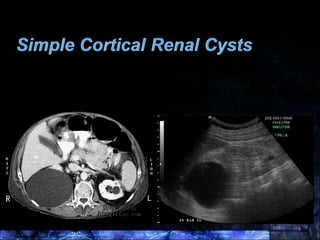
• Simple Cortical Renal Cysts
4
???
5
1. Autosomal Dominant Polycystic Kidney
Disease
2. Autosomal Recessive Polycystic Kidney
Disease
6
• Autosomal dominant.
• 1 in 1000 people.
• Third decade of life
7
Extrarenal manifestations include:
• Liver cysts in 25-50% of patients.
• Pancreatic cysts in 9%.
• Splenic cysts in 5% of patients.
• Other cysts reported include cysts of the thyroid, parathyroid, lung, brain,
pituitary gland, pineal gland, ovary, uterus, testis, seminal vesicles,
epididymis, bladder, and the peritoneum.
• Aneurysms of cerebral arteries (berry aneurysms) in 3-50% of patients.
• A variety of cardiac and aortic abnormalities including aortic root
dilatation, aortic regurgitation, bicuspid aortic valves, coarctation of the
aorta, mitral regurgitation, and abdominal aortic aneurysm.
8
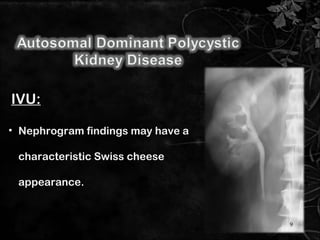
• Nephrogram findings may have a
characteristic Swiss cheese
appearance.
IVU:
9
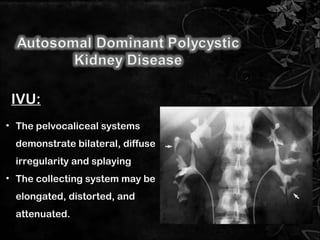
• The pelvocaliceal systems
demonstrate bilateral, diffuse
irregularity and splaying
• The collecting system may be
elongated, distorted, and
attenuated.
IVU:
10
• Most children with ADPKD have normal ultrasonographic
findings at birth
US:
11
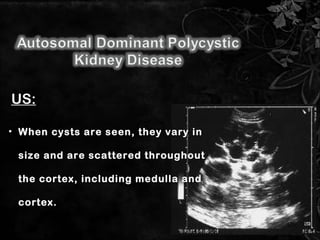
• When cysts are seen, they vary inWhen cysts are seen, they vary in
size and are scattered throughoutsize and are scattered throughout
the cortex, including medulla andthe cortex, including medulla and
cortex.cortex.
US:
12
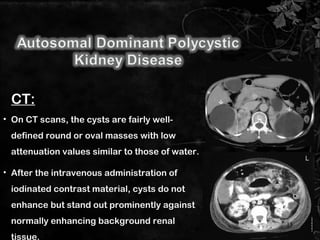
• On CT scans, the cysts are fairly well-
defined round or oval masses with low
attenuation values similar to those of water.
• After the intravenous administration of
iodinated contrast material, cysts do not
enhance but stand out prominently against
normally enhancing background renal
tissue.
CT:
13
14
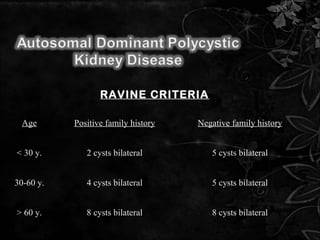
RAVINE CRITERIA
Age Positive family history Negative family history
< 30 y. 2 cysts bilateral 5 cysts bilateral
30-60 y. 4 cysts bilateral 5 cysts bilateral
> 60 y. 8 cysts bilateral 8 cysts bilateral
15
• The most common heritable cystic renal diseaseThe most common heritable cystic renal disease
occurring in infancy and childhood.occurring in infancy and childhood.
• The clinical spectrum shows a wide variability,The clinical spectrum shows a wide variability,
ranging from perinatal death to a milderranging from perinatal death to a milder
progressive form, which may not be diagnosedprogressive form, which may not be diagnosed
until adolescence.until adolescence.
• The Renal And Hepatic Disease Are InverselyThe Renal And Hepatic Disease Are Inversely
Proportional To Each Other In Individual Patients.Proportional To Each Other In Individual Patients.
Classification of ARPKD:Classification of ARPKD:
• Category 1 (Perinatal ARPKD).Category 1 (Perinatal ARPKD).
• Category 2 (Neonatal ARPKD).Category 2 (Neonatal ARPKD).
• Category 3 (Infantile ARPKD).Category 3 (Infantile ARPKD).
• Category 4 (Juvenile ARPKD).Category 4 (Juvenile ARPKD).
Category 1 (Perinatal ARPKD)Category 1 (Perinatal ARPKD)
• Approximately 90% of the collecting ducts are dilated withApproximately 90% of the collecting ducts are dilated with
minimal liver involvement.minimal liver involvement.
• Severe renal impairment in utero leads to oligohydramnios andSevere renal impairment in utero leads to oligohydramnios and
subsequent pulmonary hypoplasia. Other clinical findings maysubsequent pulmonary hypoplasia. Other clinical findings may
include sequelae of oligohydramnios, such as Potter facies andinclude sequelae of oligohydramnios, such as Potter facies and
clubfoot.clubfoot.
• Most of these infants do not survive beyond the first week of life.Most of these infants do not survive beyond the first week of life.
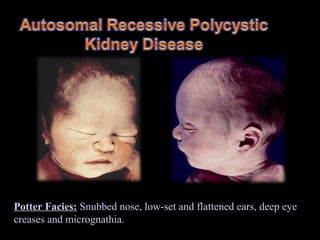
Potter Facies: Snubbed nose, low-set and flattened ears, deep eye
creases and micrognathia. 20
In the neonate:In the neonate:
• Decreased excretion of contrast material.Decreased excretion of contrast material.
• Nephromegaly.Nephromegaly.
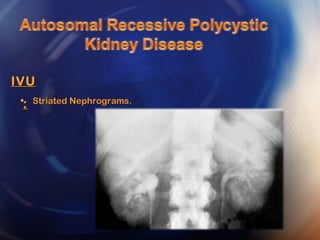
• Characteristic striated nephrograms due to dilatedCharacteristic striated nephrograms due to dilated
collecting tubules.collecting tubules.
• Contrast material may remain in the dilated tubules for daysContrast material may remain in the dilated tubules for days
without visible excretion into the renal calyces.without visible excretion into the renal calyces.
IVUIVU
::
• Striated Nephrograms.Striated Nephrograms.
IVUIVU
::
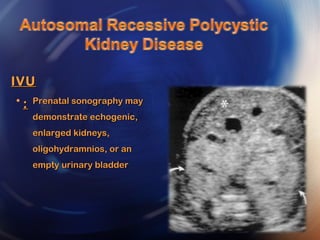
• Prenatal sonography mayPrenatal sonography may
demonstrate echogenic,demonstrate echogenic,
enlarged kidneys,enlarged kidneys,
oligohydramnios, or anoligohydramnios, or an
empty urinary bladder.empty urinary bladder.
IVUIVU
::
• Prenatal sonography mayPrenatal sonography may
demonstrate echogenic,demonstrate echogenic,
enlarged kidneys,enlarged kidneys,
oligohydramnios, or anoligohydramnios, or an
empty urinary bladderempty urinary bladder
IVUIVU
::
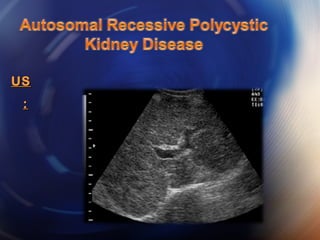
USUS
::
USUS
::
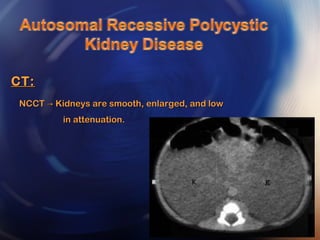
CT:CT:
NCCT Kidneys are smooth, enlarged, and low→NCCT Kidneys are smooth, enlarged, and low→
in attenuation.in attenuation.
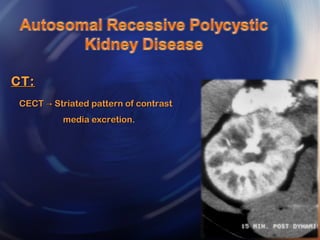
CT:CT:
CECT Striated pattern of contrast→CECT Striated pattern of contrast→
media excretion.media excretion.
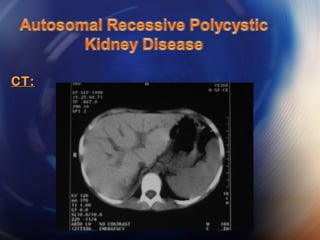
CT:CT:
CT:CT:
• Medullary Sponge Kidney.
• Medullary Cystic Disease.
• Renal Papillary Necrosis.
• Congenital disease in which the renal medulla
is replaced with numerous small cysts
producing a sponge-like appearance.
• The majority of the cysts communicate with
the tubules which may be dilated and
tortuous.
33
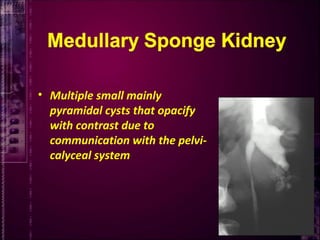
• Multiple small mainly
pyramidal cysts that opacify
with contrast due to
communication with the pelvi-
calyceal system
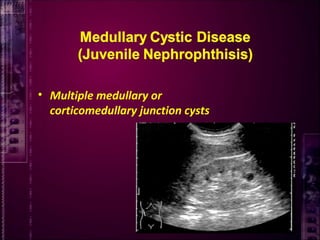
• Multiple medullary or
corticomedullary junction cysts
35
• Parapelvic cysts
• Perinephric cysts (urinoma)
Cystic renal diseases

Cystic renal diseases

  • 1.
  • 2.
    • Cortical Cysts •Polycystic Disease of Kidney • Medullary Cysts • Multi-Cystic Renal Dysplasia • Extra-Parenchymal Renal Cysts 2
  • 3.
    • Simple corticalrenal cysts • Syndromes associated with renal cysts 3
  • 4.
    • Simple CorticalRenal Cysts 4
  • 5.
  • 6.
    1. Autosomal DominantPolycystic Kidney Disease 2. Autosomal Recessive Polycystic Kidney Disease 6
  • 7.
    • Autosomal dominant. •1 in 1000 people. • Third decade of life 7
  • 8.
    Extrarenal manifestations include: •Liver cysts in 25-50% of patients. • Pancreatic cysts in 9%. • Splenic cysts in 5% of patients. • Other cysts reported include cysts of the thyroid, parathyroid, lung, brain, pituitary gland, pineal gland, ovary, uterus, testis, seminal vesicles, epididymis, bladder, and the peritoneum. • Aneurysms of cerebral arteries (berry aneurysms) in 3-50% of patients. • A variety of cardiac and aortic abnormalities including aortic root dilatation, aortic regurgitation, bicuspid aortic valves, coarctation of the aorta, mitral regurgitation, and abdominal aortic aneurysm. 8
  • 9.
    • Nephrogram findingsmay have a characteristic Swiss cheese appearance. IVU: 9
  • 10.
    • The pelvocalicealsystems demonstrate bilateral, diffuse irregularity and splaying • The collecting system may be elongated, distorted, and attenuated. IVU: 10
  • 11.
    • Most childrenwith ADPKD have normal ultrasonographic findings at birth US: 11
  • 12.
    • When cystsare seen, they vary inWhen cysts are seen, they vary in size and are scattered throughoutsize and are scattered throughout the cortex, including medulla andthe cortex, including medulla and cortex.cortex. US: 12
  • 13.
    • On CTscans, the cysts are fairly well- defined round or oval masses with low attenuation values similar to those of water. • After the intravenous administration of iodinated contrast material, cysts do not enhance but stand out prominently against normally enhancing background renal tissue. CT: 13
  • 14.
  • 15.
    RAVINE CRITERIA Age Positivefamily history Negative family history < 30 y. 2 cysts bilateral 5 cysts bilateral 30-60 y. 4 cysts bilateral 5 cysts bilateral > 60 y. 8 cysts bilateral 8 cysts bilateral 15
  • 16.
    • The mostcommon heritable cystic renal diseaseThe most common heritable cystic renal disease occurring in infancy and childhood.occurring in infancy and childhood. • The clinical spectrum shows a wide variability,The clinical spectrum shows a wide variability, ranging from perinatal death to a milderranging from perinatal death to a milder progressive form, which may not be diagnosedprogressive form, which may not be diagnosed until adolescence.until adolescence.
  • 17.
    • The RenalAnd Hepatic Disease Are InverselyThe Renal And Hepatic Disease Are Inversely Proportional To Each Other In Individual Patients.Proportional To Each Other In Individual Patients.
  • 18.
    Classification of ARPKD:Classificationof ARPKD: • Category 1 (Perinatal ARPKD).Category 1 (Perinatal ARPKD). • Category 2 (Neonatal ARPKD).Category 2 (Neonatal ARPKD). • Category 3 (Infantile ARPKD).Category 3 (Infantile ARPKD). • Category 4 (Juvenile ARPKD).Category 4 (Juvenile ARPKD).
  • 19.
    Category 1 (PerinatalARPKD)Category 1 (Perinatal ARPKD) • Approximately 90% of the collecting ducts are dilated withApproximately 90% of the collecting ducts are dilated with minimal liver involvement.minimal liver involvement. • Severe renal impairment in utero leads to oligohydramnios andSevere renal impairment in utero leads to oligohydramnios and subsequent pulmonary hypoplasia. Other clinical findings maysubsequent pulmonary hypoplasia. Other clinical findings may include sequelae of oligohydramnios, such as Potter facies andinclude sequelae of oligohydramnios, such as Potter facies and clubfoot.clubfoot. • Most of these infants do not survive beyond the first week of life.Most of these infants do not survive beyond the first week of life.
  • 20.
    Potter Facies: Snubbednose, low-set and flattened ears, deep eye creases and micrognathia. 20
  • 21.
    In the neonate:Inthe neonate: • Decreased excretion of contrast material.Decreased excretion of contrast material. • Nephromegaly.Nephromegaly. • Characteristic striated nephrograms due to dilatedCharacteristic striated nephrograms due to dilated collecting tubules.collecting tubules. • Contrast material may remain in the dilated tubules for daysContrast material may remain in the dilated tubules for days without visible excretion into the renal calyces.without visible excretion into the renal calyces. IVUIVU ::
  • 22.
    • Striated Nephrograms.StriatedNephrograms. IVUIVU ::
  • 23.
    • Prenatal sonographymayPrenatal sonography may demonstrate echogenic,demonstrate echogenic, enlarged kidneys,enlarged kidneys, oligohydramnios, or anoligohydramnios, or an empty urinary bladder.empty urinary bladder. IVUIVU ::
  • 24.
    • Prenatal sonographymayPrenatal sonography may demonstrate echogenic,demonstrate echogenic, enlarged kidneys,enlarged kidneys, oligohydramnios, or anoligohydramnios, or an empty urinary bladderempty urinary bladder IVUIVU ::
  • 25.
  • 26.
  • 27.
    CT:CT: NCCT Kidneys aresmooth, enlarged, and low→NCCT Kidneys are smooth, enlarged, and low→ in attenuation.in attenuation.
  • 28.
    CT:CT: CECT Striated patternof contrast→CECT Striated pattern of contrast→ media excretion.media excretion.
  • 29.
  • 30.
  • 31.
    • Medullary SpongeKidney. • Medullary Cystic Disease. • Renal Papillary Necrosis.
  • 32.
    • Congenital diseasein which the renal medulla is replaced with numerous small cysts producing a sponge-like appearance. • The majority of the cysts communicate with the tubules which may be dilated and tortuous.
  • 33.
    33 • Multiple smallmainly pyramidal cysts that opacify with contrast due to communication with the pelvi- calyceal system
  • 34.
    • Multiple medullaryor corticomedullary junction cysts
  • 35.
    35 • Parapelvic cysts •Perinephric cysts (urinoma)