Genito-
Urinary
Tumors
Episode 2
Genito-Urinary Tumors
• Renal tumors.
• Tumors of the ureter.
• Bladder tumors.
• Prostate tumors.
• Testicular tumors.
Angiomyolipoma
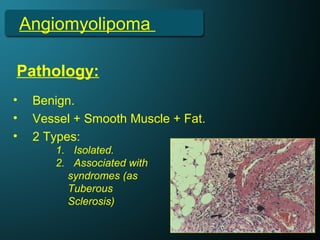
• Benign.
• Vessel + Smooth Muscle + Fat.
• 2 Types:
Pathology:
1. Isolated.
2. Associated with
syndromes (as
Tuberous
Sclerosis)
Angiomyolipoma
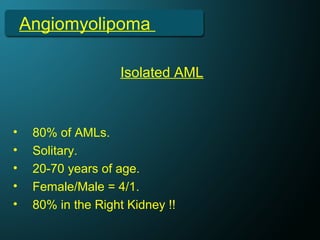
• 80% of AMLs.
• Solitary.
• 20-70 years of age.
• Female/Male = 4/1.
• 80% in the Right Kidney !!
Isolated AML
Angiomyolipoma
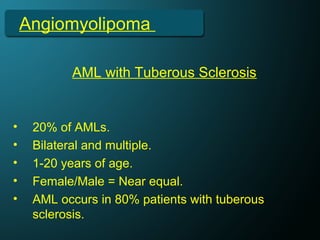
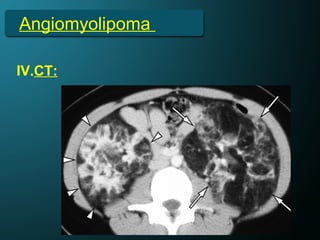
• 20% of AMLs.
• Bilateral and multiple.
• 1-20 years of age.
• Female/Male = Near equal.
• AML occurs in 80% patients with tuberous
sclerosis.
AML with Tuberous Sclerosis
Angiomyolipoma
Clinical:
• 60% asymptomatic.
• 40% are symptomatic; these can cause a
palpable abdominal mass, hematuria, or flank
pain.
• The solitary sporadic tumors may cause acute
abdomen and shock as a result of
spontaneous hemorrhage in the tumor.
Angiomyolipoma
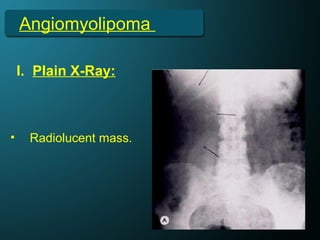
I. Plain X-Ray:
• Radiolucent mass.
Angiomyolipoma
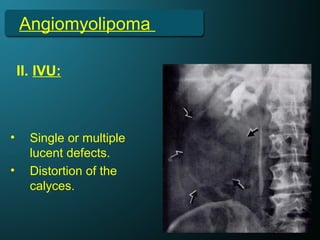
II. IVU:
• Single or multiple
lucent defects.
• Distortion of the
calyces.
Angiomyolipoma
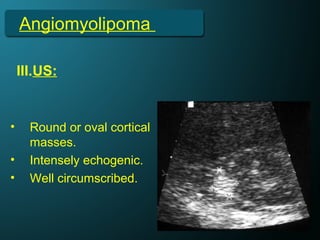
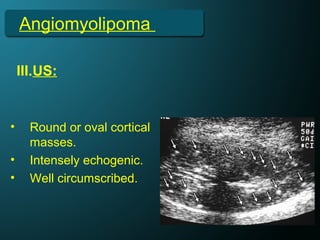
III.US:
• Round or oval cortical
masses.
• Intensely echogenic.
• Well circumscribed.
Angiomyolipoma
III.US:
• Round or oval cortical
masses.
• Intensely echogenic.
• Well circumscribed.
Angiomyolipoma
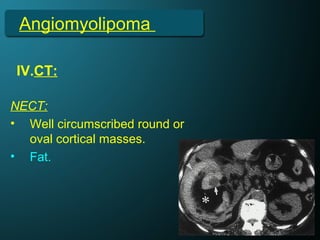
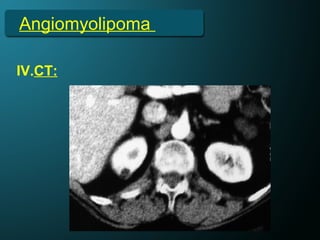
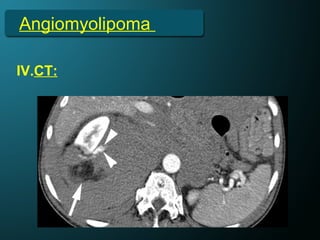
IV.CT:
NECT:
• Well circumscribed round or
oval cortical masses.
• Fat.
Angiomyolipoma
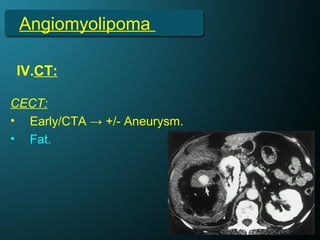
IV.CT:
CECT:
• Early/CTA → +/- Aneurysm.
• Fat.
Angiomyolipoma
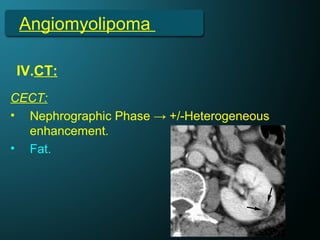
IV.CT:
CECT:
• Nephrographic Phase → +/-Heterogeneous
enhancement.
• Fat.
Angiomyolipoma
IV.CT:
Angiomyolipoma
IV.CT:
Angiomyolipoma
IV.CT:
Angiomyolipoma
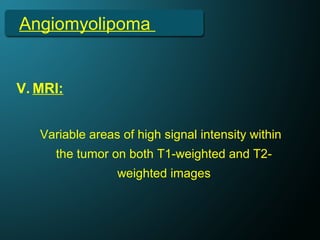
V. MRI:
Variable areas of high signal intensity within
the tumor on both T1-weighted and T2-
weighted images
Angiomyolipoma
V. MRI:
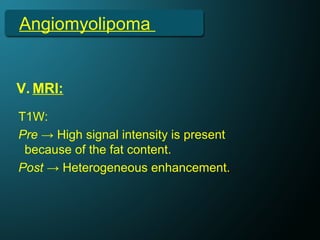
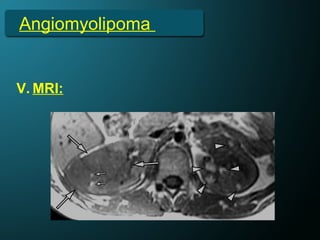
T1W:
Pre → High signal intensity is present
because of the fat content.
Post → Heterogeneous enhancement.
Angiomyolipoma
V. MRI:
Angiomyolipoma
V. MRI:
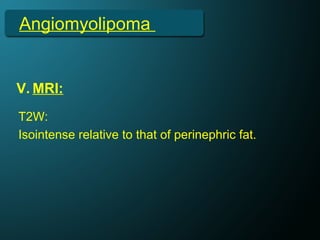
T2W:
Isointense relative to that of perinephric fat.
Angiomyolipoma
V. MRI:
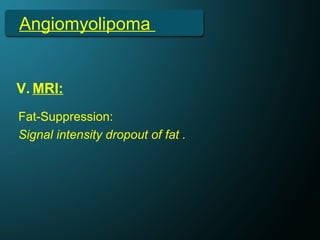
Fat-Suppression:
Signal intensity dropout of fat .
Angiomyolipoma
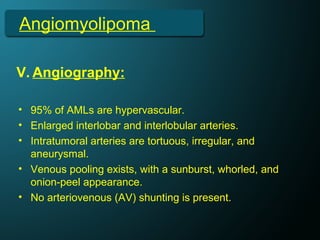
V. Angiography:
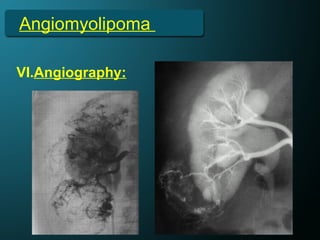
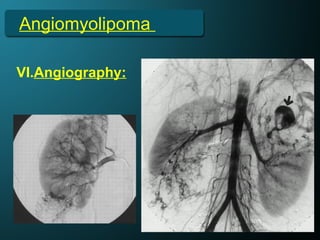
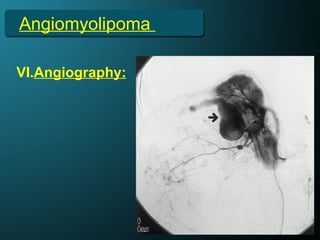
• 95% of AMLs are hypervascular.
• Enlarged interlobar and interlobular arteries.
• Intratumoral arteries are tortuous, irregular, and
aneurysmal.
• Venous pooling exists, with a sunburst, whorled, and
onion-peel appearance.
• No arteriovenous (AV) shunting is present.
Angiomyolipoma
VI.Angiography:
Angiomyolipoma
VI.Angiography:
Angiomyolipoma
VI.Angiography:
Angiomyolipoma
VI.Angiography:
• The presence of multisacculated pseudoaneurysms, the
absence of AV shunting, a sunburst appearance of the
capillary nephrogram, and an onion-skin appearance of
the peripheral vessels in the venous phase suggest AML.

Angiomyolipoma