On-Chip Variation (OCV)
Ever thought what's an interviewer's favorite questions
to rip you off - all of my previous post :).
And On-Chip Variation (OCV) is one of them,
specifically for Static Timing Analysis interview. This
analysis is coming from people who got interviewed
and recruited into leading VLSI industries.
Most importantly, my posts and videos have helped
most of them and I really feel proud about it. Nice
feeling.
Coming back to analyze OCV, the first task is to find all
possible sources variation, and find out how these can
affect a delay of a cell and hence, timing.
First things first - Sources of variation
1) Etching
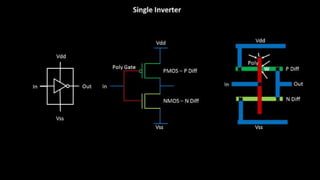
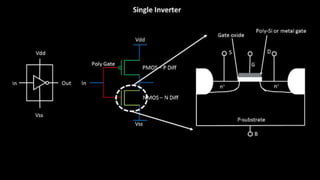
Look into the below layout of an inverter (which also
shows the Width (W) and Length (L) parameters of an
inverter)
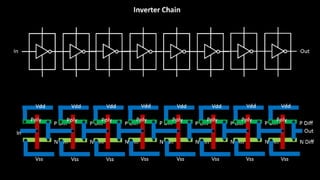
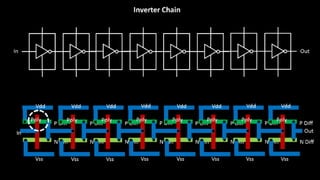
And, a chain of inverters (this is mostly the case of
clock path, be with me for upcoming posts and I will
exactly let you know, why OCV is mainly applied on
clock paths, 50% should be clear from the term "chain
of inverters")
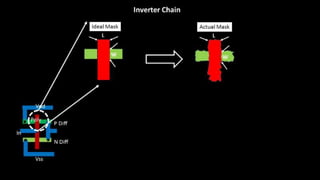
We use photo-lithography fabrication technique to
build the inverters on Silicon wafer, and this is a non-
ideal process, where the edges will not exactly be
straight lines, but there will be disturbances.
And why so, because the above technique needs photo-
masks which are created using etching, which is again
non-ideal. Below is how the ideal mask and real mask
look like
Now these variations on the sides, is also dependent
on what logic cell is present on either sides of this
inverter, if its surrounded by chain of inverters on
either sides, the variation on the sides will be less as
the process parameters to build mask for a chain of
similar size inverter, is almost the same.
But, if the inverters are surrounded by other gates, like
flip-flops, then the variation will be more.
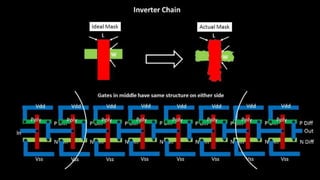
With that said, the below inverters in the middle will
have a similar and less variations ......... (sentence
continues after the below image)
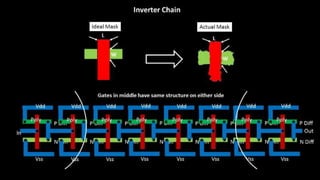
......(sentence continued from above) and the inverters
on the boundaries will have different and more
variations. (observe the difference in actual mask, in
below and above image)
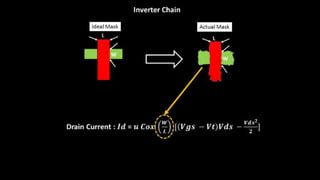
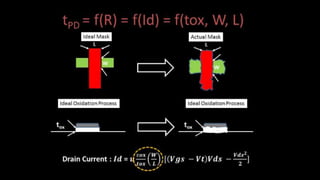
And guess what.... this directly impacts the drain
current below, as it is proportional to (W/L) ratio
You feel, we are almost there.... not yet....we need to
identify other sources of variation, find out how the
current changes, and eventually, find out a range on
what should be the value of OCV....
After this, do you feel, we are done .... not yet .... :), we
need to use these OCV values, plug it in STA analysis
and see its (+ve or -ve) impact....
We were identifying sources of variations, and below is
the second one
2) Oxide Thickness
Let's go back to the inverter layout and look which part
are we talking about
Here, we are talking about gate oxide thickness
variation
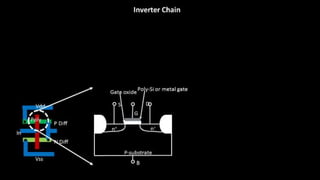
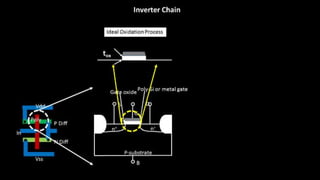
Below is the section from inverter chain, which we are
worried about
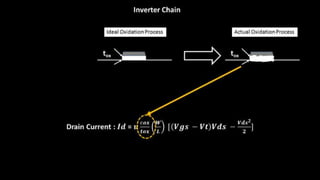
If we go by ideal fabrication process, below is what you
will achieve, a perfectly cubic shape (below is the 2D
image, so it looks rectangle) oxide layer, and perfectly
deposited metal gate or polysilicon gate
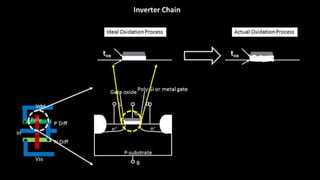
But, if we go by actual oxidation process, its very
difficult or almost impossible to achieve the above
perfect oxide thickness.
And I can confidently say that, as I have worked on
fabrication for a brief period of time during my
Masters at IIT Bombay.
Below is what you will actually get
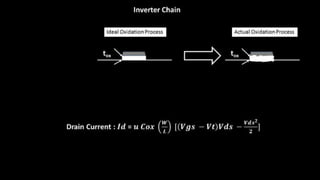
So, what's wrong having above oxide thickness.
Again, its the drain current (which is a function of
oxide thickness, shown in below image) that will get
varied for the complete chain of inverter, especially,
the one's on the sides.
The variations in middle inverters will still be uniform.
We discussed the reason for this in last post
Imagine a chain of, as long as, 40 inverters or buffers
..... the variation is HUGE. And this needs to be
accounted for, in STA.
So the challenge is, how to we find the range and
effectively model it in STA. Are we scared ? Of course
Not .... :)
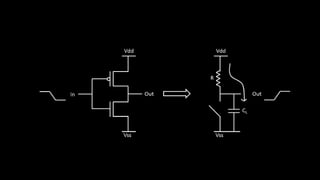
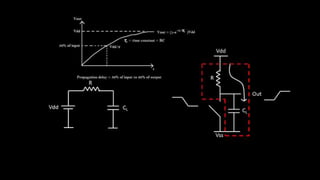
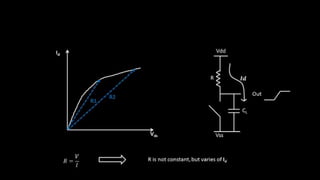
The below image models "low-to-high waveform
condition" at input of CMOS inverter, in terms of
resistances and capacitances. So, overall, its the RC
time constant that actually decides the delay of a cell
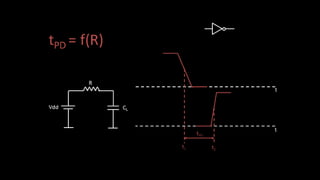
With above, we can safely say, the propagation delay
tPD is a function of 'R'
Now, from previous posts, we seen variation in drain
current 'Id' due to variation in 'W/L' and 'oxide
thickness' variations, and above we see, how
propagation delay is function of 'R'.
The question is now, what next?.
If I am, somehow, able to prove, that drain current 'Id'
strongly depends on 'R', then I can directly relate
(W/L) and oxide thickness variation to 'R', and below
images will exactly do that
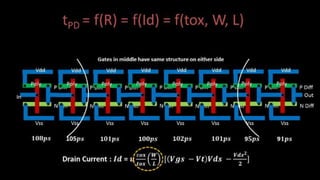
Hence, every inverter in the below chain, will have
delay which is different than the immediate next one,
something like below
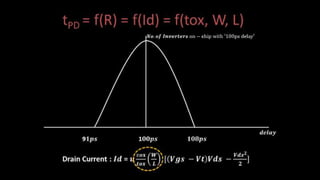
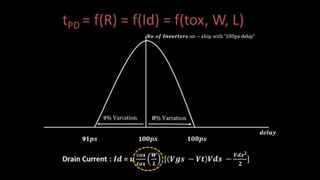
If we plot a Gaussian Curve with delays on x-axis and
no. of inverters on y-axis, it will give us a clue, about
the peak variation in inverter delays, the minimum
and maximum variation in inverter delays like below
Now, we know the percentage variation in delays of
inverter compared to '100ps', because that's where the
inverter delay (with used 'W/L' ratio) is expected to be,
and most number of inverters on chip with that 'W/L'
ratio have a delay of 100ps
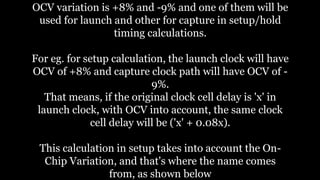
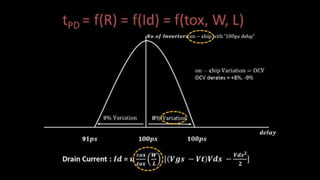
OCV variation is +8% and -9% and one of them will be
used for launch and other for capture in setup/hold
timing calculations.
For eg. for setup calculation, the launch clock will have
OCV of +8% and capture clock path will have OCV of -
9%.
That means, if the original clock cell delay is 'x' in
launch clock, with OCV into account, the same clock
cell delay will be ('x' + 0.08x).
This calculation in setup takes into account the On-
Chip Variation, and that's where the name comes
from, as shown below
The images in above ppt makes this concept so simple.
Isn't it? But, keeping things simple is the most difficult
job :) I took around 3 weeks, just to make these
images. Please ... kudos to ME :) :).
For me, solving any concept, is just like a war. Ulysses
S. Grant rightly mentions "The art of war is
simple enough. Find out where your enemy is.
Get at him as soon as you can. Strike him as
hard as you can, and keep moving on"
For more, please refer to below courses
Circuit design & SPICE simulations
https://www.udemy.com/vlsi-academy-circuit-design/?couponCode=forSlideshare
Physical design flow
https://www.udemy.com/vlsi-academy-physical-design-flow/?couponCode=forSlideshare
Clock tree synthesis
https://www.udemy.com/vlsi-academy-clock-tree-synthesis/?couponCode=forSlideshare
Signal integrity
https://www.udemy.com/vlsi-academy-crosstalk/?couponCode=forSlideshare
VLSI – Essential concepts and detailed interview guide
https://www.udemy.com/vlsi-academy/?couponCode=forSlideshare
THANK YOU

On-Chip Variation

  • 1.
  • 2.
    Ever thought what'san interviewer's favorite questions to rip you off - all of my previous post :). And On-Chip Variation (OCV) is one of them, specifically for Static Timing Analysis interview. This analysis is coming from people who got interviewed and recruited into leading VLSI industries. Most importantly, my posts and videos have helped most of them and I really feel proud about it. Nice feeling.
  • 3.
    Coming back toanalyze OCV, the first task is to find all possible sources variation, and find out how these can affect a delay of a cell and hence, timing. First things first - Sources of variation 1) Etching Look into the below layout of an inverter (which also shows the Width (W) and Length (L) parameters of an inverter)
  • 5.
    And, a chainof inverters (this is mostly the case of clock path, be with me for upcoming posts and I will exactly let you know, why OCV is mainly applied on clock paths, 50% should be clear from the term "chain of inverters")
  • 7.
    We use photo-lithographyfabrication technique to build the inverters on Silicon wafer, and this is a non- ideal process, where the edges will not exactly be straight lines, but there will be disturbances. And why so, because the above technique needs photo- masks which are created using etching, which is again non-ideal. Below is how the ideal mask and real mask look like
  • 9.
    Now these variationson the sides, is also dependent on what logic cell is present on either sides of this inverter, if its surrounded by chain of inverters on either sides, the variation on the sides will be less as the process parameters to build mask for a chain of similar size inverter, is almost the same. But, if the inverters are surrounded by other gates, like flip-flops, then the variation will be more.
  • 10.
    With that said,the below inverters in the middle will have a similar and less variations ......... (sentence continues after the below image)
  • 12.
    ......(sentence continued fromabove) and the inverters on the boundaries will have different and more variations. (observe the difference in actual mask, in below and above image)
  • 14.
    And guess what....this directly impacts the drain current below, as it is proportional to (W/L) ratio
  • 16.
    You feel, weare almost there.... not yet....we need to identify other sources of variation, find out how the current changes, and eventually, find out a range on what should be the value of OCV.... After this, do you feel, we are done .... not yet .... :), we need to use these OCV values, plug it in STA analysis and see its (+ve or -ve) impact....
  • 17.
    We were identifyingsources of variations, and below is the second one 2) Oxide Thickness Let's go back to the inverter layout and look which part are we talking about
  • 19.
    Here, we aretalking about gate oxide thickness variation Below is the section from inverter chain, which we are worried about
  • 22.
    If we goby ideal fabrication process, below is what you will achieve, a perfectly cubic shape (below is the 2D image, so it looks rectangle) oxide layer, and perfectly deposited metal gate or polysilicon gate
  • 24.
    But, if wego by actual oxidation process, its very difficult or almost impossible to achieve the above perfect oxide thickness. And I can confidently say that, as I have worked on fabrication for a brief period of time during my Masters at IIT Bombay. Below is what you will actually get
  • 26.
    So, what's wronghaving above oxide thickness. Again, its the drain current (which is a function of oxide thickness, shown in below image) that will get varied for the complete chain of inverter, especially, the one's on the sides. The variations in middle inverters will still be uniform. We discussed the reason for this in last post
  • 29.
    Imagine a chainof, as long as, 40 inverters or buffers ..... the variation is HUGE. And this needs to be accounted for, in STA. So the challenge is, how to we find the range and effectively model it in STA. Are we scared ? Of course Not .... :)
  • 30.
    The below imagemodels "low-to-high waveform condition" at input of CMOS inverter, in terms of resistances and capacitances. So, overall, its the RC time constant that actually decides the delay of a cell
  • 33.
    With above, wecan safely say, the propagation delay tPD is a function of 'R'
  • 35.
    Now, from previousposts, we seen variation in drain current 'Id' due to variation in 'W/L' and 'oxide thickness' variations, and above we see, how propagation delay is function of 'R'. The question is now, what next?. If I am, somehow, able to prove, that drain current 'Id' strongly depends on 'R', then I can directly relate (W/L) and oxide thickness variation to 'R', and below images will exactly do that
  • 38.
    Hence, every inverterin the below chain, will have delay which is different than the immediate next one, something like below
  • 40.
    If we plota Gaussian Curve with delays on x-axis and no. of inverters on y-axis, it will give us a clue, about the peak variation in inverter delays, the minimum and maximum variation in inverter delays like below
  • 42.
    Now, we knowthe percentage variation in delays of inverter compared to '100ps', because that's where the inverter delay (with used 'W/L' ratio) is expected to be, and most number of inverters on chip with that 'W/L' ratio have a delay of 100ps
  • 44.
    OCV variation is+8% and -9% and one of them will be used for launch and other for capture in setup/hold timing calculations. For eg. for setup calculation, the launch clock will have OCV of +8% and capture clock path will have OCV of - 9%. That means, if the original clock cell delay is 'x' in launch clock, with OCV into account, the same clock cell delay will be ('x' + 0.08x). This calculation in setup takes into account the On- Chip Variation, and that's where the name comes from, as shown below
  • 46.
    The images inabove ppt makes this concept so simple. Isn't it? But, keeping things simple is the most difficult job :) I took around 3 weeks, just to make these images. Please ... kudos to ME :) :). For me, solving any concept, is just like a war. Ulysses S. Grant rightly mentions "The art of war is simple enough. Find out where your enemy is. Get at him as soon as you can. Strike him as hard as you can, and keep moving on"
  • 47.
    For more, pleaserefer to below courses Circuit design & SPICE simulations https://www.udemy.com/vlsi-academy-circuit-design/?couponCode=forSlideshare Physical design flow https://www.udemy.com/vlsi-academy-physical-design-flow/?couponCode=forSlideshare Clock tree synthesis https://www.udemy.com/vlsi-academy-clock-tree-synthesis/?couponCode=forSlideshare Signal integrity https://www.udemy.com/vlsi-academy-crosstalk/?couponCode=forSlideshare VLSI – Essential concepts and detailed interview guide https://www.udemy.com/vlsi-academy/?couponCode=forSlideshare
  • 48.