Gender Planning Frameworks
• attempts to translate the ideas of academic gender
analysis and/or feminism into practical tools and
guidelines for development planners and practitioners
• used to train people who are not gender/women in
development specialists about WHY gender is an issue
in development, as well as HOW gender is an issue in
development, usually in the context of very short courses
- one to three days
• used as a basis for gender policy in many development
agencies. Increasingly the frameworks are being used in
combination to suit institutional and development needs
• aiming to equip development planners and practitioners
with a common understanding and language to analyse
important gender issues in their work
• quite different from one another. They have different
priorities, uses and limitations.
Need to use frameworks with care
While they aid analysis, raise awareness and
assist in thinking through the planning process:
• none of the gender planning frameworks say all
there is to say about gender analysis.
• It is important that frameworks are used to
stimulate rather than restrict thinking about
gender issues.
• it can be useful to look at a number of
frameworks in order to think through which
approach best suits a particular situation.
Three Common Frameworks
• Moser: distinguishes between practical and
strategic interests in planning for empowerment
and focuses on concerns about workloads of
women.
• Harvard: Concerned with making gender
divisions of labour, roles in decision-making and
levels of control over resources, visible.
• Longwe: Directly concerned with creating
situations within which inequality, discrimination
and subordination are addressed.
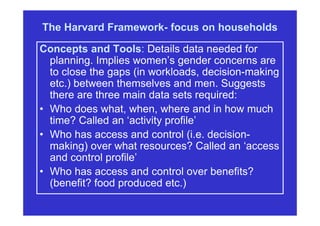
The Harvard Framework- focus on households
Concepts and Tools: Details data needed for
planning. Implies women’s gender concerns are
to close the gaps (in workloads, decision-making
etc.) between themselves and men. Suggests
there are three main data sets required:
• Who does what, when, where and in how much
time? Called an ‘activity profile’
• Who has access and control (i.e. decision-
making) over what resources? Called an ‘access
and control profile’
• Who has access and control over benefits?
(benefit? food produced etc.)
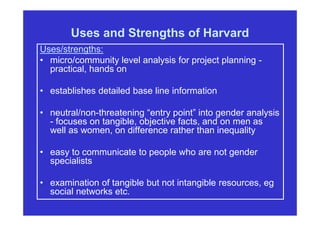
Uses and Strengths of Harvard
Uses/strengths:
• micro/community level analysis for project planning -
practical, hands on
• establishes detailed base line information
• neutral/non-threatening “entry point” into gender analysis
- focuses on tangible, objective facts, and on men as
well as women, on difference rather than inequality
• easy to communicate to people who are not gender
specialists
• examination of tangible but not intangible resources, eg
social networks etc.
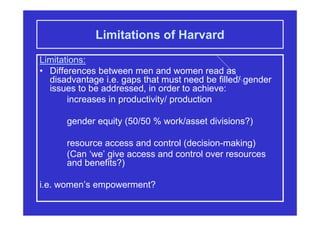
Limitations of Harvard
Limitations:
• Differences between men and women read as
disadvantage i.e. gaps that must need be filled/ gender
issues to be addressed, in order to achieve:
increases in productivity/ production
gender equity (50/50 % work/asset divisions?)
resource access and control (decision-making)
(Can ‘we’ give access and control over resources
and benefits?)
i.e. women’s empowerment?
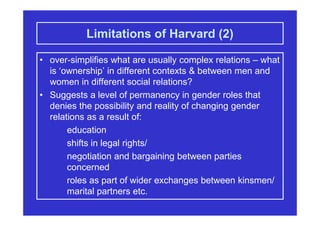
Limitations of Harvard (2)
• over-simplifies what are usually complex relations – what
is ‘ownership’ in different contexts & between men and
women in different social relations?
• Suggests a level of permanency in gender roles that
denies the possibility and reality of changing gender
relations as a result of:
education
shifts in legal rights/
negotiation and bargaining between parties
concerned
roles as part of wider exchanges between kinsmen/
marital partners etc.
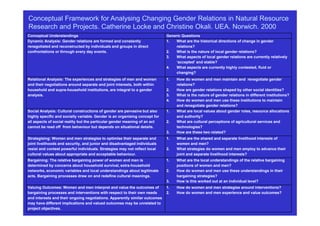
Conceptual Framework for Analysing Changing Gender Relations in Natural Resource
Research and Projects. Catherine Locke and Christine Okali. UEA. Norwich. 2000
Conceptual Understandings Generic Questions
Dynamic Analysis: Gender relations are formed and constantly
renegotiated and reconstructed by individuals and groups in direct
confrontations or through every day events.
1. What are the historical directions of change in gender
relations?
2. What is the nature of local gender relations?
3. What aspects of local gender relations are currently relatively
‘accepted’ and stable?
4. What aspects are currently highly contested, fluid or
changing?
Relational Analysis: The experiences and strategies of men and women
and their negotiations around separate and joint interests, both within
household and supra-household institutions, are integral to a gender
analysis.
1. How do women and men maintain and renegotiate gender
relations?
2. How are gender relations shaped by other social identities?
3. What is the nature of gender relations in different institutions?
4. How do women and men use these institutions to maintain
and renegotiate gender relations?
Social Analysis: Cultural constructions of gender are pervasive but also
highly specific and socially variable. Gender is an organising concept for
all aspects of social reality but the particular gender meaning of an act
cannot be read off from behaviour but depends on situational details.
1. What are local values about gender roles, resource allocations
and authority?
2. What are cultural perceptions of agricultural services and
technologies?
3. How are these two related?
Strategising: Women and men strategise to optimise their separate and
joint livelihoods and security, and junior and disadvantaged individuals
resist and contest powerful individuals. Strategies may not reflect local
cultural values about appropriate and acceptable behaviour.
1. What are the shared and separate livelihood interests of
women and men?
2. What strategies do women and men employ to advance their
joint and separate livelihood interests?
Bargaining: The relative bargaining power of women and men is
determined by concerns about household survival, extra-household
networks, economic variables and local understandings about legitimate
acts. Bargaining processes draw on and redefine cultural meanings.
1. What are the local understandings of the relative bargaining
positions of women and men?
2. How do women and men use these understandings in their
bargaining strategies?
3. How is this worked out at an individual level?
Valuing Outcomes: Women and men interpret and value the outcomes of
bargaining processes and interventions with respect to their own needs
and interests and their ongoing negotiations. Apparently similar outcomes
may have different implications and valued outcomes may be unrelated to
project objectives.
1. How do women and men strategise around interventions?
2. How do women and men experience and value outcomes?
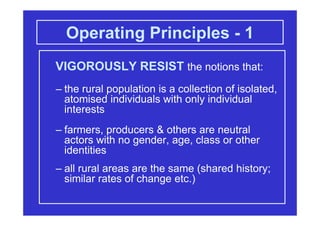
Operating Principles - 1
VIGOROUSLY RESIST the notions that:
– the rural population is a collection of isolated,
atomised individuals with only individual
interests
– farmers, producers & others are neutral
actors with no gender, age, class or other
identities
– all rural areas are the same (shared history;
similar rates of change etc.)
Operating Principles - 2
QUESTION dominant narratives about:
– women & men in agriculture
– gender relations
– households & household decision-making
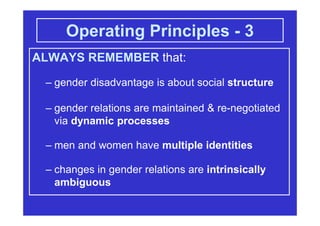
Operating Principles - 3
ALWAYS REMEMBER that:
– gender disadvantage is about social structure
– gender relations are maintained & re-negotiated
via dynamic processes
– men and women have multiple identities
– changes in gender relations are intrinsically
ambiguous

Christine Okali, Institute of Development Studies "Gender Planning Framework"

  • 1.
    Gender Planning Frameworks •attempts to translate the ideas of academic gender analysis and/or feminism into practical tools and guidelines for development planners and practitioners • used to train people who are not gender/women in development specialists about WHY gender is an issue in development, as well as HOW gender is an issue in development, usually in the context of very short courses - one to three days • used as a basis for gender policy in many development agencies. Increasingly the frameworks are being used in combination to suit institutional and development needs • aiming to equip development planners and practitioners with a common understanding and language to analyse important gender issues in their work • quite different from one another. They have different priorities, uses and limitations.
  • 2.
    Need to useframeworks with care While they aid analysis, raise awareness and assist in thinking through the planning process: • none of the gender planning frameworks say all there is to say about gender analysis. • It is important that frameworks are used to stimulate rather than restrict thinking about gender issues. • it can be useful to look at a number of frameworks in order to think through which approach best suits a particular situation.
  • 3.
    Three Common Frameworks •Moser: distinguishes between practical and strategic interests in planning for empowerment and focuses on concerns about workloads of women. • Harvard: Concerned with making gender divisions of labour, roles in decision-making and levels of control over resources, visible. • Longwe: Directly concerned with creating situations within which inequality, discrimination and subordination are addressed.
  • 4.
    The Harvard Framework-focus on households Concepts and Tools: Details data needed for planning. Implies women’s gender concerns are to close the gaps (in workloads, decision-making etc.) between themselves and men. Suggests there are three main data sets required: • Who does what, when, where and in how much time? Called an ‘activity profile’ • Who has access and control (i.e. decision- making) over what resources? Called an ‘access and control profile’ • Who has access and control over benefits? (benefit? food produced etc.)
  • 5.
    Uses and Strengthsof Harvard Uses/strengths: • micro/community level analysis for project planning - practical, hands on • establishes detailed base line information • neutral/non-threatening “entry point” into gender analysis - focuses on tangible, objective facts, and on men as well as women, on difference rather than inequality • easy to communicate to people who are not gender specialists • examination of tangible but not intangible resources, eg social networks etc.
  • 6.
    Limitations of Harvard Limitations: •Differences between men and women read as disadvantage i.e. gaps that must need be filled/ gender issues to be addressed, in order to achieve: increases in productivity/ production gender equity (50/50 % work/asset divisions?) resource access and control (decision-making) (Can ‘we’ give access and control over resources and benefits?) i.e. women’s empowerment?
  • 7.
    Limitations of Harvard(2) • over-simplifies what are usually complex relations – what is ‘ownership’ in different contexts & between men and women in different social relations? • Suggests a level of permanency in gender roles that denies the possibility and reality of changing gender relations as a result of: education shifts in legal rights/ negotiation and bargaining between parties concerned roles as part of wider exchanges between kinsmen/ marital partners etc.
  • 8.
    Conceptual Framework forAnalysing Changing Gender Relations in Natural Resource Research and Projects. Catherine Locke and Christine Okali. UEA. Norwich. 2000 Conceptual Understandings Generic Questions Dynamic Analysis: Gender relations are formed and constantly renegotiated and reconstructed by individuals and groups in direct confrontations or through every day events. 1. What are the historical directions of change in gender relations? 2. What is the nature of local gender relations? 3. What aspects of local gender relations are currently relatively ‘accepted’ and stable? 4. What aspects are currently highly contested, fluid or changing? Relational Analysis: The experiences and strategies of men and women and their negotiations around separate and joint interests, both within household and supra-household institutions, are integral to a gender analysis. 1. How do women and men maintain and renegotiate gender relations? 2. How are gender relations shaped by other social identities? 3. What is the nature of gender relations in different institutions? 4. How do women and men use these institutions to maintain and renegotiate gender relations? Social Analysis: Cultural constructions of gender are pervasive but also highly specific and socially variable. Gender is an organising concept for all aspects of social reality but the particular gender meaning of an act cannot be read off from behaviour but depends on situational details. 1. What are local values about gender roles, resource allocations and authority? 2. What are cultural perceptions of agricultural services and technologies? 3. How are these two related? Strategising: Women and men strategise to optimise their separate and joint livelihoods and security, and junior and disadvantaged individuals resist and contest powerful individuals. Strategies may not reflect local cultural values about appropriate and acceptable behaviour. 1. What are the shared and separate livelihood interests of women and men? 2. What strategies do women and men employ to advance their joint and separate livelihood interests? Bargaining: The relative bargaining power of women and men is determined by concerns about household survival, extra-household networks, economic variables and local understandings about legitimate acts. Bargaining processes draw on and redefine cultural meanings. 1. What are the local understandings of the relative bargaining positions of women and men? 2. How do women and men use these understandings in their bargaining strategies? 3. How is this worked out at an individual level? Valuing Outcomes: Women and men interpret and value the outcomes of bargaining processes and interventions with respect to their own needs and interests and their ongoing negotiations. Apparently similar outcomes may have different implications and valued outcomes may be unrelated to project objectives. 1. How do women and men strategise around interventions? 2. How do women and men experience and value outcomes?
  • 9.
    Operating Principles -1 VIGOROUSLY RESIST the notions that: – the rural population is a collection of isolated, atomised individuals with only individual interests – farmers, producers & others are neutral actors with no gender, age, class or other identities – all rural areas are the same (shared history; similar rates of change etc.)
  • 10.
    Operating Principles -2 QUESTION dominant narratives about: – women & men in agriculture – gender relations – households & household decision-making
  • 11.
    Operating Principles -3 ALWAYS REMEMBER that: – gender disadvantage is about social structure – gender relations are maintained & re-negotiated via dynamic processes – men and women have multiple identities – changes in gender relations are intrinsically ambiguous