Rural market access and nutritional outcomes in farm households 
William A. Masters 
http://sites.tufts.edu/willmasters 
Amelia F. Darrouzet-Nardi 
http://sites.tufts.edu/ameliadarrouzetnardi 
Friedman School of Nutrition, Tufts University 
Joint A4NH/ISPC workshop on agriculture-nutrition linkages 
22-23 September 2014
How do rural markets influence nutrition outcomes in farm households? 
1.Could improve or worsen nutrition, by various direct channels 
a)Household income, wealth and purchasing power 
b)Time allocation especially for women and children 
c)Relative cost of access to safe and nutritious foods 
2.Could alter the ag-nutrition relationship, by effect modifiers 
a)Separates decision-making between farm and household 
b)Alters resilience and consumption smoothing 
3.Here we add to the long and old literature on #1 
and introduce new work on #2b 
4.Will present empirical results then implications 
and start with a hypothesized causal model 
Market access and farm household nutrition motivation | the global study | the DRC study
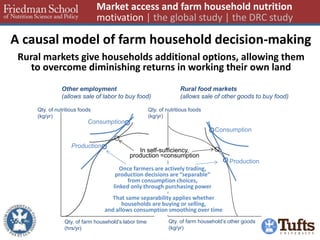
A causal model of farm household decision-making 
Market access and farm household nutrition motivation | the global study | the DRC study 
Qty. of nutritious foods 
(kg/yr) 
Qty. of farm household’s labor time (hrs/yr) 
Qty. of farm household’s other goods (kg/yr) 
Other employment 
(allows sale of labor to buy food) 
Rural markets give households additional options, allowing them to overcome diminishing returns in working their own land 
Qty. of nutritious foods 
(kg/yr) 
Once farmers are actively trading, production decisions are “separable” from consumption choices, 
linked only through purchasing power 
Rural food markets 
(allows sale of other goods to buy food) 
In self-sufficiency, production =consumption 
Consumption 
Production 
Consumption 
Production 
That same separability applies whether households are buying or selling, 
and allows consumption smoothing over time
Empirical identification of causal effects is difficult 
•Market access tends to be closely correlated with productivity and purchasing power, but relationship may not be causal 
–Markets may arise and grow where people can use them 
–People who can use them may move towards markets 
•Here, we report on two ways to identify potentially causal links between rural market access and farm household nutrition 
–Globally, do subnational administrative regions with an earlier history of urbanization have healthier maternal and child heights and weights? 
–Within DRC, do farm households located closer to rural towns have more resilience against seasonal shocks to child heights and weights? 
•Both studies construct natural experiments, using time lags and spatial variation in risk exposure to identify effects 
Market access and farm household nutrition motivation | the global study | the DRC study
The global study: 
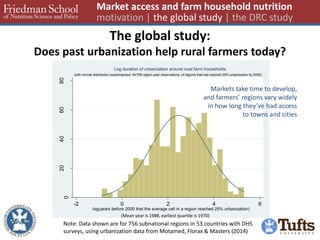
Does past urbanization help rural farmers today? 
Market access and farm household nutrition 
motivation | the global study | the DRC study 
0 
20 40 60 80 
number of regions 
-2 0 2 4 6 
log(years before 2000 that the average cell in a region reached 25% urbanization) 
(with normal distribution superimposed, N=756 region-year observations, of regions that had reached 25% urbanization by 2000) 
Log duration of urbanization around rural farm households 
Note: Data shown are for 756 subnational regions in 53 countries with DHS 
surveys, using urbanization data from Motamed, Florax & Masters (2014) 
(Mean year is 1988, earliest quartile is 1970) 
Markets take time to develop, 
and farmers’ regions vary widely 
in how long they’ve had access 
to towns and cities
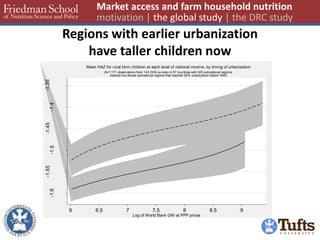
Regions with earlier urbanization have taller children now 
Market access and farm household nutrition motivation | the global study | the DRC study 
-1.6-1.55-1.5-1.45-1.4-1.35Child mean HAZ 66.577.588.59Log of World Bank GNI at PPP prices(N=1171 observations from 143 DHS surveys in 57 countries with 520 subnational regions; dashed line shows subnational regions that reached 25% urbanization before 1995Mean HAZ for rural farm children at each level of national income, by timing of urbanization
Regions with earlier urbanization 
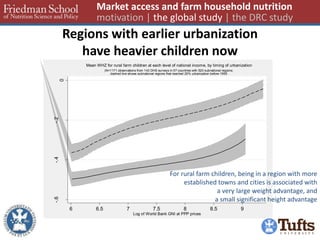
have heavier children now 
Market access and farm household nutrition 
motivation | the global study | the DRC study 
-.6 -.4 -.2 
0 
Child mean WHZ 
6 6.5 7 7.5 8 8.5 9 
Log of World Bank GNI at PPP prices 
(N=1171 observations from 143 DHS surveys in 57 countries with 520 subnational regions; 
dashed line shows subnational regions that reached 25% urbanization before 1995 
Mean WHZ for rural farm children at each level of national income, by timing of urbanization 
For rural farm children, being in a region with more 
established towns and cities is associated with 
a very large weight advantage, and 
a small significant height advantage
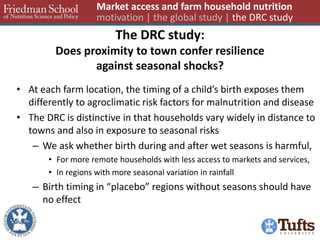
The DRC study: Does proximity to town confer resilience against seasonal shocks? 
•At each farm location, the timing of a child’s birth exposes them differently to agroclimatic risk factors for malnutrition and disease 
•The DRC is distinctive in that households vary widely in distance to towns and also in exposure to seasonal risks 
–We ask whether birth during and after wet seasons is harmful, 
•For more remote households with less access to markets and services, 
•In regions with more seasonal variation in rainfall 
–Birth timing in “placebo” regions without seasons should have no effect 
Market access and farm household nutrition motivation | the global study | the DRC study
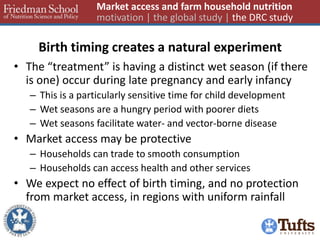
Birth timing creates a natural experiment 
•The “treatment” is having a distinct wet season (if there is one) occur during late pregnancy and early infancy 
–This is a particularly sensitive time for child development 
–Wet seasons are a hungry period with poorer diets 
–Wet seasons facilitate water- and vector-borne disease 
•Market access may be protective 
–Households can trade to smooth consumption 
–Households can access health and other services 
•We expect no effect of birth timing, and no protection from market access, in regions with uniform rainfall 
Market access and farm household nutrition motivation | the global study | the DRC study
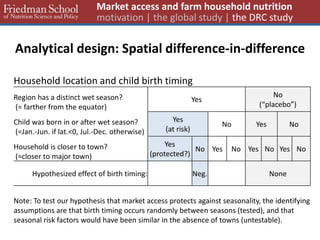
Analytical design: Spatial difference-in-difference 
Household location and child birth timing 
Region has a distinct wet season? 
(= farther from the equator) 
Yes 
No 
(“placebo”) 
Child was born in or after wet season? 
(=Jan.-Jun. if lat.<0, Jul.-Dec. otherwise) 
Yes 
(at risk) 
No 
Yes 
No 
Household is closer to town? 
(=closer to major town) 
Yes 
(protected?) 
No 
Yes 
No 
Yes 
No 
Yes 
No 
Hypothesized effect of birth timing: 
Neg. 
None 
Note: To test our hypothesis that market access protects against seasonality, the identifying assumptions are that birth timing occurs randomly between seasons (tested), and that seasonal risk factors would have been similar in the absence of towns (untestable). 
Market access and farm household nutrition motivation | the global study | the DRC study
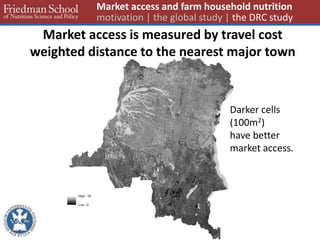
Darker cells (100m2) have better market access. 
Market access is measured by travel cost weighted distance to the nearest major town 
Market access and farm household nutrition motivation | the global study | the DRC study
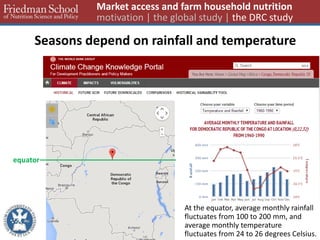
Seasons depend on rainfall and temperature 
equator 
At the equator, average monthly rainfall fluctuates from 100 to 200 mm, and average monthly temperature fluctuates from 24 to 26 degrees Celsius. 
Market access and farm household nutrition motivation | the global study | the DRC study
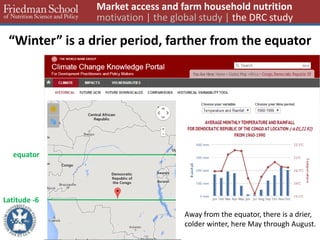
“Winter” is a drier period, farther from the equator 
equator 
Away from the equator, there is a drier, colder winter, here May through August. 
Latitude -6 
Market access and farm household nutrition motivation | the global study | the DRC study
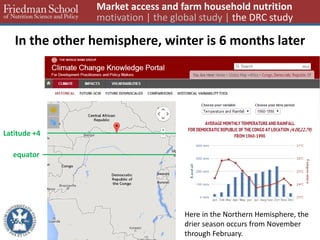
In the other hemisphere, winter is 6 months later 
equator 
Here in the Northern Hemisphere, the drier season occurs from November through February. 
Latitude +4 
Market access and farm household nutrition motivation | the global study | the DRC study
All Children 
N=2806 
Jan.-June 
No Seasons 
N=650 
Jan.-June 
Seasons 
N=903 
July-Dec. 
No Seasons 
N=563 
July-Dec. 
Seasons 
N=690 
Child status 
HAZ 
-1.47 (1.86) 
-1.51 (2.02) 
-1.51 (1.75) 
-1.61 (1.92) 
-1.26 (1.80) 
WAZ 
-1.20 (1.38) 
-1.09 (1.42) 
-1.34 (1.31) 
-1.17 (1.46) 
-1.13 (1.34) 
WHZ 
-0.38 (1.33) 
-0.22 (1.39) 
-0.53 (1.21) 
-0.24 (1.41) 
-0.45 (1.31) 
Age (mos.) 
29.16 (16.53) 
28.81 (16.82) 
28.53 (15.80) 
29.70 (17.10) 
29.88 (16.69) 
Sex (% boys) 
49.4% 
47.8% 
49.8% 
47.9% 
51.4% 
Household 
Wealth quint. 
2.9 (1.42) 
2.61 (1.25) 
3.02 (1.48) 
2.67 (1.26) 
3.19 (1.51) 
Dist. to town (km) 
64.8 (52.1) 
70.1 (47.9) 
59.6 (51.9) 
71.6 (45.3) 
60.8 (59.8) 
Environment 
Conflicts 
31.28 (66.9) 
66.53 (97.82) 
9.29 (19.47) 
48.57 (84.24) 
12.74 (22.99) 
Lat. (abs val.) 
4.31 (2.64) 
1.99 (1.16) 
6.14 (2.01) 
1.98 (1.17) 
5.99 (2.02) 
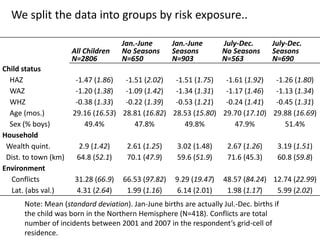
Note: Mean (standard deviation). Jan-June births are actually Jul.-Dec. births if the child was born in the Northern Hemisphere (N=418). Conflicts are total number of incidents between 2001 and 2007 in the respondent’s grid-cell of residence. 
We split the data into groups by risk exposure..
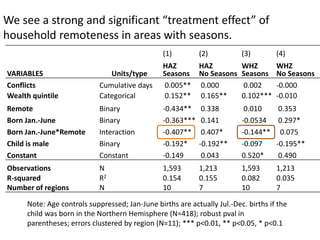
Note: Age controls suppressed; Jan-June births are actually Jul.-Dec. births if the child was born in the Northern Hemisphere (N=418); robust pval in parentheses; errors clustered by region (N=11); *** p<0.01, ** p<0.05, * p<0.1 
(1) 
(2) 
(3) 
(4) 
VARIABLES 
Units/type 
HAZ 
Seasons 
HAZ 
No Seasons 
WHZ 
Seasons 
WHZ 
No Seasons 
Conflicts 
Cumulative days 
0.005** 
0.000 
0.002 
-0.000 
Wealth quintile 
Categorical 
0.152** 
0.165** 
0.102*** 
-0.010 
Remote 
Binary 
-0.434** 
0.338 
0.010 
0.353 
Born Jan.-June 
Binary 
-0.363*** 
0.141 
-0.0534 
0.297* 
Born Jan.-June*Remote 
Interaction 
-0.407** 
0.407* 
-0.144** 
0.075 
Child is male 
Binary 
-0.192* 
-0.192** 
-0.097 
-0.195** 
Constant 
Constant 
-0.149 
0.043 
0.520* 
0.490 
Observations 
N 
1,593 
1,213 
1,593 
1,213 
R-squared 
R2 
0.154 
0.155 
0.082 
0.035 
Number of regions 
N 
10 
7 
10 
7 
We see a strong and significant “treatment effect” of household remoteness in areas with seasons.
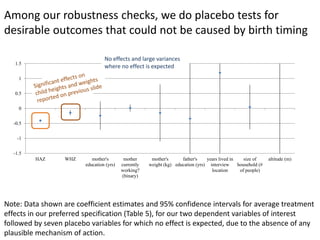
Note: Data shown are coefficient estimates and 95% confidence intervals for average treatment effects in our preferred specification (Table 5), for our two dependent variables of interest followed by seven placebo variables for which no effect is expected, due to the absence of any plausible mechanism of action. 
Among our robustness checks, we do placebo tests for desirable outcomes that could not be caused by birth timing 
-1.5 
-1 
-0.5 
0 
0.5 
1 
1.5 
HAZ 
WHZ 
mother's 
education (yrs) 
mother 
currently 
working? 
(binary) 
mother's 
weight (kg) 
father's 
education (yrs) 
years lived in 
interview 
location 
size of 
household (# 
of people) 
altitude (m) 
No effects and large variances where no effect is expected
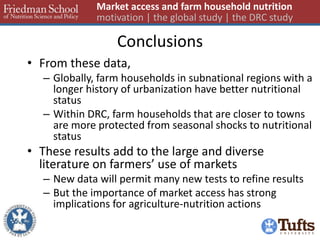
Conclusions 
•From these data, 
–Globally, farm households in subnational regions with a longer history of urbanization have better nutritional status 
–Within DRC, farm households that are closer to towns are more protected from seasonal shocks to nutritional status 
•These results add to the large and diverse literature on farmers’ use of markets 
–New data will permit many new tests to refine results 
–But the importance of market access has strong implications for agriculture-nutrition actions 
Market access and farm household nutrition motivation | the global study | the DRC study
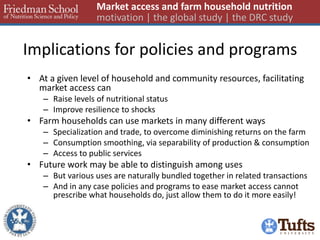
Implications for policies and programs 
•At a given level of household and community resources, facilitating market access can 
–Raise levels of nutritional status 
–Improve resilience to shocks 
•Farm households can use markets in many different ways 
–Specialization and trade, to overcome diminishing returns on the farm 
–Consumption smoothing, via separability of production & consumption 
–Access to public services 
•Future work may be able to distinguish among uses 
–But various uses are naturally bundled together in related transactions 
–And in any case policies and programs to ease market access cannot prescribe what households do, just allow them to do it more easily! 
Market access and farm household nutrition motivation | the global study | the DRC study

Masters a4 nh-ispc

  • 1.
    Rural market accessand nutritional outcomes in farm households William A. Masters http://sites.tufts.edu/willmasters Amelia F. Darrouzet-Nardi http://sites.tufts.edu/ameliadarrouzetnardi Friedman School of Nutrition, Tufts University Joint A4NH/ISPC workshop on agriculture-nutrition linkages 22-23 September 2014
  • 2.
    How do ruralmarkets influence nutrition outcomes in farm households? 1.Could improve or worsen nutrition, by various direct channels a)Household income, wealth and purchasing power b)Time allocation especially for women and children c)Relative cost of access to safe and nutritious foods 2.Could alter the ag-nutrition relationship, by effect modifiers a)Separates decision-making between farm and household b)Alters resilience and consumption smoothing 3.Here we add to the long and old literature on #1 and introduce new work on #2b 4.Will present empirical results then implications and start with a hypothesized causal model Market access and farm household nutrition motivation | the global study | the DRC study
  • 3.
    A causal modelof farm household decision-making Market access and farm household nutrition motivation | the global study | the DRC study Qty. of nutritious foods (kg/yr) Qty. of farm household’s labor time (hrs/yr) Qty. of farm household’s other goods (kg/yr) Other employment (allows sale of labor to buy food) Rural markets give households additional options, allowing them to overcome diminishing returns in working their own land Qty. of nutritious foods (kg/yr) Once farmers are actively trading, production decisions are “separable” from consumption choices, linked only through purchasing power Rural food markets (allows sale of other goods to buy food) In self-sufficiency, production =consumption Consumption Production Consumption Production That same separability applies whether households are buying or selling, and allows consumption smoothing over time
  • 4.
    Empirical identification ofcausal effects is difficult •Market access tends to be closely correlated with productivity and purchasing power, but relationship may not be causal –Markets may arise and grow where people can use them –People who can use them may move towards markets •Here, we report on two ways to identify potentially causal links between rural market access and farm household nutrition –Globally, do subnational administrative regions with an earlier history of urbanization have healthier maternal and child heights and weights? –Within DRC, do farm households located closer to rural towns have more resilience against seasonal shocks to child heights and weights? •Both studies construct natural experiments, using time lags and spatial variation in risk exposure to identify effects Market access and farm household nutrition motivation | the global study | the DRC study
  • 5.
    The global study: Does past urbanization help rural farmers today? Market access and farm household nutrition motivation | the global study | the DRC study 0 20 40 60 80 number of regions -2 0 2 4 6 log(years before 2000 that the average cell in a region reached 25% urbanization) (with normal distribution superimposed, N=756 region-year observations, of regions that had reached 25% urbanization by 2000) Log duration of urbanization around rural farm households Note: Data shown are for 756 subnational regions in 53 countries with DHS surveys, using urbanization data from Motamed, Florax & Masters (2014) (Mean year is 1988, earliest quartile is 1970) Markets take time to develop, and farmers’ regions vary widely in how long they’ve had access to towns and cities
  • 6.
    Regions with earlierurbanization have taller children now Market access and farm household nutrition motivation | the global study | the DRC study -1.6-1.55-1.5-1.45-1.4-1.35Child mean HAZ 66.577.588.59Log of World Bank GNI at PPP prices(N=1171 observations from 143 DHS surveys in 57 countries with 520 subnational regions; dashed line shows subnational regions that reached 25% urbanization before 1995Mean HAZ for rural farm children at each level of national income, by timing of urbanization
  • 7.
    Regions with earlierurbanization have heavier children now Market access and farm household nutrition motivation | the global study | the DRC study -.6 -.4 -.2 0 Child mean WHZ 6 6.5 7 7.5 8 8.5 9 Log of World Bank GNI at PPP prices (N=1171 observations from 143 DHS surveys in 57 countries with 520 subnational regions; dashed line shows subnational regions that reached 25% urbanization before 1995 Mean WHZ for rural farm children at each level of national income, by timing of urbanization For rural farm children, being in a region with more established towns and cities is associated with a very large weight advantage, and a small significant height advantage
  • 8.
    The DRC study:Does proximity to town confer resilience against seasonal shocks? •At each farm location, the timing of a child’s birth exposes them differently to agroclimatic risk factors for malnutrition and disease •The DRC is distinctive in that households vary widely in distance to towns and also in exposure to seasonal risks –We ask whether birth during and after wet seasons is harmful, •For more remote households with less access to markets and services, •In regions with more seasonal variation in rainfall –Birth timing in “placebo” regions without seasons should have no effect Market access and farm household nutrition motivation | the global study | the DRC study
  • 9.
    Birth timing createsa natural experiment •The “treatment” is having a distinct wet season (if there is one) occur during late pregnancy and early infancy –This is a particularly sensitive time for child development –Wet seasons are a hungry period with poorer diets –Wet seasons facilitate water- and vector-borne disease •Market access may be protective –Households can trade to smooth consumption –Households can access health and other services •We expect no effect of birth timing, and no protection from market access, in regions with uniform rainfall Market access and farm household nutrition motivation | the global study | the DRC study
  • 10.
    Analytical design: Spatialdifference-in-difference Household location and child birth timing Region has a distinct wet season? (= farther from the equator) Yes No (“placebo”) Child was born in or after wet season? (=Jan.-Jun. if lat.<0, Jul.-Dec. otherwise) Yes (at risk) No Yes No Household is closer to town? (=closer to major town) Yes (protected?) No Yes No Yes No Yes No Hypothesized effect of birth timing: Neg. None Note: To test our hypothesis that market access protects against seasonality, the identifying assumptions are that birth timing occurs randomly between seasons (tested), and that seasonal risk factors would have been similar in the absence of towns (untestable). Market access and farm household nutrition motivation | the global study | the DRC study
  • 11.
    Darker cells (100m2)have better market access. Market access is measured by travel cost weighted distance to the nearest major town Market access and farm household nutrition motivation | the global study | the DRC study
  • 12.
    Seasons depend onrainfall and temperature equator At the equator, average monthly rainfall fluctuates from 100 to 200 mm, and average monthly temperature fluctuates from 24 to 26 degrees Celsius. Market access and farm household nutrition motivation | the global study | the DRC study
  • 13.
    “Winter” is adrier period, farther from the equator equator Away from the equator, there is a drier, colder winter, here May through August. Latitude -6 Market access and farm household nutrition motivation | the global study | the DRC study
  • 14.
    In the otherhemisphere, winter is 6 months later equator Here in the Northern Hemisphere, the drier season occurs from November through February. Latitude +4 Market access and farm household nutrition motivation | the global study | the DRC study
  • 15.
    All Children N=2806 Jan.-June No Seasons N=650 Jan.-June Seasons N=903 July-Dec. No Seasons N=563 July-Dec. Seasons N=690 Child status HAZ -1.47 (1.86) -1.51 (2.02) -1.51 (1.75) -1.61 (1.92) -1.26 (1.80) WAZ -1.20 (1.38) -1.09 (1.42) -1.34 (1.31) -1.17 (1.46) -1.13 (1.34) WHZ -0.38 (1.33) -0.22 (1.39) -0.53 (1.21) -0.24 (1.41) -0.45 (1.31) Age (mos.) 29.16 (16.53) 28.81 (16.82) 28.53 (15.80) 29.70 (17.10) 29.88 (16.69) Sex (% boys) 49.4% 47.8% 49.8% 47.9% 51.4% Household Wealth quint. 2.9 (1.42) 2.61 (1.25) 3.02 (1.48) 2.67 (1.26) 3.19 (1.51) Dist. to town (km) 64.8 (52.1) 70.1 (47.9) 59.6 (51.9) 71.6 (45.3) 60.8 (59.8) Environment Conflicts 31.28 (66.9) 66.53 (97.82) 9.29 (19.47) 48.57 (84.24) 12.74 (22.99) Lat. (abs val.) 4.31 (2.64) 1.99 (1.16) 6.14 (2.01) 1.98 (1.17) 5.99 (2.02) Note: Mean (standard deviation). Jan-June births are actually Jul.-Dec. births if the child was born in the Northern Hemisphere (N=418). Conflicts are total number of incidents between 2001 and 2007 in the respondent’s grid-cell of residence. We split the data into groups by risk exposure..
  • 16.
    Note: Age controlssuppressed; Jan-June births are actually Jul.-Dec. births if the child was born in the Northern Hemisphere (N=418); robust pval in parentheses; errors clustered by region (N=11); *** p<0.01, ** p<0.05, * p<0.1 (1) (2) (3) (4) VARIABLES Units/type HAZ Seasons HAZ No Seasons WHZ Seasons WHZ No Seasons Conflicts Cumulative days 0.005** 0.000 0.002 -0.000 Wealth quintile Categorical 0.152** 0.165** 0.102*** -0.010 Remote Binary -0.434** 0.338 0.010 0.353 Born Jan.-June Binary -0.363*** 0.141 -0.0534 0.297* Born Jan.-June*Remote Interaction -0.407** 0.407* -0.144** 0.075 Child is male Binary -0.192* -0.192** -0.097 -0.195** Constant Constant -0.149 0.043 0.520* 0.490 Observations N 1,593 1,213 1,593 1,213 R-squared R2 0.154 0.155 0.082 0.035 Number of regions N 10 7 10 7 We see a strong and significant “treatment effect” of household remoteness in areas with seasons.
  • 17.
    Note: Data shownare coefficient estimates and 95% confidence intervals for average treatment effects in our preferred specification (Table 5), for our two dependent variables of interest followed by seven placebo variables for which no effect is expected, due to the absence of any plausible mechanism of action. Among our robustness checks, we do placebo tests for desirable outcomes that could not be caused by birth timing -1.5 -1 -0.5 0 0.5 1 1.5 HAZ WHZ mother's education (yrs) mother currently working? (binary) mother's weight (kg) father's education (yrs) years lived in interview location size of household (# of people) altitude (m) No effects and large variances where no effect is expected
  • 18.
    Conclusions •From thesedata, –Globally, farm households in subnational regions with a longer history of urbanization have better nutritional status –Within DRC, farm households that are closer to towns are more protected from seasonal shocks to nutritional status •These results add to the large and diverse literature on farmers’ use of markets –New data will permit many new tests to refine results –But the importance of market access has strong implications for agriculture-nutrition actions Market access and farm household nutrition motivation | the global study | the DRC study
  • 19.
    Implications for policiesand programs •At a given level of household and community resources, facilitating market access can –Raise levels of nutritional status –Improve resilience to shocks •Farm households can use markets in many different ways –Specialization and trade, to overcome diminishing returns on the farm –Consumption smoothing, via separability of production & consumption –Access to public services •Future work may be able to distinguish among uses –But various uses are naturally bundled together in related transactions –And in any case policies and programs to ease market access cannot prescribe what households do, just allow them to do it more easily! Market access and farm household nutrition motivation | the global study | the DRC study