IFAD’s Gender and Targeting Webinar Series
Purpose of the webinar series
Webinar programme
29 April – Livelihoods and gender analysis
20 May – Targeting and gender strategies
17 June – Monitoring and impact indicators
2 July – Gender marker
Practical tips on gender-sensitive
monitoring and impact indicators
Structure
I. Indicators in project cycle
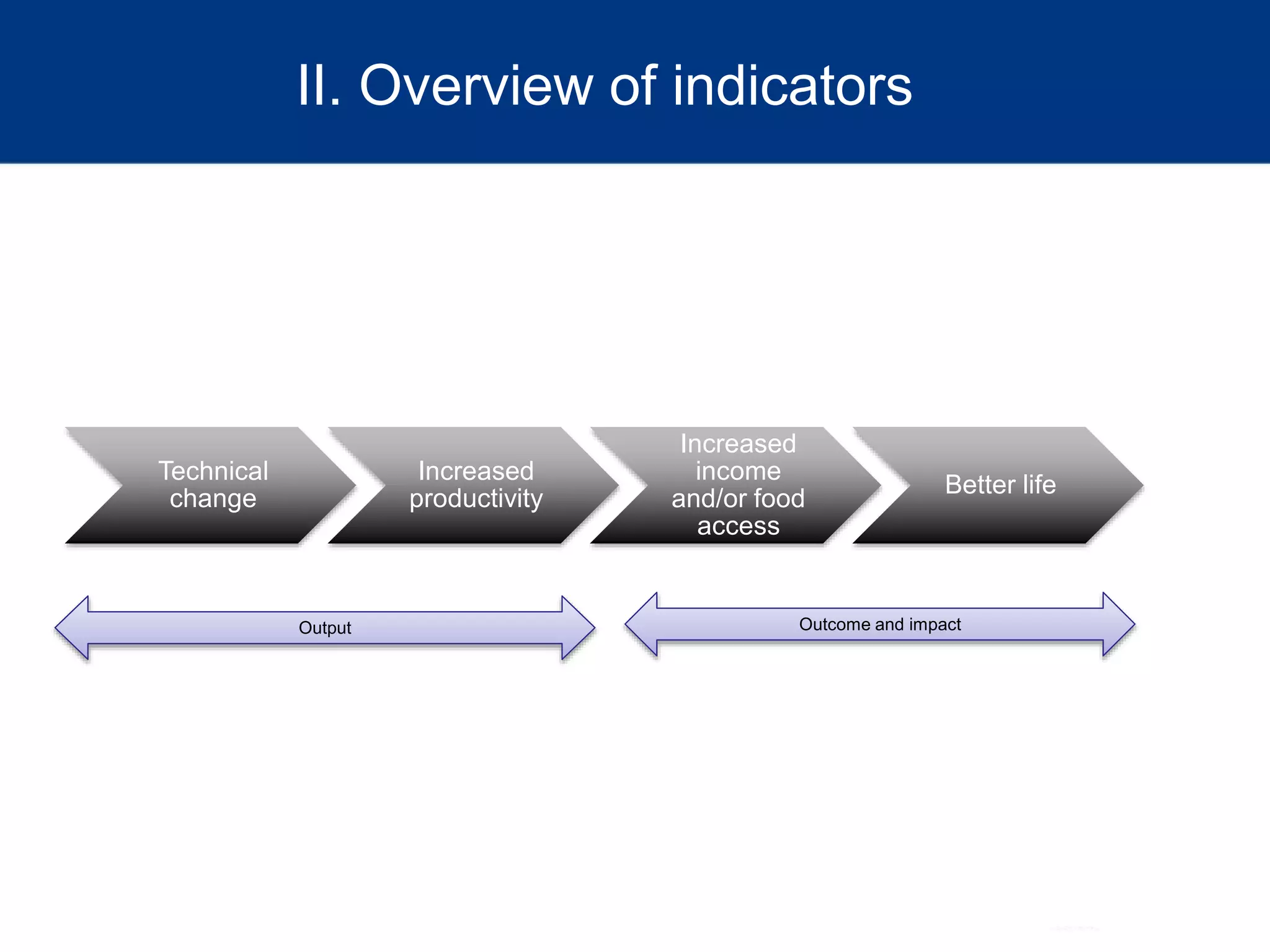
II. Overview of indicators
III. Logframe*
IV. Impact indicators*
* Opportunity for contributions
Links
IFAD Asia and Pacific Region e-
learning on M&E (to be launched
soon)
Gender in Agriculture Sourcebook
(WB, FAO and IFAD)
http://web.worldbank.org/WBSITE/EX
TERNAL/TOPICS/EXTARD/EXTGEN
AGRLIVSOUBOOK/0,,contentMDK:2
1348334~pagePK:64168427~piPK:64
168435~theSitePK:3817359,00.html
Women’s Empowerment in
Agriculture Index (WEAI)
http://www.ifpri.org/book-
9075/ourwork/program/weai-
resource-center
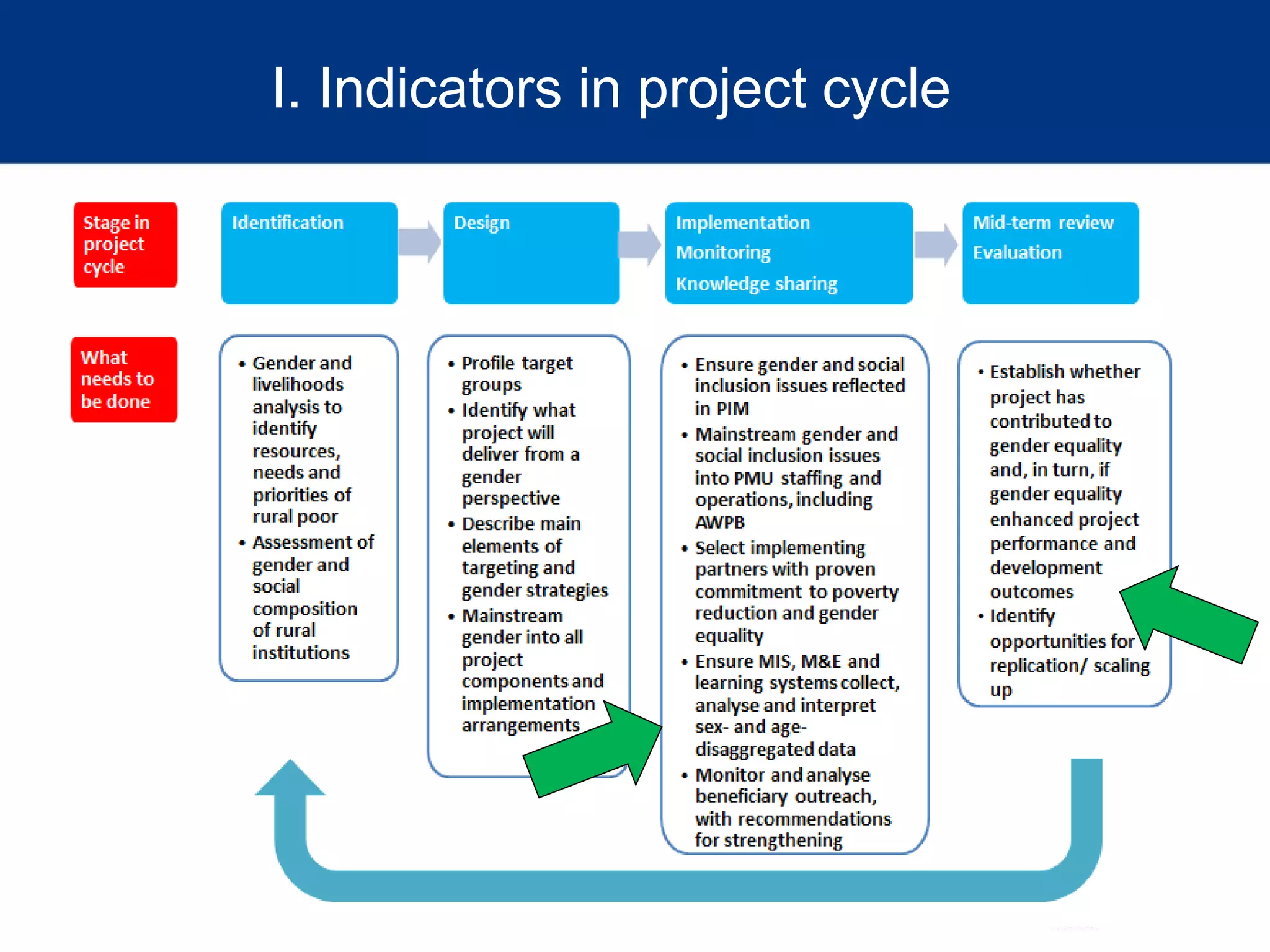
I. Indicators in project cycle
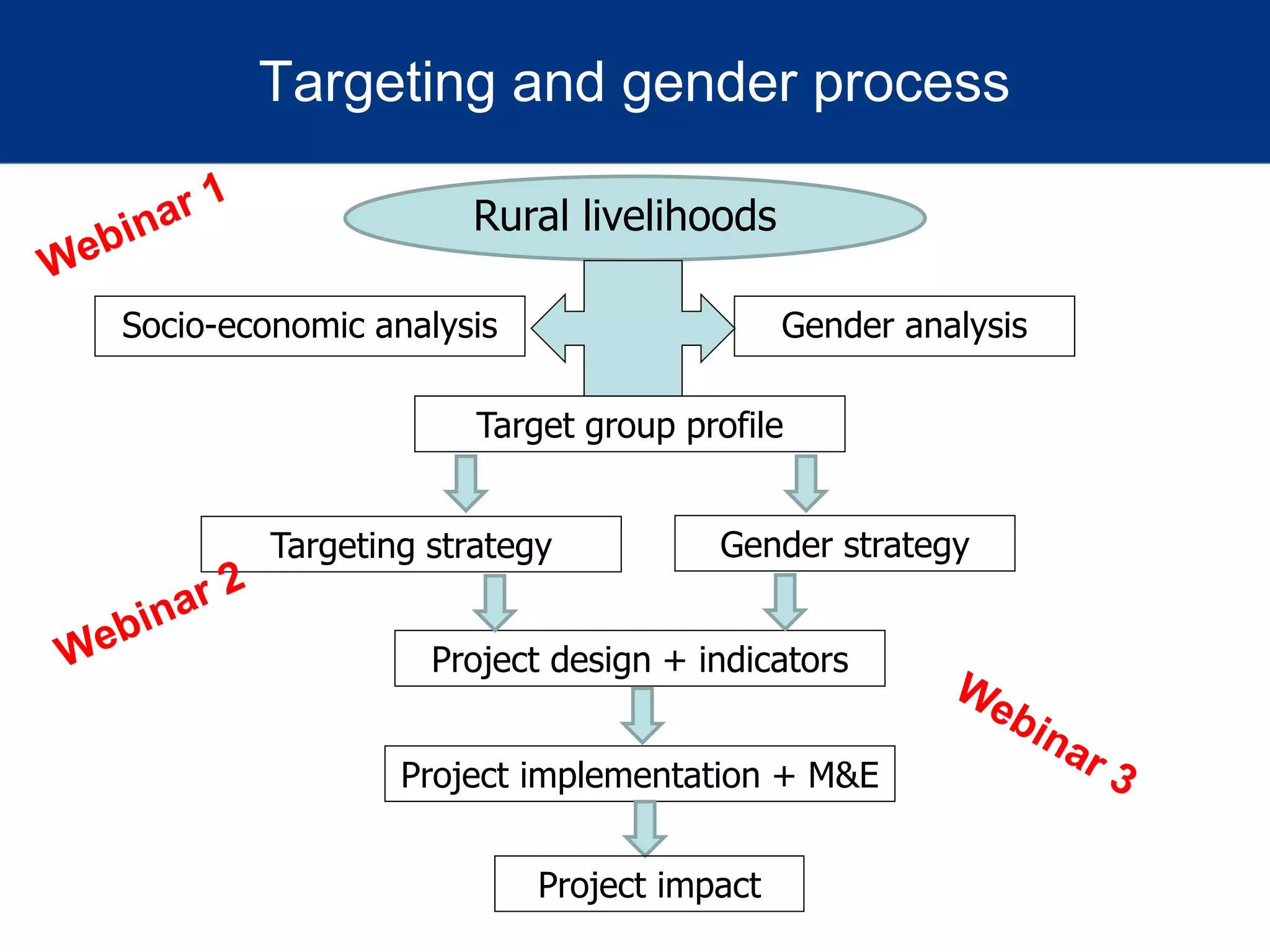
Targeting and gender process
Rural livelihoods
Project design + indicators
Gender strategyTargeting strategy
Project implementation + M&E
Project impact
Gender analysisSocio-economic analysis
Target group profile
II. Overview of indicators
Technical
change
Increased
productivity
Increased
income
and/or food
access
Better life
Output Outcome and impact
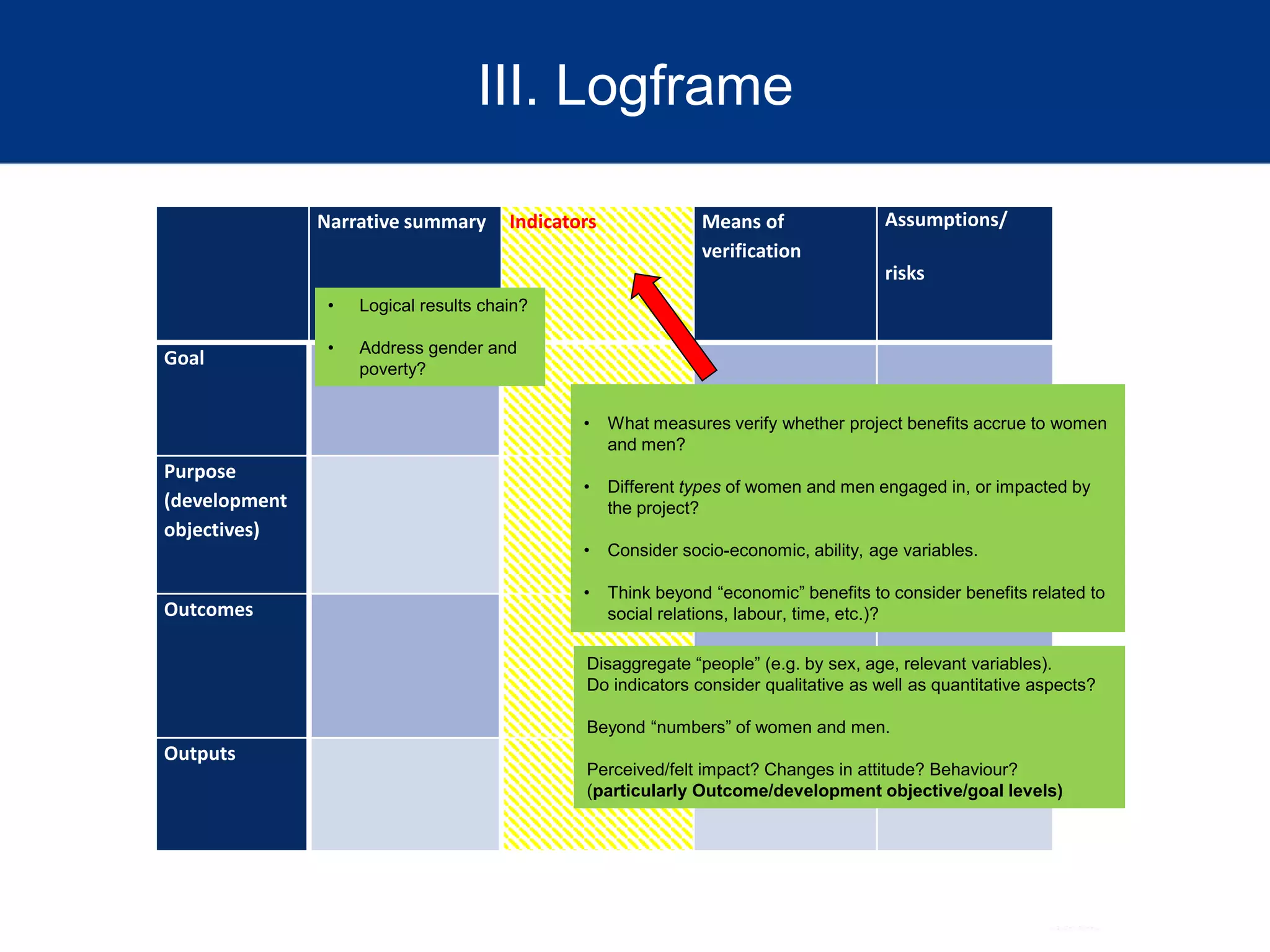
III. Logframe
Narrative summary Indicators Means of
verification
Assumptions/
risks
Goal
Purpose
(development
objectives)
Outcomes
Outputs
• Logical results chain?
• Address gender and
poverty?
Disaggregate “people” (e.g. by sex, age, relevant variables).
Do indicators consider qualitative as well as quantitative aspects?
Beyond “numbers” of women and men.
Perceived/felt impact? Changes in attitude? Behaviour?
(particularly Outcome/development objective/goal levels)
• What measures verify whether project benefits accrue to women
and men?
• Different types of women and men engaged in, or impacted by
the project?
• Consider socio-economic, ability, age variables.
• Think beyond “economic” benefits to consider benefits related to
social relations, labour, time, etc.)?
Formulating gender-sensitive indicators
• Yes, SMART, but also:
• Address diversity
- disaggregate by sex, age, socio-economic group, etc.
• Is GE, WE being measured? (reference IFAD Policy)
• Anchor in agreed conventions, rights (e.g. CEDAW)
• Suitable? Consult stakeholders in formulating, choosing
indicators
• Clarify concepts, definitions
• Mix of quantitative and qualitative
• Prioritize
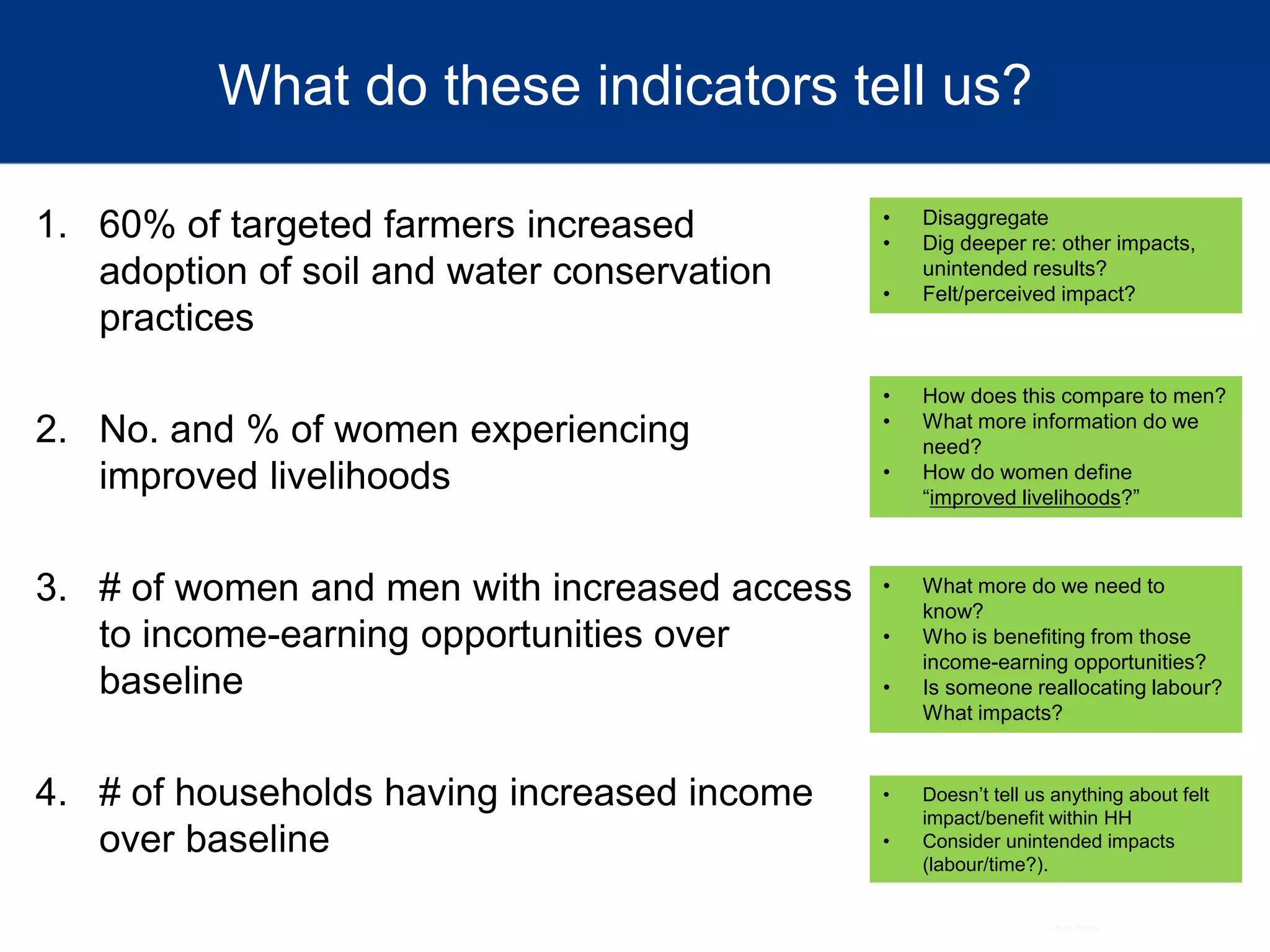
What do these indicators tell us?
1. 60% of targeted farmers increased
adoption of soil and water conservation
practices
2. No. and % of women experiencing
improved livelihoods
3. # of women and men with increased access
to income-earning opportunities over
baseline
4. # of households having increased income
over baseline
• Disaggregate
• Dig deeper re: other impacts,
unintended results?
• Felt/perceived impact?
• How does this compare to men?
• What more information do we
need?
• How do women define
“improved livelihoods?”
• What more do we need to
know?
• Who is benefiting from those
income-earning opportunities?
• Is someone reallocating labour?
What impacts?
• Doesn’t tell us anything about felt
impact/benefit within HH
• Consider unintended impacts
(labour/time?).
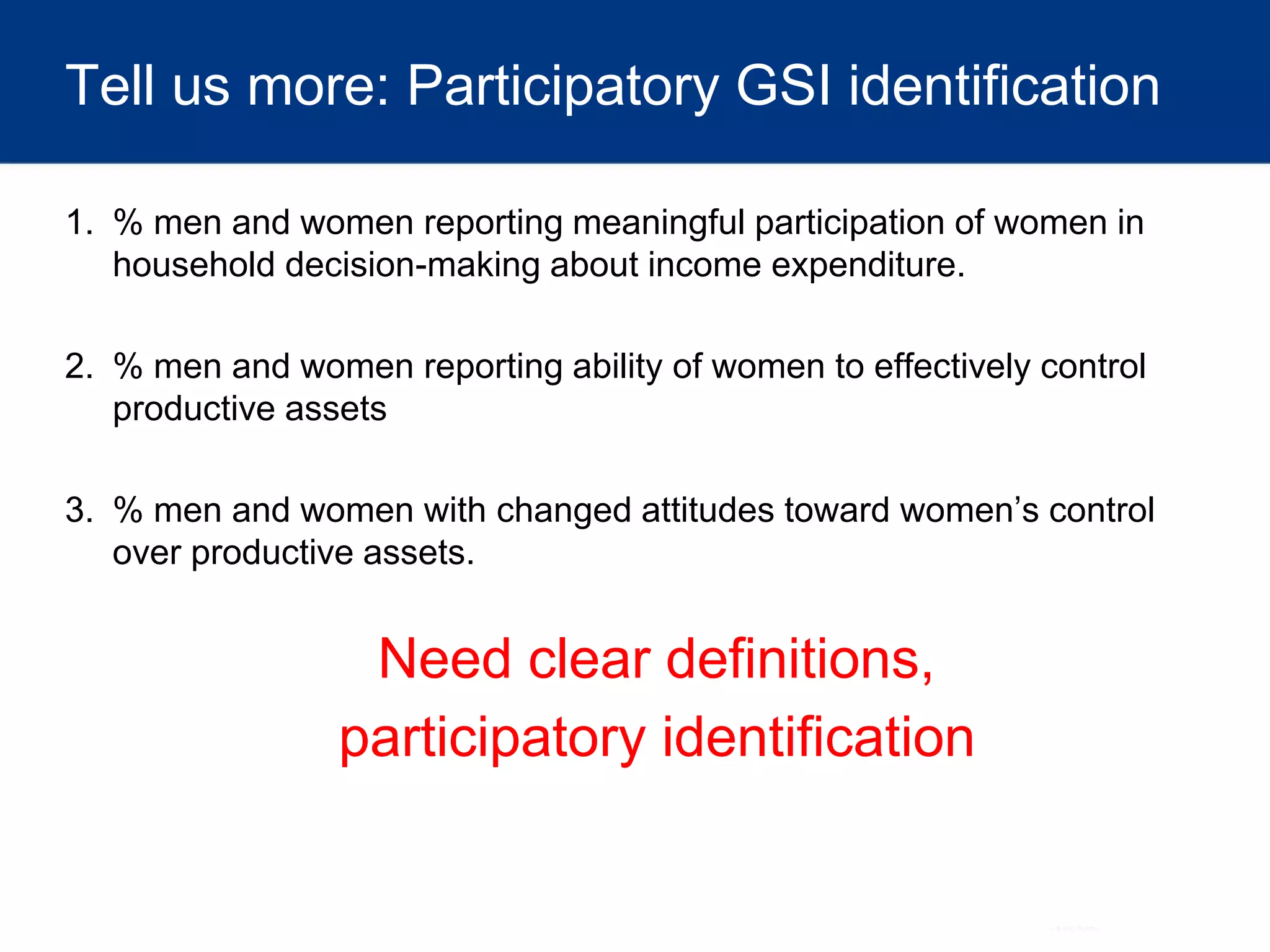
Tell us more: Participatory GSI identification
1. % men and women reporting meaningful participation of women in
household decision-making about income expenditure.
2. % men and women reporting ability of women to effectively control
productive assets
3. % men and women with changed attitudes toward women’s control
over productive assets.
Need clear definitions,
participatory identification
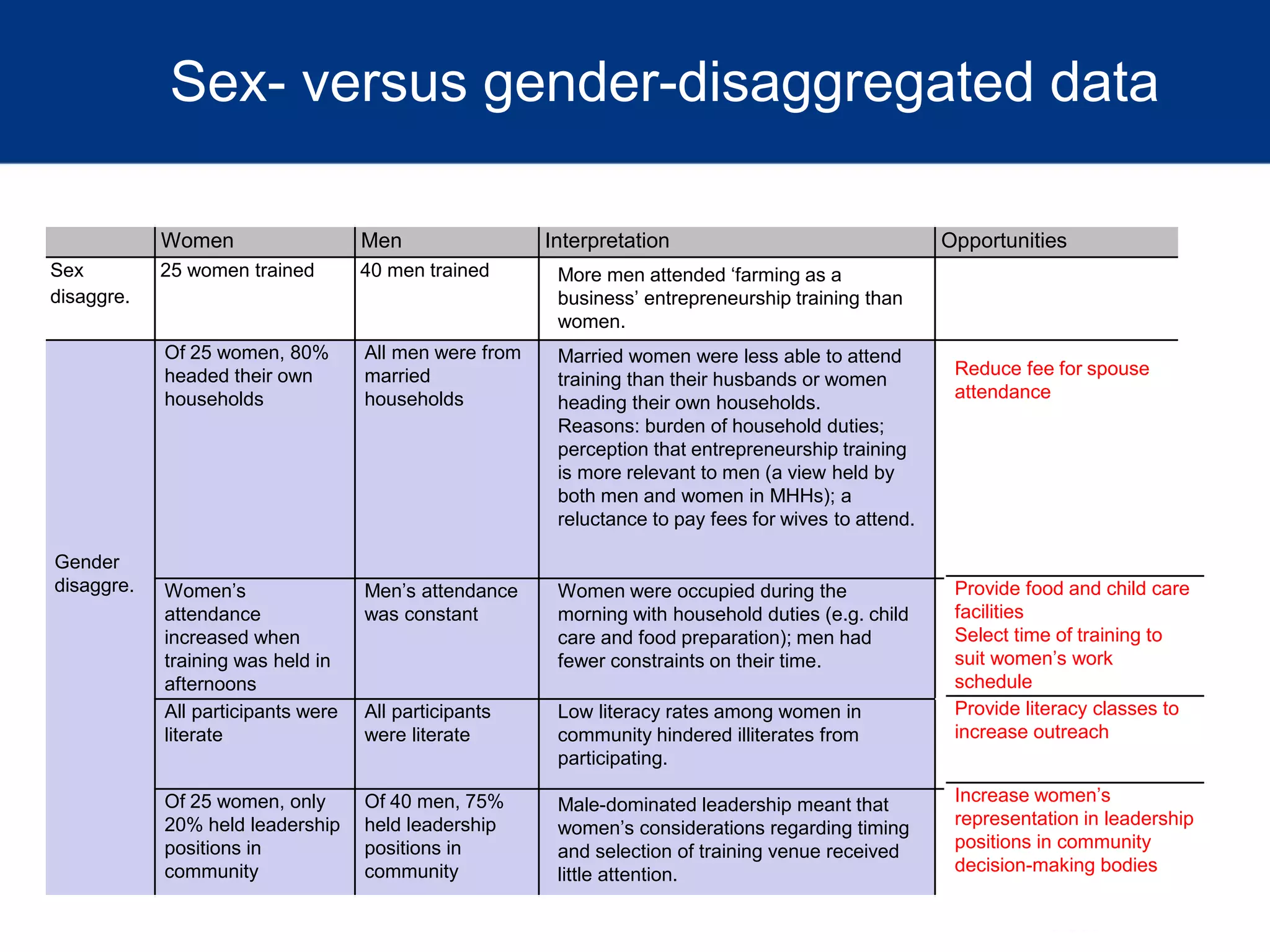
Sex- versus gender-disaggregated data
Women Men Interpretation Opportunities
Sex
disaggre.
25 women trained 40 men trained
Gender
disaggre.
Of 25 women, 80%
headed their own
households
All men were from
married
households
Women’s
attendance
increased when
training was held in
afternoons
Men’s attendance
was constant
All participants were
literate
All participants
were literate
Of 25 women, only
20% held leadership
positions in
community
Of 40 men, 75%
held leadership
positions in
community
Reduce fee for spouse
attendance
Provide food and child care
facilities
Select time of training to
suit women’s work
schedule
Provide literacy classes to
increase outreach
Increase women’s
representation in leadership
positions in community
decision-making bodies
More men attended ‘farming as a
business’ entrepreneurship training than
women.
Married women were less able to attend
training than their husbands or women
heading their own households.
Reasons: burden of household duties;
perception that entrepreneurship training
is more relevant to men (a view held by
both men and women in MHHs); a
reluctance to pay fees for wives to attend.
Women were occupied during the
morning with household duties (e.g. child
care and food preparation); men had
fewer constraints on their time.
Low literacy rates among women in
community hindered illiterates from
participating.
Male-dominated leadership meant that
women’s considerations regarding timing
and selection of training venue received
little attention.
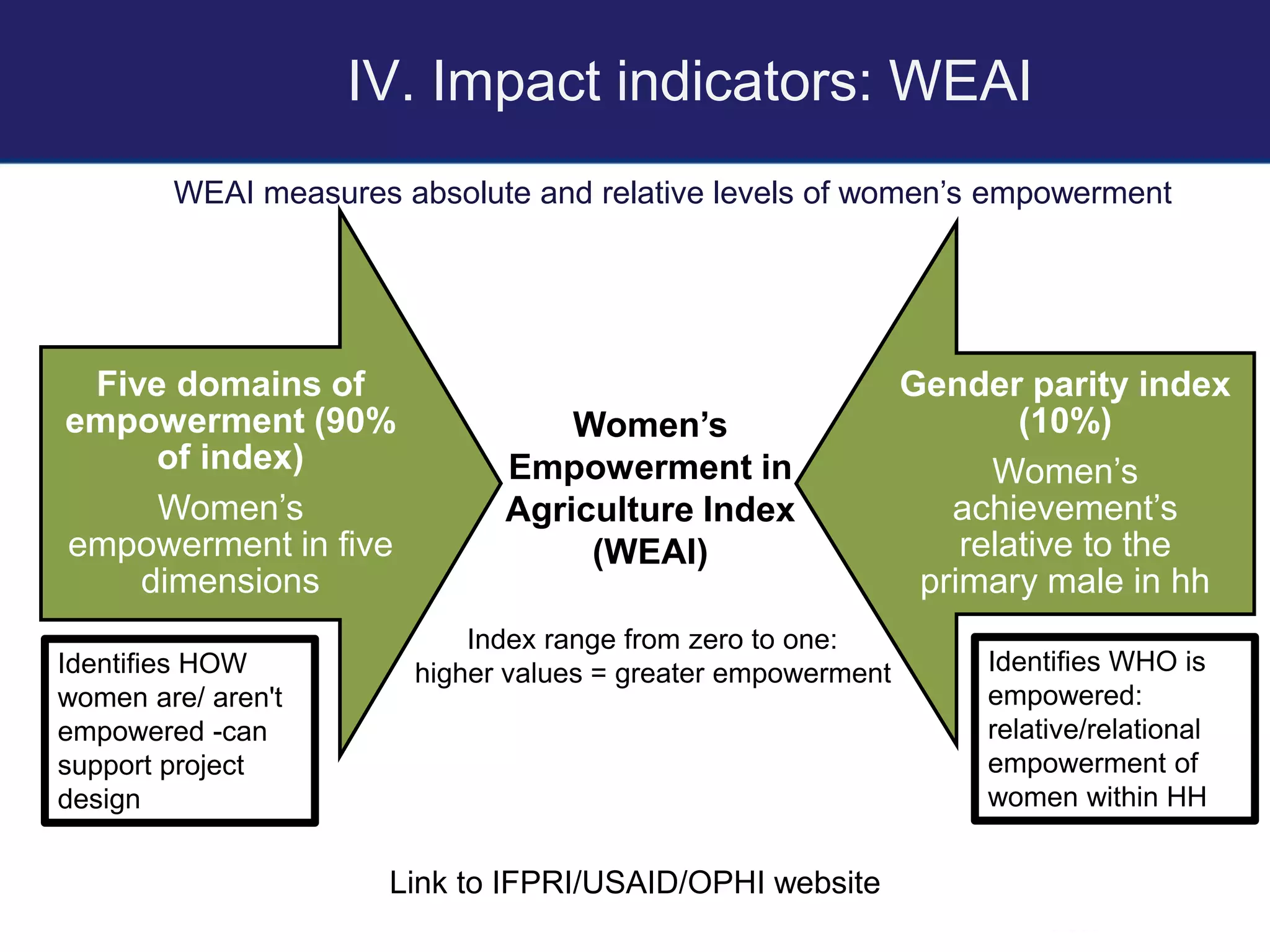
IV. Impact indicators: WEAI
Five domains of
empowerment (90%
of index)
Women’s
empowerment in five
dimensions
Gender parity index
(10%)
Women’s
achievement’s
relative to the
primary male in hh
Women’s
Empowerment in
Agriculture Index
(WEAI)
Index range from zero to one:
higher values = greater empowermentIdentifies HOW
women are/ aren't
empowered -can
support project
design
Identifies WHO is
empowered:
relative/relational
empowerment of
women within HH
WEAI measures absolute and relative levels of women’s empowerment
Link to IFPRI/USAID/OPHI website
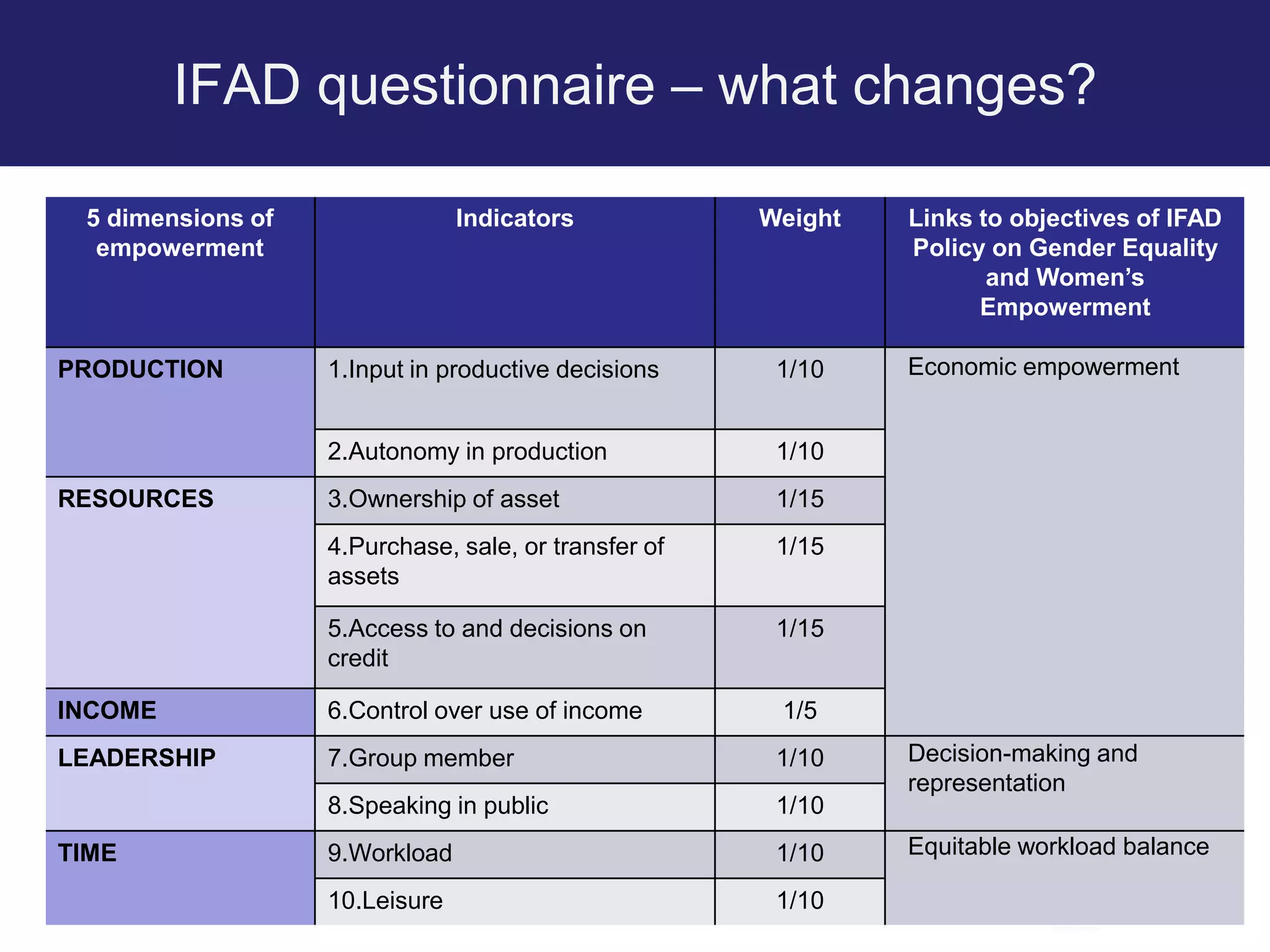
IFAD questionnaire – what changes?
5 dimensions of
empowerment
Indicators Weight Links to objectives of IFAD
Policy on Gender Equality
and Women’s
Empowerment
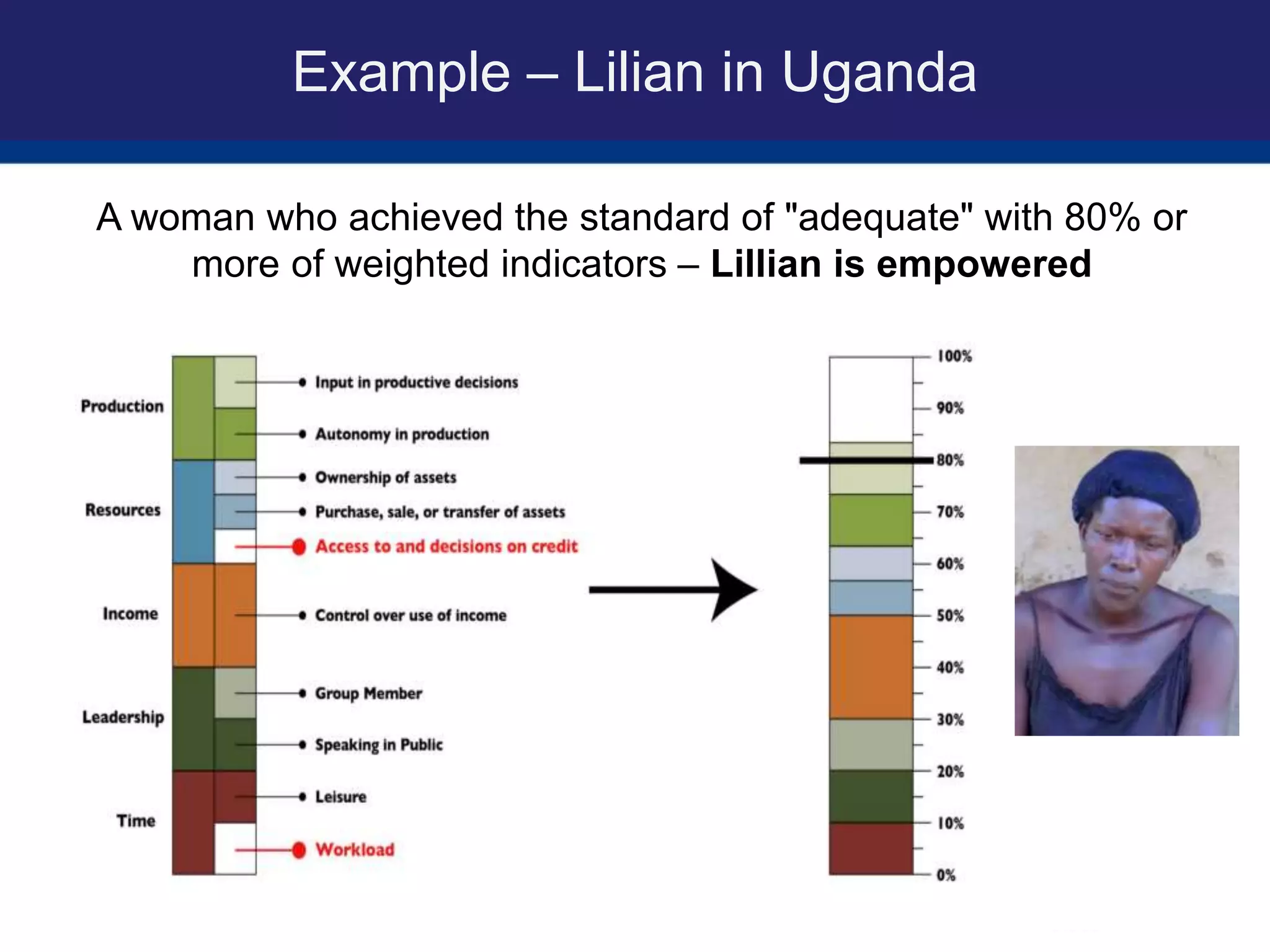
PRODUCTION 1.Input in productive decisions 1/10
2.Autonomy in production 1/10
RESOURCES 3.Ownership of asset 1/15
4.Purchase, sale, or transfer of
assets
1/15
5.Access to and decisions on
credit
1/15
INCOME 6.Control over use of income 1/5
LEADERSHIP 7.Group member 1/10
8.Speaking in public 1/10
TIME 9.Workload 1/10
10.Leisure 1/10
Economic empowerment
Decision-making and
representation
Equitable workload balance
A woman who achieved the standard of "adequate" with 80% or
more of weighted indicators – Lillian is empowered
Example – Lilian in Uganda
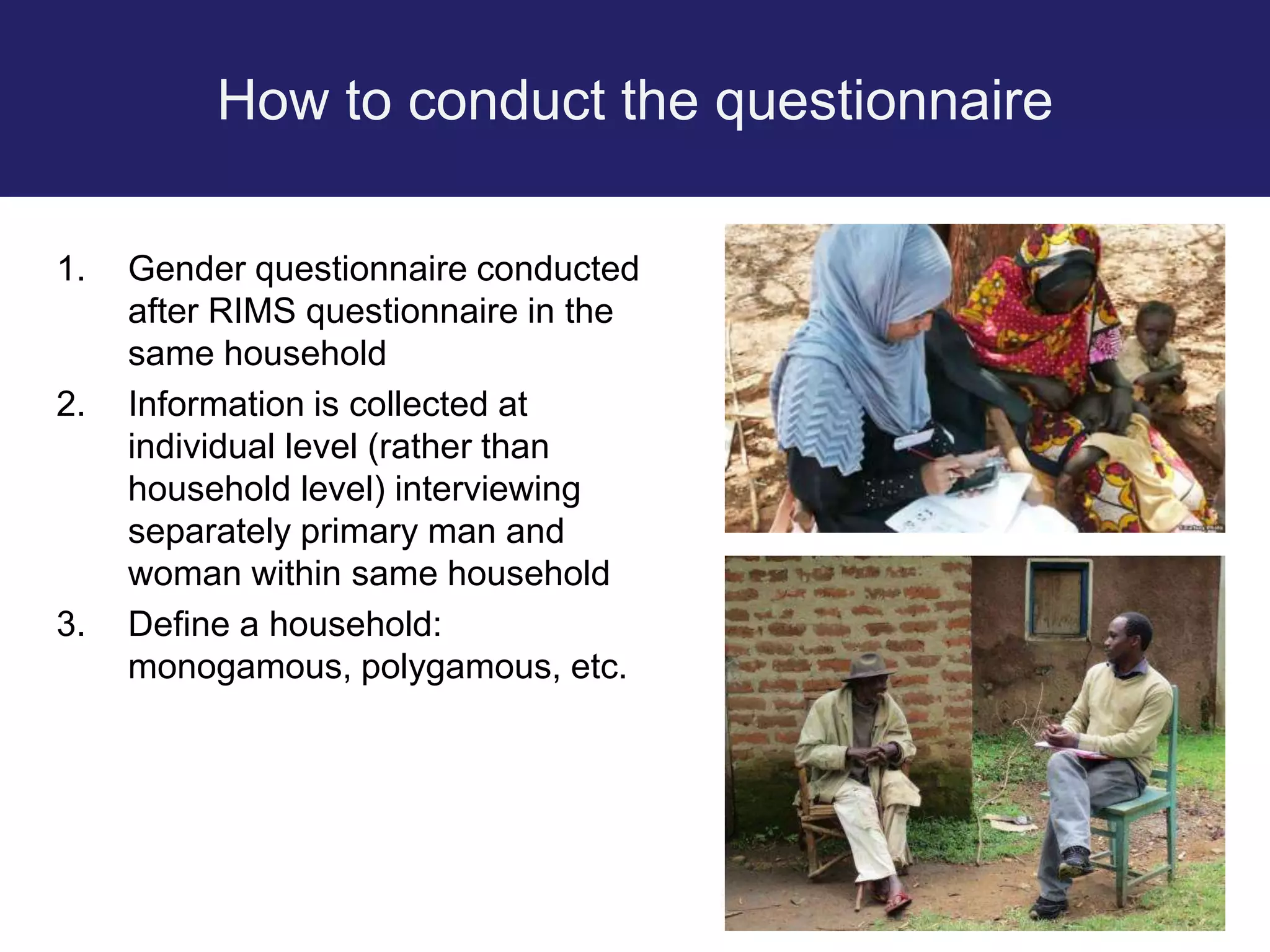
How to conduct the questionnaire
1. Gender questionnaire conducted
after RIMS questionnaire in the
same household
2. Information is collected at
individual level (rather than
household level) interviewing
separately primary man and
woman within same household
3. Define a household:
monogamous, polygamous, etc.
V. Conclusion
Webinar programme
29 April – Livelihoods and gender analysis
20 May – Targeting and gender strategies
17 June – Monitoring and impact indicators
2 July – Gender marker
Recap
I. Indicators in project cycle
II. Overview of indicators
III. Logframe
IV. Impact indicators

IFAD’s Gender and Targeting Webinar Series - Monitoring and impact indicators

  • 1.
    IFAD’s Gender andTargeting Webinar Series Purpose of the webinar series Webinar programme 29 April – Livelihoods and gender analysis 20 May – Targeting and gender strategies 17 June – Monitoring and impact indicators 2 July – Gender marker
  • 2.
    Practical tips ongender-sensitive monitoring and impact indicators Structure I. Indicators in project cycle II. Overview of indicators III. Logframe* IV. Impact indicators* * Opportunity for contributions Links IFAD Asia and Pacific Region e- learning on M&E (to be launched soon) Gender in Agriculture Sourcebook (WB, FAO and IFAD) http://web.worldbank.org/WBSITE/EX TERNAL/TOPICS/EXTARD/EXTGEN AGRLIVSOUBOOK/0,,contentMDK:2 1348334~pagePK:64168427~piPK:64 168435~theSitePK:3817359,00.html Women’s Empowerment in Agriculture Index (WEAI) http://www.ifpri.org/book- 9075/ourwork/program/weai- resource-center
  • 3.
    I. Indicators inproject cycle
  • 4.
    Targeting and genderprocess Rural livelihoods Project design + indicators Gender strategyTargeting strategy Project implementation + M&E Project impact Gender analysisSocio-economic analysis Target group profile
  • 5.
    II. Overview ofindicators Technical change Increased productivity Increased income and/or food access Better life Output Outcome and impact
  • 6.
    III. Logframe Narrative summaryIndicators Means of verification Assumptions/ risks Goal Purpose (development objectives) Outcomes Outputs • Logical results chain? • Address gender and poverty? Disaggregate “people” (e.g. by sex, age, relevant variables). Do indicators consider qualitative as well as quantitative aspects? Beyond “numbers” of women and men. Perceived/felt impact? Changes in attitude? Behaviour? (particularly Outcome/development objective/goal levels) • What measures verify whether project benefits accrue to women and men? • Different types of women and men engaged in, or impacted by the project? • Consider socio-economic, ability, age variables. • Think beyond “economic” benefits to consider benefits related to social relations, labour, time, etc.)?
  • 7.
    Formulating gender-sensitive indicators •Yes, SMART, but also: • Address diversity - disaggregate by sex, age, socio-economic group, etc. • Is GE, WE being measured? (reference IFAD Policy) • Anchor in agreed conventions, rights (e.g. CEDAW) • Suitable? Consult stakeholders in formulating, choosing indicators • Clarify concepts, definitions • Mix of quantitative and qualitative • Prioritize
  • 8.
    What do theseindicators tell us? 1. 60% of targeted farmers increased adoption of soil and water conservation practices 2. No. and % of women experiencing improved livelihoods 3. # of women and men with increased access to income-earning opportunities over baseline 4. # of households having increased income over baseline • Disaggregate • Dig deeper re: other impacts, unintended results? • Felt/perceived impact? • How does this compare to men? • What more information do we need? • How do women define “improved livelihoods?” • What more do we need to know? • Who is benefiting from those income-earning opportunities? • Is someone reallocating labour? What impacts? • Doesn’t tell us anything about felt impact/benefit within HH • Consider unintended impacts (labour/time?).
  • 9.
    Tell us more:Participatory GSI identification 1. % men and women reporting meaningful participation of women in household decision-making about income expenditure. 2. % men and women reporting ability of women to effectively control productive assets 3. % men and women with changed attitudes toward women’s control over productive assets. Need clear definitions, participatory identification
  • 10.
    Sex- versus gender-disaggregateddata Women Men Interpretation Opportunities Sex disaggre. 25 women trained 40 men trained Gender disaggre. Of 25 women, 80% headed their own households All men were from married households Women’s attendance increased when training was held in afternoons Men’s attendance was constant All participants were literate All participants were literate Of 25 women, only 20% held leadership positions in community Of 40 men, 75% held leadership positions in community Reduce fee for spouse attendance Provide food and child care facilities Select time of training to suit women’s work schedule Provide literacy classes to increase outreach Increase women’s representation in leadership positions in community decision-making bodies More men attended ‘farming as a business’ entrepreneurship training than women. Married women were less able to attend training than their husbands or women heading their own households. Reasons: burden of household duties; perception that entrepreneurship training is more relevant to men (a view held by both men and women in MHHs); a reluctance to pay fees for wives to attend. Women were occupied during the morning with household duties (e.g. child care and food preparation); men had fewer constraints on their time. Low literacy rates among women in community hindered illiterates from participating. Male-dominated leadership meant that women’s considerations regarding timing and selection of training venue received little attention.
  • 11.
    IV. Impact indicators:WEAI Five domains of empowerment (90% of index) Women’s empowerment in five dimensions Gender parity index (10%) Women’s achievement’s relative to the primary male in hh Women’s Empowerment in Agriculture Index (WEAI) Index range from zero to one: higher values = greater empowermentIdentifies HOW women are/ aren't empowered -can support project design Identifies WHO is empowered: relative/relational empowerment of women within HH WEAI measures absolute and relative levels of women’s empowerment Link to IFPRI/USAID/OPHI website
  • 12.
    IFAD questionnaire –what changes? 5 dimensions of empowerment Indicators Weight Links to objectives of IFAD Policy on Gender Equality and Women’s Empowerment PRODUCTION 1.Input in productive decisions 1/10 2.Autonomy in production 1/10 RESOURCES 3.Ownership of asset 1/15 4.Purchase, sale, or transfer of assets 1/15 5.Access to and decisions on credit 1/15 INCOME 6.Control over use of income 1/5 LEADERSHIP 7.Group member 1/10 8.Speaking in public 1/10 TIME 9.Workload 1/10 10.Leisure 1/10 Economic empowerment Decision-making and representation Equitable workload balance
  • 13.
    A woman whoachieved the standard of "adequate" with 80% or more of weighted indicators – Lillian is empowered Example – Lilian in Uganda
  • 14.
    How to conductthe questionnaire 1. Gender questionnaire conducted after RIMS questionnaire in the same household 2. Information is collected at individual level (rather than household level) interviewing separately primary man and woman within same household 3. Define a household: monogamous, polygamous, etc.
  • 15.
    V. Conclusion Webinar programme 29April – Livelihoods and gender analysis 20 May – Targeting and gender strategies 17 June – Monitoring and impact indicators 2 July – Gender marker Recap I. Indicators in project cycle II. Overview of indicators III. Logframe IV. Impact indicators

Editor's Notes

  • #13 We tried to increase the importance awarded to non-farming activities, particularly in consideration of the relevance of VCD in IFAD PRODUCTION 1.Input in productive decisions + Autonomy in production Eliminated: Taking crops to the market (or not) Livestock raising Your own (singular) wage or salary employment Major household expenditures (such as a large appliance for the house like refrigerator) LEADERSHIP 7.Group member Less types of groups (G4.05) These were excluded: Mutual help or insurance group (including burial societies) / women’s group; 8.Speaking in public The notion of infrastructure was revised : only productive infrastructure will be considered, such as irrigation schemes, market, infrastructures, roads  Less types of occasions. Excluded: To ensure proper payment of wages for public work or other similar programs? To protest the misbehaviour of authorities or elected officials? To intervene in case of a family dispute? TIME 10.Leisure Leisure activities have been slightly modified” . Original ones were: visiting neighbours, watching TV, listening to radio, seeing movies or doing sports Additional activities have been added: time used to collect water and fuel for the househols