GENDER MAINSTREAMING B R SIWAL NIPCCD NEW DELHI E-MAIL brsiwal@gmail.com
Gender Mainstreaming What is the mainstream? What is being mainstreamed? What does it mean to be part of the mainstream? What is the target of mainstreaming? What is the goal of mainstreaming?   How gender mainstreaming
The concept Gender mainstreaming occurred on  1985  Third World Conference on Women in Nairobi. The idea has been developed in the  United Nations  development community. The idea was formally featured in 1995 on the  Fourth World Conference on Women  in Beijing. Most definitions conform to the UN  Economic and Social Council  formally defined concept:
Gender mainstreaming *is the process of assessing the implications for women and men of any planned action, including  legislation ,  policies  or  programmes , in all areas and at all levels   *Is a globally accepted strategy for  promoting gender equality
Mainstreaming * Maistreaming  is not an end in  itself but  a strategy, an approach , a means to achieve the goal of gender equality. *Mainstreaming involves ensuring that gender perspectives and attention to the goal of gender equality are central to all activities -  policy development, research, advocacy/ dialogue, legislation, resource allocation, and planning, implementation and monitoring  of programmes and projects
Gender mainstreaming: Is a pro-active process designed to tackle inequalities which can and do discriminate against either sex Targets major economic and social policies that deliver major resources Makes good economic sense ensuring that women as well as men are active, using 100% of the productive labour force Represents a further step in the search for equality Recognises that gender is one of the most fundamental organising features in society and affects our lives from the moment we are born
Recognises that differences exist in men’s and women’s lives and therefore our needs, experiences and priorities are different Involves a willingness to establish a balanced distribution of responsibilities between women and men  Needs determined political action and support with clear indicators and targets Will not happen overnight, it is a continuous process
Gender mainstreaming means : That differences between women and men may never be used as a ground for discrimination Long-lasting changes in society, transforming parental roles, family structures, and the organisation of work, time and even institutional practices Reshaping the mainstream rather than adding activities for women at the margins
A partnership between women and men to ensure both participate fully in society’s development and benefit equally from society’s resources Responding to the root causes of inequality and putting remedial action in place  Ensuring that initiatives not only respond to gender differences but seek to reduce gender inequality
Gender mainstreaming is not: A Women only issue It is not just about improving access or of balancing the statistics About having well written statements About blaming anybody for the inequalities which exist About only women taking action About only women benefiting from it About stopping or replacing gender specific policies and projects targeted at either women or men
Gender mainstreaming covers: policy design decision-making access to resources procedures and practices methodology implementation monitoring and evaluation
Why Gender Mainstreaming? Shift in understanding of the problem Recognition that gender equality is integral to development goals Realization that previous approaches were not resulting in real change in the position of women and gender equality
Shift In Understanding Of The Problem Early   Approaches Current   Thinking Analysis: women left out women lack: education training credit self-esteem Analysis: social structures and processes recreate inequalities between women and men in: resources opportunities decision-making Problem:   women Problem :  inequality between women and men Approach:  women must change their attributes to be integrated into development Approach: society and institutions must change ideas and practices in support of equal choices and opportunities
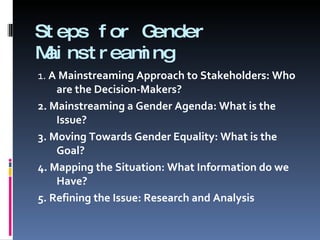
Steps for Gender  Mainstreaming 1.  A Mainstreaming Approach to Stakeholders: Who are the Decision-Makers?  2. Mainstreaming a Gender Agenda: What is the Issue?  3. Moving Towards Gender Equality: What is the Goal?  4. Mapping the Situation: What Information do we Have?  5. Refining the Issue: Research and Analysis
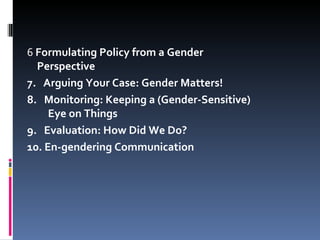
6  Formulating Policy from a Gender Perspective  7.  Arguing Your Case: Gender Matters!  8.  Monitoring: Keeping a (Gender-Sensitive)    Eye on Things  9.  Evaluation: How Did We Do?  10. En-gendering Communication
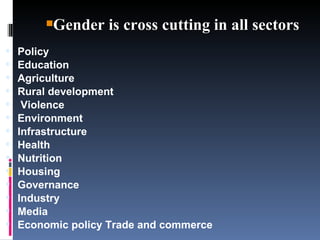
Policy Education Agriculture  Rural development Violence Environment Infrastructure  Health Nutrition Housing Governance Industry Media Economic policy Trade and commerce  Gender is cross cutting in all sectors
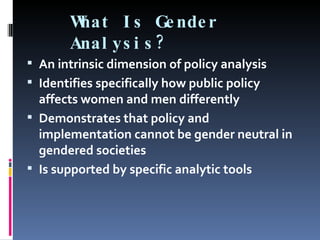
What Is Gender Analysis? An intrinsic dimension of policy analysis Identifies specifically how public policy affects women and men differently Demonstrates that policy and implementation cannot be gender neutral in gendered societies Is supported by specific analytic tools
What Competencies Are Required To Undertake Gender Analysis? Familiarity with main Gender Analysis Frameworks Ability to select the Framework most likely to yield solutions to the development problem to be addressed Able to interpret data Able to use strategic decision-making skills
GENDER ANALYSIS (GA) IS A PROCESS TO ASSESS THE  – Differential impact of proposed or existing policies, programmes, projects and legislation on women and men.  Gender analysis recognizes that realities of men’s and women’s lives are different and that equal opportunities does not necessarily men equal results. Gender analysis is a basis of all tools of gender mainstreaming.
Gender Analysis Frameworks Harvard Analytical Framework  DPU   Frameworks a) Moser (triple roles) Framework b) Levy (web of institutionalisation) Framework Gender Analysis Matrix (GAM) Equality and Empowerment Framework (Longwe) Capacities and Vulnerabilities Framework (CVA) People Oriented Framework (POP) Social Relations Approach Framework (SRA)
HARVARD FRAMEWORK OF GENDER ANALYSIS 1. Activity profile - based on gender division of labour and delineates the economic activities of pop by sex, age and other factors and time spent on economic activities. 2. Access and control profile- which identify individuals by sex have access and control over resources, services and benefits.
3. Factors influencing access and control - factors affecting access and control e.G. Social, cultural, economic in relation to gender. 4. Project cycle analysis - examine a project proposal or area of intervention in the light of gender - disaggregated data, information and social change.
HARVARD METHOD OF PROJECT CYCLE (CHECKLIST) I. PROJECT PLANNING Assessing women’s needs What needs and opportunities exist for increasing women’s participation and/or  Women’s access and control of resources, services and benefits?
Whether objectives adequately reflect women’s needs? II PROJECT IMPLEMENTATION Are project personnel sufficiently aware and sensitive towards women’s needs? Are women involved in delivery of goods and services?
Do personnel have specific skills? What training techniques will be used? Are there appropriate opportunities for women to participate in project management?
ORGANISATIONAL STRUCTURE DOES THE ORGANISATION Enhance women’s access and control of resources? Have adequate resources? Have capabilities to support and protect women during the process of change? Have delivery channel accessible?
Whether time and location suitable for women? Have management information system (MIS)? Have flexibility to meet changing requirements? Have women participated in setting objectives?
Is there any missed opportunity for women? Have there been earlier efforts and lesson learnt? Project impact on women How project affect women’s status responsibilities and role in society? Is planned change feasable and sustainable?
PRACTICAL AND STRATEGIC GENDER NEEDS(Moser method) Strategic Gender Needs (SGN) SGN relates to subordinate position of  women in society. SGN relate to gender division  of labour, power, control and issues like legal  rights over bodies oppression - SGN challenge  subordinate position  by assisting women to  achieve greater equality and changing existing  roles.
PRACTICAL GENDER NEEDS (PGN) PGN are the needs women identify in their  socially accepted role in society.  PGN do not  challenge gender division of labour or  subordination.  PGN are a response of immediate  necessity.  PGN relates to health, education,  nutrition, fuel, employment, credit, other  support services.
METHODOLOGICAL TOOLS FOR GENDER PLANNING 1. Gender roles and their identification - Gender relation - Division of labour 2. Intra-household resource allocation - Control over resources - Power of decision making
3 . Gender needs assessment - Practical gender needs - Strategic gender needs 4. Balancing roles and linkage with competitive demands between - Productive - Reproductive - Household management
5. Relationship between roles and needs 6. Equality between men and women
Thank you

Gender Mainstreaming And Planning

  • 1.
    GENDER MAINSTREAMING BR SIWAL NIPCCD NEW DELHI E-MAIL brsiwal@gmail.com
  • 2.
    Gender Mainstreaming Whatis the mainstream? What is being mainstreamed? What does it mean to be part of the mainstream? What is the target of mainstreaming? What is the goal of mainstreaming? How gender mainstreaming
  • 3.
    The concept Gendermainstreaming occurred on 1985 Third World Conference on Women in Nairobi. The idea has been developed in the United Nations development community. The idea was formally featured in 1995 on the Fourth World Conference on Women in Beijing. Most definitions conform to the UN Economic and Social Council formally defined concept:
  • 4.
    Gender mainstreaming *isthe process of assessing the implications for women and men of any planned action, including legislation , policies or programmes , in all areas and at all levels *Is a globally accepted strategy for promoting gender equality
  • 5.
    Mainstreaming * Maistreaming is not an end in itself but a strategy, an approach , a means to achieve the goal of gender equality. *Mainstreaming involves ensuring that gender perspectives and attention to the goal of gender equality are central to all activities - policy development, research, advocacy/ dialogue, legislation, resource allocation, and planning, implementation and monitoring of programmes and projects
  • 6.
    Gender mainstreaming: Isa pro-active process designed to tackle inequalities which can and do discriminate against either sex Targets major economic and social policies that deliver major resources Makes good economic sense ensuring that women as well as men are active, using 100% of the productive labour force Represents a further step in the search for equality Recognises that gender is one of the most fundamental organising features in society and affects our lives from the moment we are born
  • 7.
    Recognises that differencesexist in men’s and women’s lives and therefore our needs, experiences and priorities are different Involves a willingness to establish a balanced distribution of responsibilities between women and men Needs determined political action and support with clear indicators and targets Will not happen overnight, it is a continuous process
  • 8.
    Gender mainstreaming means: That differences between women and men may never be used as a ground for discrimination Long-lasting changes in society, transforming parental roles, family structures, and the organisation of work, time and even institutional practices Reshaping the mainstream rather than adding activities for women at the margins
  • 9.
    A partnership betweenwomen and men to ensure both participate fully in society’s development and benefit equally from society’s resources Responding to the root causes of inequality and putting remedial action in place Ensuring that initiatives not only respond to gender differences but seek to reduce gender inequality
  • 10.
    Gender mainstreaming isnot: A Women only issue It is not just about improving access or of balancing the statistics About having well written statements About blaming anybody for the inequalities which exist About only women taking action About only women benefiting from it About stopping or replacing gender specific policies and projects targeted at either women or men
  • 11.
    Gender mainstreaming covers:policy design decision-making access to resources procedures and practices methodology implementation monitoring and evaluation
  • 12.
    Why Gender Mainstreaming?Shift in understanding of the problem Recognition that gender equality is integral to development goals Realization that previous approaches were not resulting in real change in the position of women and gender equality
  • 13.
    Shift In UnderstandingOf The Problem Early Approaches Current Thinking Analysis: women left out women lack: education training credit self-esteem Analysis: social structures and processes recreate inequalities between women and men in: resources opportunities decision-making Problem: women Problem : inequality between women and men Approach: women must change their attributes to be integrated into development Approach: society and institutions must change ideas and practices in support of equal choices and opportunities
  • 14.
    Steps for Gender Mainstreaming 1. A Mainstreaming Approach to Stakeholders: Who are the Decision-Makers? 2. Mainstreaming a Gender Agenda: What is the Issue? 3. Moving Towards Gender Equality: What is the Goal? 4. Mapping the Situation: What Information do we Have? 5. Refining the Issue: Research and Analysis
  • 15.
    6 FormulatingPolicy from a Gender Perspective 7. Arguing Your Case: Gender Matters! 8. Monitoring: Keeping a (Gender-Sensitive) Eye on Things 9. Evaluation: How Did We Do? 10. En-gendering Communication
  • 16.
    Policy Education Agriculture Rural development Violence Environment Infrastructure Health Nutrition Housing Governance Industry Media Economic policy Trade and commerce Gender is cross cutting in all sectors
  • 17.
    What Is GenderAnalysis? An intrinsic dimension of policy analysis Identifies specifically how public policy affects women and men differently Demonstrates that policy and implementation cannot be gender neutral in gendered societies Is supported by specific analytic tools
  • 18.
    What Competencies AreRequired To Undertake Gender Analysis? Familiarity with main Gender Analysis Frameworks Ability to select the Framework most likely to yield solutions to the development problem to be addressed Able to interpret data Able to use strategic decision-making skills
  • 19.
    GENDER ANALYSIS (GA)IS A PROCESS TO ASSESS THE – Differential impact of proposed or existing policies, programmes, projects and legislation on women and men. Gender analysis recognizes that realities of men’s and women’s lives are different and that equal opportunities does not necessarily men equal results. Gender analysis is a basis of all tools of gender mainstreaming.
  • 20.
    Gender Analysis FrameworksHarvard Analytical Framework DPU Frameworks a) Moser (triple roles) Framework b) Levy (web of institutionalisation) Framework Gender Analysis Matrix (GAM) Equality and Empowerment Framework (Longwe) Capacities and Vulnerabilities Framework (CVA) People Oriented Framework (POP) Social Relations Approach Framework (SRA)
  • 21.
    HARVARD FRAMEWORK OFGENDER ANALYSIS 1. Activity profile - based on gender division of labour and delineates the economic activities of pop by sex, age and other factors and time spent on economic activities. 2. Access and control profile- which identify individuals by sex have access and control over resources, services and benefits.
  • 22.
    3. Factors influencingaccess and control - factors affecting access and control e.G. Social, cultural, economic in relation to gender. 4. Project cycle analysis - examine a project proposal or area of intervention in the light of gender - disaggregated data, information and social change.
  • 23.
    HARVARD METHOD OFPROJECT CYCLE (CHECKLIST) I. PROJECT PLANNING Assessing women’s needs What needs and opportunities exist for increasing women’s participation and/or Women’s access and control of resources, services and benefits?
  • 24.
    Whether objectives adequatelyreflect women’s needs? II PROJECT IMPLEMENTATION Are project personnel sufficiently aware and sensitive towards women’s needs? Are women involved in delivery of goods and services?
  • 25.
    Do personnel havespecific skills? What training techniques will be used? Are there appropriate opportunities for women to participate in project management?
  • 26.
    ORGANISATIONAL STRUCTURE DOESTHE ORGANISATION Enhance women’s access and control of resources? Have adequate resources? Have capabilities to support and protect women during the process of change? Have delivery channel accessible?
  • 27.
    Whether time andlocation suitable for women? Have management information system (MIS)? Have flexibility to meet changing requirements? Have women participated in setting objectives?
  • 28.
    Is there anymissed opportunity for women? Have there been earlier efforts and lesson learnt? Project impact on women How project affect women’s status responsibilities and role in society? Is planned change feasable and sustainable?
  • 29.
    PRACTICAL AND STRATEGICGENDER NEEDS(Moser method) Strategic Gender Needs (SGN) SGN relates to subordinate position of women in society. SGN relate to gender division of labour, power, control and issues like legal rights over bodies oppression - SGN challenge subordinate position by assisting women to achieve greater equality and changing existing roles.
  • 30.
    PRACTICAL GENDER NEEDS(PGN) PGN are the needs women identify in their socially accepted role in society. PGN do not challenge gender division of labour or subordination. PGN are a response of immediate necessity. PGN relates to health, education, nutrition, fuel, employment, credit, other support services.
  • 31.
    METHODOLOGICAL TOOLS FORGENDER PLANNING 1. Gender roles and their identification - Gender relation - Division of labour 2. Intra-household resource allocation - Control over resources - Power of decision making
  • 32.
    3 . Genderneeds assessment - Practical gender needs - Strategic gender needs 4. Balancing roles and linkage with competitive demands between - Productive - Reproductive - Household management
  • 33.
    5. Relationship betweenroles and needs 6. Equality between men and women
  • 34.