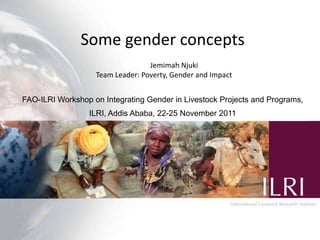
Some gender concepts
                                  Jemimah Njuki
                   Team Leader: Poverty, Gender and Impact


FAO-ILRI Workshop on Integrating Gender in Livestock Projects and Programs,
                 ILRI, Addis Ababa, 22-25 November 2011
Key Concepts
Gender
• Refers to the socially constructed roles and status of
  women and men, girls and boys. It is a set of
  culturally specific characteristics defining the social
  behaviour of women and men, boys and girls, and
  the relationships between them.

• Gender roles, status and relations vary according to
  place (countries, regions, and villages), groups (class,
  ethnic, religious, caste), generations and stages of
  the lifecycle of individuals.

• Gender is, thus, not about women but about the
  relationship between women and men.
Gender equality
• Entails the concept that all human beings, both men
  and women, are free to develop their personal
  abilities and make choices without the limitations
  set by stereotypes, rigid gender roles, or prejudices.

• Gender equality means that the different
  behaviours, aspirations and needs of women and
  men are considered, valued and favoured equally.

• It does not mean that women and men have to
  become the same, but that their rights,
  responsibilities and opportunities will not depend
  on whether they are born male or female.
Gender equity
• Means fairness of treatment for women and
  men, according to their respective needs.

• This may include equal treatment or treatment
  that is different but considered equivalent in
  terms of rights, benefits, obligations and
  opportunities.

• In the development context, a gender equity
  goal often requires built-in measures to
  compensate for the historical and social
  disadvantages of women.
Gender analysis
• Is a tool /set of tools to assist in strengthening development
  planning, implementation, monitoring and evaluation, and
  to make programmes and projects more efficient and
  relevant.

• Gender analysis should go beyond cataloguing differences
  to identifying inequalities and assessing relationships
  between women and men.

• Gender analysis helps us to frame questions about women
  and men's roles and relations in order to avoid making
  assumptions about who does what, when and why.

• The aim of such analysis is to formulate development
  interventions that are better targeted to meet both
  women's and men's needs and constraints.
Empowerment
• Implies people – both women and men – taking
  control over their lives by setting their own
  agendas, gaining skills (or having their own skills
  and knowledge recognized), increasing their self-
  confidence, solving problems, and developing
  self-reliance.

• It is both a process and an outcome.

• Empowerment implies an expansion in women's
  ability to make strategic life choices in a context
  where this ability was previously denied to them.
Gender mainstreaming
• Is a strategy for making women's, as well
  as men's, concerns and experiences an
  integral dimension in the design,
  implementation, monitoring and
  evaluation of policies and programmes in
  all political, economic and social spheres so
  that women and men benefit equally and
  inequality is not perpetuated.

• The ultimate goal is to achieve gender
  equality
Approaches
• Gender-neutral approaches do not account for the
  differences between women and men and do not consider
  how women and men may be marginalized and harmed or
  may not benefit from research, programs and policy.

• Gender aware (or responsive) approaches are designed to
  meet both women’s and men’s needs. These approaches
  ensure that both women and men will benefit, and neither
  will be harmed by research, programs and policy, such as,
  for example, by exacerbating their work burdens.

• Gender transformative approaches actively strive to
  examine, question, and change rigid gender norms and the
  imbalance of power as a means of achieving development
  goals as well as meeting gender equity objectives. These
  research, programmatic and policy approaches challenge
  the distribution of resources and allocation of duties
  between men and women.
Why Gender: The Business Case for Gender
            Mainstreaming
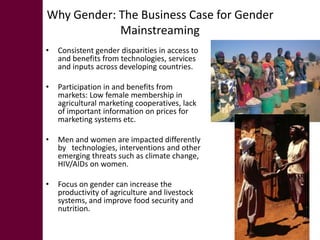
•   Consistent gender disparities in access to
    and benefits from technologies, services
    and inputs across developing countries.

•   Participation in and benefits from
    markets: Low female membership in
    agricultural marketing cooperatives, lack
    of important information on prices for
    marketing systems etc.

•   Men and women are impacted differently
    by technologies, interventions and other
    emerging threats such as climate change,
    HIV/AIDs on women.

•   Focus on gender can increase the
    productivity of agriculture and livestock
    systems, and improve food security and
    nutrition.
The Business Case for Gender Mainstreaming
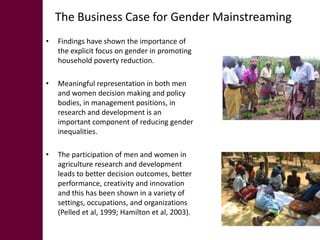
•   Findings have shown the importance of
    the explicit focus on gender in promoting
    household poverty reduction.

•   Meaningful representation in both men
    and women decision making and policy
    bodies, in management positions, in
    research and development is an
    important component of reducing gender
    inequalities.

•   The participation of men and women in
    agriculture research and development
    leads to better decision outcomes, better
    performance, creativity and innovation
    and this has been shown in a variety of
    settings, occupations, and organizations
    (Pelled et al, 1999; Hamilton et al, 2003).
 The potential gains from reducing gender disparities
•   If women had the same resources as men, they could increase
    yields on their farms by 20-30%
      – raise agricultural output by 2.5-4% and reduce hungry people
        by 100-150 million (FAO, 2011)


•   There is evidence that income under the control of women is more
    likely to be used to improve family welfare
     – women spend upto 90% of their income on their families,
          while men spend 30-40%
     – strengthening marital bargaining power and "voice" within the
          household decision-making


 Extent of gender mainstreaming /integration in agriculture
  research and development programs remains adhoc
     – There is no evidence on what potential entry points bring the
       most benefits or catalyse change

Some gender concepts

  • 1.
    Some gender concepts Jemimah Njuki Team Leader: Poverty, Gender and Impact FAO-ILRI Workshop on Integrating Gender in Livestock Projects and Programs, ILRI, Addis Ababa, 22-25 November 2011
  • 2.
    Key Concepts Gender • Refersto the socially constructed roles and status of women and men, girls and boys. It is a set of culturally specific characteristics defining the social behaviour of women and men, boys and girls, and the relationships between them. • Gender roles, status and relations vary according to place (countries, regions, and villages), groups (class, ethnic, religious, caste), generations and stages of the lifecycle of individuals. • Gender is, thus, not about women but about the relationship between women and men.
  • 3.
    Gender equality • Entailsthe concept that all human beings, both men and women, are free to develop their personal abilities and make choices without the limitations set by stereotypes, rigid gender roles, or prejudices. • Gender equality means that the different behaviours, aspirations and needs of women and men are considered, valued and favoured equally. • It does not mean that women and men have to become the same, but that their rights, responsibilities and opportunities will not depend on whether they are born male or female.
  • 4.
    Gender equity • Meansfairness of treatment for women and men, according to their respective needs. • This may include equal treatment or treatment that is different but considered equivalent in terms of rights, benefits, obligations and opportunities. • In the development context, a gender equity goal often requires built-in measures to compensate for the historical and social disadvantages of women.
  • 5.
    Gender analysis • Isa tool /set of tools to assist in strengthening development planning, implementation, monitoring and evaluation, and to make programmes and projects more efficient and relevant. • Gender analysis should go beyond cataloguing differences to identifying inequalities and assessing relationships between women and men. • Gender analysis helps us to frame questions about women and men's roles and relations in order to avoid making assumptions about who does what, when and why. • The aim of such analysis is to formulate development interventions that are better targeted to meet both women's and men's needs and constraints.
  • 6.
    Empowerment • Implies people– both women and men – taking control over their lives by setting their own agendas, gaining skills (or having their own skills and knowledge recognized), increasing their self- confidence, solving problems, and developing self-reliance. • It is both a process and an outcome. • Empowerment implies an expansion in women's ability to make strategic life choices in a context where this ability was previously denied to them.
  • 7.
    Gender mainstreaming • Isa strategy for making women's, as well as men's, concerns and experiences an integral dimension in the design, implementation, monitoring and evaluation of policies and programmes in all political, economic and social spheres so that women and men benefit equally and inequality is not perpetuated. • The ultimate goal is to achieve gender equality
  • 8.
    Approaches • Gender-neutral approachesdo not account for the differences between women and men and do not consider how women and men may be marginalized and harmed or may not benefit from research, programs and policy. • Gender aware (or responsive) approaches are designed to meet both women’s and men’s needs. These approaches ensure that both women and men will benefit, and neither will be harmed by research, programs and policy, such as, for example, by exacerbating their work burdens. • Gender transformative approaches actively strive to examine, question, and change rigid gender norms and the imbalance of power as a means of achieving development goals as well as meeting gender equity objectives. These research, programmatic and policy approaches challenge the distribution of resources and allocation of duties between men and women.
  • 9.
    Why Gender: TheBusiness Case for Gender Mainstreaming • Consistent gender disparities in access to and benefits from technologies, services and inputs across developing countries. • Participation in and benefits from markets: Low female membership in agricultural marketing cooperatives, lack of important information on prices for marketing systems etc. • Men and women are impacted differently by technologies, interventions and other emerging threats such as climate change, HIV/AIDs on women. • Focus on gender can increase the productivity of agriculture and livestock systems, and improve food security and nutrition.
  • 10.
    The Business Casefor Gender Mainstreaming • Findings have shown the importance of the explicit focus on gender in promoting household poverty reduction. • Meaningful representation in both men and women decision making and policy bodies, in management positions, in research and development is an important component of reducing gender inequalities. • The participation of men and women in agriculture research and development leads to better decision outcomes, better performance, creativity and innovation and this has been shown in a variety of settings, occupations, and organizations (Pelled et al, 1999; Hamilton et al, 2003).
  • 11.
     The potentialgains from reducing gender disparities • If women had the same resources as men, they could increase yields on their farms by 20-30% – raise agricultural output by 2.5-4% and reduce hungry people by 100-150 million (FAO, 2011) • There is evidence that income under the control of women is more likely to be used to improve family welfare – women spend upto 90% of their income on their families, while men spend 30-40% – strengthening marital bargaining power and "voice" within the household decision-making  Extent of gender mainstreaming /integration in agriculture research and development programs remains adhoc – There is no evidence on what potential entry points bring the most benefits or catalyse change