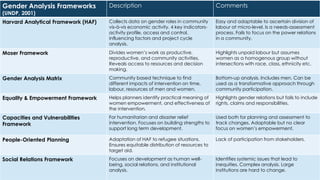
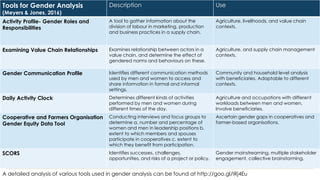
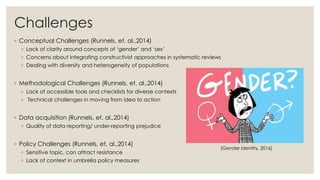
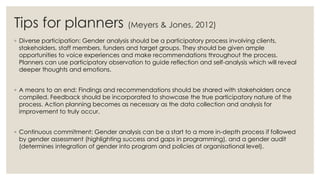
The document discusses gender analysis as a vital method for understanding gender relations, resource access, and empowerment challenges, particularly in rural planning. It outlines recommended practices for conducting gender analysis throughout project processes, various frameworks and tools available for analysis, and the importance of diverse participation and continuous commitment in planning. Additionally, it highlights the need for adapting tools to include a broader understanding of gender beyond the binary, taking into account various intersecting identities.
![Introduction
◦ Gender analysis refers to the variety of methods and tools used to understand the
relationships between different genders in an area, their access to resources, their
activities, and challenges to empowerment (Global Affairs Canada [GAC], 2016).
◦ It aims to reveal the interrelationships between gender and race, ethnicity, culture,
class, age, disability recognising that it transects multiple facets of one’s
identity (GAC, 2016).
◦ Gender analysis is used by policy makers, analysts, and program managers to find
who has access to the resources, who has control, who is likely to benefit, and who
might be impacted negatively by a program (GAC, 2016).
◦ It is also used as a tool to understand local context and to promote equality by
ensuring equal participation and partnership between men and women (GAC, 2016).
(Equality, 2015)](https://image.slidesharecdn.com/pallakarora-genderanalysis-160307221145/85/Pallak-Arora-Gender-Analysis-2-320.jpg)
![References
◦ Gender Equality. [Online image]. (2015). Retrieved from https://lindseymetter.wordpress.com/
◦ Gender Identity. [Online image]. (2016). Retrieved from
http://www.historia.ro/exclusiv_web/actualitate/articol/gender-real-thing
◦ Gender Neutrality. [Online image]. (2016). Retrieved from http://www.herts.ac.uk/about-
us/events/2016/february/beyond-binary-sexuality-and-gender
◦ Global Affairs Canada [GAC]. (2016). Gender Analysis. Retrieved from
http://www.international.gc.ca/development-developpement/priorities-priorites/ge-
es/index.aspx?lang=eng
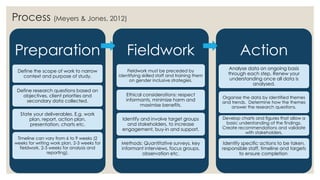
◦ Meyers, L. & Jones. L. (2012). Gender Analysis, Assessment and Audit Manual & Toolkit. Gender
Integration: ACDI/VOCA. Retrieved from
http://acdivoca.org/sites/default/files/attach/legacy/site/Lookup/ACDI-VOCA-Gender-Analysis-
Manual/$file/ACDI-VOCA-Gender-Analysis-Manual.pdf
◦ Runnels, V., Tudiver, S., Doull, M. & Boscoe, M. (2014). The challenges of including sex/gender analysis in
systematic reviews: a qualitative survey. Systematic Reviews, 3(33). DOI:10.1186/2046-4053-3-33
◦ United Nations Development Programme [UNDP]. (2001). Learning & Information Pack: Gender Analysis. Gender
in Development Programme. Retrieved from
http://acdivoca.org/sites/default/files/attach/legacy/site/Lookup/ACDI-VOCA-Gender-Analysis-
Manual/$file/ACDI-VOCA-Gender-Analysis-Manual.pdf](https://image.slidesharecdn.com/pallakarora-genderanalysis-160307221145/85/Pallak-Arora-Gender-Analysis-10-320.jpg)


