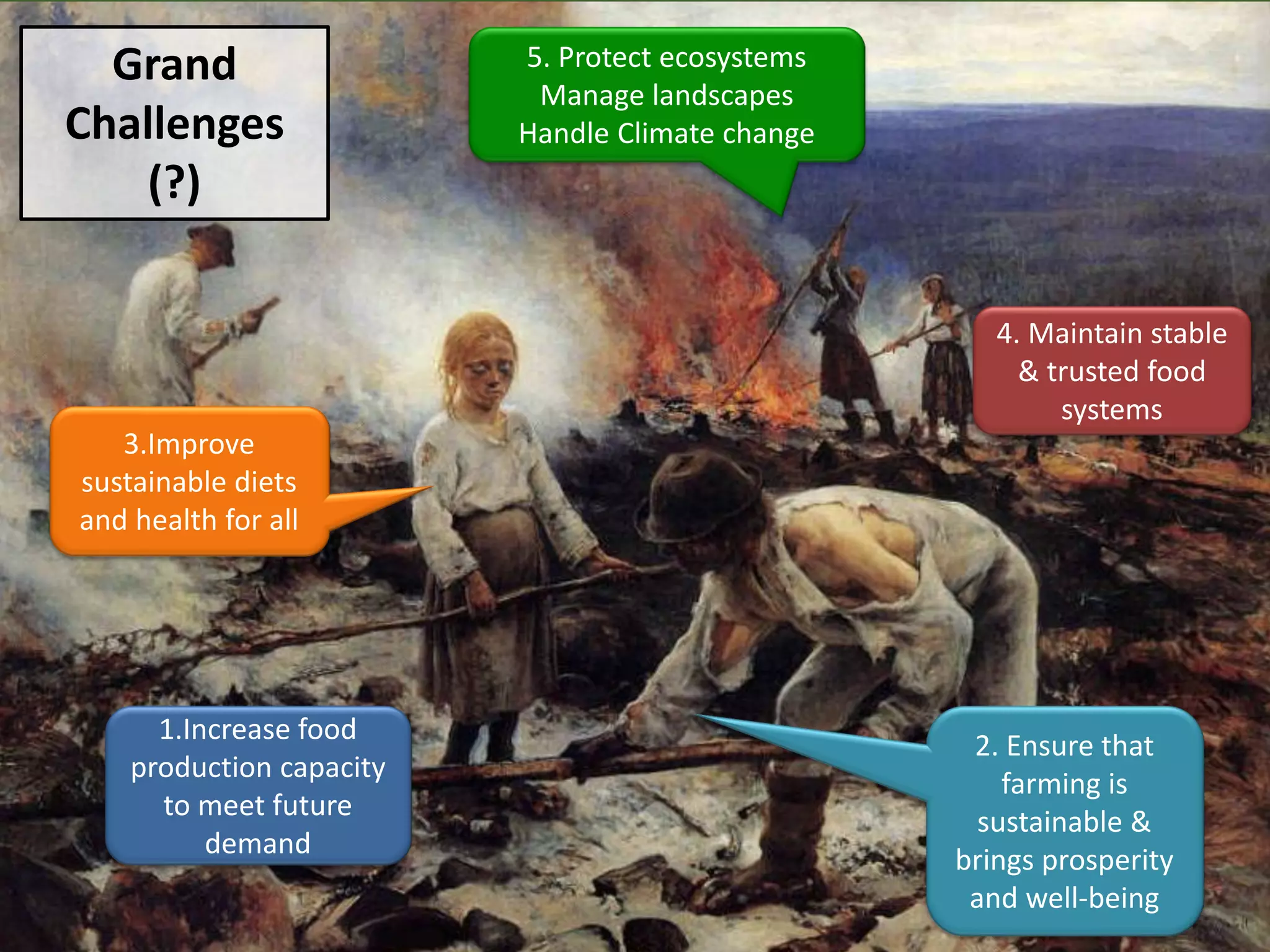

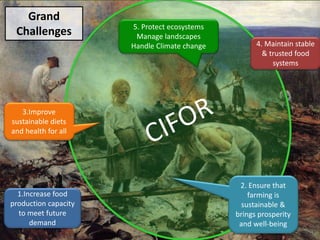
Grand
Challenges
(?)
1.Increase food
production capacity
to meet future
demand
2. Ensure that
farming is
sustainable &
brings prosperity
and well-being
3.Improve
sustainable diets
and health for all
4. Maintain stable
& trusted food
systems
5. Protect ecosystems
Manage landscapes
Handle Climate change
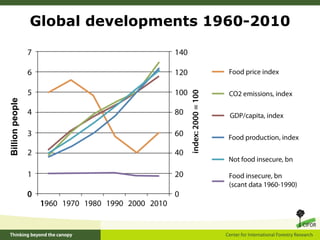
Global developments 1960-2010
Billionpeople
What to expect
• 9.6 billion people in 2050
• Changing consumption patterns
• Continued economic growth
• Expectations of justice and equity
• Migrations to seek new opportunities
• Increased climate variability
Only 30-40 years from now, the world
will not look as it does today.
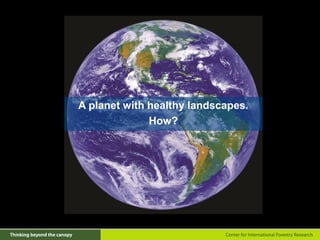
A planet with healthy landscapes.
How?
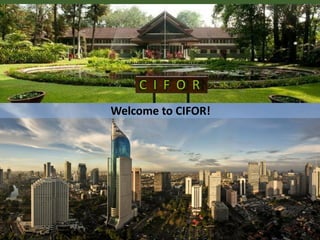
C I F O R
Welcome to CIFOR!
 250 staff representing 35 countries
 85 consultants, 29 PhD students/interns
 Network of Associates
 Budget ca USD 50m, 70+% bilateral
 Leads FTA, significant partner in CCAFS
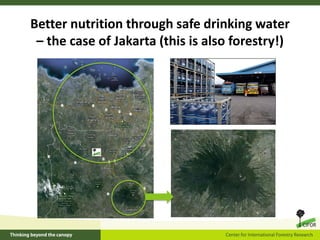
Better nutrition through safe drinking water
– the case of Jakarta (this is also forestry!)
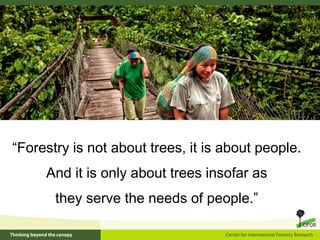
“Forestry is not about trees, it is about people.
And it is only about trees insofar as
they serve the needs of people.”
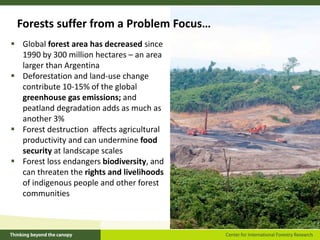
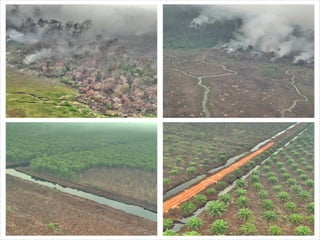
 Global forest area has decreased since
1990 by 300 million hectares – an area
larger than Argentina
 Deforestation and land-use change
contribute 10-15% of the global
greenhouse gas emissions; and
peatland degradation adds as much as
another 3%
 Forest destruction affects agricultural
productivity and can undermine food
security at landscape scales
 Forest loss endangers biodiversity, and
can threaten the rights and livelihoods
of indigenous people and other forest
communities
Forests suffer from a Problem Focus…
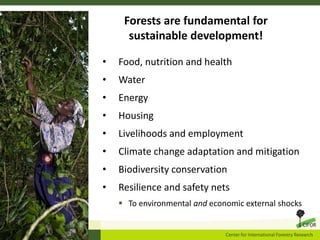
Forests are fundamental for
sustainable development!
• Food, nutrition and health
• Water
• Energy
• Housing
• Livelihoods and employment
• Climate change adaptation and mitigation
• Biodiversity conservation
• Resilience and safety nets
 To environmental and economic external shocks
SDGs – current status, note: not final
Forests / Forestry significant to achieving every goal
1. End poverty in all its forms everywhere
2. End hunger, achieve food security and improved nutrition, and promote sustainable agriculture
3. Ensure healthy lives and promote well-being for all at all ages
4. Ensure inclusive and equitable quality education and promote life-long learning opportunities for all
5. Achieve gender equality and empower all women and girls
6. Ensure availability and sustainable management of water and sanitation for all
7. Ensure access to affordable, reliable, sustainable, and modern energy for all
8. Promote sustained, inclusive and sustainable economic growth, full and productive employment and decent work for all
9. Build resilient infrastructure, promote inclusive and sustainable industrialization and foster innovation
10. Reduce inequality within and among countries
11. Make cities and human settlements inclusive, safe, resilient and sustainable
12. Ensure sustainable consumption and production patterns
13. Take urgent action to combat climate change and its impacts*
14. Conserve and sustainably use the oceans, seas and marine resources for sustainable development
15. Protect, restore and promote sustainable use of terrestrial ecosystems, sustainably manage forests, combat desertification,
and halt and reverse land degradation and halt biodiversity loss
16. Promote peaceful and inclusive societies for sustainable development, provide access to justice for all and build effective,
accountable and inclusive institutions at all levels
17. Strengthen the means of implementation and revitalize the global partnership for sustainable development
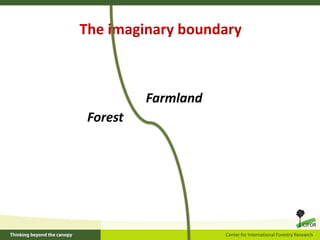
The imaginary boundary
Forest
Farmland
Are landscapes important?
1. Livelihood for billions of people
2. Production of all our food
– and other renewable products (wood, non-wood)
3. Source of 1/3 of greenhouse gas emissions (land use)
4. Home to all terrestrial biodiversity
5. Cornerstone in a green economy
Yes. They are important. Very important.
But: How are the above 5 topics dealt with?
http://pub.epsilon.slu.se/10033/1/medd_statens_skogsforskningsinst_049_05.pdf
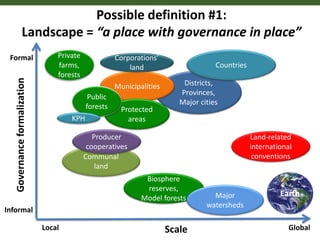
Scale
Governanceformalization
Private
farms,
forests
Districts,
Provinces,
Major cities
Communal
land
Biosphere
reserves,
Model forests
Countries
Municipalities
Producer
cooperatives
GlobalLocal
Informal
Formal Corporations’
land
Protected
areas
Possible definition #1:
Landscape = “a place with governance in place”
Earth
Land-related
international
conventions
Major
watersheds
Public
forests
KPH
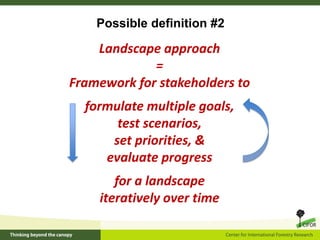
Landscape approach
=
Framework for stakeholders to
formulate multiple goals,
test scenarios,
set priorities, &
evaluate progress
for a landscape
iteratively over time
Possible definition #2
2015 – a year for integration
• Post-2015, Climate Deal (& CRP phase 2)
One note:
• UNSG report “The road to dignity 2030”
– Summarizes post-2015 process
– “Sustainable approaches to landscape
management (including agriculture and
forests)”
• Under SDG on “shared prosperity and
inclusive and transformative economic growth”
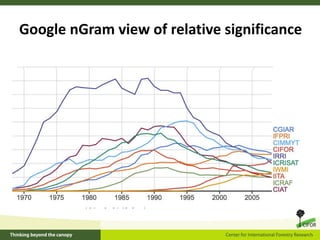
Google nGram view of relative significance
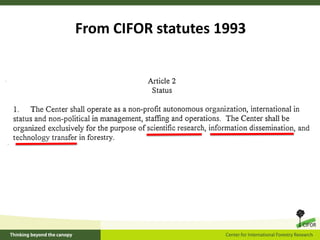
From CIFOR statutes 1993
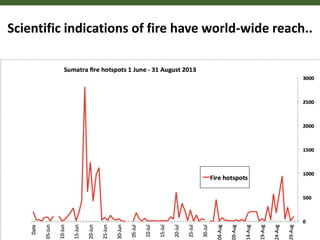
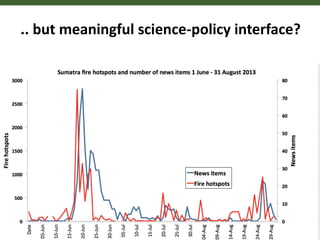
Scientific indications of fire have world-wide reach..
.. but meaningful science-policy interface?
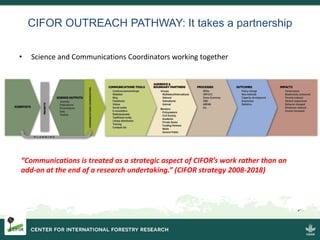
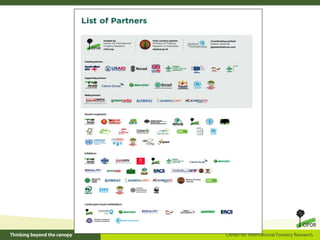
CIFOR OUTREACH PATHWAY: It takes a partnership
• Science and Communications Coordinators working together
“Communications is treated as a strategic aspect of CIFOR’s work rather than an
add-on at the end of a research undertaking.” (CIFOR strategy 2008-2018)
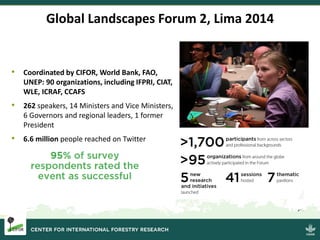
Global Landscapes Forum 2, Lima 2014
• Coordinated by CIFOR, World Bank, FAO,
UNEP: 90 organizations, including IFPRI, CIAT,
WLE, ICRAF, CCAFS
• 262 speakers, 14 Ministers and Vice Ministers,
6 Governors and regional leaders, 1 former
President
• 6.6 million people reached on Twitter
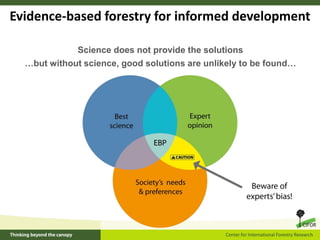
Evidence-based forestry for informed development
Science does not provide the solutions
…but without science, good solutions are unlikely to be found…
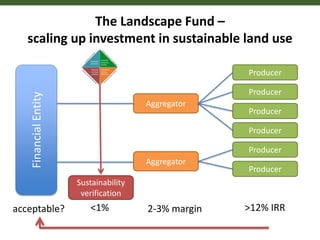
The Landscape Fund –
scaling up investment in sustainable land useFinancialEntity
Producer
Producer
Producer
Producer
Producer
Producer
Aggregator
Aggregator
Sustainability
verification
>12% IRR2-3% margin<1%acceptable?
The Royal Society, London 10-11 June 2015
Grand
Challenges
1.Increase food
production capacity
to meet future
demand
2. Ensure that
farming is
sustainable &
brings prosperity
and well-being
3.Improve
sustainable diets
and health for all
4. Maintain stable
& trusted food
systems
5. Protect ecosystems
Manage landscapes
Handle Climate change

CIFOR presentation - Peter Holmgren

  • 1.
    Grand Challenges (?) 1.Increase food production capacity tomeet future demand 2. Ensure that farming is sustainable & brings prosperity and well-being 3.Improve sustainable diets and health for all 4. Maintain stable & trusted food systems 5. Protect ecosystems Manage landscapes Handle Climate change
  • 2.
  • 3.
    What to expect •9.6 billion people in 2050 • Changing consumption patterns • Continued economic growth • Expectations of justice and equity • Migrations to seek new opportunities • Increased climate variability Only 30-40 years from now, the world will not look as it does today.
  • 4.
    A planet withhealthy landscapes. How?
  • 5.
    C I FO R Welcome to CIFOR!
  • 6.
     250 staffrepresenting 35 countries  85 consultants, 29 PhD students/interns  Network of Associates  Budget ca USD 50m, 70+% bilateral  Leads FTA, significant partner in CCAFS
  • 7.
    Better nutrition throughsafe drinking water – the case of Jakarta (this is also forestry!)
  • 8.
    “Forestry is notabout trees, it is about people. And it is only about trees insofar as they serve the needs of people.”
  • 9.
     Global forestarea has decreased since 1990 by 300 million hectares – an area larger than Argentina  Deforestation and land-use change contribute 10-15% of the global greenhouse gas emissions; and peatland degradation adds as much as another 3%  Forest destruction affects agricultural productivity and can undermine food security at landscape scales  Forest loss endangers biodiversity, and can threaten the rights and livelihoods of indigenous people and other forest communities Forests suffer from a Problem Focus…
  • 10.
    Forests are fundamentalfor sustainable development! • Food, nutrition and health • Water • Energy • Housing • Livelihoods and employment • Climate change adaptation and mitigation • Biodiversity conservation • Resilience and safety nets  To environmental and economic external shocks
  • 11.
    SDGs – currentstatus, note: not final Forests / Forestry significant to achieving every goal 1. End poverty in all its forms everywhere 2. End hunger, achieve food security and improved nutrition, and promote sustainable agriculture 3. Ensure healthy lives and promote well-being for all at all ages 4. Ensure inclusive and equitable quality education and promote life-long learning opportunities for all 5. Achieve gender equality and empower all women and girls 6. Ensure availability and sustainable management of water and sanitation for all 7. Ensure access to affordable, reliable, sustainable, and modern energy for all 8. Promote sustained, inclusive and sustainable economic growth, full and productive employment and decent work for all 9. Build resilient infrastructure, promote inclusive and sustainable industrialization and foster innovation 10. Reduce inequality within and among countries 11. Make cities and human settlements inclusive, safe, resilient and sustainable 12. Ensure sustainable consumption and production patterns 13. Take urgent action to combat climate change and its impacts* 14. Conserve and sustainably use the oceans, seas and marine resources for sustainable development 15. Protect, restore and promote sustainable use of terrestrial ecosystems, sustainably manage forests, combat desertification, and halt and reverse land degradation and halt biodiversity loss 16. Promote peaceful and inclusive societies for sustainable development, provide access to justice for all and build effective, accountable and inclusive institutions at all levels 17. Strengthen the means of implementation and revitalize the global partnership for sustainable development
  • 12.
  • 14.
    Are landscapes important? 1.Livelihood for billions of people 2. Production of all our food – and other renewable products (wood, non-wood) 3. Source of 1/3 of greenhouse gas emissions (land use) 4. Home to all terrestrial biodiversity 5. Cornerstone in a green economy Yes. They are important. Very important. But: How are the above 5 topics dealt with?
  • 15.
    http://pub.epsilon.slu.se/10033/1/medd_statens_skogsforskningsinst_049_05.pdf Scale Governanceformalization Private farms, forests Districts, Provinces, Major cities Communal land Biosphere reserves, Model forests Countries Municipalities Producer cooperatives GlobalLocal Informal FormalCorporations’ land Protected areas Possible definition #1: Landscape = “a place with governance in place” Earth Land-related international conventions Major watersheds Public forests KPH
  • 16.
    Landscape approach = Framework forstakeholders to formulate multiple goals, test scenarios, set priorities, & evaluate progress for a landscape iteratively over time Possible definition #2
  • 17.
    2015 – ayear for integration • Post-2015, Climate Deal (& CRP phase 2) One note: • UNSG report “The road to dignity 2030” – Summarizes post-2015 process – “Sustainable approaches to landscape management (including agriculture and forests)” • Under SDG on “shared prosperity and inclusive and transformative economic growth”
  • 18.
    Google nGram viewof relative significance
  • 20.
  • 21.
    Scientific indications offire have world-wide reach..
  • 22.
    .. but meaningfulscience-policy interface?
  • 23.
    CIFOR OUTREACH PATHWAY:It takes a partnership • Science and Communications Coordinators working together “Communications is treated as a strategic aspect of CIFOR’s work rather than an add-on at the end of a research undertaking.” (CIFOR strategy 2008-2018)
  • 25.
    Global Landscapes Forum2, Lima 2014 • Coordinated by CIFOR, World Bank, FAO, UNEP: 90 organizations, including IFPRI, CIAT, WLE, ICRAF, CCAFS • 262 speakers, 14 Ministers and Vice Ministers, 6 Governors and regional leaders, 1 former President • 6.6 million people reached on Twitter
  • 26.
    Evidence-based forestry forinformed development Science does not provide the solutions …but without science, good solutions are unlikely to be found…
  • 27.
    The Landscape Fund– scaling up investment in sustainable land useFinancialEntity Producer Producer Producer Producer Producer Producer Aggregator Aggregator Sustainability verification >12% IRR2-3% margin<1%acceptable?
  • 28.
    The Royal Society,London 10-11 June 2015
  • 29.
    Grand Challenges 1.Increase food production capacity tomeet future demand 2. Ensure that farming is sustainable & brings prosperity and well-being 3.Improve sustainable diets and health for all 4. Maintain stable & trusted food systems 5. Protect ecosystems Manage landscapes Handle Climate change