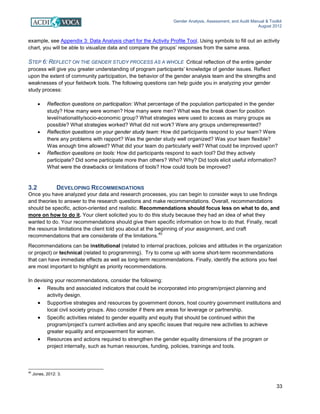
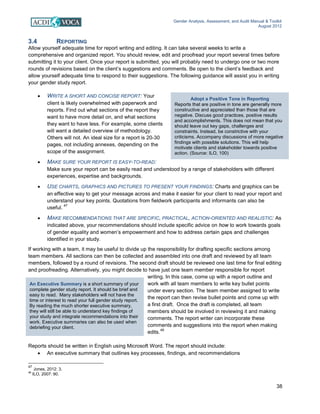
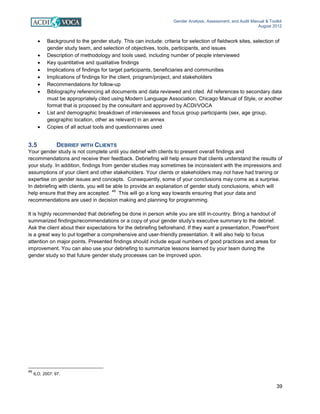
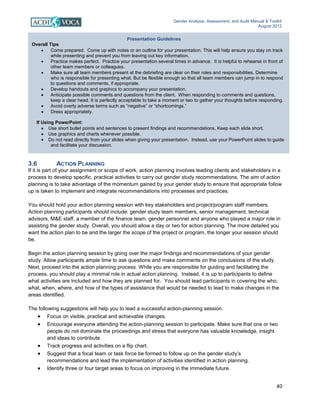
GENDER
Analysis, Assessment and Audit
Manual & Toolkit
For use by ACDI/VOCA staff and consultants in completing gender studies
Developed by Lis Meyers, independent consultant and Lindsey Jones, ACDI/VOCA
Gender Analysis, Assessment, and Audit Manual & Toolkit
August 2012
i
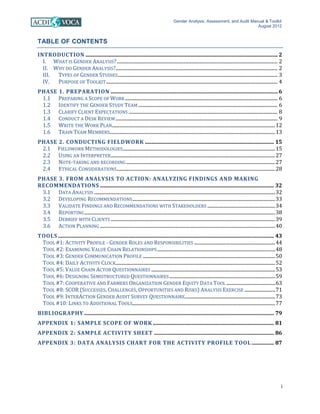
TABLE OF CONTENTS
INTRODUCTION .................................................................................................................................................. 2
I. WHAT IS GENDER ANALYSIS?....................................................................................................................................... 2
II. WHY DO GENDER ANALYSIS?........................................................................................................................................ 2
III. TYPES OF GENDER STUDIES...................................................................................................................................... 3
IV. PURPOSE OF TOOLKIT................................................................................................................................................ 4
PHASE 1. PREPARATION ...............................................................................................................................6
1.1 PREPARING A SCOPE OF WORK ................................................................................................................................ 6
1.2 IDENTIFY THE GENDER STUDY TEAM ..................................................................................................................... 6
1.3 CLARIFY CLIENT EXPECTATIONS ............................................................................................................................. 8
1.4 CONDUCT A DESK REVIEW........................................................................................................................................ 9
1.5 WRITE THE WORK PLAN.........................................................................................................................................12
1.6 TRAIN TEAM MEMBERS...........................................................................................................................................13
PHASE 2. CONDUCTING FIELDWORK .................................................................................................. 15
2.1 FIELDWORK METHODOLOGIES................................................................................................................................15
2.2 USING AN INTERPRETER..........................................................................................................................................27
2.3 NOTE-TAKING AND RECORDING .............................................................................................................................27
2.4 ETHICAL CONSIDERATIONS.....................................................................................................................................28
PHASE 3. FROM ANALYSIS TO ACTION: ANALYZING FINDINGS AND MAKING
RECOMMENDATIONS .................................................................................................................................... 32
3.1 DATA ANALYSIS ........................................................................................................................................................32
3.2 DEVELOPING RECOMMENDATIONS........................................................................................................................33
3.3 VALIDATE FINDINGS AND RECOMMENDATIONS WITH STAKEHOLDERS .........................................................34
3.4 REPORTING ................................................................................................................................................................38
3.5 DEBRIEF WITH CLIENTS ..........................................................................................................................................39
3.6 ACTION PLANNING ...................................................................................................................................................40
TOOLS .................................................................................................................................................................... 43
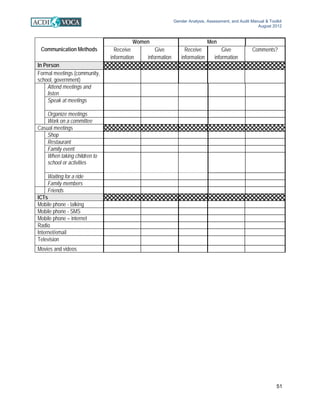
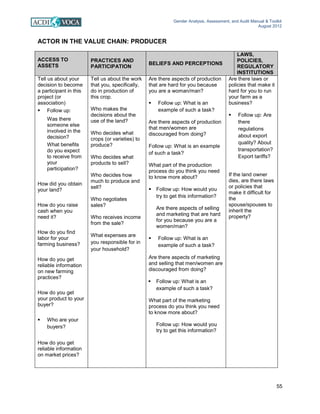
TOOL #1: ACTIVITY PROFILE - GENDER ROLES AND RESPONSIBILITIES ....................................................................44
TOOL #2: EXAMINING VALUE CHAIN RELATIONSHIPS...................................................................................................48
TOOL #3: GENDER COMMUNICATION PROFILE ...............................................................................................................50
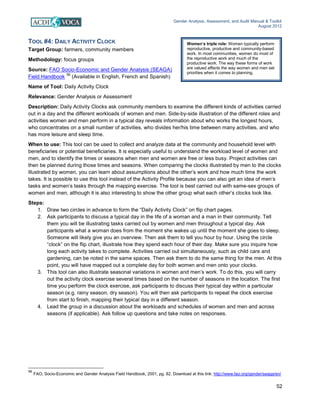
TOOL #4: DAILY ACTIVITY CLOCK......................................................................................................................................52
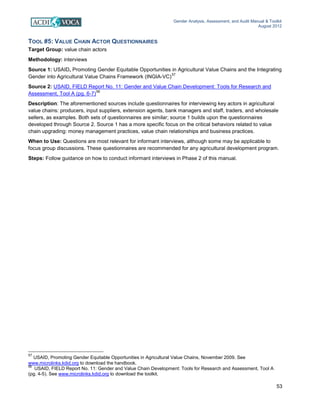
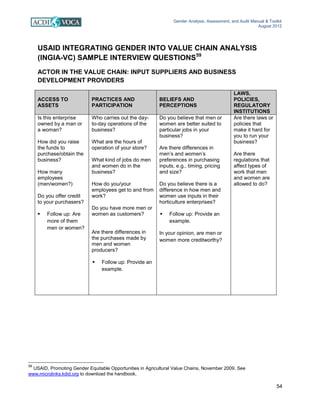
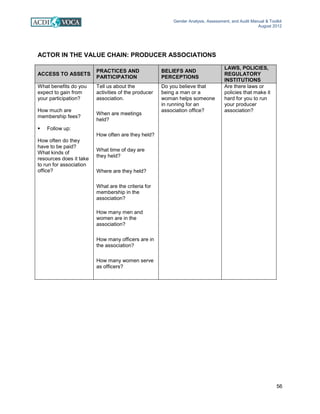
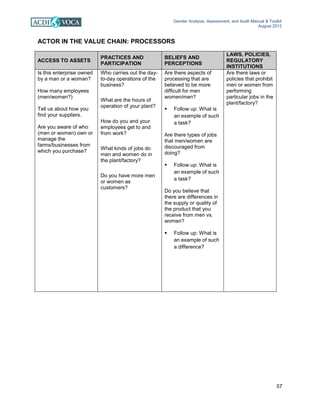
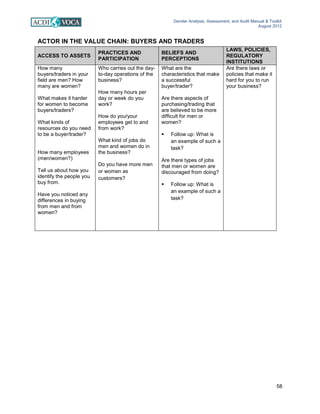
TOOL #5: VALUE CHAIN ACTOR QUESTIONNAIRES ........................................................................................................53
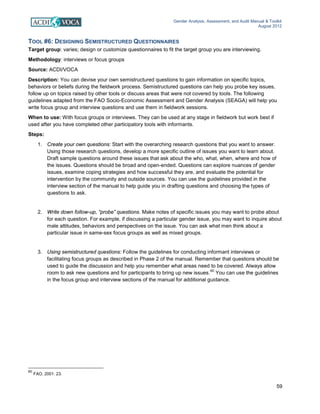
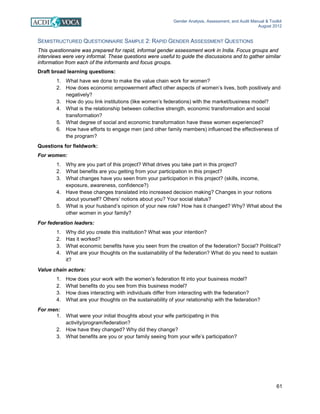
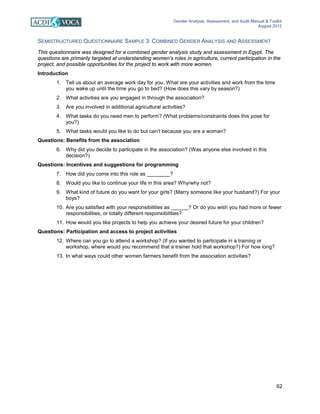
TOOL #6: DESIGNING SEMISTRUCTURED QUESTIONNAIRES.........................................................................................59
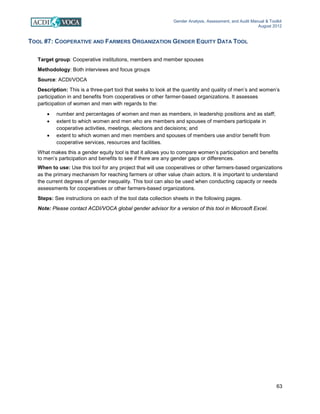
TOOL #7: COOPERATIVE AND FARMERS ORGANIZATION GENDER EQUITY DATA TOOL .........................................63
TOOL #8: SCOR (SUCCESSES, CHALLENGES, OPPORTUNITIES AND RISKS) ANALYSIS EXERCISE ..........................71
TOOL #9: INTERACTION GENDER AUDIT SURVEY QUESTIONNAIRE............................................................................73
TOOL #10: LINKS TO ADDITIONAL TOOLS........................................................................................................................77
BIBLIOGRAPHY ................................................................................................................................................ 79
APPENDIX 1: SAMPLE SCOPE OF WORK ............................................................................................ 81
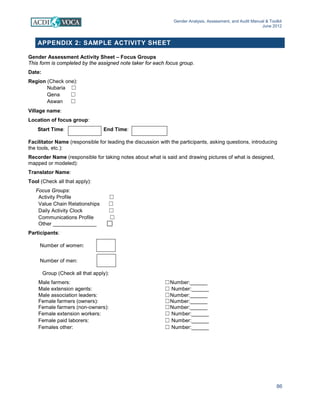
APPENDIX 2: SAMPLE ACTIVITY SHEET ........................................................................................... 86
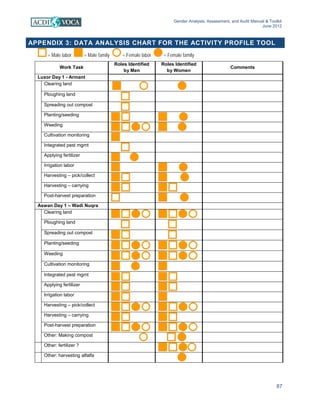
APPENDIX 3: DATA ANALYSIS CHART FOR THE ACTIVITY PROFILE TOOL ................. 87
Gender Analysis, Assessment, and Audit Manual & Toolkit
August 2012
2
Gender is defined here as the socially
constructed differences between
males and females, and the social
roles and relationships between them.
Gender constructs and identities vary
over time and culture. Gender roles
and relations shape the dynamics of
human interactions and the greater
society on all levels. Although gender
is about the roles and relationships of
women and men, the term “gender” is
typically associated with women. This
is because once you analyze the
situation of women and men in
relationship to each other, you often
see that women are disadvantaged
and unequal in comparison to men.
What’s the difference between
gender equity and gender equality?
The terms gender equity and gender
equality are often used
interchangeably, but there is a slight
difference. Gender equity refers to an
approach where measures are put in
place to compensate for the historical
and social disadvantages that prevent
women and men from operating on a
level playing field. Gender equality
refers to a relational status between
women and men. Gender equity is a
means to achieving gender equality.
INTRODUCTION
I. WHAT IS GENDER ANALYSIS?
In most countries, communities and households, men and women
perform different roles, have different responsibilities and different—
often unequal—statuses. Frequently, women have less ownership and
control over assets, reduced decision-making capacity and fewer
educational and economic opportunities than men.
1
Due to this,
women and men have different experiences, knowledge, talents and
needs. Development initiatives can affect male and female
beneficiaries in vastly different ways because of these gender
differences and inequalities. Without a deliberate consideration of
gender dynamics, women often encounter obstacles to participating in,
and benefiting from, development projects.
Understanding gender issues is therefore essential for effective
development. Gender analysis is a process of collecting and
analyzing sex-disaggregated information in order to understand
gender differences. Gender analysis explores gender differences so
policies, programs and projects can identify and meet the different needs of men and women. It also
facilitates the strategic use of the distinct knowledge and skills women and men possess.
II. WHY DO GENDER ANALYSIS?
We do gender analysis in order to:
• Design and implement development projects in a way that will
close gender inequality gaps so that both women and men
benefit from development and are equitably empowered.
• Understand how gender roles, responsibilities and inequalities
affect the project’s effectiveness and the sustainability of its
results.
Data shows that gender roles, responsibilities and inequalities can and
do affect the ability to achieve broad-based economic growth, strong
communities and food security in emerging market countries. For
example, according to the Food and Agriculture Organization (FAO), if
women had equal access to, and control over, productive resources,
agricultural production yields would increase by 20-30 percent, which
could, in turn, increase the total agricultural output in developing
countries by 2.5 - 4 percent and reduce the number of hungry individuals in the world by 12 - 17.2 percent.
3
Additionally, women allocate a greater percentage of their incomes to household and family expenses than
men. It is estimated that when women and girls earn income, they reinvest 90 percent of it into their families,
compared to only 30 to 40 percent for men.
4
Increasing women’s incomes or enabling women to have
greater influence over economic decisions would typically mean more income for food, health, education and
1
USAID, “Gender Equality and Women’s Empowerment: Integrating Gender.” (2012). Accessed June 8, 2012,
http://transition.usaid.gov/our_work/cross-cutting_programs/wid/gender/index.html
3
Food and Agriculture Organization (FAO), “State of Food and Agriculture 2010-2011, Women in Agriculture: Closing the gender gap for
development,” Rome, Italy: FAO (2011).
4
Borges, Phil, “Women Empowered: Inspiring Change in the Emerging World,” New York: Rizzoli, (2007), 13.
Gender Analysis, Assessment, and Audit Manual & Toolkit
August 2012
3
Gender Mainstreaming involves
assessing the implications, for men,
women, and other social groups, of
any action, policy, program or
legislation.
Mainstreaming makes the concerns
and experiences of all individuals an
integral dimension of the design,
implementation, monitoring and
evaluation of all policies and programs
in all political, economic, and social
spheres, so that all groups benefit
equally. Mainstreaming is not an end
in itself, but rather an approach or
means to achieve the ultimate goal of
equality.
Core Principles of Gender Studies
1) Participatory: The study should involve clients, stakeholders, staff, donors and project participants, who should all
have the opportunity to speak for themselves and share their experiences, perceptions and beliefs. While sharing this
information, the facilitator or researcher should guide them toward a reflexive process of self-analysis.
2) A means, not an end: All types of studies include recommendations on how to better include and address gender
considerations in future or existing programing or institutional processes. Findings and recommendations should
result in action and improvement.
3) Not a one-off event: The three different types of gender studies should be integrated throughout project cycles.
nutrition for the family.
5
Therefore efforts to reduce food security and
poverty should be accompanied by efforts to ensure that men and
women are able to equitably access and benefit from development
opportunities. Gender analysis is one of the first steps towards this goal.
You can use gender studies as a tool to address gender dynamics and
integrate gender considerations into programming, projects and
interventions. This process is known as “gender mainstreaming” and is
widely recognized as an important strategy for achieving equality and
equity. In addition, some types of gender studies, such as gender
assessments and audits, examine internal gender mainstreaming
processes. In recent years, there has been growing awareness of the
central role that organizational structure and culture play in the design
and delivery of gender and equality-sensitive programs and projects.
6
III. TYPES OF GENDER STUDIES
Ideally, we should incorporate gender analysis into all stages of a
project’s lifecycle: in the initial program design and approach, in assessing progress throughout
implementation and in evaluating project impact and effects. Until all development workers are able to do this
in a constant, integrated way, we will do separate gender studies, specifically: a gender analysis study, a
gender assessment or a gender audit.
A GENDER ANALYSIS STUDY analyzes the gender dynamics within a development problem. Findings and
recommendations provided through a gender analysis study help development workers understand gender
roles, relations, constraints and opportunities. They then use this information to influence the design of a
project.
A GENDER ASSESSMENT is a review—from a gender perspective—of a current or recently completed
project or activity. It assesses how a project addresses and responds to gender dynamics and inequalities in
technical programming, policies and practices. The assessment highlights successes and gaps in
programming, identifying new opportunities to improve future programming.
7
It often incorporates aspects of a
gender analysis study because it requires an understanding of gender inequality in a given setting. Gender
assessments sometimes incorporate some degree of gender auditing.
5
FAO, 2011: 43.
6
Moser, Caroline “An Introduction to Gender Audit Methodology: Its design and implementation in DFID Malawi,” London, UK: Overseas
Development Institute (2005).
7
Adapted from USAID definition as of June 2012.
Gender Analysis, Assessment, and Audit Manual & Toolkit
August 2012
4
A GENDER AUDIT: Evaluates how gender considerations are being integrated into programs and policies by
an organization, department or office. Wide in scope, audits assess gender approaches and policies, staff
capacity, tools and resources, gender mainstreaming in programs and projects, organizational culture and
workplace issues. Overall, an audit will monitor relative progress made in mainstreaming and identify
successes as well as critical gaps. Additionally, gender audits can integrate components of gender
assessments to measure the impact of interventions on beneficiaries.
Table 1 describes the differences between the three gender studies. It is important to note that the types of
studies are often used interchangeably and some agencies and institutions do not distinguish between gender
analysis, assessment or audit, as there is often overlap between the three. It is important to be consistent, but
also flexible, with terminology.
Table 1. Gender Study Approaches
8
IV. PURPOSE OF TOOLKIT
The purpose of this toolkit is to provide guidance to ACDI/VOCA staff and consultants on how to conduct
gender analysis studies, assessments and audits. It is intended for individuals who are either commissioning
or leading the gender study. The toolkit provides useful tools and methods for these studies, and guidance on
how to operationalize a study from start to finish. Many of the tools presented, such as baseline studies or
market assessments, can be easily integrated into other studies.
This manual includes materials and tools that have been drawn directly or adapted from materials produced
by others. Source materials are cited throughout the document and in the bibliography at the end of the
manual.
This manual has four sections. The first three describe the three phases of gender analysis studies,
assessments, and audits: 1) preparing for gender studies; 2) conducting fieldwork; 3) analyzing, validating,
8
ACDI/VOCA, “Gender Analyses, Assessments, and Audits Brief,” Washington D.C.: ACDI/VOCA (2012).
Gender Analysis Study Gender Assessment Gender Audit
• Conducted during program
design or planning
• Analyzes the gender
context in which the
program is operating
• Helps programmers
understand gender roles,
responsibilities, statuses
and inequalities so they can
use that information to
design, implement, monitor
and evaluate programs
• Conducted via: desk
review, key informant
interviews, and
interviews/focus groups
with beneficiaries
• Includes recommendations
on how to integrate gender
considerations into the
program
• Conducted during project
implementation or as part of the final
evaluation after a project has been
completed
• Assesses the program (both
technical and institutional processes
and results)
• Assesses the extent to which the
program integrates gender issues into
activities and institutional systems
• Assesses program results and effects
on male and female participants
• Conducted via similar research
processes as gender analysis, but
includes a more comprehensive review
of existing activities and initiatives
• Includes recommendations based on
results and lessons
• Can include components of a gender
analysis study, particularly if one has

not already been done
• Conducted during project
implementation
• Assesses the internal and
institutional context in which program
operates
• Evaluates gender integration as it
relates to: policies, staff capacity, tools,
trainings and resources, organizational
culture and workplace issues
• Conducted via: desk review,
questionnaire, and interviews and
focus groups with staff. Should ideally
be carried out by external
consultant(s)
• Makes recommendations about how to
better mainstream gender within
organization and among staff
• Can include components of a gender
assessment to assess effects of
programming on beneficiaries
Gender Analysis, Assessment, and Audit Manual & Toolkit
August 2012
5
and reporting data in a way that translates gender study findings into action. The fourth section is a series of
annexes with a number of user-friendly gender study tools.
Gender Analysis, Assessment, and Audit Manual & Toolkit
August 2012
6
PHASE 1. PREPARATION
Gender studies should begin with a planning phase. During this phase, you should develop the scope of work
and work plan, assemble teams, clarify stakeholder expectations, acquire necessary resources, conduct a
desk review, select appropriate tools and methodologies and, if necessary, train staff. You can also conduct
preliminary interviews with key personnel to gain basic insights.
1.1 PREPARING A SCOPE OF WORK
Regardless of whether you are commissioning a gender study or leading the study yourself, it is important for
you to prepare a scope of work (SOW) with a clear purpose and detailed research questions for your study.
The SOW will help ensure that those responsible for carrying out the study or implementing its
recommendations are on the same page with a clear understanding of what is expected of them and how the
gender assessment process will be carried out. SOWs should include the following sections: overview of the
project context, purpose of the assignment, key research questions, tasks, deliverables, timeline and logistics.
Templates for scopes of work can be found in Appendix 1: Sample Scope of Work.
Research questions should be based on the objectives of the assignment, the priorities of the client and the
existing information gathered during the desk review. They should be broader than the questions that you will
ask during interviews and focus groups. Aim for 3-5 key research questions.
9
Deliverables should be clearly stated in the SOW. Suggested deliverables include:
• Work plan with methodology, sampling plan, timeframe of fieldwork and copies of all tools
• Report with methodology, list and breakdown of interviewees and focus group participants, findings,
recommendations, and copies of all tools used
• Gender Integration Strategy/Action Plan (if part of assignment) with specific, practical ways to
carry out recommendations, including specific activities, indicators to monitor outcomes, and a
designation of who is responsible for implementation
• Presentation of Results (if part of assignment) to formally present and share findings and
recommendations; this could be done through a PowerPoint presentation, an executive summary
report or a stakeholders’ forum
• Other: training modules, graphics, charts, vignettes on gender sensitivity or gender issues
The timeline for the gender study will vary. Ideally, your gender study would take six to nine weeks from the
development of the SOW to the finalization of the report. Two weeks should be spent in the preparatory
phase (clarifying expectations, desk review, training team members, writing a work plan and organizing field
work), two to four weeks should be spent conducting fieldwork (informant interviews, surveys, and focus
groups) and two to three weeks should be spent on reporting (analyzing data, validating findings, writing the
report, and debriefing). However, assignment lengths can vary, particularly due to the range and scope of the
gender study. For example, gender audits of large programs/organizations with numerous field units might
take longer. In contrast, a gender assessment, analysis, or audit of a small project or proposal
reconnaissance effort will require less time.
1.2 IDENTIFY THE GENDER STUDY TEAM
Large gender studies call for a team of 4-5 people. If the gender study involves a team, it is useful to make
the team as diverse as possible, with both national and international personnel bringing different skills,
strengths and experiences to the assignment. For gender assessments and analyses, teams should always
9
Jones, Lindsey, “Gender Analysis Guidebook,” Washington D.C.: ACDI/VOCA (May 2012).
Gender Analysis, Assessment, and Audit Manual & Toolkit
August 2012
7
include locally based personnel. Gender audits can also include locally based personnel, but must be
performed by external consultants. Selection of team members can be based on, but not limited to, the
following criteria:
1) Diversity, skills and expertise
2) Familiarity with gender analysis tools and processes
3) Technical expertise in an area that is important to the study (e.g. value chain development, policy,
agriculture, health and nutrition, etc.)
4) Sensitivity to gender issues
5) Overall availability and willingness to participate in fieldwork in remote locations
10
It is important that at least one team member participates in all phases of the study from start to finish. It is
also useful if you assign one team member to handle all logistics. Finally, if the gender study involves
conducting fieldwork with target participants or beneficiaries who speak local languages, you should include a
team member who is familiar with these languages and can serve as interpreter. If only one person is
conducting the gender study, it is still beneficial to assign them personnel to assist with logistics and
translations. This is especially true if the study is conducted by a consultant or internationally based staff
member. In delegating responsibilities to team members, select a clear team leader. Make sure all team
members understand their designated roles and responsibilities, but are also flexible enough that they can
adopt new roles if needed.
Participation in gender analyses and assessments can also be an excellent learning opportunity for staff who
are unfamiliar with gender analysis processes and complex gender issues. Assign a locally based staff
member who is interested in gender issues to shadow or play a supportive role in the gender study process.
He/she will be able to work directly with the gender analysis team and observe first-hand how gender study
tools are used. This will serve as on-the-ground training and help build the capacity of local staff to participate
in future gender studies.
You will need a wide range of resources for gender studies. It is important that the scope of work details the
specific resources you expect your gender study lead or consultant to provide and what resources will be
provided for them from other sources. The most important resource is support from senior management (e.g.
work unit manager, chief of party, country director) providing guidance and much-needed logistical, time, and
personnel resources to complete the gender analysis, assessment or audit. Most gender studies require
program, project or organizational staff to participate in informant interviews, as well as in surveys and focus
groups. Senior management can ensure that time is set aside in staff schedules to participate in these
processes. They can also communicate to staff that their participation is necessary and integral to their work,
to prevent staff from viewing gender studies as secondary or unimportant.
10
Food and Agriculture Organization of the United Nations (FAO). “SEAGA: Socio-Economic and Gender Analysis Field Handbook,”
FAO (2001).
Gender Analysis, Assessment, and Audit Manual & Toolkit
August 2012
8
Resource Checklist for Gender Studies
1. From project personnel:
• Support of senior management
• Logistical and planning assistance
• Assistance in organizing focus groups with target participants or beneficiaries
• Desk review materials
• Staff to participate in informant interviews, questionnaires and focus groups (particularly for gender audits)
2. Resources provided by the gender study consultant or lead:
• Audio-recording device
• Camera
• Any special tools, equipment, or materials that will be used in the study but cannot be found in the country
where the gender study is taking place.
• Comfortable clothing that is culturally appropriate
• Laptop and charger
• Any required medicines or prescriptions
• Travel and evacuation insurance
3. Office-based resources:
• Designated workspace
• Access to computers (laptops recommended)
• Access to internet (both in the office and mobile internet devises for when in the field)
• Office supplies (e.g. pens, markers, notebooks, flip charts and stands, rulers, tape, stapler)
• Access to a printer
• Audio-visual recording equipment (e.g. audio recorders, video-recorders and cameras) and spare
batteries/chargers
4. Logistical resources:
• Mobile phones with phone credit
• Access to car and driver, particularly for fieldwork
• Accommodations when in the field
• Per diems for team members when in the field and for international team members for the duration of the study
• Accommodation for international team members
• Food and drinks for focus group participants
• Spaces to conduct interviews, focus groups and stakeholders workshops
• Printed copies of project work plan, performance management plan (PMP) and other key project documents
• Printed copies of all gender study tools and worksheets for taking notes
1.3 CLARIFY CLIENT EXPECTATIONS
When conducting a gender study, it is important that you understand the clients of the study and their needs
and expectations. Clients can include chiefs of party or country directors, headquarters-based program
managers, the government of the country in which the study is being carried out, or USAID or other donor
organizations. You should arrange an interview with your clients at the very beginning of the study. This will
be an excellent opportunity to ask questions about clients’ knowledge, priorities and expectations, and gain
overall guidance for the gender study. It will also provide you with an opportunity to make sure you are clear
on required deliverables and timeframes. Do not be afraid to ask as many questions as you need and
make suggestions regarding the scope of work. There are no wrong questions and this is your best
opportunity to make sure you and the clients are on the same page.
In conducting your interview(s) with clients, be sure you consider the following questions:
• What are their priorities in the study?
• What do they hope to do with the study findings and recommendations?
Gender Analysis, Assessment, and Audit Manual & Toolkit
August 2012
9
The Difference between Clients and Stakeholders
Your Client is the organization, colleague or agency
that contracted or asked you to carry out the gender
study and is providing funding. In many cases your
client will be ACDI/VOCA. If this is the case, your
clients will include chiefs of party or country directors,
headquarters-based program managers, and
ACDI/VOCA’s global gender advisor. In other
instances, your client may be USAID or other donor
organizations or the government of the country in
which the study is being carried out.
Stakeholders are individuals or groups who have a
vested interest in the outcome of your gender study or
the particular issues/processes your study is
assessing. They have the potential to influence or be
impacted by your gender study and their interests,
viewpoint, or influence must be recognized for your
work to be successful. Stakeholders can include:
individuals, international and national NGOs, donor
organizations, civil society groups, the government of
the country where your gender study is taking place,
leaders and program participants (i.e., beneficiaries).
• What do they already know about the topic, so
that you don’t repeat it and give them
information they know already?
• Who needs information from the gender
study?
• Who will be expected to implement the
recommendations?
Once you are clear on priorities and expectations, set
up a schedule to check in with clients on a regular
basis to ask follow up questions and make sure you
are meeting expectations. You should keep in touch
with your clients throughout the gender study
processes. These check-ins can be done in person or
by phone or email. When possible, face-to-face
meetings are highly recommended. When conducting
client check-ins, you should begin with a progress
report. Update the client about where you are in the
gender study process, share overall observations, and
give them the opportunity to ask you questions about
the work you have done so far. Get feedback from
your client to make sure you are meeting their expectations. Once you have given an update, ask them any
questions or points of clarification you may have.
1.4 CONDUCT A DESK REVIEW
Before heading to the field, or even choosing your fieldwork methodology, you need to complete background
research. This involves reviewing current literature to understand the target population and the context in
which the program, project or organization is operating. Desk reviews will help you gather sex-disaggregated,
qualitative and quantitative background information as base information to complement the results and
findings of participatory processes, rather than repeat what is already known. Finally, a desk review will inform
your fieldwork so that you can you can dig deeper into issues, patterns, activities, initiatives or programs that
were mentioned or presented in the secondary review.
11
For gender audits, your desk review will develop
essential background information and insights to support the participatory phase of the audit process and
assess how equality and gender are mainstreamed in the various written products produced by the audited
organization or project.
Desk review documents can include: statistics and reports from government departments and ministries (e.g.
demographic and health surveys), government policy documents, third-party gender studies, qualitative
reports and quantitative surveys from the World Bank, United Nations, and other parties, or program, project,
or organizational documents. You will review different kinds of documents, seeking different kinds of
information depending on whether you are conducting a gender analysis, assessment, or audit. The below
chart examines how you can use focus groups for different types of gender studies.
11
Jones, 2012: 3.
Gender Analysis, Assessment, and Audit Manual & Toolkit
August 2012
10
Table 2. Desk Reviews in Gender Studies Explained
The following links may be useful in your desk review:
• World Bank Report on Gender Equality and Development 2012
12
: Takes stock of gender equality,
including challenges and successes in achieving gender equality across the globe. The website
includes the full text of the report, as well as user-friendly charts and tables, videos, data and
qualitative assessments.
12
World Bank, “2012 World Development Report on Gender Equality and Development,” World Bank (2012), accessed June 11 2012.
Type of Study What Type of Documents Are Reviewed How the Documents Help You
Gender
Analysis
Program, project or organizational
documents: work plans, program
description, baseline study report, barrier
analysis report, monitoring and evaluation
plan and other start-up reports
• Understanding program context and whether/how
gender considerations have been integrated into
planning
Quantitative data: demographic and health
surveys, and data from the World Bank, UN
and government
• Quantitative, contextual information on gender
dynamics within the country
Third-party gender studies: gender
analyses, assessments or research papers.
• Qualitative, contextual information on gender
dynamics within the country
Gender
Assessment
Stakeholder document review: recent
project reports, mid-term and final reports
and evaluations, work plans, gender policies
and action plans, any documents that
discuss a stakeholder’s gender
mainstreaming activities
• Part of the stakeholder analysis: successes and
challenges in integrating gender into current and
past internal and external practices
• Use of gender neutral language and gender
disaggregated data
Quantitative data: demographic and health
surveys, and data from the World Bank, UN,
and government
• Quantitative, contextual information on gender
dynamics within the country
Third-Party gender studies: gender
analyses, assessments or research papers.
• Qualitative, contextual information on gender
dynamics within the country
Government legislation and policy
documents
• As part of a policy review, understanding the
legal and political context in which program(s)
operate
• Identifying successes and gaps in women’s rights
and ability to access rights
Gender Audit Program, project or organizational
documents: equality or gender policy, any
documents that discuss gender
mainstreaming activities, work plans,
proposals, baseline studies, meeting
minutes, internal memos and electronic
communications, materials on website, print
materials, public relations/informational
materials, reports, HR materials (induction
packet, job adverts), monitoring and
evaluation plans and data, project reports
• Internal gender practices
• Use of gender neutral language and gender
disaggregated data
• Documents evaluated according to their
sensitivity to, and inclusion of, gender-related
issues, with content, style, tone, and visual
representation considered. All documents scored
according to criteria on a 0-4 scale, with 0
reflecting low mainstreaming and 4 reflecting
successful mainstreaming
Gender Analysis, Assessment, and Audit Manual & Toolkit
August 2012
11
• State of Food and Agriculture 2010-2011, Women in Agriculture: Closing the gender gap for
development, FAO
13
: This report examines women’s role in agriculture and challenges in women’s
ability to access and control land, livestock, labor, education, information and extension services,
financial services and technology. It includes useful data tables on women’s labor force participation
in agriculture, land ownership, share of the rural population and adult chronic energy deficiency for all
countries.
• OECD Gender, Institutions and Development Database.
14
: This is an online tool to analyze
barriers to women’s economic development. The database includes 60 indicators on gender
discrimination and covers a range of institutional behaviors, such as household dynamics, ownership
rights, and social and cultural norms. In total, the database covers 160 countries and can be
searched by region, income group, variable and/or year to facilitate easy access.
• World Bank Gender in Agriculture Sourcebook
15
: is designed to serve as a guide for practitioners
and technical staff in addressing gender issues and integrating gender issues into the design and
delivery of agricultural projects and programs. It includes modules and case studies on gender and
food security, rural finance, agricultural innovation and education, agricultural markets, natural
resource management, land policy and monitoring and evaluation processes.
• Gender and Land Rights Database (FAO)
16
: is a website that has easy access to up-to-date
information on gender and land rights. It contains country-level information on social, economic,
political and cultural issues related to the gender inequalities. Disparity of land access is one of the
major causes for social and gender inequalities in rural areas, and it jeopardizes rural food security
and the wellbeing of individuals and families.
• Global Gender Gap, World Economic Forum
17
: Includes a global gender gap index that measures
gender-based gaps in access to resources and opportunities. The index captures the magnitude and
scope of economic, political, health and education gender-based disparities around the world and
allows comparisons across countries, regions, and income-groups, and over time.
• UN Women Resources
18
: Includes links to a number of free publications and resources on women
and global gender issues. A 2009 “World Survey on the Role of Women in Development” discusses
women’s control over economic resources and access to financial resources. A 2005, “Progress of
the World’s Women” report, explores women, work and poverty. The site also includes links to a
number of additional gender resources on gender-based violence, women in politics, and gender and
HIV/AIDS.
• Human Development Reports (UNDP)
19
: Features links for all global, regional and country-specific
Human Development Reports since 1980. The website enables thematic browsing to access Human
Development Reports on areas such as: gender, poverty and inequality, sustainable livelihoods, local
development, the private sector, and economic reforms and growth.
13
Food and Agriculture Organization (FAO), “State of Food and Agriculture 2010-2011, Women in Agriculture: Closing the gender gap
for development,” Rome, Italy: FAO (2011), accessed June 11, 2012, http://www.fao.org/docrep/013/i2050e/i2050e00.htm
14
Organisation for Economic Co-operation and Development, “Gender, Institutions and Development Database,” Organisation for
Economic Co-operation and Development, accessed June 11, 2012,
http://www.oecd.org/document/16/0,3746,en_2649_33731_39323280_1_1_1_1,00.html .”
15
World Bank, “Gender in Agriculture Sourcebook,” Washington, D.C.: World Bank, Food and Agriculture Organization of the United
Nations, International Fund for Agricultural Development (2009), accessed June 11, 2012,
ftp://ftp.fao.org/docrep/fao/011/aj288e/aj288e00.pdf.
16
Food and Agricultural Organization (FAO), “Gender and Land Rights Database,” FAO, accessed June 11, 2012,
http://www.fao.org/gender/landrights/en/.
17
World Economic Forum, “Global Gender Gap,” World Economic Forum, accessed June 11, 2012,
http://www.weforum.org/issues/global-gender-gap.
18
United Nations Entity for Gender Equality and the Empowerment of Women, “Resources,” United Nations Entity for Gender Equality
and the Empowerment of Women, accessed June 11, 2012, http://www.unwomen.org/resources/.
19
United Nations Development Programme, “Human Development Reports,” UNDP, accessed June 11, 2012,
http://hdr.undp.org/en/reports/.
Gender Analysis, Assessment, and Audit Manual & Toolkit
August 2012
12
In addition to the resources listed above, you ask your client and stakeholders for additional country- and
region-specific documents. Another way to find and access desk review sources is through word of mouth.
Ask around and contacts may direct you to useful sources. Finally, many country and region-specific
resources can be found online through a simple web search.
Note: While the bulk of your desk review should take place during the preparation phase of the study, you
should also ask about publications and reports during your fieldwork. Many organizations have useful reports
or publications that are not online and only available locally.
1.5 WRITE THE WORK PLAN
Using the information from interviews and the desk review, design your work plan. Your work plan should
reflect the priorities and expectations expressed by the clients. It should include the tools that you will use and
list the organizations and stakeholders that will be interviewed and the number and locations of focus groups
that will be conducted.
First, review and revise the research questions from your scope of work. Have they changed based on
interviews with clients and your desk review? Make sure you get permission from your client if you need to
change the initial research questions.
Second, select your fieldwork tools and techniques. This handbook provides a detailed overview of many
useful tools and techniques in the annexes. Choose tools and techniques that will give you the information
you need to answer your research questions. Tools should also empower community members to express
their opinions and analyze their knowledge and perceptions. Aim to have a mix of participatory tools and
questionnaires. Then, customize your tools and questionnaires to the program context and specifics of the
research questions. Write questionnaire guidelines with specific questions to ask during interviews and/or
focus groups.
20
Third, draft a detailed timeline for the gender study. This timeline should outline dates, times, persons
responsible, and locations for all gender study phases and activities, including interviews and fieldwork,
traveling time for trips to the field, and data analysis and report writing. This helps your client or partners
effectively plan logistics for your fieldwork. The question of how many sites to include in your fieldwork will
depend on 1) the purpose and scope of your study; 2) the size, complexity, and distance of areas to be
covered; and 3) the time and resources available to you.
21
Finally, frame your work plan in a narrative report. It should be no longer than five pages, not including
attachments. Use the following outline in writing your narrative:
• List the specific questions that the gender analysis will seek to answer
• Outline expectations of the study, briefly describe the study methodology
• Present the gender study work plan and timeline
• Describe logistical and resource needs from the client or other sources
• Include drafts of all questionnaires and tools as attachments. See the following manual on fieldwork
for examples of tools to use
20
Jones, 2012: 3.
21
FAO, 2001: 21.
Gender Analysis, Assessment, and Audit Manual & Toolkit
August 2012
13
Planning for Fieldwork Logistics for a Gender Study
It is very important to address these logistics to ensure the success of your gender study:
• Make sure that all team members have clearly defined roles and responsibilities. Specify who is
responsible for organizing fieldwork.
• Organize interviews, focus groups and field visits with plenty of advance notice. Field visits should be
supported by locally based program staff who are familiar with the communities in the fieldwork.
• Manage expectations about the gender study. Gender studies are a means, not an end. Make sure
clients and stakeholders understand that assessments will provide a roadmap to begin to address
gender inequalities and disparities, but that commitment is required to translate study findings and
recommendations into action.
• Be flexible. You are bound to encounter changes or disruptions to your work plan. When you hit
roadblocks, remain calm and work with your team to come up with suitable and realistic alternatives.
(Adapted from IGWG, 3)
1.6 TRAIN TEAM MEMBERS
If you are working with a team of people, you will probably need to train them in conducting gender study
fieldwork. Such training will be particularly needed if you have team members who have never conducted a
gender study before or if they are unfamiliar or uncomfortable with the tools you have chosen. Additionally,
training will also be needed for those assisting in note-taking or translating during fieldwork.
All trainings should be designed for, or adapted to, the specific contexts in which they are performed. The
scope of training should also depend on your target(s) and their individual needs, both in terms of their
capacity and designated role in the gender study. Depending on these factors, trainings can include modules
on the target’s responsibilities and expectations for their work, basic gender concepts, the goals and
expectations of your gender study, your chosen methodology, interview or focus group facilitation skills, note-
taking skills, and use of the gender analysis tools selected in the work plan.
Your training should be highly participatory, featuring learning-by-doing exercises. This is the best way for
team members to translate information into practice. When training staff in facilitation skills or the use of
gender analysis tools, you should provide ample time for trainees to practice skills, tools and techniques on
each other and in front of the workshop facilitator.
The following training materials and resources will assist you in organizing and conducting trainings on
gender study processes:
• Participatory Analysis for Community Action Handbook (Peace Corps)22
: The training manual
includes a number of simple and participatory exercises on focus groups, interviewing and
observation, as well as a number of gender analysis tools.
• Gender Training Toolkit (GTZ)
23
: Includes simple and user-friendly exercises on basic gender
concepts and checklists on gender analysis tools and frameworks. It also features a section on key
concepts in sensitive gender planning, case studies and training activities for working with men and
women.
22
Peace Corps, “Participatory Analysis for Community Action Training Manual,” Washington D.C.: Peace Corps Office of Overseas
Programming and Training Support (2007), accessed June 11, 2011, http://multimedia.peacecorps.gov/multimedia/pdf/library/PACA-
2007.pdf
23
German Agency for Technical Cooperation, “Gender Training Toolkit,” German Agency for Technical Cooperation Self-help Fund
Project (1998), accessed June 11, 2012,
http://www.siyanda.org/search/summary.cfm?nn=223&ST=SS&Keywords=Gender%20tPage%201/2%20aining%20tool%20kit&SUBJEC
T=0&Donor=&StartRow=1&Ref=Sim.
Gender Analysis, Assessment, and Audit Manual & Toolkit
August 2012
14
• Gender Awareness and Development Manual for Gender Trainers
24
: This resource pack provides
training modules on gender roles and relations, gender analysis frameworks, and gender planning,
among others. The gender analysis module includes activities on gender analysis frameworks and
tools, case studies, handouts, and sample training schedules.
24
Azarbaijani-Moghaddam, Sippi, “Gender Awareness and Development Manual, Resource Material for Gender Trainers,” Kabul,
Afghanistan: United Nations Development Programme, Ministry of Women’s Affairs, Afghanistan (2007), accessed June 11, 2012,
http://www.undp.org.af/whoweare/undpinafghanistan/Projects/dcse/GenderManuals/Gender%20Awareness%20and%20Development%2
0Manual.pdf.
Gender Analysis, Assessment, and Audit Manual & Toolkit
August 2012
15
Triangulation involves looking at a
problem from three or more different
perspectives as a way to cross-check
information for accuracy. Triangulation
uses research methods to gather data
on the same issue by listening to
people with different viewpoints on the
same topic. (SEAGA FAO)
Complexities in Survey Design and
Administration
Before you decide to include a survey in
your gender study methodology, you should
be aware that designing and administering a
quantitative survey can be quite complex,
resource-intensive and time-consuming.
Survey design and implementation requires
specific skills and experience. Do not
attempt to conduct a survey if you do not
have prior experience in this area. However,
you should feel free to contact
ACDI/VOCA’s headquarters-based gender
unit or M&E unit to see if they can support
you in designing, implementing and
analyzing a quality survey.
PHASE 2. CONDUCTING FIELDWORK
Typically, fieldwork is the most significant stage of your gender study.
During fieldwork you will gain new insights, perspectives and ideas
that will influence the findings and recommendations of your gender
study. It is what will distinguish your report from a desk-review
research report that could be conducted remotely from any location.
Your fieldwork is also what will make your gender study participatory.
As described in earlier sections of the manual, this means that you will
include the voices and opinions of the people you are analyzing,
assessing or auditing. Potential targets, beneficiaries, stakeholders,
and development workers will play an active role in analyzing gender
roles, responsibilities and norms, as well as behaviors, perceptions, practices and attitudes that will serve as
the foundation of your gender study. Fieldwork will also increase buy-in for the study and later support for the
study’s recommendations and interventions.
You can use several fieldwork methodologies in your gender study, including focus groups, informant
interviews and quantitative surveys. A number of tools will help you carry out each of these processes and
gain information on specific topics and themes. The manual will discuss each methodology in detail and
provide practical information on multiple tools for gender analyses, assessments and audits. Additionally, the
manual will provide guidance in facilitation skills, note-taking and recording, using an interpreter and ethical
considerations that may arise during fieldwork processes. You should select a range of methodologies, tools,
and participants when conducting fieldwork. This will help you triangulate data, ensuring that findings are as
accurate as possible.
2.1 FIELDWORK METHODOLOGIES
2.1.1 QUANTITATIVE SURVEYS
Surveys are a means of obtaining quantitative data.
ACDI/VOCA rarely incorporates quantitative surveys in gender
analysis studies. Instead, we include gender analysis questions
in the project baseline survey. If the baseline survey has not yet
occurred by the time you are conducting your gender analysis
study, work with the baseline survey design team to help them
include gender analysis questions in the survey. If the baseline
survey has already been conducted, be sure to review baseline
data during the desk review phase of your study. ACDI/VOCA
gender assessments or audits occasionally conduct quantitative
surveys with program or organization staff. If you want to use a
quantitative survey in your gender study, you must have prior
experience in survey design, implementation and data analysis
(see text box).
Gender Analysis, Assessment, and Audit Manual & Toolkit
August 2012
16
Anonymity in Survey Administration
Gender audit surveys should typically be an
anonymous process. This means that no
identifying information is collected in the
survey so that researchers cannot connect
responses with specific respondents.
Anonymity will encourage honest and open
responses. Ensuring anonymity during
focus groups and interviews is nearly
impossible, but it can be ensured for
quantitative surveys. You should never ask
for the names or exact positions of
respondents. You can, however, ask for
limited demographic data that will not give
away the identities of respondents, such as
gender and whether respondents are in
senior or junior roles, are program or
support staff, or expatriates or locally-based.
If you are administering surveys through
hard copy, ask participants to deposit
completed surveys in a box, file, or cabinet
in a neutral location instead of collecting or
receiving them yourself.
Quantitative surveys can be developed and administered
electronically, through an online tool, such as Survey Monkey.
However, keep in mind that web tools do not make up for a lack of
survey design skills. In addition, avoid using an online tool if
survey respondents have limited access to computers or internet
or have only basic computer and internet-navigation skills. Before
you administer the survey, make sure your client endorses it. In
addition, you can encourage a high response rate by asking the
client stakeholder or senior management to disseminate the
survey. Participants are more likely to set aside time if their
managers give them the survey to complete.
Using “Clickers” to Rapidly Survey Project Participants in a
Group Setting: As indicated above, surveys are generally not
included in gender analysis studies. However, you can consider
using handheld audience response devices, known as “clickers”
to conduct your survey. Clickers can be a particularly useful tool
to gain responses from respondents who lack the literacy skills
to complete print questionnaires or individuals who are too shy to
speak up in focus group sessions. However, clickers can only
used for short, rapid-response surveys in group settings. For more informaiton on the use and practicalities of
clickers, you can consult this article by Learnings Solution Magazine25
. Contact the ACDI/VOCA gender unit
if you would like to use clickers as part of a gender study.
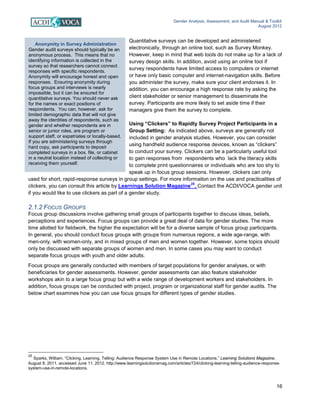
2.1.2 FOCUS GROUPS
Focus group discussions involve gathering small groups of participants together to discuss ideas, beliefs,
perceptions and experiences. Focus groups can provide a great deal of data for gender studies. The more
time allotted for fieldwork, the higher the expectation will be for a diverse sample of focus group participants.
In general, you should conduct focus groups with groups from numerous regions, a wide age-range, with
men-only, with women-only, and in mixed groups of men and women together. However, some topics should
only be discussed with separate groups of women and men. In some cases you may want to conduct
separate focus groups with youth and older adults.
Focus groups are generally conducted with members of target populations for gender analyses, or with
beneficiaries for gender assessments. However, gender assessments can also feature stakeholder
workshops akin to a large focus group but with a wide range of development workers and stakeholders. In
addition, focus groups can be conducted with project, program or organizational staff for gender audits. The
below chart examines how you can use focus groups for different types of gender studies.
25
Sparks, William, “Clicking, Learning, Telling: Audience Response System Use in Remote Locations,” Learning Solutions Magazine,
August 8, 2011, accessed June 11, 2012, http://www.learningsolutionsmag.com/articles/724/clicking-learning-telling-audience-response-
system-use-in-remote-locations.
Gender Analysis, Assessment, and Audit Manual & Toolkit
August 2012
17
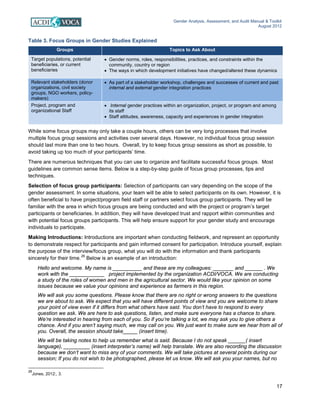
Table 3. Focus Groups in Gender Studies Explained
While some focus groups may only take a couple hours, others can be very long processes that involve
multiple focus group sessions and activities over several days. However, no individual focus group session
should last more than one to two hours. Overall, try to keep focus group sessions as short as possible, to
avoid taking up too much of your participants’ time.
There are numerous techniques that you can use to organize and facilitate successful focus groups. Most
guidelines are common sense items. Below is a step-by-step guide of focus group processes, tips and
techniques.
Selection of focus group participants: Selection of participants can vary depending on the scope of the
gender assessment. In some situations, your team will be able to select participants on its own. However, it is
often beneficial to have project/program field staff or partners select focus group participants. They will be
familiar with the area in which focus groups are being conducted and with the project or program’s target
participants or beneficiaries. In addition, they will have developed trust and rapport within communities and
with potential focus groups participants. This will help ensure support for your gender study and encourage
individuals to participate.
Making Introductions: Introductions are important when conducting fieldwork, and represent an opportunity
to demonstrate respect for participants and gain informed consent for participation. Introduce yourself, explain
the purpose of the interview/focus group, what you will do with the information and thank participants
sincerely for their time.
26
Below is an example of an introduction:
Hello and welcome. My name is __________ and these are my colleagues: _______ and ______ . We
work with the ____________ project implemented by the organization ACDI/VOCA. We are conducting
a study of the roles of women and men in the agricultural sector. We would like your opinion on some
issues because we value your opinions and experience as farmers in this region.
We will ask you some questions. Please know that there are no right or wrong answers to the questions
we are about to ask. We expect that you will have different points of view and you are welcome to share
your point of view even if it differs from what others have said. You don’t have to respond to every
question we ask. We are here to ask questions, listen, and make sure everyone has a chance to share.
We’re interested in hearing from each of you. So if you’re talking a lot, we may ask you to give others a
chance. And if you aren’t saying much, we may call on you. We just want to make sure we hear from all of
you. Overall, the session should take_____ (insert time).
We will be taking notes to help us remember what is said. Because I do not speak ______( insert
language), _________ (insert interpreter’s name) will help translate. We are also recording the discussion
because we don’t want to miss any of your comments. We will take pictures at several points during our
session; If you do not wish to be photographed, please let us know. We will ask you your names, but no
26
Jones, 2012:, 3.
Groups Topics to Ask About
Target populations, potential
beneficiaries, or current
beneficiaries
• Gender norms, roles, responsibilities, practices, and constraints within the
community, country or region
• The ways in which development initiatives have changed/altered these dynamics
Relevant stakeholders (donor
organizations, civil society
groups, NGO workers, policy-
makers)
• As part of a stakeholder workshop, challenges and successes of current and past
internal and external gender integration practices
Project, program and
organizational Staff
• Internal gender practices within an organization, project, or program and among
its staff
• Staff attitudes, awareness, capacity and experiences in gender integration
Gender Analysis, Assessment, and Audit Manual & Toolkit
August 2012
18
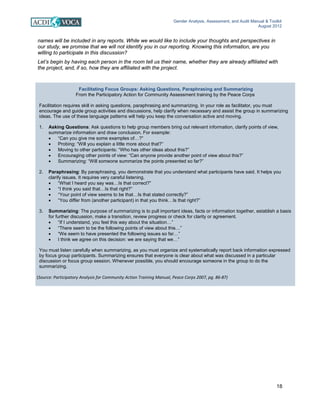
Facilitating Focus Groups: Asking Questions, Paraphrasing and Summarizing
From the Participatory Action for Community Assessment training by the Peace Corps
Facilitation requires skill in asking questions, paraphrasing and summarizing. In your role as facilitator, you must
encourage and guide group activities and discussions, help clarify when necessary and assist the group in summarizing
ideas. The use of these language patterns will help you keep the conversation active and moving.
1. Asking Questions: Ask questions to help group members bring out relevant information, clarify points of view,
summarize information and draw conclusion. For example:
• “Can you give me some examples of…?”
• Probing: “Will you explain a little more about that?”
• Moving to other participants: “Who has other ideas about this?”
• Encouraging other points of view: “Can anyone provide another point of view about this?”
• Summarizing: “Will someone summarize the points presented so far?”
2. Paraphrasing: By paraphrasing, you demonstrate that you understand what participants have said. It helps you
clarify issues. It requires very careful listening.
• “What I heard you say was…Is that correct?”
• “I think you said that…Is that right?”
• “Your point of view seems to be that…Is that stated correctly?”
• “You differ from (another participant) in that you think…Is that right?”
3. Summarizing: The purpose of summarizing is to pull important ideas, facts or information together, establish a basis
for further discussion, make a transition, review progress or check for clarity or agreement.
• “If I understand, you feel this way about the situation…”
• “There seem to be the following points of view about this…”
• “We seem to have presented the following issues so far…”
• I think we agree on this decision: we are saying that we…”
You must listen carefully when summarizing, as you must organize and systematically report back information expressed
by focus group participants. Summarizing ensures that everyone is clear about what was discussed in a particular
discussion or focus group session. Whenever possible, you should encourage someone in the group to do the
summarizing.
(Source: Participatory Analysis for Community Action Training Manual, Peace Corps 2007, pg. 86-87)
names will be included in any reports. While we would like to include your thoughts and perspectives in
our study, we promise that we will not identify you in our reporting. Knowing this information, are you
willing to participate in this discussion?
Let’s begin by having each person in the room tell us their name, whether they are already affiliated with
the project, and, if so, how they are affiliated with the project.
Gender Analysis, Assessment, and Audit Manual & Toolkit
August 2012
19
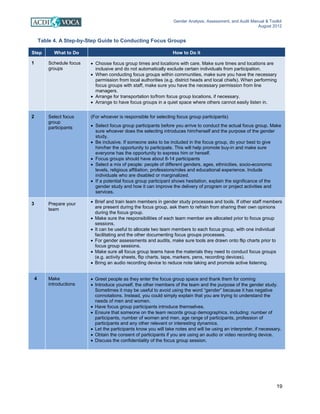
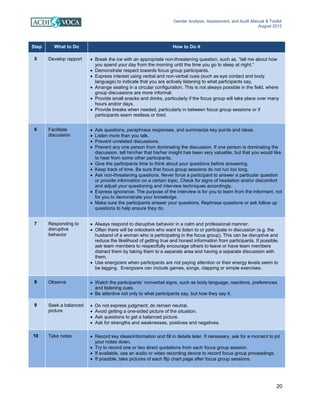
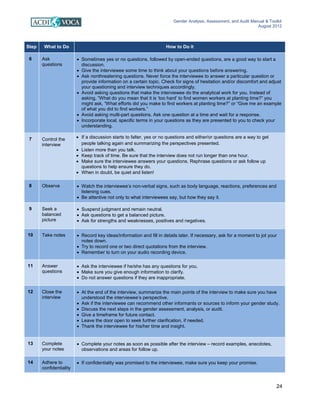
Table 4. A Step-by-Step Guide to Conducting Focus Groups
Step What to Do How to Do it
1 Schedule focus
groups
• Choose focus group times and locations with care. Make sure times and locations are
inclusive and do not automatically exclude certain individuals from participation.
• When conducting focus groups within communities, make sure you have the necessary
permission from local authorities (e.g. district heads and local chiefs). When performing
focus groups with staff, make sure you have the necessary permission from line
managers.
• Arrange for transportation to/from focus group locations, if necessary.
• Arrange to have focus groups in a quiet space where others cannot easily listen in.
2 Select focus
group
participants
(For whoever is responsible for selecting focus group participants)
• Select focus group participants before you arrive to conduct the actual focus group. Make
sure whoever does the selecting introduces him/herself and the purpose of the gender
study.
• Be inclusive. If someone asks to be included in the focus group, do your best to give
him/her the opportunity to participate. This will help promote buy-in and make sure
everyone has the opportunity to express him or herself.
• Focus groups should have about 8-14 participants
• Select a mix of people: people of different genders, ages, ethnicities, socio-economic
levels, religious affiliation, professions/roles and educational experience. Include
individuals who are disabled or marginalized.
• If a potential focus group participant shows hesitation, explain the significance of the
gender study and how it can improve the delivery of program or project activities and
services.
3 Prepare your
team
• Brief and train team members in gender study processes and tools. If other staff members
are present during the focus group, ask them to refrain from sharing their own opinions
during the focus group.
• Make sure the responsibilities of each team member are allocated prior to focus group
sessions.
• It can be useful to allocate two team members to each focus group, with one individual
facilitating and the other documenting focus groups processes.
• For gender assessments and audits, make sure tools are drawn onto flip charts prior to
focus group sessions.
• Make sure all focus group teams have the materials they need to conduct focus groups
(e.g. activity sheets, flip charts, tape, markers, pens, recording devices).
• Bring an audio recording device to reduce note taking and promote active listening.
4 Make
introductions
• Greet people as they enter the focus group space and thank them for coming
• Introduce yourself, the other members of the team and the purpose of the gender study.
Sometimes it may be useful to avoid using the word “gender” because it has negative
connotations. Instead, you could simply explain that you are trying to understand the
needs of men and women.
• Have focus group participants introduce themselves.
• Ensure that someone on the team records group demographics, including: number of
participants, number of women and men, age range of participants, profession of
participants and any other relevant or interesting dynamics.
• Let the participants know you will take notes and will be using an interpreter, if necessary.
• Obtain the consent of participants if you are using an audio or video recording device.
• Discuss the confidentiality of the focus group session.
Gender Analysis, Assessment, and Audit Manual & Toolkit
August 2012
20
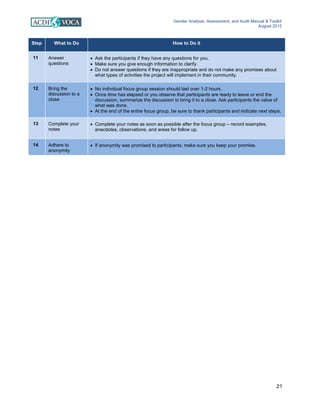
Step What to Do How to Do it
5 Develop rapport • Break the ice with an appropriate non-threatening question, such as, “tell me about how
you spend your day from the morning until the time you go to sleep at night.”
• Demonstrate respect towards focus group participants.
• Express interest using verbal and non-verbal cues (such as eye contact and body
language) to indicate that you are actively listening to what participants say.
• Arrange seating in a circular configuration. This is not always possible in the field, where
group discussions are more informal.
• Provide small snacks and drinks, particularly if the focus group will take place over many
hours and/or days.
• Provide breaks when needed, particularly in between focus group sessions or if
participants seem restless or tired.
6 Facilitate
discussion
• Ask questions, paraphrase responses, and summarize key points and ideas.
• Listen more than you talk.
• Prevent unrelated discussions.
• Prevent any one person from dominating the discussion. If one person is dominating the
discussion, tell him/her that his/her insight has been very valuable, but that you would like
to hear from some other participants.
• Give the participants time to think about your questions before answering.
• Keep track of time. Be sure that focus group sessions do not run too long.
• Ask non-threatening questions. Never force a participant to answer a particular question
or provide information on a certain topic. Check for signs of hesitation and/or discomfort
and adjust your questioning and interview techniques accordingly.
• Express ignorance. The purpose of the interview is for you to learn from the informant, not
for you to demonstrate your knowledge.
• Make sure the participants answer your questions. Rephrase questions or ask follow up
questions to help ensure they do.
7 Responding to
disruptive
behavior
• Always respond to disruptive behavior in a calm and professional manner.
• Often there will be onlookers who want to listen to or participate in discussion (e.g. the
husband of a woman who is participating in the focus group). This can be disruptive and
reduce the likelihood of getting true and honest information from participants. If possible,
ask team members to respectfully encourage others to leave or have team members
distract them by taking them to a separate area and having a separate discussion with
them.
• Use energizers when participants are not paying attention or their energy levels seem to
be lagging. Energizers can include games, songs, clapping or simple exercises.
8 Observe • Watch the participants’ nonverbal signs, such as body language, reactions, preferences
and listening cues.
• Be attentive not only to what participants say, but how they say it.
9 Seek a balanced
picture
• Do not express judgment; do remain neutral.
• Avoid getting a one-sided picture of the situation.
• Ask questions to get a balanced picture.
• Ask for strengths and weaknesses, positives and negatives.
10 Take notes • Record key ideas/information and fill in details later. If necessary, ask for a moment to jot
your notes down.
• Try to record one or two direct quotations from each focus group session.
• If available, use an audio or video recording device to record focus group proceedings.
• If possible, take pictures of each flip chart page after focus group sessions.
Gender Analysis, Assessment, and Audit Manual & Toolkit
August 2012
21
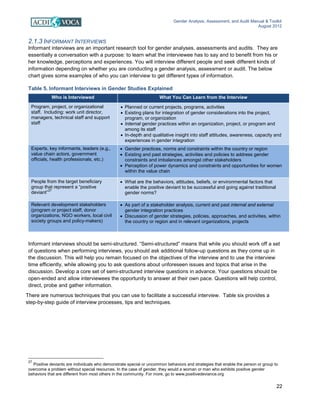
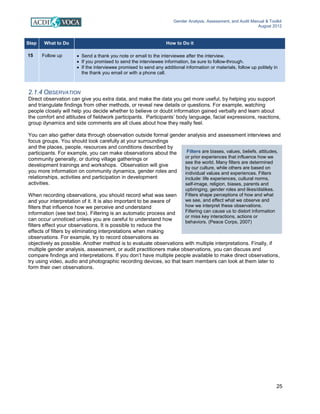
Step What to Do How to Do it
11 Answer
questions
• Ask the participants if they have any questions for you.
• Make sure you give enough information to clarify.
• Do not answer questions if they are inappropriate and do not make any promises about
what types of activities the project will implement in their community.
12 Bring the
discussion to a
close
• No individual focus group session should last over 1-2 hours.
• Once time has elapsed or you observe that participants are ready to leave or end the
discussion, summarize the discussion to bring it to a close. Ask participants the value of
what was done.
• At the end of the entire focus group, be sure to thank participants and indicate next steps.
13 Complete your
notes
• Complete your notes as soon as possible after the focus group – record examples,
anecdotes, observations, and areas for follow up.
14 Adhere to
anonymity
• If anonymity was promised to participants, make sure you keep your promise.
Gender Analysis, Assessment, and Audit Manual & Toolkit
August 2012
22
2.1.3 INFORMANT INTERVIEWS
Informant interviews are an important research tool for gender analyses, assessments and audits. They are
essentially a conversation with a purpose: to learn what the interviewee has to say and to benefit from his or
her knowledge, perceptions and experiences. You will interview different people and seek different kinds of
information depending on whether you are conducting a gender analysis, assessment or audit. The below
chart gives some examples of who you can interview to get different types of information.
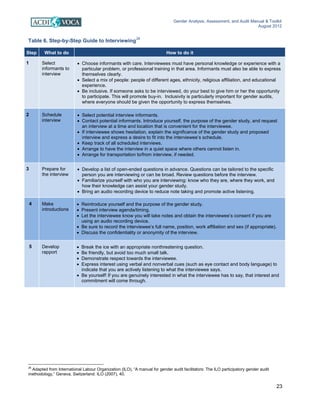
Table 5. Informant Interviews in Gender Studies Explained
Informant interviews should be semi-structured. “Semi-structured” means that while you should work off a set
of questions when performing interviews, you should ask additional follow-up questions as they come up in
the discussion. This will help you remain focused on the objectives of the interview and to use the interview
time efficiently, while allowing you to ask questions about unforeseen issues and topics that arise in the
discussion. Develop a core set of semi-structured interview questions in advance. Your questions should be
open-ended and allow interviewees the opportunity to answer at their own pace. Questions will help control,
direct, probe and gather information.
There are numerous techniques that you can use to facilitate a successful interview. Table six provides a
step-by-step guide of interview processes, tips and techniques.
27
Positive deviants are individuals who demonstrate special or uncommon behaviors and strategies that enable the person or group to
overcome a problem without special resources. In the case of gender, they would a woman or man who exhibits positive gender
behaviors that are different from most others in the community. For more, go to www.positivedeviance.org
Who is Interviewed What You Can Learn from the Interview
Program, project, or organizational
staff. Including: work unit director,
managers, technical staff and support
staff
• Planned or current projects, programs, activities
• Existing plans for integration of gender considerations into the project,
program, or organization
• Internal gender practices within an organization, project, or program and
among its staff
• In-depth and qualitative insight into staff attitudes, awareness, capacity and
experiences in gender integration
Experts, key informants, leaders (e.g.,
value chain actors, government
officials, health professionals, etc.)
• Gender practices, norms and constraints within the country or region
• Existing and past strategies, activities and policies to address gender
constraints and imbalances amongst other stakeholders
• Perception of power dynamics and constraints and opportunities for women
within the value chain
People from the target beneficiary
group that represent a “positive
deviant”
27
• What are the behaviors, attitudes, beliefs, or environmental factors that
enable the positive deviant to be successful and going against traditional
gender norms?
Relevant development stakeholders
(program or project staff, donor
organizations, NGO workers, local civil
society groups and policy-makers)
• As part of a stakeholder analysis, current and past internal and external
gender integration practices
• Discussion of gender strategies, policies, approaches, and activities, within
the country or region and in relevant organizations, projects
Gender Analysis, Assessment, and Audit Manual & Toolkit
August 2012
23
Table 6. Step-by-Step Guide to Interviewing
28
28
Adapted from International Labour Organization (ILO), “A manual for gender audit facilitators: The ILO participatory gender audit
methodology,” Geneva, Switzerland: ILO (2007), 40.
Step What to do How to do it
1 Select
informants to
interview
• Choose informants with care. Interviewees must have personal knowledge or experience with a
particular problem, or professional training in that area. Informants must also be able to express
themselves clearly.
• Select a mix of people: people of different ages, ethnicity, religious affiliation, and educational
experience.
• Be inclusive. If someone asks to be interviewed, do your best to give him or her the opportunity
to participate. This will promote buy-in. Inclusivity is particularly important for gender audits,
where everyone should be given the opportunity to express themselves.
2 Schedule
interview
• Select potential interview informants.
• Contact potential informants. Introduce yourself, the purpose of the gender study, and request
an interview at a time and location that is convenient for the interviewee.
• If interviewee shows hesitation, explain the significance of the gender study and proposed
interview and express a desire to fit into the interviewee’s schedule.
• Keep track of all scheduled interviews.
• Arrange to have the interview in a quiet space where others cannot listen in.
• Arrange for transportation to/from interview, if needed.
3 Prepare for
the interview
• Develop a list of open-ended questions in advance. Questions can be tailored to the specific
person you are interviewing or can be broad. Review questions before the interview.
• Familiarize yourself with who you are interviewing: know who they are, where they work, and
how their knowledge can assist your gender study.
• Bring an audio recording device to reduce note taking and promote active listening.
4 Make
introductions
• Reintroduce yourself and the purpose of the gender study.
• Present interview agenda/timing.
• Let the interviewee know you will take notes and obtain the interviewee’s consent if you are
using an audio recording device.
• Be sure to record the interviewee’s full name, position, work affiliation and sex (if appropriate).
• Discuss the confidentiality or anonymity of the interview.
5 Develop
rapport
• Break the ice with an appropriate nonthreatening question.
• Be friendly, but avoid too much small talk.
• Demonstrate respect towards the interviewee.
• Express interest using verbal and nonverbal cues (such as eye contact and body language) to
indicate that you are actively listening to what the interviewee says.
• Be yourself! If you are genuinely interested in what the interviewee has to say, that interest and
commitment will come through.
Gender Analysis, Assessment, and Audit Manual & Toolkit
August 2012
24
Step What to Do How to Do it
6 Ask
questions
• Sometimes yes or no questions, followed by open-ended questions, are a good way to start a
discussion.
• Give the interviewee some time to think about your questions before answering.
• Ask nonthreatening questions. Never force the interviewee to answer a particular question or
provide information on a certain topic. Check for signs of hesitation and/or discomfort and adjust
your questioning and interview techniques accordingly.
• Avoid asking questions that make the interviewee do the analytical work for you. Instead of
asking, “What do you mean that it is ‘too hard’ to find women workers at planting time?” you
might ask, “What efforts did you make to find workers at planting time?” or “Give me an example
of what you did to find workers.”
• Avoid asking multi-part questions. Ask one question at a time and wait for a response.
• Incorporate local, specific terms in your questions as they are presented to you to check your
understanding.
7 Control the
interview
• If a discussion starts to falter, yes or no questions and either/or questions are a way to get
people talking again and summarizing the perspectives presented.
• Listen more than you talk.
• Keep track of time. Be sure that the interview does not run longer than one hour.
• Make sure the interviewee answers your questions. Rephrase questions or ask follow up
questions to help ensure they do.
• When in doubt, be quiet and listen!
8 Observe • Watch the interviewee’s non-verbal signs, such as body language, reactions, preferences and
listening cues.
• Be attentive not only to what interviewees say, but how they say it.
9 Seek a
balanced
picture
• Suspend judgment and remain neutral.
• Ask questions to get a balanced picture.
• Ask for strengths and weaknesses, positives and negatives.
10 Take notes • Record key ideas/information and fill in details later. If necessary, ask for a moment to jot your
notes down.
• Try to record one or two direct quotations from the interview.
• Remember to turn on your audio recording device.
11 Answer
questions
• Ask the interviewee if he/she has any questions for you.
• Make sure you give enough information to clarify.
• Do not answer questions if they are inappropriate.
12 Close the
interview
• At the end of the interview, summarize the main points of the interview to make sure you have
understood the interviewee’s perspective.
• Ask if the interviewee can recommend other informants or sources to inform your gender study.
• Discuss the next steps in the gender assessment, analysis, or audit.
• Give a timeframe for future contact.
• Leave the door open to seek further clarification, if needed.
• Thank the interviewee for his/her time and insight.
13 Complete
your notes
• Complete your notes as soon as possible after the interview – record examples, anecdotes,
observations and areas for follow up.
14 Adhere to
confidentiality
• If confidentiality was promised to the interviewee, make sure you keep your promise.
Gender Analysis, Assessment, and Audit Manual & Toolkit
August 2012
25
Filters are biases, values, beliefs, attitudes,
or prior experiences that influence how we
see the world. Many filters are determined
by our culture, while others are based on
individual values and experiences. Filters
include: life experiences, cultural norms,
self-image, religion, biases, parents and
upbringing, gender roles and likes/dislikes.
Filters shape perceptions of how and what
we see, and effect what we observe and
how we interpret these observations.
Filtering can cause us to distort information
or miss key interactions, actions or
behaviors. (Peace Corps, 2007)
2.1.4 OBSERVATION
Direct observation can give you extra data, and make the data you get more useful, by helping you support
and triangulate findings from other methods, or reveal new details or questions. For example, watching
people closely will help you decide whether to believe or doubt information gained verbally and learn about
the comfort and attitudes of fieldwork participants. Participants’ body language, facial expressions, reactions,
group dynamics and side comments are all clues about how they really feel.
You can also gather data through observation outside formal gender analysis and assessment interviews and
focus groups. You should look carefully at your surroundings
and the places, people, resources and conditions described by
participants. For example, you can make observations about the
community generally, or during village gatherings or
development trainings and workshops. Observation will give
you more information on community dynamics, gender roles and
relationships, activities and participation in development
activities.
When recording observations, you should record what was seen
and your interpretation of it. It is also important to be aware of
filters that influence how we perceive and understand
information (see text box). Filtering is an automatic process and
can occur unnoticed unless you are careful to understand how
filters effect your observations. It is possible to reduce the
effects of filters by eliminating interpretations when making
observations. For example, try to record observations as
objectively as possible. Another method is to evaluate observations with multiple interpretations. Finally, if
multiple gender analysis, assessment, or audit practitioners make observations, you can discuss and
compare findings and interpretations. If you don’t have multiple people available to make direct observations,
try using video, audio and photographic recording devices, so that team members can look at them later to
form their own observations.
Step What to Do How to Do it
15 Follow up • Send a thank you note or email to the interviewee after the interview.
• If you promised to send the interviewee information, be sure to follow-through.
• If the interviewee promised to send any additional information or materials, follow up politely in
the thank you email or with a phone call.
Gender Analysis, Assessment, and Audit Manual & Toolkit
August 2012
26
Utilizing Observation as a Data-Gathering Tool in a Range of Contexts/Situations
Gender Analysis
Upon entering a community:
• Who can be seen around the community? Are specific segments of the population absent?
• What is housing like? How close together are houses? Who can be seen around the home?
• Is there a clinic/hospital, school, water source, and market in the community? Where is it located? Is it accessible?
Does it look clean? Who is gathered around the sites? Who seems to be utilizing these resources?
• Are there signs of under/malnutrition among children?
• What activities are people engaged in? Who is responsible for these activities?
Village Gathering
• Who plays a leadership role within the community or speaks at village gatherings and who does not?
• Who attends community gatherings and who does not?
• Where and at what time is the village gathering held? Is the time and location accessible to everyone?
• Who is treated with respect? Who is not?
During the delivery of a development activity
• Number of men and women participating in activity
• Who is paying attention and seem engaged/interested
• Are both women and men actively participating?
• Are participants doing other tasks (such as sewing/mending or watching children) while participating? Who? What?
• What does the body language of participants indicate?
• Where and at what time is the activity held? Is the time and location accessible to everyone?
During Gender Analysis and Assessment Focus Groups and Interviews
• Who is actively speaking? Who is not speaking? Does anyone seem reluctant to participate?
• What exercises, questions, or discussions make participants seem uncomfortable? Sad? Threatened? Happy?
Excited?
• How are participants dressed?
• Are participants doing other tasks (such as sewing/mending or watching children) while participating? Who? What?
• What does the body language of participants indicate?
Gender Assessments and Audits
During the delivery of a development activity
• Is the activity facilitator making an effort to engage all participants? Both women and men? Does the facilitator feel
comfortable working and engaging with both women and men?
• What tools and/or strategies does the facilitator use to ensure that everyone actively participates?
• Where and at what time are focus groups or interviews held? Is the time and location accessible to everyone?
• If any gender issues are discussed, does the facilitator seem comfortable and familiar with the information?
During an organizational, program, or project meeting
• Is anyone dominating the meeting? Who is speaking more? Women or men?
• Does everyone seem to be comfortable participating?
• Does it appear that everyone’s opinions and insights are respected when they speak?
Gender Analysis, Assessment, and Audit Manual & Toolkit
August 2012
27
Interpretation Means: More Time
Bear in mind that all processes that require
translation will take longer. Additional time
will be needed for information to be
translated and repeated across languages.
Consequently, translation can increase
fieldwork processes by almost twice the
time. Integrate these considerations into all
planning and scheduling.
2.2 USING AN INTERPRETER
If you don’t speak the language of the target study participants,
you will need an interpreter. There are important steps and
considerations you should take to make sure the
interpretation does not disrupt your study. First, find out what
language(s) are spoken by potential fieldwork participants. Then,
find out if any of the gender study team members are fluent in
these languages. If so, find out if he/she is willing to act as an
interpreter. Check the work plan and their scope of work to make
sure that assigning them translation duty will not detract from their ability to carry out their other roles and
responsibilities. If your team does not include anyone who can act as an interpreter, you will need to find one
or more interpreters. Most often, you will be able to find members from the project, program, or organization
included in the gender study to act as interpreters. This is ideal as they will be familiar with the community and
participants included in fieldwork, but will also be able to remain objective. It is also cost-effective. If you
cannot find a field-based staff member to translate, try to hire an interpreter who comes recommended. As a
last resort, you can ask a community member to translate.
Keep in mind that interpretation involves practice and specific skill sets. You will need someone who can
actively listen to both you and your fieldwork participants and provide accurate interpretations to both parties.
Additionally, make sure interpreters are clear on what is expected of them and what the fieldwork process
entails. Communicate that it is their job to remain neutral and relay information back and forth as accurately
as possible. It is a good idea to give interpreters a brief overview of the tools that will be used prior to any
focus groups or interviews.
2.3 NOTE-TAKING AND RECORDING
It is important that all fieldwork is properly documented and recorded to assist in analyzing data and meeting
gender study deliverables. In recording fieldwork, choose a system that works best for you and the particulars
of your gender study. It can be useful to have assistant note takers to sit in on fieldwork sessions. If you adopt
this approach, make sure you train assistant note-takers and ensure they are clear about your expectations.
Even so, do not rely on them for all of your notes. You should always take some notes for yourself. If you are
working as part of a team for your gender study, you can also conduct gender analysis or assessment
fieldwork in teams of two. Under this system, one individual can facilitate interviews or focus groups, while the
other takes notes and records the session. However, even in this arrangement, designated facilitators should
still take notes on key points.
Always be sure to record the date, location, and specifications of the focus group or interview,
number of people in attendance, sex of participants, and their affiliation, at the start of the meeting.
You may want to also record other demographic details such as: age range, occupation or livelihood activity,
marriage status (e.g. single, widowed, divorced, if in polygamous marriage or not), and number of children.
You will need to include this information, particularly the number of women and men who participated in
interviews and focus groups, in your final report. Much of the additional demographic data can also be used to
draw important comparisons when you begin to analyze data.
To ensure that you capture this data, it is highly recommended that you include an activity
cover sheet for each focus group and interview, and assign one person to be responsible for
completing it. Activity cover sheets should include: date, location, time, facilitator name,
recorder name (if different), interpreter name (if used), tools used and number of
participant(s) (by gender and age range). A sample activity sheet is in Appendix 2.
Gender Analysis, Assessment, and Audit Manual & Toolkit
August 2012
28
Appendix 2: SAMPLE ACTIVITY SHEET.
AUDIO AND VISUAL RECORDING: It is recommended that you use an audio-recorder device with an MP3
connection to record fieldwork processes. This way, the facilitator can engage with focus groups and
interviewees, and take additional notes from the recording at a later time. The audio recorder will enable you
to review and transcribe the full discussions. It is also recommended that you assign someone to take a few
pictures of each focus group discussion. When flip charts are used, take pictures of all flip chart pages after
the completion of a focus group. Video can also be a useful tool to record fieldwork observations and
processes, but it can make some people uncomfortable. Video can capture many observations that might go
unnoticed when initially conducting focus group and interview sessions, such as seating arrangements and
the body language of participants.
When using audio and visual recording methods, be sure that they that will be acceptable and comfortable to
interviewees and focus group participants. Gender studies often involve speaking about sensitive or
controversial topics. Participants or interviewees may feel uncomfortable or unsafe discussing these topics if
a large number of note takers are present or if sessions are being recorded. In addition, make sure the
gender dynamics of note-takers or recorders will not affect focus group or interview findings. For example,
female participants might be uncomfortable discussing sensitive topics in the presence of a male note taker or
interpreter. When using photography, video, or recording devices, you must first get informed consent from all
people being filmed, photographed or recorded. Simply ask permission at the beginning of the focus group or
interview.
2.4 ETHICAL CONSIDERATIONS
There are a number of ethical considerations to bear in mind when conducting a gender study. Most
importantly, make sure that all team members are aware of, and adhere to, the following international
guidelines on ethical principles when working with human subjects. Following these guidelines is essential for
ensuring the safety of your participants and the quality of your data.
29
• RESPECT FOR INFORMANTS: You can demonstrate respect for participants by gaining informed consent
from them before you begin fieldwork. In addition, you can also obtain support from communities before
you begin fieldwork with potential targets and beneficiaries.
• MINIMIZING HARM: Participation in fieldwork should never lead to harm. Protect your participants to the
best of your ability and adhere to confidentiality in the reporting and sharing of data. The safety of
participants and your research team is vitally important and should guide all project decisions.
• MAXIMIZING BENEFITS: Asking participants to discuss attitudes, beliefs and experiences can be
important processes of self-reflection and empowerment. Additionally, study findings should result in
policies, advocacy and interventions that work towards social change.
INFORMED CONSENT AND CONFIDENTIALITY: As indicated in the previous section of the manual, you
must obtain informed consent from all interviewees and fieldwork participants. This requires informing
participates of the purpose of your research, the structure of the focus group and/or interview, as well as the
risks and benefits of their participation. Consent can be given orally or in written format.
30
When asking for
informed consent, it is important to communicate that confidentiality will be preserved in all reports,
workshops, trainings and discussions resulting from the focus group or interview. Notes, photographs, video
29
Ellsberg, Mary, Lori Heise, “Researching Violence Against Women: A Practical Guide for Researchers and Activists, Chapter Two,”
Washington D.C., United States: World Health Organization, PATH (2005), 36.
30
SA Health Info, “8. Ethics Issues in Qualitative Research,” accessed June 8, 2012,
http://www.sahealthinfo.org/ethics/ethicsqualitative.htm
Gender Analysis, Assessment, and Audit Manual & Toolkit
August 2012
29
A Discussion on Confidentiality
Adhering to confidentiality means that while you may know the identity of gender study participants and who said what,
you won’t reveal who gave what response when reporting information and findings. Furthermore you will make every effort
to prevent anyone outside of the study from connecting individual participants with their responses. Names and identities
should never be revealed in reports or any other materials. This will prevent participants from being identified or getting
into trouble for any responses or views provided during the course of the research process. The following guidelines will
help you adhere to confidentiality.
However, in some instances, you may want to acknowledge the person who said something. For example, if someone has
the potential to be a good champion of women’s empowerment and gender initiatives, you might want to record their name
and contact information (or even take a picture of them) so that you can contact him/her later to bring into programming. If
this is the case, use the term confidentiality cautiously and request permission from the individual before sharing their
identity and/or responses. If it is essential to collect and link identifying information (e.g. participants’ names) to their
responses, you can increase your level of confidentiality by storing notes and data in a secure or locked location and
limiting who can access identifiable information. You can also assign participants with individual codenames and use
these codes in all notes and data documents. Keep a separate document that links the code of each participant to his or
her true identity and make sure this document is kept in a secure location.
If an informant specifically asks for confidentiality, then you must adhere to your promise to protect their identity or the
content of what they said. Similarly, if someone asks for their information to be private or “off the record”, then you must
keep it to yourself and cannot include it in your gender study report. You should also take special care to adhere to
confidentiality for studies that are covering especially sensitive issues, such as gender-based violence or sensitive political
issues. Regardless of what promises you make in terms of confidentiality, all information gained from fieldwork should be
handled with sensitivity and the utmost respect.
and audio documenting fieldwork processes should only be shown to those who are involved in the gender
analysis, assessment or audit and client stakeholders, and only when necessary and not a violation of
anonymity. When reporting on findings or discussing gender study processes or data with stakeholders,
colleagues, friends or others, you must be sure to adhere to confidentiality and not reveal the names or other
identifying information of your participants. In practicing informed consent and anonymity, you are adhering to
two fundamental principles: respect for autonomy and protection of vulnerable persons.
31
MANAGING EXPECTATIONS: Involvement of target populations and beneficiaries in fieldwork may generate
enthusiasm and anticipation about future development interventions. While this is positive, it can lead to
problems if expectations are too high or implementation does not occur. To help manage expectations of
participants, you should be honest and clear from the beginning of your gender study and throughout the
process about whether or not resources from outside development organizations will be available and in what
capacity. Give realistic estimates of what participants should expect and when resources will be
implemented.
32
If resources will not be available or the level of support is unknown at the time of the study,
communicate this to participants in a diplomatic way and explain the importance of participation within the
context of the gender study and future programming.
LEARNING ABOUT ILLEGAL ACTIVITIES: It is possible that fieldwork participants will reveal activities that
are against national laws. For example, participants might admit that girls are married before the legal
marriage age or that or that they collect wood from protected forests for fuel. You should decide how to
handle disclosures of illegal activities based on the openness and responsiveness of the government and
thorough discussion with client stakeholders (if appropriate). You should never use the information in a way
that might result in serious sanctions on participants or their communities.
CREATING CONFLICT: Fieldwork processes will not always lead to consensus. Sometimes, they may
expose deep differences and conflict among groups of participants. Issues of conflict should be handled with
31
Ellsberg, 2005: 36.
32
FAO, 2001:, 28.
Gender Analysis, Assessment, and Audit Manual & Toolkit
August 2012
30
Gender-Based Violence (GBV) is defined as any act
that results in, or is likely to result in, physical, sexual,
or psychological harm or suffering to women,
including threats of such acts, coercion, or arbitrary
deprivation of liberty, whether occurring in public or
private life. GBV can come in many forms and can be
committed and experienced by a wide range of
perpetrators and victims. Forms of GBV include rape,
sexual abuse, domestic violence, sexual harassment
and intimidation at work, female genital cutting and
other traditional practices that are harmful to women,
marital rape, early or forced marriage, sexual
exploitation, trafficking of women, and forced
prostitution. (U.N. Declaration on the Elimination of
Violence Against Women)
great care, particularly as they can lead to physical violence. When conflict occurs, you must either 1) take a
break or stop fieldwork or 2) use negotiation and conflict resolution methods to address conflicts. Do not use
the second option unless you have specialized skills and expertise in conflict mediation.
33
DISCUSSING HIGHLY-SENSITIVE TOPICS: Gender study processes may sometimes involve discussing
highly sensitive and potentially threatening and traumatic subject matters, such as gender-based violence
(GBV). In addition, there is a risk that participation in fieldwork will cause respondents harm. For example, a
participant may suffer physical harm if a partner finds out she participated without his permission or discussed
personal aspects of their relationship. Additionally, gender study fieldwork can often be empowering for
participants. Gender studies are often designed to ensure that women and disadvantaged groups participate
fully. More powerful groups might see this as a challenge and threat, which can also lead to violence against
your participants. As a result of these risks, you should get approval by ACDI/VOCA’s global gender
advisor before you include gender-based violence (GBV) or sensitive topics in your gender study.
If you are performing research on highly sensitive matters, such as GBV, follow these steps to minimize risks
to your team members and participants:
• If you decide it is necessary to discuss GBV or a similarly sensitive topic in your gender study, you
must get prior approval by ACDI/VOCA’s global gender advisor.
• Ensure that team members have the appropriate knowledge and training to perform fieldwork on
sensitive topics.
• Include only one participant per household in a focus group or in your entire fieldwork process.
• Conduct fieldwork in complete privacy. If an outsider enters the fieldwork space, ask questions about
non-sensitive topics until they leave.
• Do not inform the wider community on the
sensitive topics you will be discussing.
• Always be alert for signs of distress among
participants. Make sure all gender study team
members are properly trained to handle
situations of distress.
• Avoid discussing sensitive gender issues in
groups containing both women and men.
Instead, perform fieldwork with separate groups
of women and men.
• End your focus group or interview on a positive,
empowering note that emphasizes strengths.
• In case participants request assistance or
support, you should know what resources are available and where to access them. If few resources
exist, you may need to create short-term support mechanisms.
34
Refer to PATH’s Practical Guide on Researching Violence Against Women
35
for further discussion of
ethical issues that may arise when conducting your gender study. You can also consult the guidelines on
Protecting Confidentiality
36
from VirginiaTech for more information on how to use study codes.
33
Ibid, 29.
34
Ellsberg, 2005: 28, 36, & 39.
35
Ellsberg, Mary, Lori Heise, “Researching Violence Against Women: A Practical Guide for Researchers and Activists, Chapter Two,”
Washington D.C., United States: World Health Organization, PATH (2005), accessed June 11, 2012,
http://www.path.org/publications/files/GBV_rvaw_ch2.pdf.
Gender Analysis, Assessment, and Audit Manual & Toolkit
August 2012
31
36
Virginia Polytechnic Institute and State University, “Protecting Confidentiality & Anonymity,” Virginia Polytechnic Institute and State
University, accessed June 11, 2012, http://www.irb.vt.edu/pages/confidentiality.htm.
Gender Analysis, Assessment, and Audit Manual & Toolkit
August 2012
32
PHASE 3. FROM ANALYSIS TO ACTION: ANALYZING FINDINGS AND
MAKING RECOMMENDATIONS
3.1 DATA ANALYSIS
It is recommended that you analyze data on an ongoing basis throughout every stage of the gender study,
rather than leaving data analysis to the final phase of the assessment. Consider setting aside a few hours
every day, or every couple of days, to review your notes, transcribe audio recordings, and summarize initial
observations and preliminary conclusions. If working with a team, information sharing will also be a key part of
this process. Organizing findings into charts when applicable, is also helpful.
37
Overall, you should choose a data analysis system that works best for you. Here is a step-by-step process
that you can consider using.
STEP 1: REVIEW RESEARCH QUESTIONS AND FIELDWORK QUESTIONS It is important to look back and renew
your understanding of the central issues and key purposes of your gender study. Remind yourself: “Why was
this information necessary?” and “What kinds of decisions will be made based on this information?”
38
STEP 2: SKIM YOUR NOTES AND TRANSCRIPTIONS TO IDENTIFY PRELIMINARY THEMES Skim notes, charts
and transcriptions and use your working memory to identify patterns, dynamics, trends, practices and
surprises. Determine a preliminary set of themes from your notes.
STEP 3: ORGANIZE DATA BY THEME Create a “theme” document in Microsoft Word with each specific theme
listed on a separate page. Next, go through all your notes from desk review sources, interviews, focus groups,
and observations and copy and paste (do not cut and paste) comments and findings from your notes into to
the appropriate theme document. Each time you do this, put the name of the source of the information in
parentheses. Note the page number if using desk review materials. Change the color of the font in your notes
for all comments that you have copied to a theme document. This way, you can keep track of what portion of
an interview, focus group, or desk review source you have not been able to attribute to an existing theme. Go
through all your notes in this manner.
STEP 4: RE-THINK YOUR PRELIMINARY THEMES Once you have gone through all your notes, read the
portions of your notes that did not fit into any of your preliminary themes and determine what additional
themes to add. Next, read through all your notes again to add comments for your newly added themes. The
result is a comprehensive Word document that lists all themes with specific comments related to each
theme.
39
Because you have noted the source of each comment in parentheses, you will be able to keep track
of where each comment came from.
STEP 5: HOW DO THE THEMES AND THE RESPONSES ANSWER YOUR RESEARCH QUESTIONS? Following
this, read through your notes on each individual theme. Identify overarching patterns and conclusions. Take
note of contrasts between sources. Highlight information that answers your key research questions.
DATA ORGANIZATION VARIATION: USE CHARTS AND GRAPHICS TOOLS TO HELP YOU ORGANIZE YOUR
INFORMATION. Charts and graphics can be very helpful for both analyzing and displaying your findings. For
37
Jones, 2012: 3.
38
FAO, 2001: 39.
39
Keskinen, Susan, “MNEA Week: Susan Keskinen on Qualitative Data Analysis,” AEA365 (March 15, 2011), accessed June 2, 2012,
http://aea365.org/blog/?p=3103#comments
Gender Analysis, Assessment, and Audit Manual & Toolkit
August 2012
33
example, see Appendix 3: Data Analysis chart for the Activity Profile Tool. Using symbols to fill out an activity
chart, you will be able to visualize data and compare the groups’ responses from the same area.
STEP 6: REFLECT ON THE GENDER STUDY PROCESS AS A WHOLE Critical reflection of the entire gender
process will give you greater understanding of program participants’ knowledge of gender issues. Reflect
upon the extent of community participation, the behavior of the gender analysis team and the strengths and
weaknesses of your fieldwork tools. The following questions can help guide you in analyzing your gender
study process:
• Reflection questions on participation: What percentage of the population participated in the gender
study? How many were women? How many were men? What was the break down for position
level/nationality/socio-economic group? What strategies were used to access as many groups as
possible? What strategies worked? What did not work? Were any groups underrepresented?
• Reflection questions on your gender study team: How did participants respond to your team? Were
there any problems with rapport? Was the gender study well organized? Was your team flexible?
Was enough time allowed? What did your team do particularly well? What could be improved upon?
• Reflection questions on tools: How did participants respond to each tool? Did they actively
participate? Did some participate more than others? Who? Why? Did tools elicit useful information?
What were the drawbacks or limitations of tools? How could tools be improved?
3.2 DEVELOPING RECOMMENDATIONS
Once you have analyzed your data and research processes, you can begin to consider ways to use findings
and theories to answer to the research questions and make recommendations. Overall, recommendations
should be specific, action-oriented and realistic. Recommendations should focus less on what to do, and
more on how to do it. Your client solicited you to do this study because they had an idea of what they
wanted to do. Your recommendations should give them specific information on how to do that. Finally, recall
the resource limitations the client told you about at the beginning of your assignment, and craft
recommendations that are considerate of the limitations.
40
Recommendations can be institutional (related to internal practices, policies and attitudes in the organization
or project) or technical (related to programming). Try to come up with some short-term recommendations
that can have immediate effects as well as long-term recommendations. Finally, identify the actions you feel
are most important to highlight as priority recommendations.
In devising your recommendations, consider the following:
• Results and associated indicators that could be incorporated into program/project planning and
activity design.
• Supportive strategies and resources by government donors, host country government institutions and
local civil society groups. Also consider if there are areas for leverage or partnership.
• Specific activities related to gender equality and equity that should be continued within the
program/project’s current activities and any specific issues that require new activities to achieve
greater equality and empowerment for women.
• Resources and actions required to strengthen the gender equality dimensions of the program or
project internally, such as human resources, funding, policies, trainings and tools.
40
Jones, 2012: 3.
Gender Analysis, Assessment, and Audit Manual & Toolkit
August 2012
34
• Anticipated areas of resistance or constraints, and strategies to cope with such challenges.
41
If you encounter difficulties in developing suitable recommendations, it may be helpful to engage in a review
of applicable international best practices. Try to figure out what interventions, activities and policies have been
successful for other organizations, programs, and projects within the region or country of your gender study
and globally. Once you have identified several best practices, evaluate them to determine whether they are
applicable to your gender study.
The following resources may be useful for a review of best practices:
• World Bank Gender in Agriculture Sourcebook
42
: Provides case studies on innovative gender
activities around the world. Includes examples of best practices and innovations in the areas of
gender and rural finance, gender in issues of land policy and administration, gender and agricultural
markets, gender in agricultural innovation and education, gender issues in agricultural labor and
gender issues in monitoring and evaluation, among others.
• Promoting Gender Equitable Opportunities in Agricultural Value Chains
43
: This USAID
handbook brings together concepts from gender, agriculture, microenterprise development and value
chains and provides strategies for addressing gender issues in agricultural value chains. It also
includes text boxes on specific strategies that can be used as best practices, many of which have
achieved positive results when implemented by international projects.
• Gender and Rural Microfinance: Reaching and Empowering Women
44
: Developed by the
International Fund for Agricultural Development (IFAD), this guide provides short examples of global
innovations with regard to loan products, savings products, insurance programs for women, financial
literacy, integrating financial and non-financial services, and supporting women’s participation,
empowerment, property rights and political participation in and through microfinance groups.
• Gender in Planning and Urban Development
45
: This Commonwealth Secretariat Discussion Paper
presents guidelines and good practices on how to integrate gender awareness into urban planning. It
includes several case studies from Pakistan, Canada, Kenya, India and the UK on successful gender
integration approaches in urban development.
• Gender-aware Programs and Women's Roles in Agricultural Value Chains
46
: While this is
primarily a policy document on Liberia (prepared by the World Bank’s Gender and Development
Group), it includes text boxes with international best practices on sustainable seed production and
distribution, supporting agricultural value adding, and collective action and market linkages for women
farmers.
3.3 VALIDATE FINDINGS AND RECOMMENDATIONS WITH STAKEHOLDERS
41
Interagency Gender Working Group (IGWG), “A Practical Guide for Conducting and Managing Gender Assessments in the Health
Sector,” IAWG, (May 2012), 8.
42
World Bank, “Gender in Agriculture Sourcebook,” Washington, D.C.: World Bank, Food and Agriculture Organization of the United
Nations, International Fund for Agricultural Development (2009), accessed June 11, 2012,
ftp://ftp.fao.org/docrep/fao/011/aj288e/aj288e00.pdf.
43
Rubin, Deborah, Christina Manfre, and Kara Nichols Barrett, “Promoting Gender Equitable Opportunities in Agricultural Value Chains,”
Washington, D.C.: United States Agency for International Development Office of Women in Development, Greater Access for Trade
Expansion Project, accessed June 11, 2012, http://pslforum.worldbankgroup.org/docs/USAIDPromotingGenderOpportunities.pdf.
44
Mayoux, Linda, Maria Hartl, “Gender and rural microfinance: Reaching and empowering women,” Rome, Italy: International Fund for
Agricultural Development (2009), accessed June 11, 2012, http://www.ifad.org/gender/pub/gender_finance.pdf.
45
Malaza, Nqobile, Alison Todes, Amanda Williamson, and Cliff Hague, “Gender in Planning and Urban Development,” London, United
Kingdom: Commonwealth Secretariat (2009), accessed June 11, 2012,
http://www.thecommonwealth.org/files/218542/FileName/DP7withlinks.pdf.
46
World Bank Gender and Development Group, “Gender-aware Programs and Women’s Roles in Agricultural Value Chains,” Liberia:
World Bank Gender and Development Group, Ministry of Gender and Development (2010), accessed June 11, 2012,
http://siteresources.worldbank.org/EXTGENDER/Resources/LibGenAgrPolicyMem-Web-fin2.pdf.
Gender Analysis, Assessment, and Audit Manual & Toolkit
August 2012
35
When to Have a Stakeholder’s Workshop?
You can organize a stakeholder’s workshops at different stages of your gender study.
1) You can organize a stakeholder’s workshop after you have completed your research and data analysis phases. In
these cases, the purpose of your workshop is to: a) validate findings; b) formulate recommendations in a
participatory process; c) solicit feedback from stakeholders; and, d) informally survey stakeholders on the
resources and capacities needed to implement recommendations.
2) You can also organize a stakeholder’s workshop during the research stage of your gender study. In this instance,
you are using the workshop as a data-gathering tool, almost like a very large focus group. Depending on your
study’s scope, you can use the workshop to: a) introduce the study’s methodology; b) guide groups through rapid
value chain mapping exercises; c) discuss women’s and men’s roles, relationships, power dynamics, access to
resources and opportunities, and distribution of benefits; and, d) discuss institutional practices, activities,
achievements, gaps and challenges in integrating gender into programming and addressing gender-related
constraints.
Validation is a necessary process to ensure that stakeholders, gender study participants and facilitators
understand each other fully and that the overall findings and recommendations identified through the study
are correct and accurate. A great way to validate findings and recommendations is through a stakeholder’s
workshop or conference. A stakeholders’ workshop is a forum to validate gender study results with a broad
range of donors, implementing partners and public and private sector stakeholders.
Organizing a stakeholders’ workshop requires a great deal of time, effort and resources. Make sure you have
the necessary time and funding before you commit to organizing a workshop. It will not always be possible to
validate findings with stakeholders, particularly if you are lacking in time or financial resources. Additionally, a
validation process might not be included in your gender study’s scope of work.
The average length of stakeholder’s workshop is a half a day to a full day. Make sure you invite a range of
participants from different organizations and backgrounds. Invite senior representatives and officials who are
capable of providing high-level buy-in. You should also make efforts to invite significant numbers of both
women and men. In general, the workshop will feature presentations and information sharing in front of all
participants and time for participants to ask questions, give feedback and comment on presentations. This is
how you will validate your findings and recommendations. Stakeholder’s workshops can also include
participatory breakout groups for targeted discussions and activities. This will serve as another form of
validation for your gender study results. Participatory activities can include value chain mapping, discussions
on particular gender issues or constraints, or a SCOR analysis (see the tools section for more details).
The following bullet points will guide you in a step-by-step schedule for a stakeholder’s workshop:
• Begin your workshop with an introduction and welcome speech. It is sometimes a good idea to invite
your client to make introductions. It might also be worthwhile to include a brief presentation on the
role of gender in development.
• Next, present key findings and gender-disaggregated value chain maps using PowerPoint and
handouts. A round of feedback and questions should follow this.
• Your gender study team should then present the preliminary recommendations of your gender study,
followed by another round of questions and feedback.
• Following a presentation of recommendations, you can hold an optional breakout group session in
which you informally survey stakeholders on the resources and capacities needed to implement
recommendations. Breakout group discussions should then be presented to the overall workshop
group.
Gender Analysis, Assessment, and Audit Manual & Toolkit
August 2012
36
• Next, you can hold another breakout group session on certain thematic gender issues and constraints
that are integral to your gender study or suggested interventions. This is a great opportunity to use
the SCOR Tool included in the tools section to guide discussion and analyze strengths, challenges,
opportunities and risks for key issues or possible interventions. Each group should then summarize
and present their discussion to the larger workshop group.
• Finally, wrap up your workshop with a conclusion and discussion of follow-up and next steps. If your
budget allows it, conclude the workshop with a lunch or dinner to allow participants to network and
continue informal discussions on topics discussed during the workshop.
Gender Analysis, Assessment, and Audit Manual & Toolkit
August 2012
37
Resource Checklist and Guidelines for Organizing a Stakeholder’s Workshop
1. Budgeting:
• First, consult your budget, which will help you determine the length and size of your stakeholder’s workshop.
2. Select a date for your workshop:
• Confirm the date for the workshop as early as possible. Check in advance that the date works with your client
and any key stakeholders whose attendance is crucial.
• Send out or distribute a “Save the Date” announcement via email or through hard copy to invitees as soon as
your date is selected.
3. Select and book venue:
• In most cases, you will need to book an outside venue. First, make a rough count of the number of
participants you expect to attend.
• Tour several different venues and ask for price quotes. Compare quotes to your budget.
• Select a suitable venue and sign a contract that explicitly states all the services that will be provided by the
venue for your workshop. This can include: personnel to assist in preparation and clean up, seating, signs,
workshop materials (name tags, pens, flip-charts, markers, stationary), audio-visual services (microphone,
speakers, projector, screen), and food and drink.
4. Logistical arrangements:
• If not included in your agreement with the venue, you will need to make arrangements for tables and chairs at
the venue, staff to assist you during, after, and before the event (e.g. preparing and cleaning the venue
space, checking in or registering participants) workshop materials, and audio-visual services.
• It is also recommended that you provide food and drink for participants.
• You will also need to arrange for transportation to/from the venue on the day of the workshop. In some cases,
you might want to provide transportation for participants.
5. Send out invitations
• Send out invitations approximately two weeks before your workshop.
• Keep track of who is coming, who is not coming, and who has not responded in a Microsoft Word Document
or Excel Spreadsheet.
• Follow up with invitees you have not heard from a week before the workshop.
6. Prepare the presentation
• Decide and plan what activities you are going to include in your workshop.
• Develop a detailed schedule for the event. Include time for short breaks and a meal (if appropriate). Make
sure you factor in some flexible time in case participants arrive late or one activity takes longer than expected.
• Make sure all gender study team members are clear on their roles and responsibilities for the workshop.
• If you are inviting people outside of your team to give a presentation, make a speech, or lead breakout
groups, make sure you invite these individuals to participate well in advance. Make sure they have the
information and resources they need to carry out their designated role. Get in touch with them several days
before the workshop to make sure they are prepared.
• Write notes or an outline for presentations of gender study processes, findings, and recommendations, as
well as for other activities that might require facilitation. It is often useful to create a PowerPoint presentation
for your discussion of the gender study results.
• Develop and print/photo-copy handouts for the workshop. Make sure you have more copies than the
expected number of participants.
• Rehearse! It is always good to practice presentations in advance.
7. Day of your workshop
• Arrive early to oversee set up and preparation.
• Have someone assigned to check-in or register participants as they arrive. Hand out name tags to
participants.
• Take notes during discussions and break-out groups.
• Upon completion of the workshop, debrief with your team to discuss workshop processes, results, and
lessons-learned.
8. Follow-up
• Send out thank you letters to anyone who assisted you in the workshop.
• If you promised to send information or follow-up materials to participants, make sure you do so. If someone
promised to send you information or materials, send them a polite reminder.
Gender Analysis, Assessment, and Audit Manual & Toolkit
August 2012
38
Adopt a Positive Tone in Reporting
Reports that are positive in tone are generally more
constructive and appreciated than those that are
negative. Discuss good practices, positive results
and accomplishments. This does not mean that you
should leave out key gaps, challenges and
constraints. Instead, be constrictive with your
criticisms. Accompany discussions of more negative
findings with possible solutions. This will help
motivate clients and stakeholder towards positive
action. (Source: ILO, 100)
An Executive Summary is a short summary of your
complete gender study report. It should be brief and
easy to read. Many stakeholders will not have the
time or interest to read your full gender study report.
By reading the much shorter executive summary,
they will still be able to understand key findings of
your study and integrate recommendations into their
work. Executive summaries can also be used when
debriefing your client.
3.4 REPORTING
Allow yourself adequate time for report writing and editing. It can take several weeks to write a
comprehensive and organized report. You should review, edit and proofread your report several times before
submitting it to your client. Once your report is submitted, you will probably need to undergo one or two more
rounds of revisions based on the client’s suggestions and comments. Be open to the client’s feedback and
allow yourself adequate time to respond to their suggestions. The following guidance will assist you in writing
your gender study report.
• WRITE A SHORT AND CONCISE REPORT: Your
client is likely overwhelmed with paperwork and
reports. Find out what sections of the report they
want to have more detail on, and what sections
they want to have less. For example, some clients
will want a detailed overview of methodology.
Others will not. An ideal size for a report is 20-30
pages, not including annexes, depending on the
scope of the assignment.
• MAKE SURE YOUR REPORT IS EASY-TO-READ:
Make sure your report can be easily read and understood by a range of stakeholders with different
experiences, expertise and backgrounds.
• USE CHARTS, GRAPHICS AND PICTURES TO PRESENT YOUR FINDINGS: Charts and graphics can be
an effective way to get your message across and make it easier for your client to read your report and
understand your key points. Quotations from fieldwork participants and informants can also be
useful.
47
• MAKE RECOMMENDATIONS THAT ARE SPECIFIC, PRACTICAL, ACTION-ORIENTED AND REALISTIC: As
indicated above, your recommendations should include specific advice on how to work towards goals
of gender equality and women’s empowerment and how to address certain gaps and challenges
identified in your study.
If working with a team, it may be useful to divide up the responsibility for drafting specific sections among
team members. All sections can then be collected and assembled into one draft and reviewed by all team
members, followed by a round of revisions. The second draft should be reviewed one last time for final editing
and proofreading. Alternatively, you might decide to have just one team member responsible for report
writing. In this case, come up with a report outline and
work with all team members to write key bullet points
under every section. The team member assigned to write
the report can then revise bullet points and come up with
a first draft. Once the draft is completed, all team
members should be involved in reviewing it and making
comments. The report writer can incorporate these
comments and suggestions into the report when making
edits.
48
Reports should be written in English using Microsoft Word. The report should include:
• An executive summary that outlines key processes, findings, and recommendations
47
Jones, 2012: 3.
48
ILO, 2007: 90.
Gender Analysis, Assessment, and Audit Manual & Toolkit
August 2012
39
• Background to the gender study. This can include: criteria for selection of fieldwork sites, selection of
gender study team, and selection of objectives, tools, participants, and issues
• Description of methodology and tools used, including number of people interviewed
• Key quantitative and qualitative findings
• Implications of findings for target participants, beneficiaries and communities
• Implications of findings for the client, program/project, and stakeholders
• Recommendations for follow-up
• Bibliography referencing all documents and data reviewed and cited. All references to secondary data
must be appropriately cited using Modern Language Association, Chicago Manual of Style, or another
format that is proposed by the consultant and approved by ACDI/VOCA
• List and demographic breakdown of interviewees and focus group participants (sex, age group,
geographic location, other as relevant) in an annex
• Copies of all actual tools and questionnaires used
3.5 DEBRIEF WITH CLIENTS
Your gender study is not complete until you debrief with clients to present overall findings and
recommendations and receive their feedback. Debriefing will help ensure that clients understand the results of
your study. In addition, findings from gender studies may sometimes be inconsistent with the impressions and
assumptions of your client and other stakeholders. Your clients or stakeholders may not have had training or
expertise on gender issues and concepts. Consequently, some of your conclusions may come as a surprise.
In debriefing with clients, you will be able to provide an explanation of gender study conclusions, which will
help ensure that they are accepted.
49
This will go a long way towards ensuring that your data and
recommendations are used in decision making and planning for programming.
It is highly recommended that debriefing be done in person while you are still in-country. Bring a handout of
summarized findings/recommendations or a copy of your gender study’s executive summary to the debrief.
Ask the client about their expectations for the debriefing beforehand. If they want a presentation, PowerPoint
is a great way to put together a comprehensive and user-friendly presentation. It will also help to focus
attention on major points. Presented findings should include equal numbers of good practices and areas for
improvement. You can also use your debriefing to summarize lessons learned by your team during the
gender study so that future gender study processes can be improved upon.
49
ILO, 2007: 97.
Gender Analysis, Assessment, and Audit Manual & Toolkit
August 2012
40
Presentation Guidelines
Overall Tips
• Come prepared. Come up with notes or an outline for your presentation. This will help ensure you stay on track
while presenting and prevent you from leaving out key information.
• Practice makes perfect. Practice your presentation several times in advance. It is helpful to rehearse in front of
other team members or colleagues.
• Make sure all team members present at the debriefing are clear on their roles and responsibilities. Determine
who is responsible for presenting what. But be flexible enough so that all team members can jump in to respond
to questions and comments, if appropriate.
• Develop handouts and graphics to accompany your presentation.
• Anticipate possible comments and questions from the client. When responding to comments and questions,
keep a clear head. It is perfectly acceptable to take a moment or two to gather your thoughts before responding.
• Avoid overly adverse terms such as “negative” or “shortcomings.”
• Dress appropriately.
If Using PowerPoint:
• Use short bullet points and sentences to present findings and recommendations. Keep each slide short.
• Use graphics and charts whenever possible.
• Do not read directly from your slides when giving your presentation. Instead, use your PowerPoint slides to guide
and facilitate your discussion.
3.6 ACTION PLANNING
If it is part of your assignment or scope of work, action planning involves leading clients and stakeholders in a
process to develop specific, practical activities to carry out gender study recommendations. The aim of action
planning is to take advantage of the momentum gained by your gender study to ensure that appropriate follow
up is taken to implement and integrate recommendations into processes and practices.
You should hold your action planning session with key stakeholders and project/program staff members.
Action planning participants should include: gender study team members, senior management, technical
advisors, M&E staff, a member of the finance team, gender personnel and anyone who played a major role in
assisting the gender study. Overall, you should allow a day or two for action planning. The more detailed you
want the action plan to be and the larger the scope of the project or program, the longer your session should
be.
Begin the action planning session by going over the major findings and recommendations of your gender
study. Allow participants ample time to ask questions and make comments on the conclusions of the study.
Next, proceed into the action planning process. While you are responsible for guiding and facilitating the
process, you should play a minimal role in actual action planning. Instead, it is up to participants to define
what activities are included and how they are planned for. You should lead participants in covering the who,
what, when, where, and how of the types of assistance that would be needed to lead to make changes in the
areas identified.
The following suggestions will help you to lead a successful action-planning session:
• Focus on visible, practical and achievable changes.
• Encourage everyone attending the action-planning session to participate. Make sure that one or two
people do not dominate the proceedings and stress that everyone has valuable knowledge, insight
and ideas to contribute.
• Track progress and activities on a flip chart.
• Suggest that a focal team or task force be formed to follow up on the gender study’s
recommendations and lead the implementation of activities identified in action planning.
• Identify three or four target areas to focus on improving in the immediate future.
Gender Analysis, Assessment, and Audit Manual & Toolkit
August 2012
41
• Clarify to participants that it is their responsibility to ensure the action plan is implemented.
50
Action planning is best done by using a detailed, but user-friendly template. Your template should be easily
understood by participants and should include specific activities and sub-activities, intended results, target
groups, regions or locations where activities will take place, timelines, indicators to monitor outcomes and
who is responsible for implementation. An example of an action-planning template is included below. Make
sure all participants have a copy of your template to fill in as they go along. Assign one participant to be the
official note-taker of the session and have him/her fill out a version of the template on a large flip chart in front
of the group. You or one of your team members should be inputting data into the template electronically as
you go along. Once you have finished your first round of planning, print out copies of this action plan and then
distribute it to all participants. Lead participants in a final review before finalizing the plan. Make sure your
client and all action planning participants receive a copy of the finalized action plan. Encourage senior
managers to distribute the plan to the entire work unit.
Table 7. Action Planning Template
50
ILO, 2007: 100.
Project Activities
ACTIVITY
1
Activity 1: Intended Results:
(1)
(2)
Target group: Region: Purpose:
Sub-Activities Location of Activity Staff Responsible Timeline Targets
1.1
1.2
1.3
1.4
Gender Analysis, Assessment, and Audit Manual & Toolkit
August 2012
42
ANNEX: TOOLS AND QUESTIONNAIRES
The following tools have been designed to collect data for gender studies, while also empowering community
members to express their opinions and analyze their knowledge, behavior and perceptions. These tools
should serve as guidelines for your gender study methodology. For each gender analysis, try to adapt tools
to local contexts and the scope of your specific study. Make sure that all tools are useful and relevant. The
following section of tools is meant to serve as a menu; choose a few tools that work best for you and the
particular scope of your gender study.
While there are many other tools that you can use in your gender study, we have come to believe, through
practice, implementation and research, that these are some of the most efficient and effective tools available.
The tools below are easy to use, can help you to access rich sources of information, and have been tried and
tested in the field by ACDI/VOCA staff and consultants. We have also adapted some of these tools based on
lessons learned. However, you may want to consider other tools depending on the nature or the scope of your
gender study. To help you find additional tools, links to further resources are provided below.
Gender Analysis, Assessment, and Audit Manual & Toolkit
August 2012
43
GENDER ANALYSIS TOOLS
Gender Analysis, Assessment, and Audit Manual & Toolkit
August 2012
44
TOOL #1: ACTIVITY PROFILE - GENDER ROLES AND RESPONSIBILITIES
Target Group: farmers, community members
Methodology: focus groups
Source 1: USAID, FIELD Report No. 11: Gender and Value Chain Development: Tools for Research and
Assessment, Tool A (pg. 4-5)
51
Description: Use this tool gather critical information about the gender differences in the production,
marketing, and business practices of men and women in a specific value chain. The value chain tool is based
on the Harvard Analytical Framework but includes additional discussion questions, measures the intensity of
men’s and women’s participation in the activity and notes which activities are conducted by hired labor. It is
one of the most up-to-date interpretations of the Harvard Analytical Framework and has been adapted for the
value chain context.
When to use: This is tool provides essential information about the gendered division of labor. It is important
for any agriculture, livelihoods, and value chain project. This activity should be conducted with single-sex
groups so that the responses from men and women can then be compared and analyzed.
Variations: You may decide to use more traditional variations of the Harvard Analytical Framework Activity
profile.
Steps:
1. Before beginning the exercises, you may choose to have a short discussion about the experience of the
group with producing and/or marketing the crop under research. For example, you could have participants
state their name and how many years they have been producing the crop, and ask them one or two of the
following questions:
• How many years have you been farming the crop?
• How many acres and/or trees are under the cultivation of the crop?
• How long have they been producing the old and/or new variety?
2. On a flip chart, draw a table with three columns as shown below. Ask participants to brainstorm activities
related to production and marketing of the crop. List these in the first column on the flip chart. For the
purposes of this research, focus on activities related to business management and financial management.
3. Ask participants to identify which activities are done by men and/or women. Mark these activities in the
second and third columns using Xs to indicate the intensity of men’s and women’s participation in the
activity. In the table below, XXX indicates it is a task exclusive to either men or women. XX indicates that
mostly men or women undertake that task. A single X indicates that both men and women undertake the
task.
4. Ask participants which of the activities are conducted by hired labor. Denote this with an asterisk in the
appropriate column.
5. Where division of labor is strict, ask why only one gender is involved in this task. Then ask whether
decisions regarding how the task is carried out are made by the person doing the task. Identify any
gender-specific business practices.
51
USAID, FIELD Report No. 11: Gender and Value Chain Development: Tools for Research and Assessment, Tool A (pg.
4-5)
http://microlinks.kdid.org/sites/microlinks/files/resource/files/FIELD%20Report%20No%2011%20Behavior%20Change%2
0Tools_sa_na.pdf
Gender Analysis, Assessment, and Audit Manual & Toolkit
August 2012
45
At the end of the session there will be a chart that looks something like the one below. The exercise
should then be repeated with a group from the opposite gender and the responses should be compared.
ILLUSTRATIVE ACTIVITY PROFILE:
Task Women Men
Preparing the land XXX*
Plowing X XX
Planting X X
Fertilizer application X X
Weeding XXX*
Harvesting X* X*
Grading XX X
Transportation (from farm to road) XXX*
Business management
Record keeping X X
Managing sales XX X
Logistics XX X
Financial Management
Negotiating prices XXX
Receiving payments XXX
Financial decisions X X
Going to the bank for loans XX X
Going to the bank for savings XX X
Gender Analysis, Assessment, and Audit Manual & Toolkit
August 2012
46
ACTIVITY PROFILE VARIATION 1: BY CHILD/ADULT AND INCLUDING TIME AND LABOR
Activity
Gender/Age52
Time53 Locus54
Paid/
Unpaid
Female
adult
Male
adult
Female
child
Male
child
Female
elder
Male
elder
1. Production of goods and services
a. Product/Service # 1
1. Activity # 1
2. Activity # 2
3. Activity # 3
b. Agriculture (examples)
1. Seed
2. Land Preparation
3. Planting
4. Weeding
5. Cultivation
6. Storage
7. Preservation
8. Processing or food transformation
9. Marketing
c. Income Generation
1. Petty Trading
2. Tailoring, Sewing
2. Reproduction & Maintenance of Human
Resources
a. Product/Service # 1
1. Activity # 1
2. Activity # 2
3. Activity # 3
b. Water-related (carrying-water)
c. Fuel related (finding, cooking, heating)
d. Food Preparation
e. Child Care
f. Sanitation
g. Health Care
1. Health care for the ill
h. Cleaning and Repairing
1. Clothes
2. House
3. Community Work
a. Product/Service # 1
1. Activity # 1
2. Activity # 2
b. Water Associations
c. Village Meetings
d. School Meetings
e. Committee Member
Activity Profile Variation 2: By Paid and Unpaid Labor
52 FA = Female Adult; MA = Male Adult; FC = Female Child; MC = Male Child; FE = Female Elder; ME = Male Elder
53 Percentage of time allocated to each activity; seasonal; daily
54 Within home; family field or shop; local community; beyond community
Gender Analysis, Assessment, and Audit Manual & Toolkit
August 2012
47
Ask participants: I would like for you to help me identify the roles of women and men in your agricultural work. I will
show you a list of responsibilities and would like for you to let me know if women are typically responsible for that
work, if men are typically responsible for that work, or if both women and men share that work.
Facilitator note: Write only the list of responsibilities beforehand on a flip chart, leaving space to make brief notes next
to each responsibility. As participants respond to each responsibility, write “M” for men and “W” for women next to the
responsibility. Probe to see if the women or men who do the work are typically paid laborers or family members, and
if the association is involved in finding, hiring or paying the individuals doing the work. Observe any disagreements.
Activities
Women Men
Paid
Labor
Unpaid/
Family
Labor
Via
collective
group
Paid
Labor
Unpaid/
Family Labor
Via collective
group
Input Supply
Who goes to get seeds?
Who goes to get fertilizer?
Production
Land prep: clearing land
Land prep: plowing
Land prep: compost
Planting/seeding
Weeding
Cultivation
Applying fertilizer
Irrigation labor
Harvesting
Processing/PHH
Sorting
Other PHH Tasks
Storage
Marketing
Who takes product to market?
Who negotiates prices?
Who takes produce to factories?
Other?
Support Services
Who talks to extension officers?
Gender Analysis, Assessment, and Audit Manual & Toolkit
August 2012
48
TOOL #2: EXAMINING VALUE CHAIN RELATIONSHIPS
Target Group: farmers, community members
Methodology: focus groups
Source: USAID, FIELD Report No. 11: Gender and Value Chain Development: Tools for Research and
Assessment, Tool B (pg. 6-7)
55
Description: Examine the quality of relationships between farmers and other actors in a specific value chain,
and how those relationships differ as a result of gendered norms or behaviors.
When to Use: This activity should be conducted with single-sex groups so that the responses from men and
women can then be compared and analyzed. It can follow Tool #1: Activity Profile.
Steps:
1. Draw a circle in the center of the page and invite a participant to draw a picture of a farmer in the circle.
2. Ask participants to list all of the types of people and organizations (value chain actors) they have direct
contact with related to the identified value chain. Write the names down around the picture of the farmer.
If needed, help them brainstorm by suggesting:
• Input suppliers
• Banks
• Traders
• Processors
• Extension agents (Ministry of Agriculture)
• Information service providers
• Farmer-based organizations
3. Ask participants to describe their relationships with each of the actors they identified, and then ask them
the following groups of questions for each. Tell them to respond based on their experiences over the past
year.
Group 1
• Do you interact with more men or women for this category of actor (e.g. input suppliers, traders)?
• How far is this actor from your home? From your farm? [Use walking time.]
• Do you contact this actor within the community or outside the community?
Group 2
• Do you always go to the same business/individual?
• How frequently are you in contact (for business) with this actor? [Use week/month/year—whatever
timeframe fits.]
• For how long have you been dealing with this category of actor?
Group 3
• On a scale of 1- 6, how would you rank your relationship with this actor? (1 = very bad relationship, 6
= excellent relationship.) Why?*
• Probe: “Do you trust them?”
*It is important with this question to have a number of participants explain what makes a good or bad
relationship. While the group should come to an agreement on a single ranking, it is more important to
understand what qualities or criteria the participants are using to characterize good and bad relationships.
55
USAID, FIELD Report No. 11: Gender and Value Chain Development: Tools for Research and Assessment, Tool B
(pg. 6-7) See http://microlinks.kdid.org.
Gender Analysis, Assessment, and Audit Manual & Toolkit
August 2012
49
4. Summarize by asking participants to place a sticker next to the relationships they would most want to
improve.
5. Ask participants to share their longer-term goals for the farming business by addressing the question:
Where would you like to be in your farming business one year from now? What is one thing you will do to
get there?
Gender Analysis, Assessment, and Audit Manual & Toolkit
August 2012
50
TOOL #3: GENDER COMMUNICATION PROFILE
Target Group: farmers, community members
Methodology: focus groups
Source: ACDI/VOCA
Description: This tool provides information on how women and men access and share information. Fieldwork
participants review different communication methods in casual and formal settings and indicate which gender
gives and/or receives information for each technique/site of communication.
When to use: This tool can be used to collect and analyze data at the community and household level with
beneficiaries or potential beneficiaries. It works best if used after the Harvard Analytical Framework or Moser
Approach. The tool is best carried out with same-sex groups of women and men. Communication methods
and contexts should be customized based on the context of the fieldwork location.
Steps:
1. Prepare the gender communication profile chart on several flip chart pages in advance. Fill in the
different methods of communication listed in your tool in a different color marker. Be sure to leave a
few communication method boxes blank so that focus group participants can add other methods of
communication if they wish.
2. Go through each communication method one by one with your focus group. Ask participants to tell
you who receives information for each particular communication method. Is it just men? Just
women? Both? Using a third colored marker, put a check in the box for whoever receives information
for the given communication method you are discussing. You can check boxes for both women and
men if participants indicate that both genders can receive information with the communication
method. Next, ask to participants to tell you who gives information for each particular communication
method. Is it just men? Just women? Both? Using the same color marker, put a check in the box for
whoever gives information for the given communication method you are discussing. You can write
down any key comments or responses under the “Comments” column for each communication
method you discuss. Go through each communication method listed on your chart in this manner.
3. Give participants the opportunity to name any communication methods that were not on your chart.
Write these communication methods into your chart and ask participants to indicate who receives and
gives information for each one.
4. Ask follow-up questions included in the Communication Profile Tool. Use these tools to lead
participants in a discussion of the methods and places where women and men communicate.
Gender Analysis, Assessment, and Audit Manual & Toolkit
August 2012
51
Communication Methods
Women Men
Receive
information
Give
information
Receive
information
Give
information
Comments?
In Person
Formal meetings (community,
school, government)
Attend meetings and
listen
Speak at meetings
Organize meetings
Work on a committee
Casual meetings
Shop
Restaurant
Family event
When taking children to
school or activities
Waiting for a ride
Family members
Friends
ICTs
Mobile phone - talking
Mobile phone - SMS
Mobile phone – internet
Radio
Internet/email
Television
Movies and videos
Gender Analysis, Assessment, and Audit Manual & Toolkit
August 2012
52
TOOL #4: DAILY ACTIVITY CLOCK
Target Group: farmers, community members
Methodology: focus groups
Source: FAO Socio-Economic and Gender Analysis (SEAGA)
Field Handbook
56
(Available in English, French and Spanish)
Name of Tool: Daily Activity Clock
Relevance: Gender Analysis or Assessment
Description: Daily Activity Clocks ask community members to examine the different kinds of activities carried
out in a day and the different workloads of women and men. Side-by-side illustration of the different roles and
activities women and men perform in a typical day reveals information about who works the longest hours,
who concentrates on a small number of activities, who divides her/his time between many activities, and who
has more leisure and sleep time.
When to use: This tool can be used to collect and analyze data at the community and household level with
beneficiaries or potential beneficiaries. It is especially useful to understand the workload level of women and
men, and to identify the times or seasons when men and women are free or less busy. Project activities can
then be planned during those times and seasons. When comparing the clocks illustrated by men to the clocks
illustrated by women, you can learn about assumptions about the other’s work and how much time the work
takes. It is possible to use this tool instead of the Activity Profile because you can also get an idea of men’s
tasks and women’s tasks through the mapping exercise. The tool is best carried out with same-sex groups of
women and men, although it is also interesting to show the other group what each other’s clocks look like.
Steps:
1. Draw two circles in advance to form the “Daily Activity Clock” on flip chart pages.
2. Ask participants to discuss a typical day in the life of a woman and a man in their community. Tell
them you will be illustrating tasks carried out by women and men throughout a typical day. Ask
participants what a woman does from the moment she wakes up until the moment she goes to sleep.
Someone will likely give you an overview. Then ask them to tell you hour by hour. Using the circle
“clock” on the flip chart, illustrate how they spend each hour of their day. Make sure you inquire how
long each activity takes to complete. Activities carried out simultaneously, such as child care and
gardening, can be noted in the same spaces. Then ask them to do the same thing for the men. At this
point, you will have mapped out a complete day for both women and men onto your clocks.
3. This tool can also illustrate seasonal variations in women and men’s work. To do this, you will carry
out the activity clock exercise several times based on the number of seasons in the location. The first
time you perform the clock exercise, ask participants to discuss their typical day within a particular
season (e.g. rainy season, dry season). You will then ask participants to repeat the clock exercise
from start to finish, mapping their typical day in a different season.
4. Lead the group in a discussion about the workloads and schedules of women and men and across
seasons (if applicable). Ask follow up questions and take notes on responses.
56
FAO, Socio-Economic and Gender Analysis Field Handbook, 2001, pg. 82. Download at this link: http://www.fao.org/gender/seaga/en/
Women’s triple role: Women typically perform
reproductive, productive and community-based
work. In most communities, women do most of
the reproductive work and much of the
productive work. The way these forms of work
are valued affects the way women and men set
priorities when it comes to planning.
Gender Analysis, Assessment, and Audit Manual & Toolkit
August 2012
53
TOOL #5: VALUE CHAIN ACTOR QUESTIONNAIRES
Target Group: value chain actors
Methodology: interviews
Source 1: USAID, Promoting Gender Equitable Opportunities in Agricultural Value Chains and the Integrating
Gender into Agricultural Value Chains Framework (INGIA-VC)
57
Source 2: USAID, FIELD Report No. 11: Gender and Value Chain Development: Tools for Research and
Assessment, Tool A (pg. 6-7)
58
Description: The aforementioned sources include questionnaires for interviewing key actors in agricultural
value chains: producers, input suppliers, extension agents, bank managers and staff, traders, and wholesale
sellers, as examples. Both sets of questionnaires are similar; source 1 builds upon the questionnaires
developed through Source 2. Source 1 has a more specific focus on the critical behaviors related to value
chain upgrading: money management practices, value chain relationships and business practices.
When to Use: Questions are most relevant for informant interviews, although some may be applicable to
focus group discussions. These questionnaires are recommended for any agricultural development program.
Steps: Follow guidance on how to conduct informant interviews in Phase 2 of this manual.
57
USAID, Promoting Gender Equitable Opportunities in Agricultural Value Chains, November 2009. See
www.microlinks.kdid.org to download the handbook.
58
USAID, FIELD Report No. 11: Gender and Value Chain Development: Tools for Research and Assessment, Tool A
(pg. 4-5). See www.microlinks.kdid.org to download the toolkit.
Gender Analysis, Assessment, and Audit Manual & Toolkit
August 2012
54
USAID INTEGRATING GENDER INTO VALUE CHAIN ANALYSIS
(INGIA-VC) SAMPLE INTERVIEW QUESTIONS59
ACTOR IN THE VALUE CHAIN: INPUT SUPPLIERS AND BUSINESS
DEVELOPMENT PROVIDERS
ACCESS TO
ASSETS
PRACTICES AND
PARTICIPATION
BELIEFS AND
PERCEPTIONS
LAWS,
POLICIES,
REGULATORY
INSTITUTIONS
Is this enterprise
owned by a man or
a woman?
How did you raise
the funds to
purchase/obtain the
business?
How many
employees
(men/women?)
Do you offer credit
to your purchasers?
 Follow up: Are
more of them
men or women?
Who carries out the day-
to-day operations of the
business?
What are the hours of
operation of your store?
What kind of jobs do men
and women do in the
business?
How do you/your
employees get to and from
work?
Do you have more men or
women as customers?
Are there differences in
the purchases made by
men and women
producers?
 Follow up: Provide an
example.
Do you believe that men or
women are better suited to
particular jobs in your
business?
Are there differences in
men’s and women’s
preferences in purchasing
inputs, e.g., timing, pricing
and size?
Do you believe there is a
difference in how men and
women use inputs in their
horticulture enterprises?
 Follow up: Provide an
example.
In your opinion, are men or
women more creditworthy?
Are there laws or
policies that
make it hard for
you to run your
business?
Are there
regulations that
affect types of
work that men
and women are
allowed to do?
59
USAID, Promoting Gender Equitable Opportunities in Agricultural Value Chains, November 2009. See
www.microlinks.kdid.org to download the handbook.
Gender Analysis, Assessment, and Audit Manual & Toolkit
August 2012
55
ACTOR IN THE VALUE CHAIN: PRODUCER
ACCESS TO
ASSETS
PRACTICES AND
PARTICIPATION
BELIEFS AND PERCEPTIONS
LAWS,
POLICIES,
REGULATORY
INSTITUTIONS
Tell us about your
decision to become
a participant in this
project (or
association)
 Follow up:
Was there
someone else
involved in the
decision?
What benefits
do you expect
to receive from
your
participation?
How did you obtain
your land?
How do you raise
cash when you
need it?
How do you find
labor for your
farming business?
How do you get
reliable information
on new farming
practices?
How do you get
your product to your
buyer?
 Who are your
buyers?
How do you get
reliable information
on market prices?
Tell us about the work
that you, specifically,
do in production of
this crop.
Who makes the
decisions about the
use of the land?
Who decides what
crops (or varieties) to
produce?
Who decides what
products to sell?
Who decides how
much to produce and
sell?
Who negotiates
sales?
Who receives income
from the sale?
What expenses are
you responsible for in
your household?
Are there aspects of production
that are hard for you because
you are a woman/man?
 Follow up: What is an
example of such a task?
Are there aspects of production
that men/women are
discouraged from doing?
Follow up: What is an example
of such a task?
What part of the production
process do you think you need
to know more about?
 Follow up: How would you
try to get this information?
Are there aspects of selling
and marketing that are hard
for you because you are a
women/man?
 Follow up: What is an
example of such a task?
Are there aspects of marketing
and selling that men/women are
discouraged from doing?
 Follow up: What is an
example of such a task?
What part of the marketing
process do you think you need
to know more about?
Follow up: How would you
try to get this information?
Are there laws or
policies that make it
hard for you to run
your farm as a
business?
 Follow up: Are
there
regulations
about export
quality? About
transportation?
Export tariffs?
If the land owner
dies, are there laws
or policies that
make it difficult for
the
spouse/spouses to
inherit the
property?
Gender Analysis, Assessment, and Audit Manual & Toolkit
August 2012
56
ACTOR IN THE VALUE CHAIN: PRODUCER ASSOCIATIONS
ACCESS TO ASSETS
PRACTICES AND
PARTICIPATION
BELIEFS AND
PERCEPTIONS
LAWS, POLICIES,
REGULATORY
INSTITUTIONS
What benefits do you
expect to gain from
your participation?
How much are
membership fees?
 Follow up:
How often do they
have to be paid?
What kinds of
resources does it take
to run for association
office?
Tell us about the
activities of the producer
association.
When are meetings
held?
How often are they held?
What time of day are
they held?
Where are they held?
What are the criteria for
membership in the
association?
How many men and
women are in the
association?
How many officers are in
the association?
How many women serve
as officers?
Do you believe that
being a man or a
woman helps someone
in running for an
association office?
Are there laws or
policies that make it
hard for you to run
your producer
association?
Gender Analysis, Assessment, and Audit Manual & Toolkit
August 2012
57
ACTOR IN THE VALUE CHAIN: PROCESSORS
ACCESS TO ASSETS
PRACTICES AND
PARTICIPATION
BELIEFS AND
PERCEPTIONS
LAWS, POLICIES,
REGULATORY
INSTITUTIONS
Is this enterprise owned
by a man or a woman?
How many employees
(men/women?)
Tell us about how you
find your suppliers.
Are you aware of who
(men or women) own or
manage the
farms/businesses from
which you purchase?
Who carries out the day-
to-day operations of the
business?
What are the hours of
operation of your plant?
How do you and your
employees get to and
from work?
What kinds of jobs do
men and women do in
the plant/factory?
Do you have more men
or women as
customers?
Are there aspects of
processing that are
believed to be more
difficult for men
women/men?
 Follow up: What is
an example of such
a task?
Are there types of jobs
that men/women are
discouraged from
doing?
 Follow up: What is
an example of such
a task?
Do you believe that
there are differences in
the supply or quality of
the product that you
receive from men vs.
women?
 Follow up: What is
an example of such
a difference?
Are there laws or
policies that prohibit
men or women from
performing
particular jobs in the
plant/factory?
Gender Analysis, Assessment, and Audit Manual & Toolkit
August 2012
58
ACTOR IN THE VALUE CHAIN: BUYERS AND TRADERS
ACCESS TO ASSETS
PRACTICES AND
PARTICIPATION
BELIEFS AND
PERCEPTIONS
LAWS, POLICIES,
REGULATORY
INSTITUTIONS
How many
buyers/traders in your
field are men? How
many are women?
What makes it harder
for women to become
buyers/traders?
What kinds of
resources do you need
to be a buyer/trader?
How many employees
(men/women?)
Tell us about how you
identify the people you
buy from.
Have you noticed any
differences in buying
from men and from
women?
Who carries out the day-
to-day operations of the
business?
How many hours per
day or week do you
work?
How do you/your
employees get to and
from work?
What kind of jobs do
men and women do in
the business?
Do you have more men
or women as
customers?
What are the
characteristics that make
a successful
buyer/trader?
Are there aspects of
purchasing/trading that
are believed to be more
difficult for men or
women?
 Follow up: What is
an example of such a
task?
Are there types of jobs
that men or women are
discouraged from doing?
 Follow up: What is
an example of such a
task?
Are there laws or
policies that make it
hard for you to run
your business?
Gender Analysis, Assessment, and Audit Manual & Toolkit
August 2012
59
TOOL #6: DESIGNING SEMISTRUCTURED QUESTIONNAIRES
Target group: varies; design or customize questionnaires to fit the target group you are interviewing.
Methodology: interviews or focus groups
Source: ACDI/VOCA
Description: You can devise your own semistructured questions to gain information on specific topics,
behaviors or beliefs during the fieldwork process. Semistructured questions can help you probe key issues,
follow up on topics raised by other tools or discuss areas that were not covered by tools. The following
guidelines adapted from the FAO Socio-Economic Assessment and Gender Analysis (SEAGA) will help you
write focus group and interview questions and use them in fieldwork sessions.
When to use: With focus groups or interviews. They can be used at any stage in fieldwork but work best if
used after you have completed other participatory tools with informants.
Steps:
1. Create your own questions: Start with the overarching research questions that you want to answer.
Using those research questions, develop a more specific outline of issues you want to learn about.
Draft sample questions around these issues that ask about the who, what, when, where and how of
the issues. Questions should be broad and open-ended. Questions can explore nuances of gender
issues, examine coping strategies and how successful they are, and evaluate the potential for
intervention by the community and outside sources. You can use the guidelines provided in the
interview section of the manual to help guide you in drafting questions and choosing the types of
questions to ask.
2. Write down follow-up, “probe” questions. Make notes of specific issues you may want to probe about
for each question. For example, if discussing a particular gender issue, you may want to inquire about
male attitudes, behaviors and perspectives on the issue. You can ask what men think about a
particular issue in same-sex focus groups as well as mixed groups.
3. Using semistructured questions: Follow the guidelines for conducting informant interviews or
facilitating focus groups as described in Phase 2 of the manual. Remember that questions should be
used to guide the discussion and help you remember what areas need to be covered. Always allow
room to ask new questions and for participants to bring up new issues.
60
You can use the guidelines
in the focus group and interview sections of the manual for additional guidance.
60
FAO, 2001: 23.
Gender Analysis, Assessment, and Audit Manual & Toolkit
August 2012
60
SEMISTRUCTURED QUESTIONNAIRE SAMPLE 1: BASIC GENDER ANALYSIS QUESTIONS
This questionnaire is actually a combination of two questionnaires. It is ideal for a rapid gender analysis
study, such as during a proposal reconnaissance effort.
Questions for experts
(method: informant interviews)
Questions for target project participants (men and women)
(method: interviews or focus groups)
1. What are men’s and women’s roles in [target sector]?
a. What about widows and divorced women?
b. What about young women who aren’t married yet?
2. Are there any organizations that
focus on women’s empowerment,
particularly for pastoralists? Are
there any organizations that focus on
engaging men in gender issues,
such as gender-based violence?
3. What are some opportunities for
engaging women in income-
generation activities?
4. What are the constraints or barriers
to women engaging in income-
generation activities?
5. Are you aware of any new
technologies or equipment that
would help women in their work, both
in the household and in income-
generating work?
6. What critical resources do women
not have access to and control over
(e.g., land, training, inputs,
technologies, equipment,
information, health care, water,
loans, savings, etc.)? How does this
differ between women and men?
7. What traditional practices that
influence control of resources are
seen in your community?
8. How is income managed in
households?
a. Do husbands and wives “pool”
incomes?
b. Who decides how income is
spent:
i. On income-generating
investments?
ii. On food?
iii. On healthcare?
iv. On education?
9. What are the most common
expenditures for women and men?
2. [To men and women]: Tell me about your average day.
What do you do from the time that you wake up until the
time that you go to bed? (Use this question to figure out
men’s and women’s separate roles and the level of
workload of women and men)
3. [To men]: How can we help your wives in a way that will
help your family? How can we help your daughters?
Sons? (Be careful not to make promises)
4. [To women]: Are there any activities or types of work that
you do to bring in income for your family? What are they?
(Look for informal activities in addition to formal work)
a. Are there aspects of this work that are difficult for you
because you are a woman?
b. Where/how do you sell your products? Where/how do
you find buyers for them?
c. Where/how do you get the resources to make your
product?
d. Where/how do you get information about how to
make and sell your product?
5. [To women]: Are there any activities or services that
would help you live a better life? (If possible, make this
question more specific to relate to the goals of the
program)
6. [To women]: What kind of future do you want for your
children? Sons? Daughters?
a. How can organizations or agencies better help you to
get that future for your children? (Be careful not to
make promises)
7. [To women]: Are you a member of any type of group,
such as a farmers’ group or cooperative?
a. [If no] Do you know if other women are members of
any groups like that?
b. [If yes] Is the group for women only or are there men
in it?
i. What type of benefits and services do you get from
the group?
ii. What type of benefits and services would you like
to get from the group?
iii. Who are the leaders of the group? Are there any
women leaders?
Gender Analysis, Assessment, and Audit Manual & Toolkit
August 2012
61
SEMISTRUCTURED QUESTIONNAIRE SAMPLE 2: RAPID GENDER ASSESSMENT QUESTIONS
This questionnaire was prepared for rapid, informal gender assessment work in India. Focus groups and
interviews were very informal. These questions were useful to guide the discussions and to gather similar
information from each of the informants and focus groups.
Draft broad learning questions:
1. What have we done to make the value chain work for women?
2. How does economic empowerment affect other aspects of women’s lives, both positively and
negatively?
3. How do you link institutions (like women’s federations) with the market/business model?
4. What is the relationship between collective strength, economic transformation and social
transformation?
5. What degree of social and economic transformation have these women experienced?
6. How have efforts to engage men (and other family members) influenced the effectiveness of
the program?
Questions for fieldwork:
For women:
1. Why are you part of this project? What drives you take part in this project?
2. What benefits are you getting from your participation in this project?
3. What changes have you seen from your participation in this project? (skills, income,
exposure, awareness, confidence?)
4. Have these changes translated into increased decision making? Changes in your notions
about yourself? Others’ notions about you? Your social status?
5. What is your husband’s opinion of your new role? How has it changed? Why? What about the
other women in your family?
For federation leaders:
1. Why did you create this institution? What was your intention?
2. Has it worked?
3. What economic benefits have you seen from the creation of the federation? Social? Political?
4. What are your thoughts on the sustainability of the federation? What do you need to sustain
it?
Value chain actors:
1. How does your work with the women’s federation fit into your business model?
2. What benefits do you see from this business model?
3. How does interacting with individuals differ from interacting with the federation?
4. What are your thoughts on the sustainability of your relationship with the federation?
For men:
1. What were your initial thoughts about your wife participating in this
activity/program/federation?
2. How have they changed? Why did they change?
3. What benefits are you or your family seeing from your wife’s participation?
Gender Analysis, Assessment, and Audit Manual & Toolkit
August 2012
62
SEMISTRUCTURED QUESTIONNAIRE SAMPLE 3: COMBINED GENDER ANALYSIS AND ASSESSMENT
This questionnaire was designed for a combined gender analysis study and assessment in Egypt. The
questions are primarily targeted at understanding women’s roles in agriculture, current participation in the
project, and possible opportunities for the project to work with more women.
Introduction
1. Tell us about an average work day for you. What are your activities and work from the time
you wake up until the time you go to bed? (How does this vary by season?)
2. What activities are you engaged in through the association?
3. Are you involved in additional agricultural activities?
4. What tasks do you need men to perform? (What problems/constraints does this pose for
you?)
5. What tasks would you like to do but can’t because you are a woman?
Questions: Benefits from the association
6. Why did you decide to participate in the association? (Was anyone else involved in this
decision?)
Questions: Incentives and suggestions for programming
7. How did you come into this role as ________?
8. Would you like to continue your life in this area? Why/why not?
9. What kind of future do you want for your girls? (Marry someone like your husband?) For your
boys?
10. Are you satisfied with your responsibilities as ______? Or do you wish you had more or fewer
responsibilities, or totally different responsibilities?
11. How would you like projects to help you achieve your desired future for your children?
Questions: Participation and access to project activities
12. Where can you go to attend a workshop? (If you wanted to participate in a training or
workshop, where would you recommend that a trainer hold that workshop?) For how long?
13. In what ways could other women farmers benefit from the association activities?
Gender Analysis, Assessment, and Audit Manual & Toolkit
August 2012
63
TOOL #7: COOPERATIVE AND FARMERS ORGANIZATION GENDER EQUITY DATA TOOL
Target group: Cooperative institutions, members and member spouses
Methodology: Both interviews and focus groups
Source: ACDI/VOCA
Description: This is a three-part tool that seeks to look at the quantity and quality of men’s and women’s
participation in and benefits from cooperatives or other farmer-based organizations. It assesses
participation of women and men with regards to the:
• number and percentages of women and men as members, in leadership positions and as staff;
• extent to which women and men who are members and spouses of members participate in
cooperative activities, meetings, elections and decisions; and
• extent to which women and men members and spouses of members use and/or benefit from
cooperative services, resources and facilities.
What makes this a gender equity tool is that it allows you to compare women’s participation and benefits
to men’s participation and benefits to see if there are any gender gaps or differences.
When to use: Use this tool for any project that will use cooperatives or other farmers-based organizations
as the primary mechanism for reaching farmers or other value chain actors. It is important to understand
the current degrees of gender inequality. This tool can also be used when conducting capacity or needs
assessments for cooperatives or other farmers-based organizations.
Steps: See instructions on each of the tool data collection sheets in the following pages.
Note: Please contact ACDI/VOCA global gender advisor for a version of this tool in Microsoft Excel.
Gender Analysis, Assessment, and Audit Manual & Toolkit
August 2012
64
COOPERATIVE AND FARMER-BASED ORGANIZATIONS
ACDI/VOCA GENDER EQUITY DATA COLLECTION TOOL
PART 1: MEN’S AND WOMEN’S PARTICIPATION PROFILES
Instructions: Tell a reliable leader of the cooperative that you want to know the breakdown of women’s
and men’s participation in the cooperative as members, leaders and staff. Ask them for the most current
numbers for men and women in each of the total categories. To verify the responses, ask him/her to show
you where and how they keep records of this information. Make sure that the numbers of men and the
numbers of women add up to the total number. Later, calculate the percentage. Confirm the date for
which these numbers were last recorded.
Function Total
Men Women
Number
% of
Total
Number
% of
Total
I. Cooperative members
- Registered members Step 1
- Member candidates
- Non-members
II. Leadership positions
- Board of directors (BOD)
- Advisory committee
Step 2
- Manager
III. Staff
Step 3
IV. These numbers are current as of the following date: ____________
Scoring [Response options need to be adjusted to a relevant scale]
Step 1. What is the percentage of total registered members who are women?
(1) 0-14 percent
(2) 15-29 percent
(3) 30-39 percent
(4) 40-60 percent
(5) 61 percent or greater
Step 2. What is the average percentage of women in BOD, advisory committee and manager positions,
combined? (Calculate the average of the % of Total in the Women column)
(1) 0-14 percent
(2) 15-29 percent
(3) 30-39 percent
(4) 40-60 percent
(5) 61 percent or greater
Step 3. What is the percentage of total staff who are women?
(1) 0-14 percent
(2) 15-29 percent
(3) 30-39 percent
(4) 40-60 percent
(5) 61 percent or greater
Gender Analysis, Assessment, and Audit Manual & Toolkit
August 2012
65
PART 2: PARTICIPATION QUALITY (GENDER EQUITY IN COOPERATIVES DATA TOOL)
Instructions: This tool will help you determine the quality of participation in cooperative and how it varies
by registered male and female members and their spouses. There are two parts: (1) regular participation;
and (2) participation in elections. For each of the activities in the left column, and ask the interviewee to
what extent men members, their wives, women members, and their husbands participate in those
activities. Then circle the most appropriate answer from the response options: Never, Sometimes, or
Always.
For example: “To what extent do men members participate in cooperative meetings? To what
extent do their wives participate in cooperative meetings?”
Activities
1 Regular Participation
Men
members Wives
Women
members Husbands
1.1
Participation in cooperative
meetings
0.Never 0.Never 0.Never 0.Never
1.Sometimes 1.Sometimes 1.Sometimes 1.Sometimes
2.Always 2.Always 2.Always 2.Siempre
1.2
Contribute to discussions at
cooperative meetings, debates,
etc.
0.Never 0.Never 0.Never 0.Never
1.Sometimes 1.Sometimes 1.Sometimes 1.Sometimes
2.Always 2.Always 2.Always 2.Always
1.3
Take part in decisions about
internal statutes
0.Never 0.Never 0.Never 0.Never
1.Sometimes 1.Sometimes 1.Sometimes 1.Sometimes
2.Always 2.Always 2.Always 2.Always
1.4
Take part in decisions about
profits, services, etc.
0.Never 0.Never 0.Never 0.Never
1.Sometimes 1.Sometimes 1.Sometimes 1.Sometimes
2.Always 2.Always 2.Always 2.Always
1.5
Take part in financial
statements approval and/or
disapproval.
0.Never 0.Never 0.Never 0.Never
1.Sometimes 1.Sometimes 1.Sometimes 1.Sometimes
2.Always 2.Always 2.Always 2.Always
1.6
Take part in training, activities,
fairs, workgroups, etc.
0.Never 0.Never 0.Never 0.Never
1.Sometimes 1.Sometimes 1.Sometimes 1.Sometimes
2.Always 2.Always 2.Always 2.Always
TOTALS
Gender Analysis, Assessment, and Audit Manual & Toolkit
August 2012
66
2 Participation in Elections
Men
members Wives
Women
members Husbands
2.1
Vote in elections for
cooperative leaders
0.Never 0.Never 0.Never 0.Never
1.Sometimes 1.Sometimes 1.Sometimes 1.Sometimes
2.Always 2.Always 2.Always 2.Always
2.2
Vote in elections for members
of supervisory board
0.Never 0.Never 0.Never 0.Never
1.Sometimes 1.Sometimes 1.Sometimes 1.Sometimes
2.Always 2.Always 2.Always 2.Always
2.3
Vote for women as cooperative
leaders or members of
supervisory board
0.Never 0.Never 0.Never 0.Never
1.Sometimes 1.Sometimes 1.Sometimes 1.Sometimes
2.Always 2.Always 2.Always 2.Always
2.4
Run for elections as
cooperative leaders
0.Never 0.Never 0.Never 0.Never
1.Sometimes 1.Sometimes 1.Sometimes 1.Sometimes
2.Always 2.Always 2.Always 2.Always
2.5
Run for elections on
supervisory board
0.Never 0.Never 0.Never 0.Never
1.Sometimes 1.Sometimes 1.Sometimes 1.Sometimes
2.Always 2.Always 2.Always 2.Always
2.6
Run for elections on any other
cooperative position
0.Never 0.Never 0.Never 0.Never
1.Sometimes 1.Sometimes 1.Sometimes 1.Sometimes
2.Always 2.Always 2.Always 2.Always
TOTALS
Gender Analysis, Assessment, and Audit Manual & Toolkit
August 2012
67
PART 3: COOPERATIVE BENEFITS – ACCESS TO RESOURCES AND FACILITIES
Instructions: This tool will help you determine the how the cooperative benefits varies by registered male
and female members and their spouses. There are two parts: (1) Access to Resources; and (2) Access to
Facilities. For each of the activities in the left column, and ask the interviewee to what extent men
members, their wives, women members, and their husbands use those resources or facilities. Then circle
the most appropriate answer from the response options: Never, Sometimes, or Always. Please note, this
tool should be customized for each cooperative. Only ask about the resources and facilities that are
provided through the cooperative.
For example: “To what extent do men members use the land provided by the cooperative? To what
extent do their wives use the land provided by the cooperative?”
1
Use of Resources
Provided by Coop
Men
members Wives
Women
members Husbands
1.1 Land
0. Nonexistent
use
0. Nonexistent
use 0. Nonexistent use
0. Nonexistent
use
1. Low use 1. Low use 1. Low use 1. Low use
2. High use 2. High use 2. High use 2. High use
1.2 Water
0. Nonexistent
use
0. Nonexistent
use 0. Nonexistent use
0. Nonexistent
use
1. Low use 1. Low use 1. Low use 1. Low use
2. High use 2. High use 2. High use 2. High use
1.3 Raw Material
0. Nonexistent
use
0. Nonexistent
use 0. Nonexistent use
0. Nonexistent
use
1. Low use 1. Low use 1. Low use 1. Low use
2. High use 2. High use 2. High use 2. High use
1.4 Capital/credit
0. Nonexistent
use
0. Nonexistent
use 0. Nonexistent use
0. Nonexistent
use
1. Low use 1. Low use 1. Low use 1. Low use
2. High use 2. High use 2. High use 2. High use
1.5 Production inputs for:
1.5.1 Farming
1.5.1.1 Fertilizer
0. Nonexistent
use
0. Nonexistent
use 0. Nonexistent use
0. Nonexistent
use
1. Low use 1. Low use 1. Low use 1. Low use
2. High use 2. High use 2. High use 2. High use
1.5.1.2 Pesticide
0. Nonexistent
use
0. Nonexistent
use 0. Nonexistent use
0. Nonexistent
use
1. Low use 1. Low use 1. Low use 1. Low use
2. High use 2. High use 2. High use 2. High use
Gender Analysis, Assessment, and Audit Manual & Toolkit
August 2012
68
1
Use of Resources
Provided by Coop
Men
members Wives
Women
members Husbands
1.5.1.3 Seeds
0. Nonexistent
use
0. Nonexistent
use 0. Nonexistent use
0. Nonexistent
use
1. Low use 1. Low use 1. Low use 1. Low use
2. High use 2. High use 2. High use 2. High use
1.5.2 Cattle/poultry breeding
1.5.2.1 Animal feed
0. Nonexistent
use
0. Nonexistent
use 0. Nonexistent use
0. Nonexistent
use
1. Low use 1. Low use 1. Low use 1. Low use
2. High use 2. High use 2. High use 2. High use
1.5.2.2 Medicines
0. Nonexistent
use
0. Nonexistent
use 0. Nonexistent use
0. Nonexistent
use
1. Low use 1. Low use 1. Low use 1. Low use
2. High use 2. High use 2. High use 2. High use
1.5.2.3 Hybrid stock
0. Nonexistent
use
0. Nonexistent
use 0. Nonexistent use
0. Nonexistent
use
1. Low use 1. Low use 1. Low use 1. Low use
2. High use 2. High use 2. High use 2. High use
1.5.3 For Home Industry
1.5.3.1 Thread/yarns
0. Nonexistent
use
0. Nonexistent
use 0. Nonexistent use
0. Nonexistent
use
1. Low use 1. Low use 1. Low use 1. Low use
2. High use 2. High use 2. High use 2. High use
1.5.3.2 Materials
0. Nonexistent
use
0. Nonexistent
use 0. Nonexistent use
0. Nonexistent
use
1. Low use 1. Low use 1. Low use 1. Low use
2. High use 2. High use 2. High use 2. High use
1.5.3.3 Other
0. Nonexistent
use
0. Nonexistent
use 0. Nonexistent use
0. Nonexistent
use
1. Low use 1. Low use 1. Low use 1. Low use
2. High use 2. High use 2. High use 2. High use
TOTAL
Gender Analysis, Assessment, and Audit Manual & Toolkit
August 2012
69
2
Use of Facilities
Provided by Coop
Men
members Wives
Women
members Husbands
2.1 Equipment for:
2.1.1 Farming
0. Nonexistent
use
0. Nonexistent
use 0. Nonexistent use
0. Nonexistent
use
1. Low use 1. Low use 1. Low use 1. Low use
2. High use 2. High use 2. High use 2. High use
2.1.2
Cattle/poultry
breeding
0. Nonexistent
use
0. Nonexistent
use 0. Nonexistent use
0. Nonexistent
use
1. Low use 1. Low use 1. Low use 1. Low use
2. High use 2. High use 2. High use 2. High use
2.1.3 Home industry
0. Nonexistent
use
0. Nonexistent
use 0. Nonexistent use
0. Nonexistent
use
1. Low use 1. Low use 1. Low use 1. Low use
2. High use 2. High use 2. High use 2. High use
2.1.4 Other
0. Nonexistent
use
0. Nonexistent
use 0. Nonexistent use
0. Nonexistent
use
1. Low use 1. Low use 1. Low use 1. Low use
2. High use 2. High use 2. High use 2. High use
2.2 Transport
0. Nonexistent
use
0. Nonexistent
use 0. Nonexistent use
0. Nonexistent
use
1. Low use 1. Low use 1. Low use 1. Low use
2. High use 2. High use 2. High use 2. High use
2.3 Market:
2.3.1 As a seller
0. Nonexistent
use
0. Nonexistent
use 0. Nonexistent use
0. Nonexistent
use
1. Low use 1. Low use 1. Low use 1. Low use
2. High use 2. High use 2. High use 2. High use
2.3.2 As a buyer
0. Nonexistent
use
0. Nonexistent
use 0. Nonexistent use
0. Nonexistent
use
1. Low use 1. Low use 1. Low use 1. Low use
2. High use 2. High use 2. High use 2. High use
2.3.3 As a distributor
0. Nonexistent
use
0. Nonexistent
use 0. Nonexistent use
0. Nonexistent
use
1. Low use 1. Low use 1. Low use 1. Low use
2. High use 2. High use 2. High use 2. High use
Gender Analysis, Assessment, and Audit Manual & Toolkit
August 2012
70
2
Use of Facilities
Provided by Coop
Men
members Wives
Women
members Husbands
2.4 Information
0. Nonexistent
use
0. Nonexistent
use 0. Nonexistent use
0. Nonexistent
use
1. Low use 1. Low use 1. Low use 1. Low use
2. High use 2. High use 2. High use 2. High use
2.5 Training
0. Nonexistent
use
0. Nonexistent
use 0. Nonexistent use
0. Nonexistent
use
1. Low use 1. Low use 1. Low use 1. Low use
2. High use 2. High use 2. High use 2. High use
TOTALS
Gender Analysis, Assessment, and Audit Manual & Toolkit
June 2012
71
TOOL #8: SCOR (SUCCESSES, CHALLENGES, OPPORTUNITIES AND RISKS) ANALYSIS EXERCISE
Target group: Stakeholders, experts, key informants
Source: ACDI/VOCA
Methodology: As part of a stakeholder workshop for a gender assessment.
Description: A SCOR analysis helps stakeholders and development workers identify the successes,
challenges, opportunities and risks (hence the acronym “SCOR”) of a theme, topic, activity or area in their
organization, project or program. Examples of such themes are: credit and savings programs for women,
gender mainstreaming at the institutional level, organizing women into clusters and reducing women’s
workloads. It is designed to help stakeholders collaborate with each other, share experiences and come
up with solutions to problems that can be turned into recommendations from the gender study.
When to use: In small, breakout groups during a stakeholder workshop. The SCOR is useful for
documenting the experience and insights of multiple stakeholders with experience in that particular topic.
It also facilitates collective and strategic brainstorming to consider potential interventions and approaches
from numerous angles.
Steps:
1. Prepare your four-square SCOR chart on one flip chart page in advance. Preidentify the topics,
sectors, themes or activities that you want each of the groups to address with the SCOR chart.
Come up with discussion questions to help facilitate the discussion.
2. For the “Success” box, ask participants to discuss successful approaches for gender integration
that relate to the theme, topic, activity or area you are discussing. Ask: “What are some
successful approaches in this area? What has worked in the past?” Write down their responses in
the “Successes” box of the SCOR chart in a different color market. Do the same for each of the
other boxes:
• “What are some of the challenges in this area? What has not worked in the past? Why not?”
• “Where are the opportunities for interventions in this area? Have they been tried? Were they
successful? Why or Why not?”
• “What are the possible risks from interventions in this area? What are possible unintended,
negative consequences that could have an impact on women, men, communities, the market
or other entities?”
3. Once your chart has been completed, have participants look it over. Lead participants in a
discussion of their thoughts and impressions after completing the exercise. Take notes on their
comments.
Gender Analysis, Assessment, and Audit Manual & Toolkit
June 2012
72
SCOR Exercise Template
Part 1: Lead the group in completing a SCOR (successes, challenges, opportunities, risks)
analysis about your topic. A SCOR is similar to a SWOT analysis. Using the four-square table
provided, help participants address the following: what are some successful approaches in this
area? What are some of the challenges in this area? Where are the opportunities for
interventions in this area? What are the possible risks—particularly related to food security—
from interventions in this area?
Successes Challenges
Opportunities Risks
Part 2. After you have drafted a SCOR, come up with three key recommendations.
In the process of both parts, feel free to use the guiding questions below:
1. [Insert 3-5 guiding questions for your topic. For example, if your topic is related to closing
gender gaps in access to finance, you could ask, “What are different business cases that
you can make to banks to encourage them to identify flexible lending and collateral
arrangements that meet the needs of both women and banks? What are creative solutions
for identifying alternative collateral that women are more likely to have? How can we help
successful VSLs or SACUs graduate to more formal banking loans and financial services?”]
**The SCOR facilitator must ensure that all key points from breakout session are
documented in writing and returned to Gender Assessment Team**
Gender Analysis, Assessment, and Audit Manual & Toolkit
June 2012
73
TOOL #9: INTERACTION GENDER AUDIT SURVEY QUESTIONNAIRE
Target Group: Organization staff members
Source: InterAction and Commission on the Advancement of Women (CAW), 2004
Methodology: Quantitative survey for a gender audit
Description: This questionnaire is designed to obtain and assess quantitative data on the range of
understanding, attitudes, perceptions and reported behavior among staff members. Responses to the
questionnaire serve as baseline information on staff perceptions on the status of gender equality in the
organization’s programs and processes. The questionnaire contains 120 questions in total, but you do not
have to use all of the questions. Choose the questions that are most relevant to the purpose of the
gender audit. The tool also features several open-ended, qualitative questions, as well as demographic
questions. It focuses on five areas of programming and six areas of organizational processes. For
programming, it looks at: program design and guidelines, program implementation, technical expertise,
monitoring and evaluation, and partner organizations. For organizational processes, it looks at: gender
policies, staffing, human resources, advocacy, public relations and communications, financial resources,
and organizational culture.
When to use: For gender audits, the tool should be used after a desk review has been carried out and
before focus groups and interviews are conducted. It is not necessary to ask all 120 questions.
ACDI/VOCA has conducted surveys using only 25 questions from the InterAction survey; those 25
questions are on the following page. The full InterAction survey is in Attachment 3.
Gender Analysis, Assessment, and Audit Manual & Toolkit
June 2012
74
Modified InterAction Gender Audit Survey
61
Please mark the responses that most accurately reflect your answers to the following questions and
statements:
I. PROGRAMMING
1. Are gender equality goals and objectives included in project activity designs?
[ ] not at all [ ] to a limited extent
[ ] to a moderate extent [ ] to a great extent
[ ] to the fullest extent [ ] do not know
2. Does the implementation plan for your project include activities that strengthen skills and provide
women/girls with equal access to services and training?
[ ] not at all [ ] to a limited extent
[ ] to a moderate extent [ ] to a great extent
[ ] to the fullest extent [ ] do not know
3. Does the implementation plan for your project include activities that strengthen skills and provide
men/boys with equal access to services and training?
[ ] not at all [ ] to a limited extent
[ ] to a moderate extent [ ] to a great extent
[ ] to the fullest extent [ ] do not know
4. Is there a person or department responsible for gender in your organization?
[ ] not at all [ ] to a limited extent
[ ] to a moderate extent [ ] to a great extent
[ ] to the fullest extent [ ] do not know
5. Is there assigned staff responsibility for gender integration in different field offices?
[ ] not at all [ ] to a limited extent
[ ] to a moderate extent [ ] to a great extent
[ ] to the fullest extent [ ] do not know
6. Has project staff been trained in gender awareness and sensitization?
[ ] not at all [ ] to a limited extent
[ ] to a moderate extent [ ] to a great extent
[ ] to the fullest extent [ ] do not know
7. Does project staff have the necessary knowledge, skills and attitude to carry out their work with
gender awareness?
[ ] not at all [ ] to a limited extent
[ ] to a moderate extent [ ] to a great extent
[ ] to the fullest extent [ ] do not know
61
Modified from InterAction, “The Gender Audit Questionnaire Handbook,” for the Commission on the
Advancement of Women, Washington, DC (2003). Appendix F.
Gender Analysis, Assessment, and Audit Manual & Toolkit
June 2012
75
8. There has been a gradual increase of gender expertise among staff members in my organization.
[ ] not at all [ ] to a limited extent
[ ] to a moderate extent [ ] to a great extent
[ ] to the fullest extent [ ] do not know
9. Is commitment to gender equality a criterion in your organization’s selection of private sector
affiliates?
[ ] not at all [ ] to a limited extent
[ ] to a moderate extent [ ] to a great extent
[ ] to the fullest extent [ ] do not know
10. Is commitment to gender equality a criterion in your organization’s selection of local NGO affiliates?
[ ] not at all [ ] to a limited extent
[ ] to a moderate extent [ ] to a great extent
[ ] to the fullest extent [ ] do not know
11. Does your organization provide training and tools on gender planning, analysis and evaluation to
partner or local NGO affiliate staff?
[ ] not at all [ ] to a limited extent
[ ] to a moderate extent [ ] to a great extent
[ ] to the fullest extent [ ] do not know
12. What are some of the obstacles to integrating gender in project planning, implementation and
evaluation in your office? Please check all that apply.
[ ] organization size
[ ] staff capacity
[ ] office culture/environment
[ ] national culture
[ ] lack of financial resources for gender programming
[ ] lack of staff training on gender
[ ] lack of gender tools
[ ] lack of support from senior management
[ ] low organizational priority for gender issues
[ ] low donor priority for gender issues
[ ] other, please specify below:
II. OPERATIONS
1. Does your project office have a written gender policy that affirms a commitment to gender equality?
[ ] not at all [ ] to a limited extent
[ ] to a moderate extent [ ] to a great extent
[ ] to the fullest extent [ ] do not know
2. Has your project budgeted adequate financial resources to support its gender integration work?
[ ] not at all [ ] to a limited extent
[ ] to a moderate extent [ ] to a great extent
[ ] to the fullest extent [ ] do not know
3. Is there a child care and dependent care leave policy?
Gender Analysis, Assessment, and Audit Manual & Toolkit
June 2012
76
[ ] not at all [ ] to a limited extent
[ ] to a moderate extent [ ] to a great extent
[ ] to the fullest extent [ ] do not know
4. Is gender awareness included in all job descriptions?
[ ] not at all [ ] to a limited extent
[ ] to a moderate extent [ ] to a great extent
[ ] to the fullest extent [ ] do not know
5. Is gender awareness included in job performance criteria?
[ ] not at all [ ] to a limited extent
[ ] to a moderate extent [ ] to a great extent
[ ] to the fullest extent [ ] do not know
6. There is a gap between how men and women in my project office view gender issues.
[ ] strongly agree [ ] agree [ ] no opinion
[ ] disagree [ ] strongly disagree
7. Women in my organization think that the project office is woman friendly.
[ ] strongly agree [ ] agree [ ] no opinion
[ ] disagree [ ] strongly disagree
8. Men in my organization think that the project office is woman friendly.
[ ] strongly agree [ ] agree [ ] no opinion
[ ] disagree [ ] strongly disagree
9. Meetings in the project office tend to be dominated by male staff.
[ ] strongly agree [ ] agree [ ] no opinion
[ ] disagree [ ] strongly disagree
10. The working environment in the project office has improved for women over the past two years.
[ ] strongly agree [ ] agree [ ] no opinion
[ ] disagree [ ] strongly disagree
III. DEMOGRAPHICS
This section focuses on the basic demographic information of the audit’s respondents.
1. Are you male or female?
[ ] male [ ] female
2. What is your position in your organization?
[ ] Senior management
[ ] Mid-level personnel
[ ] Junior-level personnel
3. What is your age?
Gender Analysis, Assessment, and Audit Manual & Toolkit
June 2012
77
TOOL #10: LINKS TO ADDITIONAL TOOLS
The following links will connect you to additional resources and tools on gender study processes. Many of
these are gender study manuals and toolkits that have been integrated into this manual, but there are also a
number of tools and frameworks that have not been included in this manual but that could be useful to your
gender study.
• Socio-Economic and Gender Analysis (SEAGA)
62
: Designed to develop the capacity of
development specialists and humanitarian officers to incorporate socioeconomic and gender analysis
into development initiatives and interventions. FAO developed three separate guides for different
target audiences: 1) a field-level handbook to provide development workers with tools to elicit
participation and gain information from men and women at the community level; 2) an intermediate
handbook for development planners in public and private sectors to assess their organizations from a
gender perspective; and 3) a macro handbook for policy and decision-makers at national and
international levels to facilitate gender mainstreaming in programs and policies. Of the three, the field-
level handbook will probably be most useful for the purposes of your gender study.
• Gender Analysis Learning and Information Pack
63
: Provides resources on a number of gender
analysis frameworks and tools, many of which are not included in this manual. This pack also
includes a number of useful handouts and worksheets to complement gender analysis tools and
processes, as well as links to internet references.
• Participatory Analysis for Community Action Handbook (Peace Corps)
64
: The manual features
participatory gender analysis and assessment tools on community mapping, seasonal calendars,
daily activities, and needs assessment and priority ranking. Other sections of the handbook provide
guidance on observing, interviewing, facilitation, preparing for fieldwork and debriefing after fieldwork.
• Gender Awareness and Development Manual for Gender Trainers
65
: This resource manual
includes a section on gender analysis frameworks with four gender analysis approaches (including
the Harvard Analytical Framework) and a checklist for building gender equity into project design and
implementation. The manual also features exercises, case studies and handouts to promote
understanding of each analysis framework and help train others in gender analysis techniques.
• Guide for Conducting and Managing Gender Assessments in the Health Sector
66
: While this
guide is designed for conducting gender assessments in the health sector, most of the information is
applicable to other sectors. The guide features helpful questions to assist you in performing your
gender assessment desk review and stakeholder analysis. With regard to the stakeholder analysis,
the guide includes specific questions for USAID, USAID staff, implementing partners, USG partners,
other donors, field offices of implementing partners, government partners and beneficiaries.
62
Food and Agriculture Organization (FAO), “The Socio-Economic and Gender Analysis,” Rome, Italy: FAO, accessed July 14, 2012,
http://www.fao.org/gender/seaga/en/.
63
Gender and Development Programme, United Nations Development Programme (GIDP/UNDP), “UNDP Learning and Information
Pack -- Gender Mainstreaming,” New York, NY: UNDP (2000):, accessed July 12, 2012,
http://www4.worldbank.org/afr/ssatp/Resources/HTML/Gender-
RG/Source%20%20documents/Tool%20Kits%20&%20Guides/Gender%20Mainstreaming/TLGEN1%20UNDP%20Gender%20Mainstrea
ming%20Learning%20Manual%20and%20Toolket/TLGEN1.6%20UNDP%20GenderAnalysis%20toolkit.pdf
64
Peace Corps, “Participatory Analysis for Community Action Training Manual,” Washington D.C.: Peace Corps Office of Overseas
Programming and Training Support (2007), accessed July 14, 2012, http://multimedia.peacecorps.gov/multimedia/pdf/library/PACA-
2007.pdf
65
Azarbaijani-Moghaddam, Sippi, “Gender Awareness and Development Manual, Resource Material for Gender Trainers,” Kabul,
Afghanistan: United Nations Development Programme, Ministry of Women’s Affairs, Afghanistan (2007), accessed July 14, 2012,
http://www.undp.org.af/whoweare/undpinafghanistan/Projects/dcse/GenderManuals/Gender%20Awareness%20and%20Development%2
0Manual.pdf.
66
Interagency Gender Working Group (IGWG), “A Practical Guide for Conducting and Managing Gender Assessments in the Health
Sector,” IAWG, (May 2012), accessed June 1, 2012, http://www.igwg.org/igwg_media/gender-assessment-guide-2012.pdf
Gender Analysis, Assessment, and Audit Manual & Toolkit
June 2012
78
• Promoting Gender Equitable Opportunities in Agricultural Value Chains Handbook
67
: Provides
a phased process for integrating gender into agricultural value chains. Prepared under USAID’s
Office of Women in Development Greater Access to Trade Expansion (GATE) project, the handbook
offers a straightforward methodology that guides practitioners through the steps needed to address
the different types of gender issues that are embedded in the functioning of value chains.
68
• Women’s Empowerment in Agriculture Index
69
: This index can be used to directly capture
women’s empowerment, agency and inclusion level in the agricultural sector at the household level. It
measures the roles and extent of women’s engagement in five areas: 1) decisions about agricultural
production; 2) access to and decision-making power over productive resources; 3) control over
income; 4) leadership in the community; and 5) time use. It also measures the empowerment of
women compared to men within households. The index leads to the identification of women who are
disempowered and can be used to develop interventions that increase women’s decision-making
power and autonomy. It can be used for performance monitoring and impact evaluations for
agricultural programs. Many of the questions in the questionnaires could be used in gender analyses,
assessments or other studies. However, it is important to note that the index is a very complex tool. It
requires spending up to 1 ½ hours with each household, and can thus be a time-consuming and
expensive tool to implement. ACDI/VOCA staff will rarely be asked to implement this tool, but we will
be held accountable to the results in countries where USAID or local governments hire others to
conduct this survey.
• Manual For Gender Audit Facilitators (International Labour Organization)
70
: This manual is an
extremely detailed, user-friendly and practical guide to facilitating gender audits. It takes readers step
by step through the gender audit process from preparation to implementation to feedback and
reporting. It provides easy-to-adapt tools on scheduling audit processes, conducting audit desk
reviews (including a method for scoring a range of documents), facilitating informant interviews,
facilitating interactive activities to perform with focus groups and creating a gender audit
questionnaire.
• Gender Audit Questionnaire Handbook
71
: Developed by InterAction and the Commission on the
Advancement of Women, this handbook focuses primarily on gender audit questionnaires. It outlines
the process of developing and administering questionnaires and analyzing quantitative data. It also
includes a section on using questionnaire results in action planning.
• Introduction to Gender Audit Methodology
72
: This guide, developed by Caroline Moser for the
Overseas Development Institute, is a particularly useful resource in describing the aims and
objectives of gender audits and the processes of action planning and results sharing. It also features
tools on internal self-assessment questionnaires and facilitating focus group
67
Rubin, Deborah, Christina Manfre, and Kara Nichols Barrett, “Promoting Gender Equitable Opportunities in Agricultural Value Chains,”
Washington, D.C.: United States Agency for International Development Office of Women in Development, Greater Access for Trade
Expansion Project, accessed June 11, 2012, http://pslforum.worldbankgroup.org/docs/USAIDPromotingGenderOpportunities.pdf.
68
Jones, 2012: 19.
69
USAID, “Women’s Empowerment in Agriculture Index,” USAID Feed the Future (February 24, 2012), accessed June 11, 2012,
http://feedthefuture.gov/article/release-womens-empowerment-agriculture-index.
70
International Labor Organization (ILO), “A manual for gender audit facilitators: The ILO participatory gender audit methodology,”
Geneva, Switzerland: ILO (2007), accessed July 14, 2012,
http://www.ilo.org/dyn/gender/docs/RES/536/F932374742/web%20gender%20manual.pdf
71
Morris, Patricia T., “The Gender Audit Questionnaire Handbook,” Washington, D.C.: InterAction (2003), accessed July 14, 2012
72
Moser, Caroline “An Introduction to Gender Audit Methodology: Its design and implementation in DFID Malawi,” London, UK:
Overseas Development Institute (2005), accessed July 14, 2012, http://www.odi.org.uk/resources/docs/1818.pdf
Gender Analysis, Assessment, and Audit Manual & Toolkit
June 2012
79
BIBLIOGRAPHY
ACDI/VOCA, “Gender Analyses, Assessments, and Audits Brief,” Washington D.C.: ACDI/VOCA (2012).
Azarbaijani-Moghaddam, Sippi, “Gender Awareness and Development Manual, Resource Material for Gender
Trainers,” Kabul, Afghanistan: United Nations Development Programme, Ministry of Women’s Affairs,
Afghanistan (2007.
Borges, Phil, “Women Empowered: Inspiring Change in the Emerging World,” New York: Rizzoli, (2007).
Ellsberg, Mary, Lori Heise, “Researching Violence Against Women: A Practical Guide for Researchers and Activists,
Chapter Two,” Washington D.C., United States: World Health Organization, PATH (2005).
Food and Agricultural Organization (FAO), “Gender and Land Rights Database,” FAO, accessed June 11, 2012,
http://www.fao.org/gender/landrights/en/.
Food and Agriculture Organization of the United Nations (FAO). “SEAGA: Socio-Economic and Gender Analysis Field
Handbook,” FAO (2001)
Food and Agriculture Organization (FAO), “State of Food and Agriculture 2010-2011, Women in Agriculture: Closing
the gender gap for development,” Rome, Italy: FAO (2011).
Food and Agriculture Organization (FAO), “The Socio-Economic and Gender Analysis,” Rome, Italy: FAO, accessed
July 14, 2012, http://www.fao.org/gender/seaga/en/.
Gender and Development Programme, United Nations Development Programme (GIDP/UNDP), “UNDP Learning
and Information Pack -- Gender Mainstreaming,” New York, USA: UNDP (2000): accessed July 12, 2012.
InterAction, “The Gender Audit Questionnaire Handbook,” for the Commission on the Advancement of Women,
Washington, DC (2003). Appendix F.
Interagency Gender Working Group (IGWG), “A Practical Guide for Conducting and Managing Gender Assessments
in the Health Sector,” IAWG, (May 2012).
International Labour Organization (ILO), “A manual for gender audit facilitators: The ILO participatory gender audit
methodology,” Geneva, Switzerland: ILO (2007).
Keskinen, Susan, “MNEA Week: Susan Keskinen on Qualitative Data Analysis,” AEA365 (March 15, 2011),
accessed June 2, 2012, http://aea365.org/blog/?p=3103#comments.
Malaza, Nqobile, Alison Todes, Amanda Williamson, and Cliff Hague, “Gender in Planning and Urban Development,”
London, United Kingdom: Commonwealth Secretariat (2009).
Mayoux, Linda, Maria Hartl, “Gender and rural microfinance: Reaching and empowering women,” Rome, Italy:
International Fund for Agricultural Development (2009).
Meyers, Lisabeth, “Gender Integration Analysis Inception Report,” Sierra Leone: SNAP (2011).
Morris, Patricia T., “The Gender Audit Questionnaire Handbook,” Washington, D.C.: InterAction (2003).
Moser, Caroline “An Introduction to Gender Audit Methodology: Its design and implementation in DFID Malawi,”
London, UK: Overseas Development Institute (2005.
Organisation for Economic Co-operation and Development, “Gender, Institutions and Development Database,”
Organisation for Economic Co-operation and Development, accessed June 11, 2012,
http://www.oecd.org/document/16/0,3746,en_2649_33731_39323280_1_1_1_1,00.html .”
Peace Corps, “Participatory Analysis for Community Action Training Manual,” Washington, D.C.: Peace Corps Office
of Overseas Programming and Training Support (2007).
Gender Analysis, Assessment, and Audit Manual & Toolkit
June 2012
80
SA Health Info, “8. Ethics Issues in Qualitative Research,” accessed June 8, 2012,
http://www.sahealthinfo.org/ethics/ethicsqualitative.htm
Sparks, William, “Clicking, Learning, Telling: Audience Response System Use in Remote Locations,” Learning
Solutions Magazine, August 8, 2011, accessed June 11, 2012,
http://www.learningsolutionsmag.com/articles/724/clicking-learning-telling-audience-response-system-use-in-
remote-locations.
United Nations Development Programme, “Human Development Reports,” UNDP, accessed June 11, 2012,
http://hdr.undp.org/en/reports/.
United Nations Entity for Gender Equality and the Empowerment of Women, “Resources,” United Nations Entity for
Gender Equality and the Empowerment of Women, accessed June 11, 2012,
http://www.unwomen.org/resources/.
USAID, “Gender Equality and Women’s Empowerment: Integrating Gender.” (2012). Accessed June 8, 2012,
http://transition.usaid.gov/our_work/cross-cutting_programs/wid/gender/index.html
USAID, “Promoting Gender Equitable Opportunities in Agricultural Value Chains,” Washington, D.C.: United States
Agency for International Development Office of Women in Development, Greater Access for Trade Expansion
Project. Prepared by Deborah Rubin, Christina Manfre, and Kara Nichols Barrett
USAID, “Women’s Empowerment in Agriculture Index,” USAID Feed the Future (February 24, 2012), accessed June
11, 2012, http://feedthefuture.gov/article/release-womens-empowerment-agriculture-index.
USAID, FIELD Report No. 11: “Gender and Value Chain Development: Tools for Research and Assessment.”
September 2011. Prepared by Cristina Manfre and Jennefer Sebstad.
http://microlinks.kdid.org/sites/microlinks/files/resource/files/FIELD%20Report%20No%2011%20Behavior%20
Change%20Tools_sa_na.pdf
Virginia Polytechnic Institute and State University, “Protecting Confidentiality & Anonymity,” Virginia Polytechnic
Institute and State University, accessed June 11, 2012, http://www.irb.vt.edu/pages/confidentiality.htm.
World Bank, “2012 World Development Report on Gender Equality and Development,” World Bank (2012), accessed
June 11 2012,
http://econ.worldbank.org/WBSITE/EXTERNAL/EXTDEC/EXTRESEARCH/EXTWDRS/EXTWDR2012/0,,men
uPK:7778074~pagePK:7778278~piPK:7778320~theSitePK:7778063~contentMDK:22851055,00.html .
World Bank. “5.2.3. Gender Analysis,” in Tools for Institutional, Political and Social Analysis of Policy Reform: A
Sourcebook for Development Practitioners (World Bank, 2005).
World Bank Gender and Development Group, “Gender-aware Programs and Women’s Roles in Agricultural Value
Chains,” Liberia: World Bank Gender and Development Group, Ministry of Gender and Development (2010),
World Bank, “Gender in Agriculture Sourcebook,” Washington, D.C.: World Bank, Food and Agriculture Organization
of the United Nations, International Fund for Agricultural Development (2009).
World Economic Forum, “Global Gender Gap,” World Economic Forum, accessed June 11, 2012,
http://www.weforum.org/issues/global-gender-gap.
Gender Analysis, Assessment, and Audit Manual & Toolkit
June 2012
81
APPENDIX 1: SAMPLE SCOPE OF WORK
Sample Scope of Work: Gender Analysis Consultant for USAID Development Food Aid Program
(DFAP) for Burkina Faso
BACKGROUND INFORMATION
ACDI/VOCA is a U.S.-based nonprofit international development organization. In August 2011, USAID’s
Office of Food for Peace awarded ACDI/VOCA a five-year Development Food Aid Program (DFAP). Project
ViM’s goal is to reduce food insecurity among vulnerable rural populations in Sanmatenga province in Burkina
Faso. Activities and their results are designed around three integrated objectives. The project will also
address gender equity and environmental stewardship across objectives.
• Strategic Objective 1: Increased and diversified agricultural production: Activities will be
centered on enhancing productivity and increasing food availability through improved practices
and technologies. Intermediate results under SO 1 are: producer groups strengthened; improved
farm management practices adopted; smallholder access to agricultural inputs improved; and
integration of livestock into the household production system improved.
• Strategic Objective 2: Improved household incomes: Activities will be based on in-depth
value chain analyses. They will focus on developing sustainable relationships between
beneficiaries and public and private stakeholders, and on linking smallholders to profitable
domestic and regional markets. Intermediate results under SO 2 are: market linkages improved;
off-farm employment opportunities expanded; and access to market services improved. Behavior
change around food utilization will be integrated in both SO 1 and SO 2.
• Strategic Objective 3: Reduced chronic malnutrition among children under 5 years of age
and pregnant and lactating women (PLW): Activities will reduce vulnerability by improving the
caloric, protein and micronutrient intake and absorption among children under 5 and pregnant or
lactating women in Sanmantenga province. Intermediate results under SO 3 are: use of key
Maternal and Child Health and Nutrition (MCHN) and sanitation practices and services increased;
access to key MCHN services and supplies improved; and access to improved sanitation
infrastructure increased.
Over the life of the five-year program, ViM will reach approximately 147,675 direct beneficiaries by targeting
an estimated 26,400 households.
In order to equitably and inclusively achieve these goals and objectives, ACDI/VOCA will undertake a gender
analysis to understand the gender roles, power dynamics and key gender issues related to ViM’s
development problem. Findings from the gender analysis will be used by ViM programmers in strategic
planning and work plan development to enhance and modify program activities to increase overall equitability
and efficacy. Findings will also be used to develop and adapt gender indicators to effectively monitor and
evaluate gender impacts. A gender analysis is critical for the ViM program to achieve the following:
1) operationalize ACDI/VOCA’s commitment to gender equity
73
by informing VIM staff about ViM
activities so that they can effectively address gender inequalities and advance women’s
empowerment;
2) enhance the effectiveness and efficiency of ViM activities to achieve the program’s goals and
objectives, since food security and poverty are inextricably linked with gender inequality; and
3) respond to the requirements of our donor, USAID Food for Peace, which is a critical stakeholder
in the project.
74
73
http://www.acdivoca.org/gender-equity
Gender Analysis, Assessment, and Audit Manual & Toolkit
June 2012
82
GENDER ANALYSIS RESEARCH QUESTIONS AND FOCUS
ViM is an integrated food security program that operates in both the agricultural and health sectors. Gender
dynamics play an important role in the operational and technical design of the program’s three objectives.
Because youth engagement is a cross-cutting component of ViM, the gender analysis must examine
dynamics across the following age strata: child, adolescent/youth, adult and elderly.
75
The fundamental question that the gender analysis will seek to answer is: how can the ViM project
equitably engage both women and men to achieve the project’s strategic objectives and forward
women’s empowerment?
In the context of this overarching question, the analysis will investigate the following critical areas:
• intrahousehold dynamics, particularly related to polygamous household structures, and the
roles, power dynamics and labor allocation patterns within households
• intrahousehold income and budget allocation patterns of husbands, wives and other family
members, including: who is responsible for paying for household and productive goods and
services such as healthcare, education fees, household equipment and technologies, cooking
equipment and supplies, food, farm labor, seeds, fertilizers and other investments; what
determines purchasing power within the household; what are the main income streams in the
household and who is responsible for them; do household members pool income streams and
who manages them; etc.
• interhousehold and community dynamics, including community formal and nonformal
leadership structures; sources of influence; safety nets or other support systems; levels of social
engagement between households (e.g., what are perceptions and beliefs regarding community
involvement in other households’ intrahousehold affairs); etc.
• gender dynamics in producer groups and other farmers’ groups, including how women and
men fit within the leadership structure of the groups; are groups mixed gender or same-sex, and
what determines composition; do gender roles or being male or female influence membership
and leadership positions in groups; what other group structures exist in the target community,
which may or may not be agriculture-related (e.g., water management groups, self-help groups,
savings and loans groups, etc.); what similarities and differences exist between single-sex male
and female groups in terms of group dynamics, profitability, level of member engagement and
other aspects; etc.
• community ideas and perceptions on the “childcare barrier” that prevent women from
participating in, or reduce the benefit they gain from, trainings, group activities, and other
behaviors that are necessary for household food security, increased productivity and individual
empowerment.
TASKS
The consultant will lead a gender analysis process that can be divided into five components:
1. Conduct a gender analysis research study using desk review of literature and secondary
quantitative data; focus groups and participatory appraisal activities with men and women from
the targeted beneficiary groups; key informant interviews with experts on gender and food
security issues in Burkina Faso; and male and female leaders in targeted communities. Estimated
Level of effort (LOE): 15 working days in Burkina Faso plus five working days for preparation and
work planning
2. Conduct a participatory gender awareness workshop/training for ViM staff that will cover, at
a minimum, how gender affects and is affected by food security; gender equality and human
rights; basic gender analysis concepts; and how to integrate gender into daily work. The
workshop should be action-oriented and address gender integration both in program
74
See the USAID Guide to Gender Integration and Analysis (www.usaid.gov/policy/ads/200/201sab.pdf) and the Gender Integration in
USAID Bureau for Democracy, Conflict, and Humanitarian Assistance Office of Food for Peace
Operations (http://www.usaid.gov/our_work/humanitarian_assistance/ffp/polipaper.html)
75
The consultant must define the ages included in each age strata according to Burkinabe standards in Burkina Faso.
Gender Analysis, Assessment, and Audit Manual & Toolkit
June 2012
83
implementation as well as office operations, such as gender equitable workplace standards.
Estimated LOE: Two working days plus two working days for preparation
3. Document and present findings and recommendations in a clear, concise and usable written
report and oral debrief with ViM Chief of Party and programming staff, senior management and
other relevant staff, as available. The consultant is encouraged to use creative methods to
present findings and recommendations that facilitate greater readership and usability of
information by ViM programmers. Reporting format requires prior approval from ACDI/VOCA
Gender Specialist Lindsey Jones. Estimated LOE: eight working days
4. Advise the design of the ViM quantitative baseline survey by contributing a “gender lens” to
the questionnaire and methodology: review and contribute questions to the questionnaire(s);
ensure the sampling design includes an adequate sample of female head of households as well
as female respondents who are not the head of household; and advise on the baseline
methodology to ensure that it is gender responsive. Please note that it is likely that data from the
baseline survey will not be finalized before the end of the gender analysis consultancy. Therefore
the consultant should not rely on data in the survey to be included in final analysis and
documentation of results. In addition, results from the baseline survey can be excluded from the
consultant’s final documentation and presentation if they are not ready in time to be incorporated.
Estimated LOE: three working days
5. Recommend issues for inclusion in the ViM Barrier Analysis. Based on the results of the
gender analysis, the consultant should identify existing areas that warrant further exploration to
identify and prioritize key determinants of behaviors and barriers and enablers of change.
Estimated LOE: two working days
The consultancy is for a period of approximately 37 working days on a six-day work week basis, not including
time for travel to and from Burkina Faso. It is estimated that the consultant will be in-country for approximately
three to four weeks.
All travel arrangements will be made by ACDI/VOCA. A small technical support team made up of ViM staff will
assist the consultant during the fieldwork.
DELIVERABLES
1. A work plan that includes the anticipated methodology, the gender analytical frameworks that will
be used, a sampling plan, a training plan, a timeline of fieldwork and drafts of all questionnaires
and tools. The work plan will be submitted electronically to the ViM CoP and ACDI/VOCA Gender
Specialist Lindsey Jones prior to fieldwork. The consultant will finalize the inception report in
collaboration with the CoP, Gender Specialist and other ViM staff during the first few working
days in-country. The work plan should be between five and 10 pages, not including attachments.
Please see Attachment 1 for a template.
2. A gender analysis study report, written in English using Microsoft Word. The report should be
no longer than 30 pages, not including annexes. The report should include:
• a description of the methodology and gender analytical frameworks used, including actual
sample size
• a list and demographic breakdown of interviewees and focus group participants (sex, age
group, geographic location, other as relevant)
• findings
• recommendations
• a final work plan in an annex
• a bibliography referencing all documents and data reviewed and cited
• copies of training materials
• copies of all actual tools and guidelines used including surveys, interviews and focus
group guidelines.
As previously mentioned, the consultant is encouraged to use creative and user-friendly methods
to report findings and recommendations. All references to secondary data must be appropriately
cited using Modern Language Association, Chicago Manual of Style or another format that is
Gender Analysis, Assessment, and Audit Manual & Toolkit
June 2012
84
proposed by the consultant and approved by ACDI/VOCA. Findings must respond to the focal
areas and questions listed in the Focus of the Assignment section, above.
3. A gender awareness workshop for ViM staff, as described above. The consultant will consult
with the ViM CoP on the dates of training(s), location, estimated number of participants and
materials to be distributed to attendees. The consultant will submit that information in a training
plan as part of the work plan. The training plan should also include the training methodology and
anticipated agendas.
4. Debrief with the VIM Chief of Party (CoP) and relevant VIM staff including Save the Children
senior management staff prior to completion of assignment in Burkina Faso.
Please note that all reports and other written deliverables must be written entirely in English and submitted
electronically in Microsoft Word, Excel or PowerPoint format.
TIMELINE
The consultancy is for a period of 37 working days on a six-day work week basis.
LOGISTICS
All travel arrangements will be provided by ACDI/VOCA. A small technical support team made up of district
managers, a marketing officer and other field staff will assist the consultant in the fieldwork.
QUALIFICATIONS
• Advanced degree in sociology, international development, rural development or other related field
required.
• Strong working knowledge of French required.
• Broad knowledge of gender and development, food security, agriculture, and health and nutrition
issues in western Africa required, preferably in Burkina Faso.
• Substantial experience in designing, implementing and analyzing social and gender analyses
and/or assessments in rural areas required.
• Demonstrated capacity in research methods including data analysis, qualitative methods and
focus group discussions required.
• Experience training others in gender awareness required.
• Demonstrated ability to think strategically about long-term programming.
• Demonstrated capacity to analyze complex issues, draw relevant conclusions and produce a
comprehensive technical report.
• Strong writing skills with advanced skills in editing and formatting in Microsoft Word.
• Consultant must be independent but collaborative, willing to share thoughts and ideas, and able
to give constructive feedback.
• Cultural sensitivity, particularly in multiethnic and multireligious contexts.
• Experience working for international donors.
• Fluency in English required.
Work Plan Template
1. Background and purpose
2. Field research strategy
2.1 Objectives
2.2 Approach
3. Research questions
4. Data collection strategy
4.1 Sample design
4.2 Data collection tools
5. Data analysis
Gender Analysis, Assessment, and Audit Manual & Toolkit
June 2012
85
6. Report
7. Gender awareness workshop plan
8. Roles and responsibilities
9. Detailed work plan
Annex 1: Key Informant Interview Questionnaire Guidelines
Annex 2: List of Expected Interview Informants
Annex 3: Focus Group Guideline
[Include other annexes as necessary]
Gender Analysis, Assessment, and Audit Manual & Toolkit
June 2012
86
APPENDIX 2: SAMPLE ACTIVITY SHEET
Gender Assessment Activity Sheet – Focus Groups
This form is completed by the assigned note taker for each focus group.
Date:
Region (Check one):
Nubaria ☐
Qena ☐
Aswan ☐
Village name:
Location of focus group:
Start Time: End Time:
Facilitator Name (responsible for leading the discussion with the participants, asking questions, introducing
the tools, etc.):
Recorder Name (responsible for taking notes about what is said and drawing pictures of what is designed,
mapped or modeled):
Translator Name:
Tool (Check all that apply):
Focus Groups:
Activity Profile ☐
Value Chain Relationships ☐
Daily Activity Clock ☐
Communications Profile ☐
Other _______________
Participants:
Number of women:
Number of men:
Group (Check all that apply):
Male farmers: ☐Number:______
Male extension agents: ☐ Number:______
Male association leaders: ☐Number:______
Female farmers (owners): ☐Number:______
Female farmers (non-owners): ☐Number:______
Female extension workers: ☐ Number:______
Female paid laborers: ☐ Number:______
Females other: ☐ Number:______
Gender Analysis, Assessment, and Audit Manual & Toolkit
June 2012
87
APPENDIX 3: DATA ANALYSIS CHART FOR THE ACTIVITY PROFILE TOOL
= Male labor = Male family = Female labor = Female family
Work Task
Roles Identified
by Men
Roles Identified
by Women
Comments
Luxor Day 1 - Armant
Clearing land
Ploughing land
Spreading out compost
Planting/seeding
Weeding
Cultivation monitoring
Integrated pest mgmt
Applying fertilizer
Irrigation labor
Harvesting – pick/collect
Harvesting – carrying
Post-harvest preparation
Aswan Day 1 – Wadi Nuqra
Clearing land
Ploughing land
Spreading out compost
Planting/seeding
Weeding
Cultivation monitoring
Integrated pest mgmt
Applying fertilizer
Irrigation labor
Harvesting – pick/collect
Harvesting – carrying
Post-harvest preparation
Other: Making compost
Other: fertilizer ?
Other: harvesting alfalfa

ENSURE EQUAL Gender Analysis Report,.pdf

  • 1.
    GENDER Analysis, Assessment andAudit Manual & Toolkit For use by ACDI/VOCA staff and consultants in completing gender studies Developed by Lis Meyers, independent consultant and Lindsey Jones, ACDI/VOCA
  • 2.
    Gender Analysis, Assessment,and Audit Manual & Toolkit August 2012 i TABLE OF CONTENTS INTRODUCTION .................................................................................................................................................. 2 I. WHAT IS GENDER ANALYSIS?....................................................................................................................................... 2 II. WHY DO GENDER ANALYSIS?........................................................................................................................................ 2 III. TYPES OF GENDER STUDIES...................................................................................................................................... 3 IV. PURPOSE OF TOOLKIT................................................................................................................................................ 4 PHASE 1. PREPARATION ...............................................................................................................................6 1.1 PREPARING A SCOPE OF WORK ................................................................................................................................ 6 1.2 IDENTIFY THE GENDER STUDY TEAM ..................................................................................................................... 6 1.3 CLARIFY CLIENT EXPECTATIONS ............................................................................................................................. 8 1.4 CONDUCT A DESK REVIEW........................................................................................................................................ 9 1.5 WRITE THE WORK PLAN.........................................................................................................................................12 1.6 TRAIN TEAM MEMBERS...........................................................................................................................................13 PHASE 2. CONDUCTING FIELDWORK .................................................................................................. 15 2.1 FIELDWORK METHODOLOGIES................................................................................................................................15 2.2 USING AN INTERPRETER..........................................................................................................................................27 2.3 NOTE-TAKING AND RECORDING .............................................................................................................................27 2.4 ETHICAL CONSIDERATIONS.....................................................................................................................................28 PHASE 3. FROM ANALYSIS TO ACTION: ANALYZING FINDINGS AND MAKING RECOMMENDATIONS .................................................................................................................................... 32 3.1 DATA ANALYSIS ........................................................................................................................................................32 3.2 DEVELOPING RECOMMENDATIONS........................................................................................................................33 3.3 VALIDATE FINDINGS AND RECOMMENDATIONS WITH STAKEHOLDERS .........................................................34 3.4 REPORTING ................................................................................................................................................................38 3.5 DEBRIEF WITH CLIENTS ..........................................................................................................................................39 3.6 ACTION PLANNING ...................................................................................................................................................40 TOOLS .................................................................................................................................................................... 43 TOOL #1: ACTIVITY PROFILE - GENDER ROLES AND RESPONSIBILITIES ....................................................................44 TOOL #2: EXAMINING VALUE CHAIN RELATIONSHIPS...................................................................................................48 TOOL #3: GENDER COMMUNICATION PROFILE ...............................................................................................................50 TOOL #4: DAILY ACTIVITY CLOCK......................................................................................................................................52 TOOL #5: VALUE CHAIN ACTOR QUESTIONNAIRES ........................................................................................................53 TOOL #6: DESIGNING SEMISTRUCTURED QUESTIONNAIRES.........................................................................................59 TOOL #7: COOPERATIVE AND FARMERS ORGANIZATION GENDER EQUITY DATA TOOL .........................................63 TOOL #8: SCOR (SUCCESSES, CHALLENGES, OPPORTUNITIES AND RISKS) ANALYSIS EXERCISE ..........................71 TOOL #9: INTERACTION GENDER AUDIT SURVEY QUESTIONNAIRE............................................................................73 TOOL #10: LINKS TO ADDITIONAL TOOLS........................................................................................................................77 BIBLIOGRAPHY ................................................................................................................................................ 79 APPENDIX 1: SAMPLE SCOPE OF WORK ............................................................................................ 81 APPENDIX 2: SAMPLE ACTIVITY SHEET ........................................................................................... 86 APPENDIX 3: DATA ANALYSIS CHART FOR THE ACTIVITY PROFILE TOOL ................. 87
  • 3.
    Gender Analysis, Assessment,and Audit Manual & Toolkit August 2012 2 Gender is defined here as the socially constructed differences between males and females, and the social roles and relationships between them. Gender constructs and identities vary over time and culture. Gender roles and relations shape the dynamics of human interactions and the greater society on all levels. Although gender is about the roles and relationships of women and men, the term “gender” is typically associated with women. This is because once you analyze the situation of women and men in relationship to each other, you often see that women are disadvantaged and unequal in comparison to men. What’s the difference between gender equity and gender equality? The terms gender equity and gender equality are often used interchangeably, but there is a slight difference. Gender equity refers to an approach where measures are put in place to compensate for the historical and social disadvantages that prevent women and men from operating on a level playing field. Gender equality refers to a relational status between women and men. Gender equity is a means to achieving gender equality. INTRODUCTION I. WHAT IS GENDER ANALYSIS? In most countries, communities and households, men and women perform different roles, have different responsibilities and different— often unequal—statuses. Frequently, women have less ownership and control over assets, reduced decision-making capacity and fewer educational and economic opportunities than men. 1 Due to this, women and men have different experiences, knowledge, talents and needs. Development initiatives can affect male and female beneficiaries in vastly different ways because of these gender differences and inequalities. Without a deliberate consideration of gender dynamics, women often encounter obstacles to participating in, and benefiting from, development projects. Understanding gender issues is therefore essential for effective development. Gender analysis is a process of collecting and analyzing sex-disaggregated information in order to understand gender differences. Gender analysis explores gender differences so policies, programs and projects can identify and meet the different needs of men and women. It also facilitates the strategic use of the distinct knowledge and skills women and men possess. II. WHY DO GENDER ANALYSIS? We do gender analysis in order to: • Design and implement development projects in a way that will close gender inequality gaps so that both women and men benefit from development and are equitably empowered. • Understand how gender roles, responsibilities and inequalities affect the project’s effectiveness and the sustainability of its results. Data shows that gender roles, responsibilities and inequalities can and do affect the ability to achieve broad-based economic growth, strong communities and food security in emerging market countries. For example, according to the Food and Agriculture Organization (FAO), if women had equal access to, and control over, productive resources, agricultural production yields would increase by 20-30 percent, which could, in turn, increase the total agricultural output in developing countries by 2.5 - 4 percent and reduce the number of hungry individuals in the world by 12 - 17.2 percent. 3 Additionally, women allocate a greater percentage of their incomes to household and family expenses than men. It is estimated that when women and girls earn income, they reinvest 90 percent of it into their families, compared to only 30 to 40 percent for men. 4 Increasing women’s incomes or enabling women to have greater influence over economic decisions would typically mean more income for food, health, education and 1 USAID, “Gender Equality and Women’s Empowerment: Integrating Gender.” (2012). Accessed June 8, 2012, http://transition.usaid.gov/our_work/cross-cutting_programs/wid/gender/index.html 3 Food and Agriculture Organization (FAO), “State of Food and Agriculture 2010-2011, Women in Agriculture: Closing the gender gap for development,” Rome, Italy: FAO (2011). 4 Borges, Phil, “Women Empowered: Inspiring Change in the Emerging World,” New York: Rizzoli, (2007), 13.
  • 4.
    Gender Analysis, Assessment,and Audit Manual & Toolkit August 2012 3 Gender Mainstreaming involves assessing the implications, for men, women, and other social groups, of any action, policy, program or legislation. Mainstreaming makes the concerns and experiences of all individuals an integral dimension of the design, implementation, monitoring and evaluation of all policies and programs in all political, economic, and social spheres, so that all groups benefit equally. Mainstreaming is not an end in itself, but rather an approach or means to achieve the ultimate goal of equality. Core Principles of Gender Studies 1) Participatory: The study should involve clients, stakeholders, staff, donors and project participants, who should all have the opportunity to speak for themselves and share their experiences, perceptions and beliefs. While sharing this information, the facilitator or researcher should guide them toward a reflexive process of self-analysis. 2) A means, not an end: All types of studies include recommendations on how to better include and address gender considerations in future or existing programing or institutional processes. Findings and recommendations should result in action and improvement. 3) Not a one-off event: The three different types of gender studies should be integrated throughout project cycles. nutrition for the family. 5 Therefore efforts to reduce food security and poverty should be accompanied by efforts to ensure that men and women are able to equitably access and benefit from development opportunities. Gender analysis is one of the first steps towards this goal. You can use gender studies as a tool to address gender dynamics and integrate gender considerations into programming, projects and interventions. This process is known as “gender mainstreaming” and is widely recognized as an important strategy for achieving equality and equity. In addition, some types of gender studies, such as gender assessments and audits, examine internal gender mainstreaming processes. In recent years, there has been growing awareness of the central role that organizational structure and culture play in the design and delivery of gender and equality-sensitive programs and projects. 6 III. TYPES OF GENDER STUDIES Ideally, we should incorporate gender analysis into all stages of a project’s lifecycle: in the initial program design and approach, in assessing progress throughout implementation and in evaluating project impact and effects. Until all development workers are able to do this in a constant, integrated way, we will do separate gender studies, specifically: a gender analysis study, a gender assessment or a gender audit. A GENDER ANALYSIS STUDY analyzes the gender dynamics within a development problem. Findings and recommendations provided through a gender analysis study help development workers understand gender roles, relations, constraints and opportunities. They then use this information to influence the design of a project. A GENDER ASSESSMENT is a review—from a gender perspective—of a current or recently completed project or activity. It assesses how a project addresses and responds to gender dynamics and inequalities in technical programming, policies and practices. The assessment highlights successes and gaps in programming, identifying new opportunities to improve future programming. 7 It often incorporates aspects of a gender analysis study because it requires an understanding of gender inequality in a given setting. Gender assessments sometimes incorporate some degree of gender auditing. 5 FAO, 2011: 43. 6 Moser, Caroline “An Introduction to Gender Audit Methodology: Its design and implementation in DFID Malawi,” London, UK: Overseas Development Institute (2005). 7 Adapted from USAID definition as of June 2012.
  • 5.
    Gender Analysis, Assessment,and Audit Manual & Toolkit August 2012 4 A GENDER AUDIT: Evaluates how gender considerations are being integrated into programs and policies by an organization, department or office. Wide in scope, audits assess gender approaches and policies, staff capacity, tools and resources, gender mainstreaming in programs and projects, organizational culture and workplace issues. Overall, an audit will monitor relative progress made in mainstreaming and identify successes as well as critical gaps. Additionally, gender audits can integrate components of gender assessments to measure the impact of interventions on beneficiaries. Table 1 describes the differences between the three gender studies. It is important to note that the types of studies are often used interchangeably and some agencies and institutions do not distinguish between gender analysis, assessment or audit, as there is often overlap between the three. It is important to be consistent, but also flexible, with terminology. Table 1. Gender Study Approaches 8 IV. PURPOSE OF TOOLKIT The purpose of this toolkit is to provide guidance to ACDI/VOCA staff and consultants on how to conduct gender analysis studies, assessments and audits. It is intended for individuals who are either commissioning or leading the gender study. The toolkit provides useful tools and methods for these studies, and guidance on how to operationalize a study from start to finish. Many of the tools presented, such as baseline studies or market assessments, can be easily integrated into other studies. This manual includes materials and tools that have been drawn directly or adapted from materials produced by others. Source materials are cited throughout the document and in the bibliography at the end of the manual. This manual has four sections. The first three describe the three phases of gender analysis studies, assessments, and audits: 1) preparing for gender studies; 2) conducting fieldwork; 3) analyzing, validating, 8 ACDI/VOCA, “Gender Analyses, Assessments, and Audits Brief,” Washington D.C.: ACDI/VOCA (2012). Gender Analysis Study Gender Assessment Gender Audit • Conducted during program design or planning • Analyzes the gender context in which the program is operating • Helps programmers understand gender roles, responsibilities, statuses and inequalities so they can use that information to design, implement, monitor and evaluate programs • Conducted via: desk review, key informant interviews, and interviews/focus groups with beneficiaries • Includes recommendations on how to integrate gender considerations into the program • Conducted during project implementation or as part of the final evaluation after a project has been completed • Assesses the program (both technical and institutional processes and results) • Assesses the extent to which the program integrates gender issues into activities and institutional systems • Assesses program results and effects on male and female participants • Conducted via similar research processes as gender analysis, but includes a more comprehensive review of existing activities and initiatives • Includes recommendations based on results and lessons • Can include components of a gender analysis study, particularly if one has not already been done • Conducted during project implementation • Assesses the internal and institutional context in which program operates • Evaluates gender integration as it relates to: policies, staff capacity, tools, trainings and resources, organizational culture and workplace issues • Conducted via: desk review, questionnaire, and interviews and focus groups with staff. Should ideally be carried out by external consultant(s) • Makes recommendations about how to better mainstream gender within organization and among staff • Can include components of a gender assessment to assess effects of programming on beneficiaries
  • 6.
    Gender Analysis, Assessment,and Audit Manual & Toolkit August 2012 5 and reporting data in a way that translates gender study findings into action. The fourth section is a series of annexes with a number of user-friendly gender study tools.
  • 7.
    Gender Analysis, Assessment,and Audit Manual & Toolkit August 2012 6 PHASE 1. PREPARATION Gender studies should begin with a planning phase. During this phase, you should develop the scope of work and work plan, assemble teams, clarify stakeholder expectations, acquire necessary resources, conduct a desk review, select appropriate tools and methodologies and, if necessary, train staff. You can also conduct preliminary interviews with key personnel to gain basic insights. 1.1 PREPARING A SCOPE OF WORK Regardless of whether you are commissioning a gender study or leading the study yourself, it is important for you to prepare a scope of work (SOW) with a clear purpose and detailed research questions for your study. The SOW will help ensure that those responsible for carrying out the study or implementing its recommendations are on the same page with a clear understanding of what is expected of them and how the gender assessment process will be carried out. SOWs should include the following sections: overview of the project context, purpose of the assignment, key research questions, tasks, deliverables, timeline and logistics. Templates for scopes of work can be found in Appendix 1: Sample Scope of Work. Research questions should be based on the objectives of the assignment, the priorities of the client and the existing information gathered during the desk review. They should be broader than the questions that you will ask during interviews and focus groups. Aim for 3-5 key research questions. 9 Deliverables should be clearly stated in the SOW. Suggested deliverables include: • Work plan with methodology, sampling plan, timeframe of fieldwork and copies of all tools • Report with methodology, list and breakdown of interviewees and focus group participants, findings, recommendations, and copies of all tools used • Gender Integration Strategy/Action Plan (if part of assignment) with specific, practical ways to carry out recommendations, including specific activities, indicators to monitor outcomes, and a designation of who is responsible for implementation • Presentation of Results (if part of assignment) to formally present and share findings and recommendations; this could be done through a PowerPoint presentation, an executive summary report or a stakeholders’ forum • Other: training modules, graphics, charts, vignettes on gender sensitivity or gender issues The timeline for the gender study will vary. Ideally, your gender study would take six to nine weeks from the development of the SOW to the finalization of the report. Two weeks should be spent in the preparatory phase (clarifying expectations, desk review, training team members, writing a work plan and organizing field work), two to four weeks should be spent conducting fieldwork (informant interviews, surveys, and focus groups) and two to three weeks should be spent on reporting (analyzing data, validating findings, writing the report, and debriefing). However, assignment lengths can vary, particularly due to the range and scope of the gender study. For example, gender audits of large programs/organizations with numerous field units might take longer. In contrast, a gender assessment, analysis, or audit of a small project or proposal reconnaissance effort will require less time. 1.2 IDENTIFY THE GENDER STUDY TEAM Large gender studies call for a team of 4-5 people. If the gender study involves a team, it is useful to make the team as diverse as possible, with both national and international personnel bringing different skills, strengths and experiences to the assignment. For gender assessments and analyses, teams should always 9 Jones, Lindsey, “Gender Analysis Guidebook,” Washington D.C.: ACDI/VOCA (May 2012).
  • 8.
    Gender Analysis, Assessment,and Audit Manual & Toolkit August 2012 7 include locally based personnel. Gender audits can also include locally based personnel, but must be performed by external consultants. Selection of team members can be based on, but not limited to, the following criteria: 1) Diversity, skills and expertise 2) Familiarity with gender analysis tools and processes 3) Technical expertise in an area that is important to the study (e.g. value chain development, policy, agriculture, health and nutrition, etc.) 4) Sensitivity to gender issues 5) Overall availability and willingness to participate in fieldwork in remote locations 10 It is important that at least one team member participates in all phases of the study from start to finish. It is also useful if you assign one team member to handle all logistics. Finally, if the gender study involves conducting fieldwork with target participants or beneficiaries who speak local languages, you should include a team member who is familiar with these languages and can serve as interpreter. If only one person is conducting the gender study, it is still beneficial to assign them personnel to assist with logistics and translations. This is especially true if the study is conducted by a consultant or internationally based staff member. In delegating responsibilities to team members, select a clear team leader. Make sure all team members understand their designated roles and responsibilities, but are also flexible enough that they can adopt new roles if needed. Participation in gender analyses and assessments can also be an excellent learning opportunity for staff who are unfamiliar with gender analysis processes and complex gender issues. Assign a locally based staff member who is interested in gender issues to shadow or play a supportive role in the gender study process. He/she will be able to work directly with the gender analysis team and observe first-hand how gender study tools are used. This will serve as on-the-ground training and help build the capacity of local staff to participate in future gender studies. You will need a wide range of resources for gender studies. It is important that the scope of work details the specific resources you expect your gender study lead or consultant to provide and what resources will be provided for them from other sources. The most important resource is support from senior management (e.g. work unit manager, chief of party, country director) providing guidance and much-needed logistical, time, and personnel resources to complete the gender analysis, assessment or audit. Most gender studies require program, project or organizational staff to participate in informant interviews, as well as in surveys and focus groups. Senior management can ensure that time is set aside in staff schedules to participate in these processes. They can also communicate to staff that their participation is necessary and integral to their work, to prevent staff from viewing gender studies as secondary or unimportant. 10 Food and Agriculture Organization of the United Nations (FAO). “SEAGA: Socio-Economic and Gender Analysis Field Handbook,” FAO (2001).
  • 9.
    Gender Analysis, Assessment,and Audit Manual & Toolkit August 2012 8 Resource Checklist for Gender Studies 1. From project personnel: • Support of senior management • Logistical and planning assistance • Assistance in organizing focus groups with target participants or beneficiaries • Desk review materials • Staff to participate in informant interviews, questionnaires and focus groups (particularly for gender audits) 2. Resources provided by the gender study consultant or lead: • Audio-recording device • Camera • Any special tools, equipment, or materials that will be used in the study but cannot be found in the country where the gender study is taking place. • Comfortable clothing that is culturally appropriate • Laptop and charger • Any required medicines or prescriptions • Travel and evacuation insurance 3. Office-based resources: • Designated workspace • Access to computers (laptops recommended) • Access to internet (both in the office and mobile internet devises for when in the field) • Office supplies (e.g. pens, markers, notebooks, flip charts and stands, rulers, tape, stapler) • Access to a printer • Audio-visual recording equipment (e.g. audio recorders, video-recorders and cameras) and spare batteries/chargers 4. Logistical resources: • Mobile phones with phone credit • Access to car and driver, particularly for fieldwork • Accommodations when in the field • Per diems for team members when in the field and for international team members for the duration of the study • Accommodation for international team members • Food and drinks for focus group participants • Spaces to conduct interviews, focus groups and stakeholders workshops • Printed copies of project work plan, performance management plan (PMP) and other key project documents • Printed copies of all gender study tools and worksheets for taking notes 1.3 CLARIFY CLIENT EXPECTATIONS When conducting a gender study, it is important that you understand the clients of the study and their needs and expectations. Clients can include chiefs of party or country directors, headquarters-based program managers, the government of the country in which the study is being carried out, or USAID or other donor organizations. You should arrange an interview with your clients at the very beginning of the study. This will be an excellent opportunity to ask questions about clients’ knowledge, priorities and expectations, and gain overall guidance for the gender study. It will also provide you with an opportunity to make sure you are clear on required deliverables and timeframes. Do not be afraid to ask as many questions as you need and make suggestions regarding the scope of work. There are no wrong questions and this is your best opportunity to make sure you and the clients are on the same page. In conducting your interview(s) with clients, be sure you consider the following questions: • What are their priorities in the study? • What do they hope to do with the study findings and recommendations?
  • 10.
    Gender Analysis, Assessment,and Audit Manual & Toolkit August 2012 9 The Difference between Clients and Stakeholders Your Client is the organization, colleague or agency that contracted or asked you to carry out the gender study and is providing funding. In many cases your client will be ACDI/VOCA. If this is the case, your clients will include chiefs of party or country directors, headquarters-based program managers, and ACDI/VOCA’s global gender advisor. In other instances, your client may be USAID or other donor organizations or the government of the country in which the study is being carried out. Stakeholders are individuals or groups who have a vested interest in the outcome of your gender study or the particular issues/processes your study is assessing. They have the potential to influence or be impacted by your gender study and their interests, viewpoint, or influence must be recognized for your work to be successful. Stakeholders can include: individuals, international and national NGOs, donor organizations, civil society groups, the government of the country where your gender study is taking place, leaders and program participants (i.e., beneficiaries). • What do they already know about the topic, so that you don’t repeat it and give them information they know already? • Who needs information from the gender study? • Who will be expected to implement the recommendations? Once you are clear on priorities and expectations, set up a schedule to check in with clients on a regular basis to ask follow up questions and make sure you are meeting expectations. You should keep in touch with your clients throughout the gender study processes. These check-ins can be done in person or by phone or email. When possible, face-to-face meetings are highly recommended. When conducting client check-ins, you should begin with a progress report. Update the client about where you are in the gender study process, share overall observations, and give them the opportunity to ask you questions about the work you have done so far. Get feedback from your client to make sure you are meeting their expectations. Once you have given an update, ask them any questions or points of clarification you may have. 1.4 CONDUCT A DESK REVIEW Before heading to the field, or even choosing your fieldwork methodology, you need to complete background research. This involves reviewing current literature to understand the target population and the context in which the program, project or organization is operating. Desk reviews will help you gather sex-disaggregated, qualitative and quantitative background information as base information to complement the results and findings of participatory processes, rather than repeat what is already known. Finally, a desk review will inform your fieldwork so that you can you can dig deeper into issues, patterns, activities, initiatives or programs that were mentioned or presented in the secondary review. 11 For gender audits, your desk review will develop essential background information and insights to support the participatory phase of the audit process and assess how equality and gender are mainstreamed in the various written products produced by the audited organization or project. Desk review documents can include: statistics and reports from government departments and ministries (e.g. demographic and health surveys), government policy documents, third-party gender studies, qualitative reports and quantitative surveys from the World Bank, United Nations, and other parties, or program, project, or organizational documents. You will review different kinds of documents, seeking different kinds of information depending on whether you are conducting a gender analysis, assessment, or audit. The below chart examines how you can use focus groups for different types of gender studies. 11 Jones, 2012: 3.
  • 11.
    Gender Analysis, Assessment,and Audit Manual & Toolkit August 2012 10 Table 2. Desk Reviews in Gender Studies Explained The following links may be useful in your desk review: • World Bank Report on Gender Equality and Development 2012 12 : Takes stock of gender equality, including challenges and successes in achieving gender equality across the globe. The website includes the full text of the report, as well as user-friendly charts and tables, videos, data and qualitative assessments. 12 World Bank, “2012 World Development Report on Gender Equality and Development,” World Bank (2012), accessed June 11 2012. Type of Study What Type of Documents Are Reviewed How the Documents Help You Gender Analysis Program, project or organizational documents: work plans, program description, baseline study report, barrier analysis report, monitoring and evaluation plan and other start-up reports • Understanding program context and whether/how gender considerations have been integrated into planning Quantitative data: demographic and health surveys, and data from the World Bank, UN and government • Quantitative, contextual information on gender dynamics within the country Third-party gender studies: gender analyses, assessments or research papers. • Qualitative, contextual information on gender dynamics within the country Gender Assessment Stakeholder document review: recent project reports, mid-term and final reports and evaluations, work plans, gender policies and action plans, any documents that discuss a stakeholder’s gender mainstreaming activities • Part of the stakeholder analysis: successes and challenges in integrating gender into current and past internal and external practices • Use of gender neutral language and gender disaggregated data Quantitative data: demographic and health surveys, and data from the World Bank, UN, and government • Quantitative, contextual information on gender dynamics within the country Third-Party gender studies: gender analyses, assessments or research papers. • Qualitative, contextual information on gender dynamics within the country Government legislation and policy documents • As part of a policy review, understanding the legal and political context in which program(s) operate • Identifying successes and gaps in women’s rights and ability to access rights Gender Audit Program, project or organizational documents: equality or gender policy, any documents that discuss gender mainstreaming activities, work plans, proposals, baseline studies, meeting minutes, internal memos and electronic communications, materials on website, print materials, public relations/informational materials, reports, HR materials (induction packet, job adverts), monitoring and evaluation plans and data, project reports • Internal gender practices • Use of gender neutral language and gender disaggregated data • Documents evaluated according to their sensitivity to, and inclusion of, gender-related issues, with content, style, tone, and visual representation considered. All documents scored according to criteria on a 0-4 scale, with 0 reflecting low mainstreaming and 4 reflecting successful mainstreaming
  • 12.
    Gender Analysis, Assessment,and Audit Manual & Toolkit August 2012 11 • State of Food and Agriculture 2010-2011, Women in Agriculture: Closing the gender gap for development, FAO 13 : This report examines women’s role in agriculture and challenges in women’s ability to access and control land, livestock, labor, education, information and extension services, financial services and technology. It includes useful data tables on women’s labor force participation in agriculture, land ownership, share of the rural population and adult chronic energy deficiency for all countries. • OECD Gender, Institutions and Development Database. 14 : This is an online tool to analyze barriers to women’s economic development. The database includes 60 indicators on gender discrimination and covers a range of institutional behaviors, such as household dynamics, ownership rights, and social and cultural norms. In total, the database covers 160 countries and can be searched by region, income group, variable and/or year to facilitate easy access. • World Bank Gender in Agriculture Sourcebook 15 : is designed to serve as a guide for practitioners and technical staff in addressing gender issues and integrating gender issues into the design and delivery of agricultural projects and programs. It includes modules and case studies on gender and food security, rural finance, agricultural innovation and education, agricultural markets, natural resource management, land policy and monitoring and evaluation processes. • Gender and Land Rights Database (FAO) 16 : is a website that has easy access to up-to-date information on gender and land rights. It contains country-level information on social, economic, political and cultural issues related to the gender inequalities. Disparity of land access is one of the major causes for social and gender inequalities in rural areas, and it jeopardizes rural food security and the wellbeing of individuals and families. • Global Gender Gap, World Economic Forum 17 : Includes a global gender gap index that measures gender-based gaps in access to resources and opportunities. The index captures the magnitude and scope of economic, political, health and education gender-based disparities around the world and allows comparisons across countries, regions, and income-groups, and over time. • UN Women Resources 18 : Includes links to a number of free publications and resources on women and global gender issues. A 2009 “World Survey on the Role of Women in Development” discusses women’s control over economic resources and access to financial resources. A 2005, “Progress of the World’s Women” report, explores women, work and poverty. The site also includes links to a number of additional gender resources on gender-based violence, women in politics, and gender and HIV/AIDS. • Human Development Reports (UNDP) 19 : Features links for all global, regional and country-specific Human Development Reports since 1980. The website enables thematic browsing to access Human Development Reports on areas such as: gender, poverty and inequality, sustainable livelihoods, local development, the private sector, and economic reforms and growth. 13 Food and Agriculture Organization (FAO), “State of Food and Agriculture 2010-2011, Women in Agriculture: Closing the gender gap for development,” Rome, Italy: FAO (2011), accessed June 11, 2012, http://www.fao.org/docrep/013/i2050e/i2050e00.htm 14 Organisation for Economic Co-operation and Development, “Gender, Institutions and Development Database,” Organisation for Economic Co-operation and Development, accessed June 11, 2012, http://www.oecd.org/document/16/0,3746,en_2649_33731_39323280_1_1_1_1,00.html .” 15 World Bank, “Gender in Agriculture Sourcebook,” Washington, D.C.: World Bank, Food and Agriculture Organization of the United Nations, International Fund for Agricultural Development (2009), accessed June 11, 2012, ftp://ftp.fao.org/docrep/fao/011/aj288e/aj288e00.pdf. 16 Food and Agricultural Organization (FAO), “Gender and Land Rights Database,” FAO, accessed June 11, 2012, http://www.fao.org/gender/landrights/en/. 17 World Economic Forum, “Global Gender Gap,” World Economic Forum, accessed June 11, 2012, http://www.weforum.org/issues/global-gender-gap. 18 United Nations Entity for Gender Equality and the Empowerment of Women, “Resources,” United Nations Entity for Gender Equality and the Empowerment of Women, accessed June 11, 2012, http://www.unwomen.org/resources/. 19 United Nations Development Programme, “Human Development Reports,” UNDP, accessed June 11, 2012, http://hdr.undp.org/en/reports/.
  • 13.
    Gender Analysis, Assessment,and Audit Manual & Toolkit August 2012 12 In addition to the resources listed above, you ask your client and stakeholders for additional country- and region-specific documents. Another way to find and access desk review sources is through word of mouth. Ask around and contacts may direct you to useful sources. Finally, many country and region-specific resources can be found online through a simple web search. Note: While the bulk of your desk review should take place during the preparation phase of the study, you should also ask about publications and reports during your fieldwork. Many organizations have useful reports or publications that are not online and only available locally. 1.5 WRITE THE WORK PLAN Using the information from interviews and the desk review, design your work plan. Your work plan should reflect the priorities and expectations expressed by the clients. It should include the tools that you will use and list the organizations and stakeholders that will be interviewed and the number and locations of focus groups that will be conducted. First, review and revise the research questions from your scope of work. Have they changed based on interviews with clients and your desk review? Make sure you get permission from your client if you need to change the initial research questions. Second, select your fieldwork tools and techniques. This handbook provides a detailed overview of many useful tools and techniques in the annexes. Choose tools and techniques that will give you the information you need to answer your research questions. Tools should also empower community members to express their opinions and analyze their knowledge and perceptions. Aim to have a mix of participatory tools and questionnaires. Then, customize your tools and questionnaires to the program context and specifics of the research questions. Write questionnaire guidelines with specific questions to ask during interviews and/or focus groups. 20 Third, draft a detailed timeline for the gender study. This timeline should outline dates, times, persons responsible, and locations for all gender study phases and activities, including interviews and fieldwork, traveling time for trips to the field, and data analysis and report writing. This helps your client or partners effectively plan logistics for your fieldwork. The question of how many sites to include in your fieldwork will depend on 1) the purpose and scope of your study; 2) the size, complexity, and distance of areas to be covered; and 3) the time and resources available to you. 21 Finally, frame your work plan in a narrative report. It should be no longer than five pages, not including attachments. Use the following outline in writing your narrative: • List the specific questions that the gender analysis will seek to answer • Outline expectations of the study, briefly describe the study methodology • Present the gender study work plan and timeline • Describe logistical and resource needs from the client or other sources • Include drafts of all questionnaires and tools as attachments. See the following manual on fieldwork for examples of tools to use 20 Jones, 2012: 3. 21 FAO, 2001: 21.
  • 14.
    Gender Analysis, Assessment,and Audit Manual & Toolkit August 2012 13 Planning for Fieldwork Logistics for a Gender Study It is very important to address these logistics to ensure the success of your gender study: • Make sure that all team members have clearly defined roles and responsibilities. Specify who is responsible for organizing fieldwork. • Organize interviews, focus groups and field visits with plenty of advance notice. Field visits should be supported by locally based program staff who are familiar with the communities in the fieldwork. • Manage expectations about the gender study. Gender studies are a means, not an end. Make sure clients and stakeholders understand that assessments will provide a roadmap to begin to address gender inequalities and disparities, but that commitment is required to translate study findings and recommendations into action. • Be flexible. You are bound to encounter changes or disruptions to your work plan. When you hit roadblocks, remain calm and work with your team to come up with suitable and realistic alternatives. (Adapted from IGWG, 3) 1.6 TRAIN TEAM MEMBERS If you are working with a team of people, you will probably need to train them in conducting gender study fieldwork. Such training will be particularly needed if you have team members who have never conducted a gender study before or if they are unfamiliar or uncomfortable with the tools you have chosen. Additionally, training will also be needed for those assisting in note-taking or translating during fieldwork. All trainings should be designed for, or adapted to, the specific contexts in which they are performed. The scope of training should also depend on your target(s) and their individual needs, both in terms of their capacity and designated role in the gender study. Depending on these factors, trainings can include modules on the target’s responsibilities and expectations for their work, basic gender concepts, the goals and expectations of your gender study, your chosen methodology, interview or focus group facilitation skills, note- taking skills, and use of the gender analysis tools selected in the work plan. Your training should be highly participatory, featuring learning-by-doing exercises. This is the best way for team members to translate information into practice. When training staff in facilitation skills or the use of gender analysis tools, you should provide ample time for trainees to practice skills, tools and techniques on each other and in front of the workshop facilitator. The following training materials and resources will assist you in organizing and conducting trainings on gender study processes: • Participatory Analysis for Community Action Handbook (Peace Corps)22 : The training manual includes a number of simple and participatory exercises on focus groups, interviewing and observation, as well as a number of gender analysis tools. • Gender Training Toolkit (GTZ) 23 : Includes simple and user-friendly exercises on basic gender concepts and checklists on gender analysis tools and frameworks. It also features a section on key concepts in sensitive gender planning, case studies and training activities for working with men and women. 22 Peace Corps, “Participatory Analysis for Community Action Training Manual,” Washington D.C.: Peace Corps Office of Overseas Programming and Training Support (2007), accessed June 11, 2011, http://multimedia.peacecorps.gov/multimedia/pdf/library/PACA- 2007.pdf 23 German Agency for Technical Cooperation, “Gender Training Toolkit,” German Agency for Technical Cooperation Self-help Fund Project (1998), accessed June 11, 2012, http://www.siyanda.org/search/summary.cfm?nn=223&ST=SS&Keywords=Gender%20tPage%201/2%20aining%20tool%20kit&SUBJEC T=0&Donor=&StartRow=1&Ref=Sim.
  • 15.
    Gender Analysis, Assessment,and Audit Manual & Toolkit August 2012 14 • Gender Awareness and Development Manual for Gender Trainers 24 : This resource pack provides training modules on gender roles and relations, gender analysis frameworks, and gender planning, among others. The gender analysis module includes activities on gender analysis frameworks and tools, case studies, handouts, and sample training schedules. 24 Azarbaijani-Moghaddam, Sippi, “Gender Awareness and Development Manual, Resource Material for Gender Trainers,” Kabul, Afghanistan: United Nations Development Programme, Ministry of Women’s Affairs, Afghanistan (2007), accessed June 11, 2012, http://www.undp.org.af/whoweare/undpinafghanistan/Projects/dcse/GenderManuals/Gender%20Awareness%20and%20Development%2 0Manual.pdf.
  • 16.
    Gender Analysis, Assessment,and Audit Manual & Toolkit August 2012 15 Triangulation involves looking at a problem from three or more different perspectives as a way to cross-check information for accuracy. Triangulation uses research methods to gather data on the same issue by listening to people with different viewpoints on the same topic. (SEAGA FAO) Complexities in Survey Design and Administration Before you decide to include a survey in your gender study methodology, you should be aware that designing and administering a quantitative survey can be quite complex, resource-intensive and time-consuming. Survey design and implementation requires specific skills and experience. Do not attempt to conduct a survey if you do not have prior experience in this area. However, you should feel free to contact ACDI/VOCA’s headquarters-based gender unit or M&E unit to see if they can support you in designing, implementing and analyzing a quality survey. PHASE 2. CONDUCTING FIELDWORK Typically, fieldwork is the most significant stage of your gender study. During fieldwork you will gain new insights, perspectives and ideas that will influence the findings and recommendations of your gender study. It is what will distinguish your report from a desk-review research report that could be conducted remotely from any location. Your fieldwork is also what will make your gender study participatory. As described in earlier sections of the manual, this means that you will include the voices and opinions of the people you are analyzing, assessing or auditing. Potential targets, beneficiaries, stakeholders, and development workers will play an active role in analyzing gender roles, responsibilities and norms, as well as behaviors, perceptions, practices and attitudes that will serve as the foundation of your gender study. Fieldwork will also increase buy-in for the study and later support for the study’s recommendations and interventions. You can use several fieldwork methodologies in your gender study, including focus groups, informant interviews and quantitative surveys. A number of tools will help you carry out each of these processes and gain information on specific topics and themes. The manual will discuss each methodology in detail and provide practical information on multiple tools for gender analyses, assessments and audits. Additionally, the manual will provide guidance in facilitation skills, note-taking and recording, using an interpreter and ethical considerations that may arise during fieldwork processes. You should select a range of methodologies, tools, and participants when conducting fieldwork. This will help you triangulate data, ensuring that findings are as accurate as possible. 2.1 FIELDWORK METHODOLOGIES 2.1.1 QUANTITATIVE SURVEYS Surveys are a means of obtaining quantitative data. ACDI/VOCA rarely incorporates quantitative surveys in gender analysis studies. Instead, we include gender analysis questions in the project baseline survey. If the baseline survey has not yet occurred by the time you are conducting your gender analysis study, work with the baseline survey design team to help them include gender analysis questions in the survey. If the baseline survey has already been conducted, be sure to review baseline data during the desk review phase of your study. ACDI/VOCA gender assessments or audits occasionally conduct quantitative surveys with program or organization staff. If you want to use a quantitative survey in your gender study, you must have prior experience in survey design, implementation and data analysis (see text box).
  • 17.
    Gender Analysis, Assessment,and Audit Manual & Toolkit August 2012 16 Anonymity in Survey Administration Gender audit surveys should typically be an anonymous process. This means that no identifying information is collected in the survey so that researchers cannot connect responses with specific respondents. Anonymity will encourage honest and open responses. Ensuring anonymity during focus groups and interviews is nearly impossible, but it can be ensured for quantitative surveys. You should never ask for the names or exact positions of respondents. You can, however, ask for limited demographic data that will not give away the identities of respondents, such as gender and whether respondents are in senior or junior roles, are program or support staff, or expatriates or locally-based. If you are administering surveys through hard copy, ask participants to deposit completed surveys in a box, file, or cabinet in a neutral location instead of collecting or receiving them yourself. Quantitative surveys can be developed and administered electronically, through an online tool, such as Survey Monkey. However, keep in mind that web tools do not make up for a lack of survey design skills. In addition, avoid using an online tool if survey respondents have limited access to computers or internet or have only basic computer and internet-navigation skills. Before you administer the survey, make sure your client endorses it. In addition, you can encourage a high response rate by asking the client stakeholder or senior management to disseminate the survey. Participants are more likely to set aside time if their managers give them the survey to complete. Using “Clickers” to Rapidly Survey Project Participants in a Group Setting: As indicated above, surveys are generally not included in gender analysis studies. However, you can consider using handheld audience response devices, known as “clickers” to conduct your survey. Clickers can be a particularly useful tool to gain responses from respondents who lack the literacy skills to complete print questionnaires or individuals who are too shy to speak up in focus group sessions. However, clickers can only used for short, rapid-response surveys in group settings. For more informaiton on the use and practicalities of clickers, you can consult this article by Learnings Solution Magazine25 . Contact the ACDI/VOCA gender unit if you would like to use clickers as part of a gender study. 2.1.2 FOCUS GROUPS Focus group discussions involve gathering small groups of participants together to discuss ideas, beliefs, perceptions and experiences. Focus groups can provide a great deal of data for gender studies. The more time allotted for fieldwork, the higher the expectation will be for a diverse sample of focus group participants. In general, you should conduct focus groups with groups from numerous regions, a wide age-range, with men-only, with women-only, and in mixed groups of men and women together. However, some topics should only be discussed with separate groups of women and men. In some cases you may want to conduct separate focus groups with youth and older adults. Focus groups are generally conducted with members of target populations for gender analyses, or with beneficiaries for gender assessments. However, gender assessments can also feature stakeholder workshops akin to a large focus group but with a wide range of development workers and stakeholders. In addition, focus groups can be conducted with project, program or organizational staff for gender audits. The below chart examines how you can use focus groups for different types of gender studies. 25 Sparks, William, “Clicking, Learning, Telling: Audience Response System Use in Remote Locations,” Learning Solutions Magazine, August 8, 2011, accessed June 11, 2012, http://www.learningsolutionsmag.com/articles/724/clicking-learning-telling-audience-response- system-use-in-remote-locations.
  • 18.
    Gender Analysis, Assessment,and Audit Manual & Toolkit August 2012 17 Table 3. Focus Groups in Gender Studies Explained While some focus groups may only take a couple hours, others can be very long processes that involve multiple focus group sessions and activities over several days. However, no individual focus group session should last more than one to two hours. Overall, try to keep focus group sessions as short as possible, to avoid taking up too much of your participants’ time. There are numerous techniques that you can use to organize and facilitate successful focus groups. Most guidelines are common sense items. Below is a step-by-step guide of focus group processes, tips and techniques. Selection of focus group participants: Selection of participants can vary depending on the scope of the gender assessment. In some situations, your team will be able to select participants on its own. However, it is often beneficial to have project/program field staff or partners select focus group participants. They will be familiar with the area in which focus groups are being conducted and with the project or program’s target participants or beneficiaries. In addition, they will have developed trust and rapport within communities and with potential focus groups participants. This will help ensure support for your gender study and encourage individuals to participate. Making Introductions: Introductions are important when conducting fieldwork, and represent an opportunity to demonstrate respect for participants and gain informed consent for participation. Introduce yourself, explain the purpose of the interview/focus group, what you will do with the information and thank participants sincerely for their time. 26 Below is an example of an introduction: Hello and welcome. My name is __________ and these are my colleagues: _______ and ______ . We work with the ____________ project implemented by the organization ACDI/VOCA. We are conducting a study of the roles of women and men in the agricultural sector. We would like your opinion on some issues because we value your opinions and experience as farmers in this region. We will ask you some questions. Please know that there are no right or wrong answers to the questions we are about to ask. We expect that you will have different points of view and you are welcome to share your point of view even if it differs from what others have said. You don’t have to respond to every question we ask. We are here to ask questions, listen, and make sure everyone has a chance to share. We’re interested in hearing from each of you. So if you’re talking a lot, we may ask you to give others a chance. And if you aren’t saying much, we may call on you. We just want to make sure we hear from all of you. Overall, the session should take_____ (insert time). We will be taking notes to help us remember what is said. Because I do not speak ______( insert language), _________ (insert interpreter’s name) will help translate. We are also recording the discussion because we don’t want to miss any of your comments. We will take pictures at several points during our session; If you do not wish to be photographed, please let us know. We will ask you your names, but no 26 Jones, 2012:, 3. Groups Topics to Ask About Target populations, potential beneficiaries, or current beneficiaries • Gender norms, roles, responsibilities, practices, and constraints within the community, country or region • The ways in which development initiatives have changed/altered these dynamics Relevant stakeholders (donor organizations, civil society groups, NGO workers, policy- makers) • As part of a stakeholder workshop, challenges and successes of current and past internal and external gender integration practices Project, program and organizational Staff • Internal gender practices within an organization, project, or program and among its staff • Staff attitudes, awareness, capacity and experiences in gender integration
  • 19.
    Gender Analysis, Assessment,and Audit Manual & Toolkit August 2012 18 Facilitating Focus Groups: Asking Questions, Paraphrasing and Summarizing From the Participatory Action for Community Assessment training by the Peace Corps Facilitation requires skill in asking questions, paraphrasing and summarizing. In your role as facilitator, you must encourage and guide group activities and discussions, help clarify when necessary and assist the group in summarizing ideas. The use of these language patterns will help you keep the conversation active and moving. 1. Asking Questions: Ask questions to help group members bring out relevant information, clarify points of view, summarize information and draw conclusion. For example: • “Can you give me some examples of…?” • Probing: “Will you explain a little more about that?” • Moving to other participants: “Who has other ideas about this?” • Encouraging other points of view: “Can anyone provide another point of view about this?” • Summarizing: “Will someone summarize the points presented so far?” 2. Paraphrasing: By paraphrasing, you demonstrate that you understand what participants have said. It helps you clarify issues. It requires very careful listening. • “What I heard you say was…Is that correct?” • “I think you said that…Is that right?” • “Your point of view seems to be that…Is that stated correctly?” • “You differ from (another participant) in that you think…Is that right?” 3. Summarizing: The purpose of summarizing is to pull important ideas, facts or information together, establish a basis for further discussion, make a transition, review progress or check for clarity or agreement. • “If I understand, you feel this way about the situation…” • “There seem to be the following points of view about this…” • “We seem to have presented the following issues so far…” • I think we agree on this decision: we are saying that we…” You must listen carefully when summarizing, as you must organize and systematically report back information expressed by focus group participants. Summarizing ensures that everyone is clear about what was discussed in a particular discussion or focus group session. Whenever possible, you should encourage someone in the group to do the summarizing. (Source: Participatory Analysis for Community Action Training Manual, Peace Corps 2007, pg. 86-87) names will be included in any reports. While we would like to include your thoughts and perspectives in our study, we promise that we will not identify you in our reporting. Knowing this information, are you willing to participate in this discussion? Let’s begin by having each person in the room tell us their name, whether they are already affiliated with the project, and, if so, how they are affiliated with the project.
  • 20.
    Gender Analysis, Assessment,and Audit Manual & Toolkit August 2012 19 Table 4. A Step-by-Step Guide to Conducting Focus Groups Step What to Do How to Do it 1 Schedule focus groups • Choose focus group times and locations with care. Make sure times and locations are inclusive and do not automatically exclude certain individuals from participation. • When conducting focus groups within communities, make sure you have the necessary permission from local authorities (e.g. district heads and local chiefs). When performing focus groups with staff, make sure you have the necessary permission from line managers. • Arrange for transportation to/from focus group locations, if necessary. • Arrange to have focus groups in a quiet space where others cannot easily listen in. 2 Select focus group participants (For whoever is responsible for selecting focus group participants) • Select focus group participants before you arrive to conduct the actual focus group. Make sure whoever does the selecting introduces him/herself and the purpose of the gender study. • Be inclusive. If someone asks to be included in the focus group, do your best to give him/her the opportunity to participate. This will help promote buy-in and make sure everyone has the opportunity to express him or herself. • Focus groups should have about 8-14 participants • Select a mix of people: people of different genders, ages, ethnicities, socio-economic levels, religious affiliation, professions/roles and educational experience. Include individuals who are disabled or marginalized. • If a potential focus group participant shows hesitation, explain the significance of the gender study and how it can improve the delivery of program or project activities and services. 3 Prepare your team • Brief and train team members in gender study processes and tools. If other staff members are present during the focus group, ask them to refrain from sharing their own opinions during the focus group. • Make sure the responsibilities of each team member are allocated prior to focus group sessions. • It can be useful to allocate two team members to each focus group, with one individual facilitating and the other documenting focus groups processes. • For gender assessments and audits, make sure tools are drawn onto flip charts prior to focus group sessions. • Make sure all focus group teams have the materials they need to conduct focus groups (e.g. activity sheets, flip charts, tape, markers, pens, recording devices). • Bring an audio recording device to reduce note taking and promote active listening. 4 Make introductions • Greet people as they enter the focus group space and thank them for coming • Introduce yourself, the other members of the team and the purpose of the gender study. Sometimes it may be useful to avoid using the word “gender” because it has negative connotations. Instead, you could simply explain that you are trying to understand the needs of men and women. • Have focus group participants introduce themselves. • Ensure that someone on the team records group demographics, including: number of participants, number of women and men, age range of participants, profession of participants and any other relevant or interesting dynamics. • Let the participants know you will take notes and will be using an interpreter, if necessary. • Obtain the consent of participants if you are using an audio or video recording device. • Discuss the confidentiality of the focus group session.
  • 21.
    Gender Analysis, Assessment,and Audit Manual & Toolkit August 2012 20 Step What to Do How to Do it 5 Develop rapport • Break the ice with an appropriate non-threatening question, such as, “tell me about how you spend your day from the morning until the time you go to sleep at night.” • Demonstrate respect towards focus group participants. • Express interest using verbal and non-verbal cues (such as eye contact and body language) to indicate that you are actively listening to what participants say. • Arrange seating in a circular configuration. This is not always possible in the field, where group discussions are more informal. • Provide small snacks and drinks, particularly if the focus group will take place over many hours and/or days. • Provide breaks when needed, particularly in between focus group sessions or if participants seem restless or tired. 6 Facilitate discussion • Ask questions, paraphrase responses, and summarize key points and ideas. • Listen more than you talk. • Prevent unrelated discussions. • Prevent any one person from dominating the discussion. If one person is dominating the discussion, tell him/her that his/her insight has been very valuable, but that you would like to hear from some other participants. • Give the participants time to think about your questions before answering. • Keep track of time. Be sure that focus group sessions do not run too long. • Ask non-threatening questions. Never force a participant to answer a particular question or provide information on a certain topic. Check for signs of hesitation and/or discomfort and adjust your questioning and interview techniques accordingly. • Express ignorance. The purpose of the interview is for you to learn from the informant, not for you to demonstrate your knowledge. • Make sure the participants answer your questions. Rephrase questions or ask follow up questions to help ensure they do. 7 Responding to disruptive behavior • Always respond to disruptive behavior in a calm and professional manner. • Often there will be onlookers who want to listen to or participate in discussion (e.g. the husband of a woman who is participating in the focus group). This can be disruptive and reduce the likelihood of getting true and honest information from participants. If possible, ask team members to respectfully encourage others to leave or have team members distract them by taking them to a separate area and having a separate discussion with them. • Use energizers when participants are not paying attention or their energy levels seem to be lagging. Energizers can include games, songs, clapping or simple exercises. 8 Observe • Watch the participants’ nonverbal signs, such as body language, reactions, preferences and listening cues. • Be attentive not only to what participants say, but how they say it. 9 Seek a balanced picture • Do not express judgment; do remain neutral. • Avoid getting a one-sided picture of the situation. • Ask questions to get a balanced picture. • Ask for strengths and weaknesses, positives and negatives. 10 Take notes • Record key ideas/information and fill in details later. If necessary, ask for a moment to jot your notes down. • Try to record one or two direct quotations from each focus group session. • If available, use an audio or video recording device to record focus group proceedings. • If possible, take pictures of each flip chart page after focus group sessions.
  • 22.
    Gender Analysis, Assessment,and Audit Manual & Toolkit August 2012 21 Step What to Do How to Do it 11 Answer questions • Ask the participants if they have any questions for you. • Make sure you give enough information to clarify. • Do not answer questions if they are inappropriate and do not make any promises about what types of activities the project will implement in their community. 12 Bring the discussion to a close • No individual focus group session should last over 1-2 hours. • Once time has elapsed or you observe that participants are ready to leave or end the discussion, summarize the discussion to bring it to a close. Ask participants the value of what was done. • At the end of the entire focus group, be sure to thank participants and indicate next steps. 13 Complete your notes • Complete your notes as soon as possible after the focus group – record examples, anecdotes, observations, and areas for follow up. 14 Adhere to anonymity • If anonymity was promised to participants, make sure you keep your promise.
  • 23.
    Gender Analysis, Assessment,and Audit Manual & Toolkit August 2012 22 2.1.3 INFORMANT INTERVIEWS Informant interviews are an important research tool for gender analyses, assessments and audits. They are essentially a conversation with a purpose: to learn what the interviewee has to say and to benefit from his or her knowledge, perceptions and experiences. You will interview different people and seek different kinds of information depending on whether you are conducting a gender analysis, assessment or audit. The below chart gives some examples of who you can interview to get different types of information. Table 5. Informant Interviews in Gender Studies Explained Informant interviews should be semi-structured. “Semi-structured” means that while you should work off a set of questions when performing interviews, you should ask additional follow-up questions as they come up in the discussion. This will help you remain focused on the objectives of the interview and to use the interview time efficiently, while allowing you to ask questions about unforeseen issues and topics that arise in the discussion. Develop a core set of semi-structured interview questions in advance. Your questions should be open-ended and allow interviewees the opportunity to answer at their own pace. Questions will help control, direct, probe and gather information. There are numerous techniques that you can use to facilitate a successful interview. Table six provides a step-by-step guide of interview processes, tips and techniques. 27 Positive deviants are individuals who demonstrate special or uncommon behaviors and strategies that enable the person or group to overcome a problem without special resources. In the case of gender, they would a woman or man who exhibits positive gender behaviors that are different from most others in the community. For more, go to www.positivedeviance.org Who is Interviewed What You Can Learn from the Interview Program, project, or organizational staff. Including: work unit director, managers, technical staff and support staff • Planned or current projects, programs, activities • Existing plans for integration of gender considerations into the project, program, or organization • Internal gender practices within an organization, project, or program and among its staff • In-depth and qualitative insight into staff attitudes, awareness, capacity and experiences in gender integration Experts, key informants, leaders (e.g., value chain actors, government officials, health professionals, etc.) • Gender practices, norms and constraints within the country or region • Existing and past strategies, activities and policies to address gender constraints and imbalances amongst other stakeholders • Perception of power dynamics and constraints and opportunities for women within the value chain People from the target beneficiary group that represent a “positive deviant” 27 • What are the behaviors, attitudes, beliefs, or environmental factors that enable the positive deviant to be successful and going against traditional gender norms? Relevant development stakeholders (program or project staff, donor organizations, NGO workers, local civil society groups and policy-makers) • As part of a stakeholder analysis, current and past internal and external gender integration practices • Discussion of gender strategies, policies, approaches, and activities, within the country or region and in relevant organizations, projects
  • 24.
    Gender Analysis, Assessment,and Audit Manual & Toolkit August 2012 23 Table 6. Step-by-Step Guide to Interviewing 28 28 Adapted from International Labour Organization (ILO), “A manual for gender audit facilitators: The ILO participatory gender audit methodology,” Geneva, Switzerland: ILO (2007), 40. Step What to do How to do it 1 Select informants to interview • Choose informants with care. Interviewees must have personal knowledge or experience with a particular problem, or professional training in that area. Informants must also be able to express themselves clearly. • Select a mix of people: people of different ages, ethnicity, religious affiliation, and educational experience. • Be inclusive. If someone asks to be interviewed, do your best to give him or her the opportunity to participate. This will promote buy-in. Inclusivity is particularly important for gender audits, where everyone should be given the opportunity to express themselves. 2 Schedule interview • Select potential interview informants. • Contact potential informants. Introduce yourself, the purpose of the gender study, and request an interview at a time and location that is convenient for the interviewee. • If interviewee shows hesitation, explain the significance of the gender study and proposed interview and express a desire to fit into the interviewee’s schedule. • Keep track of all scheduled interviews. • Arrange to have the interview in a quiet space where others cannot listen in. • Arrange for transportation to/from interview, if needed. 3 Prepare for the interview • Develop a list of open-ended questions in advance. Questions can be tailored to the specific person you are interviewing or can be broad. Review questions before the interview. • Familiarize yourself with who you are interviewing: know who they are, where they work, and how their knowledge can assist your gender study. • Bring an audio recording device to reduce note taking and promote active listening. 4 Make introductions • Reintroduce yourself and the purpose of the gender study. • Present interview agenda/timing. • Let the interviewee know you will take notes and obtain the interviewee’s consent if you are using an audio recording device. • Be sure to record the interviewee’s full name, position, work affiliation and sex (if appropriate). • Discuss the confidentiality or anonymity of the interview. 5 Develop rapport • Break the ice with an appropriate nonthreatening question. • Be friendly, but avoid too much small talk. • Demonstrate respect towards the interviewee. • Express interest using verbal and nonverbal cues (such as eye contact and body language) to indicate that you are actively listening to what the interviewee says. • Be yourself! If you are genuinely interested in what the interviewee has to say, that interest and commitment will come through.
  • 25.
    Gender Analysis, Assessment,and Audit Manual & Toolkit August 2012 24 Step What to Do How to Do it 6 Ask questions • Sometimes yes or no questions, followed by open-ended questions, are a good way to start a discussion. • Give the interviewee some time to think about your questions before answering. • Ask nonthreatening questions. Never force the interviewee to answer a particular question or provide information on a certain topic. Check for signs of hesitation and/or discomfort and adjust your questioning and interview techniques accordingly. • Avoid asking questions that make the interviewee do the analytical work for you. Instead of asking, “What do you mean that it is ‘too hard’ to find women workers at planting time?” you might ask, “What efforts did you make to find workers at planting time?” or “Give me an example of what you did to find workers.” • Avoid asking multi-part questions. Ask one question at a time and wait for a response. • Incorporate local, specific terms in your questions as they are presented to you to check your understanding. 7 Control the interview • If a discussion starts to falter, yes or no questions and either/or questions are a way to get people talking again and summarizing the perspectives presented. • Listen more than you talk. • Keep track of time. Be sure that the interview does not run longer than one hour. • Make sure the interviewee answers your questions. Rephrase questions or ask follow up questions to help ensure they do. • When in doubt, be quiet and listen! 8 Observe • Watch the interviewee’s non-verbal signs, such as body language, reactions, preferences and listening cues. • Be attentive not only to what interviewees say, but how they say it. 9 Seek a balanced picture • Suspend judgment and remain neutral. • Ask questions to get a balanced picture. • Ask for strengths and weaknesses, positives and negatives. 10 Take notes • Record key ideas/information and fill in details later. If necessary, ask for a moment to jot your notes down. • Try to record one or two direct quotations from the interview. • Remember to turn on your audio recording device. 11 Answer questions • Ask the interviewee if he/she has any questions for you. • Make sure you give enough information to clarify. • Do not answer questions if they are inappropriate. 12 Close the interview • At the end of the interview, summarize the main points of the interview to make sure you have understood the interviewee’s perspective. • Ask if the interviewee can recommend other informants or sources to inform your gender study. • Discuss the next steps in the gender assessment, analysis, or audit. • Give a timeframe for future contact. • Leave the door open to seek further clarification, if needed. • Thank the interviewee for his/her time and insight. 13 Complete your notes • Complete your notes as soon as possible after the interview – record examples, anecdotes, observations and areas for follow up. 14 Adhere to confidentiality • If confidentiality was promised to the interviewee, make sure you keep your promise.
  • 26.
    Gender Analysis, Assessment,and Audit Manual & Toolkit August 2012 25 Filters are biases, values, beliefs, attitudes, or prior experiences that influence how we see the world. Many filters are determined by our culture, while others are based on individual values and experiences. Filters include: life experiences, cultural norms, self-image, religion, biases, parents and upbringing, gender roles and likes/dislikes. Filters shape perceptions of how and what we see, and effect what we observe and how we interpret these observations. Filtering can cause us to distort information or miss key interactions, actions or behaviors. (Peace Corps, 2007) 2.1.4 OBSERVATION Direct observation can give you extra data, and make the data you get more useful, by helping you support and triangulate findings from other methods, or reveal new details or questions. For example, watching people closely will help you decide whether to believe or doubt information gained verbally and learn about the comfort and attitudes of fieldwork participants. Participants’ body language, facial expressions, reactions, group dynamics and side comments are all clues about how they really feel. You can also gather data through observation outside formal gender analysis and assessment interviews and focus groups. You should look carefully at your surroundings and the places, people, resources and conditions described by participants. For example, you can make observations about the community generally, or during village gatherings or development trainings and workshops. Observation will give you more information on community dynamics, gender roles and relationships, activities and participation in development activities. When recording observations, you should record what was seen and your interpretation of it. It is also important to be aware of filters that influence how we perceive and understand information (see text box). Filtering is an automatic process and can occur unnoticed unless you are careful to understand how filters effect your observations. It is possible to reduce the effects of filters by eliminating interpretations when making observations. For example, try to record observations as objectively as possible. Another method is to evaluate observations with multiple interpretations. Finally, if multiple gender analysis, assessment, or audit practitioners make observations, you can discuss and compare findings and interpretations. If you don’t have multiple people available to make direct observations, try using video, audio and photographic recording devices, so that team members can look at them later to form their own observations. Step What to Do How to Do it 15 Follow up • Send a thank you note or email to the interviewee after the interview. • If you promised to send the interviewee information, be sure to follow-through. • If the interviewee promised to send any additional information or materials, follow up politely in the thank you email or with a phone call.
  • 27.
    Gender Analysis, Assessment,and Audit Manual & Toolkit August 2012 26 Utilizing Observation as a Data-Gathering Tool in a Range of Contexts/Situations Gender Analysis Upon entering a community: • Who can be seen around the community? Are specific segments of the population absent? • What is housing like? How close together are houses? Who can be seen around the home? • Is there a clinic/hospital, school, water source, and market in the community? Where is it located? Is it accessible? Does it look clean? Who is gathered around the sites? Who seems to be utilizing these resources? • Are there signs of under/malnutrition among children? • What activities are people engaged in? Who is responsible for these activities? Village Gathering • Who plays a leadership role within the community or speaks at village gatherings and who does not? • Who attends community gatherings and who does not? • Where and at what time is the village gathering held? Is the time and location accessible to everyone? • Who is treated with respect? Who is not? During the delivery of a development activity • Number of men and women participating in activity • Who is paying attention and seem engaged/interested • Are both women and men actively participating? • Are participants doing other tasks (such as sewing/mending or watching children) while participating? Who? What? • What does the body language of participants indicate? • Where and at what time is the activity held? Is the time and location accessible to everyone? During Gender Analysis and Assessment Focus Groups and Interviews • Who is actively speaking? Who is not speaking? Does anyone seem reluctant to participate? • What exercises, questions, or discussions make participants seem uncomfortable? Sad? Threatened? Happy? Excited? • How are participants dressed? • Are participants doing other tasks (such as sewing/mending or watching children) while participating? Who? What? • What does the body language of participants indicate? Gender Assessments and Audits During the delivery of a development activity • Is the activity facilitator making an effort to engage all participants? Both women and men? Does the facilitator feel comfortable working and engaging with both women and men? • What tools and/or strategies does the facilitator use to ensure that everyone actively participates? • Where and at what time are focus groups or interviews held? Is the time and location accessible to everyone? • If any gender issues are discussed, does the facilitator seem comfortable and familiar with the information? During an organizational, program, or project meeting • Is anyone dominating the meeting? Who is speaking more? Women or men? • Does everyone seem to be comfortable participating? • Does it appear that everyone’s opinions and insights are respected when they speak?
  • 28.
    Gender Analysis, Assessment,and Audit Manual & Toolkit August 2012 27 Interpretation Means: More Time Bear in mind that all processes that require translation will take longer. Additional time will be needed for information to be translated and repeated across languages. Consequently, translation can increase fieldwork processes by almost twice the time. Integrate these considerations into all planning and scheduling. 2.2 USING AN INTERPRETER If you don’t speak the language of the target study participants, you will need an interpreter. There are important steps and considerations you should take to make sure the interpretation does not disrupt your study. First, find out what language(s) are spoken by potential fieldwork participants. Then, find out if any of the gender study team members are fluent in these languages. If so, find out if he/she is willing to act as an interpreter. Check the work plan and their scope of work to make sure that assigning them translation duty will not detract from their ability to carry out their other roles and responsibilities. If your team does not include anyone who can act as an interpreter, you will need to find one or more interpreters. Most often, you will be able to find members from the project, program, or organization included in the gender study to act as interpreters. This is ideal as they will be familiar with the community and participants included in fieldwork, but will also be able to remain objective. It is also cost-effective. If you cannot find a field-based staff member to translate, try to hire an interpreter who comes recommended. As a last resort, you can ask a community member to translate. Keep in mind that interpretation involves practice and specific skill sets. You will need someone who can actively listen to both you and your fieldwork participants and provide accurate interpretations to both parties. Additionally, make sure interpreters are clear on what is expected of them and what the fieldwork process entails. Communicate that it is their job to remain neutral and relay information back and forth as accurately as possible. It is a good idea to give interpreters a brief overview of the tools that will be used prior to any focus groups or interviews. 2.3 NOTE-TAKING AND RECORDING It is important that all fieldwork is properly documented and recorded to assist in analyzing data and meeting gender study deliverables. In recording fieldwork, choose a system that works best for you and the particulars of your gender study. It can be useful to have assistant note takers to sit in on fieldwork sessions. If you adopt this approach, make sure you train assistant note-takers and ensure they are clear about your expectations. Even so, do not rely on them for all of your notes. You should always take some notes for yourself. If you are working as part of a team for your gender study, you can also conduct gender analysis or assessment fieldwork in teams of two. Under this system, one individual can facilitate interviews or focus groups, while the other takes notes and records the session. However, even in this arrangement, designated facilitators should still take notes on key points. Always be sure to record the date, location, and specifications of the focus group or interview, number of people in attendance, sex of participants, and their affiliation, at the start of the meeting. You may want to also record other demographic details such as: age range, occupation or livelihood activity, marriage status (e.g. single, widowed, divorced, if in polygamous marriage or not), and number of children. You will need to include this information, particularly the number of women and men who participated in interviews and focus groups, in your final report. Much of the additional demographic data can also be used to draw important comparisons when you begin to analyze data. To ensure that you capture this data, it is highly recommended that you include an activity cover sheet for each focus group and interview, and assign one person to be responsible for completing it. Activity cover sheets should include: date, location, time, facilitator name, recorder name (if different), interpreter name (if used), tools used and number of participant(s) (by gender and age range). A sample activity sheet is in Appendix 2.
  • 29.
    Gender Analysis, Assessment,and Audit Manual & Toolkit August 2012 28 Appendix 2: SAMPLE ACTIVITY SHEET. AUDIO AND VISUAL RECORDING: It is recommended that you use an audio-recorder device with an MP3 connection to record fieldwork processes. This way, the facilitator can engage with focus groups and interviewees, and take additional notes from the recording at a later time. The audio recorder will enable you to review and transcribe the full discussions. It is also recommended that you assign someone to take a few pictures of each focus group discussion. When flip charts are used, take pictures of all flip chart pages after the completion of a focus group. Video can also be a useful tool to record fieldwork observations and processes, but it can make some people uncomfortable. Video can capture many observations that might go unnoticed when initially conducting focus group and interview sessions, such as seating arrangements and the body language of participants. When using audio and visual recording methods, be sure that they that will be acceptable and comfortable to interviewees and focus group participants. Gender studies often involve speaking about sensitive or controversial topics. Participants or interviewees may feel uncomfortable or unsafe discussing these topics if a large number of note takers are present or if sessions are being recorded. In addition, make sure the gender dynamics of note-takers or recorders will not affect focus group or interview findings. For example, female participants might be uncomfortable discussing sensitive topics in the presence of a male note taker or interpreter. When using photography, video, or recording devices, you must first get informed consent from all people being filmed, photographed or recorded. Simply ask permission at the beginning of the focus group or interview. 2.4 ETHICAL CONSIDERATIONS There are a number of ethical considerations to bear in mind when conducting a gender study. Most importantly, make sure that all team members are aware of, and adhere to, the following international guidelines on ethical principles when working with human subjects. Following these guidelines is essential for ensuring the safety of your participants and the quality of your data. 29 • RESPECT FOR INFORMANTS: You can demonstrate respect for participants by gaining informed consent from them before you begin fieldwork. In addition, you can also obtain support from communities before you begin fieldwork with potential targets and beneficiaries. • MINIMIZING HARM: Participation in fieldwork should never lead to harm. Protect your participants to the best of your ability and adhere to confidentiality in the reporting and sharing of data. The safety of participants and your research team is vitally important and should guide all project decisions. • MAXIMIZING BENEFITS: Asking participants to discuss attitudes, beliefs and experiences can be important processes of self-reflection and empowerment. Additionally, study findings should result in policies, advocacy and interventions that work towards social change. INFORMED CONSENT AND CONFIDENTIALITY: As indicated in the previous section of the manual, you must obtain informed consent from all interviewees and fieldwork participants. This requires informing participates of the purpose of your research, the structure of the focus group and/or interview, as well as the risks and benefits of their participation. Consent can be given orally or in written format. 30 When asking for informed consent, it is important to communicate that confidentiality will be preserved in all reports, workshops, trainings and discussions resulting from the focus group or interview. Notes, photographs, video 29 Ellsberg, Mary, Lori Heise, “Researching Violence Against Women: A Practical Guide for Researchers and Activists, Chapter Two,” Washington D.C., United States: World Health Organization, PATH (2005), 36. 30 SA Health Info, “8. Ethics Issues in Qualitative Research,” accessed June 8, 2012, http://www.sahealthinfo.org/ethics/ethicsqualitative.htm
  • 30.
    Gender Analysis, Assessment,and Audit Manual & Toolkit August 2012 29 A Discussion on Confidentiality Adhering to confidentiality means that while you may know the identity of gender study participants and who said what, you won’t reveal who gave what response when reporting information and findings. Furthermore you will make every effort to prevent anyone outside of the study from connecting individual participants with their responses. Names and identities should never be revealed in reports or any other materials. This will prevent participants from being identified or getting into trouble for any responses or views provided during the course of the research process. The following guidelines will help you adhere to confidentiality. However, in some instances, you may want to acknowledge the person who said something. For example, if someone has the potential to be a good champion of women’s empowerment and gender initiatives, you might want to record their name and contact information (or even take a picture of them) so that you can contact him/her later to bring into programming. If this is the case, use the term confidentiality cautiously and request permission from the individual before sharing their identity and/or responses. If it is essential to collect and link identifying information (e.g. participants’ names) to their responses, you can increase your level of confidentiality by storing notes and data in a secure or locked location and limiting who can access identifiable information. You can also assign participants with individual codenames and use these codes in all notes and data documents. Keep a separate document that links the code of each participant to his or her true identity and make sure this document is kept in a secure location. If an informant specifically asks for confidentiality, then you must adhere to your promise to protect their identity or the content of what they said. Similarly, if someone asks for their information to be private or “off the record”, then you must keep it to yourself and cannot include it in your gender study report. You should also take special care to adhere to confidentiality for studies that are covering especially sensitive issues, such as gender-based violence or sensitive political issues. Regardless of what promises you make in terms of confidentiality, all information gained from fieldwork should be handled with sensitivity and the utmost respect. and audio documenting fieldwork processes should only be shown to those who are involved in the gender analysis, assessment or audit and client stakeholders, and only when necessary and not a violation of anonymity. When reporting on findings or discussing gender study processes or data with stakeholders, colleagues, friends or others, you must be sure to adhere to confidentiality and not reveal the names or other identifying information of your participants. In practicing informed consent and anonymity, you are adhering to two fundamental principles: respect for autonomy and protection of vulnerable persons. 31 MANAGING EXPECTATIONS: Involvement of target populations and beneficiaries in fieldwork may generate enthusiasm and anticipation about future development interventions. While this is positive, it can lead to problems if expectations are too high or implementation does not occur. To help manage expectations of participants, you should be honest and clear from the beginning of your gender study and throughout the process about whether or not resources from outside development organizations will be available and in what capacity. Give realistic estimates of what participants should expect and when resources will be implemented. 32 If resources will not be available or the level of support is unknown at the time of the study, communicate this to participants in a diplomatic way and explain the importance of participation within the context of the gender study and future programming. LEARNING ABOUT ILLEGAL ACTIVITIES: It is possible that fieldwork participants will reveal activities that are against national laws. For example, participants might admit that girls are married before the legal marriage age or that or that they collect wood from protected forests for fuel. You should decide how to handle disclosures of illegal activities based on the openness and responsiveness of the government and thorough discussion with client stakeholders (if appropriate). You should never use the information in a way that might result in serious sanctions on participants or their communities. CREATING CONFLICT: Fieldwork processes will not always lead to consensus. Sometimes, they may expose deep differences and conflict among groups of participants. Issues of conflict should be handled with 31 Ellsberg, 2005: 36. 32 FAO, 2001:, 28.
  • 31.
    Gender Analysis, Assessment,and Audit Manual & Toolkit August 2012 30 Gender-Based Violence (GBV) is defined as any act that results in, or is likely to result in, physical, sexual, or psychological harm or suffering to women, including threats of such acts, coercion, or arbitrary deprivation of liberty, whether occurring in public or private life. GBV can come in many forms and can be committed and experienced by a wide range of perpetrators and victims. Forms of GBV include rape, sexual abuse, domestic violence, sexual harassment and intimidation at work, female genital cutting and other traditional practices that are harmful to women, marital rape, early or forced marriage, sexual exploitation, trafficking of women, and forced prostitution. (U.N. Declaration on the Elimination of Violence Against Women) great care, particularly as they can lead to physical violence. When conflict occurs, you must either 1) take a break or stop fieldwork or 2) use negotiation and conflict resolution methods to address conflicts. Do not use the second option unless you have specialized skills and expertise in conflict mediation. 33 DISCUSSING HIGHLY-SENSITIVE TOPICS: Gender study processes may sometimes involve discussing highly sensitive and potentially threatening and traumatic subject matters, such as gender-based violence (GBV). In addition, there is a risk that participation in fieldwork will cause respondents harm. For example, a participant may suffer physical harm if a partner finds out she participated without his permission or discussed personal aspects of their relationship. Additionally, gender study fieldwork can often be empowering for participants. Gender studies are often designed to ensure that women and disadvantaged groups participate fully. More powerful groups might see this as a challenge and threat, which can also lead to violence against your participants. As a result of these risks, you should get approval by ACDI/VOCA’s global gender advisor before you include gender-based violence (GBV) or sensitive topics in your gender study. If you are performing research on highly sensitive matters, such as GBV, follow these steps to minimize risks to your team members and participants: • If you decide it is necessary to discuss GBV or a similarly sensitive topic in your gender study, you must get prior approval by ACDI/VOCA’s global gender advisor. • Ensure that team members have the appropriate knowledge and training to perform fieldwork on sensitive topics. • Include only one participant per household in a focus group or in your entire fieldwork process. • Conduct fieldwork in complete privacy. If an outsider enters the fieldwork space, ask questions about non-sensitive topics until they leave. • Do not inform the wider community on the sensitive topics you will be discussing. • Always be alert for signs of distress among participants. Make sure all gender study team members are properly trained to handle situations of distress. • Avoid discussing sensitive gender issues in groups containing both women and men. Instead, perform fieldwork with separate groups of women and men. • End your focus group or interview on a positive, empowering note that emphasizes strengths. • In case participants request assistance or support, you should know what resources are available and where to access them. If few resources exist, you may need to create short-term support mechanisms. 34 Refer to PATH’s Practical Guide on Researching Violence Against Women 35 for further discussion of ethical issues that may arise when conducting your gender study. You can also consult the guidelines on Protecting Confidentiality 36 from VirginiaTech for more information on how to use study codes. 33 Ibid, 29. 34 Ellsberg, 2005: 28, 36, & 39. 35 Ellsberg, Mary, Lori Heise, “Researching Violence Against Women: A Practical Guide for Researchers and Activists, Chapter Two,” Washington D.C., United States: World Health Organization, PATH (2005), accessed June 11, 2012, http://www.path.org/publications/files/GBV_rvaw_ch2.pdf.
  • 32.
    Gender Analysis, Assessment,and Audit Manual & Toolkit August 2012 31 36 Virginia Polytechnic Institute and State University, “Protecting Confidentiality & Anonymity,” Virginia Polytechnic Institute and State University, accessed June 11, 2012, http://www.irb.vt.edu/pages/confidentiality.htm.
  • 33.
    Gender Analysis, Assessment,and Audit Manual & Toolkit August 2012 32 PHASE 3. FROM ANALYSIS TO ACTION: ANALYZING FINDINGS AND MAKING RECOMMENDATIONS 3.1 DATA ANALYSIS It is recommended that you analyze data on an ongoing basis throughout every stage of the gender study, rather than leaving data analysis to the final phase of the assessment. Consider setting aside a few hours every day, or every couple of days, to review your notes, transcribe audio recordings, and summarize initial observations and preliminary conclusions. If working with a team, information sharing will also be a key part of this process. Organizing findings into charts when applicable, is also helpful. 37 Overall, you should choose a data analysis system that works best for you. Here is a step-by-step process that you can consider using. STEP 1: REVIEW RESEARCH QUESTIONS AND FIELDWORK QUESTIONS It is important to look back and renew your understanding of the central issues and key purposes of your gender study. Remind yourself: “Why was this information necessary?” and “What kinds of decisions will be made based on this information?” 38 STEP 2: SKIM YOUR NOTES AND TRANSCRIPTIONS TO IDENTIFY PRELIMINARY THEMES Skim notes, charts and transcriptions and use your working memory to identify patterns, dynamics, trends, practices and surprises. Determine a preliminary set of themes from your notes. STEP 3: ORGANIZE DATA BY THEME Create a “theme” document in Microsoft Word with each specific theme listed on a separate page. Next, go through all your notes from desk review sources, interviews, focus groups, and observations and copy and paste (do not cut and paste) comments and findings from your notes into to the appropriate theme document. Each time you do this, put the name of the source of the information in parentheses. Note the page number if using desk review materials. Change the color of the font in your notes for all comments that you have copied to a theme document. This way, you can keep track of what portion of an interview, focus group, or desk review source you have not been able to attribute to an existing theme. Go through all your notes in this manner. STEP 4: RE-THINK YOUR PRELIMINARY THEMES Once you have gone through all your notes, read the portions of your notes that did not fit into any of your preliminary themes and determine what additional themes to add. Next, read through all your notes again to add comments for your newly added themes. The result is a comprehensive Word document that lists all themes with specific comments related to each theme. 39 Because you have noted the source of each comment in parentheses, you will be able to keep track of where each comment came from. STEP 5: HOW DO THE THEMES AND THE RESPONSES ANSWER YOUR RESEARCH QUESTIONS? Following this, read through your notes on each individual theme. Identify overarching patterns and conclusions. Take note of contrasts between sources. Highlight information that answers your key research questions. DATA ORGANIZATION VARIATION: USE CHARTS AND GRAPHICS TOOLS TO HELP YOU ORGANIZE YOUR INFORMATION. Charts and graphics can be very helpful for both analyzing and displaying your findings. For 37 Jones, 2012: 3. 38 FAO, 2001: 39. 39 Keskinen, Susan, “MNEA Week: Susan Keskinen on Qualitative Data Analysis,” AEA365 (March 15, 2011), accessed June 2, 2012, http://aea365.org/blog/?p=3103#comments
  • 34.
    Gender Analysis, Assessment,and Audit Manual & Toolkit August 2012 33 example, see Appendix 3: Data Analysis chart for the Activity Profile Tool. Using symbols to fill out an activity chart, you will be able to visualize data and compare the groups’ responses from the same area. STEP 6: REFLECT ON THE GENDER STUDY PROCESS AS A WHOLE Critical reflection of the entire gender process will give you greater understanding of program participants’ knowledge of gender issues. Reflect upon the extent of community participation, the behavior of the gender analysis team and the strengths and weaknesses of your fieldwork tools. The following questions can help guide you in analyzing your gender study process: • Reflection questions on participation: What percentage of the population participated in the gender study? How many were women? How many were men? What was the break down for position level/nationality/socio-economic group? What strategies were used to access as many groups as possible? What strategies worked? What did not work? Were any groups underrepresented? • Reflection questions on your gender study team: How did participants respond to your team? Were there any problems with rapport? Was the gender study well organized? Was your team flexible? Was enough time allowed? What did your team do particularly well? What could be improved upon? • Reflection questions on tools: How did participants respond to each tool? Did they actively participate? Did some participate more than others? Who? Why? Did tools elicit useful information? What were the drawbacks or limitations of tools? How could tools be improved? 3.2 DEVELOPING RECOMMENDATIONS Once you have analyzed your data and research processes, you can begin to consider ways to use findings and theories to answer to the research questions and make recommendations. Overall, recommendations should be specific, action-oriented and realistic. Recommendations should focus less on what to do, and more on how to do it. Your client solicited you to do this study because they had an idea of what they wanted to do. Your recommendations should give them specific information on how to do that. Finally, recall the resource limitations the client told you about at the beginning of your assignment, and craft recommendations that are considerate of the limitations. 40 Recommendations can be institutional (related to internal practices, policies and attitudes in the organization or project) or technical (related to programming). Try to come up with some short-term recommendations that can have immediate effects as well as long-term recommendations. Finally, identify the actions you feel are most important to highlight as priority recommendations. In devising your recommendations, consider the following: • Results and associated indicators that could be incorporated into program/project planning and activity design. • Supportive strategies and resources by government donors, host country government institutions and local civil society groups. Also consider if there are areas for leverage or partnership. • Specific activities related to gender equality and equity that should be continued within the program/project’s current activities and any specific issues that require new activities to achieve greater equality and empowerment for women. • Resources and actions required to strengthen the gender equality dimensions of the program or project internally, such as human resources, funding, policies, trainings and tools. 40 Jones, 2012: 3.
  • 35.
    Gender Analysis, Assessment,and Audit Manual & Toolkit August 2012 34 • Anticipated areas of resistance or constraints, and strategies to cope with such challenges. 41 If you encounter difficulties in developing suitable recommendations, it may be helpful to engage in a review of applicable international best practices. Try to figure out what interventions, activities and policies have been successful for other organizations, programs, and projects within the region or country of your gender study and globally. Once you have identified several best practices, evaluate them to determine whether they are applicable to your gender study. The following resources may be useful for a review of best practices: • World Bank Gender in Agriculture Sourcebook 42 : Provides case studies on innovative gender activities around the world. Includes examples of best practices and innovations in the areas of gender and rural finance, gender in issues of land policy and administration, gender and agricultural markets, gender in agricultural innovation and education, gender issues in agricultural labor and gender issues in monitoring and evaluation, among others. • Promoting Gender Equitable Opportunities in Agricultural Value Chains 43 : This USAID handbook brings together concepts from gender, agriculture, microenterprise development and value chains and provides strategies for addressing gender issues in agricultural value chains. It also includes text boxes on specific strategies that can be used as best practices, many of which have achieved positive results when implemented by international projects. • Gender and Rural Microfinance: Reaching and Empowering Women 44 : Developed by the International Fund for Agricultural Development (IFAD), this guide provides short examples of global innovations with regard to loan products, savings products, insurance programs for women, financial literacy, integrating financial and non-financial services, and supporting women’s participation, empowerment, property rights and political participation in and through microfinance groups. • Gender in Planning and Urban Development 45 : This Commonwealth Secretariat Discussion Paper presents guidelines and good practices on how to integrate gender awareness into urban planning. It includes several case studies from Pakistan, Canada, Kenya, India and the UK on successful gender integration approaches in urban development. • Gender-aware Programs and Women's Roles in Agricultural Value Chains 46 : While this is primarily a policy document on Liberia (prepared by the World Bank’s Gender and Development Group), it includes text boxes with international best practices on sustainable seed production and distribution, supporting agricultural value adding, and collective action and market linkages for women farmers. 3.3 VALIDATE FINDINGS AND RECOMMENDATIONS WITH STAKEHOLDERS 41 Interagency Gender Working Group (IGWG), “A Practical Guide for Conducting and Managing Gender Assessments in the Health Sector,” IAWG, (May 2012), 8. 42 World Bank, “Gender in Agriculture Sourcebook,” Washington, D.C.: World Bank, Food and Agriculture Organization of the United Nations, International Fund for Agricultural Development (2009), accessed June 11, 2012, ftp://ftp.fao.org/docrep/fao/011/aj288e/aj288e00.pdf. 43 Rubin, Deborah, Christina Manfre, and Kara Nichols Barrett, “Promoting Gender Equitable Opportunities in Agricultural Value Chains,” Washington, D.C.: United States Agency for International Development Office of Women in Development, Greater Access for Trade Expansion Project, accessed June 11, 2012, http://pslforum.worldbankgroup.org/docs/USAIDPromotingGenderOpportunities.pdf. 44 Mayoux, Linda, Maria Hartl, “Gender and rural microfinance: Reaching and empowering women,” Rome, Italy: International Fund for Agricultural Development (2009), accessed June 11, 2012, http://www.ifad.org/gender/pub/gender_finance.pdf. 45 Malaza, Nqobile, Alison Todes, Amanda Williamson, and Cliff Hague, “Gender in Planning and Urban Development,” London, United Kingdom: Commonwealth Secretariat (2009), accessed June 11, 2012, http://www.thecommonwealth.org/files/218542/FileName/DP7withlinks.pdf. 46 World Bank Gender and Development Group, “Gender-aware Programs and Women’s Roles in Agricultural Value Chains,” Liberia: World Bank Gender and Development Group, Ministry of Gender and Development (2010), accessed June 11, 2012, http://siteresources.worldbank.org/EXTGENDER/Resources/LibGenAgrPolicyMem-Web-fin2.pdf.
  • 36.
    Gender Analysis, Assessment,and Audit Manual & Toolkit August 2012 35 When to Have a Stakeholder’s Workshop? You can organize a stakeholder’s workshops at different stages of your gender study. 1) You can organize a stakeholder’s workshop after you have completed your research and data analysis phases. In these cases, the purpose of your workshop is to: a) validate findings; b) formulate recommendations in a participatory process; c) solicit feedback from stakeholders; and, d) informally survey stakeholders on the resources and capacities needed to implement recommendations. 2) You can also organize a stakeholder’s workshop during the research stage of your gender study. In this instance, you are using the workshop as a data-gathering tool, almost like a very large focus group. Depending on your study’s scope, you can use the workshop to: a) introduce the study’s methodology; b) guide groups through rapid value chain mapping exercises; c) discuss women’s and men’s roles, relationships, power dynamics, access to resources and opportunities, and distribution of benefits; and, d) discuss institutional practices, activities, achievements, gaps and challenges in integrating gender into programming and addressing gender-related constraints. Validation is a necessary process to ensure that stakeholders, gender study participants and facilitators understand each other fully and that the overall findings and recommendations identified through the study are correct and accurate. A great way to validate findings and recommendations is through a stakeholder’s workshop or conference. A stakeholders’ workshop is a forum to validate gender study results with a broad range of donors, implementing partners and public and private sector stakeholders. Organizing a stakeholders’ workshop requires a great deal of time, effort and resources. Make sure you have the necessary time and funding before you commit to organizing a workshop. It will not always be possible to validate findings with stakeholders, particularly if you are lacking in time or financial resources. Additionally, a validation process might not be included in your gender study’s scope of work. The average length of stakeholder’s workshop is a half a day to a full day. Make sure you invite a range of participants from different organizations and backgrounds. Invite senior representatives and officials who are capable of providing high-level buy-in. You should also make efforts to invite significant numbers of both women and men. In general, the workshop will feature presentations and information sharing in front of all participants and time for participants to ask questions, give feedback and comment on presentations. This is how you will validate your findings and recommendations. Stakeholder’s workshops can also include participatory breakout groups for targeted discussions and activities. This will serve as another form of validation for your gender study results. Participatory activities can include value chain mapping, discussions on particular gender issues or constraints, or a SCOR analysis (see the tools section for more details). The following bullet points will guide you in a step-by-step schedule for a stakeholder’s workshop: • Begin your workshop with an introduction and welcome speech. It is sometimes a good idea to invite your client to make introductions. It might also be worthwhile to include a brief presentation on the role of gender in development. • Next, present key findings and gender-disaggregated value chain maps using PowerPoint and handouts. A round of feedback and questions should follow this. • Your gender study team should then present the preliminary recommendations of your gender study, followed by another round of questions and feedback. • Following a presentation of recommendations, you can hold an optional breakout group session in which you informally survey stakeholders on the resources and capacities needed to implement recommendations. Breakout group discussions should then be presented to the overall workshop group.
  • 37.
    Gender Analysis, Assessment,and Audit Manual & Toolkit August 2012 36 • Next, you can hold another breakout group session on certain thematic gender issues and constraints that are integral to your gender study or suggested interventions. This is a great opportunity to use the SCOR Tool included in the tools section to guide discussion and analyze strengths, challenges, opportunities and risks for key issues or possible interventions. Each group should then summarize and present their discussion to the larger workshop group. • Finally, wrap up your workshop with a conclusion and discussion of follow-up and next steps. If your budget allows it, conclude the workshop with a lunch or dinner to allow participants to network and continue informal discussions on topics discussed during the workshop.
  • 38.
    Gender Analysis, Assessment,and Audit Manual & Toolkit August 2012 37 Resource Checklist and Guidelines for Organizing a Stakeholder’s Workshop 1. Budgeting: • First, consult your budget, which will help you determine the length and size of your stakeholder’s workshop. 2. Select a date for your workshop: • Confirm the date for the workshop as early as possible. Check in advance that the date works with your client and any key stakeholders whose attendance is crucial. • Send out or distribute a “Save the Date” announcement via email or through hard copy to invitees as soon as your date is selected. 3. Select and book venue: • In most cases, you will need to book an outside venue. First, make a rough count of the number of participants you expect to attend. • Tour several different venues and ask for price quotes. Compare quotes to your budget. • Select a suitable venue and sign a contract that explicitly states all the services that will be provided by the venue for your workshop. This can include: personnel to assist in preparation and clean up, seating, signs, workshop materials (name tags, pens, flip-charts, markers, stationary), audio-visual services (microphone, speakers, projector, screen), and food and drink. 4. Logistical arrangements: • If not included in your agreement with the venue, you will need to make arrangements for tables and chairs at the venue, staff to assist you during, after, and before the event (e.g. preparing and cleaning the venue space, checking in or registering participants) workshop materials, and audio-visual services. • It is also recommended that you provide food and drink for participants. • You will also need to arrange for transportation to/from the venue on the day of the workshop. In some cases, you might want to provide transportation for participants. 5. Send out invitations • Send out invitations approximately two weeks before your workshop. • Keep track of who is coming, who is not coming, and who has not responded in a Microsoft Word Document or Excel Spreadsheet. • Follow up with invitees you have not heard from a week before the workshop. 6. Prepare the presentation • Decide and plan what activities you are going to include in your workshop. • Develop a detailed schedule for the event. Include time for short breaks and a meal (if appropriate). Make sure you factor in some flexible time in case participants arrive late or one activity takes longer than expected. • Make sure all gender study team members are clear on their roles and responsibilities for the workshop. • If you are inviting people outside of your team to give a presentation, make a speech, or lead breakout groups, make sure you invite these individuals to participate well in advance. Make sure they have the information and resources they need to carry out their designated role. Get in touch with them several days before the workshop to make sure they are prepared. • Write notes or an outline for presentations of gender study processes, findings, and recommendations, as well as for other activities that might require facilitation. It is often useful to create a PowerPoint presentation for your discussion of the gender study results. • Develop and print/photo-copy handouts for the workshop. Make sure you have more copies than the expected number of participants. • Rehearse! It is always good to practice presentations in advance. 7. Day of your workshop • Arrive early to oversee set up and preparation. • Have someone assigned to check-in or register participants as they arrive. Hand out name tags to participants. • Take notes during discussions and break-out groups. • Upon completion of the workshop, debrief with your team to discuss workshop processes, results, and lessons-learned. 8. Follow-up • Send out thank you letters to anyone who assisted you in the workshop. • If you promised to send information or follow-up materials to participants, make sure you do so. If someone promised to send you information or materials, send them a polite reminder.
  • 39.
    Gender Analysis, Assessment,and Audit Manual & Toolkit August 2012 38 Adopt a Positive Tone in Reporting Reports that are positive in tone are generally more constructive and appreciated than those that are negative. Discuss good practices, positive results and accomplishments. This does not mean that you should leave out key gaps, challenges and constraints. Instead, be constrictive with your criticisms. Accompany discussions of more negative findings with possible solutions. This will help motivate clients and stakeholder towards positive action. (Source: ILO, 100) An Executive Summary is a short summary of your complete gender study report. It should be brief and easy to read. Many stakeholders will not have the time or interest to read your full gender study report. By reading the much shorter executive summary, they will still be able to understand key findings of your study and integrate recommendations into their work. Executive summaries can also be used when debriefing your client. 3.4 REPORTING Allow yourself adequate time for report writing and editing. It can take several weeks to write a comprehensive and organized report. You should review, edit and proofread your report several times before submitting it to your client. Once your report is submitted, you will probably need to undergo one or two more rounds of revisions based on the client’s suggestions and comments. Be open to the client’s feedback and allow yourself adequate time to respond to their suggestions. The following guidance will assist you in writing your gender study report. • WRITE A SHORT AND CONCISE REPORT: Your client is likely overwhelmed with paperwork and reports. Find out what sections of the report they want to have more detail on, and what sections they want to have less. For example, some clients will want a detailed overview of methodology. Others will not. An ideal size for a report is 20-30 pages, not including annexes, depending on the scope of the assignment. • MAKE SURE YOUR REPORT IS EASY-TO-READ: Make sure your report can be easily read and understood by a range of stakeholders with different experiences, expertise and backgrounds. • USE CHARTS, GRAPHICS AND PICTURES TO PRESENT YOUR FINDINGS: Charts and graphics can be an effective way to get your message across and make it easier for your client to read your report and understand your key points. Quotations from fieldwork participants and informants can also be useful. 47 • MAKE RECOMMENDATIONS THAT ARE SPECIFIC, PRACTICAL, ACTION-ORIENTED AND REALISTIC: As indicated above, your recommendations should include specific advice on how to work towards goals of gender equality and women’s empowerment and how to address certain gaps and challenges identified in your study. If working with a team, it may be useful to divide up the responsibility for drafting specific sections among team members. All sections can then be collected and assembled into one draft and reviewed by all team members, followed by a round of revisions. The second draft should be reviewed one last time for final editing and proofreading. Alternatively, you might decide to have just one team member responsible for report writing. In this case, come up with a report outline and work with all team members to write key bullet points under every section. The team member assigned to write the report can then revise bullet points and come up with a first draft. Once the draft is completed, all team members should be involved in reviewing it and making comments. The report writer can incorporate these comments and suggestions into the report when making edits. 48 Reports should be written in English using Microsoft Word. The report should include: • An executive summary that outlines key processes, findings, and recommendations 47 Jones, 2012: 3. 48 ILO, 2007: 90.
  • 40.
    Gender Analysis, Assessment,and Audit Manual & Toolkit August 2012 39 • Background to the gender study. This can include: criteria for selection of fieldwork sites, selection of gender study team, and selection of objectives, tools, participants, and issues • Description of methodology and tools used, including number of people interviewed • Key quantitative and qualitative findings • Implications of findings for target participants, beneficiaries and communities • Implications of findings for the client, program/project, and stakeholders • Recommendations for follow-up • Bibliography referencing all documents and data reviewed and cited. All references to secondary data must be appropriately cited using Modern Language Association, Chicago Manual of Style, or another format that is proposed by the consultant and approved by ACDI/VOCA • List and demographic breakdown of interviewees and focus group participants (sex, age group, geographic location, other as relevant) in an annex • Copies of all actual tools and questionnaires used 3.5 DEBRIEF WITH CLIENTS Your gender study is not complete until you debrief with clients to present overall findings and recommendations and receive their feedback. Debriefing will help ensure that clients understand the results of your study. In addition, findings from gender studies may sometimes be inconsistent with the impressions and assumptions of your client and other stakeholders. Your clients or stakeholders may not have had training or expertise on gender issues and concepts. Consequently, some of your conclusions may come as a surprise. In debriefing with clients, you will be able to provide an explanation of gender study conclusions, which will help ensure that they are accepted. 49 This will go a long way towards ensuring that your data and recommendations are used in decision making and planning for programming. It is highly recommended that debriefing be done in person while you are still in-country. Bring a handout of summarized findings/recommendations or a copy of your gender study’s executive summary to the debrief. Ask the client about their expectations for the debriefing beforehand. If they want a presentation, PowerPoint is a great way to put together a comprehensive and user-friendly presentation. It will also help to focus attention on major points. Presented findings should include equal numbers of good practices and areas for improvement. You can also use your debriefing to summarize lessons learned by your team during the gender study so that future gender study processes can be improved upon. 49 ILO, 2007: 97.
  • 41.
    Gender Analysis, Assessment,and Audit Manual & Toolkit August 2012 40 Presentation Guidelines Overall Tips • Come prepared. Come up with notes or an outline for your presentation. This will help ensure you stay on track while presenting and prevent you from leaving out key information. • Practice makes perfect. Practice your presentation several times in advance. It is helpful to rehearse in front of other team members or colleagues. • Make sure all team members present at the debriefing are clear on their roles and responsibilities. Determine who is responsible for presenting what. But be flexible enough so that all team members can jump in to respond to questions and comments, if appropriate. • Develop handouts and graphics to accompany your presentation. • Anticipate possible comments and questions from the client. When responding to comments and questions, keep a clear head. It is perfectly acceptable to take a moment or two to gather your thoughts before responding. • Avoid overly adverse terms such as “negative” or “shortcomings.” • Dress appropriately. If Using PowerPoint: • Use short bullet points and sentences to present findings and recommendations. Keep each slide short. • Use graphics and charts whenever possible. • Do not read directly from your slides when giving your presentation. Instead, use your PowerPoint slides to guide and facilitate your discussion. 3.6 ACTION PLANNING If it is part of your assignment or scope of work, action planning involves leading clients and stakeholders in a process to develop specific, practical activities to carry out gender study recommendations. The aim of action planning is to take advantage of the momentum gained by your gender study to ensure that appropriate follow up is taken to implement and integrate recommendations into processes and practices. You should hold your action planning session with key stakeholders and project/program staff members. Action planning participants should include: gender study team members, senior management, technical advisors, M&E staff, a member of the finance team, gender personnel and anyone who played a major role in assisting the gender study. Overall, you should allow a day or two for action planning. The more detailed you want the action plan to be and the larger the scope of the project or program, the longer your session should be. Begin the action planning session by going over the major findings and recommendations of your gender study. Allow participants ample time to ask questions and make comments on the conclusions of the study. Next, proceed into the action planning process. While you are responsible for guiding and facilitating the process, you should play a minimal role in actual action planning. Instead, it is up to participants to define what activities are included and how they are planned for. You should lead participants in covering the who, what, when, where, and how of the types of assistance that would be needed to lead to make changes in the areas identified. The following suggestions will help you to lead a successful action-planning session: • Focus on visible, practical and achievable changes. • Encourage everyone attending the action-planning session to participate. Make sure that one or two people do not dominate the proceedings and stress that everyone has valuable knowledge, insight and ideas to contribute. • Track progress and activities on a flip chart. • Suggest that a focal team or task force be formed to follow up on the gender study’s recommendations and lead the implementation of activities identified in action planning. • Identify three or four target areas to focus on improving in the immediate future.
  • 42.
    Gender Analysis, Assessment,and Audit Manual & Toolkit August 2012 41 • Clarify to participants that it is their responsibility to ensure the action plan is implemented. 50 Action planning is best done by using a detailed, but user-friendly template. Your template should be easily understood by participants and should include specific activities and sub-activities, intended results, target groups, regions or locations where activities will take place, timelines, indicators to monitor outcomes and who is responsible for implementation. An example of an action-planning template is included below. Make sure all participants have a copy of your template to fill in as they go along. Assign one participant to be the official note-taker of the session and have him/her fill out a version of the template on a large flip chart in front of the group. You or one of your team members should be inputting data into the template electronically as you go along. Once you have finished your first round of planning, print out copies of this action plan and then distribute it to all participants. Lead participants in a final review before finalizing the plan. Make sure your client and all action planning participants receive a copy of the finalized action plan. Encourage senior managers to distribute the plan to the entire work unit. Table 7. Action Planning Template 50 ILO, 2007: 100. Project Activities ACTIVITY 1 Activity 1: Intended Results: (1) (2) Target group: Region: Purpose: Sub-Activities Location of Activity Staff Responsible Timeline Targets 1.1 1.2 1.3 1.4
  • 43.
    Gender Analysis, Assessment,and Audit Manual & Toolkit August 2012 42 ANNEX: TOOLS AND QUESTIONNAIRES The following tools have been designed to collect data for gender studies, while also empowering community members to express their opinions and analyze their knowledge, behavior and perceptions. These tools should serve as guidelines for your gender study methodology. For each gender analysis, try to adapt tools to local contexts and the scope of your specific study. Make sure that all tools are useful and relevant. The following section of tools is meant to serve as a menu; choose a few tools that work best for you and the particular scope of your gender study. While there are many other tools that you can use in your gender study, we have come to believe, through practice, implementation and research, that these are some of the most efficient and effective tools available. The tools below are easy to use, can help you to access rich sources of information, and have been tried and tested in the field by ACDI/VOCA staff and consultants. We have also adapted some of these tools based on lessons learned. However, you may want to consider other tools depending on the nature or the scope of your gender study. To help you find additional tools, links to further resources are provided below.
  • 44.
    Gender Analysis, Assessment,and Audit Manual & Toolkit August 2012 43 GENDER ANALYSIS TOOLS
  • 45.
    Gender Analysis, Assessment,and Audit Manual & Toolkit August 2012 44 TOOL #1: ACTIVITY PROFILE - GENDER ROLES AND RESPONSIBILITIES Target Group: farmers, community members Methodology: focus groups Source 1: USAID, FIELD Report No. 11: Gender and Value Chain Development: Tools for Research and Assessment, Tool A (pg. 4-5) 51 Description: Use this tool gather critical information about the gender differences in the production, marketing, and business practices of men and women in a specific value chain. The value chain tool is based on the Harvard Analytical Framework but includes additional discussion questions, measures the intensity of men’s and women’s participation in the activity and notes which activities are conducted by hired labor. It is one of the most up-to-date interpretations of the Harvard Analytical Framework and has been adapted for the value chain context. When to use: This is tool provides essential information about the gendered division of labor. It is important for any agriculture, livelihoods, and value chain project. This activity should be conducted with single-sex groups so that the responses from men and women can then be compared and analyzed. Variations: You may decide to use more traditional variations of the Harvard Analytical Framework Activity profile. Steps: 1. Before beginning the exercises, you may choose to have a short discussion about the experience of the group with producing and/or marketing the crop under research. For example, you could have participants state their name and how many years they have been producing the crop, and ask them one or two of the following questions: • How many years have you been farming the crop? • How many acres and/or trees are under the cultivation of the crop? • How long have they been producing the old and/or new variety? 2. On a flip chart, draw a table with three columns as shown below. Ask participants to brainstorm activities related to production and marketing of the crop. List these in the first column on the flip chart. For the purposes of this research, focus on activities related to business management and financial management. 3. Ask participants to identify which activities are done by men and/or women. Mark these activities in the second and third columns using Xs to indicate the intensity of men’s and women’s participation in the activity. In the table below, XXX indicates it is a task exclusive to either men or women. XX indicates that mostly men or women undertake that task. A single X indicates that both men and women undertake the task. 4. Ask participants which of the activities are conducted by hired labor. Denote this with an asterisk in the appropriate column. 5. Where division of labor is strict, ask why only one gender is involved in this task. Then ask whether decisions regarding how the task is carried out are made by the person doing the task. Identify any gender-specific business practices. 51 USAID, FIELD Report No. 11: Gender and Value Chain Development: Tools for Research and Assessment, Tool A (pg. 4-5) http://microlinks.kdid.org/sites/microlinks/files/resource/files/FIELD%20Report%20No%2011%20Behavior%20Change%2 0Tools_sa_na.pdf
  • 46.
    Gender Analysis, Assessment,and Audit Manual & Toolkit August 2012 45 At the end of the session there will be a chart that looks something like the one below. The exercise should then be repeated with a group from the opposite gender and the responses should be compared. ILLUSTRATIVE ACTIVITY PROFILE: Task Women Men Preparing the land XXX* Plowing X XX Planting X X Fertilizer application X X Weeding XXX* Harvesting X* X* Grading XX X Transportation (from farm to road) XXX* Business management Record keeping X X Managing sales XX X Logistics XX X Financial Management Negotiating prices XXX Receiving payments XXX Financial decisions X X Going to the bank for loans XX X Going to the bank for savings XX X
  • 47.
    Gender Analysis, Assessment,and Audit Manual & Toolkit August 2012 46 ACTIVITY PROFILE VARIATION 1: BY CHILD/ADULT AND INCLUDING TIME AND LABOR Activity Gender/Age52 Time53 Locus54 Paid/ Unpaid Female adult Male adult Female child Male child Female elder Male elder 1. Production of goods and services a. Product/Service # 1 1. Activity # 1 2. Activity # 2 3. Activity # 3 b. Agriculture (examples) 1. Seed 2. Land Preparation 3. Planting 4. Weeding 5. Cultivation 6. Storage 7. Preservation 8. Processing or food transformation 9. Marketing c. Income Generation 1. Petty Trading 2. Tailoring, Sewing 2. Reproduction & Maintenance of Human Resources a. Product/Service # 1 1. Activity # 1 2. Activity # 2 3. Activity # 3 b. Water-related (carrying-water) c. Fuel related (finding, cooking, heating) d. Food Preparation e. Child Care f. Sanitation g. Health Care 1. Health care for the ill h. Cleaning and Repairing 1. Clothes 2. House 3. Community Work a. Product/Service # 1 1. Activity # 1 2. Activity # 2 b. Water Associations c. Village Meetings d. School Meetings e. Committee Member Activity Profile Variation 2: By Paid and Unpaid Labor 52 FA = Female Adult; MA = Male Adult; FC = Female Child; MC = Male Child; FE = Female Elder; ME = Male Elder 53 Percentage of time allocated to each activity; seasonal; daily 54 Within home; family field or shop; local community; beyond community
  • 48.
    Gender Analysis, Assessment,and Audit Manual & Toolkit August 2012 47 Ask participants: I would like for you to help me identify the roles of women and men in your agricultural work. I will show you a list of responsibilities and would like for you to let me know if women are typically responsible for that work, if men are typically responsible for that work, or if both women and men share that work. Facilitator note: Write only the list of responsibilities beforehand on a flip chart, leaving space to make brief notes next to each responsibility. As participants respond to each responsibility, write “M” for men and “W” for women next to the responsibility. Probe to see if the women or men who do the work are typically paid laborers or family members, and if the association is involved in finding, hiring or paying the individuals doing the work. Observe any disagreements. Activities Women Men Paid Labor Unpaid/ Family Labor Via collective group Paid Labor Unpaid/ Family Labor Via collective group Input Supply Who goes to get seeds? Who goes to get fertilizer? Production Land prep: clearing land Land prep: plowing Land prep: compost Planting/seeding Weeding Cultivation Applying fertilizer Irrigation labor Harvesting Processing/PHH Sorting Other PHH Tasks Storage Marketing Who takes product to market? Who negotiates prices? Who takes produce to factories? Other? Support Services Who talks to extension officers?
  • 49.
    Gender Analysis, Assessment,and Audit Manual & Toolkit August 2012 48 TOOL #2: EXAMINING VALUE CHAIN RELATIONSHIPS Target Group: farmers, community members Methodology: focus groups Source: USAID, FIELD Report No. 11: Gender and Value Chain Development: Tools for Research and Assessment, Tool B (pg. 6-7) 55 Description: Examine the quality of relationships between farmers and other actors in a specific value chain, and how those relationships differ as a result of gendered norms or behaviors. When to Use: This activity should be conducted with single-sex groups so that the responses from men and women can then be compared and analyzed. It can follow Tool #1: Activity Profile. Steps: 1. Draw a circle in the center of the page and invite a participant to draw a picture of a farmer in the circle. 2. Ask participants to list all of the types of people and organizations (value chain actors) they have direct contact with related to the identified value chain. Write the names down around the picture of the farmer. If needed, help them brainstorm by suggesting: • Input suppliers • Banks • Traders • Processors • Extension agents (Ministry of Agriculture) • Information service providers • Farmer-based organizations 3. Ask participants to describe their relationships with each of the actors they identified, and then ask them the following groups of questions for each. Tell them to respond based on their experiences over the past year. Group 1 • Do you interact with more men or women for this category of actor (e.g. input suppliers, traders)? • How far is this actor from your home? From your farm? [Use walking time.] • Do you contact this actor within the community or outside the community? Group 2 • Do you always go to the same business/individual? • How frequently are you in contact (for business) with this actor? [Use week/month/year—whatever timeframe fits.] • For how long have you been dealing with this category of actor? Group 3 • On a scale of 1- 6, how would you rank your relationship with this actor? (1 = very bad relationship, 6 = excellent relationship.) Why?* • Probe: “Do you trust them?” *It is important with this question to have a number of participants explain what makes a good or bad relationship. While the group should come to an agreement on a single ranking, it is more important to understand what qualities or criteria the participants are using to characterize good and bad relationships. 55 USAID, FIELD Report No. 11: Gender and Value Chain Development: Tools for Research and Assessment, Tool B (pg. 6-7) See http://microlinks.kdid.org.
  • 50.
    Gender Analysis, Assessment,and Audit Manual & Toolkit August 2012 49 4. Summarize by asking participants to place a sticker next to the relationships they would most want to improve. 5. Ask participants to share their longer-term goals for the farming business by addressing the question: Where would you like to be in your farming business one year from now? What is one thing you will do to get there?
  • 51.
    Gender Analysis, Assessment,and Audit Manual & Toolkit August 2012 50 TOOL #3: GENDER COMMUNICATION PROFILE Target Group: farmers, community members Methodology: focus groups Source: ACDI/VOCA Description: This tool provides information on how women and men access and share information. Fieldwork participants review different communication methods in casual and formal settings and indicate which gender gives and/or receives information for each technique/site of communication. When to use: This tool can be used to collect and analyze data at the community and household level with beneficiaries or potential beneficiaries. It works best if used after the Harvard Analytical Framework or Moser Approach. The tool is best carried out with same-sex groups of women and men. Communication methods and contexts should be customized based on the context of the fieldwork location. Steps: 1. Prepare the gender communication profile chart on several flip chart pages in advance. Fill in the different methods of communication listed in your tool in a different color marker. Be sure to leave a few communication method boxes blank so that focus group participants can add other methods of communication if they wish. 2. Go through each communication method one by one with your focus group. Ask participants to tell you who receives information for each particular communication method. Is it just men? Just women? Both? Using a third colored marker, put a check in the box for whoever receives information for the given communication method you are discussing. You can check boxes for both women and men if participants indicate that both genders can receive information with the communication method. Next, ask to participants to tell you who gives information for each particular communication method. Is it just men? Just women? Both? Using the same color marker, put a check in the box for whoever gives information for the given communication method you are discussing. You can write down any key comments or responses under the “Comments” column for each communication method you discuss. Go through each communication method listed on your chart in this manner. 3. Give participants the opportunity to name any communication methods that were not on your chart. Write these communication methods into your chart and ask participants to indicate who receives and gives information for each one. 4. Ask follow-up questions included in the Communication Profile Tool. Use these tools to lead participants in a discussion of the methods and places where women and men communicate.
  • 52.
    Gender Analysis, Assessment,and Audit Manual & Toolkit August 2012 51 Communication Methods Women Men Receive information Give information Receive information Give information Comments? In Person Formal meetings (community, school, government) Attend meetings and listen Speak at meetings Organize meetings Work on a committee Casual meetings Shop Restaurant Family event When taking children to school or activities Waiting for a ride Family members Friends ICTs Mobile phone - talking Mobile phone - SMS Mobile phone – internet Radio Internet/email Television Movies and videos
  • 53.
    Gender Analysis, Assessment,and Audit Manual & Toolkit August 2012 52 TOOL #4: DAILY ACTIVITY CLOCK Target Group: farmers, community members Methodology: focus groups Source: FAO Socio-Economic and Gender Analysis (SEAGA) Field Handbook 56 (Available in English, French and Spanish) Name of Tool: Daily Activity Clock Relevance: Gender Analysis or Assessment Description: Daily Activity Clocks ask community members to examine the different kinds of activities carried out in a day and the different workloads of women and men. Side-by-side illustration of the different roles and activities women and men perform in a typical day reveals information about who works the longest hours, who concentrates on a small number of activities, who divides her/his time between many activities, and who has more leisure and sleep time. When to use: This tool can be used to collect and analyze data at the community and household level with beneficiaries or potential beneficiaries. It is especially useful to understand the workload level of women and men, and to identify the times or seasons when men and women are free or less busy. Project activities can then be planned during those times and seasons. When comparing the clocks illustrated by men to the clocks illustrated by women, you can learn about assumptions about the other’s work and how much time the work takes. It is possible to use this tool instead of the Activity Profile because you can also get an idea of men’s tasks and women’s tasks through the mapping exercise. The tool is best carried out with same-sex groups of women and men, although it is also interesting to show the other group what each other’s clocks look like. Steps: 1. Draw two circles in advance to form the “Daily Activity Clock” on flip chart pages. 2. Ask participants to discuss a typical day in the life of a woman and a man in their community. Tell them you will be illustrating tasks carried out by women and men throughout a typical day. Ask participants what a woman does from the moment she wakes up until the moment she goes to sleep. Someone will likely give you an overview. Then ask them to tell you hour by hour. Using the circle “clock” on the flip chart, illustrate how they spend each hour of their day. Make sure you inquire how long each activity takes to complete. Activities carried out simultaneously, such as child care and gardening, can be noted in the same spaces. Then ask them to do the same thing for the men. At this point, you will have mapped out a complete day for both women and men onto your clocks. 3. This tool can also illustrate seasonal variations in women and men’s work. To do this, you will carry out the activity clock exercise several times based on the number of seasons in the location. The first time you perform the clock exercise, ask participants to discuss their typical day within a particular season (e.g. rainy season, dry season). You will then ask participants to repeat the clock exercise from start to finish, mapping their typical day in a different season. 4. Lead the group in a discussion about the workloads and schedules of women and men and across seasons (if applicable). Ask follow up questions and take notes on responses. 56 FAO, Socio-Economic and Gender Analysis Field Handbook, 2001, pg. 82. Download at this link: http://www.fao.org/gender/seaga/en/ Women’s triple role: Women typically perform reproductive, productive and community-based work. In most communities, women do most of the reproductive work and much of the productive work. The way these forms of work are valued affects the way women and men set priorities when it comes to planning.
  • 54.
    Gender Analysis, Assessment,and Audit Manual & Toolkit August 2012 53 TOOL #5: VALUE CHAIN ACTOR QUESTIONNAIRES Target Group: value chain actors Methodology: interviews Source 1: USAID, Promoting Gender Equitable Opportunities in Agricultural Value Chains and the Integrating Gender into Agricultural Value Chains Framework (INGIA-VC) 57 Source 2: USAID, FIELD Report No. 11: Gender and Value Chain Development: Tools for Research and Assessment, Tool A (pg. 6-7) 58 Description: The aforementioned sources include questionnaires for interviewing key actors in agricultural value chains: producers, input suppliers, extension agents, bank managers and staff, traders, and wholesale sellers, as examples. Both sets of questionnaires are similar; source 1 builds upon the questionnaires developed through Source 2. Source 1 has a more specific focus on the critical behaviors related to value chain upgrading: money management practices, value chain relationships and business practices. When to Use: Questions are most relevant for informant interviews, although some may be applicable to focus group discussions. These questionnaires are recommended for any agricultural development program. Steps: Follow guidance on how to conduct informant interviews in Phase 2 of this manual. 57 USAID, Promoting Gender Equitable Opportunities in Agricultural Value Chains, November 2009. See www.microlinks.kdid.org to download the handbook. 58 USAID, FIELD Report No. 11: Gender and Value Chain Development: Tools for Research and Assessment, Tool A (pg. 4-5). See www.microlinks.kdid.org to download the toolkit.
  • 55.
    Gender Analysis, Assessment,and Audit Manual & Toolkit August 2012 54 USAID INTEGRATING GENDER INTO VALUE CHAIN ANALYSIS (INGIA-VC) SAMPLE INTERVIEW QUESTIONS59 ACTOR IN THE VALUE CHAIN: INPUT SUPPLIERS AND BUSINESS DEVELOPMENT PROVIDERS ACCESS TO ASSETS PRACTICES AND PARTICIPATION BELIEFS AND PERCEPTIONS LAWS, POLICIES, REGULATORY INSTITUTIONS Is this enterprise owned by a man or a woman? How did you raise the funds to purchase/obtain the business? How many employees (men/women?) Do you offer credit to your purchasers?  Follow up: Are more of them men or women? Who carries out the day- to-day operations of the business? What are the hours of operation of your store? What kind of jobs do men and women do in the business? How do you/your employees get to and from work? Do you have more men or women as customers? Are there differences in the purchases made by men and women producers?  Follow up: Provide an example. Do you believe that men or women are better suited to particular jobs in your business? Are there differences in men’s and women’s preferences in purchasing inputs, e.g., timing, pricing and size? Do you believe there is a difference in how men and women use inputs in their horticulture enterprises?  Follow up: Provide an example. In your opinion, are men or women more creditworthy? Are there laws or policies that make it hard for you to run your business? Are there regulations that affect types of work that men and women are allowed to do? 59 USAID, Promoting Gender Equitable Opportunities in Agricultural Value Chains, November 2009. See www.microlinks.kdid.org to download the handbook.
  • 56.
    Gender Analysis, Assessment,and Audit Manual & Toolkit August 2012 55 ACTOR IN THE VALUE CHAIN: PRODUCER ACCESS TO ASSETS PRACTICES AND PARTICIPATION BELIEFS AND PERCEPTIONS LAWS, POLICIES, REGULATORY INSTITUTIONS Tell us about your decision to become a participant in this project (or association)  Follow up: Was there someone else involved in the decision? What benefits do you expect to receive from your participation? How did you obtain your land? How do you raise cash when you need it? How do you find labor for your farming business? How do you get reliable information on new farming practices? How do you get your product to your buyer?  Who are your buyers? How do you get reliable information on market prices? Tell us about the work that you, specifically, do in production of this crop. Who makes the decisions about the use of the land? Who decides what crops (or varieties) to produce? Who decides what products to sell? Who decides how much to produce and sell? Who negotiates sales? Who receives income from the sale? What expenses are you responsible for in your household? Are there aspects of production that are hard for you because you are a woman/man?  Follow up: What is an example of such a task? Are there aspects of production that men/women are discouraged from doing? Follow up: What is an example of such a task? What part of the production process do you think you need to know more about?  Follow up: How would you try to get this information? Are there aspects of selling and marketing that are hard for you because you are a women/man?  Follow up: What is an example of such a task? Are there aspects of marketing and selling that men/women are discouraged from doing?  Follow up: What is an example of such a task? What part of the marketing process do you think you need to know more about? Follow up: How would you try to get this information? Are there laws or policies that make it hard for you to run your farm as a business?  Follow up: Are there regulations about export quality? About transportation? Export tariffs? If the land owner dies, are there laws or policies that make it difficult for the spouse/spouses to inherit the property?
  • 57.
    Gender Analysis, Assessment,and Audit Manual & Toolkit August 2012 56 ACTOR IN THE VALUE CHAIN: PRODUCER ASSOCIATIONS ACCESS TO ASSETS PRACTICES AND PARTICIPATION BELIEFS AND PERCEPTIONS LAWS, POLICIES, REGULATORY INSTITUTIONS What benefits do you expect to gain from your participation? How much are membership fees?  Follow up: How often do they have to be paid? What kinds of resources does it take to run for association office? Tell us about the activities of the producer association. When are meetings held? How often are they held? What time of day are they held? Where are they held? What are the criteria for membership in the association? How many men and women are in the association? How many officers are in the association? How many women serve as officers? Do you believe that being a man or a woman helps someone in running for an association office? Are there laws or policies that make it hard for you to run your producer association?
  • 58.
    Gender Analysis, Assessment,and Audit Manual & Toolkit August 2012 57 ACTOR IN THE VALUE CHAIN: PROCESSORS ACCESS TO ASSETS PRACTICES AND PARTICIPATION BELIEFS AND PERCEPTIONS LAWS, POLICIES, REGULATORY INSTITUTIONS Is this enterprise owned by a man or a woman? How many employees (men/women?) Tell us about how you find your suppliers. Are you aware of who (men or women) own or manage the farms/businesses from which you purchase? Who carries out the day- to-day operations of the business? What are the hours of operation of your plant? How do you and your employees get to and from work? What kinds of jobs do men and women do in the plant/factory? Do you have more men or women as customers? Are there aspects of processing that are believed to be more difficult for men women/men?  Follow up: What is an example of such a task? Are there types of jobs that men/women are discouraged from doing?  Follow up: What is an example of such a task? Do you believe that there are differences in the supply or quality of the product that you receive from men vs. women?  Follow up: What is an example of such a difference? Are there laws or policies that prohibit men or women from performing particular jobs in the plant/factory?
  • 59.
    Gender Analysis, Assessment,and Audit Manual & Toolkit August 2012 58 ACTOR IN THE VALUE CHAIN: BUYERS AND TRADERS ACCESS TO ASSETS PRACTICES AND PARTICIPATION BELIEFS AND PERCEPTIONS LAWS, POLICIES, REGULATORY INSTITUTIONS How many buyers/traders in your field are men? How many are women? What makes it harder for women to become buyers/traders? What kinds of resources do you need to be a buyer/trader? How many employees (men/women?) Tell us about how you identify the people you buy from. Have you noticed any differences in buying from men and from women? Who carries out the day- to-day operations of the business? How many hours per day or week do you work? How do you/your employees get to and from work? What kind of jobs do men and women do in the business? Do you have more men or women as customers? What are the characteristics that make a successful buyer/trader? Are there aspects of purchasing/trading that are believed to be more difficult for men or women?  Follow up: What is an example of such a task? Are there types of jobs that men or women are discouraged from doing?  Follow up: What is an example of such a task? Are there laws or policies that make it hard for you to run your business?
  • 60.
    Gender Analysis, Assessment,and Audit Manual & Toolkit August 2012 59 TOOL #6: DESIGNING SEMISTRUCTURED QUESTIONNAIRES Target group: varies; design or customize questionnaires to fit the target group you are interviewing. Methodology: interviews or focus groups Source: ACDI/VOCA Description: You can devise your own semistructured questions to gain information on specific topics, behaviors or beliefs during the fieldwork process. Semistructured questions can help you probe key issues, follow up on topics raised by other tools or discuss areas that were not covered by tools. The following guidelines adapted from the FAO Socio-Economic Assessment and Gender Analysis (SEAGA) will help you write focus group and interview questions and use them in fieldwork sessions. When to use: With focus groups or interviews. They can be used at any stage in fieldwork but work best if used after you have completed other participatory tools with informants. Steps: 1. Create your own questions: Start with the overarching research questions that you want to answer. Using those research questions, develop a more specific outline of issues you want to learn about. Draft sample questions around these issues that ask about the who, what, when, where and how of the issues. Questions should be broad and open-ended. Questions can explore nuances of gender issues, examine coping strategies and how successful they are, and evaluate the potential for intervention by the community and outside sources. You can use the guidelines provided in the interview section of the manual to help guide you in drafting questions and choosing the types of questions to ask. 2. Write down follow-up, “probe” questions. Make notes of specific issues you may want to probe about for each question. For example, if discussing a particular gender issue, you may want to inquire about male attitudes, behaviors and perspectives on the issue. You can ask what men think about a particular issue in same-sex focus groups as well as mixed groups. 3. Using semistructured questions: Follow the guidelines for conducting informant interviews or facilitating focus groups as described in Phase 2 of the manual. Remember that questions should be used to guide the discussion and help you remember what areas need to be covered. Always allow room to ask new questions and for participants to bring up new issues. 60 You can use the guidelines in the focus group and interview sections of the manual for additional guidance. 60 FAO, 2001: 23.
  • 61.
    Gender Analysis, Assessment,and Audit Manual & Toolkit August 2012 60 SEMISTRUCTURED QUESTIONNAIRE SAMPLE 1: BASIC GENDER ANALYSIS QUESTIONS This questionnaire is actually a combination of two questionnaires. It is ideal for a rapid gender analysis study, such as during a proposal reconnaissance effort. Questions for experts (method: informant interviews) Questions for target project participants (men and women) (method: interviews or focus groups) 1. What are men’s and women’s roles in [target sector]? a. What about widows and divorced women? b. What about young women who aren’t married yet? 2. Are there any organizations that focus on women’s empowerment, particularly for pastoralists? Are there any organizations that focus on engaging men in gender issues, such as gender-based violence? 3. What are some opportunities for engaging women in income- generation activities? 4. What are the constraints or barriers to women engaging in income- generation activities? 5. Are you aware of any new technologies or equipment that would help women in their work, both in the household and in income- generating work? 6. What critical resources do women not have access to and control over (e.g., land, training, inputs, technologies, equipment, information, health care, water, loans, savings, etc.)? How does this differ between women and men? 7. What traditional practices that influence control of resources are seen in your community? 8. How is income managed in households? a. Do husbands and wives “pool” incomes? b. Who decides how income is spent: i. On income-generating investments? ii. On food? iii. On healthcare? iv. On education? 9. What are the most common expenditures for women and men? 2. [To men and women]: Tell me about your average day. What do you do from the time that you wake up until the time that you go to bed? (Use this question to figure out men’s and women’s separate roles and the level of workload of women and men) 3. [To men]: How can we help your wives in a way that will help your family? How can we help your daughters? Sons? (Be careful not to make promises) 4. [To women]: Are there any activities or types of work that you do to bring in income for your family? What are they? (Look for informal activities in addition to formal work) a. Are there aspects of this work that are difficult for you because you are a woman? b. Where/how do you sell your products? Where/how do you find buyers for them? c. Where/how do you get the resources to make your product? d. Where/how do you get information about how to make and sell your product? 5. [To women]: Are there any activities or services that would help you live a better life? (If possible, make this question more specific to relate to the goals of the program) 6. [To women]: What kind of future do you want for your children? Sons? Daughters? a. How can organizations or agencies better help you to get that future for your children? (Be careful not to make promises) 7. [To women]: Are you a member of any type of group, such as a farmers’ group or cooperative? a. [If no] Do you know if other women are members of any groups like that? b. [If yes] Is the group for women only or are there men in it? i. What type of benefits and services do you get from the group? ii. What type of benefits and services would you like to get from the group? iii. Who are the leaders of the group? Are there any women leaders?
  • 62.
    Gender Analysis, Assessment,and Audit Manual & Toolkit August 2012 61 SEMISTRUCTURED QUESTIONNAIRE SAMPLE 2: RAPID GENDER ASSESSMENT QUESTIONS This questionnaire was prepared for rapid, informal gender assessment work in India. Focus groups and interviews were very informal. These questions were useful to guide the discussions and to gather similar information from each of the informants and focus groups. Draft broad learning questions: 1. What have we done to make the value chain work for women? 2. How does economic empowerment affect other aspects of women’s lives, both positively and negatively? 3. How do you link institutions (like women’s federations) with the market/business model? 4. What is the relationship between collective strength, economic transformation and social transformation? 5. What degree of social and economic transformation have these women experienced? 6. How have efforts to engage men (and other family members) influenced the effectiveness of the program? Questions for fieldwork: For women: 1. Why are you part of this project? What drives you take part in this project? 2. What benefits are you getting from your participation in this project? 3. What changes have you seen from your participation in this project? (skills, income, exposure, awareness, confidence?) 4. Have these changes translated into increased decision making? Changes in your notions about yourself? Others’ notions about you? Your social status? 5. What is your husband’s opinion of your new role? How has it changed? Why? What about the other women in your family? For federation leaders: 1. Why did you create this institution? What was your intention? 2. Has it worked? 3. What economic benefits have you seen from the creation of the federation? Social? Political? 4. What are your thoughts on the sustainability of the federation? What do you need to sustain it? Value chain actors: 1. How does your work with the women’s federation fit into your business model? 2. What benefits do you see from this business model? 3. How does interacting with individuals differ from interacting with the federation? 4. What are your thoughts on the sustainability of your relationship with the federation? For men: 1. What were your initial thoughts about your wife participating in this activity/program/federation? 2. How have they changed? Why did they change? 3. What benefits are you or your family seeing from your wife’s participation?
  • 63.
    Gender Analysis, Assessment,and Audit Manual & Toolkit August 2012 62 SEMISTRUCTURED QUESTIONNAIRE SAMPLE 3: COMBINED GENDER ANALYSIS AND ASSESSMENT This questionnaire was designed for a combined gender analysis study and assessment in Egypt. The questions are primarily targeted at understanding women’s roles in agriculture, current participation in the project, and possible opportunities for the project to work with more women. Introduction 1. Tell us about an average work day for you. What are your activities and work from the time you wake up until the time you go to bed? (How does this vary by season?) 2. What activities are you engaged in through the association? 3. Are you involved in additional agricultural activities? 4. What tasks do you need men to perform? (What problems/constraints does this pose for you?) 5. What tasks would you like to do but can’t because you are a woman? Questions: Benefits from the association 6. Why did you decide to participate in the association? (Was anyone else involved in this decision?) Questions: Incentives and suggestions for programming 7. How did you come into this role as ________? 8. Would you like to continue your life in this area? Why/why not? 9. What kind of future do you want for your girls? (Marry someone like your husband?) For your boys? 10. Are you satisfied with your responsibilities as ______? Or do you wish you had more or fewer responsibilities, or totally different responsibilities? 11. How would you like projects to help you achieve your desired future for your children? Questions: Participation and access to project activities 12. Where can you go to attend a workshop? (If you wanted to participate in a training or workshop, where would you recommend that a trainer hold that workshop?) For how long? 13. In what ways could other women farmers benefit from the association activities?
  • 64.
    Gender Analysis, Assessment,and Audit Manual & Toolkit August 2012 63 TOOL #7: COOPERATIVE AND FARMERS ORGANIZATION GENDER EQUITY DATA TOOL Target group: Cooperative institutions, members and member spouses Methodology: Both interviews and focus groups Source: ACDI/VOCA Description: This is a three-part tool that seeks to look at the quantity and quality of men’s and women’s participation in and benefits from cooperatives or other farmer-based organizations. It assesses participation of women and men with regards to the: • number and percentages of women and men as members, in leadership positions and as staff; • extent to which women and men who are members and spouses of members participate in cooperative activities, meetings, elections and decisions; and • extent to which women and men members and spouses of members use and/or benefit from cooperative services, resources and facilities. What makes this a gender equity tool is that it allows you to compare women’s participation and benefits to men’s participation and benefits to see if there are any gender gaps or differences. When to use: Use this tool for any project that will use cooperatives or other farmers-based organizations as the primary mechanism for reaching farmers or other value chain actors. It is important to understand the current degrees of gender inequality. This tool can also be used when conducting capacity or needs assessments for cooperatives or other farmers-based organizations. Steps: See instructions on each of the tool data collection sheets in the following pages. Note: Please contact ACDI/VOCA global gender advisor for a version of this tool in Microsoft Excel.
  • 65.
    Gender Analysis, Assessment,and Audit Manual & Toolkit August 2012 64 COOPERATIVE AND FARMER-BASED ORGANIZATIONS ACDI/VOCA GENDER EQUITY DATA COLLECTION TOOL PART 1: MEN’S AND WOMEN’S PARTICIPATION PROFILES Instructions: Tell a reliable leader of the cooperative that you want to know the breakdown of women’s and men’s participation in the cooperative as members, leaders and staff. Ask them for the most current numbers for men and women in each of the total categories. To verify the responses, ask him/her to show you where and how they keep records of this information. Make sure that the numbers of men and the numbers of women add up to the total number. Later, calculate the percentage. Confirm the date for which these numbers were last recorded. Function Total Men Women Number % of Total Number % of Total I. Cooperative members - Registered members Step 1 - Member candidates - Non-members II. Leadership positions - Board of directors (BOD) - Advisory committee Step 2 - Manager III. Staff Step 3 IV. These numbers are current as of the following date: ____________ Scoring [Response options need to be adjusted to a relevant scale] Step 1. What is the percentage of total registered members who are women? (1) 0-14 percent (2) 15-29 percent (3) 30-39 percent (4) 40-60 percent (5) 61 percent or greater Step 2. What is the average percentage of women in BOD, advisory committee and manager positions, combined? (Calculate the average of the % of Total in the Women column) (1) 0-14 percent (2) 15-29 percent (3) 30-39 percent (4) 40-60 percent (5) 61 percent or greater Step 3. What is the percentage of total staff who are women? (1) 0-14 percent (2) 15-29 percent (3) 30-39 percent (4) 40-60 percent (5) 61 percent or greater
  • 66.
    Gender Analysis, Assessment,and Audit Manual & Toolkit August 2012 65 PART 2: PARTICIPATION QUALITY (GENDER EQUITY IN COOPERATIVES DATA TOOL) Instructions: This tool will help you determine the quality of participation in cooperative and how it varies by registered male and female members and their spouses. There are two parts: (1) regular participation; and (2) participation in elections. For each of the activities in the left column, and ask the interviewee to what extent men members, their wives, women members, and their husbands participate in those activities. Then circle the most appropriate answer from the response options: Never, Sometimes, or Always. For example: “To what extent do men members participate in cooperative meetings? To what extent do their wives participate in cooperative meetings?” Activities 1 Regular Participation Men members Wives Women members Husbands 1.1 Participation in cooperative meetings 0.Never 0.Never 0.Never 0.Never 1.Sometimes 1.Sometimes 1.Sometimes 1.Sometimes 2.Always 2.Always 2.Always 2.Siempre 1.2 Contribute to discussions at cooperative meetings, debates, etc. 0.Never 0.Never 0.Never 0.Never 1.Sometimes 1.Sometimes 1.Sometimes 1.Sometimes 2.Always 2.Always 2.Always 2.Always 1.3 Take part in decisions about internal statutes 0.Never 0.Never 0.Never 0.Never 1.Sometimes 1.Sometimes 1.Sometimes 1.Sometimes 2.Always 2.Always 2.Always 2.Always 1.4 Take part in decisions about profits, services, etc. 0.Never 0.Never 0.Never 0.Never 1.Sometimes 1.Sometimes 1.Sometimes 1.Sometimes 2.Always 2.Always 2.Always 2.Always 1.5 Take part in financial statements approval and/or disapproval. 0.Never 0.Never 0.Never 0.Never 1.Sometimes 1.Sometimes 1.Sometimes 1.Sometimes 2.Always 2.Always 2.Always 2.Always 1.6 Take part in training, activities, fairs, workgroups, etc. 0.Never 0.Never 0.Never 0.Never 1.Sometimes 1.Sometimes 1.Sometimes 1.Sometimes 2.Always 2.Always 2.Always 2.Always TOTALS
  • 67.
    Gender Analysis, Assessment,and Audit Manual & Toolkit August 2012 66 2 Participation in Elections Men members Wives Women members Husbands 2.1 Vote in elections for cooperative leaders 0.Never 0.Never 0.Never 0.Never 1.Sometimes 1.Sometimes 1.Sometimes 1.Sometimes 2.Always 2.Always 2.Always 2.Always 2.2 Vote in elections for members of supervisory board 0.Never 0.Never 0.Never 0.Never 1.Sometimes 1.Sometimes 1.Sometimes 1.Sometimes 2.Always 2.Always 2.Always 2.Always 2.3 Vote for women as cooperative leaders or members of supervisory board 0.Never 0.Never 0.Never 0.Never 1.Sometimes 1.Sometimes 1.Sometimes 1.Sometimes 2.Always 2.Always 2.Always 2.Always 2.4 Run for elections as cooperative leaders 0.Never 0.Never 0.Never 0.Never 1.Sometimes 1.Sometimes 1.Sometimes 1.Sometimes 2.Always 2.Always 2.Always 2.Always 2.5 Run for elections on supervisory board 0.Never 0.Never 0.Never 0.Never 1.Sometimes 1.Sometimes 1.Sometimes 1.Sometimes 2.Always 2.Always 2.Always 2.Always 2.6 Run for elections on any other cooperative position 0.Never 0.Never 0.Never 0.Never 1.Sometimes 1.Sometimes 1.Sometimes 1.Sometimes 2.Always 2.Always 2.Always 2.Always TOTALS
  • 68.
    Gender Analysis, Assessment,and Audit Manual & Toolkit August 2012 67 PART 3: COOPERATIVE BENEFITS – ACCESS TO RESOURCES AND FACILITIES Instructions: This tool will help you determine the how the cooperative benefits varies by registered male and female members and their spouses. There are two parts: (1) Access to Resources; and (2) Access to Facilities. For each of the activities in the left column, and ask the interviewee to what extent men members, their wives, women members, and their husbands use those resources or facilities. Then circle the most appropriate answer from the response options: Never, Sometimes, or Always. Please note, this tool should be customized for each cooperative. Only ask about the resources and facilities that are provided through the cooperative. For example: “To what extent do men members use the land provided by the cooperative? To what extent do their wives use the land provided by the cooperative?” 1 Use of Resources Provided by Coop Men members Wives Women members Husbands 1.1 Land 0. Nonexistent use 0. Nonexistent use 0. Nonexistent use 0. Nonexistent use 1. Low use 1. Low use 1. Low use 1. Low use 2. High use 2. High use 2. High use 2. High use 1.2 Water 0. Nonexistent use 0. Nonexistent use 0. Nonexistent use 0. Nonexistent use 1. Low use 1. Low use 1. Low use 1. Low use 2. High use 2. High use 2. High use 2. High use 1.3 Raw Material 0. Nonexistent use 0. Nonexistent use 0. Nonexistent use 0. Nonexistent use 1. Low use 1. Low use 1. Low use 1. Low use 2. High use 2. High use 2. High use 2. High use 1.4 Capital/credit 0. Nonexistent use 0. Nonexistent use 0. Nonexistent use 0. Nonexistent use 1. Low use 1. Low use 1. Low use 1. Low use 2. High use 2. High use 2. High use 2. High use 1.5 Production inputs for: 1.5.1 Farming 1.5.1.1 Fertilizer 0. Nonexistent use 0. Nonexistent use 0. Nonexistent use 0. Nonexistent use 1. Low use 1. Low use 1. Low use 1. Low use 2. High use 2. High use 2. High use 2. High use 1.5.1.2 Pesticide 0. Nonexistent use 0. Nonexistent use 0. Nonexistent use 0. Nonexistent use 1. Low use 1. Low use 1. Low use 1. Low use 2. High use 2. High use 2. High use 2. High use
  • 69.
    Gender Analysis, Assessment,and Audit Manual & Toolkit August 2012 68 1 Use of Resources Provided by Coop Men members Wives Women members Husbands 1.5.1.3 Seeds 0. Nonexistent use 0. Nonexistent use 0. Nonexistent use 0. Nonexistent use 1. Low use 1. Low use 1. Low use 1. Low use 2. High use 2. High use 2. High use 2. High use 1.5.2 Cattle/poultry breeding 1.5.2.1 Animal feed 0. Nonexistent use 0. Nonexistent use 0. Nonexistent use 0. Nonexistent use 1. Low use 1. Low use 1. Low use 1. Low use 2. High use 2. High use 2. High use 2. High use 1.5.2.2 Medicines 0. Nonexistent use 0. Nonexistent use 0. Nonexistent use 0. Nonexistent use 1. Low use 1. Low use 1. Low use 1. Low use 2. High use 2. High use 2. High use 2. High use 1.5.2.3 Hybrid stock 0. Nonexistent use 0. Nonexistent use 0. Nonexistent use 0. Nonexistent use 1. Low use 1. Low use 1. Low use 1. Low use 2. High use 2. High use 2. High use 2. High use 1.5.3 For Home Industry 1.5.3.1 Thread/yarns 0. Nonexistent use 0. Nonexistent use 0. Nonexistent use 0. Nonexistent use 1. Low use 1. Low use 1. Low use 1. Low use 2. High use 2. High use 2. High use 2. High use 1.5.3.2 Materials 0. Nonexistent use 0. Nonexistent use 0. Nonexistent use 0. Nonexistent use 1. Low use 1. Low use 1. Low use 1. Low use 2. High use 2. High use 2. High use 2. High use 1.5.3.3 Other 0. Nonexistent use 0. Nonexistent use 0. Nonexistent use 0. Nonexistent use 1. Low use 1. Low use 1. Low use 1. Low use 2. High use 2. High use 2. High use 2. High use TOTAL
  • 70.
    Gender Analysis, Assessment,and Audit Manual & Toolkit August 2012 69 2 Use of Facilities Provided by Coop Men members Wives Women members Husbands 2.1 Equipment for: 2.1.1 Farming 0. Nonexistent use 0. Nonexistent use 0. Nonexistent use 0. Nonexistent use 1. Low use 1. Low use 1. Low use 1. Low use 2. High use 2. High use 2. High use 2. High use 2.1.2 Cattle/poultry breeding 0. Nonexistent use 0. Nonexistent use 0. Nonexistent use 0. Nonexistent use 1. Low use 1. Low use 1. Low use 1. Low use 2. High use 2. High use 2. High use 2. High use 2.1.3 Home industry 0. Nonexistent use 0. Nonexistent use 0. Nonexistent use 0. Nonexistent use 1. Low use 1. Low use 1. Low use 1. Low use 2. High use 2. High use 2. High use 2. High use 2.1.4 Other 0. Nonexistent use 0. Nonexistent use 0. Nonexistent use 0. Nonexistent use 1. Low use 1. Low use 1. Low use 1. Low use 2. High use 2. High use 2. High use 2. High use 2.2 Transport 0. Nonexistent use 0. Nonexistent use 0. Nonexistent use 0. Nonexistent use 1. Low use 1. Low use 1. Low use 1. Low use 2. High use 2. High use 2. High use 2. High use 2.3 Market: 2.3.1 As a seller 0. Nonexistent use 0. Nonexistent use 0. Nonexistent use 0. Nonexistent use 1. Low use 1. Low use 1. Low use 1. Low use 2. High use 2. High use 2. High use 2. High use 2.3.2 As a buyer 0. Nonexistent use 0. Nonexistent use 0. Nonexistent use 0. Nonexistent use 1. Low use 1. Low use 1. Low use 1. Low use 2. High use 2. High use 2. High use 2. High use 2.3.3 As a distributor 0. Nonexistent use 0. Nonexistent use 0. Nonexistent use 0. Nonexistent use 1. Low use 1. Low use 1. Low use 1. Low use 2. High use 2. High use 2. High use 2. High use
  • 71.
    Gender Analysis, Assessment,and Audit Manual & Toolkit August 2012 70 2 Use of Facilities Provided by Coop Men members Wives Women members Husbands 2.4 Information 0. Nonexistent use 0. Nonexistent use 0. Nonexistent use 0. Nonexistent use 1. Low use 1. Low use 1. Low use 1. Low use 2. High use 2. High use 2. High use 2. High use 2.5 Training 0. Nonexistent use 0. Nonexistent use 0. Nonexistent use 0. Nonexistent use 1. Low use 1. Low use 1. Low use 1. Low use 2. High use 2. High use 2. High use 2. High use TOTALS
  • 72.
    Gender Analysis, Assessment,and Audit Manual & Toolkit June 2012 71 TOOL #8: SCOR (SUCCESSES, CHALLENGES, OPPORTUNITIES AND RISKS) ANALYSIS EXERCISE Target group: Stakeholders, experts, key informants Source: ACDI/VOCA Methodology: As part of a stakeholder workshop for a gender assessment. Description: A SCOR analysis helps stakeholders and development workers identify the successes, challenges, opportunities and risks (hence the acronym “SCOR”) of a theme, topic, activity or area in their organization, project or program. Examples of such themes are: credit and savings programs for women, gender mainstreaming at the institutional level, organizing women into clusters and reducing women’s workloads. It is designed to help stakeholders collaborate with each other, share experiences and come up with solutions to problems that can be turned into recommendations from the gender study. When to use: In small, breakout groups during a stakeholder workshop. The SCOR is useful for documenting the experience and insights of multiple stakeholders with experience in that particular topic. It also facilitates collective and strategic brainstorming to consider potential interventions and approaches from numerous angles. Steps: 1. Prepare your four-square SCOR chart on one flip chart page in advance. Preidentify the topics, sectors, themes or activities that you want each of the groups to address with the SCOR chart. Come up with discussion questions to help facilitate the discussion. 2. For the “Success” box, ask participants to discuss successful approaches for gender integration that relate to the theme, topic, activity or area you are discussing. Ask: “What are some successful approaches in this area? What has worked in the past?” Write down their responses in the “Successes” box of the SCOR chart in a different color market. Do the same for each of the other boxes: • “What are some of the challenges in this area? What has not worked in the past? Why not?” • “Where are the opportunities for interventions in this area? Have they been tried? Were they successful? Why or Why not?” • “What are the possible risks from interventions in this area? What are possible unintended, negative consequences that could have an impact on women, men, communities, the market or other entities?” 3. Once your chart has been completed, have participants look it over. Lead participants in a discussion of their thoughts and impressions after completing the exercise. Take notes on their comments.
  • 73.
    Gender Analysis, Assessment,and Audit Manual & Toolkit June 2012 72 SCOR Exercise Template Part 1: Lead the group in completing a SCOR (successes, challenges, opportunities, risks) analysis about your topic. A SCOR is similar to a SWOT analysis. Using the four-square table provided, help participants address the following: what are some successful approaches in this area? What are some of the challenges in this area? Where are the opportunities for interventions in this area? What are the possible risks—particularly related to food security— from interventions in this area? Successes Challenges Opportunities Risks Part 2. After you have drafted a SCOR, come up with three key recommendations. In the process of both parts, feel free to use the guiding questions below: 1. [Insert 3-5 guiding questions for your topic. For example, if your topic is related to closing gender gaps in access to finance, you could ask, “What are different business cases that you can make to banks to encourage them to identify flexible lending and collateral arrangements that meet the needs of both women and banks? What are creative solutions for identifying alternative collateral that women are more likely to have? How can we help successful VSLs or SACUs graduate to more formal banking loans and financial services?”] **The SCOR facilitator must ensure that all key points from breakout session are documented in writing and returned to Gender Assessment Team**
  • 74.
    Gender Analysis, Assessment,and Audit Manual & Toolkit June 2012 73 TOOL #9: INTERACTION GENDER AUDIT SURVEY QUESTIONNAIRE Target Group: Organization staff members Source: InterAction and Commission on the Advancement of Women (CAW), 2004 Methodology: Quantitative survey for a gender audit Description: This questionnaire is designed to obtain and assess quantitative data on the range of understanding, attitudes, perceptions and reported behavior among staff members. Responses to the questionnaire serve as baseline information on staff perceptions on the status of gender equality in the organization’s programs and processes. The questionnaire contains 120 questions in total, but you do not have to use all of the questions. Choose the questions that are most relevant to the purpose of the gender audit. The tool also features several open-ended, qualitative questions, as well as demographic questions. It focuses on five areas of programming and six areas of organizational processes. For programming, it looks at: program design and guidelines, program implementation, technical expertise, monitoring and evaluation, and partner organizations. For organizational processes, it looks at: gender policies, staffing, human resources, advocacy, public relations and communications, financial resources, and organizational culture. When to use: For gender audits, the tool should be used after a desk review has been carried out and before focus groups and interviews are conducted. It is not necessary to ask all 120 questions. ACDI/VOCA has conducted surveys using only 25 questions from the InterAction survey; those 25 questions are on the following page. The full InterAction survey is in Attachment 3.
  • 75.
    Gender Analysis, Assessment,and Audit Manual & Toolkit June 2012 74 Modified InterAction Gender Audit Survey 61 Please mark the responses that most accurately reflect your answers to the following questions and statements: I. PROGRAMMING 1. Are gender equality goals and objectives included in project activity designs? [ ] not at all [ ] to a limited extent [ ] to a moderate extent [ ] to a great extent [ ] to the fullest extent [ ] do not know 2. Does the implementation plan for your project include activities that strengthen skills and provide women/girls with equal access to services and training? [ ] not at all [ ] to a limited extent [ ] to a moderate extent [ ] to a great extent [ ] to the fullest extent [ ] do not know 3. Does the implementation plan for your project include activities that strengthen skills and provide men/boys with equal access to services and training? [ ] not at all [ ] to a limited extent [ ] to a moderate extent [ ] to a great extent [ ] to the fullest extent [ ] do not know 4. Is there a person or department responsible for gender in your organization? [ ] not at all [ ] to a limited extent [ ] to a moderate extent [ ] to a great extent [ ] to the fullest extent [ ] do not know 5. Is there assigned staff responsibility for gender integration in different field offices? [ ] not at all [ ] to a limited extent [ ] to a moderate extent [ ] to a great extent [ ] to the fullest extent [ ] do not know 6. Has project staff been trained in gender awareness and sensitization? [ ] not at all [ ] to a limited extent [ ] to a moderate extent [ ] to a great extent [ ] to the fullest extent [ ] do not know 7. Does project staff have the necessary knowledge, skills and attitude to carry out their work with gender awareness? [ ] not at all [ ] to a limited extent [ ] to a moderate extent [ ] to a great extent [ ] to the fullest extent [ ] do not know 61 Modified from InterAction, “The Gender Audit Questionnaire Handbook,” for the Commission on the Advancement of Women, Washington, DC (2003). Appendix F.
  • 76.
    Gender Analysis, Assessment,and Audit Manual & Toolkit June 2012 75 8. There has been a gradual increase of gender expertise among staff members in my organization. [ ] not at all [ ] to a limited extent [ ] to a moderate extent [ ] to a great extent [ ] to the fullest extent [ ] do not know 9. Is commitment to gender equality a criterion in your organization’s selection of private sector affiliates? [ ] not at all [ ] to a limited extent [ ] to a moderate extent [ ] to a great extent [ ] to the fullest extent [ ] do not know 10. Is commitment to gender equality a criterion in your organization’s selection of local NGO affiliates? [ ] not at all [ ] to a limited extent [ ] to a moderate extent [ ] to a great extent [ ] to the fullest extent [ ] do not know 11. Does your organization provide training and tools on gender planning, analysis and evaluation to partner or local NGO affiliate staff? [ ] not at all [ ] to a limited extent [ ] to a moderate extent [ ] to a great extent [ ] to the fullest extent [ ] do not know 12. What are some of the obstacles to integrating gender in project planning, implementation and evaluation in your office? Please check all that apply. [ ] organization size [ ] staff capacity [ ] office culture/environment [ ] national culture [ ] lack of financial resources for gender programming [ ] lack of staff training on gender [ ] lack of gender tools [ ] lack of support from senior management [ ] low organizational priority for gender issues [ ] low donor priority for gender issues [ ] other, please specify below: II. OPERATIONS 1. Does your project office have a written gender policy that affirms a commitment to gender equality? [ ] not at all [ ] to a limited extent [ ] to a moderate extent [ ] to a great extent [ ] to the fullest extent [ ] do not know 2. Has your project budgeted adequate financial resources to support its gender integration work? [ ] not at all [ ] to a limited extent [ ] to a moderate extent [ ] to a great extent [ ] to the fullest extent [ ] do not know 3. Is there a child care and dependent care leave policy?
  • 77.
    Gender Analysis, Assessment,and Audit Manual & Toolkit June 2012 76 [ ] not at all [ ] to a limited extent [ ] to a moderate extent [ ] to a great extent [ ] to the fullest extent [ ] do not know 4. Is gender awareness included in all job descriptions? [ ] not at all [ ] to a limited extent [ ] to a moderate extent [ ] to a great extent [ ] to the fullest extent [ ] do not know 5. Is gender awareness included in job performance criteria? [ ] not at all [ ] to a limited extent [ ] to a moderate extent [ ] to a great extent [ ] to the fullest extent [ ] do not know 6. There is a gap between how men and women in my project office view gender issues. [ ] strongly agree [ ] agree [ ] no opinion [ ] disagree [ ] strongly disagree 7. Women in my organization think that the project office is woman friendly. [ ] strongly agree [ ] agree [ ] no opinion [ ] disagree [ ] strongly disagree 8. Men in my organization think that the project office is woman friendly. [ ] strongly agree [ ] agree [ ] no opinion [ ] disagree [ ] strongly disagree 9. Meetings in the project office tend to be dominated by male staff. [ ] strongly agree [ ] agree [ ] no opinion [ ] disagree [ ] strongly disagree 10. The working environment in the project office has improved for women over the past two years. [ ] strongly agree [ ] agree [ ] no opinion [ ] disagree [ ] strongly disagree III. DEMOGRAPHICS This section focuses on the basic demographic information of the audit’s respondents. 1. Are you male or female? [ ] male [ ] female 2. What is your position in your organization? [ ] Senior management [ ] Mid-level personnel [ ] Junior-level personnel 3. What is your age?
  • 78.
    Gender Analysis, Assessment,and Audit Manual & Toolkit June 2012 77 TOOL #10: LINKS TO ADDITIONAL TOOLS The following links will connect you to additional resources and tools on gender study processes. Many of these are gender study manuals and toolkits that have been integrated into this manual, but there are also a number of tools and frameworks that have not been included in this manual but that could be useful to your gender study. • Socio-Economic and Gender Analysis (SEAGA) 62 : Designed to develop the capacity of development specialists and humanitarian officers to incorporate socioeconomic and gender analysis into development initiatives and interventions. FAO developed three separate guides for different target audiences: 1) a field-level handbook to provide development workers with tools to elicit participation and gain information from men and women at the community level; 2) an intermediate handbook for development planners in public and private sectors to assess their organizations from a gender perspective; and 3) a macro handbook for policy and decision-makers at national and international levels to facilitate gender mainstreaming in programs and policies. Of the three, the field- level handbook will probably be most useful for the purposes of your gender study. • Gender Analysis Learning and Information Pack 63 : Provides resources on a number of gender analysis frameworks and tools, many of which are not included in this manual. This pack also includes a number of useful handouts and worksheets to complement gender analysis tools and processes, as well as links to internet references. • Participatory Analysis for Community Action Handbook (Peace Corps) 64 : The manual features participatory gender analysis and assessment tools on community mapping, seasonal calendars, daily activities, and needs assessment and priority ranking. Other sections of the handbook provide guidance on observing, interviewing, facilitation, preparing for fieldwork and debriefing after fieldwork. • Gender Awareness and Development Manual for Gender Trainers 65 : This resource manual includes a section on gender analysis frameworks with four gender analysis approaches (including the Harvard Analytical Framework) and a checklist for building gender equity into project design and implementation. The manual also features exercises, case studies and handouts to promote understanding of each analysis framework and help train others in gender analysis techniques. • Guide for Conducting and Managing Gender Assessments in the Health Sector 66 : While this guide is designed for conducting gender assessments in the health sector, most of the information is applicable to other sectors. The guide features helpful questions to assist you in performing your gender assessment desk review and stakeholder analysis. With regard to the stakeholder analysis, the guide includes specific questions for USAID, USAID staff, implementing partners, USG partners, other donors, field offices of implementing partners, government partners and beneficiaries. 62 Food and Agriculture Organization (FAO), “The Socio-Economic and Gender Analysis,” Rome, Italy: FAO, accessed July 14, 2012, http://www.fao.org/gender/seaga/en/. 63 Gender and Development Programme, United Nations Development Programme (GIDP/UNDP), “UNDP Learning and Information Pack -- Gender Mainstreaming,” New York, NY: UNDP (2000):, accessed July 12, 2012, http://www4.worldbank.org/afr/ssatp/Resources/HTML/Gender- RG/Source%20%20documents/Tool%20Kits%20&%20Guides/Gender%20Mainstreaming/TLGEN1%20UNDP%20Gender%20Mainstrea ming%20Learning%20Manual%20and%20Toolket/TLGEN1.6%20UNDP%20GenderAnalysis%20toolkit.pdf 64 Peace Corps, “Participatory Analysis for Community Action Training Manual,” Washington D.C.: Peace Corps Office of Overseas Programming and Training Support (2007), accessed July 14, 2012, http://multimedia.peacecorps.gov/multimedia/pdf/library/PACA- 2007.pdf 65 Azarbaijani-Moghaddam, Sippi, “Gender Awareness and Development Manual, Resource Material for Gender Trainers,” Kabul, Afghanistan: United Nations Development Programme, Ministry of Women’s Affairs, Afghanistan (2007), accessed July 14, 2012, http://www.undp.org.af/whoweare/undpinafghanistan/Projects/dcse/GenderManuals/Gender%20Awareness%20and%20Development%2 0Manual.pdf. 66 Interagency Gender Working Group (IGWG), “A Practical Guide for Conducting and Managing Gender Assessments in the Health Sector,” IAWG, (May 2012), accessed June 1, 2012, http://www.igwg.org/igwg_media/gender-assessment-guide-2012.pdf
  • 79.
    Gender Analysis, Assessment,and Audit Manual & Toolkit June 2012 78 • Promoting Gender Equitable Opportunities in Agricultural Value Chains Handbook 67 : Provides a phased process for integrating gender into agricultural value chains. Prepared under USAID’s Office of Women in Development Greater Access to Trade Expansion (GATE) project, the handbook offers a straightforward methodology that guides practitioners through the steps needed to address the different types of gender issues that are embedded in the functioning of value chains. 68 • Women’s Empowerment in Agriculture Index 69 : This index can be used to directly capture women’s empowerment, agency and inclusion level in the agricultural sector at the household level. It measures the roles and extent of women’s engagement in five areas: 1) decisions about agricultural production; 2) access to and decision-making power over productive resources; 3) control over income; 4) leadership in the community; and 5) time use. It also measures the empowerment of women compared to men within households. The index leads to the identification of women who are disempowered and can be used to develop interventions that increase women’s decision-making power and autonomy. It can be used for performance monitoring and impact evaluations for agricultural programs. Many of the questions in the questionnaires could be used in gender analyses, assessments or other studies. However, it is important to note that the index is a very complex tool. It requires spending up to 1 ½ hours with each household, and can thus be a time-consuming and expensive tool to implement. ACDI/VOCA staff will rarely be asked to implement this tool, but we will be held accountable to the results in countries where USAID or local governments hire others to conduct this survey. • Manual For Gender Audit Facilitators (International Labour Organization) 70 : This manual is an extremely detailed, user-friendly and practical guide to facilitating gender audits. It takes readers step by step through the gender audit process from preparation to implementation to feedback and reporting. It provides easy-to-adapt tools on scheduling audit processes, conducting audit desk reviews (including a method for scoring a range of documents), facilitating informant interviews, facilitating interactive activities to perform with focus groups and creating a gender audit questionnaire. • Gender Audit Questionnaire Handbook 71 : Developed by InterAction and the Commission on the Advancement of Women, this handbook focuses primarily on gender audit questionnaires. It outlines the process of developing and administering questionnaires and analyzing quantitative data. It also includes a section on using questionnaire results in action planning. • Introduction to Gender Audit Methodology 72 : This guide, developed by Caroline Moser for the Overseas Development Institute, is a particularly useful resource in describing the aims and objectives of gender audits and the processes of action planning and results sharing. It also features tools on internal self-assessment questionnaires and facilitating focus group 67 Rubin, Deborah, Christina Manfre, and Kara Nichols Barrett, “Promoting Gender Equitable Opportunities in Agricultural Value Chains,” Washington, D.C.: United States Agency for International Development Office of Women in Development, Greater Access for Trade Expansion Project, accessed June 11, 2012, http://pslforum.worldbankgroup.org/docs/USAIDPromotingGenderOpportunities.pdf. 68 Jones, 2012: 19. 69 USAID, “Women’s Empowerment in Agriculture Index,” USAID Feed the Future (February 24, 2012), accessed June 11, 2012, http://feedthefuture.gov/article/release-womens-empowerment-agriculture-index. 70 International Labor Organization (ILO), “A manual for gender audit facilitators: The ILO participatory gender audit methodology,” Geneva, Switzerland: ILO (2007), accessed July 14, 2012, http://www.ilo.org/dyn/gender/docs/RES/536/F932374742/web%20gender%20manual.pdf 71 Morris, Patricia T., “The Gender Audit Questionnaire Handbook,” Washington, D.C.: InterAction (2003), accessed July 14, 2012 72 Moser, Caroline “An Introduction to Gender Audit Methodology: Its design and implementation in DFID Malawi,” London, UK: Overseas Development Institute (2005), accessed July 14, 2012, http://www.odi.org.uk/resources/docs/1818.pdf
  • 80.
    Gender Analysis, Assessment,and Audit Manual & Toolkit June 2012 79 BIBLIOGRAPHY ACDI/VOCA, “Gender Analyses, Assessments, and Audits Brief,” Washington D.C.: ACDI/VOCA (2012). Azarbaijani-Moghaddam, Sippi, “Gender Awareness and Development Manual, Resource Material for Gender Trainers,” Kabul, Afghanistan: United Nations Development Programme, Ministry of Women’s Affairs, Afghanistan (2007. Borges, Phil, “Women Empowered: Inspiring Change in the Emerging World,” New York: Rizzoli, (2007). Ellsberg, Mary, Lori Heise, “Researching Violence Against Women: A Practical Guide for Researchers and Activists, Chapter Two,” Washington D.C., United States: World Health Organization, PATH (2005). Food and Agricultural Organization (FAO), “Gender and Land Rights Database,” FAO, accessed June 11, 2012, http://www.fao.org/gender/landrights/en/. Food and Agriculture Organization of the United Nations (FAO). “SEAGA: Socio-Economic and Gender Analysis Field Handbook,” FAO (2001) Food and Agriculture Organization (FAO), “State of Food and Agriculture 2010-2011, Women in Agriculture: Closing the gender gap for development,” Rome, Italy: FAO (2011). Food and Agriculture Organization (FAO), “The Socio-Economic and Gender Analysis,” Rome, Italy: FAO, accessed July 14, 2012, http://www.fao.org/gender/seaga/en/. Gender and Development Programme, United Nations Development Programme (GIDP/UNDP), “UNDP Learning and Information Pack -- Gender Mainstreaming,” New York, USA: UNDP (2000): accessed July 12, 2012. InterAction, “The Gender Audit Questionnaire Handbook,” for the Commission on the Advancement of Women, Washington, DC (2003). Appendix F. Interagency Gender Working Group (IGWG), “A Practical Guide for Conducting and Managing Gender Assessments in the Health Sector,” IAWG, (May 2012). International Labour Organization (ILO), “A manual for gender audit facilitators: The ILO participatory gender audit methodology,” Geneva, Switzerland: ILO (2007). Keskinen, Susan, “MNEA Week: Susan Keskinen on Qualitative Data Analysis,” AEA365 (March 15, 2011), accessed June 2, 2012, http://aea365.org/blog/?p=3103#comments. Malaza, Nqobile, Alison Todes, Amanda Williamson, and Cliff Hague, “Gender in Planning and Urban Development,” London, United Kingdom: Commonwealth Secretariat (2009). Mayoux, Linda, Maria Hartl, “Gender and rural microfinance: Reaching and empowering women,” Rome, Italy: International Fund for Agricultural Development (2009). Meyers, Lisabeth, “Gender Integration Analysis Inception Report,” Sierra Leone: SNAP (2011). Morris, Patricia T., “The Gender Audit Questionnaire Handbook,” Washington, D.C.: InterAction (2003). Moser, Caroline “An Introduction to Gender Audit Methodology: Its design and implementation in DFID Malawi,” London, UK: Overseas Development Institute (2005. Organisation for Economic Co-operation and Development, “Gender, Institutions and Development Database,” Organisation for Economic Co-operation and Development, accessed June 11, 2012, http://www.oecd.org/document/16/0,3746,en_2649_33731_39323280_1_1_1_1,00.html .” Peace Corps, “Participatory Analysis for Community Action Training Manual,” Washington, D.C.: Peace Corps Office of Overseas Programming and Training Support (2007).
  • 81.
    Gender Analysis, Assessment,and Audit Manual & Toolkit June 2012 80 SA Health Info, “8. Ethics Issues in Qualitative Research,” accessed June 8, 2012, http://www.sahealthinfo.org/ethics/ethicsqualitative.htm Sparks, William, “Clicking, Learning, Telling: Audience Response System Use in Remote Locations,” Learning Solutions Magazine, August 8, 2011, accessed June 11, 2012, http://www.learningsolutionsmag.com/articles/724/clicking-learning-telling-audience-response-system-use-in- remote-locations. United Nations Development Programme, “Human Development Reports,” UNDP, accessed June 11, 2012, http://hdr.undp.org/en/reports/. United Nations Entity for Gender Equality and the Empowerment of Women, “Resources,” United Nations Entity for Gender Equality and the Empowerment of Women, accessed June 11, 2012, http://www.unwomen.org/resources/. USAID, “Gender Equality and Women’s Empowerment: Integrating Gender.” (2012). Accessed June 8, 2012, http://transition.usaid.gov/our_work/cross-cutting_programs/wid/gender/index.html USAID, “Promoting Gender Equitable Opportunities in Agricultural Value Chains,” Washington, D.C.: United States Agency for International Development Office of Women in Development, Greater Access for Trade Expansion Project. Prepared by Deborah Rubin, Christina Manfre, and Kara Nichols Barrett USAID, “Women’s Empowerment in Agriculture Index,” USAID Feed the Future (February 24, 2012), accessed June 11, 2012, http://feedthefuture.gov/article/release-womens-empowerment-agriculture-index. USAID, FIELD Report No. 11: “Gender and Value Chain Development: Tools for Research and Assessment.” September 2011. Prepared by Cristina Manfre and Jennefer Sebstad. http://microlinks.kdid.org/sites/microlinks/files/resource/files/FIELD%20Report%20No%2011%20Behavior%20 Change%20Tools_sa_na.pdf Virginia Polytechnic Institute and State University, “Protecting Confidentiality & Anonymity,” Virginia Polytechnic Institute and State University, accessed June 11, 2012, http://www.irb.vt.edu/pages/confidentiality.htm. World Bank, “2012 World Development Report on Gender Equality and Development,” World Bank (2012), accessed June 11 2012, http://econ.worldbank.org/WBSITE/EXTERNAL/EXTDEC/EXTRESEARCH/EXTWDRS/EXTWDR2012/0,,men uPK:7778074~pagePK:7778278~piPK:7778320~theSitePK:7778063~contentMDK:22851055,00.html . World Bank. “5.2.3. Gender Analysis,” in Tools for Institutional, Political and Social Analysis of Policy Reform: A Sourcebook for Development Practitioners (World Bank, 2005). World Bank Gender and Development Group, “Gender-aware Programs and Women’s Roles in Agricultural Value Chains,” Liberia: World Bank Gender and Development Group, Ministry of Gender and Development (2010), World Bank, “Gender in Agriculture Sourcebook,” Washington, D.C.: World Bank, Food and Agriculture Organization of the United Nations, International Fund for Agricultural Development (2009). World Economic Forum, “Global Gender Gap,” World Economic Forum, accessed June 11, 2012, http://www.weforum.org/issues/global-gender-gap.
  • 82.
    Gender Analysis, Assessment,and Audit Manual & Toolkit June 2012 81 APPENDIX 1: SAMPLE SCOPE OF WORK Sample Scope of Work: Gender Analysis Consultant for USAID Development Food Aid Program (DFAP) for Burkina Faso BACKGROUND INFORMATION ACDI/VOCA is a U.S.-based nonprofit international development organization. In August 2011, USAID’s Office of Food for Peace awarded ACDI/VOCA a five-year Development Food Aid Program (DFAP). Project ViM’s goal is to reduce food insecurity among vulnerable rural populations in Sanmatenga province in Burkina Faso. Activities and their results are designed around three integrated objectives. The project will also address gender equity and environmental stewardship across objectives. • Strategic Objective 1: Increased and diversified agricultural production: Activities will be centered on enhancing productivity and increasing food availability through improved practices and technologies. Intermediate results under SO 1 are: producer groups strengthened; improved farm management practices adopted; smallholder access to agricultural inputs improved; and integration of livestock into the household production system improved. • Strategic Objective 2: Improved household incomes: Activities will be based on in-depth value chain analyses. They will focus on developing sustainable relationships between beneficiaries and public and private stakeholders, and on linking smallholders to profitable domestic and regional markets. Intermediate results under SO 2 are: market linkages improved; off-farm employment opportunities expanded; and access to market services improved. Behavior change around food utilization will be integrated in both SO 1 and SO 2. • Strategic Objective 3: Reduced chronic malnutrition among children under 5 years of age and pregnant and lactating women (PLW): Activities will reduce vulnerability by improving the caloric, protein and micronutrient intake and absorption among children under 5 and pregnant or lactating women in Sanmantenga province. Intermediate results under SO 3 are: use of key Maternal and Child Health and Nutrition (MCHN) and sanitation practices and services increased; access to key MCHN services and supplies improved; and access to improved sanitation infrastructure increased. Over the life of the five-year program, ViM will reach approximately 147,675 direct beneficiaries by targeting an estimated 26,400 households. In order to equitably and inclusively achieve these goals and objectives, ACDI/VOCA will undertake a gender analysis to understand the gender roles, power dynamics and key gender issues related to ViM’s development problem. Findings from the gender analysis will be used by ViM programmers in strategic planning and work plan development to enhance and modify program activities to increase overall equitability and efficacy. Findings will also be used to develop and adapt gender indicators to effectively monitor and evaluate gender impacts. A gender analysis is critical for the ViM program to achieve the following: 1) operationalize ACDI/VOCA’s commitment to gender equity 73 by informing VIM staff about ViM activities so that they can effectively address gender inequalities and advance women’s empowerment; 2) enhance the effectiveness and efficiency of ViM activities to achieve the program’s goals and objectives, since food security and poverty are inextricably linked with gender inequality; and 3) respond to the requirements of our donor, USAID Food for Peace, which is a critical stakeholder in the project. 74 73 http://www.acdivoca.org/gender-equity
  • 83.
    Gender Analysis, Assessment,and Audit Manual & Toolkit June 2012 82 GENDER ANALYSIS RESEARCH QUESTIONS AND FOCUS ViM is an integrated food security program that operates in both the agricultural and health sectors. Gender dynamics play an important role in the operational and technical design of the program’s three objectives. Because youth engagement is a cross-cutting component of ViM, the gender analysis must examine dynamics across the following age strata: child, adolescent/youth, adult and elderly. 75 The fundamental question that the gender analysis will seek to answer is: how can the ViM project equitably engage both women and men to achieve the project’s strategic objectives and forward women’s empowerment? In the context of this overarching question, the analysis will investigate the following critical areas: • intrahousehold dynamics, particularly related to polygamous household structures, and the roles, power dynamics and labor allocation patterns within households • intrahousehold income and budget allocation patterns of husbands, wives and other family members, including: who is responsible for paying for household and productive goods and services such as healthcare, education fees, household equipment and technologies, cooking equipment and supplies, food, farm labor, seeds, fertilizers and other investments; what determines purchasing power within the household; what are the main income streams in the household and who is responsible for them; do household members pool income streams and who manages them; etc. • interhousehold and community dynamics, including community formal and nonformal leadership structures; sources of influence; safety nets or other support systems; levels of social engagement between households (e.g., what are perceptions and beliefs regarding community involvement in other households’ intrahousehold affairs); etc. • gender dynamics in producer groups and other farmers’ groups, including how women and men fit within the leadership structure of the groups; are groups mixed gender or same-sex, and what determines composition; do gender roles or being male or female influence membership and leadership positions in groups; what other group structures exist in the target community, which may or may not be agriculture-related (e.g., water management groups, self-help groups, savings and loans groups, etc.); what similarities and differences exist between single-sex male and female groups in terms of group dynamics, profitability, level of member engagement and other aspects; etc. • community ideas and perceptions on the “childcare barrier” that prevent women from participating in, or reduce the benefit they gain from, trainings, group activities, and other behaviors that are necessary for household food security, increased productivity and individual empowerment. TASKS The consultant will lead a gender analysis process that can be divided into five components: 1. Conduct a gender analysis research study using desk review of literature and secondary quantitative data; focus groups and participatory appraisal activities with men and women from the targeted beneficiary groups; key informant interviews with experts on gender and food security issues in Burkina Faso; and male and female leaders in targeted communities. Estimated Level of effort (LOE): 15 working days in Burkina Faso plus five working days for preparation and work planning 2. Conduct a participatory gender awareness workshop/training for ViM staff that will cover, at a minimum, how gender affects and is affected by food security; gender equality and human rights; basic gender analysis concepts; and how to integrate gender into daily work. The workshop should be action-oriented and address gender integration both in program 74 See the USAID Guide to Gender Integration and Analysis (www.usaid.gov/policy/ads/200/201sab.pdf) and the Gender Integration in USAID Bureau for Democracy, Conflict, and Humanitarian Assistance Office of Food for Peace Operations (http://www.usaid.gov/our_work/humanitarian_assistance/ffp/polipaper.html) 75 The consultant must define the ages included in each age strata according to Burkinabe standards in Burkina Faso.
  • 84.
    Gender Analysis, Assessment,and Audit Manual & Toolkit June 2012 83 implementation as well as office operations, such as gender equitable workplace standards. Estimated LOE: Two working days plus two working days for preparation 3. Document and present findings and recommendations in a clear, concise and usable written report and oral debrief with ViM Chief of Party and programming staff, senior management and other relevant staff, as available. The consultant is encouraged to use creative methods to present findings and recommendations that facilitate greater readership and usability of information by ViM programmers. Reporting format requires prior approval from ACDI/VOCA Gender Specialist Lindsey Jones. Estimated LOE: eight working days 4. Advise the design of the ViM quantitative baseline survey by contributing a “gender lens” to the questionnaire and methodology: review and contribute questions to the questionnaire(s); ensure the sampling design includes an adequate sample of female head of households as well as female respondents who are not the head of household; and advise on the baseline methodology to ensure that it is gender responsive. Please note that it is likely that data from the baseline survey will not be finalized before the end of the gender analysis consultancy. Therefore the consultant should not rely on data in the survey to be included in final analysis and documentation of results. In addition, results from the baseline survey can be excluded from the consultant’s final documentation and presentation if they are not ready in time to be incorporated. Estimated LOE: three working days 5. Recommend issues for inclusion in the ViM Barrier Analysis. Based on the results of the gender analysis, the consultant should identify existing areas that warrant further exploration to identify and prioritize key determinants of behaviors and barriers and enablers of change. Estimated LOE: two working days The consultancy is for a period of approximately 37 working days on a six-day work week basis, not including time for travel to and from Burkina Faso. It is estimated that the consultant will be in-country for approximately three to four weeks. All travel arrangements will be made by ACDI/VOCA. A small technical support team made up of ViM staff will assist the consultant during the fieldwork. DELIVERABLES 1. A work plan that includes the anticipated methodology, the gender analytical frameworks that will be used, a sampling plan, a training plan, a timeline of fieldwork and drafts of all questionnaires and tools. The work plan will be submitted electronically to the ViM CoP and ACDI/VOCA Gender Specialist Lindsey Jones prior to fieldwork. The consultant will finalize the inception report in collaboration with the CoP, Gender Specialist and other ViM staff during the first few working days in-country. The work plan should be between five and 10 pages, not including attachments. Please see Attachment 1 for a template. 2. A gender analysis study report, written in English using Microsoft Word. The report should be no longer than 30 pages, not including annexes. The report should include: • a description of the methodology and gender analytical frameworks used, including actual sample size • a list and demographic breakdown of interviewees and focus group participants (sex, age group, geographic location, other as relevant) • findings • recommendations • a final work plan in an annex • a bibliography referencing all documents and data reviewed and cited • copies of training materials • copies of all actual tools and guidelines used including surveys, interviews and focus group guidelines. As previously mentioned, the consultant is encouraged to use creative and user-friendly methods to report findings and recommendations. All references to secondary data must be appropriately cited using Modern Language Association, Chicago Manual of Style or another format that is
  • 85.
    Gender Analysis, Assessment,and Audit Manual & Toolkit June 2012 84 proposed by the consultant and approved by ACDI/VOCA. Findings must respond to the focal areas and questions listed in the Focus of the Assignment section, above. 3. A gender awareness workshop for ViM staff, as described above. The consultant will consult with the ViM CoP on the dates of training(s), location, estimated number of participants and materials to be distributed to attendees. The consultant will submit that information in a training plan as part of the work plan. The training plan should also include the training methodology and anticipated agendas. 4. Debrief with the VIM Chief of Party (CoP) and relevant VIM staff including Save the Children senior management staff prior to completion of assignment in Burkina Faso. Please note that all reports and other written deliverables must be written entirely in English and submitted electronically in Microsoft Word, Excel or PowerPoint format. TIMELINE The consultancy is for a period of 37 working days on a six-day work week basis. LOGISTICS All travel arrangements will be provided by ACDI/VOCA. A small technical support team made up of district managers, a marketing officer and other field staff will assist the consultant in the fieldwork. QUALIFICATIONS • Advanced degree in sociology, international development, rural development or other related field required. • Strong working knowledge of French required. • Broad knowledge of gender and development, food security, agriculture, and health and nutrition issues in western Africa required, preferably in Burkina Faso. • Substantial experience in designing, implementing and analyzing social and gender analyses and/or assessments in rural areas required. • Demonstrated capacity in research methods including data analysis, qualitative methods and focus group discussions required. • Experience training others in gender awareness required. • Demonstrated ability to think strategically about long-term programming. • Demonstrated capacity to analyze complex issues, draw relevant conclusions and produce a comprehensive technical report. • Strong writing skills with advanced skills in editing and formatting in Microsoft Word. • Consultant must be independent but collaborative, willing to share thoughts and ideas, and able to give constructive feedback. • Cultural sensitivity, particularly in multiethnic and multireligious contexts. • Experience working for international donors. • Fluency in English required. Work Plan Template 1. Background and purpose 2. Field research strategy 2.1 Objectives 2.2 Approach 3. Research questions 4. Data collection strategy 4.1 Sample design 4.2 Data collection tools 5. Data analysis
  • 86.
    Gender Analysis, Assessment,and Audit Manual & Toolkit June 2012 85 6. Report 7. Gender awareness workshop plan 8. Roles and responsibilities 9. Detailed work plan Annex 1: Key Informant Interview Questionnaire Guidelines Annex 2: List of Expected Interview Informants Annex 3: Focus Group Guideline [Include other annexes as necessary]
  • 87.
    Gender Analysis, Assessment,and Audit Manual & Toolkit June 2012 86 APPENDIX 2: SAMPLE ACTIVITY SHEET Gender Assessment Activity Sheet – Focus Groups This form is completed by the assigned note taker for each focus group. Date: Region (Check one): Nubaria ☐ Qena ☐ Aswan ☐ Village name: Location of focus group: Start Time: End Time: Facilitator Name (responsible for leading the discussion with the participants, asking questions, introducing the tools, etc.): Recorder Name (responsible for taking notes about what is said and drawing pictures of what is designed, mapped or modeled): Translator Name: Tool (Check all that apply): Focus Groups: Activity Profile ☐ Value Chain Relationships ☐ Daily Activity Clock ☐ Communications Profile ☐ Other _______________ Participants: Number of women: Number of men: Group (Check all that apply): Male farmers: ☐Number:______ Male extension agents: ☐ Number:______ Male association leaders: ☐Number:______ Female farmers (owners): ☐Number:______ Female farmers (non-owners): ☐Number:______ Female extension workers: ☐ Number:______ Female paid laborers: ☐ Number:______ Females other: ☐ Number:______
  • 88.
    Gender Analysis, Assessment,and Audit Manual & Toolkit June 2012 87 APPENDIX 3: DATA ANALYSIS CHART FOR THE ACTIVITY PROFILE TOOL = Male labor = Male family = Female labor = Female family Work Task Roles Identified by Men Roles Identified by Women Comments Luxor Day 1 - Armant Clearing land Ploughing land Spreading out compost Planting/seeding Weeding Cultivation monitoring Integrated pest mgmt Applying fertilizer Irrigation labor Harvesting – pick/collect Harvesting – carrying Post-harvest preparation Aswan Day 1 – Wadi Nuqra Clearing land Ploughing land Spreading out compost Planting/seeding Weeding Cultivation monitoring Integrated pest mgmt Applying fertilizer Irrigation labor Harvesting – pick/collect Harvesting – carrying Post-harvest preparation Other: Making compost Other: fertilizer ? Other: harvesting alfalfa