GENDER PLANING B R SIWAL NIPCCD NEW DELHI
METHODOLOGICAL TOOLS FOR GENDER PLANNING 1. Gender roles and their identification - Gender relation - Division of labour 2. Intra-household resource allocation - Control over resources - Power of decision making
3 . Gender needs assessment - Practical gender needs - Strategic gender needs 4. Balancing roles and linkage with competitive demands between - Productive - Reproductive - Household management
5. Relationship between roles and needs 6. Equality between men and women
METHODOLOGY OF GENDER PLANNING FOCUS KNOWLEDGE  GOAL Gender Feminist theories and WID/GAD debates Women’s release from Sub-ordinate and ‘ Emancipation’
OBJECTIVES AGENDA Gender equity and  empowerment through pgn and sgn Context specific sgn  Such as - -equality in the gender division of labour within the household
- Equal control over resources and power of decision - making within the family - Equality in paid employment - Equal participation in political process
PLANNING FRAMEWORK (A) Gender planning  tools (B) component of  gender planning  practices (C) gender planning  procedures
Gender Indicators Sex-disaggregated statistics Gender statistics Gender-sensitive indicators
Approaches to Address Women’s Needs and Interests Welfare Equity  Anti-poverty Efficiency Empowerment
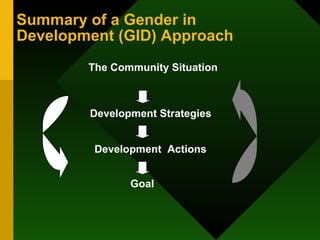
Summary of a Gender in Development (GID) Approach The Community Situation Development Strategies Development  Actions Goal
CHECKLIST 1: Women’s dimension in project identification What needs and opportunities exist for increasing women’s productivity and/or production?  What needs and opportunities exist for increasing women’s access to and control of resources?
What needs and opportunities exist for increasing women’s access to and control of benefits?  How do these needs and opportunities relate to the country’s other general and sectoral development needs and opportunities?  Have women been directly consulted in identifying such needs and opportunities?
Defining general project objectives Are project objectives explicitly related to women’s needs?  Do these objectives adequately reflect women’s needs?  have women participated in setting those objectives?  Have their been any earlier efforts?  How has the present proposal built on earlier activity?
Identifying possible negative effects Might the project reduce women’s access to or control of resources and benefits?  Might it adversely affect women’s situation in some other way?  What will be the effects on women in the short and longer term?
CHECKLIST 2: Women’s dimension  in project design  Project impact on women’s activities Which of these activities (Production, reproduction and maintenance, socio-political) does the project affect?  Is the planned component consistent with the current gender needs
If it is planned to change the women’s performance of that activity is this feasible, and what positive or negative effects would there be on women?  If it does not change, is this a missed opportunity for women’s roles in the development process?  How can the project design be adjusted to increase the above-mentioned positive effects, and reduce or eliminate the negative ones?
Project impact on women’s access and control How will each of the project components affect women’s access to and control of the resources and benefits engaged in and stemming from the production of goods and services?  How will each of the project components affect women’s access to and control of the resources and benefits engaged in and stemming from the reproduction and maintenance of the human resources?
How will each of the project components affect women’s access to and control of the resources and benefits engaged in and stemming from the socio-political functions?  What forces have been set into motion to induce further exploration of constraints and possible improvements?  How can the project design be adjusted to increase women’s access to and control of resources and benefits?
CHECKLIST 3: Women’s dimension in project implementation Personnel What training techniques will be used to develop delivery systems? Are project personnel aware of and sympathetic to women’s needs?  Are women used to deliver the goods and services to women beneficiaries?  Do personnel have the necessary skills to provide any special inputs required by women?  Are there appropriate opportunities for women to participate in project management positions?
Organisational structures Does the organisational form enhance women’s access to resources?  Does the organisation have adequate power to obtain resources needed by women from other organisations?  Does the organisation have the institutional capability to support and protect women during the change process?
Operations and logistics Are the organisation’s delivery channels accessible to women in terms of personnel, location and timing?  Do control procedures exist to ensure dependable delivery of the goods and services?  Are there mechanisms to ensure that the project resources or benefits are not usurped by males?
Finances Do funding mechanisms exist to ensure programme continuity?  Are funding levels adequate for proposed tasks?  Is preferential access to resources by males avoided?  Is it possible tot race funds for women from allocation to delivery with a fair deal of accuracy?
Flexibility Does the project have a management information system which will allow it to detect the effects of the operation on women?  Does the organisation have enough flexibility to adapt its structures and operations to meet the changing or new-found situations of women?
CHECKLIST 4: Women’s dimension in project evaluation Data requirements Does the project’s monitoring and evaluation system explicitly measure the project’s effects on women?  Does it also collect data to update the Activity Analysis and the Women’s Access and Control Analysis?  Are women involved in designing the data requirements?
Data collection and analysis Are the data collected with sufficient frequency so that necessary project adjustments could be made during the project?  Are the data fed back to project personnel and beneficiaries in an understandable form and on a timely basis to allow project adjustments?  Are women involved in the collection and interpretation of data?  Are data analysed so as to provide guidance to the design of other projects?  Are key areas of WID research identified?
THANK  YOU

Gender Planning

  • 1.
    GENDER PLANING BR SIWAL NIPCCD NEW DELHI
  • 2.
    METHODOLOGICAL TOOLS FORGENDER PLANNING 1. Gender roles and their identification - Gender relation - Division of labour 2. Intra-household resource allocation - Control over resources - Power of decision making
  • 3.
    3 . Genderneeds assessment - Practical gender needs - Strategic gender needs 4. Balancing roles and linkage with competitive demands between - Productive - Reproductive - Household management
  • 4.
    5. Relationship betweenroles and needs 6. Equality between men and women
  • 5.
    METHODOLOGY OF GENDERPLANNING FOCUS KNOWLEDGE GOAL Gender Feminist theories and WID/GAD debates Women’s release from Sub-ordinate and ‘ Emancipation’
  • 6.
    OBJECTIVES AGENDA Genderequity and empowerment through pgn and sgn Context specific sgn Such as - -equality in the gender division of labour within the household
  • 7.
    - Equal controlover resources and power of decision - making within the family - Equality in paid employment - Equal participation in political process
  • 8.
    PLANNING FRAMEWORK (A)Gender planning tools (B) component of gender planning practices (C) gender planning procedures
  • 9.
    Gender Indicators Sex-disaggregatedstatistics Gender statistics Gender-sensitive indicators
  • 10.
    Approaches to AddressWomen’s Needs and Interests Welfare Equity Anti-poverty Efficiency Empowerment
  • 11.
    Summary of aGender in Development (GID) Approach The Community Situation Development Strategies Development Actions Goal
  • 12.
    CHECKLIST 1: Women’sdimension in project identification What needs and opportunities exist for increasing women’s productivity and/or production? What needs and opportunities exist for increasing women’s access to and control of resources?
  • 13.
    What needs andopportunities exist for increasing women’s access to and control of benefits? How do these needs and opportunities relate to the country’s other general and sectoral development needs and opportunities? Have women been directly consulted in identifying such needs and opportunities?
  • 14.
    Defining general projectobjectives Are project objectives explicitly related to women’s needs? Do these objectives adequately reflect women’s needs? have women participated in setting those objectives? Have their been any earlier efforts? How has the present proposal built on earlier activity?
  • 15.
    Identifying possible negativeeffects Might the project reduce women’s access to or control of resources and benefits? Might it adversely affect women’s situation in some other way? What will be the effects on women in the short and longer term?
  • 16.
    CHECKLIST 2: Women’sdimension in project design Project impact on women’s activities Which of these activities (Production, reproduction and maintenance, socio-political) does the project affect? Is the planned component consistent with the current gender needs
  • 17.
    If it isplanned to change the women’s performance of that activity is this feasible, and what positive or negative effects would there be on women? If it does not change, is this a missed opportunity for women’s roles in the development process? How can the project design be adjusted to increase the above-mentioned positive effects, and reduce or eliminate the negative ones?
  • 18.
    Project impact onwomen’s access and control How will each of the project components affect women’s access to and control of the resources and benefits engaged in and stemming from the production of goods and services? How will each of the project components affect women’s access to and control of the resources and benefits engaged in and stemming from the reproduction and maintenance of the human resources?
  • 19.
    How will eachof the project components affect women’s access to and control of the resources and benefits engaged in and stemming from the socio-political functions? What forces have been set into motion to induce further exploration of constraints and possible improvements? How can the project design be adjusted to increase women’s access to and control of resources and benefits?
  • 20.
    CHECKLIST 3: Women’sdimension in project implementation Personnel What training techniques will be used to develop delivery systems? Are project personnel aware of and sympathetic to women’s needs? Are women used to deliver the goods and services to women beneficiaries? Do personnel have the necessary skills to provide any special inputs required by women? Are there appropriate opportunities for women to participate in project management positions?
  • 21.
    Organisational structures Doesthe organisational form enhance women’s access to resources? Does the organisation have adequate power to obtain resources needed by women from other organisations? Does the organisation have the institutional capability to support and protect women during the change process?
  • 22.
    Operations and logisticsAre the organisation’s delivery channels accessible to women in terms of personnel, location and timing? Do control procedures exist to ensure dependable delivery of the goods and services? Are there mechanisms to ensure that the project resources or benefits are not usurped by males?
  • 23.
    Finances Do fundingmechanisms exist to ensure programme continuity? Are funding levels adequate for proposed tasks? Is preferential access to resources by males avoided? Is it possible tot race funds for women from allocation to delivery with a fair deal of accuracy?
  • 24.
    Flexibility Does theproject have a management information system which will allow it to detect the effects of the operation on women? Does the organisation have enough flexibility to adapt its structures and operations to meet the changing or new-found situations of women?
  • 25.
    CHECKLIST 4: Women’sdimension in project evaluation Data requirements Does the project’s monitoring and evaluation system explicitly measure the project’s effects on women? Does it also collect data to update the Activity Analysis and the Women’s Access and Control Analysis? Are women involved in designing the data requirements?
  • 26.
    Data collection andanalysis Are the data collected with sufficient frequency so that necessary project adjustments could be made during the project? Are the data fed back to project personnel and beneficiaries in an understandable form and on a timely basis to allow project adjustments? Are women involved in the collection and interpretation of data? Are data analysed so as to provide guidance to the design of other projects? Are key areas of WID research identified?
  • 27.