Module 2: Gender Strategy Development
ILRI, ICARDA and Transition International
Gender Capacity Development Training, ILRI Addis, 23-27 October 2017
1. Objective of module 2: Gender strategy
development
• To increase participants’ knowledge on how to use
gender-sensitive data to develop gender-responsive
programs, strategies and interventions and apply this
with their own programs and organizations.
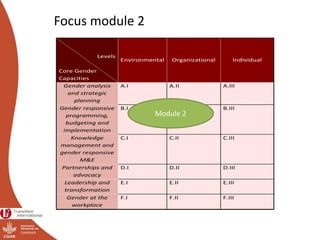
Focus
The focus of this module will be on the core gender
capacity of gender responsive programming, budgeting
and implementation, while significant attention is given
to the differences between accommodating and
transformative approaches (the core gender capacity on
innovation in gender responsive approaches).
focus on external, program issues.
Specific contents and outcomes for each program.
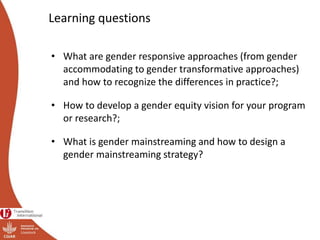
Learning questions
• What are gender responsive approaches (from gender
accommodating to gender transformative approaches)
and how to recognize the differences in practice?;
• How to develop a gender equity vision for your program
or research?;
• What is gender mainstreaming and how to design a
gender mainstreaming strategy?
Levels
Core Gender
Capacities
Environmental Organizational Individual
Gender analysis
and strategic
planning
A.I A.II A.III
Gender responsive
programming,
budgeting and
implementation
B.I B.II B.III
Knowledge
management and
gender responsive
M&E
C.I C.II C.III
Partnerships and
advocacy
D.I D.II D.III
Leadership and
transformation
E.I E.II E.III
Gender at the
workplace
F.I F.II F.III
Module 2
Focus module 2
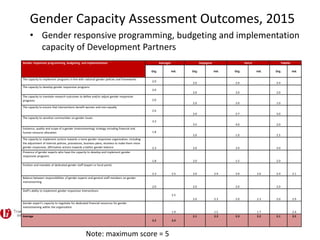
Gender Capacity Assessment Outcomes, 2015
• Gender responsive programming, budgeting and implementation
capacity of Development Partners
Note: maximum score = 5
Gender responsive programming, budgeting, and implementation Averages Doyogena Horro Yabello
Org. Ind. Org. Ind. Org. Ind. Org. Ind.
The capacity to implement programs in line with national gender policies and frameworks
2.0
2.0 2.0 2.0
The capacity to develop gender responsive programs
2.0
2.0 2.0 2.0
The capacity to translate research outcomes to define and/or adjust gender responsive
programs 2.0
2.0 3.0 1.0
The capacity to ensure that interventions benefit women and men equally
2.6
2.0 2.7 3.0
The capacity to sensitize communities on gender issues
3.2
3.5 4.0 2.0
Existence, quality and scope of a gender (mainstreaming) strategy including financial and
human resource allocation 1.8
2.0 1.0 2.5
The capacity to implement actions towards a more gender responsive organization, including
the adjustment of internal policies, procedures, business plans, etcetera to make them more
gender responsive, affirmative actions towards a better gender balance. 2.3 2.0 2.0 3.0
Presence of gender experts who have the capacity to develop and implement gender
responsive programs
1.8 2.0 1.5 2.0
Position and mandate of dedicated gender staff (expert or focal point)
2.3 2.5 2.0 2.9 3.0 2.6 2.0 2.1
Balance between responsibilities of gender experts and general staff members on gender
mainstreaming
2.0 2.0 2.0 2.0
Staff’s ability to implement gender responsive interventions
2.5
2.0 2.3 2.0 2.3 2.0 2.9
Gender expert’s capacity to negotiate for dedicated financial resources for gender
mainstreaming within the organization
1.9 1.5 1.7 2.4
Average
2.2 2.3
2.1 2.3 2.3 2.2 2.1 2.5
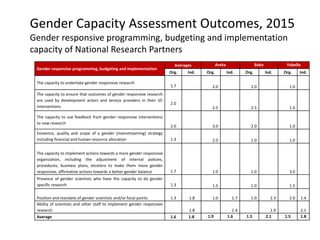
Gender Capacity Assessment Outcomes, 2015
Gender responsive programming, budgeting and implementation
capacity of National Research Partners
Gender responsive programming, budgeting and implementation
Averages Areka Bako Yabello
Org. Ind. Org. Ind. Org. Ind. Org. Ind.
The capacity to undertake gender responsive research
1.7 2.0 2.0 1.0
The capacity to ensure that outcomes of gender responsive research
are used by development actors and service providers in their VC
interventions
2.0
2.5 2.5 1.0
The capacity to use feedback from gender responsive interventions
to new research
2.0 3.0 2.0 1.0
Existence, quality and scope of a gender (mainstreaming) strategy
including financial and human resource allocation 1.3 2.0 1.0 1.0
The capacity to implement actions towards a more gender responsive
organization, including the adjustment of internal policies,
procedures, business plans, etcetera to make them more gender
responsive, affirmative actions towards a better gender balance 1.7 1.0 1.0 3.0
Presence of gender scientists who have the capacity to do gender
specific research 1.3 1.5 1.0 1.5
Position and mandate of gender scientists and/or focal points 1.3 1.8 1.0 1.7 1.0 2.3 2.0 1.4
Ability of scientists and other staff to implement gender responsive
research 1.8 1.4 1.9 2.1
Average 1.6 1.8 1.9 1.6 1.5 2.1 1.5 1.8
Content of the module
1. Introduction to the module
2. Gender responsive approaches: definitions and
examples;
3. Assessing an existing gender mainstreaming strategy;
4. Developing a gender equity vision;
5. Designing a gender mainstreaming strategy;
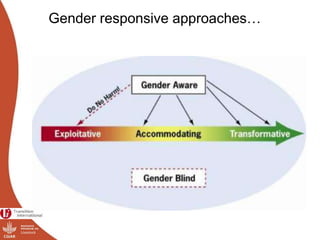
2. Gender responsive approaches
• Consider gender roles and relations and respond to these
through:
– Gender accommodating approaches
– Gender transformative approaches
• Do no harm to women
• Facilitate movement to a more gender equal society
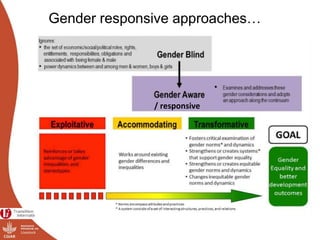
Gender responsive approaches…
/ responsive
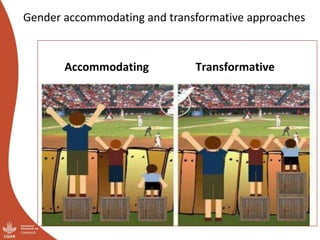
Gender accommodating and transformative approaches
Accommodating Transformative
Exercises
• Which type of approach is your organization applying at
the moment?
– Write the name of your organization on a post-it and
locate it on a flip chart
Examples of gender integration strategies
• Discuss case studies on gender integration strategies
(best practices)
Generalization of concepts and
methodologies
What is gender mainstreaming
• Strategy for making women's as well as men's concerns and
experiences an integral dimension of the design,
implementation, monitoring and evaluation of policies and
programs.
• Is the process of assessing the implications for women and
men of any planned action, including legislation, policies or
programs, in all areas and at all levels.
• can include gender accommodating or transformative
approaches or a combination of those.
• GM strategies are specific with objectives, activities, budgets
• Ultimate goal is to achieve gender equality
History of gender mainstreaming
• The concept of gender mainstreaming was first mentioned
at the Third World Conference on Women in
Nairobi, Kenya in 1985.
• The concept was formally used in 1995 at the Fourth
World Conference on Women in Beijing, China when it
was integrated into the Beijing Platform for Action.
• Dual approach of achieving gender equality and
empowerment of women proposed
– Gender strategic (empowerment focus)
– Integrated (gender equality as a cross cutting issue)
Women’s Empowerment
• The ability of women to take control over their lives:
• setting their own agendas, gaining skills, building self-
confidence, solving problems and developing self-reliance.
• Ability to make choices and have a voice
• Institutions and organizations can support processes
that can nurture self-empowerment of individuals or
groups
Affirmative action
• Aims to establish policies or practices that give a certain
social group (women in this case) preferential treatment
in the access to and control of resources or services in
order to improve the quality of life
• Empowerment requires a series of affirmative actions
that enable women to carry out their activities with
greater autonomy and self-esteem.
• Examples are policies that promote property of land for
women or scholarships targeted specifically at women
Women in Development (WID)
• Aims to integrate women into the existing development process
by targeting them, often in women-specific activities.
• Women are usually passive recipients in WID projects
• Emphasis is on making women more efficient producers and
increasing their income
• Many WID projects are not sustainable because they did not
transform unequal relationships, which are necessary to
maintain changes on the long run.
• Such projects tend to be blind to men’s roles and
responsibilities in women’s (dis)empowerment
Gender and Development (GAD)
• The approach focuses on addressing unequal gender
relations which prevent equitable development and which
often lock women out of full participation.
• GAD seeks to have both women and men participate, make
decisions and share benefits.
• GAD is informed by gender analysis unlike WID
Gender budgeting
• The process of conceiving, planning, approving, executing,
monitoring, analyzing and auditing budgets in a gender-
sensitive way
• Involves analysis of actual expenditure and revenue (of
your organization) on women and girls as compared to
expenditures on men and boys
• Helps to decide how policies need to be made, adjusted
and reprioritized
• Is a tool for effective policy/program implementation
where one can check if the allocations are in line with
policy/program commitments and are having the desired
impact.
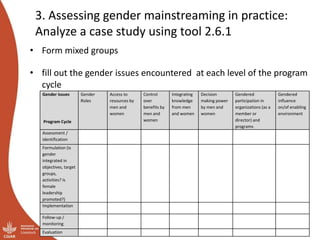
3. Assessing gender mainstreaming in practice:
Analyze a case study using tool 2.6.1
• Form mixed groups
• fill out the gender issues encountered at each level of the program
cycle
Gender issues
Program Cycle
Gender
Roles
Access to
resources by
men and
women
Control
over
benefits by
men and
women
Integrating
knowledge
from men
and women
Decision
making power
by men and
women
Gendered
participation in
organizations (as a
member or
director) and
programs
Gendered
influence
on/of enabling
environment
Assessment /
identification
Formulation (is
gender
integrated in
objectives, target
groups,
activities? Is
female
leadership
promoted?)
Implementation
Follow-up /
monitoring
Evaluation
4. Developing a gender equity vision
• Form groups by organization
• Follow steps written down in the gender equity tree
(Tool 2.6.2)
5. Designing a gender mainstreaming (GM)
strategy
• Aids institutionalization of shared gender equity
perspective as an effective mechanism for
promoting gender equity/equality at all levels of the
organization (internally and externally).
• Includes production processes, marketing,
organizational structure, decision making, access to
and control of resources, capacity development etc.
• Assign a budget to the implementation of the
strategy for its success
Designing a gender mainstreaming (GM)
strategy…
• Everybody in the organization is responsible for the
success implementation of the strategy
• Assign someone or team to monitor and evaluate
its implementation
• The strategy affects everybody in the organization
Exercise
• Recall the gender issues developed so far
• Each participate:
– write down two gender equity objectives you want the
organization to achieve internally (e.g. internal
policies, structure, staff, mission etc
– write down two gender equity objectives you want the
organization to achieve externally (e.g. target groups,
collaborations, interventions, research etc)
– Share with team
– As a team prioritize one internal and one external
objectives
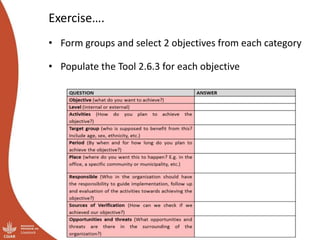
Exercise….
• Form groups and select 2 objectives from each category
• Populate the Tool 2.6.3 for each objective
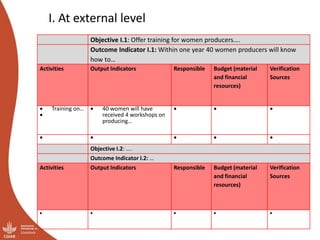
I. At external level
Objective I.1: Offer training for women producers….
Outcome Indicator I.1: Within one year 40 women producers will know
how to…
Activities Output Indicators Responsible Budget (material
and financial
resources)
Verification
Sources
 Training on…

 40 women will have
received 4 workshops on
producing…
  
    
Objective I.2: ….
Outcome Indicator I.2: …
Activities Output Indicators Responsible Budget (material
and financial
resources)
Verification
Sources
    
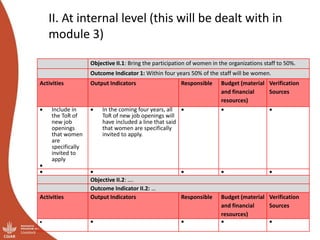
II. At internal level (this will be dealt with in
module 3)
Objective II.1: Bring the participation of women in the organizations staff to 50%.
Outcome Indicator 1: Within four years 50% of the staff will be women.
Activities Output Indicators Responsible Budget (material
and financial
resources)
Verification
Sources
 Include in
the ToR of
new job
openings
that women
are
specifically
invited to
apply

 In the coming four years, all
ToR of new job openings will
have included a line that said
that women are specifically
invited to apply.
  
    
Objective II.2: ….
Outcome Indicator II.2: …
Activities Output Indicators Responsible Budget (material
and financial
resources)
Verification
Sources
    
CGIAR Research Program on Livestock
livestock.cgiar.org
The CGIAR Research Program on Livestock aims to increase the productivity and profitability of livestock agri-food
systems in sustainable ways, making meat, milk and eggs more available and affordable across the developing world.
This presentation is licensed for use under the Creative Commons Attribution 4.0 International Licence.
The program thanks all donors and organizations which globally support its work through their contributions to the
CGIAR system

Module 2: Gender Strategy Development

  • 1.
    Module 2: GenderStrategy Development ILRI, ICARDA and Transition International Gender Capacity Development Training, ILRI Addis, 23-27 October 2017
  • 2.
    1. Objective ofmodule 2: Gender strategy development • To increase participants’ knowledge on how to use gender-sensitive data to develop gender-responsive programs, strategies and interventions and apply this with their own programs and organizations.
  • 3.
    Focus The focus ofthis module will be on the core gender capacity of gender responsive programming, budgeting and implementation, while significant attention is given to the differences between accommodating and transformative approaches (the core gender capacity on innovation in gender responsive approaches). focus on external, program issues. Specific contents and outcomes for each program.
  • 4.
    Learning questions • Whatare gender responsive approaches (from gender accommodating to gender transformative approaches) and how to recognize the differences in practice?; • How to develop a gender equity vision for your program or research?; • What is gender mainstreaming and how to design a gender mainstreaming strategy?
  • 5.
    Levels Core Gender Capacities Environmental OrganizationalIndividual Gender analysis and strategic planning A.I A.II A.III Gender responsive programming, budgeting and implementation B.I B.II B.III Knowledge management and gender responsive M&E C.I C.II C.III Partnerships and advocacy D.I D.II D.III Leadership and transformation E.I E.II E.III Gender at the workplace F.I F.II F.III Module 2 Focus module 2
  • 6.
    Gender Capacity AssessmentOutcomes, 2015 • Gender responsive programming, budgeting and implementation capacity of Development Partners Note: maximum score = 5 Gender responsive programming, budgeting, and implementation Averages Doyogena Horro Yabello Org. Ind. Org. Ind. Org. Ind. Org. Ind. The capacity to implement programs in line with national gender policies and frameworks 2.0 2.0 2.0 2.0 The capacity to develop gender responsive programs 2.0 2.0 2.0 2.0 The capacity to translate research outcomes to define and/or adjust gender responsive programs 2.0 2.0 3.0 1.0 The capacity to ensure that interventions benefit women and men equally 2.6 2.0 2.7 3.0 The capacity to sensitize communities on gender issues 3.2 3.5 4.0 2.0 Existence, quality and scope of a gender (mainstreaming) strategy including financial and human resource allocation 1.8 2.0 1.0 2.5 The capacity to implement actions towards a more gender responsive organization, including the adjustment of internal policies, procedures, business plans, etcetera to make them more gender responsive, affirmative actions towards a better gender balance. 2.3 2.0 2.0 3.0 Presence of gender experts who have the capacity to develop and implement gender responsive programs 1.8 2.0 1.5 2.0 Position and mandate of dedicated gender staff (expert or focal point) 2.3 2.5 2.0 2.9 3.0 2.6 2.0 2.1 Balance between responsibilities of gender experts and general staff members on gender mainstreaming 2.0 2.0 2.0 2.0 Staff’s ability to implement gender responsive interventions 2.5 2.0 2.3 2.0 2.3 2.0 2.9 Gender expert’s capacity to negotiate for dedicated financial resources for gender mainstreaming within the organization 1.9 1.5 1.7 2.4 Average 2.2 2.3 2.1 2.3 2.3 2.2 2.1 2.5
  • 7.
    Gender Capacity AssessmentOutcomes, 2015 Gender responsive programming, budgeting and implementation capacity of National Research Partners Gender responsive programming, budgeting and implementation Averages Areka Bako Yabello Org. Ind. Org. Ind. Org. Ind. Org. Ind. The capacity to undertake gender responsive research 1.7 2.0 2.0 1.0 The capacity to ensure that outcomes of gender responsive research are used by development actors and service providers in their VC interventions 2.0 2.5 2.5 1.0 The capacity to use feedback from gender responsive interventions to new research 2.0 3.0 2.0 1.0 Existence, quality and scope of a gender (mainstreaming) strategy including financial and human resource allocation 1.3 2.0 1.0 1.0 The capacity to implement actions towards a more gender responsive organization, including the adjustment of internal policies, procedures, business plans, etcetera to make them more gender responsive, affirmative actions towards a better gender balance 1.7 1.0 1.0 3.0 Presence of gender scientists who have the capacity to do gender specific research 1.3 1.5 1.0 1.5 Position and mandate of gender scientists and/or focal points 1.3 1.8 1.0 1.7 1.0 2.3 2.0 1.4 Ability of scientists and other staff to implement gender responsive research 1.8 1.4 1.9 2.1 Average 1.6 1.8 1.9 1.6 1.5 2.1 1.5 1.8
  • 8.
    Content of themodule 1. Introduction to the module 2. Gender responsive approaches: definitions and examples; 3. Assessing an existing gender mainstreaming strategy; 4. Developing a gender equity vision; 5. Designing a gender mainstreaming strategy;
  • 9.
    2. Gender responsiveapproaches • Consider gender roles and relations and respond to these through: – Gender accommodating approaches – Gender transformative approaches • Do no harm to women • Facilitate movement to a more gender equal society
  • 10.
  • 11.
  • 12.
    Gender accommodating andtransformative approaches Accommodating Transformative
  • 13.
    Exercises • Which typeof approach is your organization applying at the moment? – Write the name of your organization on a post-it and locate it on a flip chart
  • 14.
    Examples of genderintegration strategies • Discuss case studies on gender integration strategies (best practices)
  • 15.
    Generalization of conceptsand methodologies
  • 16.
    What is gendermainstreaming • Strategy for making women's as well as men's concerns and experiences an integral dimension of the design, implementation, monitoring and evaluation of policies and programs. • Is the process of assessing the implications for women and men of any planned action, including legislation, policies or programs, in all areas and at all levels. • can include gender accommodating or transformative approaches or a combination of those. • GM strategies are specific with objectives, activities, budgets • Ultimate goal is to achieve gender equality
  • 17.
    History of gendermainstreaming • The concept of gender mainstreaming was first mentioned at the Third World Conference on Women in Nairobi, Kenya in 1985. • The concept was formally used in 1995 at the Fourth World Conference on Women in Beijing, China when it was integrated into the Beijing Platform for Action. • Dual approach of achieving gender equality and empowerment of women proposed – Gender strategic (empowerment focus) – Integrated (gender equality as a cross cutting issue)
  • 18.
    Women’s Empowerment • Theability of women to take control over their lives: • setting their own agendas, gaining skills, building self- confidence, solving problems and developing self-reliance. • Ability to make choices and have a voice • Institutions and organizations can support processes that can nurture self-empowerment of individuals or groups
  • 19.
    Affirmative action • Aimsto establish policies or practices that give a certain social group (women in this case) preferential treatment in the access to and control of resources or services in order to improve the quality of life • Empowerment requires a series of affirmative actions that enable women to carry out their activities with greater autonomy and self-esteem. • Examples are policies that promote property of land for women or scholarships targeted specifically at women
  • 20.
    Women in Development(WID) • Aims to integrate women into the existing development process by targeting them, often in women-specific activities. • Women are usually passive recipients in WID projects • Emphasis is on making women more efficient producers and increasing their income • Many WID projects are not sustainable because they did not transform unequal relationships, which are necessary to maintain changes on the long run. • Such projects tend to be blind to men’s roles and responsibilities in women’s (dis)empowerment
  • 21.
    Gender and Development(GAD) • The approach focuses on addressing unequal gender relations which prevent equitable development and which often lock women out of full participation. • GAD seeks to have both women and men participate, make decisions and share benefits. • GAD is informed by gender analysis unlike WID
  • 22.
    Gender budgeting • Theprocess of conceiving, planning, approving, executing, monitoring, analyzing and auditing budgets in a gender- sensitive way • Involves analysis of actual expenditure and revenue (of your organization) on women and girls as compared to expenditures on men and boys • Helps to decide how policies need to be made, adjusted and reprioritized • Is a tool for effective policy/program implementation where one can check if the allocations are in line with policy/program commitments and are having the desired impact.
  • 23.
    3. Assessing gendermainstreaming in practice: Analyze a case study using tool 2.6.1 • Form mixed groups • fill out the gender issues encountered at each level of the program cycle Gender issues Program Cycle Gender Roles Access to resources by men and women Control over benefits by men and women Integrating knowledge from men and women Decision making power by men and women Gendered participation in organizations (as a member or director) and programs Gendered influence on/of enabling environment Assessment / identification Formulation (is gender integrated in objectives, target groups, activities? Is female leadership promoted?) Implementation Follow-up / monitoring Evaluation
  • 24.
    4. Developing agender equity vision • Form groups by organization • Follow steps written down in the gender equity tree (Tool 2.6.2)
  • 25.
    5. Designing agender mainstreaming (GM) strategy • Aids institutionalization of shared gender equity perspective as an effective mechanism for promoting gender equity/equality at all levels of the organization (internally and externally). • Includes production processes, marketing, organizational structure, decision making, access to and control of resources, capacity development etc. • Assign a budget to the implementation of the strategy for its success
  • 26.
    Designing a gendermainstreaming (GM) strategy… • Everybody in the organization is responsible for the success implementation of the strategy • Assign someone or team to monitor and evaluate its implementation • The strategy affects everybody in the organization
  • 27.
    Exercise • Recall thegender issues developed so far • Each participate: – write down two gender equity objectives you want the organization to achieve internally (e.g. internal policies, structure, staff, mission etc – write down two gender equity objectives you want the organization to achieve externally (e.g. target groups, collaborations, interventions, research etc) – Share with team – As a team prioritize one internal and one external objectives
  • 28.
    Exercise…. • Form groupsand select 2 objectives from each category • Populate the Tool 2.6.3 for each objective
  • 29.
    I. At externallevel Objective I.1: Offer training for women producers…. Outcome Indicator I.1: Within one year 40 women producers will know how to… Activities Output Indicators Responsible Budget (material and financial resources) Verification Sources  Training on…   40 women will have received 4 workshops on producing…         Objective I.2: …. Outcome Indicator I.2: … Activities Output Indicators Responsible Budget (material and financial resources) Verification Sources     
  • 30.
    II. At internallevel (this will be dealt with in module 3) Objective II.1: Bring the participation of women in the organizations staff to 50%. Outcome Indicator 1: Within four years 50% of the staff will be women. Activities Output Indicators Responsible Budget (material and financial resources) Verification Sources  Include in the ToR of new job openings that women are specifically invited to apply   In the coming four years, all ToR of new job openings will have included a line that said that women are specifically invited to apply.         Objective II.2: …. Outcome Indicator II.2: … Activities Output Indicators Responsible Budget (material and financial resources) Verification Sources     
  • 31.
    CGIAR Research Programon Livestock livestock.cgiar.org The CGIAR Research Program on Livestock aims to increase the productivity and profitability of livestock agri-food systems in sustainable ways, making meat, milk and eggs more available and affordable across the developing world. This presentation is licensed for use under the Creative Commons Attribution 4.0 International Licence. The program thanks all donors and organizations which globally support its work through their contributions to the CGIAR system