Mashiur Rahman
EDRD*6000 – Qualitative Analysis
University of Guelph
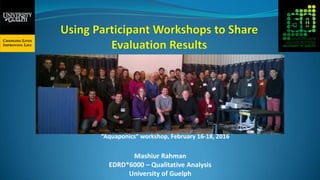
“Aquaponics” workshop, February 16-18, 2016
What is participatory evaluation?
“Participatory evaluation is a partnership approach to evaluation
in which stakeholders actively engage in developing the
evaluation and all phases of its implementation”. It is radically
thinking who initiates and undertakes the process, and who learns
or benefits from the findings. – Institute of Development Studies,
1998.
Stakeholders are — partners, program beneficiaries, funders and key decision makers play active
roles. The active participation occurs throughout the evaluation process including:
➣ identifying relevant questions;
➣ planning the evaluation design;
➣ selecting appropriate measures and data collection methods;
➣ gathering and analyzing data;
➣ reaching consensus about findings, conclusions and recommendations;
➣ disseminating results and preparing an action plan.
When should we use participants’ evaluation?
 When we committed to a participatory process for workshop;
 When there may be issues in the participant that outside evaluators aren't likely to be aware of;
 When we need information that it will be difficult for anyone outside the participant;
 When part of the goal of the workshop is to empower participants and help them develop
transferable skills;
 When we want to bring the community or population together.
Source:
http://betterevaluation.org/plan/app
roach/cort
Who should be involved participatory evaluation?
The people who are directly affected by the project
being evaluated. Varies project to project,
depending on the focus, funding and intended
outcomes. Different groups are involved such as:
 Participants or stakeholders or beneficiaries
 Project line staff and/or volunteers
 Administrators
 Outside evaluators
 Community officials
 Others whose lives are affected by the project Source: FAO (Food and Agriculture
Organization)
Why workshop evaluation?
An organized, well-planned and well-conducted evaluation
can provide useful information to funding agencies,
sponsoring institutions, instructors, and participants.
Evaluation data can serve
 to show the real worth of a program,
 to show where to improve future workshops and
institutes,
 to justify funds expended, and
 as a basis for rational decisions about future funding or
sponsorship.
HOW DO YOU CONDUCT A PARTICIPATORY EVALUATION?
• Decide if a participatory evaluation approach is
appropriate.
• Use communication channels and styles that
reach the people you're aiming at
• Make your message as clear as possible
• Identify who should and wants to be involved.
• Collaborate on creating an evaluation plan
• Gather information, analyze it and build
consensus on results, collectively
• Agree on findings and how they will be used.
• Explain what people may gain from participation
University of Kansas 2014a
Comparative advantages?
Participatory evaluation Conventional evaluation
Who drives evaluation? Stakeholders, project staff,
community residents
Program managers and funders
Who determine progress? Stakeholders, evaluators, staff Professional evaluators and experts
Who is responsible for
data collection, analysis
and preparing final
reports?
Participating stakeholders and
shared responsibility of
evaluator
Professional experts and evaluators
What is the role of the
local evaluator?
Negotiator, facilitator, coach Expert, leader
What are the benefits? Build knowledge, skills and
relationship
Verification of information
Local knowledge
Independent judgment
Standardized indicators
Institute of Development Studies, 1998.
What are some challenges in participatory evaluation?
 Time and commitment from many players which involves coordinating, training and building
the skills of diverse participants from backgrounds, skills and interest levels in the evaluation
 Resources - as requires the involvement of many people, need to consider and allocate funds
and resources realistically.
 Conflicts between approaches - require planning for conflict resolution among the individuals
involved
 Unclear purpose of participation, or a purpose that is not aligned with evaluation design
 Lack of facilitation skills
 Only focusing on participation in one aspect of the evaluation process, e.g. data collection
 Lack of cultural and contextual understanding, and the implications of these for the evaluation
design
Establishing the Evaluation Plan
Planning for a workshop evaluation all Cutting Edge are expected to:
 Collect an individual action plan and end of workshop survey from each participant
 Develop a post-workshop evaluation summary that includes evidence from collected evaluation
instruments and convener observations
 Complete a post-workshop follow up survey of participants that focuses on action plan responses
In planning for your evaluation of the workshop think about:
 What do you want the overall outcome(s) of the workshop to be for the participants?
 How would you define or recognize success?
 What do you want the larger community to learn from the workshop?
There are routinely use three types of surveys:
 daily roadchecks,
 action plans, and
 end of workshop surveys
Personal Experience in a workshop
I had an opportunity to participate in an aquaponics workshop on
February 16-18, 2016 in NOA fisheries Whitby, Ontario. Aquaponics
farming is a new innovation of aquaculture and getting popularity in
North America very rapidly to produce household/small scale fish
protein and organic vegetable. NOA fisheries started 2010, previously a
dairy farm, to produce a pure strain of the highest genetic quality,
without inbreeding, hormone free, non-GMO tilapia. NOA fisheries is a
member of aquaponics association and jointly organized the workshop
for focusing their business. The participants are from university student,
farm owner, OMAFRA aquaculture specialist, entrepreneurs,
government officials, farm construction supplier and many more.
At the last session of the workshop, NOA fisheries organized a
survey to understand participants’/stakeholders’ knowledge and
understanding, motivation, learning and recommendations for the next
workshop. The purpose to examine the participants’ perspective of the
efficacy of the training they received.
Sample:
Aquaponics
workshop
feedback by
participants’
Expected outcomes from the participants
The workshop organizers set out to answer the following questions:
 What were the participants’ expectations from the workshop?
 What were their impressions after the workshop? and
 What were the implications of the training and further development?
References:
Love, D. C., Fry, J. P., Genello, L., Hill, E. S., Frederick, J. A., Li, X., & Semmens, K. (2014). An international survey of
aquaponics practitioners. PloS one, 9(7), e102662.
Love, D. C., Fry, J. P., Li, X., Hill, E. S., Genello, L., Semmens, K., & Thompson, R. E. (2015). Commercial aquaponics
production and profitability: Findings from an international survey. Aquaculture, 435, 67-74.
University of Kansas, Work Group for Community Health and Development. (2014a). Community Toolbox:
Participatory Evaluation. Retrieved from http://ctb.ku.edu/en/table-of-
contents/evaluate/evaluation/participatory-evaluation/main
University of Kansas, Work Group for Community Health and Development. (2014b). Community Toolbox: Obtaining
and Using Feedback from Participants. Retrieved from http://ctb.ku.edu/en/table-of-
contents/maintain/maintain-quality-performance/feedback-from-clients/main
Workshop Evaluation: Using Social Indicators to Focus Efforts for NPS Projects
http://www.uwex.edu/ces/regionalwaterquality/Flagships/SI-Docs/workshops-eval.pdf
Wright, S., McNeill, M., Tan, S., Tan, C., Fry, J., & Schempp, P. (2006). Participant evaluation of a mentor training
workshop: Implications for faculty development. The ICHPER-SD Journal of Research in Health, Physical
Education, Recreation, Sport & Dance, 1(2), 27.
http://pareonline.net/getvn.asp?v=1&n=8

Mashiur rahman

  • 1.
    Mashiur Rahman EDRD*6000 –Qualitative Analysis University of Guelph “Aquaponics” workshop, February 16-18, 2016
  • 2.
    What is participatoryevaluation? “Participatory evaluation is a partnership approach to evaluation in which stakeholders actively engage in developing the evaluation and all phases of its implementation”. It is radically thinking who initiates and undertakes the process, and who learns or benefits from the findings. – Institute of Development Studies, 1998. Stakeholders are — partners, program beneficiaries, funders and key decision makers play active roles. The active participation occurs throughout the evaluation process including: ➣ identifying relevant questions; ➣ planning the evaluation design; ➣ selecting appropriate measures and data collection methods; ➣ gathering and analyzing data; ➣ reaching consensus about findings, conclusions and recommendations; ➣ disseminating results and preparing an action plan.
  • 3.
    When should weuse participants’ evaluation?  When we committed to a participatory process for workshop;  When there may be issues in the participant that outside evaluators aren't likely to be aware of;  When we need information that it will be difficult for anyone outside the participant;  When part of the goal of the workshop is to empower participants and help them develop transferable skills;  When we want to bring the community or population together. Source: http://betterevaluation.org/plan/app roach/cort
  • 4.
    Who should beinvolved participatory evaluation? The people who are directly affected by the project being evaluated. Varies project to project, depending on the focus, funding and intended outcomes. Different groups are involved such as:  Participants or stakeholders or beneficiaries  Project line staff and/or volunteers  Administrators  Outside evaluators  Community officials  Others whose lives are affected by the project Source: FAO (Food and Agriculture Organization)
  • 5.
    Why workshop evaluation? Anorganized, well-planned and well-conducted evaluation can provide useful information to funding agencies, sponsoring institutions, instructors, and participants. Evaluation data can serve  to show the real worth of a program,  to show where to improve future workshops and institutes,  to justify funds expended, and  as a basis for rational decisions about future funding or sponsorship.
  • 6.
    HOW DO YOUCONDUCT A PARTICIPATORY EVALUATION? • Decide if a participatory evaluation approach is appropriate. • Use communication channels and styles that reach the people you're aiming at • Make your message as clear as possible • Identify who should and wants to be involved. • Collaborate on creating an evaluation plan • Gather information, analyze it and build consensus on results, collectively • Agree on findings and how they will be used. • Explain what people may gain from participation University of Kansas 2014a
  • 7.
    Comparative advantages? Participatory evaluationConventional evaluation Who drives evaluation? Stakeholders, project staff, community residents Program managers and funders Who determine progress? Stakeholders, evaluators, staff Professional evaluators and experts Who is responsible for data collection, analysis and preparing final reports? Participating stakeholders and shared responsibility of evaluator Professional experts and evaluators What is the role of the local evaluator? Negotiator, facilitator, coach Expert, leader What are the benefits? Build knowledge, skills and relationship Verification of information Local knowledge Independent judgment Standardized indicators Institute of Development Studies, 1998.
  • 8.
    What are somechallenges in participatory evaluation?  Time and commitment from many players which involves coordinating, training and building the skills of diverse participants from backgrounds, skills and interest levels in the evaluation  Resources - as requires the involvement of many people, need to consider and allocate funds and resources realistically.  Conflicts between approaches - require planning for conflict resolution among the individuals involved  Unclear purpose of participation, or a purpose that is not aligned with evaluation design  Lack of facilitation skills  Only focusing on participation in one aspect of the evaluation process, e.g. data collection  Lack of cultural and contextual understanding, and the implications of these for the evaluation design
  • 9.
    Establishing the EvaluationPlan Planning for a workshop evaluation all Cutting Edge are expected to:  Collect an individual action plan and end of workshop survey from each participant  Develop a post-workshop evaluation summary that includes evidence from collected evaluation instruments and convener observations  Complete a post-workshop follow up survey of participants that focuses on action plan responses In planning for your evaluation of the workshop think about:  What do you want the overall outcome(s) of the workshop to be for the participants?  How would you define or recognize success?  What do you want the larger community to learn from the workshop? There are routinely use three types of surveys:  daily roadchecks,  action plans, and  end of workshop surveys
  • 10.
    Personal Experience ina workshop I had an opportunity to participate in an aquaponics workshop on February 16-18, 2016 in NOA fisheries Whitby, Ontario. Aquaponics farming is a new innovation of aquaculture and getting popularity in North America very rapidly to produce household/small scale fish protein and organic vegetable. NOA fisheries started 2010, previously a dairy farm, to produce a pure strain of the highest genetic quality, without inbreeding, hormone free, non-GMO tilapia. NOA fisheries is a member of aquaponics association and jointly organized the workshop for focusing their business. The participants are from university student, farm owner, OMAFRA aquaculture specialist, entrepreneurs, government officials, farm construction supplier and many more. At the last session of the workshop, NOA fisheries organized a survey to understand participants’/stakeholders’ knowledge and understanding, motivation, learning and recommendations for the next workshop. The purpose to examine the participants’ perspective of the efficacy of the training they received.
  • 11.
  • 12.
    Expected outcomes fromthe participants The workshop organizers set out to answer the following questions:  What were the participants’ expectations from the workshop?  What were their impressions after the workshop? and  What were the implications of the training and further development?
  • 13.
    References: Love, D. C.,Fry, J. P., Genello, L., Hill, E. S., Frederick, J. A., Li, X., & Semmens, K. (2014). An international survey of aquaponics practitioners. PloS one, 9(7), e102662. Love, D. C., Fry, J. P., Li, X., Hill, E. S., Genello, L., Semmens, K., & Thompson, R. E. (2015). Commercial aquaponics production and profitability: Findings from an international survey. Aquaculture, 435, 67-74. University of Kansas, Work Group for Community Health and Development. (2014a). Community Toolbox: Participatory Evaluation. Retrieved from http://ctb.ku.edu/en/table-of- contents/evaluate/evaluation/participatory-evaluation/main University of Kansas, Work Group for Community Health and Development. (2014b). Community Toolbox: Obtaining and Using Feedback from Participants. Retrieved from http://ctb.ku.edu/en/table-of- contents/maintain/maintain-quality-performance/feedback-from-clients/main Workshop Evaluation: Using Social Indicators to Focus Efforts for NPS Projects http://www.uwex.edu/ces/regionalwaterquality/Flagships/SI-Docs/workshops-eval.pdf Wright, S., McNeill, M., Tan, S., Tan, C., Fry, J., & Schempp, P. (2006). Participant evaluation of a mentor training workshop: Implications for faculty development. The ICHPER-SD Journal of Research in Health, Physical Education, Recreation, Sport & Dance, 1(2), 27. http://pareonline.net/getvn.asp?v=1&n=8