Water
PRESENTED BY
MS. MONIKA P. MASKE
ASSISTANT PROFESSOR
M. PHARM
(PHARMACEUTICAL CHEMISTRY) 1
2
Introduction
• Water is most widely required solvent for any industry.
• Pharmaceutical industry requires different types.
• Water is present in three physical state i.e. solid, liquid, gas.
• Water occupies about three quarter of surface of earth.
• Potable water fit for human consumption which are available on lands under the
surface of earth and from rivers, dams, etc.
3
Physical Properties of water
• Water is clear liquid, colourless and without odour.
• When freeze at 0⁰ C to form ice which floats on water.
• When heated to 100⁰C it convert to steam.
• It has high boiling point and freezing point.
• Water possess dipole moment and dielectric dipole.
4
Chemical properties of water
1. Thermal stability- under ordinary condition water is chemically stable.
2. Ionic dissociation- the dissociation constant varies directly with temperature.
3. Solvent property- its important property. Water act as solvent for wide range
of substance because water have high dielectric constant and polarity.
5
4. Hydration- it follows “like dissolves like”, because of strong permeant
dipole, water act as ligand in formation of complex.
5. Amphoteric character- water act as solvent in acid-base reactions.
6. Redox property- water act as oxidizing agent.
7. Catalytic property- water act as catalyst and play important role in reactions
6
Hardness of Water
• The nature & amount of chemical salts present in the water, hardness is given to
water.
• It define as, the property of water to form an insoluble curd with soap instead of
leather.
• In other words it’s the soap destroying property due to presence of
bicarbonates, sulphates, chlorides and magnesium.
7
water
Temporary
Hardness
Its due to presence of bicarbonates of calcium &
Mg and removed by Boiling
o- easily removed by heating
Permanent
Hardness
Its due to the presence of sulphates, nitrates &
chlorides of calcium & magnesium
- Cannot removed simply by boiling
8
9
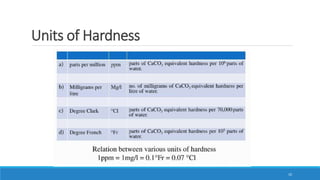
Units of Hardness
10
Methods of Softening of hard water
The following softening methods are used:
1. Lime soda process
2. Zeolite softening process
3. Ion exchange process
11
1. Lime soda process
12
13
14
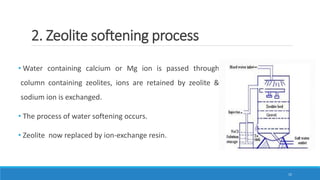
2. Zeolite softening process
• Water containing calcium or Mg ion is passed through
column containing zeolites, ions are retained by zeolite &
sodium ion is exchanged.
• The process of water softening occurs.
• Zeolite now replaced by ion-exchange resin.
15
3. Ion exchange process
• For demineralization of water, this method is used.
• Resin contained acidic group which act as cation exchange & having basic group
as anion exchangers.
• The cation & anion exchange resin are filled in tubes, columns or bed and water
is passed through them.
• The exchange phenomenon the cations like calcium, Mg present in water are
exchanged with H+ or Na+ ion present on cation exchange resin.
16
17
Natural & Portable Water
• Natural water or rain water is purest form of water.
• When water falls down into soil during this large number of salts, ions, gases get
dissolved into it.
• The soil particles, plants, animals debris and various kind of organisms, waste
ultimately introduce impurities.
• For drinking purposes as well as industrial use some treatment is necessary.
• Depending upon the source of water, kind, type of impurities.
18
• For soil particles, plants, animal debris the suspended particle treatment and
filtration is carried out.
• Drinking purposes chlorination, fluorination etc. are carried out.
19
Sterile Water for Injection
• Its suitably packed.
• Should not contain any antimicrobial agent or other added substances.
• It should comply all test described for purified water & water for injection as
per IP.
• It comply test for sterility.
• It should supplied in single dose container.
20
Water for Injection
• Water prepared by distilling portable water from natural glass or metal still
fitted with device for preventing the entrainment of droplets.
• First distillate and distillate water collect in suitable containers & sterilised in an
autoclave or by filtration without adding bacteriostatic agents.
• Water should comply purified water and test for pyrogens.
• It should stored in tightly closed containers.
21
• Its used as a solvent preparation of parental solution which are sterilised after
preparation.
• No sterility test.
• If parental solution is to be prepared under aseptic conditions & not sterilized in final
container, every care should taken to protect water from bacterial contamination.
• Every care of aseptic technique is followed in its preparation by distillation method.
22
Purified Water
• Purified water prepared from suitable portable water by distillation or using ion-exchange
resins.
• Distillation apparatus is used for distillation.
• Distilled water is purified water.
• In this technique dissolved solids & non-volatile matter or impurities get removed.
• obtained distilled water of high purity with special chemical treatment.
• The demineralised method depends on used of ion-exchange resins.
23
• Demineralised water is free from mineral salts.
• Purified water should have 4.5 – 7.
• it should comply test for CO2, NH3, nitrate, chloride, calcium, sulphate, heavy metals.
• Total solids not exceeding 0.001%.
• Stored in tightly closed container and when distilled water is prescribed, purified water
should be supplied.
24
Selection of Suitable Water for Use
• Potable water is cheapest, demineralized is next cheapest, than distilled & sterile water, water
for injection.
• For parenteral used the potable water.
• Limits of total solids, pH, bacterial purity all check for selection of water for purpose.
• The pH of water should consider when pH sensitive substances, like chlorinated water used
which has acidic pH.
• Purify and potable water for parental use required same limits like pyrogen test, sterility.
25
• For precreation of solution it should comply sterility test.
• All requires to comply with good manufacturing practices.
26
Solubility of Pharmaceuticals
• The term solubility is referred as the concentration of dissolved solute at an
equilibrium at saturation point.
• When the concentration of any solute in a liquid more the solubility, results in
ppt. or stage of supersaturation.
• Solvents with high ionic or polar character dissolve most substances.
• Solvents with low dielectric constant or polarity are less effective in solubility.
27
Methods of Expression of Solubility
28
Solubility Ratio
• Normal solution (N)-
When solution contains 1 g equivalent weight of a substance per litre, its called
as normal solution.
• Molar solution (M)-
A solution containing 1 mole per thousand ml of solution is called as molar solution.
• Molal solution- a solution containing 1 mole of solute per thousand g of solvent.
29
Factors Affecting Solubility
1. Influence of Temperature & Pressure-
• Solubility of salts or solute molecule is temperature dependent.
• Solubility increases with increases in temperature.
• Pressure also affect solubility.
• Solubility increase with increase in pressure.
• When pressure is reduced the dissolved solute escapes out from the solution.
30
2. Influence of Other Salts/Solutes-
• Solubility may affect by other dissolved substances.
• This effect more when forging substance present in high concentration.
• This produced change in dielectric constant of solvent.
31
Thank You
32

Water

  • 1.
    Water PRESENTED BY MS. MONIKAP. MASKE ASSISTANT PROFESSOR M. PHARM (PHARMACEUTICAL CHEMISTRY) 1
  • 2.
  • 3.
    Introduction • Water ismost widely required solvent for any industry. • Pharmaceutical industry requires different types. • Water is present in three physical state i.e. solid, liquid, gas. • Water occupies about three quarter of surface of earth. • Potable water fit for human consumption which are available on lands under the surface of earth and from rivers, dams, etc. 3
  • 4.
    Physical Properties ofwater • Water is clear liquid, colourless and without odour. • When freeze at 0⁰ C to form ice which floats on water. • When heated to 100⁰C it convert to steam. • It has high boiling point and freezing point. • Water possess dipole moment and dielectric dipole. 4
  • 5.
    Chemical properties ofwater 1. Thermal stability- under ordinary condition water is chemically stable. 2. Ionic dissociation- the dissociation constant varies directly with temperature. 3. Solvent property- its important property. Water act as solvent for wide range of substance because water have high dielectric constant and polarity. 5
  • 6.
    4. Hydration- itfollows “like dissolves like”, because of strong permeant dipole, water act as ligand in formation of complex. 5. Amphoteric character- water act as solvent in acid-base reactions. 6. Redox property- water act as oxidizing agent. 7. Catalytic property- water act as catalyst and play important role in reactions 6
  • 7.
    Hardness of Water •The nature & amount of chemical salts present in the water, hardness is given to water. • It define as, the property of water to form an insoluble curd with soap instead of leather. • In other words it’s the soap destroying property due to presence of bicarbonates, sulphates, chlorides and magnesium. 7
  • 8.
    water Temporary Hardness Its due topresence of bicarbonates of calcium & Mg and removed by Boiling o- easily removed by heating Permanent Hardness Its due to the presence of sulphates, nitrates & chlorides of calcium & magnesium - Cannot removed simply by boiling 8
  • 9.
  • 10.
  • 11.
    Methods of Softeningof hard water The following softening methods are used: 1. Lime soda process 2. Zeolite softening process 3. Ion exchange process 11
  • 12.
    1. Lime sodaprocess 12
  • 13.
  • 14.
  • 15.
    2. Zeolite softeningprocess • Water containing calcium or Mg ion is passed through column containing zeolites, ions are retained by zeolite & sodium ion is exchanged. • The process of water softening occurs. • Zeolite now replaced by ion-exchange resin. 15
  • 16.
    3. Ion exchangeprocess • For demineralization of water, this method is used. • Resin contained acidic group which act as cation exchange & having basic group as anion exchangers. • The cation & anion exchange resin are filled in tubes, columns or bed and water is passed through them. • The exchange phenomenon the cations like calcium, Mg present in water are exchanged with H+ or Na+ ion present on cation exchange resin. 16
  • 17.
  • 18.
    Natural & PortableWater • Natural water or rain water is purest form of water. • When water falls down into soil during this large number of salts, ions, gases get dissolved into it. • The soil particles, plants, animals debris and various kind of organisms, waste ultimately introduce impurities. • For drinking purposes as well as industrial use some treatment is necessary. • Depending upon the source of water, kind, type of impurities. 18
  • 19.
    • For soilparticles, plants, animal debris the suspended particle treatment and filtration is carried out. • Drinking purposes chlorination, fluorination etc. are carried out. 19
  • 20.
    Sterile Water forInjection • Its suitably packed. • Should not contain any antimicrobial agent or other added substances. • It should comply all test described for purified water & water for injection as per IP. • It comply test for sterility. • It should supplied in single dose container. 20
  • 21.
    Water for Injection •Water prepared by distilling portable water from natural glass or metal still fitted with device for preventing the entrainment of droplets. • First distillate and distillate water collect in suitable containers & sterilised in an autoclave or by filtration without adding bacteriostatic agents. • Water should comply purified water and test for pyrogens. • It should stored in tightly closed containers. 21
  • 22.
    • Its usedas a solvent preparation of parental solution which are sterilised after preparation. • No sterility test. • If parental solution is to be prepared under aseptic conditions & not sterilized in final container, every care should taken to protect water from bacterial contamination. • Every care of aseptic technique is followed in its preparation by distillation method. 22
  • 23.
    Purified Water • Purifiedwater prepared from suitable portable water by distillation or using ion-exchange resins. • Distillation apparatus is used for distillation. • Distilled water is purified water. • In this technique dissolved solids & non-volatile matter or impurities get removed. • obtained distilled water of high purity with special chemical treatment. • The demineralised method depends on used of ion-exchange resins. 23
  • 24.
    • Demineralised wateris free from mineral salts. • Purified water should have 4.5 – 7. • it should comply test for CO2, NH3, nitrate, chloride, calcium, sulphate, heavy metals. • Total solids not exceeding 0.001%. • Stored in tightly closed container and when distilled water is prescribed, purified water should be supplied. 24
  • 25.
    Selection of SuitableWater for Use • Potable water is cheapest, demineralized is next cheapest, than distilled & sterile water, water for injection. • For parenteral used the potable water. • Limits of total solids, pH, bacterial purity all check for selection of water for purpose. • The pH of water should consider when pH sensitive substances, like chlorinated water used which has acidic pH. • Purify and potable water for parental use required same limits like pyrogen test, sterility. 25
  • 26.
    • For precreationof solution it should comply sterility test. • All requires to comply with good manufacturing practices. 26
  • 27.
    Solubility of Pharmaceuticals •The term solubility is referred as the concentration of dissolved solute at an equilibrium at saturation point. • When the concentration of any solute in a liquid more the solubility, results in ppt. or stage of supersaturation. • Solvents with high ionic or polar character dissolve most substances. • Solvents with low dielectric constant or polarity are less effective in solubility. 27
  • 28.
    Methods of Expressionof Solubility 28 Solubility Ratio
  • 29.
    • Normal solution(N)- When solution contains 1 g equivalent weight of a substance per litre, its called as normal solution. • Molar solution (M)- A solution containing 1 mole per thousand ml of solution is called as molar solution. • Molal solution- a solution containing 1 mole of solute per thousand g of solvent. 29
  • 30.
    Factors Affecting Solubility 1.Influence of Temperature & Pressure- • Solubility of salts or solute molecule is temperature dependent. • Solubility increases with increases in temperature. • Pressure also affect solubility. • Solubility increase with increase in pressure. • When pressure is reduced the dissolved solute escapes out from the solution. 30
  • 31.
    2. Influence ofOther Salts/Solutes- • Solubility may affect by other dissolved substances. • This effect more when forging substance present in high concentration. • This produced change in dielectric constant of solvent. 31
  • 32.