OCULAR
VISCOSURGICAL
DEVICES
Dr. Nikhil R P
Junior Resident
Dept. of Ophthalmology
Narayana medical college
History
■ In 1970’s first ACIOL and PCIOL’s were invented and the move from ICCE to ECCE
resulted in Increased number of Post OP Corneal Decompression that resulted in
full thickness corneal grafts
■ Dr Endre A Balazs introducedViscoelastics
■ He worked on structure and biological activity of hyaluronan, a viscoelastic
substance present in all tissues
■ Swedish pharmacia patented it and introduced HEALON . 1980
Characteristics of ideal viscoelastic
■ Inert and iso- osmotic
■ Non inflammatory and non toxic
■ Optically clear
■ Contaminant free , particle free
■ Should have a pH similar toAC
■ Cost effective
■ Should not interfere with wound healing
■ It should have high viscosity to prevent damage to tissues
Commonly used families of OVDs
■ Sodium hyaluronate
■ Chondroitin sulphate
■ Hydroxypropyl methylcellulose
Sodium hyaluronate
■ Its a biopolymer found in connective tissues including trabecular
meswork, aqueous and vitreous humour
■ Hyaluronate refers to conjugate base of hyaluronic acid
■ It is used as a single combination or in combination with chondritin
sulpahte
Chondritin Sulphate
■ Its a biopolymer found in Extra cellular matrix
■ It is used for coating but h as less viscosity
■ High concentration causes endothelial dehydration and
endothelial cell toxicity
■ 3% Na Ha + 4% CS – good coating ability + good cell protection
Hydroxypropyl methylcellulose
■ It is a disaccharide with side chains
■ Hydrophillic
■ It is synthesized from methylcellulose , a component of plant
fibres
■ Used as a lubricant because of its wetting and coating capacity
■ Once injected , it shows inflammatory reactions and difficult to
metabolise
■ It is difficult to remove fromAC
Physical properties of OVD
■ Viscosity
■ Pseudoplasticity
■ Elasticity
■ Coatability
■ Cohesiveness
■ Dispersiveness
Viscosity
■ Internal friction caused by molecular attraction that leads to a
solution’s resistance to flow
■ Determined by molecular weight
■ It denotes the protective and lubricating property of a viscoelastic
■ High molecular weight and high concentration have highest
viscosity
■ High viscosity solutions tend to stay within the AC and separate
the tissues well
■ Shear force/rate- stress that is applied parallel to the material
Pseudoplasticity
■ Aka Rheofluidity
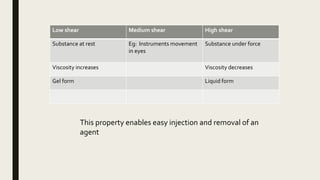
■ It refers to changes in viscosity with different shear rates
■ It is the ability of the solution to transform from gel like state into
liquid like state(viscosity reduces) under pressure ( shear force )
Low shear Medium shear High shear
Substance at rest Eg: Instruments movement
in eyes
Substance under force
Viscosity increases Viscosity decreases
Gel form Liquid form
This property enables easy injection and removal of an
agent
Elasticity
■ It refers to ability of a substance or material to return to it original
shape after being deformed ( stretched or compressed )
■ Elastic substances are good for maintaining space
■ High molecular weight highly elastic
Coatability /Lubricating power
■ It measures the adhesion capacity of OVD
■ It is inversely proportional to surface tension and the contact angle b/w
OVD and a solid material
■ Low surface tension, low contact angles, more negatively chargedOVDs
better coat the endothelium
■ HPMC, Chondritn sulphate > Na Hya
Cohesiveness
■ It is the degree to which the material adheres to itself
■ It depends on molecular weight, strength of molecular binding and
elasticity
■ The more cohesive an OVD, the lower the flow rate and hence
they are good for space maintaining and are easily removed
Dispersiveness
■ It is the tendency of a material to disperse when injected into AC
Cohesive / dispersive index
■ Its is defined as percentage of viscoelastic agent aspirated/100mmhg
■ The higher the CDI , the quicker the substance can be aspirated
when a certain amount of aspiration is reached
Classification of OVDs
■ Dispersive
■ Cohesive
■ Combination
■ Viscoadaptive
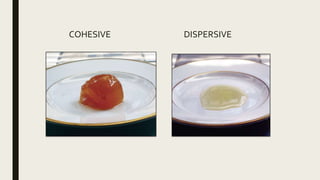
Dispersive
■ Low viscosity
■ Ability to coat intraocular structures
■ The molecules behave separately and build up a solution ( honey
Like )
■ They tend to stay in fluidic movements of phaco surgery
■ Eg: HPMC, Dispersive Na Ha
Cohesive
■ High viscosity
■ Able to give pressure to the eye and create space and
maintain space
■ They act like a gel
■ Eg: Cohesive Na-Ha, Super Cohesive Na Ha
Combination
■ New generation
■ Highly viscous dispersive OVDs
■ Advantages of both cohesives and dispersive
Viscoadaptive OVD
■ Changes its behaviour at different flow rates
■ Eg: Healon 5 ( Abbott Medical optics )
■ :
Low flow rate – it is very viscous and cohesive
High flow rate – it becomes pseudo dispersive and effectively
protects endothelial cells
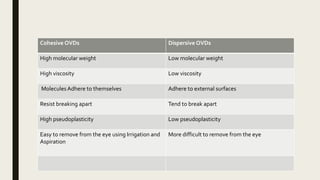
Cohesive OVDs Dispersive OVDs
High molecular weight Low molecular weight
High viscosity Low viscosity
Molecules Adhere to themselves Adhere to external surfaces
Resist breaking apart Tend to break apart
High pseudoplasticity Low pseudoplasticity
Easy to remove from the eye using Irrigation and
Aspiration
More difficult to remove from the eye
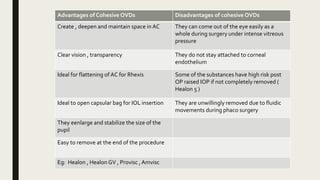
Advantages of Cohesive OVDs Disadvantages of cohesive OVDs
Create , deepen and maintain space in AC They can come out of the eye easily as a
whole during surgery under intense vitreous
pressure
Clear vision , transparency They do not stay attached to corneal
endothelium
Ideal for flattening of AC for Rhexis Some of the substances have high risk post
OP raised IOP if not completely removed (
Healon 5 )
Ideal to open capsular bag for IOL insertion They are unwillingly removed due to fluidic
movements during phaco surgery
They eenlarge and stabilize the size of the
pupil
Easy to remove at the end of the procedure
Eg: Healon , Healon GV , Provisc , Amvisc
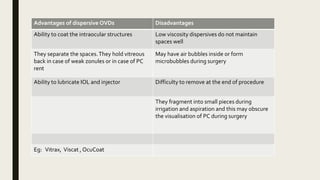
Advantages of dispersive OVDs Disadvantages
Ability to coat the intraocular structures Low viscosity dispersives do not maintain
spaces well
They separate the spaces.They hold vitreous
back in case of weak zonules or in case of PC
rent
May have air bubbles inside or form
microbubbles during surgery
Ability to lubricate IOL and injector Difficulty to remove at the end of procedure
They fragment into small pieces during
irrigation and aspiration and this may obscure
the visualisation of PC during surgery
Eg: Vitrax, Viscat , OcuCoat
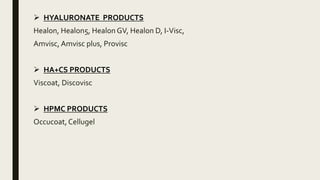
 HYALURONATE PRODUCTS
Healon, Healon5, Healon GV, Healon D, I-Visc,
Amvisc, Amvisc plus, Provisc
 HA+CS PRODUCTS
Viscoat, Discovisc
 HPMC PRODUCTS
Occucoat,Cellugel
COHESIVE DISPERSIVE
CLINICAL APPLICATIONS
 Cataract surgery
■ Protection of endothelium
■ Maintaining of AC
■ CAPSULAR RHEXXIS
■ Cleavage of lens structure
■ Visco -expression of lens
■ Phacoemulsification of nucleus
■ IOL implantation
■ dilate the pupil & maintain a good intraoperative mydriasis
■ Iris herniation or prolapse
■ Posterior capsule tear
■ Pediatric cataract Sx – while performing capsulorrhexis
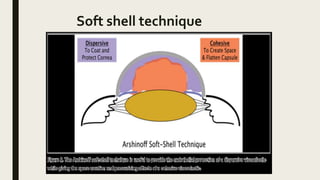
Soft shell technique
■ Developed by Arshinoff
■ Use of both lower viscosity dispersive & high viscosity cohesive OVDs
together to minimise their drawbacks & to get best properties of both
Soft shell technique
Uses
■ Floppy iris syndrome, the soft-shell technique can hold the iris in place
throughout the surgery.
■ Cases of broken zonules, the dispersiveOVD can compartmentalize the eye
and keep vitreous pushed posteriorly, while the cohesiveOVD keeps the
anterior chamber formed and pressurized.
■ Highly myopic eyes, dispersiveOVDs protect the cornea, while re-
application of cohesiveOVDs to pressurize the anterior segment can
minimize traction on the vitreous base and decrease retinal risk
Floppy iris syndrome
■ Because of use of systemicTAMSULOSIN, a selective alpha 1 blocker
■ During cataract surgery, it presents as an undulating iris.The iris has a
tendency to prolapse and progressive miosis is observed
Glaucoma surgery
Visco-canalostomy
■ Means opening of schlemm’s canal by OVD
■ A Non penetrating procedure ,independent of external filtration
■ Advantages-decrease risk of infection,
-decrease incidence of cataract
-hypotony
-flat AC
-Excludes risk of late infection & conjunctival & episcleral scarring
■ Healon GV and healon5 are used
Keratoplasty
■ Used to fill the AC before removing corneal button from donor eyes as it
helps to protect corneal endothelium and provides an even and circular
trephination
■ In recipients eyes helps to have even and circular trephination, protects
other intraocular structures maintains IOP and prevents sudden collapse of
AC during trephination
■ In lamellar keratoplasty helps in the dissection of deep stroma during
dissection of recipients stroma,called viscodelamination of cornea
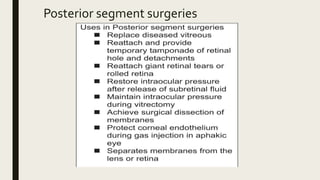
Posterior segment surgeries
■ In strabismus sx Force required to bring the muscle to its insertion is
significantly less with the use of subconjunctival viscoelastic
■ In plastic surgery during DCR helps in identifying lacrimal sac
■ Viscoelastics have a role in canalicular repair where the uninjured
canaliculus is irrigated with fluorescein dye tinted viscoelastic , that spills
from the other end ; helping to locate the proximal end of the injured
canaliculus
VISCOSTAINING OF CAPSULE
■ Techniques-staining from above under an air bubble & intracameral
subcapsular inj.of Fl.Na ( staining from below)with blue-light
enhancement.
■ Any instrument entering eye will cause some air to escape with rise of
lens-iris plane
■ A small amount of high density viscoelastic placed near incision prevents
air escape & minimizes risk of sudden collapse.
■ Alternatively-dye mixed with OVD called as viscostaining of ant.lens
capsule covers ant capsule without coming in contact with corneal
endothelium
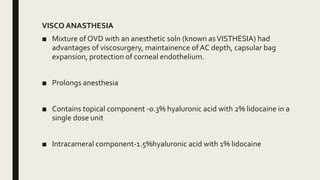
VISCO ANASTHESIA
■ Mixture of OVD with an anesthetic soln (known asVISTHESIA) had
advantages of viscosurgery, maintainence of AC depth, capsular bag
expansion, protection of corneal endothelium.
■ Prolongs anesthesia
■ Contains topical component -0.3% hyaluronic acid with 2% lidocaine in a
single dose unit
■ Intracameral component-1.5%hyaluronic acid with 1% lidocaine
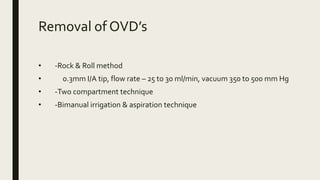
Removal of OVD’s
• -Rock & Roll method
• 0.3mm I/A tip, flow rate – 25 to 30 ml/min, vacuum 350 to 500 mm Hg
• -Two compartment technique
• -Bimanual irrigation & aspiration technique
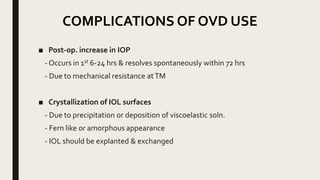
COMPLICATIONS OF OVD USE
■ Post-op. increase in IOP
- Occurs in 1st 6-24 hrs & resolves spontaneously within 72 hrs
- Due to mechanical resistance atTM
■ Crystallization of IOL surfaces
- Due to precipitation or deposition of viscoelastic soln.
- Fern like or amorphous appearance
- IOL should be explanted & exchanged
Capsular block syndrome or Capsular bag distension syndrome (CBS)
Characterised by accumulation of liquefied substance within a closed
chamber inside the capsular bag, formed because the lens nucleus or the
PCIOL optic occludes the ant. capsule opening created by capsulorrhexis
■ Classified as :
1.Intra-op – time of nucleus luxation following hydro-dissection
2.Early post-op
3.Late post op. – with liquefied after cataract
■ Eg:Use of high density viscoelastic agent like Healon GV causes late CBS
■ Reduced distance visual acuity and improved near acuity due to induced
myopia :forward shift of IOL.
■ IOP is normal, despite shallow anterior chamber.
■ Treatment is done by yag laser application to anterior capsule to allow OVD
to escape anteriorly or posterior capsule may be lasered with escape of OVD
posteriorly.
■ Calcific band keratopathy
- Occurs with chondroitin sulphate containing OVDs
■ Pseudo Anterior uveitis
- Due to OVDs viscous nature & the electrostatic charge of it
- RBCs & inflammatory cells remain in AC giving it appearance of uveitis
- Spontaneously resolves within 3 days
- Intra ocular haemorrhage may be trapped between vitreous space & OVD in
AC mimickingVH
Thank you

Ocular viscosurgical devices

  • 1.
    OCULAR VISCOSURGICAL DEVICES Dr. Nikhil RP Junior Resident Dept. of Ophthalmology Narayana medical college
  • 2.
    History ■ In 1970’sfirst ACIOL and PCIOL’s were invented and the move from ICCE to ECCE resulted in Increased number of Post OP Corneal Decompression that resulted in full thickness corneal grafts ■ Dr Endre A Balazs introducedViscoelastics ■ He worked on structure and biological activity of hyaluronan, a viscoelastic substance present in all tissues ■ Swedish pharmacia patented it and introduced HEALON . 1980
  • 3.
    Characteristics of idealviscoelastic ■ Inert and iso- osmotic ■ Non inflammatory and non toxic ■ Optically clear ■ Contaminant free , particle free ■ Should have a pH similar toAC ■ Cost effective ■ Should not interfere with wound healing ■ It should have high viscosity to prevent damage to tissues
  • 4.
    Commonly used familiesof OVDs ■ Sodium hyaluronate ■ Chondroitin sulphate ■ Hydroxypropyl methylcellulose
  • 5.
    Sodium hyaluronate ■ Itsa biopolymer found in connective tissues including trabecular meswork, aqueous and vitreous humour ■ Hyaluronate refers to conjugate base of hyaluronic acid ■ It is used as a single combination or in combination with chondritin sulpahte
  • 6.
    Chondritin Sulphate ■ Itsa biopolymer found in Extra cellular matrix ■ It is used for coating but h as less viscosity ■ High concentration causes endothelial dehydration and endothelial cell toxicity ■ 3% Na Ha + 4% CS – good coating ability + good cell protection
  • 7.
    Hydroxypropyl methylcellulose ■ Itis a disaccharide with side chains ■ Hydrophillic ■ It is synthesized from methylcellulose , a component of plant fibres ■ Used as a lubricant because of its wetting and coating capacity ■ Once injected , it shows inflammatory reactions and difficult to metabolise ■ It is difficult to remove fromAC
  • 8.
    Physical properties ofOVD ■ Viscosity ■ Pseudoplasticity ■ Elasticity ■ Coatability ■ Cohesiveness ■ Dispersiveness
  • 9.
    Viscosity ■ Internal frictioncaused by molecular attraction that leads to a solution’s resistance to flow ■ Determined by molecular weight ■ It denotes the protective and lubricating property of a viscoelastic
  • 10.
    ■ High molecularweight and high concentration have highest viscosity ■ High viscosity solutions tend to stay within the AC and separate the tissues well ■ Shear force/rate- stress that is applied parallel to the material
  • 11.
    Pseudoplasticity ■ Aka Rheofluidity ■It refers to changes in viscosity with different shear rates ■ It is the ability of the solution to transform from gel like state into liquid like state(viscosity reduces) under pressure ( shear force )
  • 12.
    Low shear Mediumshear High shear Substance at rest Eg: Instruments movement in eyes Substance under force Viscosity increases Viscosity decreases Gel form Liquid form This property enables easy injection and removal of an agent
  • 13.
    Elasticity ■ It refersto ability of a substance or material to return to it original shape after being deformed ( stretched or compressed ) ■ Elastic substances are good for maintaining space ■ High molecular weight highly elastic
  • 14.
    Coatability /Lubricating power ■It measures the adhesion capacity of OVD ■ It is inversely proportional to surface tension and the contact angle b/w OVD and a solid material ■ Low surface tension, low contact angles, more negatively chargedOVDs better coat the endothelium ■ HPMC, Chondritn sulphate > Na Hya
  • 15.
    Cohesiveness ■ It isthe degree to which the material adheres to itself ■ It depends on molecular weight, strength of molecular binding and elasticity ■ The more cohesive an OVD, the lower the flow rate and hence they are good for space maintaining and are easily removed
  • 16.
    Dispersiveness ■ It isthe tendency of a material to disperse when injected into AC
  • 17.
    Cohesive / dispersiveindex ■ Its is defined as percentage of viscoelastic agent aspirated/100mmhg ■ The higher the CDI , the quicker the substance can be aspirated when a certain amount of aspiration is reached
  • 18.
    Classification of OVDs ■Dispersive ■ Cohesive ■ Combination ■ Viscoadaptive
  • 19.
    Dispersive ■ Low viscosity ■Ability to coat intraocular structures ■ The molecules behave separately and build up a solution ( honey Like ) ■ They tend to stay in fluidic movements of phaco surgery ■ Eg: HPMC, Dispersive Na Ha
  • 20.
    Cohesive ■ High viscosity ■Able to give pressure to the eye and create space and maintain space ■ They act like a gel ■ Eg: Cohesive Na-Ha, Super Cohesive Na Ha
  • 21.
    Combination ■ New generation ■Highly viscous dispersive OVDs ■ Advantages of both cohesives and dispersive
  • 22.
    Viscoadaptive OVD ■ Changesits behaviour at different flow rates ■ Eg: Healon 5 ( Abbott Medical optics ) ■ : Low flow rate – it is very viscous and cohesive High flow rate – it becomes pseudo dispersive and effectively protects endothelial cells
  • 23.
    Cohesive OVDs DispersiveOVDs High molecular weight Low molecular weight High viscosity Low viscosity Molecules Adhere to themselves Adhere to external surfaces Resist breaking apart Tend to break apart High pseudoplasticity Low pseudoplasticity Easy to remove from the eye using Irrigation and Aspiration More difficult to remove from the eye
  • 24.
    Advantages of CohesiveOVDs Disadvantages of cohesive OVDs Create , deepen and maintain space in AC They can come out of the eye easily as a whole during surgery under intense vitreous pressure Clear vision , transparency They do not stay attached to corneal endothelium Ideal for flattening of AC for Rhexis Some of the substances have high risk post OP raised IOP if not completely removed ( Healon 5 ) Ideal to open capsular bag for IOL insertion They are unwillingly removed due to fluidic movements during phaco surgery They eenlarge and stabilize the size of the pupil Easy to remove at the end of the procedure Eg: Healon , Healon GV , Provisc , Amvisc
  • 25.
    Advantages of dispersiveOVDs Disadvantages Ability to coat the intraocular structures Low viscosity dispersives do not maintain spaces well They separate the spaces.They hold vitreous back in case of weak zonules or in case of PC rent May have air bubbles inside or form microbubbles during surgery Ability to lubricate IOL and injector Difficulty to remove at the end of procedure They fragment into small pieces during irrigation and aspiration and this may obscure the visualisation of PC during surgery Eg: Vitrax, Viscat , OcuCoat
  • 27.
     HYALURONATE PRODUCTS Healon,Healon5, Healon GV, Healon D, I-Visc, Amvisc, Amvisc plus, Provisc  HA+CS PRODUCTS Viscoat, Discovisc  HPMC PRODUCTS Occucoat,Cellugel
  • 28.
  • 29.
    CLINICAL APPLICATIONS  Cataractsurgery ■ Protection of endothelium ■ Maintaining of AC ■ CAPSULAR RHEXXIS ■ Cleavage of lens structure ■ Visco -expression of lens ■ Phacoemulsification of nucleus ■ IOL implantation ■ dilate the pupil & maintain a good intraoperative mydriasis ■ Iris herniation or prolapse ■ Posterior capsule tear ■ Pediatric cataract Sx – while performing capsulorrhexis
  • 30.
    Soft shell technique ■Developed by Arshinoff ■ Use of both lower viscosity dispersive & high viscosity cohesive OVDs together to minimise their drawbacks & to get best properties of both
  • 31.
  • 32.
    Uses ■ Floppy irissyndrome, the soft-shell technique can hold the iris in place throughout the surgery. ■ Cases of broken zonules, the dispersiveOVD can compartmentalize the eye and keep vitreous pushed posteriorly, while the cohesiveOVD keeps the anterior chamber formed and pressurized. ■ Highly myopic eyes, dispersiveOVDs protect the cornea, while re- application of cohesiveOVDs to pressurize the anterior segment can minimize traction on the vitreous base and decrease retinal risk
  • 33.
    Floppy iris syndrome ■Because of use of systemicTAMSULOSIN, a selective alpha 1 blocker ■ During cataract surgery, it presents as an undulating iris.The iris has a tendency to prolapse and progressive miosis is observed
  • 34.
    Glaucoma surgery Visco-canalostomy ■ Meansopening of schlemm’s canal by OVD ■ A Non penetrating procedure ,independent of external filtration ■ Advantages-decrease risk of infection, -decrease incidence of cataract -hypotony -flat AC -Excludes risk of late infection & conjunctival & episcleral scarring ■ Healon GV and healon5 are used
  • 35.
    Keratoplasty ■ Used tofill the AC before removing corneal button from donor eyes as it helps to protect corneal endothelium and provides an even and circular trephination ■ In recipients eyes helps to have even and circular trephination, protects other intraocular structures maintains IOP and prevents sudden collapse of AC during trephination ■ In lamellar keratoplasty helps in the dissection of deep stroma during dissection of recipients stroma,called viscodelamination of cornea
  • 36.
  • 37.
    ■ In strabismussx Force required to bring the muscle to its insertion is significantly less with the use of subconjunctival viscoelastic ■ In plastic surgery during DCR helps in identifying lacrimal sac ■ Viscoelastics have a role in canalicular repair where the uninjured canaliculus is irrigated with fluorescein dye tinted viscoelastic , that spills from the other end ; helping to locate the proximal end of the injured canaliculus
  • 38.
    VISCOSTAINING OF CAPSULE ■Techniques-staining from above under an air bubble & intracameral subcapsular inj.of Fl.Na ( staining from below)with blue-light enhancement. ■ Any instrument entering eye will cause some air to escape with rise of lens-iris plane ■ A small amount of high density viscoelastic placed near incision prevents air escape & minimizes risk of sudden collapse. ■ Alternatively-dye mixed with OVD called as viscostaining of ant.lens capsule covers ant capsule without coming in contact with corneal endothelium
  • 39.
    VISCO ANASTHESIA ■ Mixtureof OVD with an anesthetic soln (known asVISTHESIA) had advantages of viscosurgery, maintainence of AC depth, capsular bag expansion, protection of corneal endothelium. ■ Prolongs anesthesia ■ Contains topical component -0.3% hyaluronic acid with 2% lidocaine in a single dose unit ■ Intracameral component-1.5%hyaluronic acid with 1% lidocaine
  • 40.
    Removal of OVD’s •-Rock & Roll method • 0.3mm I/A tip, flow rate – 25 to 30 ml/min, vacuum 350 to 500 mm Hg • -Two compartment technique • -Bimanual irrigation & aspiration technique
  • 41.
    COMPLICATIONS OF OVDUSE ■ Post-op. increase in IOP - Occurs in 1st 6-24 hrs & resolves spontaneously within 72 hrs - Due to mechanical resistance atTM ■ Crystallization of IOL surfaces - Due to precipitation or deposition of viscoelastic soln. - Fern like or amorphous appearance - IOL should be explanted & exchanged
  • 42.
    Capsular block syndromeor Capsular bag distension syndrome (CBS) Characterised by accumulation of liquefied substance within a closed chamber inside the capsular bag, formed because the lens nucleus or the PCIOL optic occludes the ant. capsule opening created by capsulorrhexis ■ Classified as : 1.Intra-op – time of nucleus luxation following hydro-dissection 2.Early post-op 3.Late post op. – with liquefied after cataract
  • 43.
    ■ Eg:Use ofhigh density viscoelastic agent like Healon GV causes late CBS ■ Reduced distance visual acuity and improved near acuity due to induced myopia :forward shift of IOL. ■ IOP is normal, despite shallow anterior chamber. ■ Treatment is done by yag laser application to anterior capsule to allow OVD to escape anteriorly or posterior capsule may be lasered with escape of OVD posteriorly.
  • 44.
    ■ Calcific bandkeratopathy - Occurs with chondroitin sulphate containing OVDs ■ Pseudo Anterior uveitis - Due to OVDs viscous nature & the electrostatic charge of it - RBCs & inflammatory cells remain in AC giving it appearance of uveitis - Spontaneously resolves within 3 days - Intra ocular haemorrhage may be trapped between vitreous space & OVD in AC mimickingVH
  • 45.