Anesthesia for Cataract Surgery
• Local and topical techniques are now the 
norm 
• 2% of patients requiring general anesthesia
Local Anesthesia 
• Minimal disruption for the patient 
• Sedation may be useful (Standard fasting 
times) 
• Monitoring: ECG, pulse oximetry 
• Supplemental oxygen
Local Anesthesia 
• Topical anesthesia 
• Retrobulbar block 
• Peribulbar block 
• Sub-Tenon's block
Topical anesthesia 
• Oxybuprocaine (benoxinate) 0.4% : frequently 
used 
• Proparacaine (proxymetacaine) 0.5% is less 
toxic to the corneal epithelium, shorter 
duration of action (20 min) 
• Other: including tetracaine (amethocaine) 
0.5–1%, lidocaine 1–4% and bupivacaine 0.5– 
0.75%, longer duration, but increased 
associated corneal toxicity
Advantages 
•No risk associated with needle insertion 
•Reduced risk of periocular hemorrhage 
•Functional vision is maintained; advantageous for uniocular patients 
•Reduced postoperative diplopia and ptosis 
Disadvantages 
•An awake and talkative patient can be distracting for the surgeon 
•No akinesia of the eye 
•Less-effective anesthesia than sub-Tenon's block 
•Increased risk of surgical complications. If difficulties or problems 
occur anesthesia may be inadequate 
•May be unsuitable for less-experienced surgeons
Adverse Effects of Topical Ocular Anesthetics 
•Direct corneal effects – alteration of lacrimation and tear film stability 
•Epithelial toxicity – healing has been shown to be delayed when an 
epithelial defect occurs (lidocaine does not appear to affect healing) 
•Endothelial toxicity – this occurs when penetrating trauma is present 
and appears to be related to the preservative benzalkonium 
•Systemic effects – lethal toxicity (this is only a problem with cocaine) 
•Allergy and idiosyncratic reactions 
Secondary Adverse Effects 
•Surface keratopathy
• Topical anesthesia may be combined with 
subconjunctival or, more commonly, 
intracameral anesthesia to improve patient 
comfort 
• As visual perception is not lost 
• Several studies showing inferior analgesia 
compared to both peribulbar and sub-Tenon's 
blocks, and an increase in surgical 
complication rate
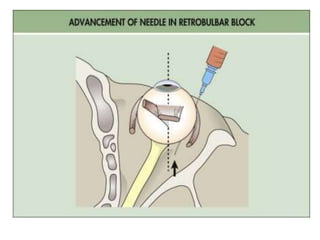
Retrobulbar Block 
• Aim is to block the oculomotor nerves before 
they enter the four rectus muscles by 
depositing local anesthetic directly into the 
posterior intraconal space 
• Peribulbar block offers a safer
Advantages 
•Reliable akinesia 
•Onset of block is quicker than with peribulbar anesthesia 
•Low volumes of anesthetic result in a lower intraorbital 
tension and less chemosis than with peribulbar blocks 
•Temporary loss of visual acuity occurs more reliably than for 
peribulbar block 
Disadvantages 
•Risk of brainstem anesthesia – reason for the development 
of the peribulbar block 
•Risk of myotoxicity and globe perforation
• Clean the lower lid with the prep wipe. 
• Ask an assistant to pull the upper lid upward to see if the block needle is 
going through muscle, which will be indicated by movement of the globe. 
• Palpate the inferior orbital margin. Feel the infraorbital notch, 
approximately at the junction between the medial two thirds and the 
lateral one third of the inferior orbital rim. 
• Make a skin wheal immediately lateral to the notch using a small gauge 
(30 gauge) needle and syringe. 
• Advance the block needle straight down and perpendicular to the plane of 
the face, until you encounter a distinct pop that indicates passage through 
the orbital septum 
• Angle the block needle 45 degrees medially and 45 degrees superiorly 
toward the apex of the orbit until the second pop through the muscle 
cone is felt 
• Aspirate for blood. 
• Inject 2 to 3 mL of the anesthetic solution.
Peribulbar Block 
• instill local anesthetic outside the posterior 
muscle cone 
• avoid accidental injection into the optic nerve
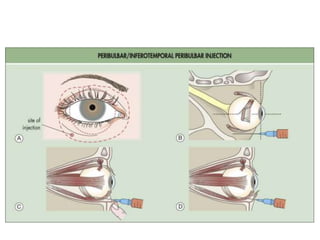
Technique 
• local anesthetic drops are applied to the cornea 
• At the inferotemporal lower orbital margin a 25- 
gauge, 25 mm needle is advanced parallel to the 
plane of the orbital floor either transcutaneously 
or transconjunctivally 
• A degree of upwards and inwards angulation may 
be needed once past the equator of the globe 
• Local anesthetic (4–6 mL) is injected at a depth 
of about 20 mm from the inferior orbital rim
Complications 
-Most serious complications of peribulbar 
anesthesia relate to the use of sharp needles. 
•Globe perforation/penetration 
•Retrobulbar hemorrhage 
•Extraocular myotoxicity
Sub-Tenon's Block 
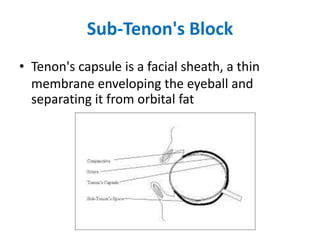
• Tenon's capsule is a facial sheath, a thin 
membrane enveloping the eyeball and 
separating it from orbital fat
Technique 
• The conjunctiva is anesthetized first with a topical local 
anesthetic of choice 
• The commonest approach is via the infranasal quadrant 
• The eye is cleaned with iodine 5% and the patient asked to 
look upwards and outwards 
• Aseptically, the conjunctiva and Tenon's capsule are held 3– 
5 mm from the limbus using non-toothed Moorfields 
forceps 
• A small incision is made through these layers using blunt-tipped, 
sprung Westcott scissors exposing the sclera 
• A cannula is then advanced into the sub-Tenon space and 
around the globe
General Anesthesia 
• unsuitable for local anesthesia 
• method of choice for babies, children, and the 
uncooperative
Advantages 
•Patient comfort 
•Ideal operating conditions – a quiet, immobile patient and soft eye 
•Allows for rapid alterations in intraocular pressure if required 
•No risk of complications associated with local anesthetic blocks 
•No residual paralysis of the eye when the patient is awake 
•Bilateral surgery can be performed 
•Better conditions for teaching 
Disadvantages 
•Slower turnaround times 
•More expensive 
•Greater risk in frail elderly 
•Greater physiological disruption for patient
• Ophthalmology , Fourth Edition, Myron Yanoff, 
and Jay S. Duker

Anesthesia for cataract surgery

  • 1.
  • 2.
    • Local andtopical techniques are now the norm • 2% of patients requiring general anesthesia
  • 3.
    Local Anesthesia •Minimal disruption for the patient • Sedation may be useful (Standard fasting times) • Monitoring: ECG, pulse oximetry • Supplemental oxygen
  • 4.
    Local Anesthesia •Topical anesthesia • Retrobulbar block • Peribulbar block • Sub-Tenon's block
  • 5.
    Topical anesthesia •Oxybuprocaine (benoxinate) 0.4% : frequently used • Proparacaine (proxymetacaine) 0.5% is less toxic to the corneal epithelium, shorter duration of action (20 min) • Other: including tetracaine (amethocaine) 0.5–1%, lidocaine 1–4% and bupivacaine 0.5– 0.75%, longer duration, but increased associated corneal toxicity
  • 6.
    Advantages •No riskassociated with needle insertion •Reduced risk of periocular hemorrhage •Functional vision is maintained; advantageous for uniocular patients •Reduced postoperative diplopia and ptosis Disadvantages •An awake and talkative patient can be distracting for the surgeon •No akinesia of the eye •Less-effective anesthesia than sub-Tenon's block •Increased risk of surgical complications. If difficulties or problems occur anesthesia may be inadequate •May be unsuitable for less-experienced surgeons
  • 7.
    Adverse Effects ofTopical Ocular Anesthetics •Direct corneal effects – alteration of lacrimation and tear film stability •Epithelial toxicity – healing has been shown to be delayed when an epithelial defect occurs (lidocaine does not appear to affect healing) •Endothelial toxicity – this occurs when penetrating trauma is present and appears to be related to the preservative benzalkonium •Systemic effects – lethal toxicity (this is only a problem with cocaine) •Allergy and idiosyncratic reactions Secondary Adverse Effects •Surface keratopathy
  • 8.
    • Topical anesthesiamay be combined with subconjunctival or, more commonly, intracameral anesthesia to improve patient comfort • As visual perception is not lost • Several studies showing inferior analgesia compared to both peribulbar and sub-Tenon's blocks, and an increase in surgical complication rate
  • 9.
    Retrobulbar Block •Aim is to block the oculomotor nerves before they enter the four rectus muscles by depositing local anesthetic directly into the posterior intraconal space • Peribulbar block offers a safer
  • 10.
    Advantages •Reliable akinesia •Onset of block is quicker than with peribulbar anesthesia •Low volumes of anesthetic result in a lower intraorbital tension and less chemosis than with peribulbar blocks •Temporary loss of visual acuity occurs more reliably than for peribulbar block Disadvantages •Risk of brainstem anesthesia – reason for the development of the peribulbar block •Risk of myotoxicity and globe perforation
  • 12.
    • Clean thelower lid with the prep wipe. • Ask an assistant to pull the upper lid upward to see if the block needle is going through muscle, which will be indicated by movement of the globe. • Palpate the inferior orbital margin. Feel the infraorbital notch, approximately at the junction between the medial two thirds and the lateral one third of the inferior orbital rim. • Make a skin wheal immediately lateral to the notch using a small gauge (30 gauge) needle and syringe. • Advance the block needle straight down and perpendicular to the plane of the face, until you encounter a distinct pop that indicates passage through the orbital septum • Angle the block needle 45 degrees medially and 45 degrees superiorly toward the apex of the orbit until the second pop through the muscle cone is felt • Aspirate for blood. • Inject 2 to 3 mL of the anesthetic solution.
  • 13.
    Peribulbar Block •instill local anesthetic outside the posterior muscle cone • avoid accidental injection into the optic nerve
  • 14.
    Technique • localanesthetic drops are applied to the cornea • At the inferotemporal lower orbital margin a 25- gauge, 25 mm needle is advanced parallel to the plane of the orbital floor either transcutaneously or transconjunctivally • A degree of upwards and inwards angulation may be needed once past the equator of the globe • Local anesthetic (4–6 mL) is injected at a depth of about 20 mm from the inferior orbital rim
  • 16.
    Complications -Most seriouscomplications of peribulbar anesthesia relate to the use of sharp needles. •Globe perforation/penetration •Retrobulbar hemorrhage •Extraocular myotoxicity
  • 17.
    Sub-Tenon's Block •Tenon's capsule is a facial sheath, a thin membrane enveloping the eyeball and separating it from orbital fat
  • 18.
    Technique • Theconjunctiva is anesthetized first with a topical local anesthetic of choice • The commonest approach is via the infranasal quadrant • The eye is cleaned with iodine 5% and the patient asked to look upwards and outwards • Aseptically, the conjunctiva and Tenon's capsule are held 3– 5 mm from the limbus using non-toothed Moorfields forceps • A small incision is made through these layers using blunt-tipped, sprung Westcott scissors exposing the sclera • A cannula is then advanced into the sub-Tenon space and around the globe
  • 21.
    General Anesthesia •unsuitable for local anesthesia • method of choice for babies, children, and the uncooperative
  • 22.
    Advantages •Patient comfort •Ideal operating conditions – a quiet, immobile patient and soft eye •Allows for rapid alterations in intraocular pressure if required •No risk of complications associated with local anesthetic blocks •No residual paralysis of the eye when the patient is awake •Bilateral surgery can be performed •Better conditions for teaching Disadvantages •Slower turnaround times •More expensive •Greater risk in frail elderly •Greater physiological disruption for patient
  • 23.
    • Ophthalmology ,Fourth Edition, Myron Yanoff, and Jay S. Duker

Editor's Notes

  • #16 Inferotemporal peribulbar injection. (A) The needle enters the orbit at the junction of its floor with the lateral wall, very close to the bony rim. (B) The needle passes backward in a sagittal plane parallel to the orbit floor. (C) It passes the globe equator when the needle-hub junction reaches the plane of the iris. (D) After test aspiration, up to 10 mL anesthetic solution is injected.