Helping More 90% of Students
  Become Proficient Readers


Oct. 31, 2011 Donaldson In-Service Grades 3-5
                 Presented by Leah Vestal
Preface:


• Some kids are good readers without instruction.
• Some kids would improve with explicit reading instruction.
• Some kids are puzzles that we have yet to figure out.
• The way many of us teach reading has trickled down from
  teachers that have been long retired and our own teachers.
  There’s been a lot of research in reading instruction since
  that time.
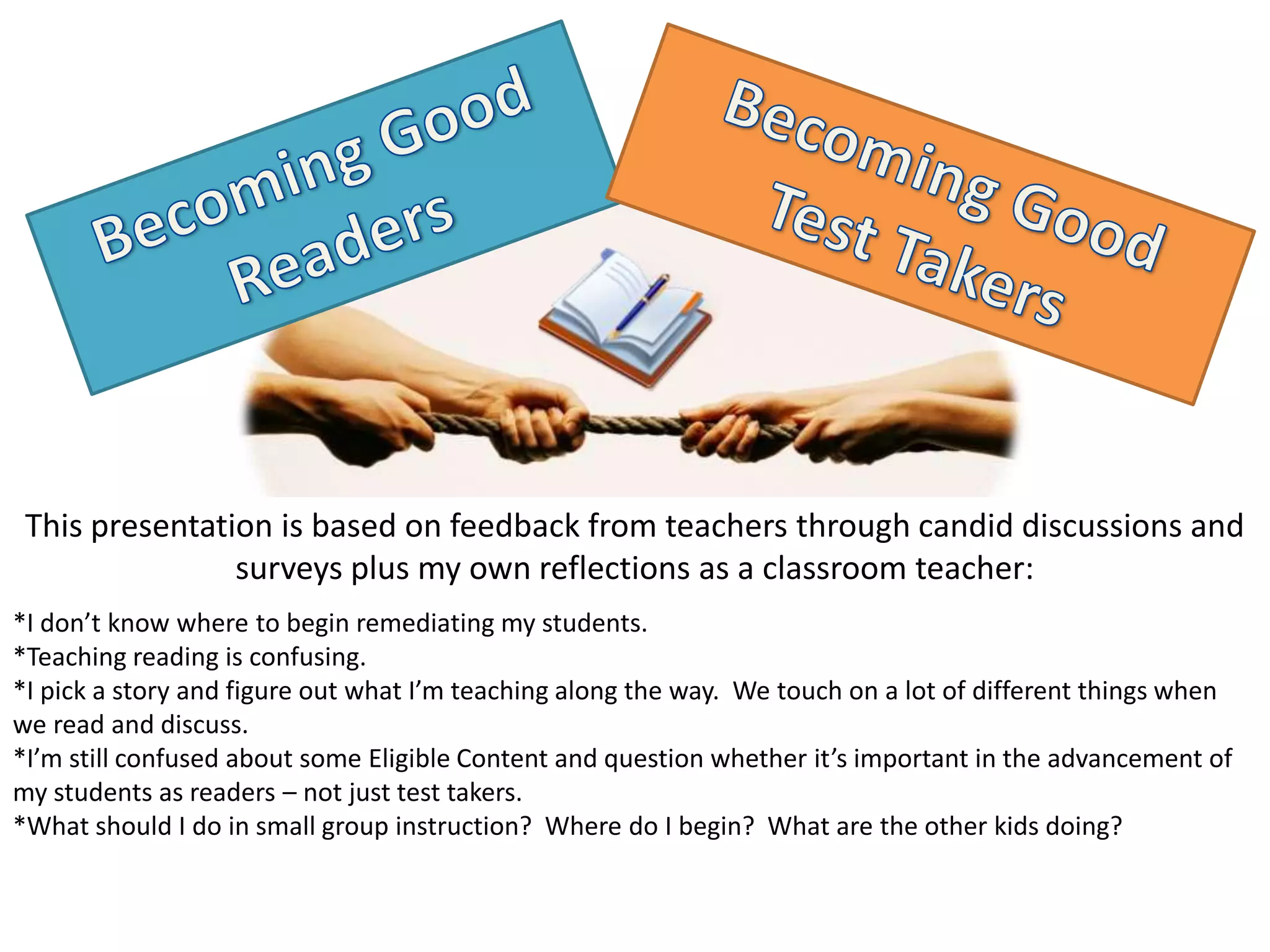
This presentation is based on feedback from teachers through candid discussions and
                surveys plus my own reflections as a classroom teacher:
*I don’t know where to begin remediating my students.
*Teaching reading is confusing.
*I pick a story and figure out what I’m teaching along the way. We touch on a lot of different things when
we read and discuss.
*I’m still confused about some Eligible Content and question whether it’s important in the advancement of
my students as readers – not just test takers.
*What should I do in small group instruction? Where do I begin? What are the other kids doing?
Explicit Instruction: Planning and
 Implementing the Mini-Lesson
Explicit Instruction: Effective, Intentional
                                                       Planning

What comprehension skills or strategy does Harcourt suggest for the selection? Too many?
Not eligible? Something that your kids already have a grip on? You like another better with
that particular story?

Doesn’t really matter all that much as long as it builds upon prior knowledge…..
                             Pick something that is…..
1) in our curriculum (EC) and
2) That is conducive with the selection.
3) Pay attention to the verbs. Identify? Compare? Explain? Describe? Analyze?
What precisely are you after?
              •There were times that I wasn’t ready to “go there” with
              summarizing……..
              •I preferred to wait to introduce ______ until I read the story……..
              •Other subjects were complicated, so I didn’t want to choose a
              skill/strategy that was so rigorous…..
              •Sometimes I didn’t understand why a reader needed this
              skill/strategy……
Explicit Instruction: Effective, Intentional
                            Modeling – “The Mini Lesson”
1) Model for the kids EXCPLICITY how “the pros” do it. How do you use this skill
   or strategy before/during/after your own reading? Think out loud.

2) If you don’t understand why something in the reading curriculum can help a
   reader, talk to a reading specialist and ask her. She’ll shed some light on it.
   Avoiding something because you don’t understand it is a detriment to our
   students.


             •Why does an 8 year old need to know an author’s
             purpose?
             •How does text organization aid in comprehension?
             •How does summarizing help?
Explicit Instruction: Effective, Intentional
                            Modeling – “The Mini Lesson”

Materials Needed:

• Harcourt Text or Picture Book or other text that is relevant to the
  skill/strategy you’re are teaching -

                                And probably…….
• Whatever material they will use when they are practicing….graphic organizer,
  sticky notes, etc., so you can demonstrate with that tool - (more on that)

                         And for the super ambitious…..

• Smart Board lesson that illustrates this process in an engaging way -
Explicit Instruction: Effective, Intentional
                             Modeling – “The Mini Lesson”

Use Mini-Lessons to model all skills/strategies included in the EC.

                                 As well as……

• Any other reading skill/strategy that is not in the EC (but in our
  curriculum – it may be worded differently, though) that is crucial to reading
  success….i.e. Back up and re-read; predict; question yourself,
  etc…

• Behaviors that support reading…..choosing good books that are
  in your range; reading quietly during partner pairs; staying in
  one spot the whole time
Discussion Point
The mini-lesson is not a new idea.
In fact, it’s right there in the Harcourt manual.
Why have we gotten away from this?
•   Kids can read well without explicit instruction
•   Failed efforts
•   Academic freedom
•   Don’t understand the rationale/importance
•   Something’s gotta give….
I need to learn more about this EC:______________________________
Explicit = (Most) kids could say, “My teacher showed us how non-fiction text
is organized differently and if can spot that pattern, it can help me understand
what I’m reading.

• What have I explicitly modeled in reading last week?
  Last month?
• How is “touching on” something different than
  explicit instruction?
• What mini-lesson can I plan to model this week?


The EC I plan on explicitly modeling this week:______________________
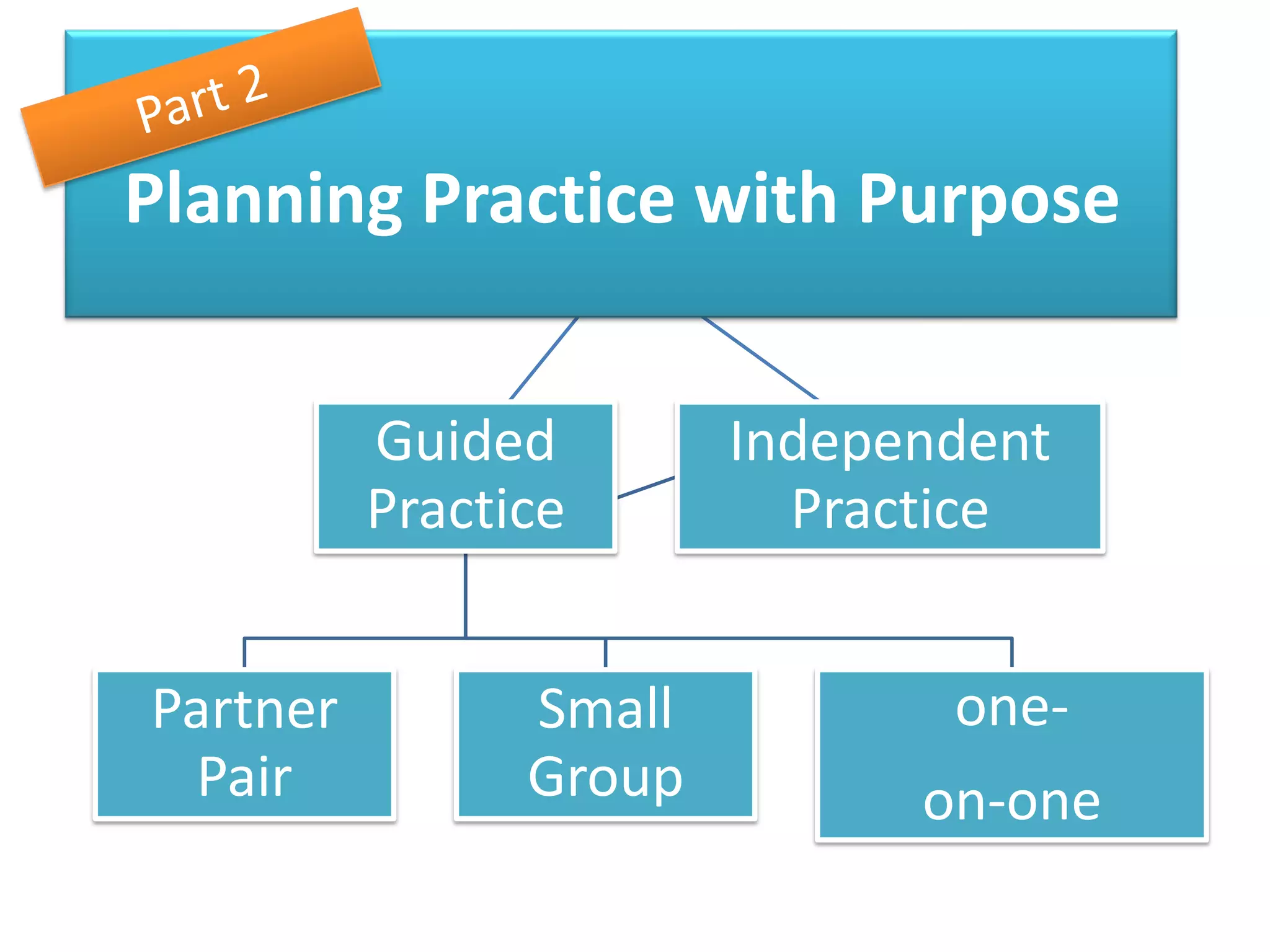
Planning Practice with Purpose


          Guided        Independent
          Practice        Practice


Partner         Small          one-
 Pair           Group         on-one
Practice with Purpose


1) Does the practice you are providing line up
with the VERB?
1. Does the practice you are providing line up
   with the VERB?

2. Does the practice you provide help develop
   strategic readers as well develop good PSSA
   test takers?
The Sticky Note

• A practical way for students to SHARE how they are
  practicing a mental strategy when you can’t be one-on-
  one with them.
• If you asked students to practice the strategy you
  modeled, how would you formatively assess them?

• A good alternative to some graphic organizers that are
  more confusing than helpful.

• How would you keep them on task?
Practice with Purpose
                   Examples of Comprehension Practice 1-2-3
Example: Summarize the key details and events of a text
                    as a whole.
1. Using the Harcourt passage, pairs can emulate the teacher’s “think
aloud”/modeling. (Teacher is facilitating.)

2. Students practice independently using Harcourt, their AR books, or other text.
(Teacher works with at-risk group using leveled readers.)
                                                               Sticky Summarizing

3. In the future, follow through with explicit modeling, practice and independent
open-ended practice if applicable assuming they have the prerequisites.
Example: Summarize what happened after Virtue ate the rice.
         Summarize how children of Iceland capture and release the puffins.
Practice with Purpose
                     Examples of Comprehension Practice 1-2-3

 Example: Identify, explain, interpret, compare, and/or describe
                          connections between texts.
1. Using the Harcourt passage, pairs can emulate the teacher’s “think aloud”/modeling.
   (Teacher is facilitating.)

2. Students practice independently using Harcourt, their AR books, or other text.
   (Teacher works with at-risk group using leveled readers.) Sticky Connections
                                         &
                                      summarize
3.   In the future, follow through with explicit modeling, practice and
     independent open-ended practice if applicable assuming they have the
     prerequisites.

Explain how the poem “Pizza” is different than the poem “Stromboli”. Use 2
details to support your answer.
Being Efficient…..
                      Examples of Comprehension Practice 1-2-3
Example: Make inferences and/or draw conclusions based on information from
the text.

1. Using the Harcourt passage, pairs can emulate the teacher’s “think
   aloud”/modeling. (Teacher is facilitating.)

2. Students practice independently using Harcourt, their AR books, or other text.
   (Teacher works with at-risk group using leveled readers.) Sticky Inferencing

3.   In the future, follow through with explicit modeling, practice and
     independent open-ended practice if applicable assuming they have the
     prerequisites.

Explain why the character believed that the Old Woman lived in a shoe. Use at least 2
details from the passage to support your answer.
• What are some other quick methods to formatively
  assess students’ REAL reading other than sticky notes?

• What is your next step in implementing explicit
  practice?

• How can you tell if EC is tested using the open-ended
  format and requires us to practice like that?

 How I plan on formatively assessing during reading strategies:
 __________________________________
Parts 1 and 2 - Summary

We need to be mindful of the eligible content and the associated
verbs when planning mini-lessons and practice.

It is important to explicitly model for students the thinking process
that good readers do. Some students have acquired good reading
strategies automatically while other readers will need much more
direct instruction.

Provide the students with both guided practice and independent
practice so we can monitor progress and adjust our instructional
goals.

Be mindful of the PSSA question stems during modeling and practice.
                  Reader’s Workshop Approach
Ideas for Integrated Repeated Practice
serve dual purposes using materials you already have
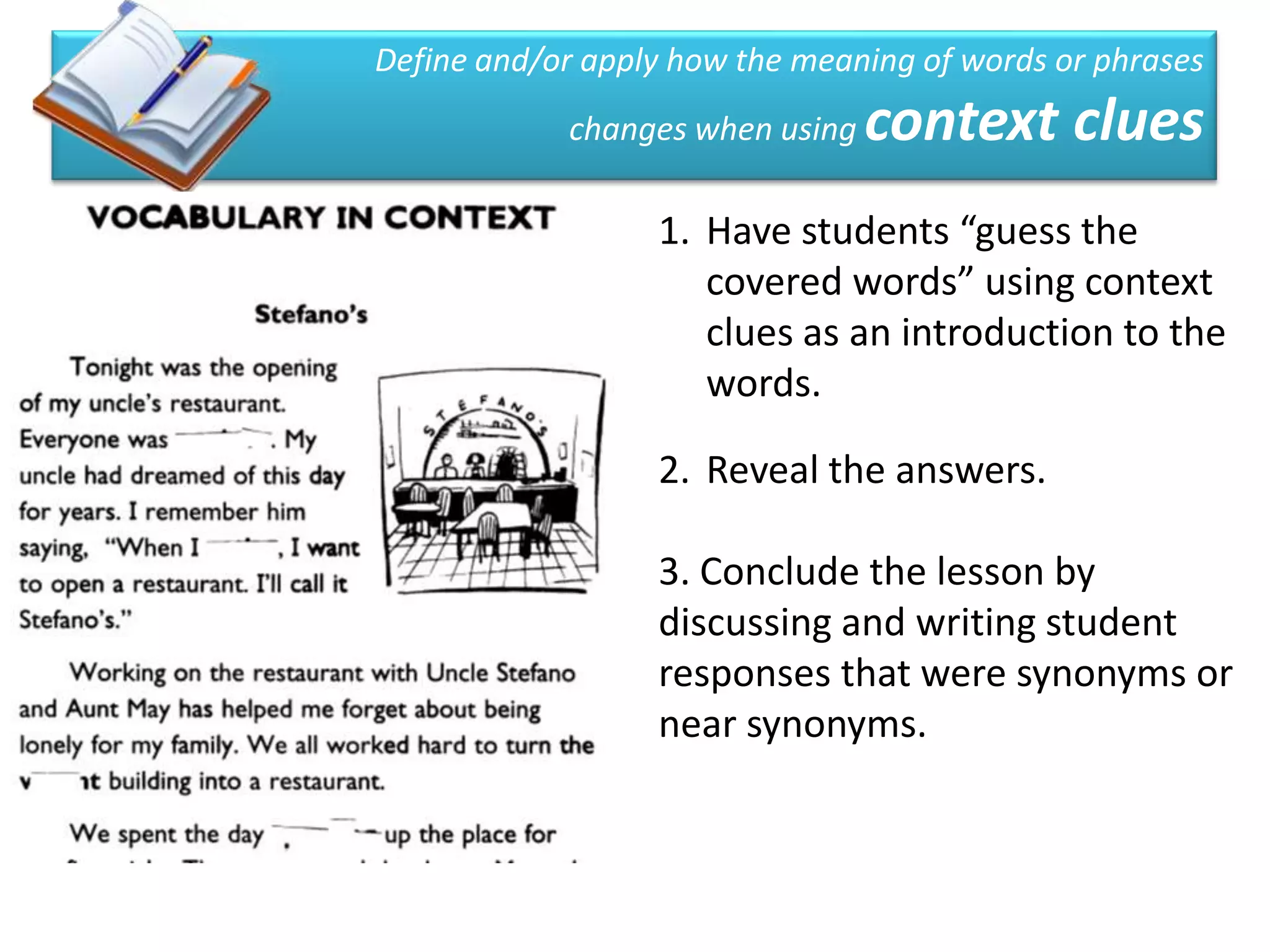
Define and/or apply how the meaning of words or phrases
            changes when using   context clues
                  1. Have students “guess the
                     covered words” using context
                     clues as an introduction to the
                     words.

                  2. Reveal the answers.

                  3. Conclude the lesson by
                  discussing and writing student
                  responses that were synonyms or
                  near synonyms.
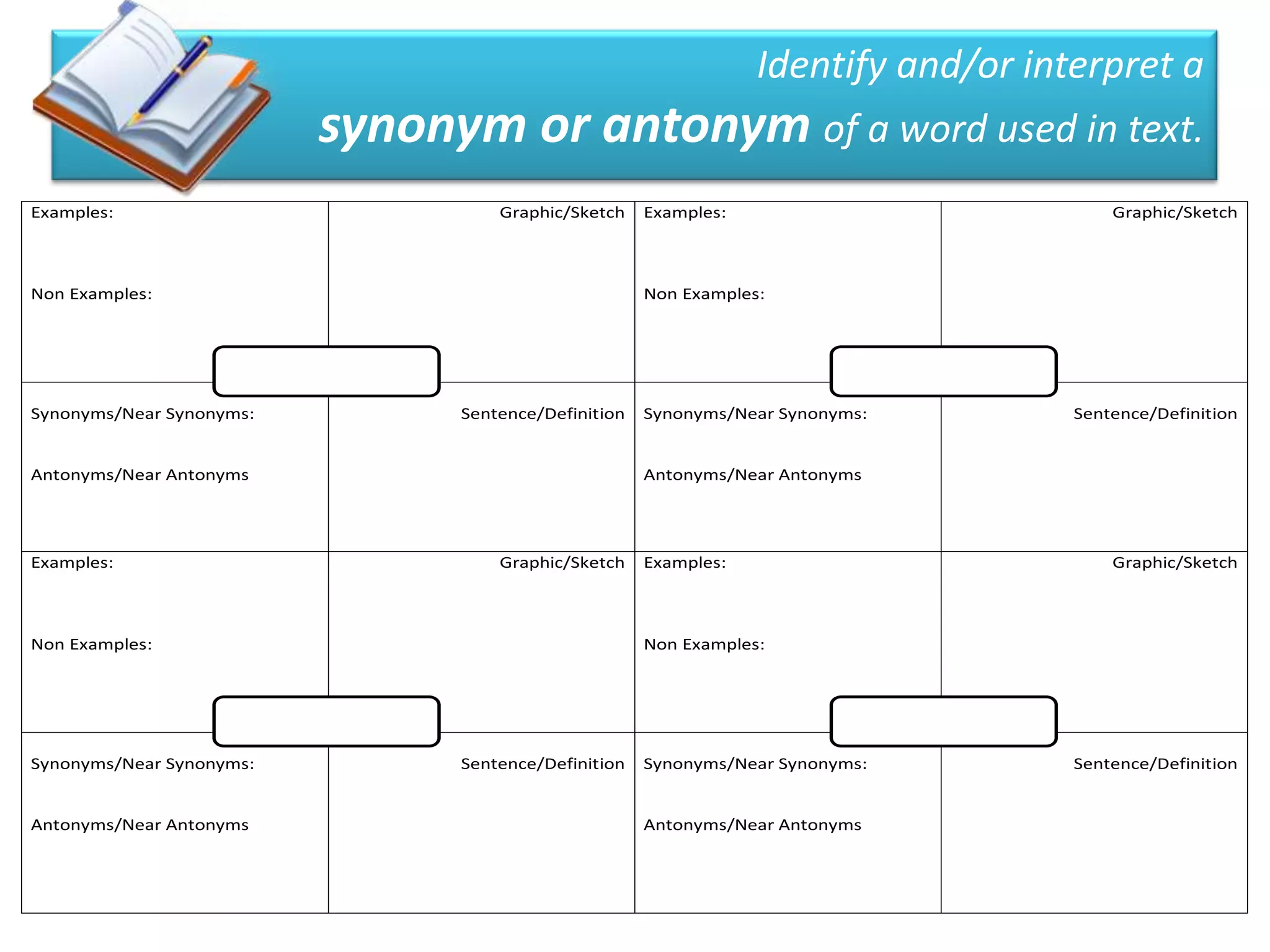
Identify and/or interpret a
                          synonym or antonym of a word used in text.
Examples:                           Graphic/Sketch    Examples:                          Graphic/Sketch


Non Examples:                                         Non Examples:


Synonyms/Near Synonyms:         Sentence/Definition   Synonyms/Near Synonyms:        Sentence/Definition


Antonyms/Near Antonyms                                Antonyms/Near Antonyms


Examples:                           Graphic/Sketch    Examples:                          Graphic/Sketch


Non Examples:                                         Non Examples:


Synonyms/Near Synonyms:         Sentence/Definition   Synonyms/Near Synonyms:        Sentence/Definition


Antonyms/Near Antonyms                                Antonyms/Near Antonyms
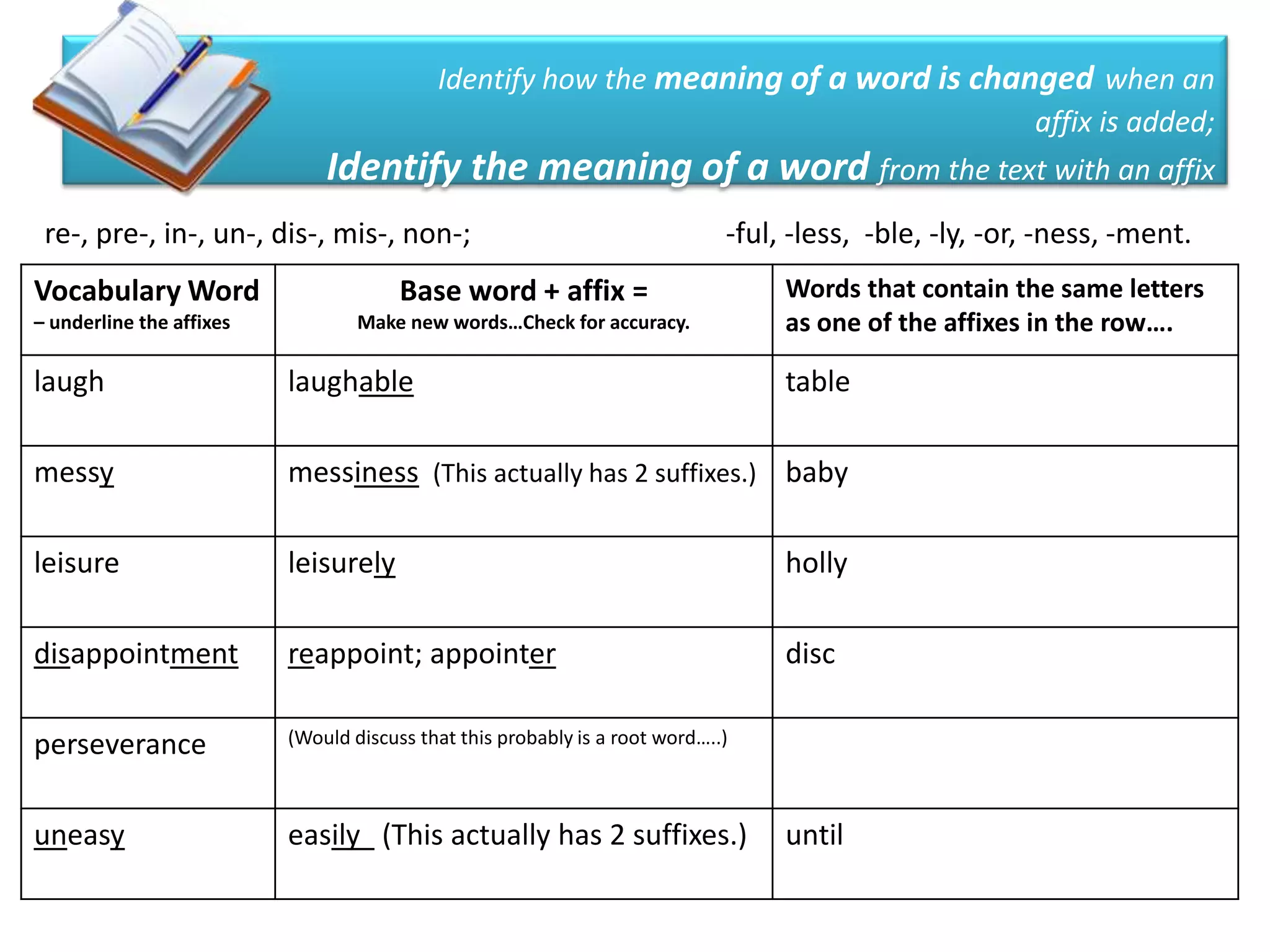
Identify how the meaning of a word is changed when an
                                                                                     affix is added;
                              Identify the meaning of a word from the text with an affix
 re-, pre-, in-, un-, dis-, mis-, non-;                                      -ful, -less, -ble, -ly, -or, -ness, -ment.
Vocabulary Word                        Base word + affix =                        Words that contain the same letters
– underline the affixes           Make new words…Check for accuracy.              as one of the affixes in the row….

laugh                     laughable                                               table

messy                     messiness (This actually has 2 suffixes.) baby

leisure                   leisurely                                               holly

disappointment            reappoint; appointer                                    disc

perseverance              (Would discuss that this probably is a root word…..)


uneasy                    easily (This actually has 2 suffixes.)                  until
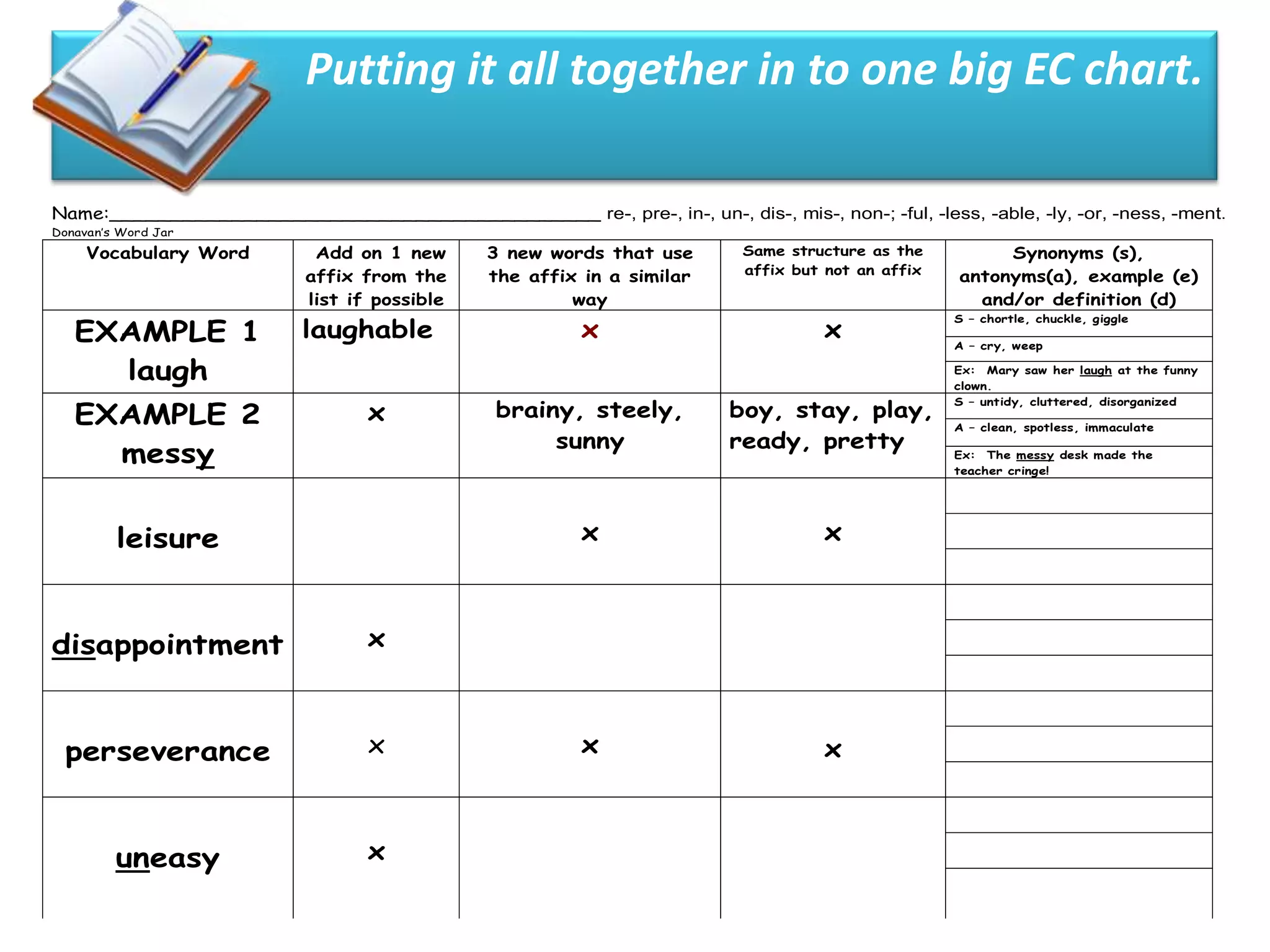
Putting it all together in to one big EC chart.

Name:________________________________________ re-, pre-, in-, un-, dis-, mis-, non-; -ful, -less, -able, -ly, -or, -ness, -ment.
Donavan’s Word Jar

     Vocabulary Word        Add on 1 new       3 new words that use        Same structure as the         Synonyms (s),
                           affix from the      the affix in a similar      affix but not an affix   antonyms(a), example (e)
                           list if possible             way                                           and/or definition (d)

   EXAMPLE 1               laughable                     x                          x
                                                                                                    S – chortle, chuckle, giggle

                                                                                                    A – cry, weep

     laugh                                                                                          Ex: Mary saw her laugh at the funny
                                                                                                    clown.


   EXAMPLE 2                      x             brainy, steely,          boy, stay, play,
                                                                                                    S – untidy, cluttered, disorganized

                                                                                                    A – clean, spotless, immaculate
                                                     sunny               ready, pretty
     messy                                                                                          Ex: The messy desk made the
                                                                                                    teacher cringe!


         leisure                                         x                          x


disappointment                    x


 perseverance                     x                      x                          x


         uneasy                   x
Discussion Point
• Think of your vocabulary assignments you routinely
  assign. What value are the students getting beyond
  learning new words?

• Did you know…..all of these ideas can be made into
  interactive SmartBoard lessons to use for modeling
  and small group practice? (And independent practice at individual
    computers)

A vocabulary strategy I could explicitly model then use for practice on a
regular basis to give added value is_______________________________
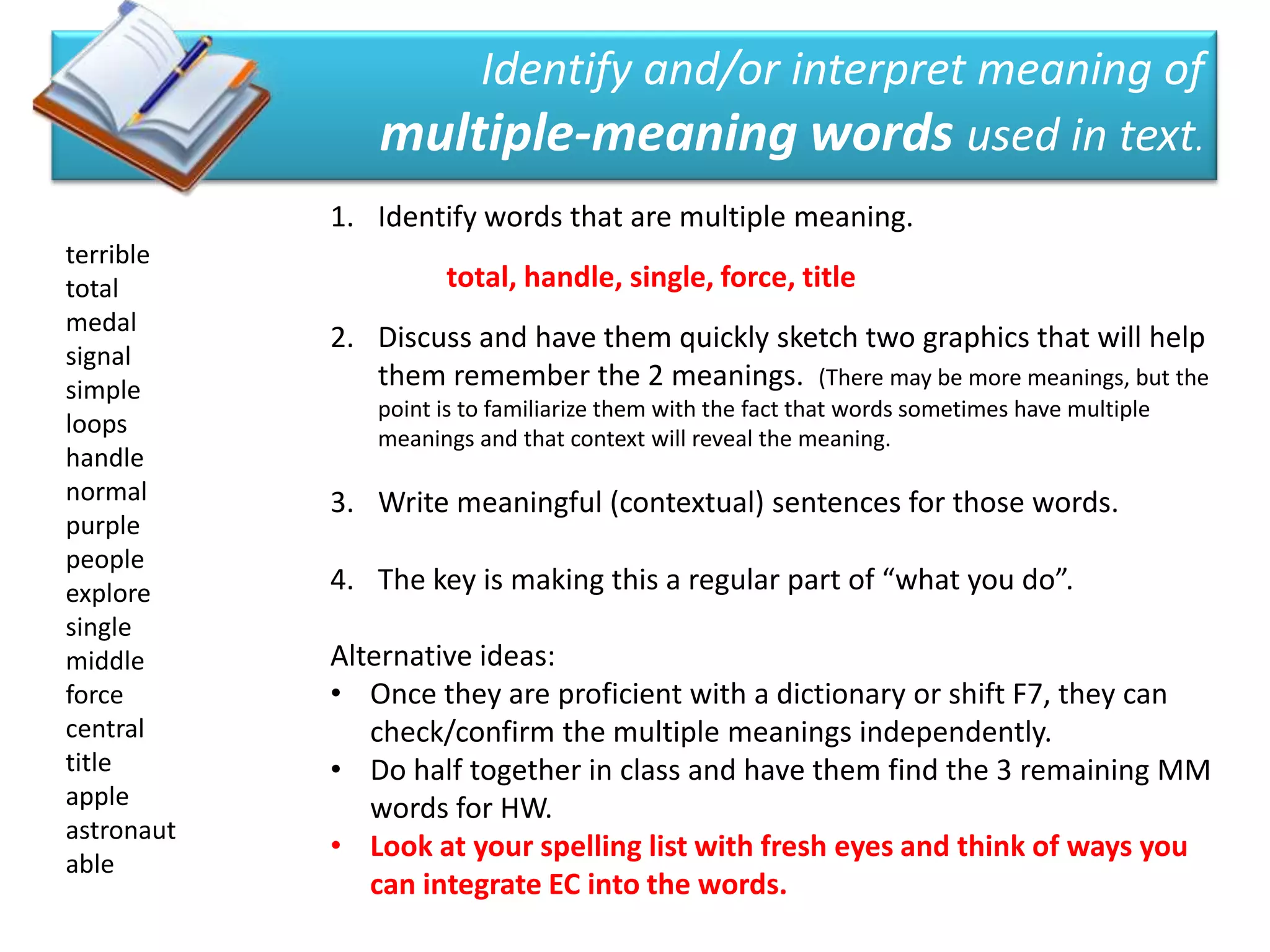
Identify and/or interpret meaning of
               multiple-meaning words used in text.
            1. Identify words that are multiple meaning.
terrible
total                total, handle, single, force, title
medal
            2. Discuss and have them quickly sketch two graphics that will help
signal
simple         them remember the 2 meanings. (There may be more meanings, but the
               point is to familiarize them with the fact that words sometimes have multiple
loops          meanings and that context will reveal the meaning.
handle
normal      3. Write meaningful (contextual) sentences for those words.
purple
people
explore     4. The key is making this a regular part of “what you do”.
single
middle      Alternative ideas:
force       • Once they are proficient with a dictionary or shift F7, they can
central        check/confirm the multiple meanings independently.
title       • Do half together in class and have them find the 3 remaining MM
apple          words for HW.
astronaut
            • Look at your spelling list with fresh eyes and think of ways you
able
               can integrate EC into the words.
Identify, explain, interpret, compare, and/or describe
                                 connections between texts.
                                                       &
                                  Identify, explain, interpret, compare, and/or
      describe components      of fiction and literary nonfiction:
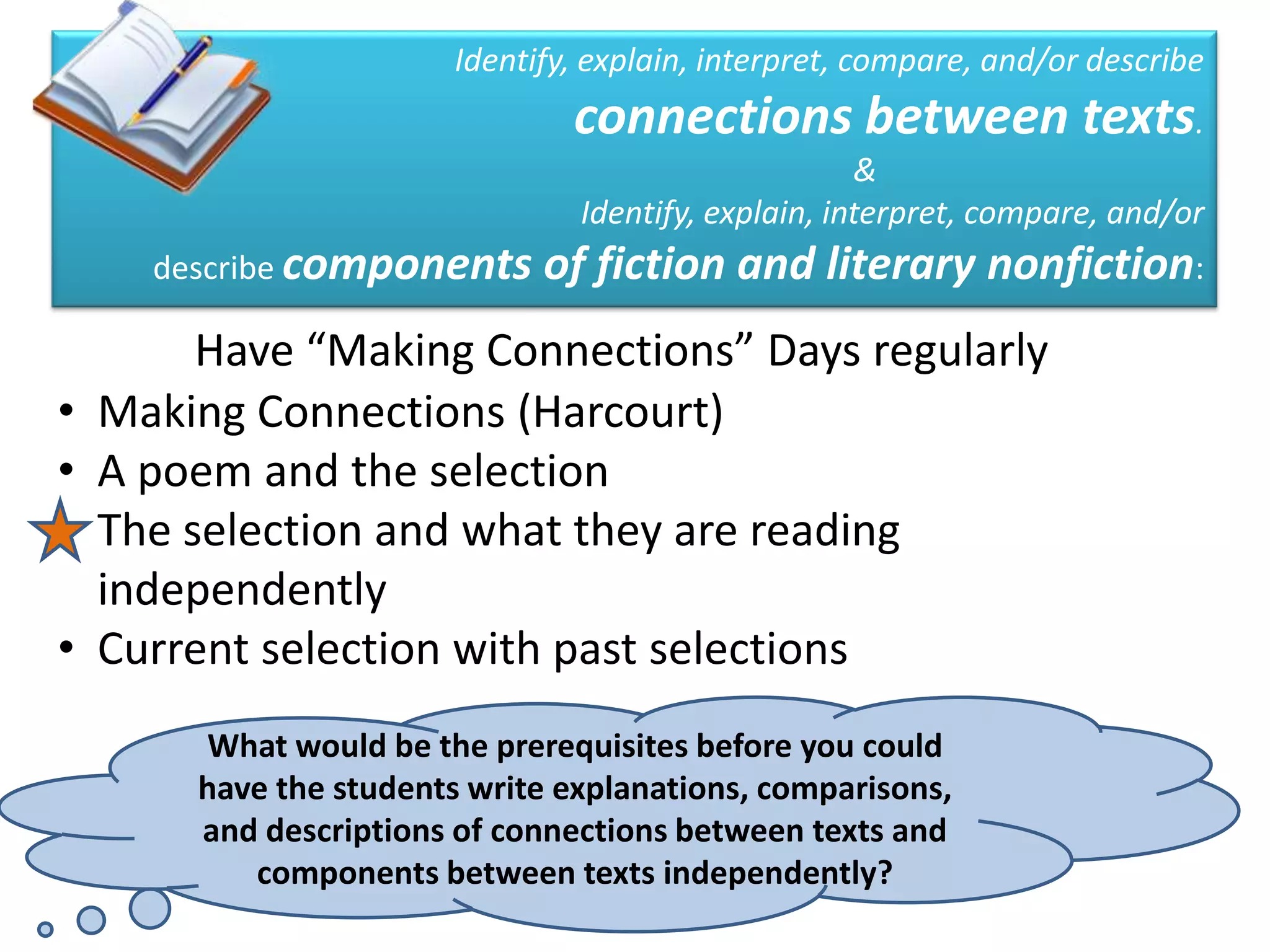
         Have “Making Connections” Days regularly
•   Making Connections (Harcourt)
•   A poem and the selection
•   The selection and what they are reading
    independently
•   Current selection with past selections
        What would be the prerequisites before you could
        have the students write explanations, comparisons,
        and descriptions of connections between texts and
           components between texts independently?
Identify, explain, interpret, compare, and/or describe
                                connections between texts.
                                                      &
                                 Identify, explain, interpret, compare, and/or
       describe components    of fiction and literary nonfiction:

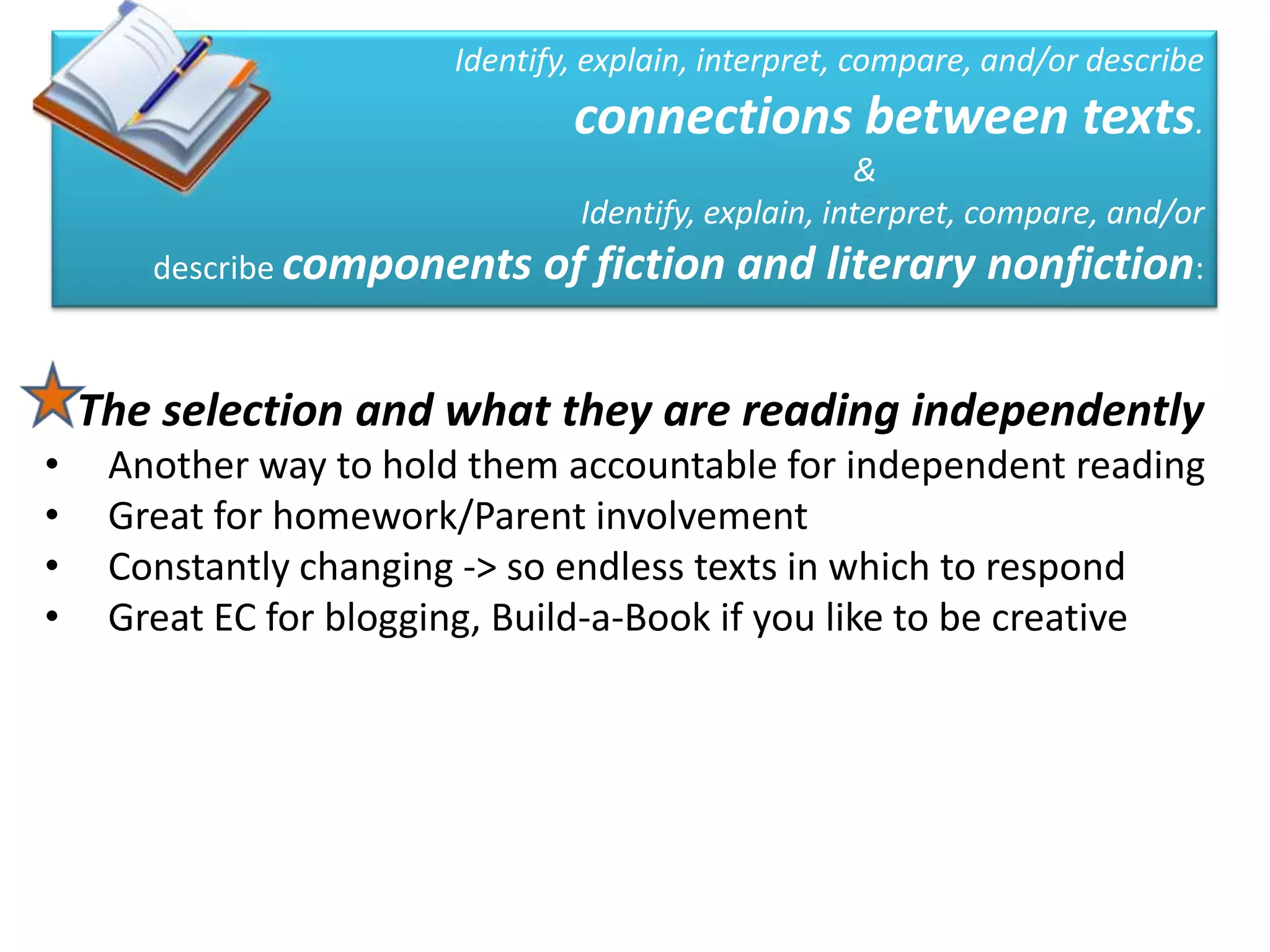
    The selection and what they are reading independently
•    Another way to hold them accountable for independent reading
•    Great for homework/Parent involvement
•    Constantly changing -> so endless texts in which to respond
•    Great EC for blogging, Build-a-Book if you like to be creative
Non-Fictional ONLY EC

1. Use template with PSSA question stems for periodicals to
   provide practice on applicable skills.
2. Use effective questioning techniques when reading non-fiction
   across the curriculum.

3. Use social studies and science as a time to intentionally
   practice non-fiction reading strategies.

              What would be the prerequisites before you
              could have students practice the non-fiction
            reading strategies and get the results you want?
                     Why is discussing not enough?
Discussion Point
• How might social studies or science routines
  change to include more explicit instruction?
• How can you integrate that in with your existing
  structure?


 My next step towards intentional, routine non-fiction
 reading:________________________________________________
Part 3 - Summary

We should be providing our students with a lot of practice on what
we have explicitly taught. Not only are we concerned about
helping them become strategic readers but also strategic test
takers.

We should be mindful that our practice helps accomplish both of
these tasks.

We know that kids who struggle need lots and lots of practice and
including them into our routines is one way to make sure we are
regularly including that practice.

Keep in mind the prerequisites the students will need before
planning our lessons and assigning independent practice.
Assessment
Harcourt Tests

• Limited in what this test tells us due to repeated readings of
  the story, but you want a grade (That’s cultural.)

• Modify tests to include more EC, but keep in mind….

• New series in 2 years? (They will still have a place…..)

• Can use these tests to practice QAR (challenging) or Thick
  vs. Thin (easier) and eliminating choices

• Additional reading assessments from Harcourt are available
  on I drive. Good for cold assessment to re-evaluate needs.
Conferring

• Sit down next to a child as they read and have them
  read to you. Are they applying what you explicitly
  modeled and practiced? Coach them….

• Pull kids together that have similar needs and provide
  further practice.

• It will become apparent that most of your class is
  independent and you can just hone in on……
• What are you typically doing when students are
  practicing reading? Can you imagine yourself
  conferring with a couple of at-risk students each day?

• What are some other benefits of conferring with
  students?


Three students to confer with this week:________________________________________
000-099 Generalities
Monitor Independent Reading
                                 More Closely

• Students have to read on their own level to
  apply the skills and strategies we have
  explicitly modeled and taught.

• AR is the tool we are using to help monitor
  that.
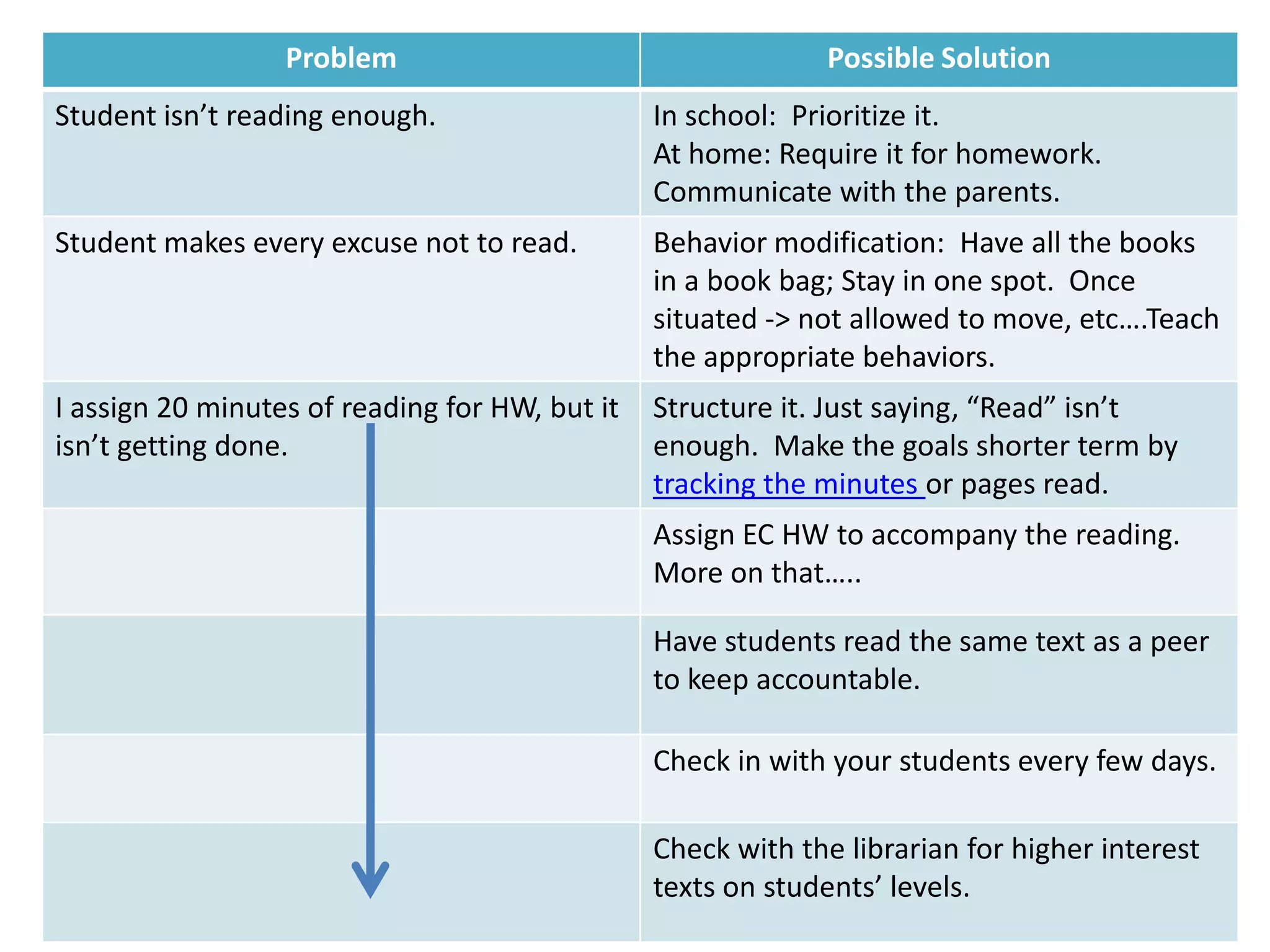
Problem                                     Possible Solution
Student isn’t reading enough.                   In school: Prioritize it.
                                                At home: Require it for homework.
                                                Communicate with the parents.
Student makes every excuse not to read.         Behavior modification: Have all the books
                                                in a book bag; Stay in one spot. Once
                                                situated -> not allowed to move, etc….Teach
                                                the appropriate behaviors.
I assign 20 minutes of reading for HW, but it   Structure it. Just saying, “Read” isn’t
isn’t getting done.                             enough. Make the goals shorter term by
                                                tracking the minutes or pages read.
                                                Assign EC HW to accompany the reading.
                                                More on that…..

                                                Have students read the same text as a peer
                                                to keep accountable.

                                                Check in with your students every few days.

                                                Check with the librarian for higher interest
                                                texts on students’ levels.
The Big I
                             It really makes a BIG difference.
• The BIG I was selected over a 'hamburger' or other organizer b/c it's
  easy to draw and works for this purpose

• We need uniformity among and between grade levels and special
  area teachers.

• Written expression is a prerequisite to students explaining,
  describing, and comparing (in writing) what they are reading.

• It is recommended to teach the structures (basic description and
  compare/contrast) early without the reading component so the
  students have the prerequisites skills needed to apply that to a
  reading situation.
Smarter Centers
•   Many of the ideas presented can become “centers” once students are at least
    proficient enough to work on the task in a small group.

•   The Smart Board has many interactive features which could be used as a center.

•   Reading Skills and Test Tutor links are classified by EC and can be found under
    TeacherSites. (Ask me why….)

•   Generic vocabulary games like Rummy and affix board game….add new words with
    each new selection -> new application

•   How about some generic PSSA Lingo discussion cards for students to use at a
    discussion centers?

•   Making connections where pairs compare across texts (a poem and Harcourt
    selection, for example); Fill out large laminated Venn share write a response using
    BIG I.
References/Resources
Beth Newingham – Guru on Reader’s Workshop…contemporary model of teaching
reading including the mini-lesson, guided practice, and independent practice

The Café Book - A system of explicitly modeling a skill and progress monitoring

The Sisters – CAFÉ interactive resources – Don’t understand why a skill or strategy is
important? These helpful “Ready References” may be what you need.

The Art of Teaching Reading

Oct 31

  • 1.
    Helping More 90%of Students Become Proficient Readers Oct. 31, 2011 Donaldson In-Service Grades 3-5 Presented by Leah Vestal
  • 2.
    Preface: • Some kidsare good readers without instruction. • Some kids would improve with explicit reading instruction. • Some kids are puzzles that we have yet to figure out. • The way many of us teach reading has trickled down from teachers that have been long retired and our own teachers. There’s been a lot of research in reading instruction since that time.
  • 3.
    This presentation isbased on feedback from teachers through candid discussions and surveys plus my own reflections as a classroom teacher: *I don’t know where to begin remediating my students. *Teaching reading is confusing. *I pick a story and figure out what I’m teaching along the way. We touch on a lot of different things when we read and discuss. *I’m still confused about some Eligible Content and question whether it’s important in the advancement of my students as readers – not just test takers. *What should I do in small group instruction? Where do I begin? What are the other kids doing?
  • 4.
    Explicit Instruction: Planningand Implementing the Mini-Lesson
  • 5.
    Explicit Instruction: Effective,Intentional Planning What comprehension skills or strategy does Harcourt suggest for the selection? Too many? Not eligible? Something that your kids already have a grip on? You like another better with that particular story? Doesn’t really matter all that much as long as it builds upon prior knowledge….. Pick something that is….. 1) in our curriculum (EC) and 2) That is conducive with the selection. 3) Pay attention to the verbs. Identify? Compare? Explain? Describe? Analyze? What precisely are you after? •There were times that I wasn’t ready to “go there” with summarizing…….. •I preferred to wait to introduce ______ until I read the story…….. •Other subjects were complicated, so I didn’t want to choose a skill/strategy that was so rigorous….. •Sometimes I didn’t understand why a reader needed this skill/strategy……
  • 6.
    Explicit Instruction: Effective,Intentional Modeling – “The Mini Lesson” 1) Model for the kids EXCPLICITY how “the pros” do it. How do you use this skill or strategy before/during/after your own reading? Think out loud. 2) If you don’t understand why something in the reading curriculum can help a reader, talk to a reading specialist and ask her. She’ll shed some light on it. Avoiding something because you don’t understand it is a detriment to our students. •Why does an 8 year old need to know an author’s purpose? •How does text organization aid in comprehension? •How does summarizing help?
  • 7.
    Explicit Instruction: Effective,Intentional Modeling – “The Mini Lesson” Materials Needed: • Harcourt Text or Picture Book or other text that is relevant to the skill/strategy you’re are teaching - And probably……. • Whatever material they will use when they are practicing….graphic organizer, sticky notes, etc., so you can demonstrate with that tool - (more on that) And for the super ambitious….. • Smart Board lesson that illustrates this process in an engaging way -
  • 8.
    Explicit Instruction: Effective,Intentional Modeling – “The Mini Lesson” Use Mini-Lessons to model all skills/strategies included in the EC. As well as…… • Any other reading skill/strategy that is not in the EC (but in our curriculum – it may be worded differently, though) that is crucial to reading success….i.e. Back up and re-read; predict; question yourself, etc… • Behaviors that support reading…..choosing good books that are in your range; reading quietly during partner pairs; staying in one spot the whole time
  • 9.
    Discussion Point The mini-lessonis not a new idea. In fact, it’s right there in the Harcourt manual. Why have we gotten away from this? • Kids can read well without explicit instruction • Failed efforts • Academic freedom • Don’t understand the rationale/importance • Something’s gotta give…. I need to learn more about this EC:______________________________
  • 10.
    Explicit = (Most)kids could say, “My teacher showed us how non-fiction text is organized differently and if can spot that pattern, it can help me understand what I’m reading. • What have I explicitly modeled in reading last week? Last month? • How is “touching on” something different than explicit instruction? • What mini-lesson can I plan to model this week? The EC I plan on explicitly modeling this week:______________________
  • 11.
    Planning Practice withPurpose Guided Independent Practice Practice Partner Small one- Pair Group on-one
  • 12.
    Practice with Purpose 1)Does the practice you are providing line up with the VERB?
  • 13.
    1. Does thepractice you are providing line up with the VERB? 2. Does the practice you provide help develop strategic readers as well develop good PSSA test takers?
  • 14.
    The Sticky Note •A practical way for students to SHARE how they are practicing a mental strategy when you can’t be one-on- one with them. • If you asked students to practice the strategy you modeled, how would you formatively assess them? • A good alternative to some graphic organizers that are more confusing than helpful. • How would you keep them on task?
  • 15.
    Practice with Purpose Examples of Comprehension Practice 1-2-3 Example: Summarize the key details and events of a text as a whole. 1. Using the Harcourt passage, pairs can emulate the teacher’s “think aloud”/modeling. (Teacher is facilitating.) 2. Students practice independently using Harcourt, their AR books, or other text. (Teacher works with at-risk group using leveled readers.) Sticky Summarizing 3. In the future, follow through with explicit modeling, practice and independent open-ended practice if applicable assuming they have the prerequisites. Example: Summarize what happened after Virtue ate the rice. Summarize how children of Iceland capture and release the puffins.
  • 16.
    Practice with Purpose Examples of Comprehension Practice 1-2-3 Example: Identify, explain, interpret, compare, and/or describe connections between texts. 1. Using the Harcourt passage, pairs can emulate the teacher’s “think aloud”/modeling. (Teacher is facilitating.) 2. Students practice independently using Harcourt, their AR books, or other text. (Teacher works with at-risk group using leveled readers.) Sticky Connections & summarize 3. In the future, follow through with explicit modeling, practice and independent open-ended practice if applicable assuming they have the prerequisites. Explain how the poem “Pizza” is different than the poem “Stromboli”. Use 2 details to support your answer.
  • 17.
    Being Efficient….. Examples of Comprehension Practice 1-2-3 Example: Make inferences and/or draw conclusions based on information from the text. 1. Using the Harcourt passage, pairs can emulate the teacher’s “think aloud”/modeling. (Teacher is facilitating.) 2. Students practice independently using Harcourt, their AR books, or other text. (Teacher works with at-risk group using leveled readers.) Sticky Inferencing 3. In the future, follow through with explicit modeling, practice and independent open-ended practice if applicable assuming they have the prerequisites. Explain why the character believed that the Old Woman lived in a shoe. Use at least 2 details from the passage to support your answer.
  • 18.
    • What aresome other quick methods to formatively assess students’ REAL reading other than sticky notes? • What is your next step in implementing explicit practice? • How can you tell if EC is tested using the open-ended format and requires us to practice like that? How I plan on formatively assessing during reading strategies: __________________________________
  • 19.
    Parts 1 and2 - Summary We need to be mindful of the eligible content and the associated verbs when planning mini-lessons and practice. It is important to explicitly model for students the thinking process that good readers do. Some students have acquired good reading strategies automatically while other readers will need much more direct instruction. Provide the students with both guided practice and independent practice so we can monitor progress and adjust our instructional goals. Be mindful of the PSSA question stems during modeling and practice. Reader’s Workshop Approach
  • 20.
    Ideas for IntegratedRepeated Practice serve dual purposes using materials you already have
  • 21.
    Define and/or applyhow the meaning of words or phrases changes when using context clues 1. Have students “guess the covered words” using context clues as an introduction to the words. 2. Reveal the answers. 3. Conclude the lesson by discussing and writing student responses that were synonyms or near synonyms.
  • 22.
    Identify and/or interpreta synonym or antonym of a word used in text. Examples: Graphic/Sketch Examples: Graphic/Sketch Non Examples: Non Examples: Synonyms/Near Synonyms: Sentence/Definition Synonyms/Near Synonyms: Sentence/Definition Antonyms/Near Antonyms Antonyms/Near Antonyms Examples: Graphic/Sketch Examples: Graphic/Sketch Non Examples: Non Examples: Synonyms/Near Synonyms: Sentence/Definition Synonyms/Near Synonyms: Sentence/Definition Antonyms/Near Antonyms Antonyms/Near Antonyms
  • 23.
    Identify how themeaning of a word is changed when an affix is added; Identify the meaning of a word from the text with an affix re-, pre-, in-, un-, dis-, mis-, non-; -ful, -less, -ble, -ly, -or, -ness, -ment. Vocabulary Word Base word + affix = Words that contain the same letters – underline the affixes Make new words…Check for accuracy. as one of the affixes in the row…. laugh laughable table messy messiness (This actually has 2 suffixes.) baby leisure leisurely holly disappointment reappoint; appointer disc perseverance (Would discuss that this probably is a root word…..) uneasy easily (This actually has 2 suffixes.) until
  • 24.
    Putting it alltogether in to one big EC chart. Name:________________________________________ re-, pre-, in-, un-, dis-, mis-, non-; -ful, -less, -able, -ly, -or, -ness, -ment. Donavan’s Word Jar Vocabulary Word Add on 1 new 3 new words that use Same structure as the Synonyms (s), affix from the the affix in a similar affix but not an affix antonyms(a), example (e) list if possible way and/or definition (d) EXAMPLE 1 laughable x x S – chortle, chuckle, giggle A – cry, weep laugh Ex: Mary saw her laugh at the funny clown. EXAMPLE 2 x brainy, steely, boy, stay, play, S – untidy, cluttered, disorganized A – clean, spotless, immaculate sunny ready, pretty messy Ex: The messy desk made the teacher cringe! leisure x x disappointment x perseverance x x x uneasy x
  • 25.
    Discussion Point • Thinkof your vocabulary assignments you routinely assign. What value are the students getting beyond learning new words? • Did you know…..all of these ideas can be made into interactive SmartBoard lessons to use for modeling and small group practice? (And independent practice at individual computers) A vocabulary strategy I could explicitly model then use for practice on a regular basis to give added value is_______________________________
  • 26.
    Identify and/or interpretmeaning of multiple-meaning words used in text. 1. Identify words that are multiple meaning. terrible total total, handle, single, force, title medal 2. Discuss and have them quickly sketch two graphics that will help signal simple them remember the 2 meanings. (There may be more meanings, but the point is to familiarize them with the fact that words sometimes have multiple loops meanings and that context will reveal the meaning. handle normal 3. Write meaningful (contextual) sentences for those words. purple people explore 4. The key is making this a regular part of “what you do”. single middle Alternative ideas: force • Once they are proficient with a dictionary or shift F7, they can central check/confirm the multiple meanings independently. title • Do half together in class and have them find the 3 remaining MM apple words for HW. astronaut • Look at your spelling list with fresh eyes and think of ways you able can integrate EC into the words.
  • 27.
    Identify, explain, interpret,compare, and/or describe connections between texts. & Identify, explain, interpret, compare, and/or describe components of fiction and literary nonfiction: Have “Making Connections” Days regularly • Making Connections (Harcourt) • A poem and the selection • The selection and what they are reading independently • Current selection with past selections What would be the prerequisites before you could have the students write explanations, comparisons, and descriptions of connections between texts and components between texts independently?
  • 28.
    Identify, explain, interpret,compare, and/or describe connections between texts. & Identify, explain, interpret, compare, and/or describe components of fiction and literary nonfiction: The selection and what they are reading independently • Another way to hold them accountable for independent reading • Great for homework/Parent involvement • Constantly changing -> so endless texts in which to respond • Great EC for blogging, Build-a-Book if you like to be creative
  • 29.
    Non-Fictional ONLY EC 1.Use template with PSSA question stems for periodicals to provide practice on applicable skills. 2. Use effective questioning techniques when reading non-fiction across the curriculum. 3. Use social studies and science as a time to intentionally practice non-fiction reading strategies. What would be the prerequisites before you could have students practice the non-fiction reading strategies and get the results you want? Why is discussing not enough?
  • 30.
    Discussion Point • Howmight social studies or science routines change to include more explicit instruction? • How can you integrate that in with your existing structure? My next step towards intentional, routine non-fiction reading:________________________________________________
  • 31.
    Part 3 -Summary We should be providing our students with a lot of practice on what we have explicitly taught. Not only are we concerned about helping them become strategic readers but also strategic test takers. We should be mindful that our practice helps accomplish both of these tasks. We know that kids who struggle need lots and lots of practice and including them into our routines is one way to make sure we are regularly including that practice. Keep in mind the prerequisites the students will need before planning our lessons and assigning independent practice.
  • 32.
  • 33.
    Harcourt Tests • Limitedin what this test tells us due to repeated readings of the story, but you want a grade (That’s cultural.) • Modify tests to include more EC, but keep in mind…. • New series in 2 years? (They will still have a place…..) • Can use these tests to practice QAR (challenging) or Thick vs. Thin (easier) and eliminating choices • Additional reading assessments from Harcourt are available on I drive. Good for cold assessment to re-evaluate needs.
  • 34.
    Conferring • Sit downnext to a child as they read and have them read to you. Are they applying what you explicitly modeled and practiced? Coach them…. • Pull kids together that have similar needs and provide further practice. • It will become apparent that most of your class is independent and you can just hone in on……
  • 35.
    • What areyou typically doing when students are practicing reading? Can you imagine yourself conferring with a couple of at-risk students each day? • What are some other benefits of conferring with students? Three students to confer with this week:________________________________________
  • 36.
  • 37.
    Monitor Independent Reading More Closely • Students have to read on their own level to apply the skills and strategies we have explicitly modeled and taught. • AR is the tool we are using to help monitor that.
  • 38.
    Problem Possible Solution Student isn’t reading enough. In school: Prioritize it. At home: Require it for homework. Communicate with the parents. Student makes every excuse not to read. Behavior modification: Have all the books in a book bag; Stay in one spot. Once situated -> not allowed to move, etc….Teach the appropriate behaviors. I assign 20 minutes of reading for HW, but it Structure it. Just saying, “Read” isn’t isn’t getting done. enough. Make the goals shorter term by tracking the minutes or pages read. Assign EC HW to accompany the reading. More on that….. Have students read the same text as a peer to keep accountable. Check in with your students every few days. Check with the librarian for higher interest texts on students’ levels.
  • 39.
    The Big I It really makes a BIG difference. • The BIG I was selected over a 'hamburger' or other organizer b/c it's easy to draw and works for this purpose • We need uniformity among and between grade levels and special area teachers. • Written expression is a prerequisite to students explaining, describing, and comparing (in writing) what they are reading. • It is recommended to teach the structures (basic description and compare/contrast) early without the reading component so the students have the prerequisites skills needed to apply that to a reading situation.
  • 40.
    Smarter Centers • Many of the ideas presented can become “centers” once students are at least proficient enough to work on the task in a small group. • The Smart Board has many interactive features which could be used as a center. • Reading Skills and Test Tutor links are classified by EC and can be found under TeacherSites. (Ask me why….) • Generic vocabulary games like Rummy and affix board game….add new words with each new selection -> new application • How about some generic PSSA Lingo discussion cards for students to use at a discussion centers? • Making connections where pairs compare across texts (a poem and Harcourt selection, for example); Fill out large laminated Venn share write a response using BIG I.
  • 41.
    References/Resources Beth Newingham –Guru on Reader’s Workshop…contemporary model of teaching reading including the mini-lesson, guided practice, and independent practice The Café Book - A system of explicitly modeling a skill and progress monitoring The Sisters – CAFÉ interactive resources – Don’t understand why a skill or strategy is important? These helpful “Ready References” may be what you need. The Art of Teaching Reading