Reading
Strategies to
Help students
reading skills
Before, During
and After
reading!
By: Elena Damian
5 strategies to use BEFORE
reading
Strategy number #1:
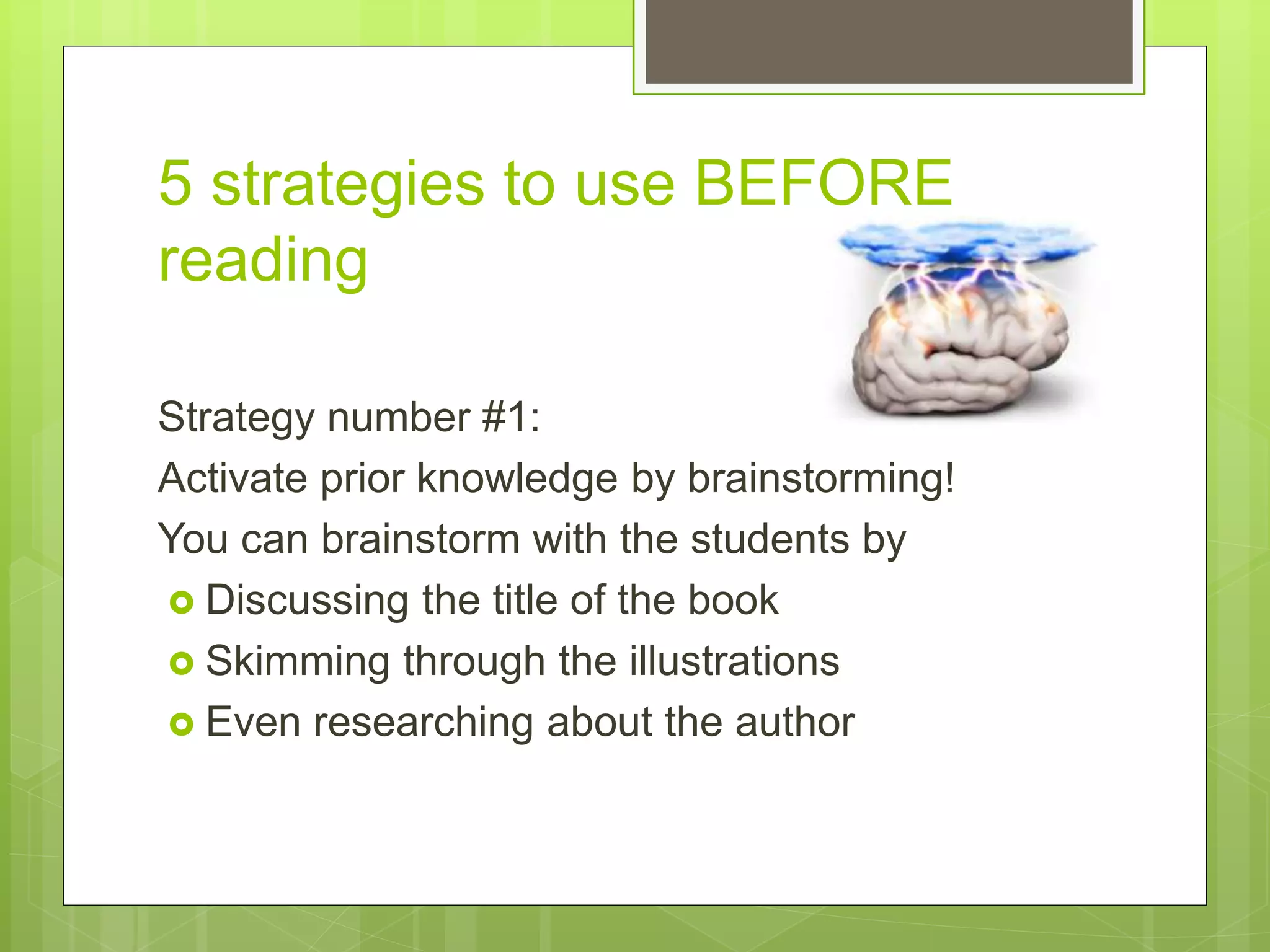
Activate prior knowledge by brainstorming!
You can brainstorm with the students by
 Discussing the title of the book
 Skimming through the illustrations
 Even researching about the author
BEFORE reading
Strategy number #2:
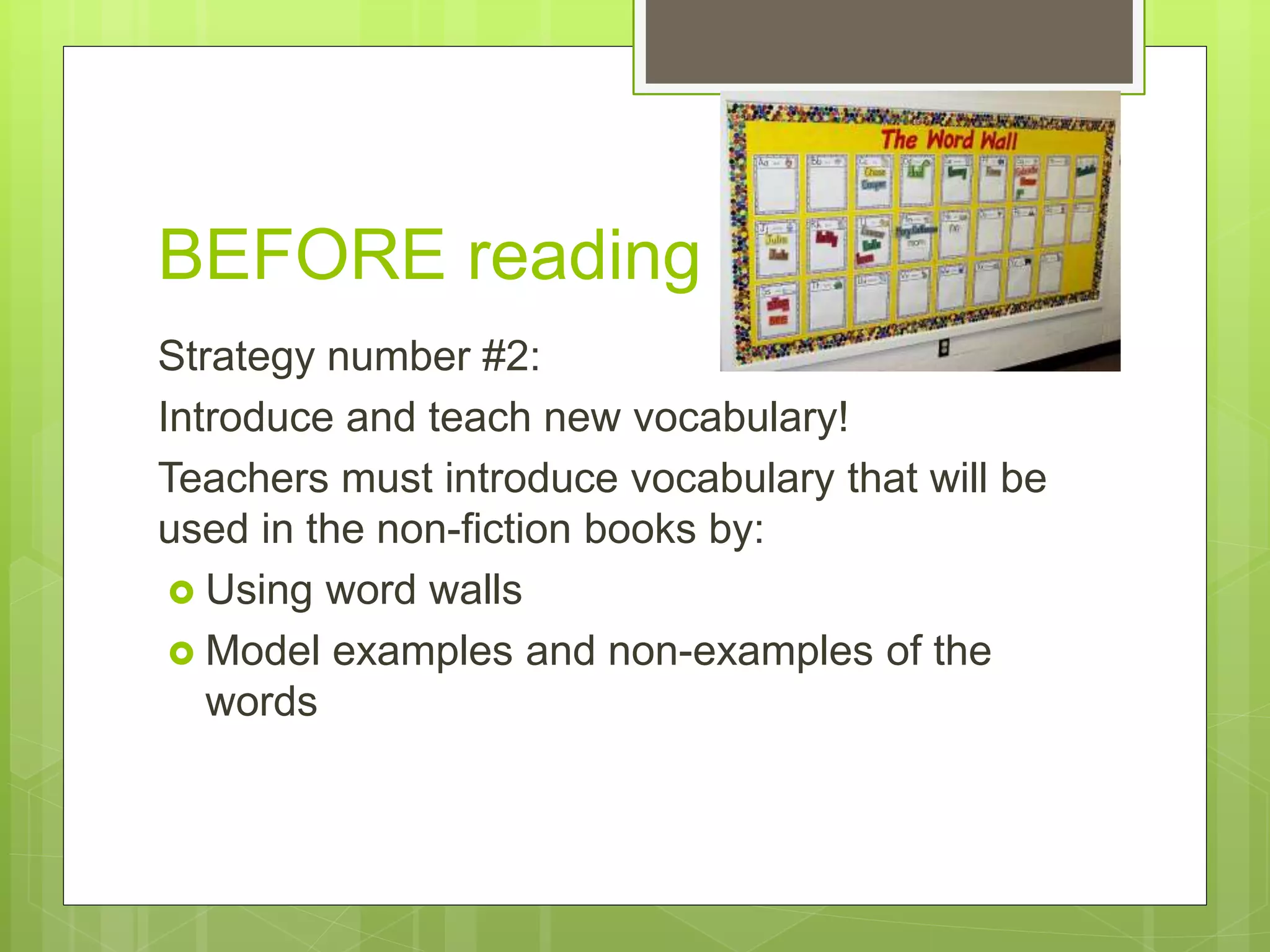
Introduce and teach new vocabulary!
Teachers must introduce vocabulary that will be
used in the non-fiction books by:
 Using word walls
 Model examples and non-examples of the
words
BEFORE reading
Strategy number #3:
Set a purpose for reading!
Student must know why they are reading, it will
not only help them focus but at the same time
motivate them to keep reading.
Set a purpose by discussing if the book:
 Is for entertainment?
 To help you create something new?
 To help you get informed?
BEFORE reading
Strategy number #4:
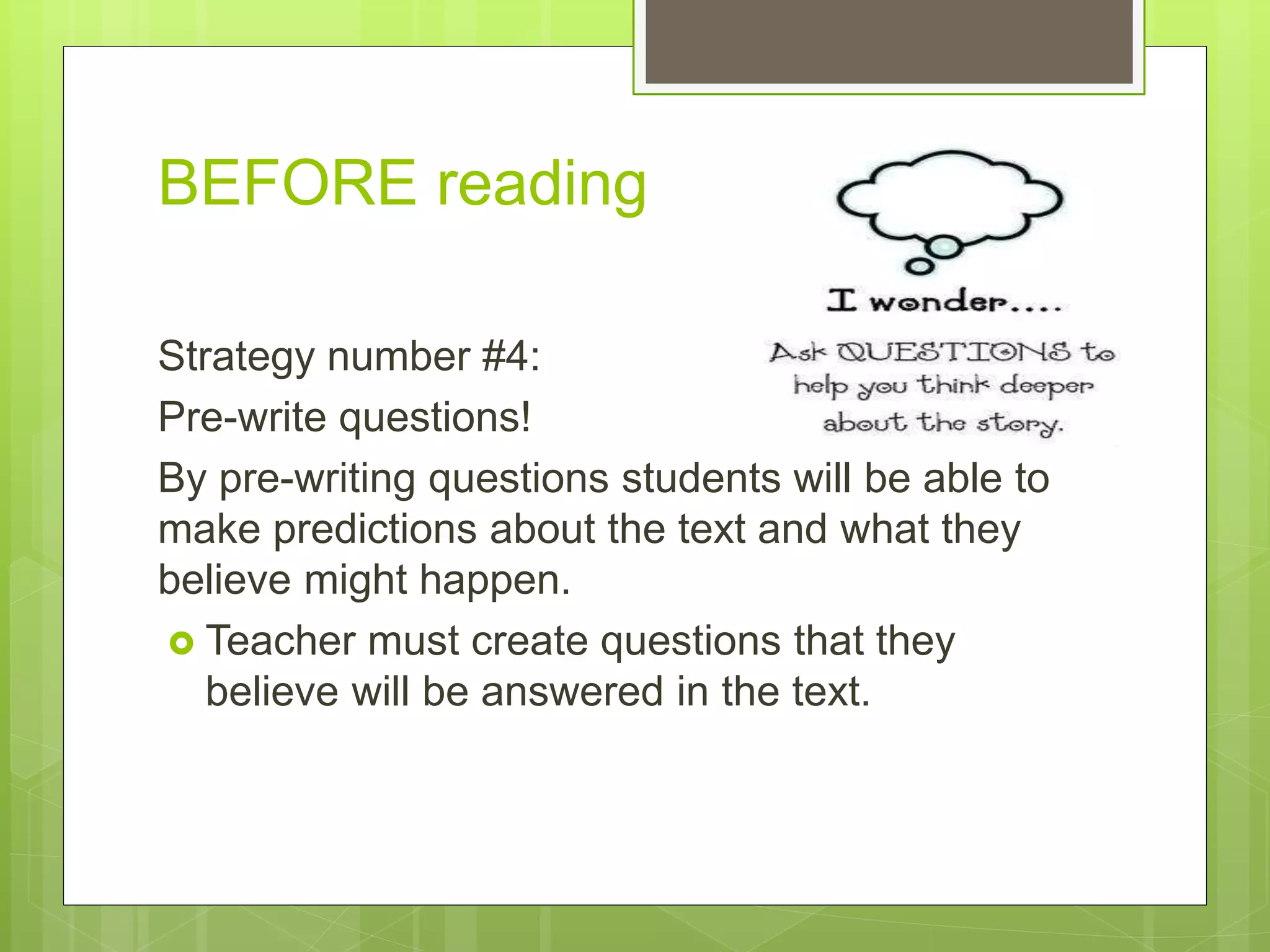
Pre-write questions!
By pre-writing questions students will be able to
make predictions about the text and what they
believe might happen.
 Teacher must create questions that they
believe will be answered in the text.
BEFORE Reading
Strategy number #5
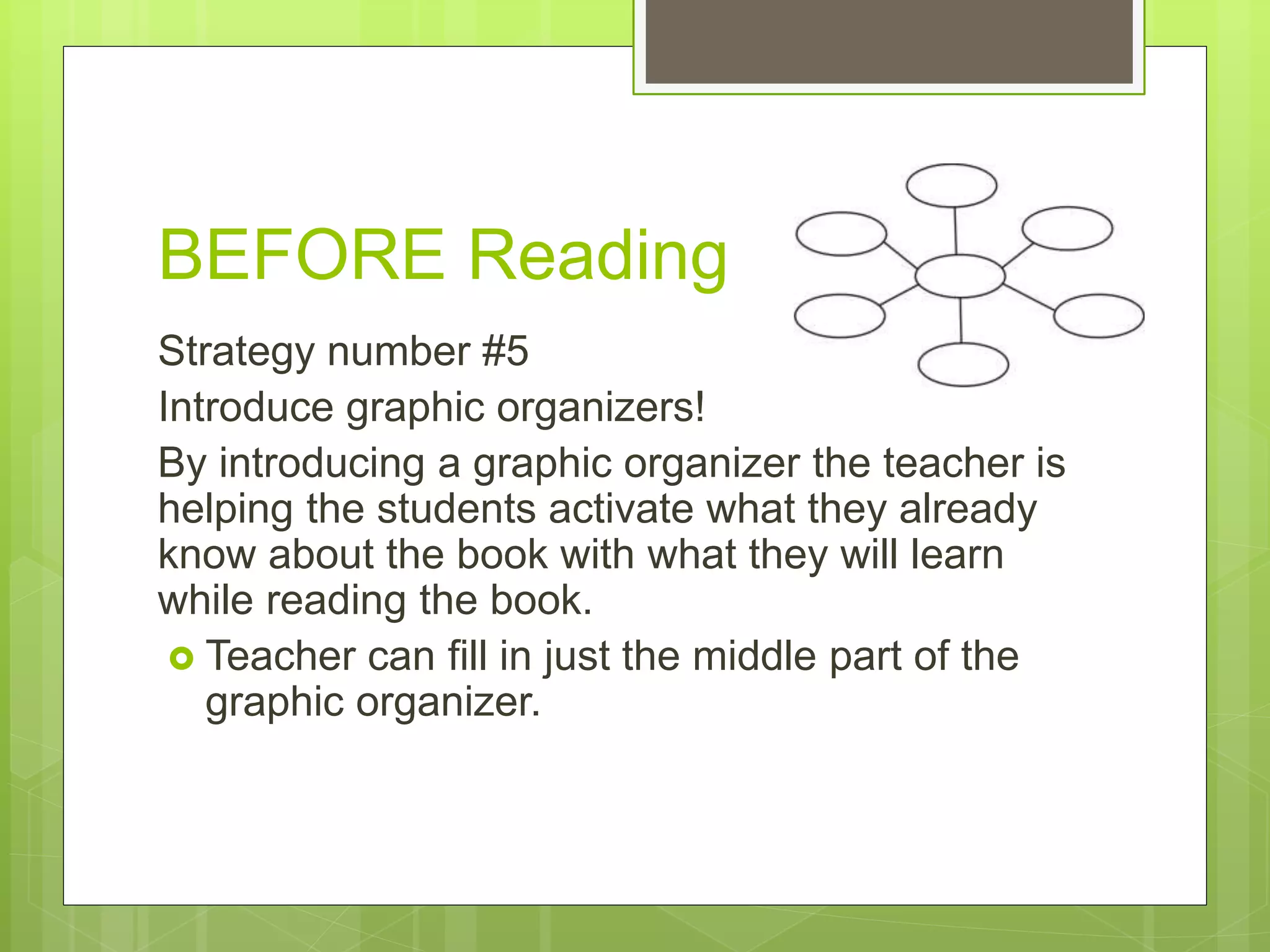
Introduce graphic organizers!
By introducing a graphic organizer the teacher is
helping the students activate what they already
know about the book with what they will learn
while reading the book.
 Teacher can fill in just the middle part of the
graphic organizer.
Strategies to use DURING
reading
Strategy number #1:
Model “good reader” strategies!
Teacher must model how to
 Pause at punctuation
 Use context clues to figure out unfamiliar vocabulary
 Look back at the graphic organizer.
DURING reading
Strategy number #2:
Clarify unknown Vocabulary!
Student can clarify unknown vocabulary by:
 Using context clues
 Illustrations
 Draw inferences through think-aloud
DURING reading
Strategy number #3:
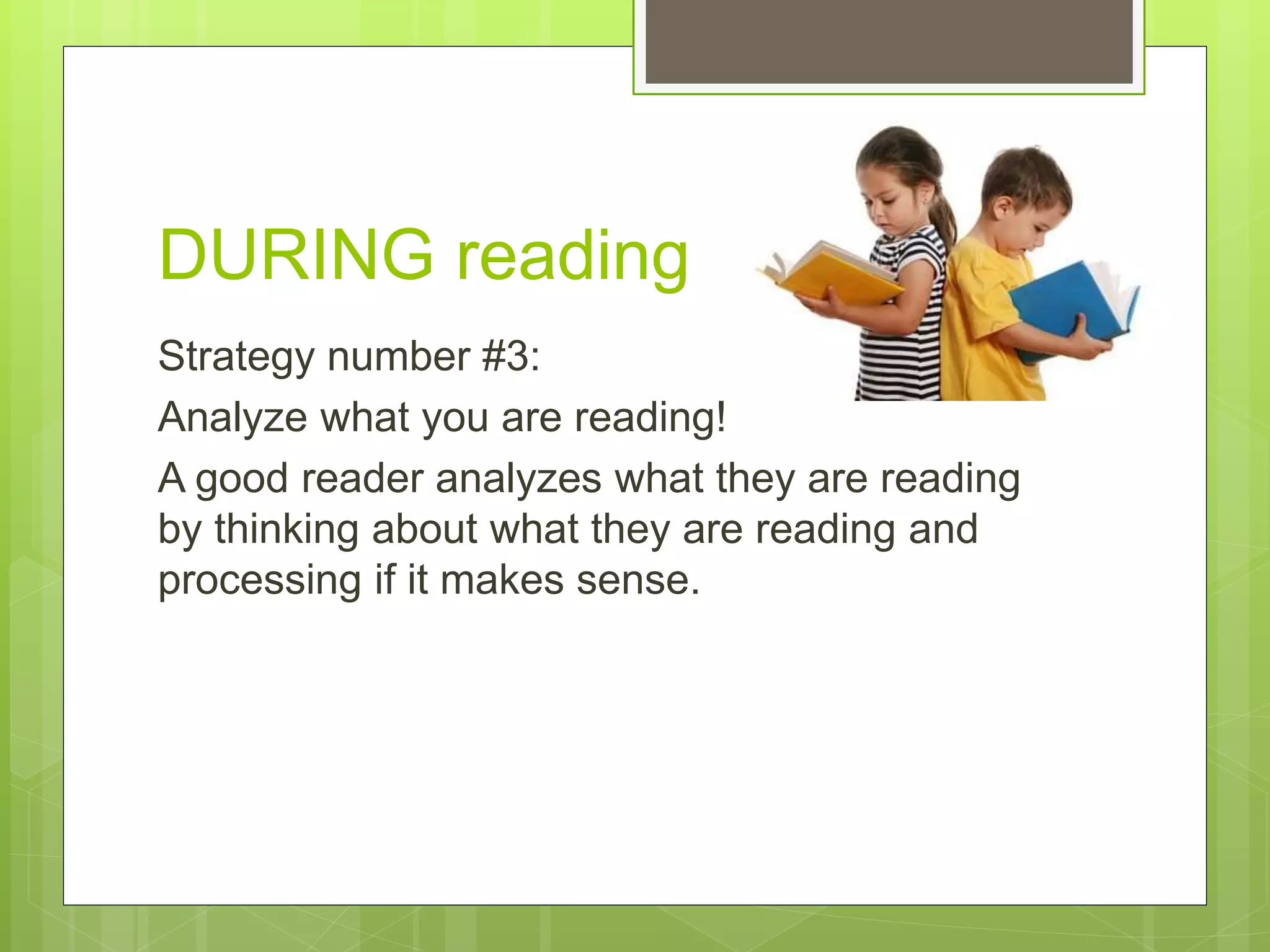
Analyze what you are reading!
A good reader analyzes what they are reading
by thinking about what they are reading and
processing if it makes sense.
DURING reading
Strategy number #4:
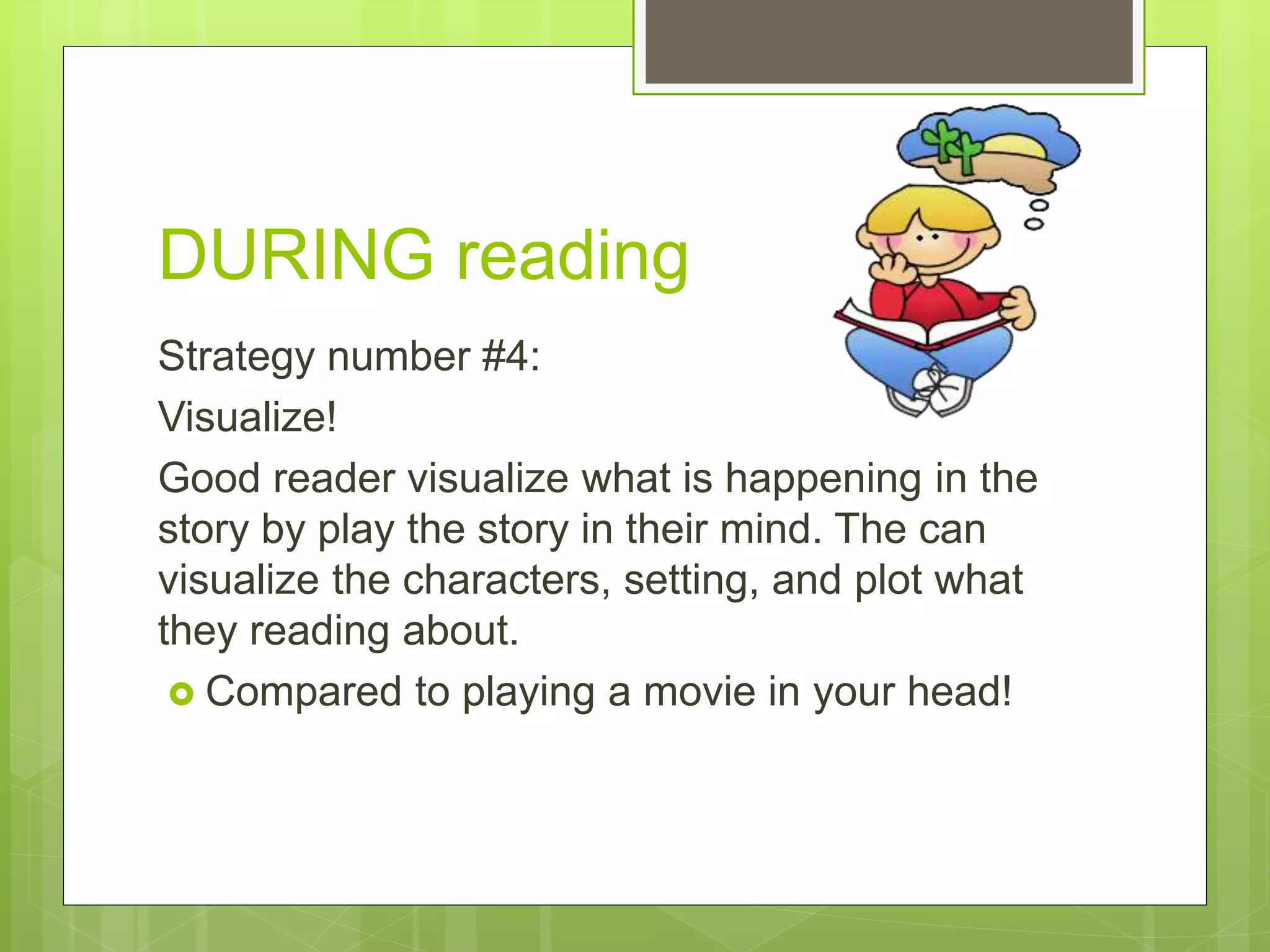
Visualize!
Good reader visualize what is happening in the
story by play the story in their mind. The can
visualize the characters, setting, and plot what
they reading about.
 Compared to playing a movie in your head!
DURING reading
Strategy number #5:
Use the graphic organizer!
Now the student can fill in the graphic organizer to provided
connections between their ideas or concepts of the book. Also
they can confirm or disconfirm questions that were asked before
reading.
AFTER reading
Strategy number #1:
Summarize!
A good reader also stops a summarizes what
they have read so far.
Student can summarize by:
 Writing summary in a journal
 Using think-maps
 Have groups discussions
AFTER reading
Strategy number #2:
Compare and contrast!
Student can compare and contrast to what was
read to something they have already learned.
 This will ensure the student has meaningful
experiences.
 And reflect how they can use this information
in the future.
AFTER reading
Strategy number #3:
Group discussions!
By having group discussion the students are
able to share their thoughts and feeling about
the book to their peers and help students
integrate the information provided in the book to
their own knowledge.
After reading
Strategy number #4:
Retelling the story!
By having student retell the story teacher can be able to
determine if the information was retained into the students long-
term memory.
 This can be by using a Story Retelling Checklist.
AFTER reading
Strategy number #5:
Questions answered!
Now students are able to answer pre-write
questions which will help the students to develop
comprehension skills and to re-think about the
story and it’s meaning.
References
 http://www.cde.state.co.us/sites/default/files/docu
ments/coloradoliteracy/clf/downloads/understandi
ng_the_relationship_between_reading_comprehe
nsion_skills_and_strategies.pdf
 http://www.readingrockets.org/article/103-things-
do-beforeduringafter-reading
 Bursuck, W., & Damer, M. (2011). Teaching
reading to students who are at risk or have
disabilities: A multi-tier approach (2nd ed.). Upper
Saddle River, New Jersey: Pearson.

Before, During and After Reading Skills

  • 1.
    Reading Strategies to Help students readingskills Before, During and After reading! By: Elena Damian
  • 2.
    5 strategies touse BEFORE reading Strategy number #1: Activate prior knowledge by brainstorming! You can brainstorm with the students by  Discussing the title of the book  Skimming through the illustrations  Even researching about the author
  • 3.
    BEFORE reading Strategy number#2: Introduce and teach new vocabulary! Teachers must introduce vocabulary that will be used in the non-fiction books by:  Using word walls  Model examples and non-examples of the words
  • 4.
    BEFORE reading Strategy number#3: Set a purpose for reading! Student must know why they are reading, it will not only help them focus but at the same time motivate them to keep reading. Set a purpose by discussing if the book:  Is for entertainment?  To help you create something new?  To help you get informed?
  • 5.
    BEFORE reading Strategy number#4: Pre-write questions! By pre-writing questions students will be able to make predictions about the text and what they believe might happen.  Teacher must create questions that they believe will be answered in the text.
  • 6.
    BEFORE Reading Strategy number#5 Introduce graphic organizers! By introducing a graphic organizer the teacher is helping the students activate what they already know about the book with what they will learn while reading the book.  Teacher can fill in just the middle part of the graphic organizer.
  • 7.
    Strategies to useDURING reading Strategy number #1: Model “good reader” strategies! Teacher must model how to  Pause at punctuation  Use context clues to figure out unfamiliar vocabulary  Look back at the graphic organizer.
  • 8.
    DURING reading Strategy number#2: Clarify unknown Vocabulary! Student can clarify unknown vocabulary by:  Using context clues  Illustrations  Draw inferences through think-aloud
  • 9.
    DURING reading Strategy number#3: Analyze what you are reading! A good reader analyzes what they are reading by thinking about what they are reading and processing if it makes sense.
  • 10.
    DURING reading Strategy number#4: Visualize! Good reader visualize what is happening in the story by play the story in their mind. The can visualize the characters, setting, and plot what they reading about.  Compared to playing a movie in your head!
  • 11.
    DURING reading Strategy number#5: Use the graphic organizer! Now the student can fill in the graphic organizer to provided connections between their ideas or concepts of the book. Also they can confirm or disconfirm questions that were asked before reading.
  • 12.
    AFTER reading Strategy number#1: Summarize! A good reader also stops a summarizes what they have read so far. Student can summarize by:  Writing summary in a journal  Using think-maps  Have groups discussions
  • 13.
    AFTER reading Strategy number#2: Compare and contrast! Student can compare and contrast to what was read to something they have already learned.  This will ensure the student has meaningful experiences.  And reflect how they can use this information in the future.
  • 14.
    AFTER reading Strategy number#3: Group discussions! By having group discussion the students are able to share their thoughts and feeling about the book to their peers and help students integrate the information provided in the book to their own knowledge.
  • 15.
    After reading Strategy number#4: Retelling the story! By having student retell the story teacher can be able to determine if the information was retained into the students long- term memory.  This can be by using a Story Retelling Checklist.
  • 16.
    AFTER reading Strategy number#5: Questions answered! Now students are able to answer pre-write questions which will help the students to develop comprehension skills and to re-think about the story and it’s meaning.
  • 17.