BEFORE, DURING, AND AFTER
READING STRATEGIES
RED 4348 CRITICAL ASSIGNMENT 1
CASSANDRA LARATONDO
Before Reading
Strategies
1. Story Impression
2. Word Splash
3. Prewrite Questions
4. Picture Walk
5. Word Graffiti
Story Impression
Details
• In this activity, the teacher selects key
points or concepts that occur in the text.
The teacher will list these concepts
sequentially on the board to provide the
students with an impression of the text.
• This can be discussed aloud so the
students have an opportunity to express
their interpretation of the list.
How does it apply to the reading
process?
• Making predictions is key in the pre-
reading stage of the reading process.
• Students can be provided with a guide to
making predictions from the list of
concepts that the teacher drafts.
• This can also be used as a tool to pre-teach
vocabulary in a nonfiction text. If the
students don’t know the meaning of an
academic vocabulary word, then it would
be difficult to create a prediction form the
list of impressions.
Word Splash
Details
• In this activity, the students use
familiar and unknown words from the
text to write a story. The students can
share aloud or the teacher can read
the student’s writing privately as a
diagnosis.
• The goal of this activity is to evaluate
misconceptions the students may have
and direct teaching of words.
How does it apply to the reading
process?
• This activity achieves the goal of the
pre-reading process of making content
more comprehensible. By pre-teaching
vocabulary
Prewrite Questions
• The students preview the text and ask
questions that they will seek to answer.
• This activity can be done as a class, in
groups, or individually.
• A K-W-L chart could serve as a useful
tool in this activity. The questions
would go under the “W” section of the
chart.
• Previewing the text is part of the pre-
reading process that allows the
students to begin to activate prior
knowledge and get their mind ready to
learn about what is being read
• Asking questions sets a purpose for
reading.
Details
How does it apply to the reading
process?
Picture Walk
• Have the students turn through the text
and note bold words, pictures, charts,
graphs, and captions.
• After the students conduct the picture
walk, the teacher should have questions
prepared for the students.
• There should be some type of conversation
after the students conduct their picture
walk so that the students are able to hear
other observations.
• Activating prior knowledge and developing
new insight to text gives the students a
chance to prepare to read.
Details
How does it apply to the reading
process?
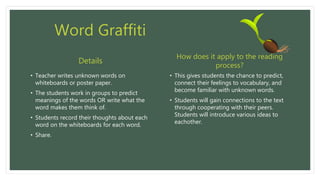
Word Graffiti
• Teacher writes unknown words on
whiteboards or poster paper.
• The students work in groups to predict
meanings of the words OR write what the
word makes them think of.
• Students record their thoughts about each
word on the whiteboards for each word.
• Share.
• This gives students the chance to predict,
connect their feelings to vocabulary, and
become familiar with unknown words.
• Students will gain connections to the text
through cooperating with their peers.
Students will introduce various ideas to
eachother.
Details
How does it apply to the reading
process?
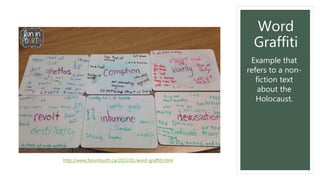
Word
Graffiti
Example that
refers to a non-
fiction text
about the
Holocaust.
http://www.funinfourth.ca/2015/01/word-graffiti.html
During Reading
Strategies
1. Think- Pair- Share
2. Think Aloud
3. Answer Questions
4. Direct Listening – Thinking Activity (DL-
TA)
5. Text Rendering
Think- Pair- Share
The students work with a partner to read and
discuss a book. First, the teacher must set
distinct stopping points within the text.
These stopping points can include places to
simply stop and think aloud with each other
or include some sample higher-order
thinking questions for the student to answer
in their discussion.
The teacher can write questions that target many skills and
strategies that the student could be applying during their
reading. It is important that the students have low-risk
opportunities to apply their reading strategies:
Vocabulary:
• What does the word _______ mean in this context?
Comprehension:
• Wait! What is going on here?
• What have you been visualizing in your mind?
Inferring:
• Why did a character act this way? Why?
Details How does it apply to the reading
process?
Think- Pair- Share Example
video
Think Aloud
• The teacher models aloud the process of
applying a skill or strategy. As the teacher
is reading, they stop and model the
process from beginning to end. Then the
teacher continues to read.
• A think-aloud is a great way to show to
students what a process, skill, or strategy
looks like through modeling (Bursuck,
2015, pg. 289).
• The teacher provides a model for how to apply
strategies while reading. This applies to the
reading process because knowing how to apply
strategies is the first step to actually doing it.
Students should have a grasp on how to apply
context clues and what it looks/sounds like to
follow the process.
• Encourages student to self-regulate as they
read.
• This benefit’s the student’s comprehension
abilities and shows them how to make
connections with a text.
Details
How does it apply to the reading
process?
Answer Questions
Students typically start reading
nonfiction text with some questions.
Answering these questions keeps the
purpose for reading. Also, this keeps the
student engaged if they are looking to
learn from the text that they are
presented with.
• Monitors comprehension and keeps
the purpose for reading nonfiction
text.
• This is an example of actively reading
and students will practice self-
regulation as they read through a
nonfiction text.
Details
How does it apply to the reading
process?
Direct Listening – Thinking Activity
This strategy has three steps:
• In the first stage, the students will make their
predictions about what is going to be read. They
will look at the cover and title before any reading
occurs.
• Second, the students will periodically check
their predictions throughout the book in order
to use the new information heard to modify,
confirm, or reject their prediction.
• After reading, the students summarize and explain
why their predictions may have changed. The
teacher will then expand upon the
vocabulary/concepts throughout the book.
• Listening comprehension is a skill that
can be applied across the curriculum.
• Continuing to make predictions during
reading allows a student to stay
engaged with the text. The suspense
and curiosity factors are exciting!
Details How does it apply to the reading
process?
Text Rendering
• Students actively read outside of the
traditional highlighting method.
Students make connections with the
text through symbols, post-it notes,
emoji's, etc.
• Students can write on the passage or
use stickers/post-its.
• Making connections with the text is a
bridge to understanding.
• Metacognitive awareness is an
important piece of comprehension.
Details
How does it apply to the reading
process?
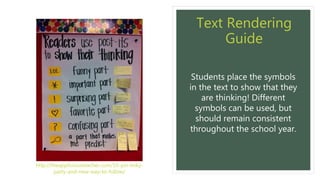
Text Rendering
Guide
Students place the symbols
in the text to show that they
are thinking! Different
symbols can be used, but
should remain consistent
throughout the school year.
http://theappliciousteacher.com/10-pin-linky-
party-and-new-way-to-follow/
After Reading
Strategies
1. Speed Chatting
2. Roll and Retell
3. Make a Test
4. Jigsaw
5. Interviews
Speed Chatting
• Students are set up in two parallel rows.
• They are given 60 seconds (or another
predetermined time) to chat about
something they have read.
• The teacher can choose to focus on many
skills and strategies for the post-reading
experience.
• Speaking about reading allows students to
deepen their understanding through
discussion.
• Teacher directs questions towards the skills
and strategies that the students should be
developing.
Details
How does it apply to the reading
process?
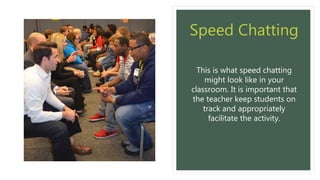
Speed Chatting
This is what speed chatting
might look like in your
classroom. It is important that
the teacher keep students on
track and appropriately
facilitate the activity.
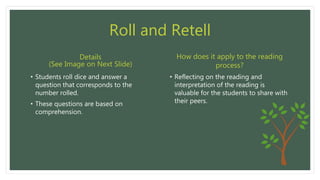
Roll and Retell
• Students roll dice and answer a
question that corresponds to the
number rolled.
• These questions are based on
comprehension.
Details
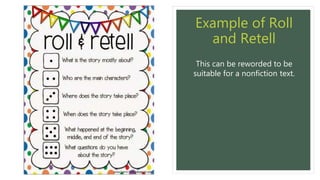
(See Image on Next Slide)
How does it apply to the reading
process?
• Reflecting on the reading and
interpretation of the reading is
valuable for the students to share with
their peers.
Example of Roll
and Retell
This can be reworded to be
suitable for a nonfiction text.
Make a Test
After studying and reading a nonfiction
text, the students have the opportunity
to make a test that summarizes key
points and concepts from the reading.
• Determining importance of details and
points made in a text is a reflective
strategy.
Details
How does it apply to the reading
process?
Jigsaw
Teacher divides the nonfiction text for
students to study with a group. Then,
the group teaches their assigned section
to their peers.
This tool works for students studying a
nonfiction text because students are
able to explore the text in a more in-
depth manner. Students become
content experts and are able to explore
their reading in a more complex way.
Details
How does it apply to the reading
process?
Interviews
After the students have read a history text,
have them interview the historical figure(s).
Students must write interview questions and
have appropriate knowledge to answer the
questions accurately.
This leads into the create tier of Bloom’s
Taxonomy. Students are creating questions
and responses with a background that
adequately represents their knowledge of the
historical non-fiction text.
Students are able to reflect on what they
have learned about this historical figure and
identify memorable quotations and
information about the historical figure.
Details
How does it apply to the reading
process?
Resources
Bursuck, W. D., & Damer, M. (2011). Teaching reading to
students who are at risk or have disabilities: A multi-tier
approach. Pearson.
Pennsylvania Department of Education. (2016). Before-during-
after reading strategies. Retrieved April 4, 2017 from
http://www.education.pa.gov/Teachers%20-
%20Administrators/Curriculum/Pages/Before-During-
After-Reading-Strategies.aspx#tab-1
Tompkins, G., Campbell, R., Green, D., & Smith, C. (2014).
Literacy for the 21st century. Pearson Australia.

RED4348 CA2 "Before, During, and After Strategies"

  • 1.
    BEFORE, DURING, ANDAFTER READING STRATEGIES RED 4348 CRITICAL ASSIGNMENT 1 CASSANDRA LARATONDO
  • 2.
    Before Reading Strategies 1. StoryImpression 2. Word Splash 3. Prewrite Questions 4. Picture Walk 5. Word Graffiti
  • 3.
    Story Impression Details • Inthis activity, the teacher selects key points or concepts that occur in the text. The teacher will list these concepts sequentially on the board to provide the students with an impression of the text. • This can be discussed aloud so the students have an opportunity to express their interpretation of the list. How does it apply to the reading process? • Making predictions is key in the pre- reading stage of the reading process. • Students can be provided with a guide to making predictions from the list of concepts that the teacher drafts. • This can also be used as a tool to pre-teach vocabulary in a nonfiction text. If the students don’t know the meaning of an academic vocabulary word, then it would be difficult to create a prediction form the list of impressions.
  • 4.
    Word Splash Details • Inthis activity, the students use familiar and unknown words from the text to write a story. The students can share aloud or the teacher can read the student’s writing privately as a diagnosis. • The goal of this activity is to evaluate misconceptions the students may have and direct teaching of words. How does it apply to the reading process? • This activity achieves the goal of the pre-reading process of making content more comprehensible. By pre-teaching vocabulary
  • 5.
    Prewrite Questions • Thestudents preview the text and ask questions that they will seek to answer. • This activity can be done as a class, in groups, or individually. • A K-W-L chart could serve as a useful tool in this activity. The questions would go under the “W” section of the chart. • Previewing the text is part of the pre- reading process that allows the students to begin to activate prior knowledge and get their mind ready to learn about what is being read • Asking questions sets a purpose for reading. Details How does it apply to the reading process?
  • 6.
    Picture Walk • Havethe students turn through the text and note bold words, pictures, charts, graphs, and captions. • After the students conduct the picture walk, the teacher should have questions prepared for the students. • There should be some type of conversation after the students conduct their picture walk so that the students are able to hear other observations. • Activating prior knowledge and developing new insight to text gives the students a chance to prepare to read. Details How does it apply to the reading process?
  • 7.
    Word Graffiti • Teacherwrites unknown words on whiteboards or poster paper. • The students work in groups to predict meanings of the words OR write what the word makes them think of. • Students record their thoughts about each word on the whiteboards for each word. • Share. • This gives students the chance to predict, connect their feelings to vocabulary, and become familiar with unknown words. • Students will gain connections to the text through cooperating with their peers. Students will introduce various ideas to eachother. Details How does it apply to the reading process?
  • 8.
    Word Graffiti Example that refers toa non- fiction text about the Holocaust. http://www.funinfourth.ca/2015/01/word-graffiti.html
  • 9.
    During Reading Strategies 1. Think-Pair- Share 2. Think Aloud 3. Answer Questions 4. Direct Listening – Thinking Activity (DL- TA) 5. Text Rendering
  • 10.
    Think- Pair- Share Thestudents work with a partner to read and discuss a book. First, the teacher must set distinct stopping points within the text. These stopping points can include places to simply stop and think aloud with each other or include some sample higher-order thinking questions for the student to answer in their discussion. The teacher can write questions that target many skills and strategies that the student could be applying during their reading. It is important that the students have low-risk opportunities to apply their reading strategies: Vocabulary: • What does the word _______ mean in this context? Comprehension: • Wait! What is going on here? • What have you been visualizing in your mind? Inferring: • Why did a character act this way? Why? Details How does it apply to the reading process? Think- Pair- Share Example video
  • 11.
    Think Aloud • Theteacher models aloud the process of applying a skill or strategy. As the teacher is reading, they stop and model the process from beginning to end. Then the teacher continues to read. • A think-aloud is a great way to show to students what a process, skill, or strategy looks like through modeling (Bursuck, 2015, pg. 289). • The teacher provides a model for how to apply strategies while reading. This applies to the reading process because knowing how to apply strategies is the first step to actually doing it. Students should have a grasp on how to apply context clues and what it looks/sounds like to follow the process. • Encourages student to self-regulate as they read. • This benefit’s the student’s comprehension abilities and shows them how to make connections with a text. Details How does it apply to the reading process?
  • 12.
    Answer Questions Students typicallystart reading nonfiction text with some questions. Answering these questions keeps the purpose for reading. Also, this keeps the student engaged if they are looking to learn from the text that they are presented with. • Monitors comprehension and keeps the purpose for reading nonfiction text. • This is an example of actively reading and students will practice self- regulation as they read through a nonfiction text. Details How does it apply to the reading process?
  • 13.
    Direct Listening –Thinking Activity This strategy has three steps: • In the first stage, the students will make their predictions about what is going to be read. They will look at the cover and title before any reading occurs. • Second, the students will periodically check their predictions throughout the book in order to use the new information heard to modify, confirm, or reject their prediction. • After reading, the students summarize and explain why their predictions may have changed. The teacher will then expand upon the vocabulary/concepts throughout the book. • Listening comprehension is a skill that can be applied across the curriculum. • Continuing to make predictions during reading allows a student to stay engaged with the text. The suspense and curiosity factors are exciting! Details How does it apply to the reading process?
  • 14.
    Text Rendering • Studentsactively read outside of the traditional highlighting method. Students make connections with the text through symbols, post-it notes, emoji's, etc. • Students can write on the passage or use stickers/post-its. • Making connections with the text is a bridge to understanding. • Metacognitive awareness is an important piece of comprehension. Details How does it apply to the reading process?
  • 15.
    Text Rendering Guide Students placethe symbols in the text to show that they are thinking! Different symbols can be used, but should remain consistent throughout the school year. http://theappliciousteacher.com/10-pin-linky- party-and-new-way-to-follow/
  • 16.
    After Reading Strategies 1. SpeedChatting 2. Roll and Retell 3. Make a Test 4. Jigsaw 5. Interviews
  • 17.
    Speed Chatting • Studentsare set up in two parallel rows. • They are given 60 seconds (or another predetermined time) to chat about something they have read. • The teacher can choose to focus on many skills and strategies for the post-reading experience. • Speaking about reading allows students to deepen their understanding through discussion. • Teacher directs questions towards the skills and strategies that the students should be developing. Details How does it apply to the reading process?
  • 18.
    Speed Chatting This iswhat speed chatting might look like in your classroom. It is important that the teacher keep students on track and appropriately facilitate the activity.
  • 19.
    Roll and Retell •Students roll dice and answer a question that corresponds to the number rolled. • These questions are based on comprehension. Details (See Image on Next Slide) How does it apply to the reading process? • Reflecting on the reading and interpretation of the reading is valuable for the students to share with their peers.
  • 20.
    Example of Roll andRetell This can be reworded to be suitable for a nonfiction text.
  • 21.
    Make a Test Afterstudying and reading a nonfiction text, the students have the opportunity to make a test that summarizes key points and concepts from the reading. • Determining importance of details and points made in a text is a reflective strategy. Details How does it apply to the reading process?
  • 22.
    Jigsaw Teacher divides thenonfiction text for students to study with a group. Then, the group teaches their assigned section to their peers. This tool works for students studying a nonfiction text because students are able to explore the text in a more in- depth manner. Students become content experts and are able to explore their reading in a more complex way. Details How does it apply to the reading process?
  • 23.
    Interviews After the studentshave read a history text, have them interview the historical figure(s). Students must write interview questions and have appropriate knowledge to answer the questions accurately. This leads into the create tier of Bloom’s Taxonomy. Students are creating questions and responses with a background that adequately represents their knowledge of the historical non-fiction text. Students are able to reflect on what they have learned about this historical figure and identify memorable quotations and information about the historical figure. Details How does it apply to the reading process?
  • 24.
    Resources Bursuck, W. D.,& Damer, M. (2011). Teaching reading to students who are at risk or have disabilities: A multi-tier approach. Pearson. Pennsylvania Department of Education. (2016). Before-during- after reading strategies. Retrieved April 4, 2017 from http://www.education.pa.gov/Teachers%20- %20Administrators/Curriculum/Pages/Before-During- After-Reading-Strategies.aspx#tab-1 Tompkins, G., Campbell, R., Green, D., & Smith, C. (2014). Literacy for the 21st century. Pearson Australia.