Fetal presenting partother than vertex includes
breech, face, brow, transverse, and compound
presentation.
3.
More thanone pregnancy (e.g. Multipara,Grand multipara )
More than one fetus (e.g. Twins)
Too much or too little amniotic fluid (e.g.
Polyhydramnious,
oligohydramnios)
Abnormal uterine shape (e.g. Arcuate ,septate, supseptate)
or abnormal growth (e.g Fibroid)
Placenta previa
The baby is preterm
4.
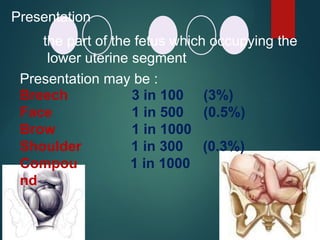
Presentation
the part ofthe fetus which occupying the
lower uterine segment
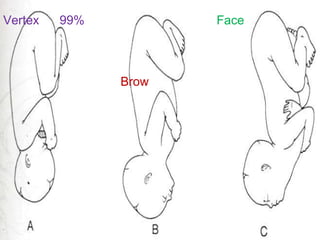
Presentation may be :
(3%)
(0.5%)
Breech
Face
Brow
Shoulder
Compou
nd
3 in 100
1 in 500
1 in 1000
1 in 300
1 in 1000
(0.3%)
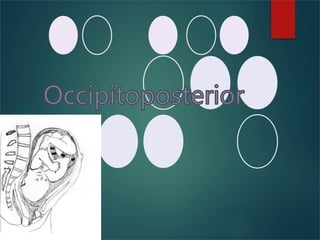
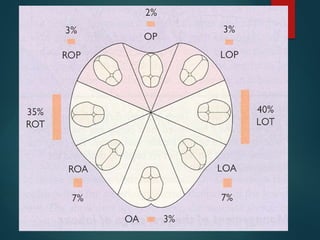
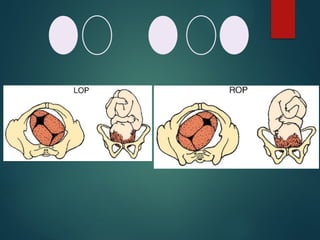
The occiputis in the posterior segment of pelvis,
overlying the sacroiliac joint or the sacrum
Occipitoposterior position is responsible for most cases
of prolonged labour and second stage delay and is the
most common cause of a mobile head at term
When the occiput is in front of the sacrum, it is termed
direct Occipitoposterior
In the right Occipitoposterior, the occiput overlies the
right sacroiliac joint and in left Occipitoposterior, it
overlies the left sacroiliac joint
Thus,3 positions are described –ROP
, LOP, Direct
Occipitoposterior
11.
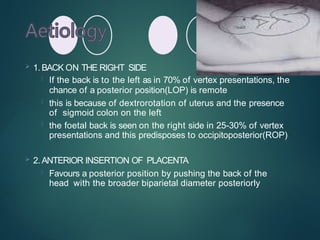
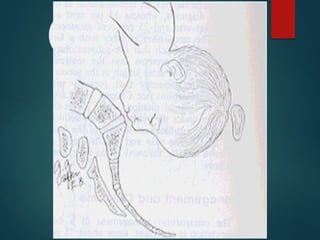
1. BACKON THE RIGHT SIDE
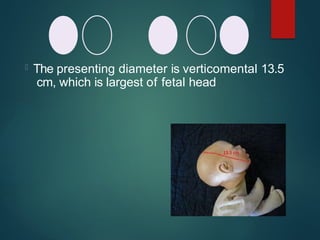
If the back is to the left as in 70% of vertex presentations, the
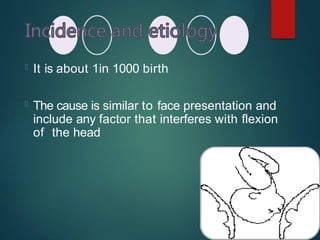
chance of a posterior position(LOP) is remote
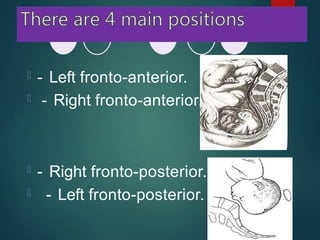
this is because of dextrorotation of uterus and the presence
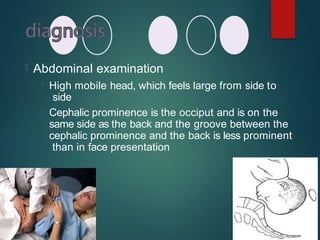
of sigmoid colon on the left
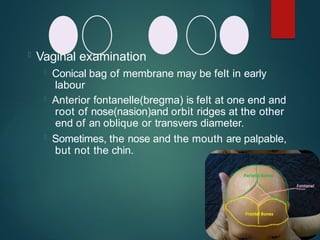
the foetal back is seen on the right side in 25-30% of vertex
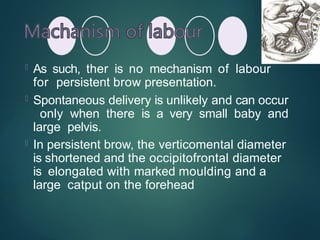
presentations and this predisposes to occipitoposterior(ROP)
2. ANTERIOR INSERTION OF PLACENTA
Favours a posterior position by pushing the back of the
head with the broader biparietal diameter posteriorly
12.
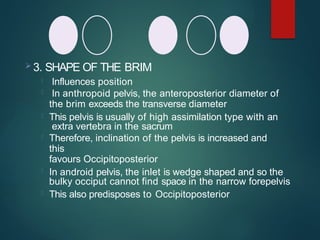
3. SHAPEOF THE BRIM
Influences position
In anthropoid pelvis, the anteroposterior diameter of
the brim exceeds the transverse diameter
This pelvis is usually of high assimilation type with an
extra vertebra in the sacrum
Therefore, inclination of the pelvis is increased and
this
favours Occipitoposterior
In android pelvis, the inlet is wedge shaped and so the
bulky occiput cannot find space in the narrow forepelvis
This also predisposes to Occipitoposterior
13.
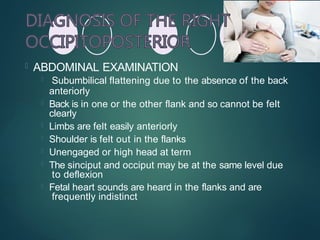
ABDOMINAL EXAMINATION
Subumbilical flattening due to the absence of the back
anteriorly
Back is in one or the other flank and so cannot be felt
clearly
Limbs are felt easily anteriorly
Shoulder is felt out in the flanks
Unengaged or high head at term
The sinciput and occiput may be at the same level due
to deflexion
Fetal heart sounds are heard in the flanks and are
frequently indistinct
14.
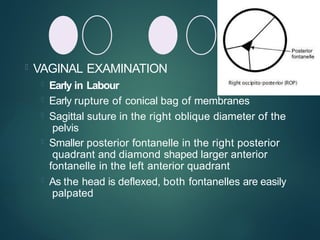
VAGINAL EXAMINATION
Early in Labour
Early rupture of conical bag of membranes
Sagittal suture in the right oblique diameter of the
pelvis
Smaller posterior fontanelle in the right posterior
quadrant and diamond shaped larger anterior
fontanelle in the left anterior quadrant
As the head is deflexed, both fontanelles are easily
palpated
15.
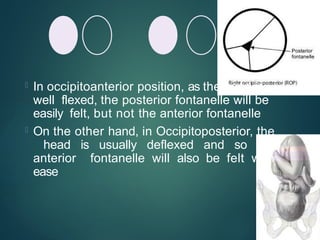
In occipitoanteriorposition, as the head is
well flexed, the posterior fontanelle will be
easily felt, but not the anterior fontanelle
On the other hand, in Occipitoposterior, the
head is usually deflexed and so the
anterior fontanelle will also be felt with
ease
16.
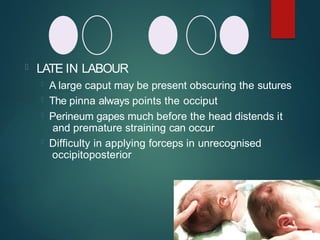
LATE INLABOUR
A large caput may be present obscuring the sutures
The pinna always points the occiput
Perineum gapes much before the head distends it
and premature straining can occur
Difficulty in applying forceps in unrecognised
occipitoposterior
17.
Occipitoposterior positionis the
common cause for prolonged labour in
a vertex presentation
The mechanism of labour will depend upon
whether the vertex is well flexed. in
occipitoposterior position with a well flexed
head, the occiput being the lower will touch
the pelvic floor first and rotate anteriorly and
labour proceeds normally
18.
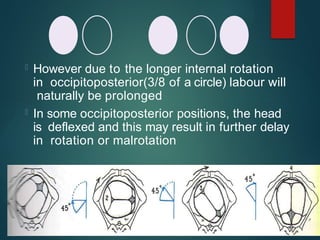
However dueto the longer internal rotation
in occipitoposterior(3/8 of a circle) labour will
naturally be prolonged
In some occipitoposterior positions, the head
is deflexed and this may result in further delay
in rotation or malrotation
19.
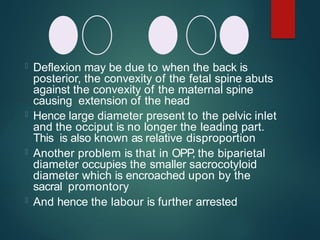
Deflexion maybe due to when the back is
posterior, the convexity of the fetal spine abuts
against the convexity of the maternal spine
causing extension of the head
Hence large diameter present to the pelvic inlet
and the occiput is no longer the leading part.
This is also known as relative disproportion
Another problem is that in OPP
, the biparietal
diameter occupies the smaller sacrocotyloid
diameter which is encroached upon by the
sacral promontory
And hence the labour is further arrested
20.
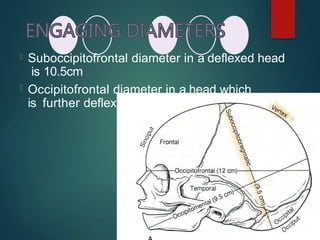
Suboccipitofrontal diameterin a deflexed head
is 10.5cm
Occipitofrontal diameter in a head which
is further deflexed is 11.5cm
21.
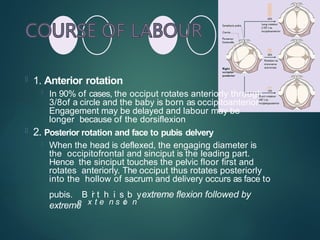
1. Anteriorrotation
In 90% of cases, the occiput rotates anteriorly through
3/8of a circle and the baby is born as occipitoanterior.
Engagement may be delayed and labour may be
longer because of the dorsiflexion
2. Posterior rotation and face to pubis delvery
When the head is deflexed, the engaging diameter is
the occipitofrontal and sinciput is the leading part.
Hence the sinciput touches the pelvic floor first and
rotates anteriorly. The occiput thus rotates posteriorly
into the hollow of sacrum and delivery occurs as face to
pubis.
e
B
x
i
r
t
t
e
h
n
i
s
s
i
o
b
n
yextreme flexion followed by
extreme
22.
Perineal tearsare common as the occiput is
posterior and it is the longer biparietal
diameter(9.4), which distends the perineum rather
than the smaller bitemporal(8cm). Hence liberal
episiotomy should be given.
3. Failure of rotation
Per
rotation
sistent
and
occi
the
pitopost
head
erior is the a
b
s
e
n
c
e
of
remains ROP or LOP
Deep
s
t
e
r
e
a
r
tr
d
ansve
w
i
t
h
rs
t
h
e
e ar
s
a
g
rest is defined as the
head being
diameter at the level
ittal suture in the
transverse
dilatation of cervix
of ischial spine,
23.
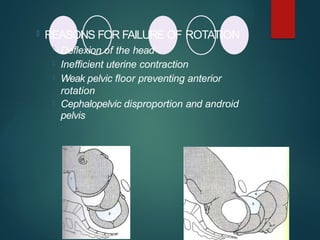
REASONS FORFAILURE OF ROTATION
Deflexion of the head
Inefficient uterine contraction
Weak pelvic floor preventing anterior
rotation
Cephalopelvic disproportion and android
pelvis
24.
Most ofthe malposition will rotate anteriorly
and the baby will be born spontaneously as
occiput anterior
Alternatively, they may rotate posteriorly
and deliver as face to pubis which need
liberal episiotomy.
As the labour is longer, judicious use of fluids
and analgesia is needed.
Epidural analgesia is ideal.
25.
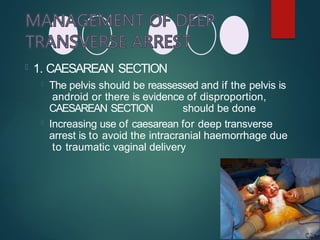
1. CAESAREANSECTION
The pelvis should be reassessed and if the pelvis is
android or there is evidence of disproportion,
CAESAREAN SECTION should be done
Increasing use of caesarean for deep transverse
arrest is to avoid the intracranial haemorrhage due
to traumatic vaginal delivery
26.
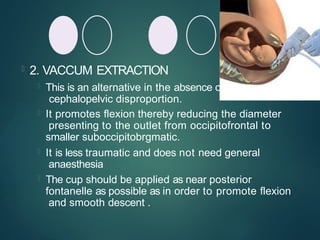
2. VACCUMEXTRACTION
This is an alternative in the absence of
cephalopelvic disproportion.
It promotes flexion thereby reducing the diameter
presenting to the outlet from occipitofrontal to
smaller suboccipitobrgmatic.
It is less traumatic and does not need general
anaesthesia
The cup should be applied as near posterior
fontanelle as possible as in order to promote flexion
and smooth descent .
27.
3. MANUALROTATION
This procedure can be employed if the obstetrician
is well versed in this technique.
Under the general anaesthesia, the right hand
grasps the sinciput displacing it thereby increasing
flexion.
The smaller bitemporal diameter allows more space
for the thumb and finger to have a firm grasp
across the temple with middle finger on the frontal
suture. In LOP, the left hand is used. Then the
sinciput is rotated and forceps or vaccum is applied
28.
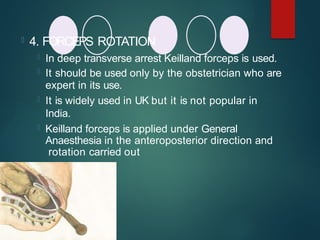
4. FORCEPSROTATION
In deep transverse arrest Keilland forceps is used.
It should be used only by the obstetrician who are
expert in its use.
It is widely used in UK but it is not popular in
India.
Keilland forceps is applied under General
Anaesthesia in the anteroposterior direction and
rotation carried out
30.
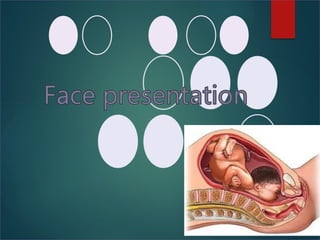
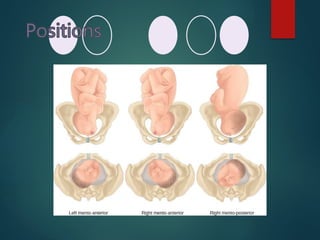
This isa cephalic presentation where the attitude is one
of complete extension, presenting part is the face
(area between chin and glabella)and denominator is
the chin or mentum.
Primary face presentation: present before the onset
of labour and are rare
Secondary face presentation: caused by extension
during labour.( E.g. . left mentoanterior is a result of
extension of right Occipitoposterior)
Maternal
Contractedpelvis
Oblique of uterus
Multiparity and pendulous abdomen
Fetal
Anencephaly and iniencephlaly
Cord round neck
Tumor of neck like congenital goiter
Spasm of sternocleidomastoid muscle
Dolichocephalic head
34.
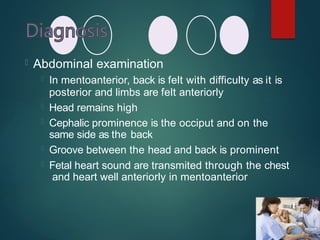
Abdominal examination
In mentoanterior, back is felt with difficulty as it is
posterior and limbs are felt anteriorly
Head remains high
Cephalic prominence is the occiput and on the
same side as the back
Groove between the head and back is prominent
Fetal heart sound are transmited through the chest
and heart well anteriorly in mentoanterior
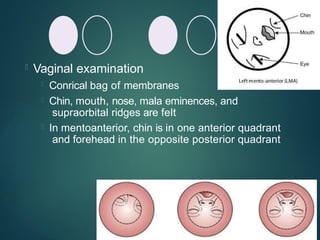
35.
Vaginal examination
Conrical bag of membranes
Chin, mouth, nose, mala eminences, and
supraorbital ridges are felt
In mentoanterior, chin is in one anterior quadrant
and forehead in the opposite posterior quadrant
36.
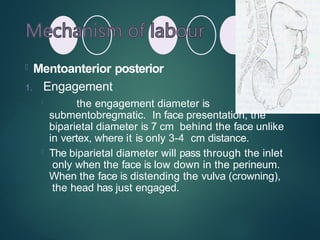
Mentoanterior posterior
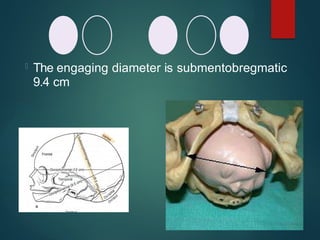
1.Engagement
the engagement diameter is
submentobregmatic. In face presentation, the
biparietal diameter is 7 cm behind the face unlike
in vertex, where it is only 3-4 cm distance.
The biparietal diameter will pass through the inlet
only when the face is low down in the perineum.
When the face is distending the vulva (crowning),
the head has just engaged.
37.
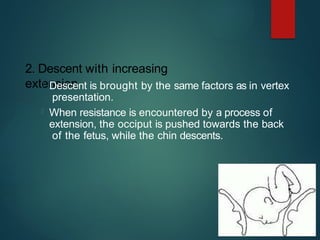
2. Descent withincreasing
extension
Descent is brought by the same factors as in vertex
presentation.
When resistance is encountered by a process of
extension, the occiput is pushed towards the back
of the fetus, while the chin descents.
38.
3. Internal rotation
On further descent, the chin reach
0
es the pelvic
floor and rotates anteriorly through 45 towards
the symphysis.
Anterior rotation does not take place until the
face is well applied to the pelvic floor and may be
delayed. Only internal rotation takes place this
manner, can the neck travers the posterior surface
of the symphysis pubis.
39.
4.
flexion
The headis born by flexion. The chin pivots under
the symphysis pubis and the mouth, nose, orbits,
forehead, vertex and occiput are born by flexion
5.Restitution and external rotation
Restitution and external rotation of chin occurs
towards the side to which it was originally directed,
and the shoulder are born as in vertex
40.
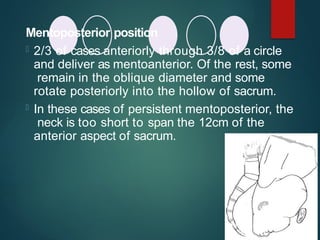
Mentoposterior position
2/3of cases anteriorly through 3/8 of a circle
and deliver as mentoanterior. Of the rest, some
remain in the oblique diameter and some
rotate posteriorly into the hollow of sacrum.
In these cases of persistent mentoposterior, the
neck is too short to span the 12cm of the
anterior aspect of sacrum.
41.
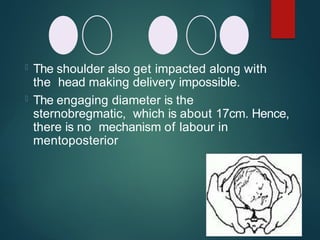
The shoulderalso get impacted along with
the head making delivery impossible.
The engaging diameter is the
sternobregmatic, which is about 17cm. Hence,
there is no mechanism of labour in
mentoposterior
42.
Cause ofprolonged labour in
face
Face is less effective dilator of cervix
No moulding of face
More chance of premature rupture
of membrane
Long internal rotation in
mentoposterior
Internal rotation occurs only late in
the second
stage
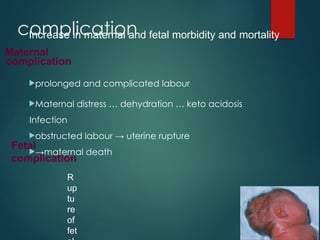
43.
complication
prolonged and complicatedlabour
Maternal distress … dehydration … keto acidosis
Infection
obstructed labour → uterine rupture
→maternal death
Fetal
complication
R
up
tu
re
of
fet
Increase in maternal and fetal morbidity and mortality
Maternal
complication
44.
Evaluate thecephalopelvic disproportion
or other associated complication and in
such situation, caesarian section is done.
If there is no disproportion and position
is mentoanterior, labour can be allowed
to progress.
In persistent mentoposterior, cescerian section
is done.
46.
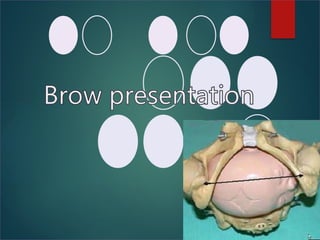
It isthe least common among
cephalic presentation and most
unfavorable.
The attitude is one of partial extension ,
the presenting part being the area
between the anterior fontanelle(bregma)
above and the glabella and orbital ridges
bellow and denominator is the forehead
or frontum.
47.
The presentingdiameter is verticomental 13.5
cm, which is largest of fetal head
48.
It isabout 1in 1000 birth
The cause is similar to face presentation and
include any factor that interferes with flexion
of the head
49.
- Leftfronto-anterior.
- Right fronto-anterior.
- Right fronto-posterior.
- Left fronto-posterior.
50.
Abdominal examination
High mobile head, which feels large from side to
side
Cephalic prominence is the occiput and is on the
same side as the back and the groove between the
cephalic prominence and the back is less prominent
than in face presentation
51.
Vaginal examination
Conical bag of membrane may be felt in early
labour
Anterior fontanelle(bregma) is felt at one end and
root of nose(nasion)and orbit ridges at the other
end of an oblique or transvers diameter.
Sometimes, the nose and the mouth are palpable,
but not the chin.
52.
As such,ther is no mechanism of labour
for persistent brow presentation.
Spontaneous delivery is unlikely and can occur
only when there is a very small baby and
large pelvis.
In persistent brow, the verticomental diameter
is shortened and the occipitofrontal diameter
is elongated with marked moulding and a
large catput on the forehead
54.
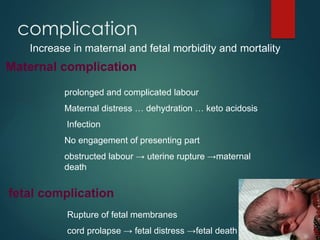
complication
Increase in maternaland fetal morbidity and mortality
Maternal complication
prolonged and complicated labour
Maternal distress … dehydration … keto acidosis
Infection
No engagement of presenting part
obstructed labour → uterine rupture →maternal
death
fetal complication
Rupture of fetal membranes
cord prolapse → fetal distress →fetal death
55.
Antepartum
Itis better to wait until the onset of labour in
the hope that correction to vertex or face.
Early labour
Cesarean section should be done. If diagnosis in
early labour before rupture of membrane, a short
period of time can be given under close supervision
in the hope of spontaneous correction.
56.
Late labour
It there is feature of obstructed labour, cesarean
section is performed immediately even if the fetus is
dead.



![Cells and Organs of immune system [Autosaved].pptx](https://cdn.slidesharecdn.com/ss_thumbnails/cellsandorgansofimmunesystemautosaved-260123152717-ea0cb261-thumbnail.jpg?width=640&height=640&fit=bounds)


