Suri V S Lalithamadhuri, K. Ramadevi / International Journal of Engineering Research and
Applications (IJERA) ISSN: 2248-9622 www.ijera.com
Vol. 3, Issue 4, Jul-Aug 2013, pp.2463-2467
2463 | P a g e
Ofdm Implementation Using Self-Cancellation Techniques in
Wireless Networks
Suri V S Lalithamadhuri*, K. Ramadevi**
*(Dept. of E.C.E, University college of Engineering, JNTUK,Kakinada, India.
**(Dept. of E.C.E, University college of Engineering, JNTUK, Kakinada, India.
ABSTRACT
With the rapid growth of digital
communication in recent years, the need for high
speed data transmission is increased. Moreover,
futureWirelessSystemsare expected to support a
wide range of services which includes video, data
and voice. OFDMis a promising candidate for
achieving high data rates in mobile environment
because of its multicarrier modulation technique
and ability to convert a frequency selective fading
channel into severalnearly flat fading channels.
Now OFDM is being widely used in wireless
communications standards, such as IEEE 802.11a,
the multimedia mobile access communication
(MMAC), and the HIPERLAN/2. However, one of
the main disadvantages of OFDM is its sensitivity
against carrier frequency offset and high PAPR
which causes intercarrier interference (ICI). This
paper deals with design of an OFDM mechanism
in a wireless technology and implementation of
double frequency hopping in CDMA to overcome
inter channel interferences.
Keywords- FHCDMA, HIPERLAN, ICI, MMAC,
OFDM
I. INTRODUTION
This project investigates an efficient ICI
cancellation method termed ICI self-cancellation
scheme for combating the impact of ICI on OFDM
systems. The ICI self-cancellation scheme is a
techniqueinwhichredundantdatais transmitted onto
adjacent sub-carriers such that the ICI between
adjacent sub-carriers cancels out at the receiver.
OFDM-Impact on Wireless Networks
Orthogonal Frequency Division
Multiplexing (OFDM) is a special form of multi
carrier modulation technique which is used to
generate waveforms that are mutually orthogonal. In
an OFDM scheme, a large number of orthogonal,
overlapping, narrow band sub-carriers are transmitted
in parallel. These carriers divide the available
transmission bandwidth. The separation of the sub-
carriers is such that there is a very compact spectral
utilization. With OFDM, it is possible to have
overlapping sub channels in the frequency domain,
thus increasing the transmission rate. In order to
avoid a large number of modulators and filters at the
transmitter and complementary filters and
demodulators at the receiver, it is desirable to be able
to use modern digital signal processing techniques,
such as fast Fourier transform (FFT). After more than
forty years of research and development carried out
in different places, OFDM is now being widely
implemented in high-speed digital communications.
OFDM has been accepted as standard in several wire
line and wireless applications. Due to the recent
advancements in digital signal processing (DSP) and
very large-scale integrated circuits (VLSI)
technologies, the initial obstacles of OFDM
implementations do not exist anymore. In a basic
communication system, the data are modulated onto a
single carrier frequency. The available bandwidth is
then totally occupied by each symbol. This kind of
system can lead to inter-symbol-interference (ISI) in
case of frequency selective channel. The basicidea of
OFDM is to divide the available spectrum into
several orthogonal sub channels so that each
narrowband sub channels experiences almost flat
fading. Many research centers in the world have
specialized teams working in the optimization of
OFDM systems. The attraction of OFDM is mainly
because of its way of handling the
multipathinterference at the receiver.Multipath
phenomenon generates two effects (a) Frequency
selective fading and (b) interference (ISI). The
"flatness” perceived by a narrowband channel
overcomes the frequency selective fading. On the
other hand, modulating symbols at a verylow rate
makes the symbols much longer than channel
impulse response and hence reduces the ISI. Use of
suitable error correcting codes provides more
robustness against frequency selective fading. The
insertion of an extra guard interval between
consecutive OFDM symbols can reduce the effects of
ISI even more. Theuse of FFT technique to
implement modulation and demodulation functions
makes it computationally more efficient. OFDM
systems have gained an increased interest during the
last years. It is used in the European digital broadcast
radio system, as well as in wired environment such as
asymmetric digital subscriber lines (ADSL). This
technique is used in digital subscriber lines (DSL) to
provides high bit rate over a twisted-pair of wires.
II. ADVANTAGES & APPLICATIONS
OF OFDM
Suri V S Lalithamadhuri, K. Ramadevi / International Journal of Engineering Research and
Applications (IJERA) ISSN: 2248-9622 www.ijera.com
Vol. 3, Issue 4, Jul-Aug 2013, pp.2463-2467
2464 | P a g e
A well-known problem of orthogonal
frequency division multiplexing (OFDM), however,
is its sensitivity to frequency offset between the
transmitted and received signals, which may be
caused by Doppler shift in the channel, or by the
difference between the transmitter and receiver local
oscillator frequencies. This carrier frequency offset
causes loss of orthogonality between sub-carriers and
the signals transmitted on each carrier are not
independent of each other. The orthogonality of the
carriers is no longer maintained, which results in
inter-carrier interference (ICI). The undesired ICI
degrades the performance of the system. Depending
on the Doppler spread in the channel and the block
length chosen for transmission, ICI can potentially
cause a severe deterioration of quality of service
(QOS) in OFDM systems. ICI mitigation techniques
are essential in improving the performance of an
OFDM system in an environment which induces
frequency offset error in the transmitted signal. The
comparisons of these schemes in terms of various
parameters will be useful in determining the choice
of ICI mitigation techniques for different applications
and mobile environments. The figure 1.2 shows the
basic OFDM block diagram.
The baseband OFDM signals can be written as
…(1)
Wherefm=m/T is the central frequency of the mth
sub-channeland Xmis the
correspondingtransmittedsymbol.
The signalsare orthogonal over [0, T ]
….(2)
OFDM is spectrally efficient - IFFT/FFT
operation ensures that sub-carriers do not interfere
with each other.OFDM has an inherent robustness
against narrowband interference. Narrowband
interference will affect at most a couple of
subchannels. Informationfrom the affected
subchannels can be erased and recovered via the
forward error correction (FEC) codes. Equalization is
very simple compared to Single-Carrier systems.
Figure 1.1 shows the frequency spectrum of OFDM
transmission technique.
Fig.1.1Frequencyspectrum of OFDM transmission
Fig.1.2 The basic OFDM block diagram
III. EXISTING TECHNOLOGY
In OFDM besides the inter-carrier-
interference (ICI) caused by receiver frequency offset
and by time variation of the mobile channel, its high
peak-to- average power ratio (PAPR) is a serious
drawback.Many researches concentrated on this
problem [9]- [12] because high PAPR generally
requires power amplifiers to operate with a large
back-off, which reduces amplifier power efficiency
[1]. The basic approach for this large PAPR of
OFDM signals is to intentionally clip high amplitude
signals which increases PAPR and results in more
ICI.
The existing transmission techniques in
CDMA over wireless networks for spreading the
bandwidth of the signal are:
Three types of spread spectrum techniques
There are three ways to spread the bandwidth of the
signal:
Frequency hopping: The signal is rapidly
switched between different frequencies within the
hopping bandwidth pseudo-randomly, and the
receiver knows beforehand where to find the signal at
any given time.
Time hopping: The signal is transmitted in
short bursts pseudo-randomly, and the receiver
knows beforehand when to expect the burst.
Direct sequence: The digital data is directly
coded at a much higher frequency. The code is
generated pseudo-randomly, the receiver knows how
to generate the same code, and correlates the received
signal with that code to extract the data. CDMA is a
Direct Sequence Spread Spectrum system. The
CDMA system works directly on 64kbit/sec digital
signals.
IV. PROPOSED TECHNOLOGY
In this project we have investigated an
efficient ICI cancellation method termed ICI self-
cancellation scheme for combating the impact of ICI
on OFDM systems. The ICI self-cancellation scheme
is a technique in which redundant data is transmitted
Suri V S Lalithamadhuri, K. Ramadevi / International Journal of Engineering Research and
Applications (IJERA) ISSN: 2248-9622 www.ijera.com
Vol. 3, Issue 4, Jul-Aug 2013, pp.2463-2467
2465 | P a g e
onto adjacent sub-carriers such that the ICI between
adjacent sub-carriers cancels out at the receiver. We
introduced HPA(high power amplification) technique
to reduce PAPR. We propose a two level FH-CDMA
in OFDM transmission technique which increases the
flexibility of transmission of high data bits along with
increasing the security of data without wastage of
bandwidth.
Algorithm:
1. The input parameters are initialized
2. The random input signal is reshaped; the input
data bits are converted into decimals.
3. TheInverse Fast Fourier Transform (IFFT) is
performed.
4. Sampling at ∆t=T /N A1, the OFDM signal
sampled at time instant t = k∆t can be expressed
as
Where A1 is an oversampling factor.
5. High power amplification(HPA) is done to
reduce the effect of PAPR.
PAPR =
Two level Frequency Hoping Technique is
introduced by spreading the signal on to different
frequencies at the transmission end.
6. The signal is transmitted through AWGN
channel with added noise.
7. The vice versa is performed at the receiver end.
Figure 2 shows the process of frequency spreading.
In general, the bandwidth of a digital signal is twice
its bit rate. The bandwidths of the information data
(fi) and the PN code are shown together. The
bandwidth of the combination of the two, for fc>fi,
can be approximated by the bandwidth of the PN
code
Fig.2.Frequency spreading of the signal.
V. PERFORMANCE EVALUVATION
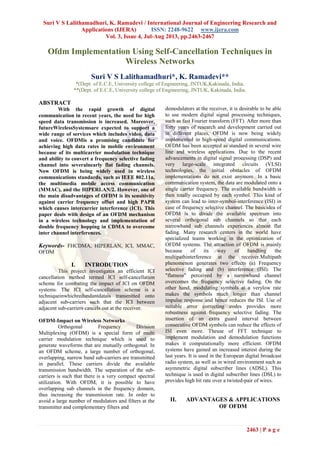
The bit error rate(BER) is calculated for
BPSK and 16-QAM techniques implemented in
OFDM with a total band width of 1MHz,carrier
frequency of 2GHz,52 number of bits per symbol,64
subcarriers, symbol period of 128µsec. For the
analyzing purpose MATLAB and MATLAB tools
have been used.
Figure 3.1 shows the MATLAB simulation
result of BER calculated for BPSK OFDM using self-
cancellation coding scheme.
Fig 3.1.BER curve for BPSK using OFDM self-
cancellation scheme
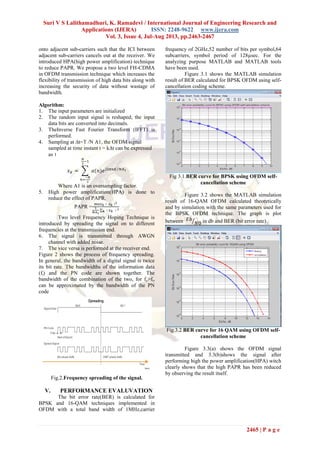
Figure 3.2 shows the MATLAB simulation
result of 16-QAM OFDM calculated theoretically
and by simulation with the same parameters used for
the BPSK OFDM technique. The graph is plot
between in db and BER (bit error rate).
Fig.3.2 BER curve for 16 QAM using OFDM self-
cancellation scheme
Figure 3.3(a) shows the OFDM signal
transmitted and 3.3(b)shows the signal after
performing high the power amplification(HPA) witch
clearly shows that the high PAPR has been reduced
by observing the result itself.
Suri V S Lalithamadhuri, K. Ramadevi / International Journal of Engineering Research and
Applications (IJERA) ISSN: 2248-9622 www.ijera.com
Vol. 3, Issue 4, Jul-Aug 2013, pp.2463-2467
2466 | P a g e
Fig.3.3 (a).modulated OFDM signal
Fig.3.3 (b) OFDM signal after HPA
Figure 3.4(a) shows the BPSK OFDM signal
which is single frequency hopped at the transmission
end before passing through the channel.FH-CDMA
provides frequencydiversity and helps modulation
codes and FH patterns in order to meet different
systemmultipath fading and diversify interference
[1], [2]. Majoradvantages of FH-CDMA over direct-
sequence CDMA [3], [4] include better resistance to
multiple access interference (MAI), less stringent
power control, and reduced near-far problem and
multipath interference. By assigning a unique FH
pattern to each user, a FH-CDMA system allows
multiple users to share the same transmission channel
simultaneously.
Fig.3.4(a)Frequency hopped spread spectrum
signal
Fig.3.4(b)Double frequency hopped spread
spectrum signal
The final output after reception of signal at
the receiver end is shown in the figure 3.5. The
transmitted input signal is almost equal to the
receivedsignal.
Fig 3.5 Scattered plot of transmitted and received
signals.
VI. CONCLUSION
In this paper, theoretically and by
simulation, we clarify the behavior of self-
cancellation coding concerning the high Peak- to-
Average-Power Ratio (PAPR) problem observed in
OFDM and compared their efficiencies with the
normal OFDM. High power amplification(HPA) is
shown as solution for high PAPR.We proposed a new
two-level FH-CDMAscheme. The performance
analyses showed that the two-level FH-CDMA
scheme provided atrade-off between performance and
data rate. Thetwo-level FH-CDMA scheme increased
the number of possible users and exhibited higher
data rate scheme offered more flexibility in the
design of FH-CDMAsystems to meet different
operating requirements.
REFERENCES
Suri V S Lalithamadhuri, K. Ramadevi / International Journal of Engineering Research and
Applications (IJERA) ISSN: 2248-9622 www.ijera.com
Vol. 3, Issue 4, Jul-Aug 2013, pp.2463-2467
2467 | P a g e
[1] H.Sari,G.Karam,and I. Jeanclaude,
"Transmission techniques for
digitalterrestrial TV broadcasting," IEEE
Comm. Mag., vol. 33, pp. 100-109,Feb.
1995.
[2] R. van Nee and R. Prasad, OFDM for
Wireless Multimedia Communications.
Artech House, 2000.
[3] J.-Z. Wang and L. B. Milstein, “CDMA
overlay situations for micro-cellular mobile
communications," IEEE Trans. Commun.,
vol. 43, no.2/3/4, pp. 603-614,
Feb./Mar./Apr. 1995.
[4] J.-Z. Wang and J. Chen, “Performance of
wideband CDMA systemswith complex
spreading and imperfect channel
estimation,"IEEE J. Sel.AreasCommun., vol.
19, no. 1, pp. 152-163, Jan. 2001
[5] AbdullahS. ALARAIMInd Takeshi
HASHIMOTO “PAPR and OOBP of
OFDM and their Improvementby using Self
Cancellation Codings” IEEE Commun.,PP3
-4Oct 2011
[6] “A Two-Level FH-CDMA Scheme
forWireless Communication Systems over
Fading Channels”bySung-Ming Wu, Guu-
Chang Yang,Cheng-Yuan Chang,andWing
C. Kwong,IEEE transactions on
communications, vol. 59, no. 1, January
2011.
[7] C.-H. Hsieh, G.-C. Yang, C.-Y. Chang, and
W.C. Kwong, “Multilevelprime codes for
optical CDMA systems,"J. Opt. Commun.
Netw.,vol.1, no. 7, pp. 600-607, Dec. 2009.
[8] P. Banelli, "Theoretical analysis and
performance of OFDM signals innonlinear
fading channels," IEEE Trans. Wireless
Commun., vol. 2, pp284-293, March. 2003
[9] X. Li, and L. Cimini, "Effect of clipping and
filtering on the performance of OFDM,"
Electron. Lett. vol. 2, No. 5, pp. 131-133,
May 1998.
[10] A. Bahai, M. Singh, A. Goldsmith, and B.
Saltzberg"A new approachfor evaluating
clipping distortion in multicarrier systems,"
IEEE Trans Selected Area in Commun., vol.
20, No. 5, pp. 1037-1046, June. 2002.
[11] P. Banelli, "Theoretical analysis and
performance of OFDM signals innonlinear
fading channels," IEEE Trans. Wireless
Commun., vol. 2, pp. 284-293, March. 2003.
[12] K. R. Panta and J. Armstrong, "Effects of
clipping on the error performance of OFDM
in frequency selective fading channels,"
IEEE Trans. Wireless Commun., vol. 3, pp.
668-671, March. 2004.
Books
[13] “Computer Networks” (Fourth Edition)
by ANDREW S. TANENBAUM.
[14] “Wireless Communication and
Networks”(Second Edition) by William
Stallings.
K. RamaDevi obtained M.Tech degreein
Microwave and Radar Engineering from Osmania
University College of Engineering, Hyderabad in
2003. She is presently working as Assistant
Professor in the Department of Electronics and
Communication Engineering, University College of
Engineering,JNTUK,Kakinada, A.P., INDIA. She is
presently pursuing Doctoral degree from J.N.T.U.
College of Engineering, Kakinada. She presented
many research papers in various national and
international journals and conferences. Her research
interests include MicroStrip Patch Antennas,
Communications, slot antennas simulated in
MATLAB and HFSS.
Suri V S LalithaMadhuri,received the
B.Tech degree in Electronics andCommunication
Engineering in 2011 from JNTUK,Kakinada and
pursuing M.Tech degree in JNTUK, Kakinada, India.

Oc3424632467

  • 1.
    Suri V SLalithamadhuri, K. Ramadevi / International Journal of Engineering Research and Applications (IJERA) ISSN: 2248-9622 www.ijera.com Vol. 3, Issue 4, Jul-Aug 2013, pp.2463-2467 2463 | P a g e Ofdm Implementation Using Self-Cancellation Techniques in Wireless Networks Suri V S Lalithamadhuri*, K. Ramadevi** *(Dept. of E.C.E, University college of Engineering, JNTUK,Kakinada, India. **(Dept. of E.C.E, University college of Engineering, JNTUK, Kakinada, India. ABSTRACT With the rapid growth of digital communication in recent years, the need for high speed data transmission is increased. Moreover, futureWirelessSystemsare expected to support a wide range of services which includes video, data and voice. OFDMis a promising candidate for achieving high data rates in mobile environment because of its multicarrier modulation technique and ability to convert a frequency selective fading channel into severalnearly flat fading channels. Now OFDM is being widely used in wireless communications standards, such as IEEE 802.11a, the multimedia mobile access communication (MMAC), and the HIPERLAN/2. However, one of the main disadvantages of OFDM is its sensitivity against carrier frequency offset and high PAPR which causes intercarrier interference (ICI). This paper deals with design of an OFDM mechanism in a wireless technology and implementation of double frequency hopping in CDMA to overcome inter channel interferences. Keywords- FHCDMA, HIPERLAN, ICI, MMAC, OFDM I. INTRODUTION This project investigates an efficient ICI cancellation method termed ICI self-cancellation scheme for combating the impact of ICI on OFDM systems. The ICI self-cancellation scheme is a techniqueinwhichredundantdatais transmitted onto adjacent sub-carriers such that the ICI between adjacent sub-carriers cancels out at the receiver. OFDM-Impact on Wireless Networks Orthogonal Frequency Division Multiplexing (OFDM) is a special form of multi carrier modulation technique which is used to generate waveforms that are mutually orthogonal. In an OFDM scheme, a large number of orthogonal, overlapping, narrow band sub-carriers are transmitted in parallel. These carriers divide the available transmission bandwidth. The separation of the sub- carriers is such that there is a very compact spectral utilization. With OFDM, it is possible to have overlapping sub channels in the frequency domain, thus increasing the transmission rate. In order to avoid a large number of modulators and filters at the transmitter and complementary filters and demodulators at the receiver, it is desirable to be able to use modern digital signal processing techniques, such as fast Fourier transform (FFT). After more than forty years of research and development carried out in different places, OFDM is now being widely implemented in high-speed digital communications. OFDM has been accepted as standard in several wire line and wireless applications. Due to the recent advancements in digital signal processing (DSP) and very large-scale integrated circuits (VLSI) technologies, the initial obstacles of OFDM implementations do not exist anymore. In a basic communication system, the data are modulated onto a single carrier frequency. The available bandwidth is then totally occupied by each symbol. This kind of system can lead to inter-symbol-interference (ISI) in case of frequency selective channel. The basicidea of OFDM is to divide the available spectrum into several orthogonal sub channels so that each narrowband sub channels experiences almost flat fading. Many research centers in the world have specialized teams working in the optimization of OFDM systems. The attraction of OFDM is mainly because of its way of handling the multipathinterference at the receiver.Multipath phenomenon generates two effects (a) Frequency selective fading and (b) interference (ISI). The "flatness” perceived by a narrowband channel overcomes the frequency selective fading. On the other hand, modulating symbols at a verylow rate makes the symbols much longer than channel impulse response and hence reduces the ISI. Use of suitable error correcting codes provides more robustness against frequency selective fading. The insertion of an extra guard interval between consecutive OFDM symbols can reduce the effects of ISI even more. Theuse of FFT technique to implement modulation and demodulation functions makes it computationally more efficient. OFDM systems have gained an increased interest during the last years. It is used in the European digital broadcast radio system, as well as in wired environment such as asymmetric digital subscriber lines (ADSL). This technique is used in digital subscriber lines (DSL) to provides high bit rate over a twisted-pair of wires. II. ADVANTAGES & APPLICATIONS OF OFDM
  • 2.
    Suri V SLalithamadhuri, K. Ramadevi / International Journal of Engineering Research and Applications (IJERA) ISSN: 2248-9622 www.ijera.com Vol. 3, Issue 4, Jul-Aug 2013, pp.2463-2467 2464 | P a g e A well-known problem of orthogonal frequency division multiplexing (OFDM), however, is its sensitivity to frequency offset between the transmitted and received signals, which may be caused by Doppler shift in the channel, or by the difference between the transmitter and receiver local oscillator frequencies. This carrier frequency offset causes loss of orthogonality between sub-carriers and the signals transmitted on each carrier are not independent of each other. The orthogonality of the carriers is no longer maintained, which results in inter-carrier interference (ICI). The undesired ICI degrades the performance of the system. Depending on the Doppler spread in the channel and the block length chosen for transmission, ICI can potentially cause a severe deterioration of quality of service (QOS) in OFDM systems. ICI mitigation techniques are essential in improving the performance of an OFDM system in an environment which induces frequency offset error in the transmitted signal. The comparisons of these schemes in terms of various parameters will be useful in determining the choice of ICI mitigation techniques for different applications and mobile environments. The figure 1.2 shows the basic OFDM block diagram. The baseband OFDM signals can be written as …(1) Wherefm=m/T is the central frequency of the mth sub-channeland Xmis the correspondingtransmittedsymbol. The signalsare orthogonal over [0, T ] ….(2) OFDM is spectrally efficient - IFFT/FFT operation ensures that sub-carriers do not interfere with each other.OFDM has an inherent robustness against narrowband interference. Narrowband interference will affect at most a couple of subchannels. Informationfrom the affected subchannels can be erased and recovered via the forward error correction (FEC) codes. Equalization is very simple compared to Single-Carrier systems. Figure 1.1 shows the frequency spectrum of OFDM transmission technique. Fig.1.1Frequencyspectrum of OFDM transmission Fig.1.2 The basic OFDM block diagram III. EXISTING TECHNOLOGY In OFDM besides the inter-carrier- interference (ICI) caused by receiver frequency offset and by time variation of the mobile channel, its high peak-to- average power ratio (PAPR) is a serious drawback.Many researches concentrated on this problem [9]- [12] because high PAPR generally requires power amplifiers to operate with a large back-off, which reduces amplifier power efficiency [1]. The basic approach for this large PAPR of OFDM signals is to intentionally clip high amplitude signals which increases PAPR and results in more ICI. The existing transmission techniques in CDMA over wireless networks for spreading the bandwidth of the signal are: Three types of spread spectrum techniques There are three ways to spread the bandwidth of the signal: Frequency hopping: The signal is rapidly switched between different frequencies within the hopping bandwidth pseudo-randomly, and the receiver knows beforehand where to find the signal at any given time. Time hopping: The signal is transmitted in short bursts pseudo-randomly, and the receiver knows beforehand when to expect the burst. Direct sequence: The digital data is directly coded at a much higher frequency. The code is generated pseudo-randomly, the receiver knows how to generate the same code, and correlates the received signal with that code to extract the data. CDMA is a Direct Sequence Spread Spectrum system. The CDMA system works directly on 64kbit/sec digital signals. IV. PROPOSED TECHNOLOGY In this project we have investigated an efficient ICI cancellation method termed ICI self- cancellation scheme for combating the impact of ICI on OFDM systems. The ICI self-cancellation scheme is a technique in which redundant data is transmitted
  • 3.
    Suri V SLalithamadhuri, K. Ramadevi / International Journal of Engineering Research and Applications (IJERA) ISSN: 2248-9622 www.ijera.com Vol. 3, Issue 4, Jul-Aug 2013, pp.2463-2467 2465 | P a g e onto adjacent sub-carriers such that the ICI between adjacent sub-carriers cancels out at the receiver. We introduced HPA(high power amplification) technique to reduce PAPR. We propose a two level FH-CDMA in OFDM transmission technique which increases the flexibility of transmission of high data bits along with increasing the security of data without wastage of bandwidth. Algorithm: 1. The input parameters are initialized 2. The random input signal is reshaped; the input data bits are converted into decimals. 3. TheInverse Fast Fourier Transform (IFFT) is performed. 4. Sampling at ∆t=T /N A1, the OFDM signal sampled at time instant t = k∆t can be expressed as Where A1 is an oversampling factor. 5. High power amplification(HPA) is done to reduce the effect of PAPR. PAPR = Two level Frequency Hoping Technique is introduced by spreading the signal on to different frequencies at the transmission end. 6. The signal is transmitted through AWGN channel with added noise. 7. The vice versa is performed at the receiver end. Figure 2 shows the process of frequency spreading. In general, the bandwidth of a digital signal is twice its bit rate. The bandwidths of the information data (fi) and the PN code are shown together. The bandwidth of the combination of the two, for fc>fi, can be approximated by the bandwidth of the PN code Fig.2.Frequency spreading of the signal. V. PERFORMANCE EVALUVATION The bit error rate(BER) is calculated for BPSK and 16-QAM techniques implemented in OFDM with a total band width of 1MHz,carrier frequency of 2GHz,52 number of bits per symbol,64 subcarriers, symbol period of 128µsec. For the analyzing purpose MATLAB and MATLAB tools have been used. Figure 3.1 shows the MATLAB simulation result of BER calculated for BPSK OFDM using self- cancellation coding scheme. Fig 3.1.BER curve for BPSK using OFDM self- cancellation scheme Figure 3.2 shows the MATLAB simulation result of 16-QAM OFDM calculated theoretically and by simulation with the same parameters used for the BPSK OFDM technique. The graph is plot between in db and BER (bit error rate). Fig.3.2 BER curve for 16 QAM using OFDM self- cancellation scheme Figure 3.3(a) shows the OFDM signal transmitted and 3.3(b)shows the signal after performing high the power amplification(HPA) witch clearly shows that the high PAPR has been reduced by observing the result itself.
  • 4.
    Suri V SLalithamadhuri, K. Ramadevi / International Journal of Engineering Research and Applications (IJERA) ISSN: 2248-9622 www.ijera.com Vol. 3, Issue 4, Jul-Aug 2013, pp.2463-2467 2466 | P a g e Fig.3.3 (a).modulated OFDM signal Fig.3.3 (b) OFDM signal after HPA Figure 3.4(a) shows the BPSK OFDM signal which is single frequency hopped at the transmission end before passing through the channel.FH-CDMA provides frequencydiversity and helps modulation codes and FH patterns in order to meet different systemmultipath fading and diversify interference [1], [2]. Majoradvantages of FH-CDMA over direct- sequence CDMA [3], [4] include better resistance to multiple access interference (MAI), less stringent power control, and reduced near-far problem and multipath interference. By assigning a unique FH pattern to each user, a FH-CDMA system allows multiple users to share the same transmission channel simultaneously. Fig.3.4(a)Frequency hopped spread spectrum signal Fig.3.4(b)Double frequency hopped spread spectrum signal The final output after reception of signal at the receiver end is shown in the figure 3.5. The transmitted input signal is almost equal to the receivedsignal. Fig 3.5 Scattered plot of transmitted and received signals. VI. CONCLUSION In this paper, theoretically and by simulation, we clarify the behavior of self- cancellation coding concerning the high Peak- to- Average-Power Ratio (PAPR) problem observed in OFDM and compared their efficiencies with the normal OFDM. High power amplification(HPA) is shown as solution for high PAPR.We proposed a new two-level FH-CDMAscheme. The performance analyses showed that the two-level FH-CDMA scheme provided atrade-off between performance and data rate. Thetwo-level FH-CDMA scheme increased the number of possible users and exhibited higher data rate scheme offered more flexibility in the design of FH-CDMAsystems to meet different operating requirements. REFERENCES
  • 5.
    Suri V SLalithamadhuri, K. Ramadevi / International Journal of Engineering Research and Applications (IJERA) ISSN: 2248-9622 www.ijera.com Vol. 3, Issue 4, Jul-Aug 2013, pp.2463-2467 2467 | P a g e [1] H.Sari,G.Karam,and I. Jeanclaude, "Transmission techniques for digitalterrestrial TV broadcasting," IEEE Comm. Mag., vol. 33, pp. 100-109,Feb. 1995. [2] R. van Nee and R. Prasad, OFDM for Wireless Multimedia Communications. Artech House, 2000. [3] J.-Z. Wang and L. B. Milstein, “CDMA overlay situations for micro-cellular mobile communications," IEEE Trans. Commun., vol. 43, no.2/3/4, pp. 603-614, Feb./Mar./Apr. 1995. [4] J.-Z. Wang and J. Chen, “Performance of wideband CDMA systemswith complex spreading and imperfect channel estimation,"IEEE J. Sel.AreasCommun., vol. 19, no. 1, pp. 152-163, Jan. 2001 [5] AbdullahS. ALARAIMInd Takeshi HASHIMOTO “PAPR and OOBP of OFDM and their Improvementby using Self Cancellation Codings” IEEE Commun.,PP3 -4Oct 2011 [6] “A Two-Level FH-CDMA Scheme forWireless Communication Systems over Fading Channels”bySung-Ming Wu, Guu- Chang Yang,Cheng-Yuan Chang,andWing C. Kwong,IEEE transactions on communications, vol. 59, no. 1, January 2011. [7] C.-H. Hsieh, G.-C. Yang, C.-Y. Chang, and W.C. Kwong, “Multilevelprime codes for optical CDMA systems,"J. Opt. Commun. Netw.,vol.1, no. 7, pp. 600-607, Dec. 2009. [8] P. Banelli, "Theoretical analysis and performance of OFDM signals innonlinear fading channels," IEEE Trans. Wireless Commun., vol. 2, pp284-293, March. 2003 [9] X. Li, and L. Cimini, "Effect of clipping and filtering on the performance of OFDM," Electron. Lett. vol. 2, No. 5, pp. 131-133, May 1998. [10] A. Bahai, M. Singh, A. Goldsmith, and B. Saltzberg"A new approachfor evaluating clipping distortion in multicarrier systems," IEEE Trans Selected Area in Commun., vol. 20, No. 5, pp. 1037-1046, June. 2002. [11] P. Banelli, "Theoretical analysis and performance of OFDM signals innonlinear fading channels," IEEE Trans. Wireless Commun., vol. 2, pp. 284-293, March. 2003. [12] K. R. Panta and J. Armstrong, "Effects of clipping on the error performance of OFDM in frequency selective fading channels," IEEE Trans. Wireless Commun., vol. 3, pp. 668-671, March. 2004. Books [13] “Computer Networks” (Fourth Edition) by ANDREW S. TANENBAUM. [14] “Wireless Communication and Networks”(Second Edition) by William Stallings. K. RamaDevi obtained M.Tech degreein Microwave and Radar Engineering from Osmania University College of Engineering, Hyderabad in 2003. She is presently working as Assistant Professor in the Department of Electronics and Communication Engineering, University College of Engineering,JNTUK,Kakinada, A.P., INDIA. She is presently pursuing Doctoral degree from J.N.T.U. College of Engineering, Kakinada. She presented many research papers in various national and international journals and conferences. Her research interests include MicroStrip Patch Antennas, Communications, slot antennas simulated in MATLAB and HFSS. Suri V S LalithaMadhuri,received the B.Tech degree in Electronics andCommunication Engineering in 2011 from JNTUK,Kakinada and pursuing M.Tech degree in JNTUK, Kakinada, India.