Dr. Nabarun Biswas
(FCPS Surgery)
Registrar
Mymensingh Medical College Hospital
What is ODS ?
“ Difficulty in evacuation, which may or
may not be associated with constipation“
“ Difficulty in evacuation or emptying the
rectum which may occur even with frequent
visits to the toilet and even with passing
soft motions”
What is Constipation?
“Constipation is a symptom, not a
disease characterized by infrequent
bowel movements, usually less than
3 stools per week or hard to pass”.
Common causes of
constipation
 Diet
 Medications
 Medical conditions
slow movement of stool within the colon, irritable
bowel syndrome, and pelvic floor disorders
 associated diseases:
hypothyroidism, diabetes, Parkinson's, celiac
disease, non-celiac gluten sensitivity, colon
cancer, diverticulitis, and IBD
 Psychological
 Congenital
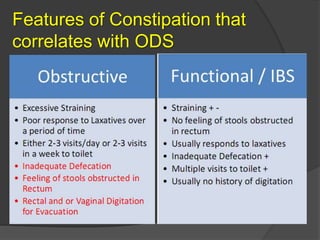
Features of Constipation that
correlates with ODS
Pathophysiology of ODS
 ODS has been shown to be the result of an
abnormal function of the muscles involved in
defecation or an anatomical abnormality of the
pelvic organs
 ODS is a complex and multifactorial condition
which is often referred to as an “Iceberg
Syndrome”
Why Obstructed Defecation
occurs?
One review stated that the most common
causes of disruption to the defecation cycle
are associated with pregnancy and childbirth,
gynaecological descent or neurogenic
disturbances of the brain-bowel axis. Patients
with obstructed defecation appear to have
impaired pelvic floor function
Specific causes of Obstructed
Defecation
 Anismus and pelvic floor dysfunction
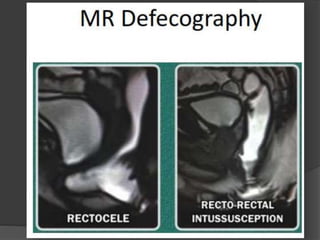
 Rectocele
 Rectal invagination/ intussusception
 Internal anal sphincter hypertonia
 Anal stenosis
 Fecal impaction
 Rectal or anal cancer
 Descending perineum syndrome
Correlation with ODS
Obstructed defecation is one of the cause of-
1. Chronic constipation
2. Incomplete evacuation of bowel
3. Chronic large bowel obstruction and
4. Tenesmus
Classification
Outlet obstruction can be classified into 4 groups
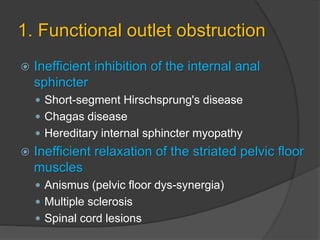
1. Functional outlet obstruction
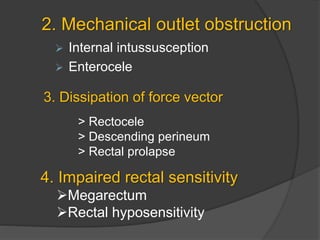
2. Mechanical outlet obstruction
3. Dissipation of force vector
4. Impaired rectal sensitivity
1. Functional outlet obstruction
 Inefficient inhibition of the internal anal
sphincter
 Short-segment Hirschsprung's disease
 Chagas disease
 Hereditary internal sphincter myopathy
 Inefficient relaxation of the striated pelvic floor
muscles
 Anismus (pelvic floor dys-synergia)
 Multiple sclerosis
 Spinal cord lesions
2. Mechanical outlet obstruction
 Internal intussusception
 Enterocele
3. Dissipation of force vector
> Rectocele
> Descending perineum
> Rectal prolapse
4. Impaired rectal sensitivity
Megarectum
Rectal hyposensitivity
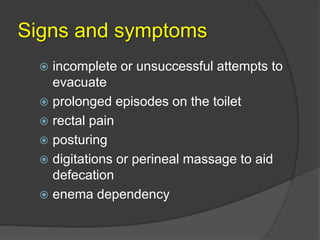
Signs and symptoms
 incomplete or unsuccessful attempts to
evacuate
 prolonged episodes on the toilet
 rectal pain
 posturing
 digitations or perineal massage to aid
defecation
 enema dependency
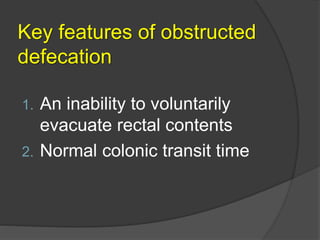
Key features of obstructed
defecation
1. An inability to voluntarily
evacuate rectal contents
2. Normal colonic transit time
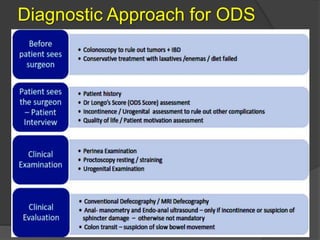
Five Questionnaire to diagnose &
grading ODS
1. Excessive straining?
2. Incomplete rectal evacuation?
3. Use of enemas and/or laxatives?
4. Vaginal-anal-perineal digitations (needing to
press in the back wall of the vagina or on the
perineum to aid defecation)
5. Abdominal discomfort and/or pain?
Diagnostic Approach for ODS
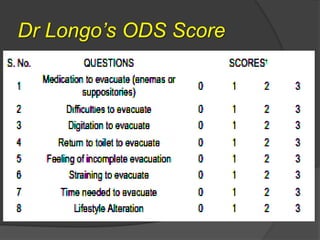
Dr Longo’s ODS Score
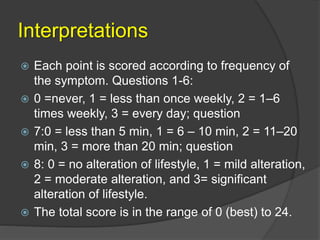
Interpretations
 Each point is scored according to frequency of
the symptom. Questions 1-6:
 0 =never, 1 = less than once weekly, 2 = 1–6
times weekly, 3 = every day; question
 7:0 = less than 5 min, 1 = 6 – 10 min, 2 = 11–20
min, 3 = more than 20 min; question
 8: 0 = no alteration of lifestyle, 1 = mild alteration,
2 = moderate alteration, and 3= significant
alteration of lifestyle.
 The total score is in the range of 0 (best) to 24.
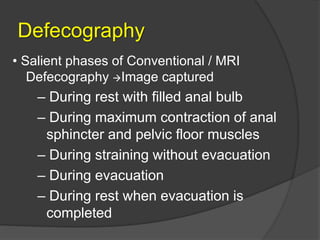
Defecography
• Salient phases of Conventional / MRI
Defecography Image captured
– During rest with filled anal bulb
– During maximum contraction of anal
sphincter and pelvic floor muscles
– During straining without evacuation
– During evacuation
– During rest when evacuation is
completed
Management
Specific to the cause:
 Conservative:
 Dietary fiber
 Plenty of water
 Laxatives
 Rectal enema/ irrigation
 Biofeedback for anismus
 Psychotherapy
 Avoid chocolate and constipating
foods
Management
 Surgical treatment:
1. Manual technique
2. Stapled technique
Manual technique
I. to perform a kind of “surgical” irrigation;
II. to perform either a resection or a plication or
a pexy in case of internal mucosal prolapse;
III. to reinforce the rectovaginal septum and/or,
again, resect the redundant mucosa, in case
of significant rectocele; and
IV. to perform miotomy in case ODS is due to a
muscular disorder.
Stapled technique
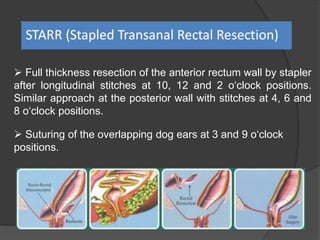
STARR procedure
 Full thickness resection of the anterior rectum wall by stapler
after longitudinal stitches at 10, 12 and 2 o‘clock positions.
Similar approach at the posterior wall with stitches at 4, 6 and
8 o‘clock positions.
 Suturing of the overlapping dog ears at 3 and 9 o‘clock
positions.
Let’s see a video
Conclusion
ODS is a problem that is
frequently encountered in the
elderly females, and the
management should be tailor-
made to each clinical scenario.
Obstructive defecation syndrome

Obstructive defecation syndrome

  • 1.
    Dr. Nabarun Biswas (FCPSSurgery) Registrar Mymensingh Medical College Hospital
  • 2.
    What is ODS? “ Difficulty in evacuation, which may or may not be associated with constipation“ “ Difficulty in evacuation or emptying the rectum which may occur even with frequent visits to the toilet and even with passing soft motions”
  • 3.
    What is Constipation? “Constipationis a symptom, not a disease characterized by infrequent bowel movements, usually less than 3 stools per week or hard to pass”.
  • 4.
    Common causes of constipation Diet  Medications  Medical conditions slow movement of stool within the colon, irritable bowel syndrome, and pelvic floor disorders  associated diseases: hypothyroidism, diabetes, Parkinson's, celiac disease, non-celiac gluten sensitivity, colon cancer, diverticulitis, and IBD  Psychological  Congenital
  • 5.
    Features of Constipationthat correlates with ODS
  • 6.
    Pathophysiology of ODS ODS has been shown to be the result of an abnormal function of the muscles involved in defecation or an anatomical abnormality of the pelvic organs  ODS is a complex and multifactorial condition which is often referred to as an “Iceberg Syndrome”
  • 7.
    Why Obstructed Defecation occurs? Onereview stated that the most common causes of disruption to the defecation cycle are associated with pregnancy and childbirth, gynaecological descent or neurogenic disturbances of the brain-bowel axis. Patients with obstructed defecation appear to have impaired pelvic floor function
  • 8.
    Specific causes ofObstructed Defecation  Anismus and pelvic floor dysfunction  Rectocele  Rectal invagination/ intussusception  Internal anal sphincter hypertonia  Anal stenosis  Fecal impaction  Rectal or anal cancer  Descending perineum syndrome
  • 9.
    Correlation with ODS Obstructeddefecation is one of the cause of- 1. Chronic constipation 2. Incomplete evacuation of bowel 3. Chronic large bowel obstruction and 4. Tenesmus
  • 10.
    Classification Outlet obstruction canbe classified into 4 groups 1. Functional outlet obstruction 2. Mechanical outlet obstruction 3. Dissipation of force vector 4. Impaired rectal sensitivity
  • 11.
    1. Functional outletobstruction  Inefficient inhibition of the internal anal sphincter  Short-segment Hirschsprung's disease  Chagas disease  Hereditary internal sphincter myopathy  Inefficient relaxation of the striated pelvic floor muscles  Anismus (pelvic floor dys-synergia)  Multiple sclerosis  Spinal cord lesions
  • 12.
    2. Mechanical outletobstruction  Internal intussusception  Enterocele 3. Dissipation of force vector > Rectocele > Descending perineum > Rectal prolapse 4. Impaired rectal sensitivity Megarectum Rectal hyposensitivity
  • 13.
    Signs and symptoms incomplete or unsuccessful attempts to evacuate  prolonged episodes on the toilet  rectal pain  posturing  digitations or perineal massage to aid defecation  enema dependency
  • 14.
    Key features ofobstructed defecation 1. An inability to voluntarily evacuate rectal contents 2. Normal colonic transit time
  • 15.
    Five Questionnaire todiagnose & grading ODS 1. Excessive straining? 2. Incomplete rectal evacuation? 3. Use of enemas and/or laxatives? 4. Vaginal-anal-perineal digitations (needing to press in the back wall of the vagina or on the perineum to aid defecation) 5. Abdominal discomfort and/or pain?
  • 16.
  • 17.
  • 18.
    Interpretations  Each pointis scored according to frequency of the symptom. Questions 1-6:  0 =never, 1 = less than once weekly, 2 = 1–6 times weekly, 3 = every day; question  7:0 = less than 5 min, 1 = 6 – 10 min, 2 = 11–20 min, 3 = more than 20 min; question  8: 0 = no alteration of lifestyle, 1 = mild alteration, 2 = moderate alteration, and 3= significant alteration of lifestyle.  The total score is in the range of 0 (best) to 24.
  • 19.
    Defecography • Salient phasesof Conventional / MRI Defecography Image captured – During rest with filled anal bulb – During maximum contraction of anal sphincter and pelvic floor muscles – During straining without evacuation – During evacuation – During rest when evacuation is completed
  • 21.
    Management Specific to thecause:  Conservative:  Dietary fiber  Plenty of water  Laxatives  Rectal enema/ irrigation  Biofeedback for anismus  Psychotherapy  Avoid chocolate and constipating foods
  • 22.
    Management  Surgical treatment: 1.Manual technique 2. Stapled technique
  • 23.
    Manual technique I. toperform a kind of “surgical” irrigation; II. to perform either a resection or a plication or a pexy in case of internal mucosal prolapse; III. to reinforce the rectovaginal septum and/or, again, resect the redundant mucosa, in case of significant rectocele; and IV. to perform miotomy in case ODS is due to a muscular disorder.
  • 24.
  • 25.
     Full thicknessresection of the anterior rectum wall by stapler after longitudinal stitches at 10, 12 and 2 o‘clock positions. Similar approach at the posterior wall with stitches at 4, 6 and 8 o‘clock positions.  Suturing of the overlapping dog ears at 3 and 9 o‘clock positions.
  • 26.
  • 27.
    Conclusion ODS is aproblem that is frequently encountered in the elderly females, and the management should be tailor- made to each clinical scenario.

Editor's Notes

  • #7 Iceberg Syndrome : The acute condition is what we call the tip of the iceberg. There is a lot going on below it.
  • #17 Dr longo’s score :
  • #22 Biofeedback therapy is a non-drug treatment in which patients learn to control bodily processes that are normally involuntary, such as muscle tension, blood pressure, or heart rate. There are three common types of biofeedback therapy: Thermal biofeedback measures skin temperature Electromyography measures muscle tension Neurofeedback, or EEG biofeedback When a person is stressed, their internal processes such as blood pressure can become irregular. Biofeedback therapy teaches relaxation and mental exercises that can alleviate symptoms. During a biofeedback session, the therapist attaches electrodes to the patient's skin, and these send information to a monitoring box. The therapist views the measurements on the monitor, and, through trial and error, identifies a range of mental activities and relaxation techniques that can help regulate the patient's bodily processes