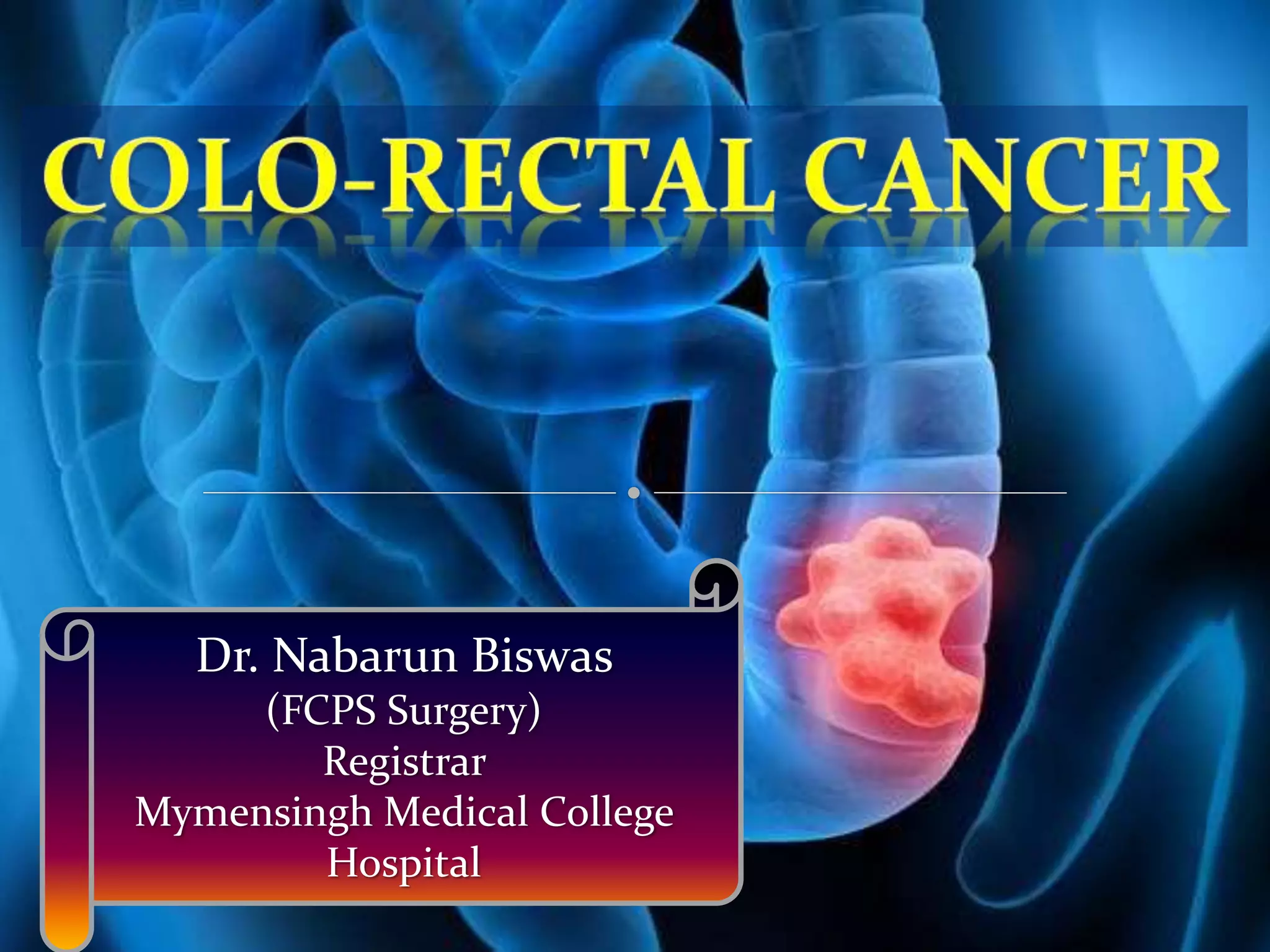

Dr. Nabarun Biswas
(FCPS Surgery)
Registrar
Mymensingh Medical College
Hospital
• 2nd most common malignancy in female &
3rd most common in male
• 4th most common cause of cancer death
after lung, stomach & liver
• Most common malignancy in GIT
• Peak incidence above 70 years
• 7% less than 40 year
• Synchronous 7%
• Metachronous 3%
1. Adenocarcinomas:
2. Carcinoid tumors:
3. Gastrointestinal stromal tumors
(GISTs):
4. Lymphomas:
5. Sarcomas:
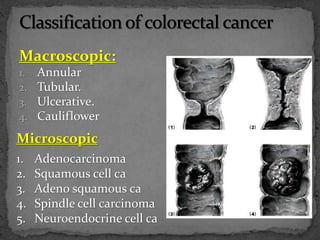
Macroscopic:
1. Annular
2. Tubular.
3. Ulcerative.
4. Cauliflower
Microscopic
1. Adenocarcinoma
2. Squamous cell ca
3. Adeno squamous ca
4. Spindle cell carcinoma
5. Neuroendocrine cell ca
 Red meat and saturated fatty acids
 Obesity
 Sedentary lifestyle
 Old age
 Alcohol and Smoking
 FAP - defect in APC gene on chromosome
5q21
 HNPCC - MSH2 & MLH1 gene defect
 Family history – 2 or more first degree relatives
 Inflammatory bowel disease – Ulcerative Colitis
 Adenomatous polyp
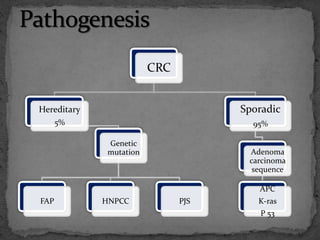
CRC
Hereditary
5%
Genetic
mutation
FAP HNPCC PJS
Sporadic
95%
Adenoma
carcinoma
sequence
APC
K-ras
P 53
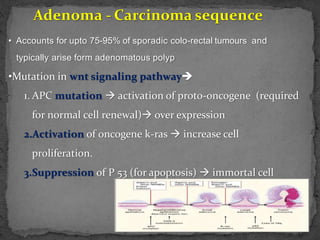
• Accounts for upto 75-95% of sporadic colo-rectal tumours and
typically arise form adenomatous polyp
•Mutation in wnt signaling pathway
1. APC mutation  activation of proto-oncogene (required
for normal cell renewal) over expression
2.Activation of oncogene k-ras  increase cell
proliferation.
3.Suppression of P 53 (for apoptosis)  immortal cell
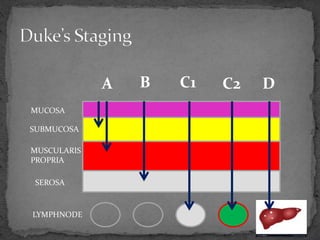
Duke’s
Astler-Coller
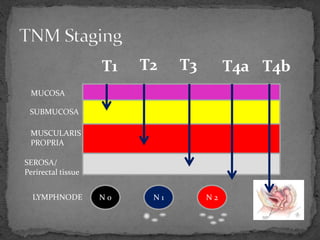
TNM
A B C1 C2 D
MUCOSA
SUBMUCOSA
MUSCULARIS
PROPRIA
SEROSA
LYMPHNODE
N 0 N 1 N 2
T1 T2 T3 T4a T4b
MUCOSA
SUBMUCOSA
MUSCULARIS
PROPRIA
SEROSA/
Perirectal tissue
LYMPHNODE
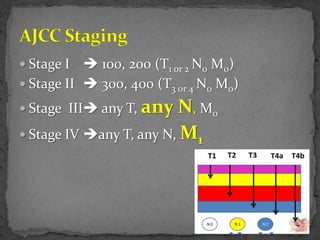
 Stage I  100, 200 (T1 or 2 N0 M0)
 Stage II  300, 400 (T3 or 4 N0 M0)
 Stage III any T, any N, M0
 Stage IV any T, any N, M1
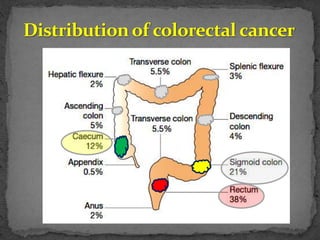
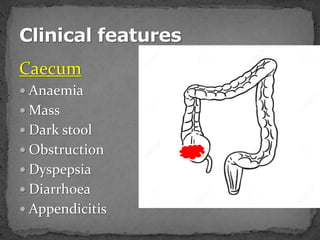
Caecum
 Anaemia
 Mass
 Dark stool
 Obstruction
 Dyspepsia
 Diarrhoea
 Appendicitis
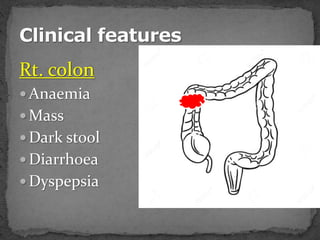
Rt. colon
 Anaemia
 Mass
 Dark stool
 Diarrhoea
 Dyspepsia
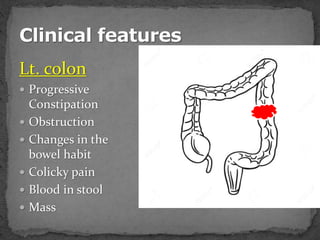
Lt. colon
 Progressive
Constipation
 Obstruction
 Changes in the
bowel habit
 Colicky pain
 Blood in stool
 Mass
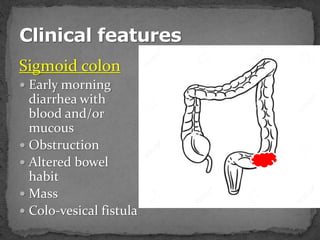
Sigmoid colon
 Early morning
diarrhea with
blood and/or
mucous
 Obstruction
 Altered bowel
habit
 Mass
 Colo-vesical fistula
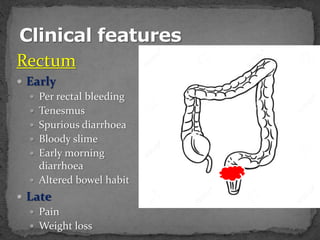
Rectum
 Early
 Per rectal bleeding
 Tenesmus
 Spurious diarrhoea
 Bloody slime
 Early morning
diarrhoea
 Altered bowel habit
 Late
 Pain
 Weight loss
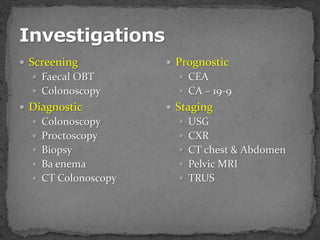
 Screening
 Faecal OBT
 Colonoscopy
 Diagnostic
 Colonoscopy
 Proctoscopy
 Biopsy
 Ba enema
 CT Colonoscopy
 Prognostic
 CEA
 CA – 19-9
 Staging
 USG
 CXR
 CT chest & Abdomen
 Pelvic MRI
 TRUS
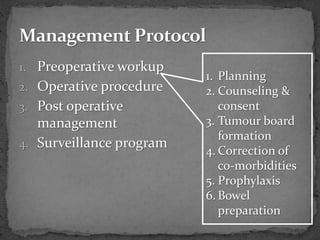
1. Preoperative workup
2. Operative procedure
3. Post operative
management
4. Surveillance program
1. Planning
2. Counseling &
consent
3. Tumour board
formation
4. Correction of
co-morbidities
5. Prophylaxis
6. Bowel
preparation
 Surgery
 Chemotherapy
 Radiotherapy
 Targeted therapy
 Immuno therapy
 Alternative treatment
 Surgery is the mainstay of treatment
 Radiation and/ or chemotherapy are given
before or after surgery
 The type of surgery depends on the site and
stage of the cancer
 Surgical treatment maybe curative (stage
I,II, III, or IV with resectable metastatic
disease) or palliative ( stage IVb)
1. Local excision: TEMS / TAMIS
2. Radical surgery
I. AR with TME
a. High AR
b. Low AR
c. Ultra Low AR
II. APR
3. Surgery in advanced carcinoma
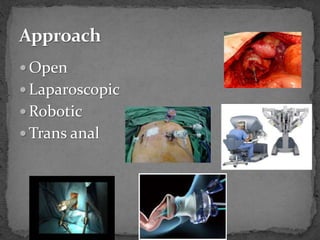
 Open
 Laparoscopic
 Robotic
 Trans anal
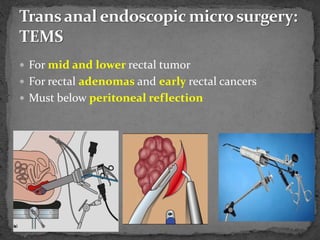
 For mid and lower rectal tumor
 For rectal adenomas and early rectal cancers
 Must below peritoneal reflection
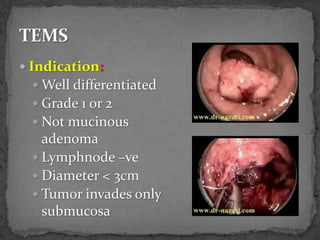
 Indication:
 Well differentiated
 Grade 1 or 2
 Not mucinous
adenoma
 Lymphnode –ve
 Diameter < 3cm
 Tumor invades only
submucosa
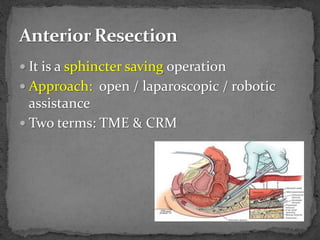
 It is a sphincter saving operation
 Approach: open / laparoscopic / robotic
assistance
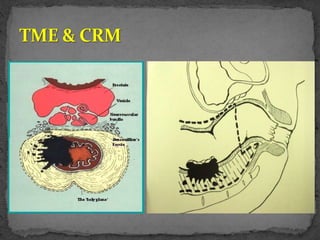
 Two terms: TME & CRM
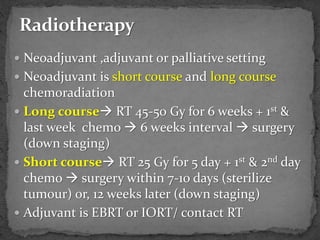
 Neoadjuvant ,adjuvant or palliative setting
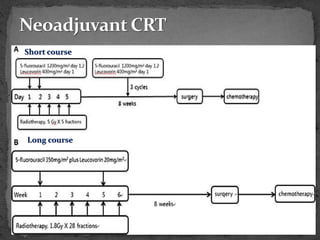
 Neoadjuvant is short course and long course
chemoradiation
 Long course RT 45-50 Gy for 6 weeks + 1st &
last week chemo  6 weeks interval  surgery
(down staging)
 Short course RT 25 Gy for 5 day + 1st & 2nd day
chemo  surgery within 7-10 days (sterilize
tumour) or, 12 weeks later (down staging)
 Adjuvant is EBRT or IORT/ contact RT
Short course
Long course
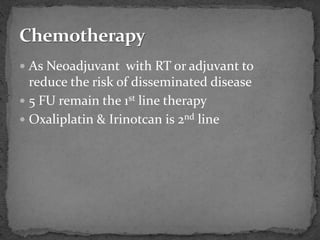
 As Neoadjuvant with RT or adjuvant to
reduce the risk of disseminated disease
 5 FU remain the 1st line therapy
 Oxaliplatin & Irinotcan is 2nd line
 Target specific type of cancer cells
 One type stops the growth of new blood vessel into
rectal tumour
 second type stops the cancer cells from receiving
signal to grow
 less likely to harm normal cells than chemotherapy
 eg, Bivacizumab
 Increases the activity of immune system
 Improves body’s ability to find and
destroy cancer cell
 Drugs are called checkpoint inhibitor
 eg: Ipilimumab
 Palliative resection
 Diversion / bipass
 Stenting
 Ablasion
 Palliative radiation
Colorectal ca

Colorectal ca

  • 1.
    Dr. Nabarun Biswas (FCPSSurgery) Registrar Mymensingh Medical College Hospital
  • 2.
    • 2nd mostcommon malignancy in female & 3rd most common in male • 4th most common cause of cancer death after lung, stomach & liver • Most common malignancy in GIT • Peak incidence above 70 years • 7% less than 40 year • Synchronous 7% • Metachronous 3%
  • 3.
    1. Adenocarcinomas: 2. Carcinoidtumors: 3. Gastrointestinal stromal tumors (GISTs): 4. Lymphomas: 5. Sarcomas:
  • 4.
    Macroscopic: 1. Annular 2. Tubular. 3.Ulcerative. 4. Cauliflower Microscopic 1. Adenocarcinoma 2. Squamous cell ca 3. Adeno squamous ca 4. Spindle cell carcinoma 5. Neuroendocrine cell ca
  • 5.
     Red meatand saturated fatty acids  Obesity  Sedentary lifestyle  Old age  Alcohol and Smoking  FAP - defect in APC gene on chromosome 5q21  HNPCC - MSH2 & MLH1 gene defect  Family history – 2 or more first degree relatives  Inflammatory bowel disease – Ulcerative Colitis  Adenomatous polyp
  • 6.
  • 7.
    • Accounts forupto 75-95% of sporadic colo-rectal tumours and typically arise form adenomatous polyp •Mutation in wnt signaling pathway 1. APC mutation  activation of proto-oncogene (required for normal cell renewal) over expression 2.Activation of oncogene k-ras  increase cell proliferation. 3.Suppression of P 53 (for apoptosis)  immortal cell
  • 8.
  • 9.
    A B C1C2 D MUCOSA SUBMUCOSA MUSCULARIS PROPRIA SEROSA LYMPHNODE
  • 10.
    N 0 N1 N 2 T1 T2 T3 T4a T4b MUCOSA SUBMUCOSA MUSCULARIS PROPRIA SEROSA/ Perirectal tissue LYMPHNODE
  • 11.
     Stage I 100, 200 (T1 or 2 N0 M0)  Stage II  300, 400 (T3 or 4 N0 M0)  Stage III any T, any N, M0  Stage IV any T, any N, M1
  • 13.
    Caecum  Anaemia  Mass Dark stool  Obstruction  Dyspepsia  Diarrhoea  Appendicitis
  • 14.
    Rt. colon  Anaemia Mass  Dark stool  Diarrhoea  Dyspepsia
  • 15.
    Lt. colon  Progressive Constipation Obstruction  Changes in the bowel habit  Colicky pain  Blood in stool  Mass
  • 16.
    Sigmoid colon  Earlymorning diarrhea with blood and/or mucous  Obstruction  Altered bowel habit  Mass  Colo-vesical fistula
  • 17.
    Rectum  Early  Perrectal bleeding  Tenesmus  Spurious diarrhoea  Bloody slime  Early morning diarrhoea  Altered bowel habit  Late  Pain  Weight loss
  • 18.
     Screening  FaecalOBT  Colonoscopy  Diagnostic  Colonoscopy  Proctoscopy  Biopsy  Ba enema  CT Colonoscopy  Prognostic  CEA  CA – 19-9  Staging  USG  CXR  CT chest & Abdomen  Pelvic MRI  TRUS
  • 19.
    1. Preoperative workup 2.Operative procedure 3. Post operative management 4. Surveillance program 1. Planning 2. Counseling & consent 3. Tumour board formation 4. Correction of co-morbidities 5. Prophylaxis 6. Bowel preparation
  • 20.
     Surgery  Chemotherapy Radiotherapy  Targeted therapy  Immuno therapy  Alternative treatment
  • 21.
     Surgery isthe mainstay of treatment  Radiation and/ or chemotherapy are given before or after surgery  The type of surgery depends on the site and stage of the cancer  Surgical treatment maybe curative (stage I,II, III, or IV with resectable metastatic disease) or palliative ( stage IVb)
  • 24.
    1. Local excision:TEMS / TAMIS 2. Radical surgery I. AR with TME a. High AR b. Low AR c. Ultra Low AR II. APR 3. Surgery in advanced carcinoma
  • 25.
     Open  Laparoscopic Robotic  Trans anal
  • 26.
     For midand lower rectal tumor  For rectal adenomas and early rectal cancers  Must below peritoneal reflection
  • 27.
     Indication:  Welldifferentiated  Grade 1 or 2  Not mucinous adenoma  Lymphnode –ve  Diameter < 3cm  Tumor invades only submucosa
  • 28.
     It isa sphincter saving operation  Approach: open / laparoscopic / robotic assistance  Two terms: TME & CRM
  • 30.
     Neoadjuvant ,adjuvantor palliative setting  Neoadjuvant is short course and long course chemoradiation  Long course RT 45-50 Gy for 6 weeks + 1st & last week chemo  6 weeks interval  surgery (down staging)  Short course RT 25 Gy for 5 day + 1st & 2nd day chemo  surgery within 7-10 days (sterilize tumour) or, 12 weeks later (down staging)  Adjuvant is EBRT or IORT/ contact RT
  • 31.
  • 32.
     As Neoadjuvantwith RT or adjuvant to reduce the risk of disseminated disease  5 FU remain the 1st line therapy  Oxaliplatin & Irinotcan is 2nd line
  • 33.
     Target specifictype of cancer cells  One type stops the growth of new blood vessel into rectal tumour  second type stops the cancer cells from receiving signal to grow  less likely to harm normal cells than chemotherapy  eg, Bivacizumab
  • 34.
     Increases theactivity of immune system  Improves body’s ability to find and destroy cancer cell  Drugs are called checkpoint inhibitor  eg: Ipilimumab
  • 35.
     Palliative resection Diversion / bipass  Stenting  Ablasion  Palliative radiation

Editor's Notes

  • #8 It is a stepwise pattern of genetic mutation  mutation in wnt signaling pathway APC mutation  activation of proto-oncogene (required for normal cell renewal) over expression Activation of oncogene k-ras  increase cell proliferation. Suppression of P 53 (for apoptosis)  immortal cell