Bowel elimination
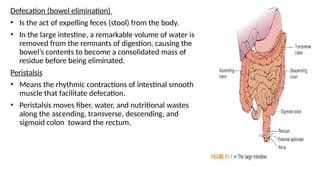
Defecation (bowel elimination)
• Is the act of expelling feces (stool) from the body.
• In the large intestine, a remarkable volume of water is
removed from the remnants of digestion, causing the
bowel’s contents to become a consolidated mass of
residue before being eliminated.
Peristalsis
• Means the rhythmic contractions of intestinal smooth
muscle that facilitate defecation.
• Peristalsis moves fiber, water, and nutritional wastes
along the ascending, transverse, descending, and
sigmoid colon toward the rectum.
• Peristalsis becomes even more active during eating; this increased peristaltic activity is
termed the gastrocolic reflex.
• The gastrocolic reflex: It’s accelerated wavelike movements, sometimes perceived as slight
abdominal cramping, propel stool forward, packing it within the rectum.
• As the rectum distends, the person feels the urge to defecate.
• Stool is eventually released when the anal sphincters (ring-shaped bands of muscles) relax.
• Performing the Valsalva maneuver (closing the glottis and contracting the pelvic and
abdominal muscles to increase abdominal pressure) facilitates this process.
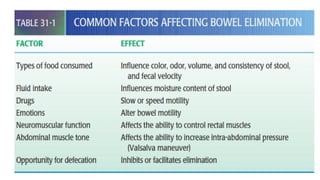
• Several dietary, physical, social, and emotional factors can influence the bowel’s mechanical
function.
Assessment of bowel elimination
1- Elimination Patterns Because various elimination
patterns can be normal, it is essential to determine
the client’s usual patterns, including
• frequency of elimination
• effort required to expel stool
• What elimination aids used.
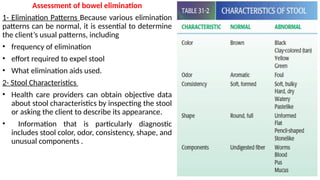
2- Stool Characteristics
• Health care providers can obtain objective data
about stool characteristics by inspecting the stool
or asking the client to describe its appearance.
• Information that is particularly diagnostic
includes stool color, odor, consistency, shape, and
unusual components .
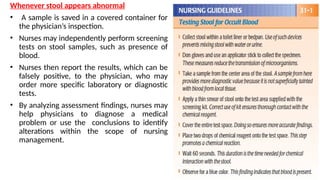
Whenever stool appears abnormal
• A sample is saved in a covered container for
the physician’s inspection.
• Nurses may independently perform screening
tests on stool samples, such as presence of
blood.
• Nurses then report the results, which can be
falsely positive, to the physician, who may
order more specific laboratory or diagnostic
tests.
• By analyzing assessment findings, nurses may
help physicians to diagnose a medical
problem or use the conclusions to identify
alterations within the scope of nursing
management.
1- Constipation: An elimination problem characterized by dry, hard stool that is difficult to pass with various accompanying signs
and symptoms include
• Complaints of abdominal fullness or bloating • Abdominal distention
• Complaints of rectal fullness or pressure • Pain on defecation
• Decreased frequency of bowel movements • Inability to pass stool
 Changes in stool characteristics such as oozing liquid stool or hard small stool Infrequent elimination of stool does not
necessarily indicate that a person is constipated.
 Some people may be constipated even though they have a daily bowel movement, whereas others who defecate irregularly
may have normal bowel function.
 The incidence of constipation tends to be high among those whose dietary habits lack adequate fiber (such as not eating
sufficient raw fruits and vegetables, whole grains, seeds, and nuts).
 Dietary fiber, which becomes undigested cellulose, is important because it attracts water within the bowel, resulting in bulkier
stool that is more quickly and easily eliminated.
 The longer stool is retained, the more contact with and absorption of toxic substances takes place.
5
-
Common alterations in bowel elimination
Constipation is classified into (primary, secondary, iatrogenic, and pseudoconstipation), according to the
underlying cause
.
Primary/ simple Constipation
 Results from lifestyle factors such as inactivity, inadequate intake of fiber, insufficient fluid intake, or
ignoring the urge to defecate.
Secondary Constipation
 It is a consequence of a pathologic disorder such as a partial bowel obstruction. It usually resolves when
the primary cause is treated.
Iatrogenic Constipation
 It occurs as a consequence of other medical treatment. as, prolonged use of narcotic analgesia tends to
cause constipation. These and other drugs slow peristalsis, delaying transit time.
 The longer the stool remains in the colon, the drier it becomes, making it more difficult to pass
Pseudo/ perceived constipation
 It is a term used when clients believe themselves to be constipated even though they are not.
 It may occur in people who are extremely concerned about having a daily bowel movement.
 In their zeal for regularity, they often overuse or abuse laxatives, suppositories, and enemas.
 Such self treatment may ultimately cause rather than treat constipation. Chronic purging eventually
weakens bowel tone; consequently, bowel elimination
2
-
Fecal Impaction
 Occurs when a large, hardened mass of stool interferes with defecation, making it
impossible for the client to pass feces voluntarily.
 Result from unrelieved constipation, retained barium from an intestinal x-ray, dehydration,
and weakness of abdominal muscles.
 Clients with impaction usually report a frequent desire to defecate but an inability to do so.
 Rectal pain may result from unsuccessful efforts to evacuate the lower bowel.
 Some clients with an impaction pass liquid stool, which they may misinterpret as diarrhea.
 Forceful muscular contractions of peristalsis in higher bowel areas, where the stool is still
fluid, cause the liquid stool. These contractions send the liquid around the margins of the
impacted stool, but this passage of liquid stool does not relieve the initial condition.
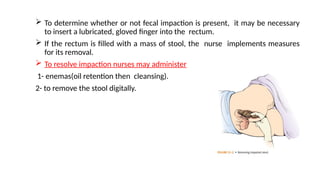
 To determine whether or not fecal impaction is present, it may be necessary
to insert a lubricated, gloved finger into the rectum.
 If the rectum is filled with a mass of stool, the nurse implements measures
for its removal.
 To resolve impaction nurses may administer
1- enemas(oil retention then cleansing).
2- to remove the stool digitally.
3
-
Flatulence/ flatus
 An excessive accumulation of intestinal gas results from
1- swallowing air while eating
2- sluggish (slow) peristalsis
3- the gas that forms as a byproduct of bacterial fermentation in the bowel.
4- gas forming food as (cabbage, cucumbers, Beans and onions) . As it creates
intestinal gas because humans lack an enzyme to completely digest their particular
form of complex carbohydrate.
 Regardless of its cause, flatus may be expelled through
1-ambulation
2- Insertion of rectal tube
 to thus reducing the cramping pain or other symptoms occur when clients are
extremely uncomfortable.
4- Diarrhea
 is the urgent passage of watery stool and commonly is accompanied by abdominal
cramping.
 Simple diarrhea usually begins suddenly and lasts for a short period.
 Other associated signs and symptoms include nausea and vomiting and blood or mucus in
the stools.
 Usually diarrhea is a means of eliminating an irritating substance such as tainted food or
intestinal pathogens.
 Diarrhea may also result from emotional stress, dietary indiscretions, laxative abuse, or
bowel disorders.
Management:
1- Resting the bowel temporarily may relieve simple diarrhea
2- drinks clear liquids but avoids solid foods for 12 to 24 hours
3- Resumed eating begins with bland foods and those low in residue such as bananas,
applesauce, and cottage cheese.
 If diarrhea is not relieved within 24 hours, it is best to consult a physician
5
-
Fecal Incontinence
 inability to control the elimination of stool.
 It does not necessarily imply that stool is loose or watery, although that may be
the case.
 In some instances, bowel function is normal, but incontinence results from
neurologic changes that impair muscle activity, sensation, or thought processes.
 Even a fecal impaction may be an underlying cause of incontinence.
 Incontinence also may occur when a person cannot reach a toilet in time to
eliminate, such as after taking a harsh laxative.
 Chronic fecal incontinence can be devastating socially and emotionally.
 Clients who cope with chronic fecal incontinence and their families require much
support and understanding.
Measures to promote bowel elimination
1- inserting suppositories
2- administering enemas
to promote elimination when it does not occur naturally or when the bowel must be cleansed for
other purposes, such as preparation for surgery and endoscopic or x-ray examinations.
Inserting a Rectal Suppository
 A suppository (oval or cone-shaped mass that melts at body temperature) is inserted into a
body cavity such as the rectum that will promote expulsion of feces.
 Other medications, such as drugs to control vomiting and to reduce fever, also are available in
suppository form.
 Medications released from the suppository can have local or systemic effects.
 Depending on the drug, local effects may include softening and lubricating dry stool, irritating
the wall of the rectum and anal canal to stimulate smooth muscle contraction, and liberating
carbon dioxide, thus increasing rectal distention and the urge to defecate.
 Drugs administered in suppository form to achieve systemic effects are chosen when clients
have difficulty retaining or absorbing oral medications because of chronic vomiting or an
impaired ability to swallow.
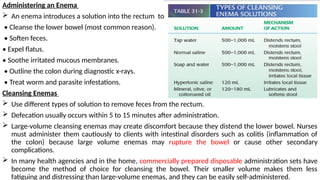
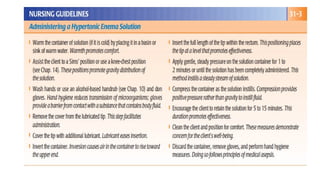
Administering an Enema
 An enema introduces a solution into the rectum to
• Cleanse the lower bowel (most common reason).
• Soften feces.
• Expel flatus.
• Soothe irritated mucous membranes.
• Outline the colon during diagnostic x-rays.
• Treat worm and parasite infestations.
Cleansing Enemas
 Use different types of solution to remove feces from the rectum.
 Defecation usually occurs within 5 to 15 minutes after administration.
 Large-volume cleansing enemas may create discomfort because they distend the lower bowel. Nurses
must administer them cautiously to clients with intestinal disorders such as colitis (inflammation of
the colon) because large volume enemas may rupture the bowel or cause other secondary
complications.
 In many health agencies and in the home, commercially prepared disposable administration sets have
become the method of choice for cleansing the bowel. Their smaller volume makes them less
fatiguing and distressing than large-volume enemas, and they can be easily self-administered.
Tap water and normal saline enemas
.
 Tap water and normal saline solutions are preferred for their nonirritating
effects, especially for clients with rectal diseases or those being prepared
for rectal examinations.
 Tap water and normal saline appear to have about the same degree of
effectiveness for cleansing the bowel.
 Because tap water is hypotonic, the fluid can be absorbed through the
bowel. Consequently, if several enemas are administered in succession,
fluid and electrolyte imbalances may occur.
 Therefore, to ensure client safety, if stool continues to be expelled after the
administration of three enemas, the nurse consults the physician before
administering any more.
Soap solution enemas
.
 is a mixture of water and soap.
 Many disposable enema kits contain an envelope of soap mixed with up to
1 quart (1,000 mL) of water. If these soap packets are not available, a
comparable mixture is 1 mL of mild liquid soap per 200 mL of solution, or a
1:200 ratio.
 Therefore, 5 mL of soap is added to prepare a volume of 1,000 mL.
 Soap causes chemical irritation of the mucous membranes. Adding too
much soap or using strong soap can potentiate the irritating effect.
Hypertonic saline (sodium phosphate) enemas
.
Draws fluid from body tissues into the bowel.
This increases the fluid volume in the intestine beyond what was
originally instilled.
The concentrated solution also acts as a local irritant on the mucous
membranes.
It is available in commercially prepared, disposable containers holding
approximately 4 oz (120 mL) of solution.
The container, which has a lubricated tip, substitutes for enema
equipment and tubing.
 oil retention enema is A type of retention enema in which the fluid instilled is mineral,
cottonseed, or olive oil.
 Oils lubricate and soften the stool, so it can be expelled more easily.
 The oil may come in a prefilled container similar to those that contain hypertonic saline.
 If disposable equipment is not available, the nurse lubricates and inserts a 14 to 22 F tube in
the rectum.
 A small funnel or large syringe is attached to the tube, and the nurse instills approximately
100 to 200 mL of warmed oil slowly to avoid stimulating an urge to defecate.
 Premature defecation defeats the purpose of retaining the oil.
Retention Enemas
 uses a solution held within the large intestine for a specified period, usually at
least 30 minutes. Some of them are not expelled at all.
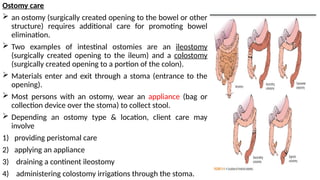
Ostomy care
 an ostomy (surgically created opening to the bowel or other
structure) requires additional care for promoting bowel
elimination.
 Two examples of intestinal ostomies are an ileostomy
(surgically created opening to the ileum) and a colostomy
(surgically created opening to a portion of the colon).
 Materials enter and exit through a stoma (entrance to the
opening).
 Most persons with an ostomy, wear an appliance (bag or
collection device over the stoma) to collect stool.
 Depending an ostomy type & location, client care may
involve
1) providing peristomal care
2) applying an appliance
3) draining a continent ileostomy
4) administering colostomy irrigations through the stoma.
Providing peristomal Care
 Preventing skin breakdown is a major challenge in ostomy care.
 Enzymes in stool can quickly cause excoriation (chemical injury of skin).
 Washing the stoma and surrounding skin with mild soap and water and
patting it dry can preserve skin integrity.
 Another way to protect the skin is to apply barrier substances such as karaya,
a plant substance that becomes gelatinous when moistened, and commercial
skin preparations around the stoma.
 An enterostomal therapist, a nurse certified in caring for ostomies and
related skin problems, may be consulted regarding skin and stomal care.
Applying an Ostomy Appliance
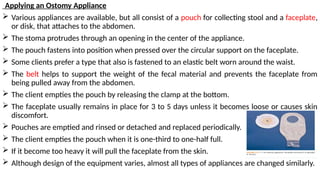
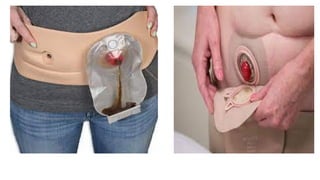
 Various appliances are available, but all consist of a pouch for collecting stool and a faceplate,
or disk, that attaches to the abdomen.
 The stoma protrudes through an opening in the center of the appliance.
 The pouch fastens into position when pressed over the circular support on the faceplate.
 Some clients prefer a type that also is fastened to an elastic belt worn around the waist.
 The belt helps to support the weight of the fecal material and prevents the faceplate from
being pulled away from the abdomen.
 The client empties the pouch by releasing the clamp at the bottom.
 The faceplate usually remains in place for 3 to 5 days unless it becomes loose or causes skin
discomfort.
 Pouches are emptied and rinsed or detached and replaced periodically.
 The client empties the pouch when it is one-third to one-half full.
 If it become too heavy it will pull the faceplate from the skin.
 Although design of the equipment varies, almost all types of appliances are changed similarly.
Draining a Continent Ileostomy
 A continent ostomy (surgically created opening
that controls the drainage of liquid stool or urine
by siphoning it from an internal reservoir) also is
referred to as a Kock pouch, after the surgeon
who developed the technique.
 This type of ostomy requires no appliance;
however, the client must drain the accumulating
liquid stool or urine approximately every 4 to 6
hours. The client can use a gravity drainage
system at night.
Irrigating a Colostomy
 Clients with a colostomy whose stool is more solid sometimes require the instillation of
fluid to promote elimination.
 Colostomy irrigation involves instilling solution through the stoma into the colon, a
process similar to administering an enema.
 The purpose of the irrigation is to remove formed stool and in some cases to regulate the
timing of bowel movements.
 With regulation, a client with a sigmoid colostomy may not need to wear an appliance.
 The colostomy irrigation helps to train the bowel to eliminate formed stool following the
irrigation.
 Once the client has eliminated the stool, he or she will expel no more until the next
irrigation.
 This mimics the pattern of natural bowel elimination for most people.
 Because of the predictability of bowel elimination, some clients with a sigmoid
colostomy feel it is unnecessary to wear an appliance.
NURSING IMPLICATIONS
While assessing and caring for clients with altered bowel elimination, the nurse
may identify one or more of the following nursing diagnoses
:
•
Constipation
•
Risk for Constipation
•
Perceived Constipation
•
Diarrhea
•
Bowel Incontinence
•
Toileting Self-Care Deficit
•
Situational Low Self-Esteem
Question #1
When a client tells the nurse that he cannot have a bowel movement
without taking a daily laxative, what information is essential for the
nurse to explain?
1. Chronic use of laxatives impairs natural bowel tone.
2. Stool softeners are likely to be less harsh.
3. Daily enemas are more preferable than laxatives.
4. Dilating the anal sphincter may aid bowel elimination.
• Which of the following assessments is the best indication that a client
has a fecal impaction?
1. The client passes liquid stool frequently.
2. The client has extremely offending bad breath.
3. The client requests medication for a headache.
4. The client has not been eating well lately.
Question #2