 Constipation
 Impaction
 Diarrhea
 Incontinence
 Flatulence
 Hemorrhoids
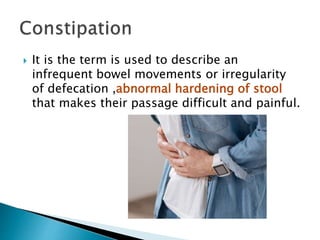
 It is the term is used to describe an
infrequent bowel movements or irregularity
of defecation ,abnormal hardening of stool
that makes their passage difficult and painful.
 Causes
◦ Irregular bowel habits and ignoring the urge to
defecate
◦ Chronic diseases
◦ Low fiber diet and high in animal fat
◦ less fluid intake
◦ Anxiety, depression, cognitive impairment
◦ Immobilization or lack of exercise
◦ Laxative misuse
◦ Illnesses (neurological illnesses & organic illnesses)
◦ Medications
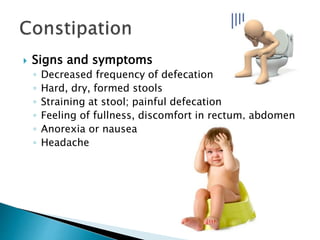
 Signs and symptoms
◦ Decreased frequency of defecation
◦ Hard, dry, formed stools
◦ Straining at stool; painful defecation
◦ Feeling of fullness, discomfort in rectum, abdomen
◦ Anorexia or nausea
◦ Headache
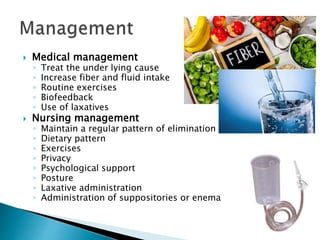
 Medical management
◦ Treat the under lying cause
◦ Increase fiber and fluid intake
◦ Routine exercises
◦ Biofeedback
◦ Use of laxatives
 Nursing management
◦ Maintain a regular pattern of elimination
◦ Dietary pattern
◦ Exercises
◦ Privacy
◦ Psychological support
◦ Posture
◦ Laxative administration
◦ Administration of suppositories or enema
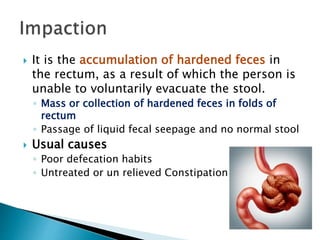
 It is the accumulation of hardened feces in
the rectum, as a result of which the person is
unable to voluntarily evacuate the stool.
◦ Mass or collection of hardened feces in folds of
rectum
◦ Passage of liquid fecal seepage and no normal stool
 Usual causes
◦ Poor defecation habits
◦ Untreated or un relieved Constipation
 Signs and symptoms
◦ Feeling of fullness in rectum and abdomen
◦ An urge for defecation and inability to pass stool
◦ Generalized malaise
◦ Loss of appetite
◦ Nausea/vomiting
◦ Abdominal distension
 Management
◦ Laxatives , enema or manual removal of the
stool(digital evacuation)
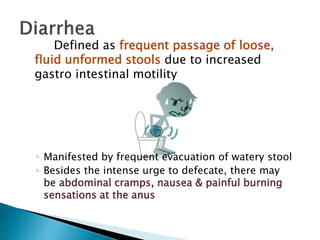
Defined as frequent passage of loose,
fluid unformed stools due to increased
gastro intestinal motility
◦ Manifested by frequent evacuation of watery stool
◦ Besides the intense urge to defecate, there may
be abdominal cramps, nausea & painful burning
sensations at the anus
 Causes
◦ Intestinal infections (enteritis)
◦ Nervous tension (emotional or psychogenic diarrhea
……excessive stimulation of parasympathetic
nervous system
◦ Medications ( antibiotics &iron supplements)
◦ Abuse of cathartics
◦ Mechanical causes : incomplete obstruction
….stenosis,adhesions and tumors
◦ Other causes :Malabsorption syndrome, irritable
colon, narcotic withdrawal. Etc.
 Management
◦ Replace the fluid and electrolytes
◦ Treat the cause
◦ Drug therapy
 Antibiotics/antimicrobials
 Antimotility agents (loperamide)
 Nursing care
◦ Replacements of fluid and electrolytes ( potassium)
◦ Small frequent diet.. Avoid spicy foods
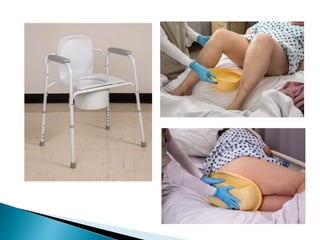
◦ Use of bedpan and commodes
◦ Skin care
◦ Adequate rest
◦ Psychological support
◦ Medications
◦ Healthy eating habits
 The loss of voluntary ability to control fecal and
gaseous discharges through the anal sphincter
 Types :
◦ Partial :inability to control flatus or to prevent minor
soiling
◦ Major : inability to control feces of normal consistency
 Causes
◦ Neuromuscular disease
◦ Spinal cord trauma
◦ Tumors
 Treated with surgery
◦ Repair of sphincter
◦ Fecal incontinence pouch
◦ Bowel diversion or colostomy
 Flatulence is the presence of excessive flatus in
the intestines and leads to stretching and
inflation of the intestines (intestinal distensions)
 Causes
◦ Action of bacteria on the Chyme in L.intestine
◦ Swallowed air
◦ Gas that diffuses between the blood stream and the
intestine
◦ Foods (cabbage, onions)
 Signs
◦ Gastric distension
 Management :insertion of rectal tube
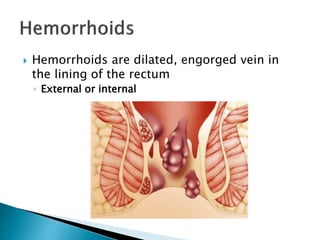
 Hemorrhoids are dilated, engorged vein in
the lining of the rectum
◦ External or internal
 External
 Clearly visible as protrusions of skin
 If underlying vein is hardened or purple colored
 Pain
 Need to be excised
 Internal
 An outer mucus membrane
 Causes :
 Increased venous pressure due to straining
 Pregnancy
 Heart failure
 Chronic liver diseases
 Treatment
 Hemorrhoidectomy
Nursing process
 History
 Physical examination
 Food and fluid intake
 Chewing ability
 Medications
 Recent illnesses or stressors
 Fecal characteristics & Review of relevant results
◦ Examination of fecal specimen for
 Occult blood
 Stool culture
 Fecal fat
◦ Laboratory tests
 Total bilirubin
 Alkaline phosphate
 Amylase
◦ Direct visualization (Endoscopy & colonoscopy)
◦ Indirect visualization (x ray film with contrast medium)
 Constipation
 Risk for constipation
 Perceived constipation
 Chronic functional constipation
 Risk for chronic functional constipation
 Diarrhoea
 Dysfunctional gastrointestinal motility
 Bowel incontinence
 As etiology
◦ Risk for electrolyte imbalance
◦ Risk for imbalanced fluid volume
◦ Deficient fluid volume
◦ Risk for deficient fluid volume
◦ Impaired skin integrity
◦ Risk for Impaired skin integrity
◦ Impaired comfort
 Goals / objectives
◦ Maintain or restore normal bowel
elimination pattern
◦ Maintain or regain normal stool
consistency
◦ Prevent associated risks
Promoting regular defecation
Privacy
Timing
Nutrition and fluids
For constipation, diarrhea, flatulence
Exercise
Positioning
Commode
Bedpan
 Decreasing flatulence
◦ Avoid gas-producing foods
◦ Exercise
◦ Movement in bed ( position)
◦ Ambulation
◦ Probiotics
 Administering enemas
 Rectal suppositories
 Bowel wash
 Digital removal of a fecal impaction
 Bowel training programs
◦ Based on factors within client's control
◦ Goal of establishing normal defecation pattern
 Bowel training programs
◦ Major phases
 Determine client's usual habits and factors that help or
hinder defecation
 Design plan with client
 Determine fluid, fiber, hot drinks, exercise
 Maintain routine for 2–3 weeks
 Cathartic suppositories
 Prompt response to urges
 Privacy
 Effective physical positioning
 Provide positive feedback for successful defecation
 Offer support; encourage client to have patience with the
process
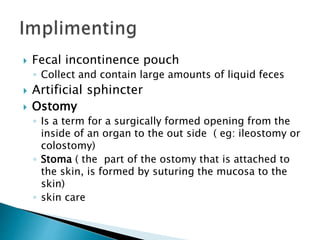
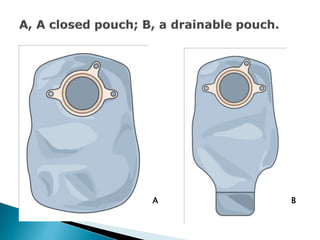
 Fecal incontinence pouch
◦ Collect and contain large amounts of liquid feces
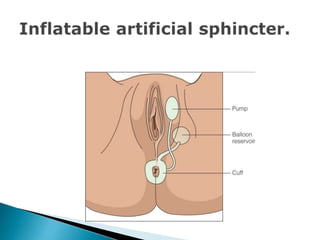
 Artificial sphincter
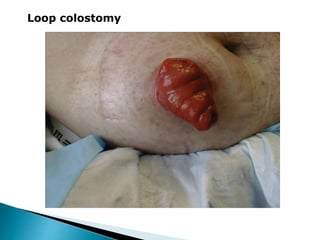
 Ostomy
◦ Is a term for a surgically formed opening from the
inside of an organ to the out side ( eg: ileostomy or
colostomy)
◦ Stoma ( the part of the ostomy that is attached to
the skin, is formed by suturing the mucosa to the
skin)
◦ skin care
A B
Loop colostomy
alternationsinbowelelimination-190624040214.pdf

alternationsinbowelelimination-190624040214.pdf

  • 2.
     Constipation  Impaction Diarrhea  Incontinence  Flatulence  Hemorrhoids
  • 3.
     It isthe term is used to describe an infrequent bowel movements or irregularity of defecation ,abnormal hardening of stool that makes their passage difficult and painful.
  • 4.
     Causes ◦ Irregularbowel habits and ignoring the urge to defecate ◦ Chronic diseases ◦ Low fiber diet and high in animal fat ◦ less fluid intake ◦ Anxiety, depression, cognitive impairment ◦ Immobilization or lack of exercise ◦ Laxative misuse ◦ Illnesses (neurological illnesses & organic illnesses) ◦ Medications
  • 5.
     Signs andsymptoms ◦ Decreased frequency of defecation ◦ Hard, dry, formed stools ◦ Straining at stool; painful defecation ◦ Feeling of fullness, discomfort in rectum, abdomen ◦ Anorexia or nausea ◦ Headache
  • 6.
     Medical management ◦Treat the under lying cause ◦ Increase fiber and fluid intake ◦ Routine exercises ◦ Biofeedback ◦ Use of laxatives  Nursing management ◦ Maintain a regular pattern of elimination ◦ Dietary pattern ◦ Exercises ◦ Privacy ◦ Psychological support ◦ Posture ◦ Laxative administration ◦ Administration of suppositories or enema
  • 7.
     It isthe accumulation of hardened feces in the rectum, as a result of which the person is unable to voluntarily evacuate the stool. ◦ Mass or collection of hardened feces in folds of rectum ◦ Passage of liquid fecal seepage and no normal stool  Usual causes ◦ Poor defecation habits ◦ Untreated or un relieved Constipation
  • 8.
     Signs andsymptoms ◦ Feeling of fullness in rectum and abdomen ◦ An urge for defecation and inability to pass stool ◦ Generalized malaise ◦ Loss of appetite ◦ Nausea/vomiting ◦ Abdominal distension  Management ◦ Laxatives , enema or manual removal of the stool(digital evacuation)
  • 9.
    Defined as frequentpassage of loose, fluid unformed stools due to increased gastro intestinal motility ◦ Manifested by frequent evacuation of watery stool ◦ Besides the intense urge to defecate, there may be abdominal cramps, nausea & painful burning sensations at the anus
  • 10.
     Causes ◦ Intestinalinfections (enteritis) ◦ Nervous tension (emotional or psychogenic diarrhea ……excessive stimulation of parasympathetic nervous system ◦ Medications ( antibiotics &iron supplements) ◦ Abuse of cathartics ◦ Mechanical causes : incomplete obstruction ….stenosis,adhesions and tumors ◦ Other causes :Malabsorption syndrome, irritable colon, narcotic withdrawal. Etc.
  • 11.
     Management ◦ Replacethe fluid and electrolytes ◦ Treat the cause ◦ Drug therapy  Antibiotics/antimicrobials  Antimotility agents (loperamide)  Nursing care ◦ Replacements of fluid and electrolytes ( potassium) ◦ Small frequent diet.. Avoid spicy foods ◦ Use of bedpan and commodes ◦ Skin care ◦ Adequate rest ◦ Psychological support ◦ Medications ◦ Healthy eating habits
  • 13.
     The lossof voluntary ability to control fecal and gaseous discharges through the anal sphincter  Types : ◦ Partial :inability to control flatus or to prevent minor soiling ◦ Major : inability to control feces of normal consistency  Causes ◦ Neuromuscular disease ◦ Spinal cord trauma ◦ Tumors  Treated with surgery ◦ Repair of sphincter ◦ Fecal incontinence pouch ◦ Bowel diversion or colostomy
  • 14.
     Flatulence isthe presence of excessive flatus in the intestines and leads to stretching and inflation of the intestines (intestinal distensions)  Causes ◦ Action of bacteria on the Chyme in L.intestine ◦ Swallowed air ◦ Gas that diffuses between the blood stream and the intestine ◦ Foods (cabbage, onions)  Signs ◦ Gastric distension  Management :insertion of rectal tube
  • 15.
     Hemorrhoids aredilated, engorged vein in the lining of the rectum ◦ External or internal
  • 16.
     External  Clearlyvisible as protrusions of skin  If underlying vein is hardened or purple colored  Pain  Need to be excised  Internal  An outer mucus membrane  Causes :  Increased venous pressure due to straining  Pregnancy  Heart failure  Chronic liver diseases  Treatment  Hemorrhoidectomy
  • 17.
  • 18.
     History  Physicalexamination  Food and fluid intake  Chewing ability  Medications  Recent illnesses or stressors
  • 19.
     Fecal characteristics& Review of relevant results ◦ Examination of fecal specimen for  Occult blood  Stool culture  Fecal fat ◦ Laboratory tests  Total bilirubin  Alkaline phosphate  Amylase ◦ Direct visualization (Endoscopy & colonoscopy) ◦ Indirect visualization (x ray film with contrast medium)
  • 20.
     Constipation  Riskfor constipation  Perceived constipation  Chronic functional constipation  Risk for chronic functional constipation  Diarrhoea  Dysfunctional gastrointestinal motility  Bowel incontinence
  • 21.
     As etiology ◦Risk for electrolyte imbalance ◦ Risk for imbalanced fluid volume ◦ Deficient fluid volume ◦ Risk for deficient fluid volume ◦ Impaired skin integrity ◦ Risk for Impaired skin integrity ◦ Impaired comfort
  • 22.
     Goals /objectives ◦ Maintain or restore normal bowel elimination pattern ◦ Maintain or regain normal stool consistency ◦ Prevent associated risks
  • 23.
    Promoting regular defecation Privacy Timing Nutritionand fluids For constipation, diarrhea, flatulence Exercise Positioning Commode Bedpan
  • 24.
     Decreasing flatulence ◦Avoid gas-producing foods ◦ Exercise ◦ Movement in bed ( position) ◦ Ambulation ◦ Probiotics  Administering enemas  Rectal suppositories  Bowel wash  Digital removal of a fecal impaction  Bowel training programs ◦ Based on factors within client's control ◦ Goal of establishing normal defecation pattern
  • 25.
     Bowel trainingprograms ◦ Major phases  Determine client's usual habits and factors that help or hinder defecation  Design plan with client  Determine fluid, fiber, hot drinks, exercise  Maintain routine for 2–3 weeks  Cathartic suppositories  Prompt response to urges  Privacy  Effective physical positioning  Provide positive feedback for successful defecation  Offer support; encourage client to have patience with the process
  • 26.
     Fecal incontinencepouch ◦ Collect and contain large amounts of liquid feces  Artificial sphincter  Ostomy ◦ Is a term for a surgically formed opening from the inside of an organ to the out side ( eg: ileostomy or colostomy) ◦ Stoma ( the part of the ostomy that is attached to the skin, is formed by suturing the mucosa to the skin) ◦ skin care
  • 27.
  • 29.