1. They are safe streets.
2. The manager talks quietly.
3. She described it well.
4. It’s a fast elevator.
L O O K A T T H E S E S E N T E N C E S . F I N D T H E
P A R T S O F S P E E C H .
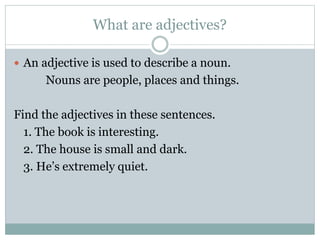
What are adjectives?
 An adjective is used to describe a noun.
Nouns are people, places and things.
Find the adjectives in these sentences.
1. The book is interesting.
2. The house is small and dark.
3. He’s extremely quiet.
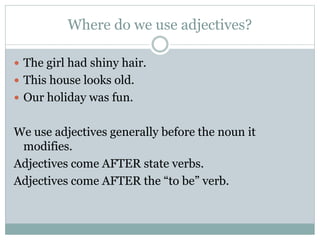
Where do we use adjectives?
 The girl had shiny hair.
 This house looks old.
 Our holiday was fun.
We use adjectives generally before the noun it
modifies.
Adjectives come AFTER state verbs.
Adjectives come AFTER the “to be” verb.
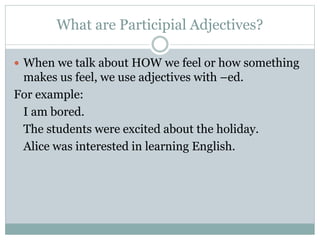
What are Participial Adjectives?
 When we talk about HOW we feel or how something
makes us feel, we use adjectives with –ed.
For example:
I am bored.
The students were excited about the holiday.
Alice was interested in learning English.
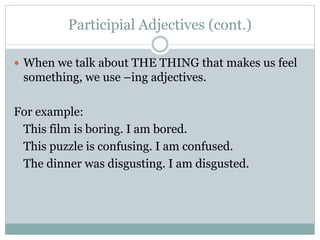
Participial Adjectives (cont.)
 When we talk about THE THING that makes us feel
something, we use –ing adjectives.
For example:
This film is boring. I am bored.
This puzzle is confusing. I am confused.
The dinner was disgusting. I am disgusted.
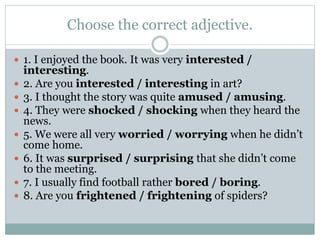
Choose the correct adjective.
 1. I enjoyed the book. It was very interested /
interesting.
 2. Are you interested / interesting in art?
 3. I thought the story was quite amused / amusing.
 4. They were shocked / shocking when they heard the
news.
 5. We were all very worried / worrying when he didn’t
come home.
 6. It was surprised / surprising that she didn’t come
to the meeting.
 7. I usually find football rather bored / boring.
 8. Are you frightened / frightening of spiders?
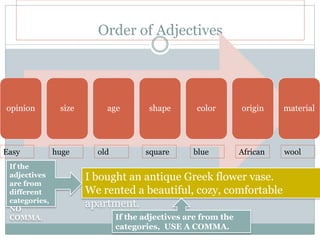
Order of Adjectives
opinion size age shape color origin material
huge old square blue African woolEasy
I bought an antique Greek flower vase.
We rented a beautiful, cozy, comfortable
apartment.
If the
adjectives
are from
different
categories,
NO
COMMA. If the adjectives are from the
categories, USE A COMMA.
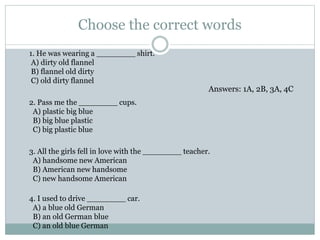
Choose the correct words
1. He was wearing a ________ shirt.
A) dirty old flannel
B) flannel old dirty
C) old dirty flannel
2. Pass me the ________ cups.
A) plastic big blue
B) big blue plastic
C) big plastic blue
3. All the girls fell in love with the ________ teacher.
A) handsome new American
B) American new handsome
C) new handsome American
4. I used to drive ________ car.
A) a blue old German
B) an old German blue
C) an old blue German
Answers: 1A, 2B, 3A, 4C
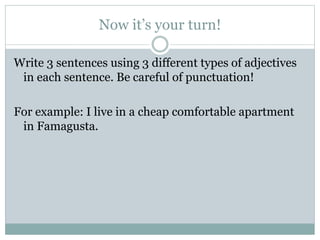
Now it’s your turn!
Write 3 sentences using 3 different types of adjectives
in each sentence. Be careful of punctuation!
For example: I live in a cheap comfortable apartment
in Famagusta.
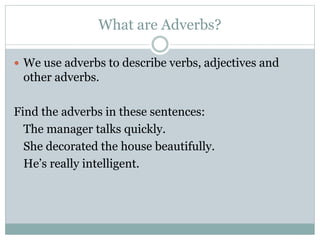
What are Adverbs?
 We use adverbs to describe verbs, adjectives and
other adverbs.
Find the adverbs in these sentences:
The manager talks quickly.
She decorated the house beautifully.
He’s really intelligent.
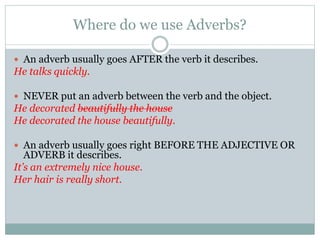
Where do we use Adverbs?
 An adverb usually goes AFTER the verb it describes.
He talks quickly.
 NEVER put an adverb between the verb and the object.
He decorated beautifully the house
He decorated the house beautifully.
 An adverb usually goes right BEFORE THE ADJECTIVE OR
ADVERB it describes.
It’s an extremely nice house.
Her hair is really short.
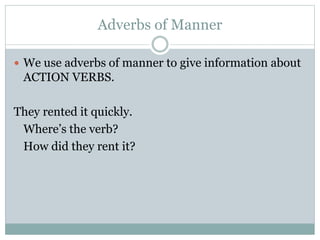
Adverbs of Manner
 We use adverbs of manner to give information about
ACTION VERBS.
They rented it quickly.
Where’s the verb?
How did they rent it?
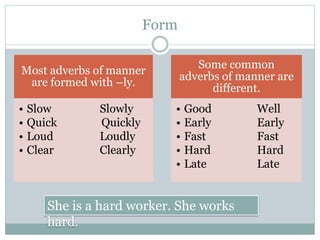
Form
Most adverbs of manner
are formed with –ly.
• Slow Slowly
• Quick Quickly
• Loud Loudly
• Clear Clearly
Some common
adverbs of manner are
different.
• Good Well
• Early Early
• Fast Fast
• Hard Hard
• Late Late
She is a hard worker. She works
hard.
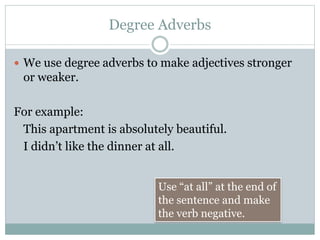
Degree Adverbs
 We use degree adverbs to make adjectives stronger
or weaker.
For example:
This apartment is absolutely beautiful.
I didn’t like the dinner at all.
Use “at all” at the end of
the sentence and make
the verb negative.
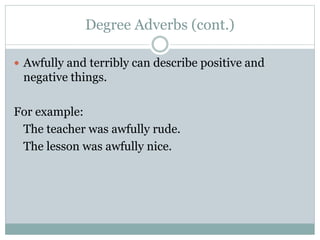
Degree Adverbs (cont.)
 Awfully and terribly can describe positive and
negative things.
For example:
The teacher was awfully rude.
The lesson was awfully nice.
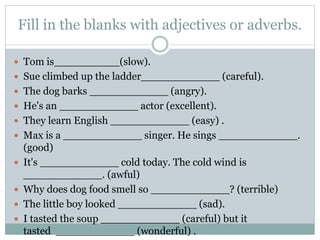
Fill in the blanks with adjectives or adverbs.
 Tom is__________(slow).
 Sue climbed up the ladder____________ (careful).
 The dog barks ____________ (angry).
 He's an ____________ actor (excellent).
 They learn English ____________ (easy) .
 Max is a ____________ singer. He sings ____________.
(good)
 It's ____________ cold today. The cold wind is
____________. (awful)
 Why does dog food smell so ____________? (terrible)
 The little boy looked ____________ (sad).
 I tasted the soup ____________ (careful) but it
tasted ____________ (wonderful) .

Adjectives and adverbs

  • 1.
    1. They aresafe streets. 2. The manager talks quietly. 3. She described it well. 4. It’s a fast elevator. L O O K A T T H E S E S E N T E N C E S . F I N D T H E P A R T S O F S P E E C H .
  • 2.
    What are adjectives? An adjective is used to describe a noun. Nouns are people, places and things. Find the adjectives in these sentences. 1. The book is interesting. 2. The house is small and dark. 3. He’s extremely quiet.
  • 3.
    Where do weuse adjectives?  The girl had shiny hair.  This house looks old.  Our holiday was fun. We use adjectives generally before the noun it modifies. Adjectives come AFTER state verbs. Adjectives come AFTER the “to be” verb.
  • 4.
    What are ParticipialAdjectives?  When we talk about HOW we feel or how something makes us feel, we use adjectives with –ed. For example: I am bored. The students were excited about the holiday. Alice was interested in learning English.
  • 5.
    Participial Adjectives (cont.) When we talk about THE THING that makes us feel something, we use –ing adjectives. For example: This film is boring. I am bored. This puzzle is confusing. I am confused. The dinner was disgusting. I am disgusted.
  • 6.
    Choose the correctadjective.  1. I enjoyed the book. It was very interested / interesting.  2. Are you interested / interesting in art?  3. I thought the story was quite amused / amusing.  4. They were shocked / shocking when they heard the news.  5. We were all very worried / worrying when he didn’t come home.  6. It was surprised / surprising that she didn’t come to the meeting.  7. I usually find football rather bored / boring.  8. Are you frightened / frightening of spiders?
  • 7.
    Order of Adjectives opinionsize age shape color origin material huge old square blue African woolEasy I bought an antique Greek flower vase. We rented a beautiful, cozy, comfortable apartment. If the adjectives are from different categories, NO COMMA. If the adjectives are from the categories, USE A COMMA.
  • 8.
    Choose the correctwords 1. He was wearing a ________ shirt. A) dirty old flannel B) flannel old dirty C) old dirty flannel 2. Pass me the ________ cups. A) plastic big blue B) big blue plastic C) big plastic blue 3. All the girls fell in love with the ________ teacher. A) handsome new American B) American new handsome C) new handsome American 4. I used to drive ________ car. A) a blue old German B) an old German blue C) an old blue German Answers: 1A, 2B, 3A, 4C
  • 9.
    Now it’s yourturn! Write 3 sentences using 3 different types of adjectives in each sentence. Be careful of punctuation! For example: I live in a cheap comfortable apartment in Famagusta.
  • 10.
    What are Adverbs? We use adverbs to describe verbs, adjectives and other adverbs. Find the adverbs in these sentences: The manager talks quickly. She decorated the house beautifully. He’s really intelligent.
  • 11.
    Where do weuse Adverbs?  An adverb usually goes AFTER the verb it describes. He talks quickly.  NEVER put an adverb between the verb and the object. He decorated beautifully the house He decorated the house beautifully.  An adverb usually goes right BEFORE THE ADJECTIVE OR ADVERB it describes. It’s an extremely nice house. Her hair is really short.
  • 12.
    Adverbs of Manner We use adverbs of manner to give information about ACTION VERBS. They rented it quickly. Where’s the verb? How did they rent it?
  • 13.
    Form Most adverbs ofmanner are formed with –ly. • Slow Slowly • Quick Quickly • Loud Loudly • Clear Clearly Some common adverbs of manner are different. • Good Well • Early Early • Fast Fast • Hard Hard • Late Late She is a hard worker. She works hard.
  • 14.
    Degree Adverbs  Weuse degree adverbs to make adjectives stronger or weaker. For example: This apartment is absolutely beautiful. I didn’t like the dinner at all. Use “at all” at the end of the sentence and make the verb negative.
  • 15.
    Degree Adverbs (cont.) Awfully and terribly can describe positive and negative things. For example: The teacher was awfully rude. The lesson was awfully nice.
  • 16.
    Fill in theblanks with adjectives or adverbs.  Tom is__________(slow).  Sue climbed up the ladder____________ (careful).  The dog barks ____________ (angry).  He's an ____________ actor (excellent).  They learn English ____________ (easy) .  Max is a ____________ singer. He sings ____________. (good)  It's ____________ cold today. The cold wind is ____________. (awful)  Why does dog food smell so ____________? (terrible)  The little boy looked ____________ (sad).  I tasted the soup ____________ (careful) but it tasted ____________ (wonderful) .