The document discusses various expressions used to indicate preferences and obligations in English:
1. "Prefer to" and "prefer doing" are used to express general preferences, while "would prefer to" refers to preferences in a particular situation.
2. "Would rather" with the infinitive is used similarly to "would prefer to" to express preferences.
3. "Had better" implies something is advisable and its negative form is "had better not."
4. "It's time" followed by the past tense verb implies it is present or future time for something, while criticizing delays.
5. Expressions like "It's no use," "There's no point
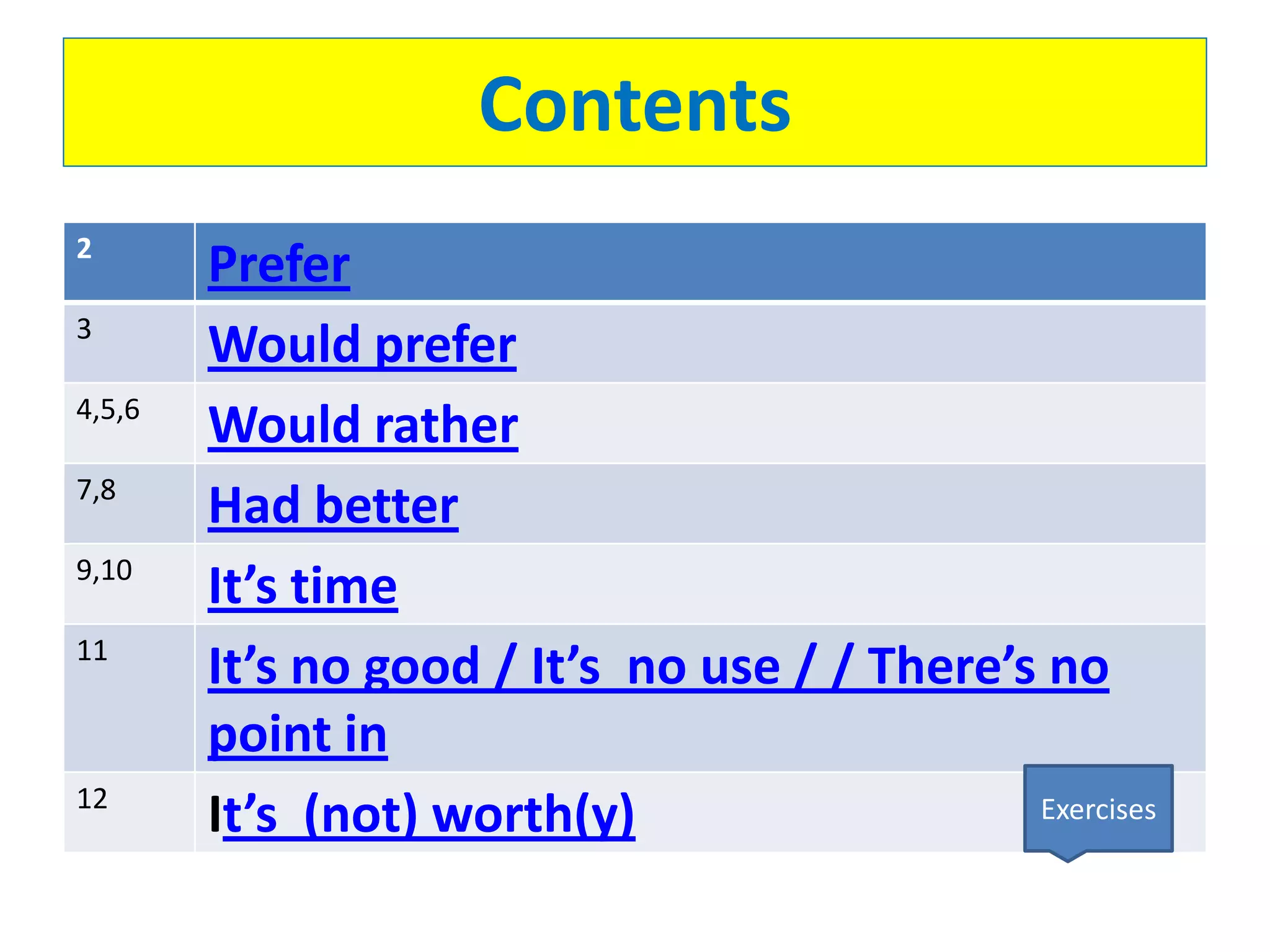
Contents
2
Prefer
3
Would prefer
4,5,6
Would rather
7,8
Had better
9,10
It’s time
11
It’s no good / It’s no use / / There’s no
point in
12
It’s (not) worth(y) Exercises
2.
Prefer / Wouldrather
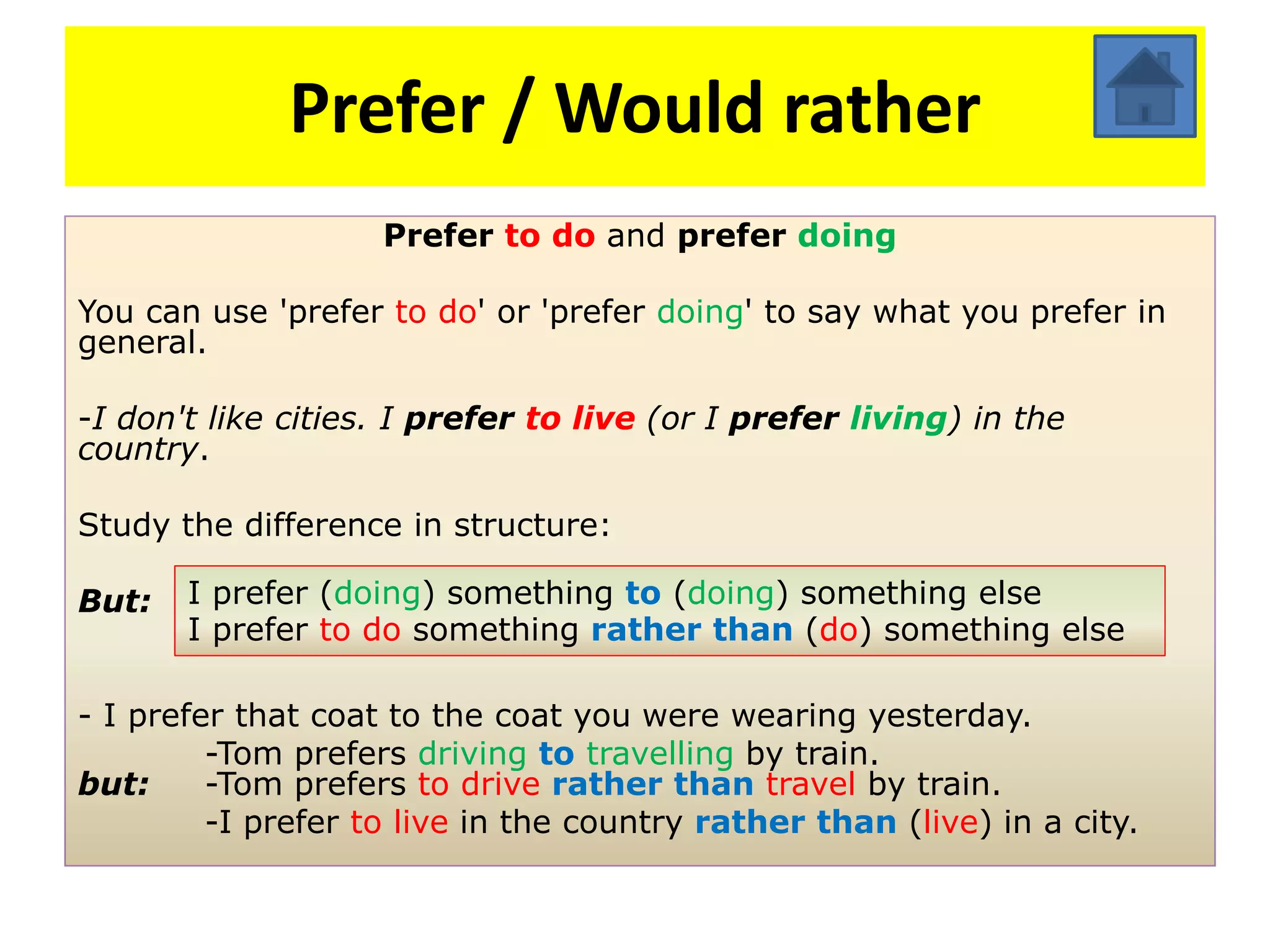
Prefer to do and prefer doing
You can use 'prefer to do' or 'prefer doing' to say what you prefer in
general.
-I don't like cities. I prefer to live (or I prefer living) in the
country.
Study the difference in structure:
But: I prefer (doing) something to (doing) something else
I prefer to do something rather than (do) something else
- I prefer that coat to the coat you were wearing yesterday.
-Tom prefers driving to travelling by train.
but: -Tom prefers to drive rather than travel by train.
-I prefer to live in the country rather than (live) in a city.
3.
Prefer / Wouldrather
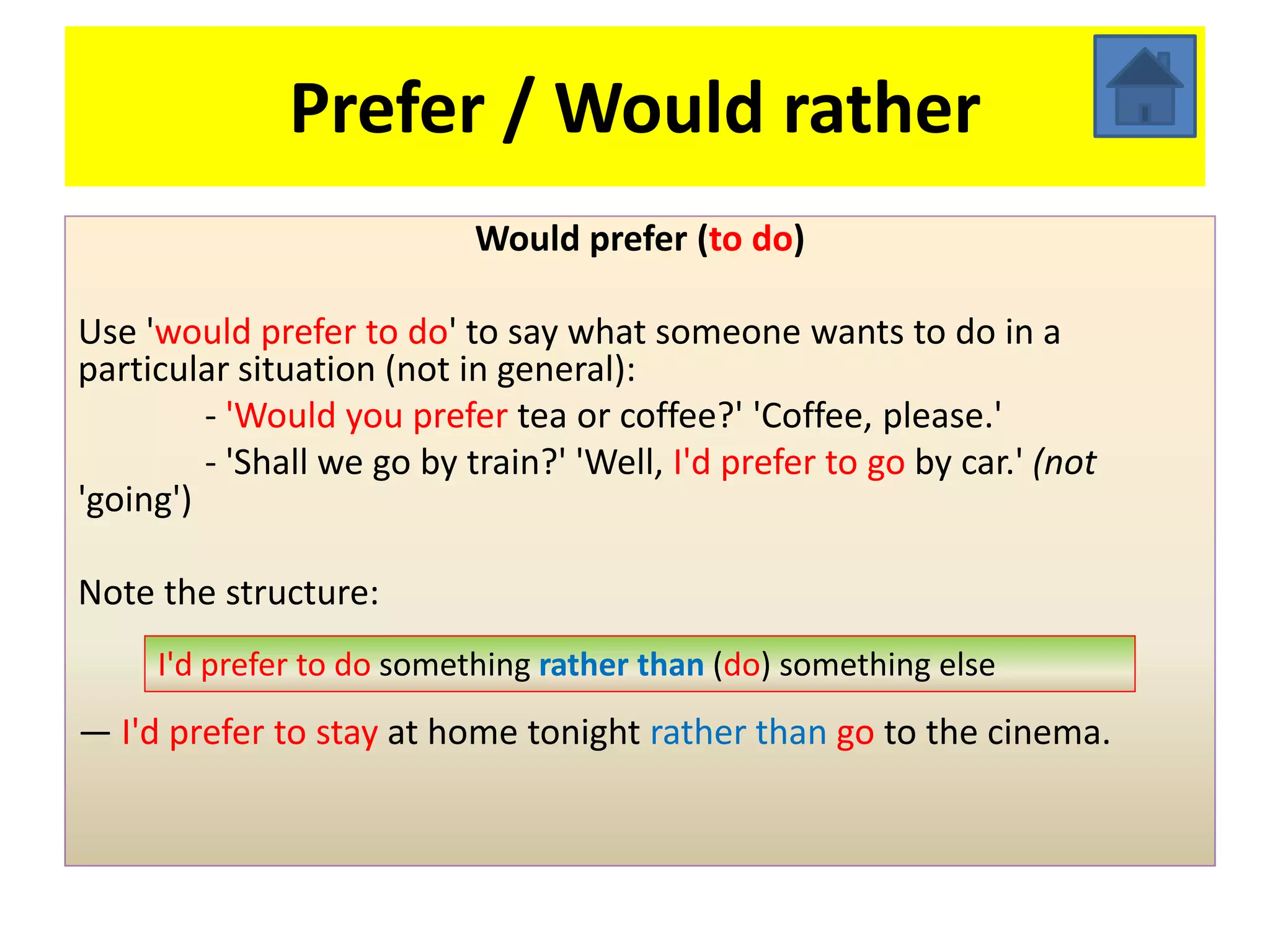
Would prefer (to do)
Use 'would prefer to do' to say what someone wants to do in a
particular situation (not in general):
- 'Would you prefer tea or coffee?' 'Coffee, please.'
- 'Shall we go by train?' 'Well, I'd prefer to go by car.' (not
'going')
Note the structure:
I'd prefer to do something rather than (do) something else
— I'd prefer to stay at home tonight rather than go to the cinema.
4.
Prefer / Wouldrather
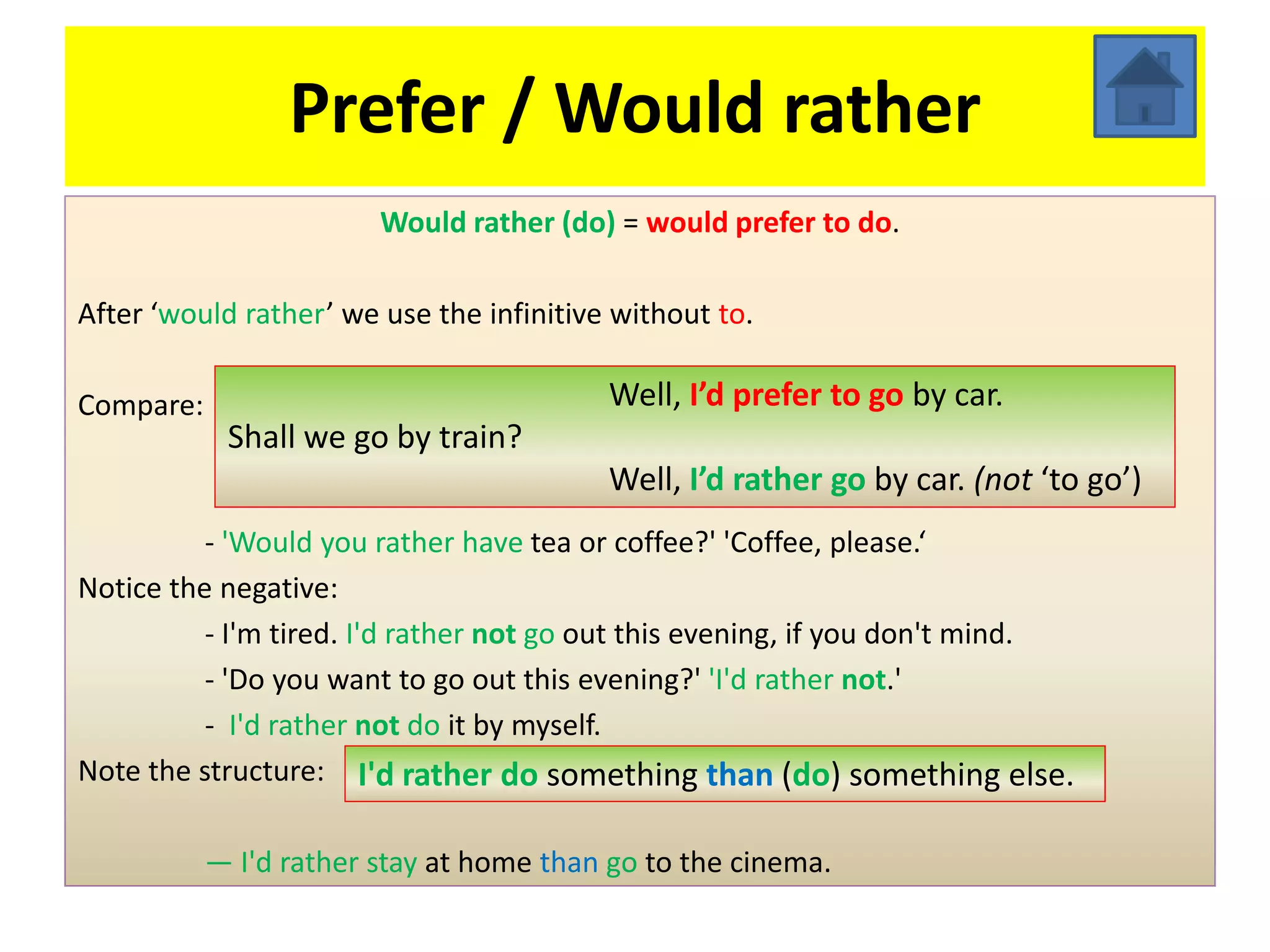
Would rather (do) = would prefer to do.
After ‘would rather’ we use the infinitive without to.
Compare: Well, I’d prefer to go by car.
Shall we go by train?
Well, I’d rather go by car. (not ‘to go’)
- 'Would you rather have tea or coffee?' 'Coffee, please.‘
Notice the negative:
- I'm tired. I'd rather not go out this evening, if you don't mind.
- 'Do you want to go out this evening?' 'I'd rather not.'
- I'd rather not do it by myself.
Note the structure: I'd rather do something than (do) something else.
— I'd rather stay at home than go to the cinema.
5.
Prefer / Wouldrather
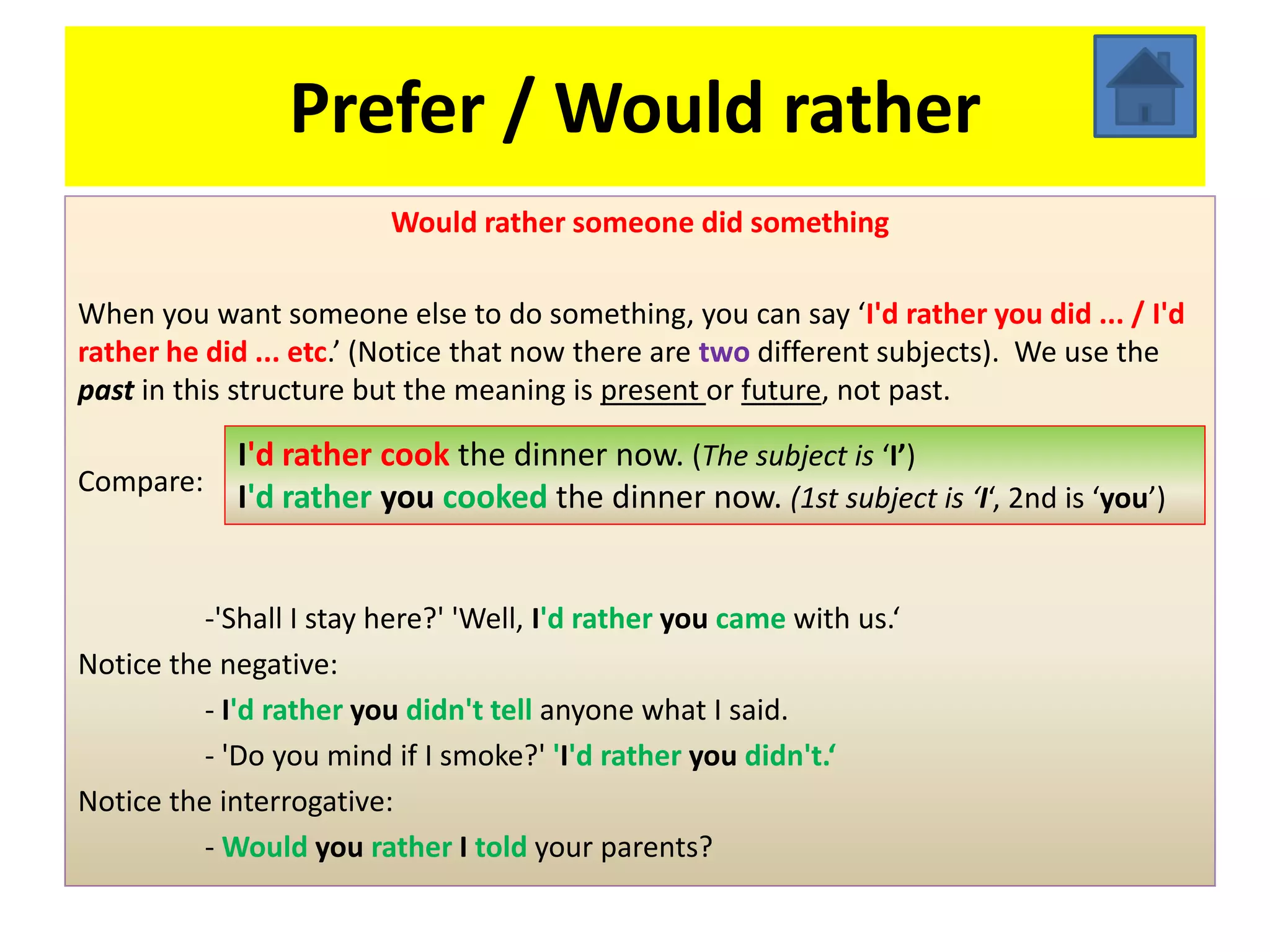
Would rather someone did something
When you want someone else to do something, you can say ‘I'd rather you did ... / I'd
rather he did ... etc.’ (Notice that now there are two different subjects). We use the
past in this structure but the meaning is present or future, not past.
I'd rather cook the dinner now. (The subject is ‘I’)
Compare:
I'd rather you cooked the dinner now. (1st subject is ‘I‘, 2nd is ‘you’)
-'Shall I stay here?' 'Well, I'd rather you came with us.‘
Notice the negative:
- I'd rather you didn't tell anyone what I said.
- 'Do you mind if I smoke?' 'I'd rather you didn't.‘
Notice the interrogative:
- Would you rather I told your parents?
6.
Prefer / Wouldrather
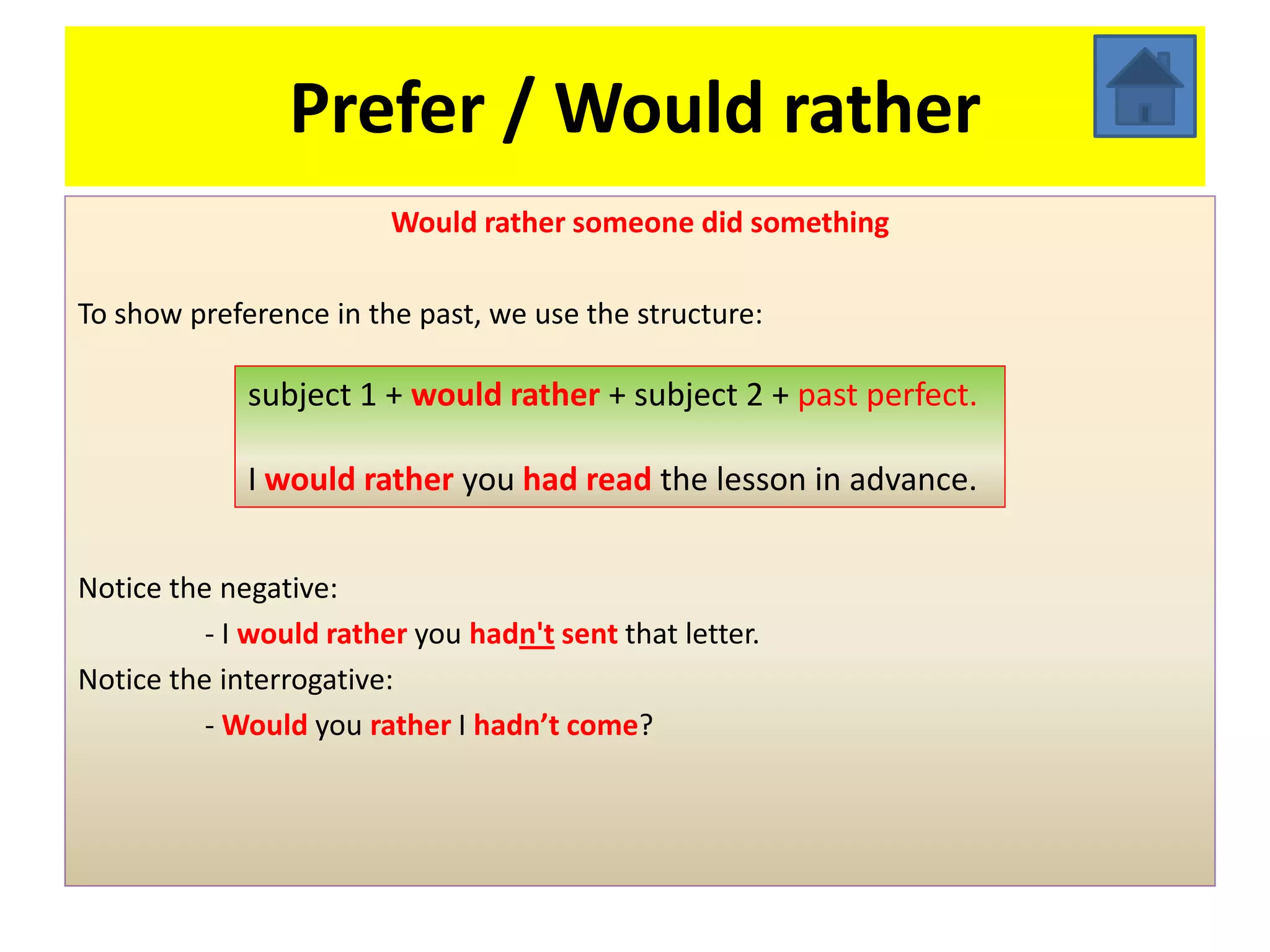
Would rather someone did something
To show preference in the past, we use the structure:
subject 1 + would rather + subject 2 + past perfect.
I would rather you had read the lesson in advance.
Notice the negative:
- I would rather you hadn't sent that letter.
Notice the interrogative:
- Would you rather I hadn’t come?
7.
Had better
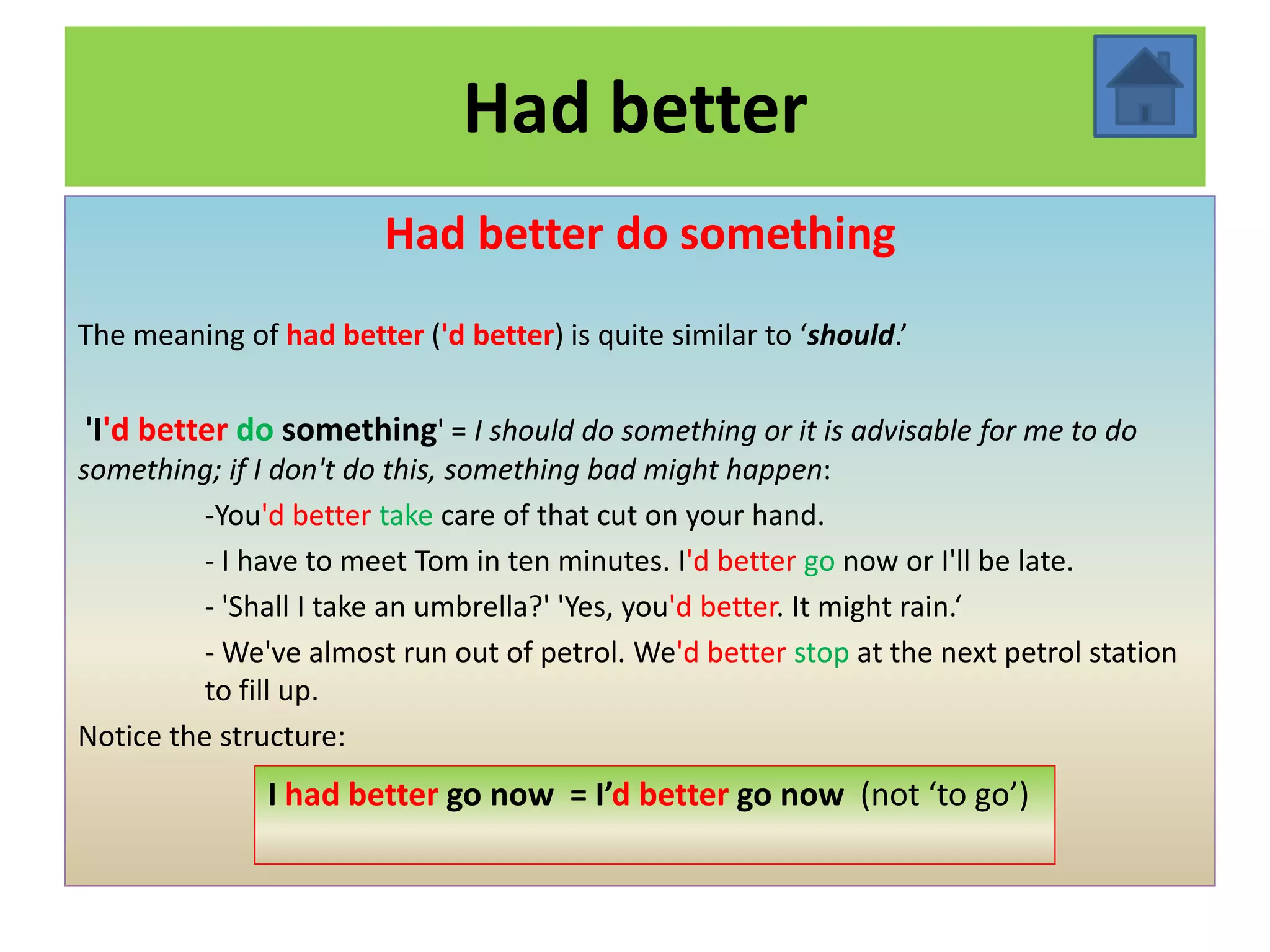
Had better do something
The meaning of had better ('d better) is quite similar to ‘should.’
'I'd better do something' = I should do something or it is advisable for me to do
something; if I don't do this, something bad might happen:
-You'd better take care of that cut on your hand.
- I have to meet Tom in ten minutes. I'd better go now or I'll be late.
- 'Shall I take an umbrella?' 'Yes, you'd better. It might rain.‘
- We've almost run out of petrol. We'd better stop at the next petrol station
to fill up.
Notice the structure:
I had better go now = I’d better go now (not ‘to go’)
8.
Had better
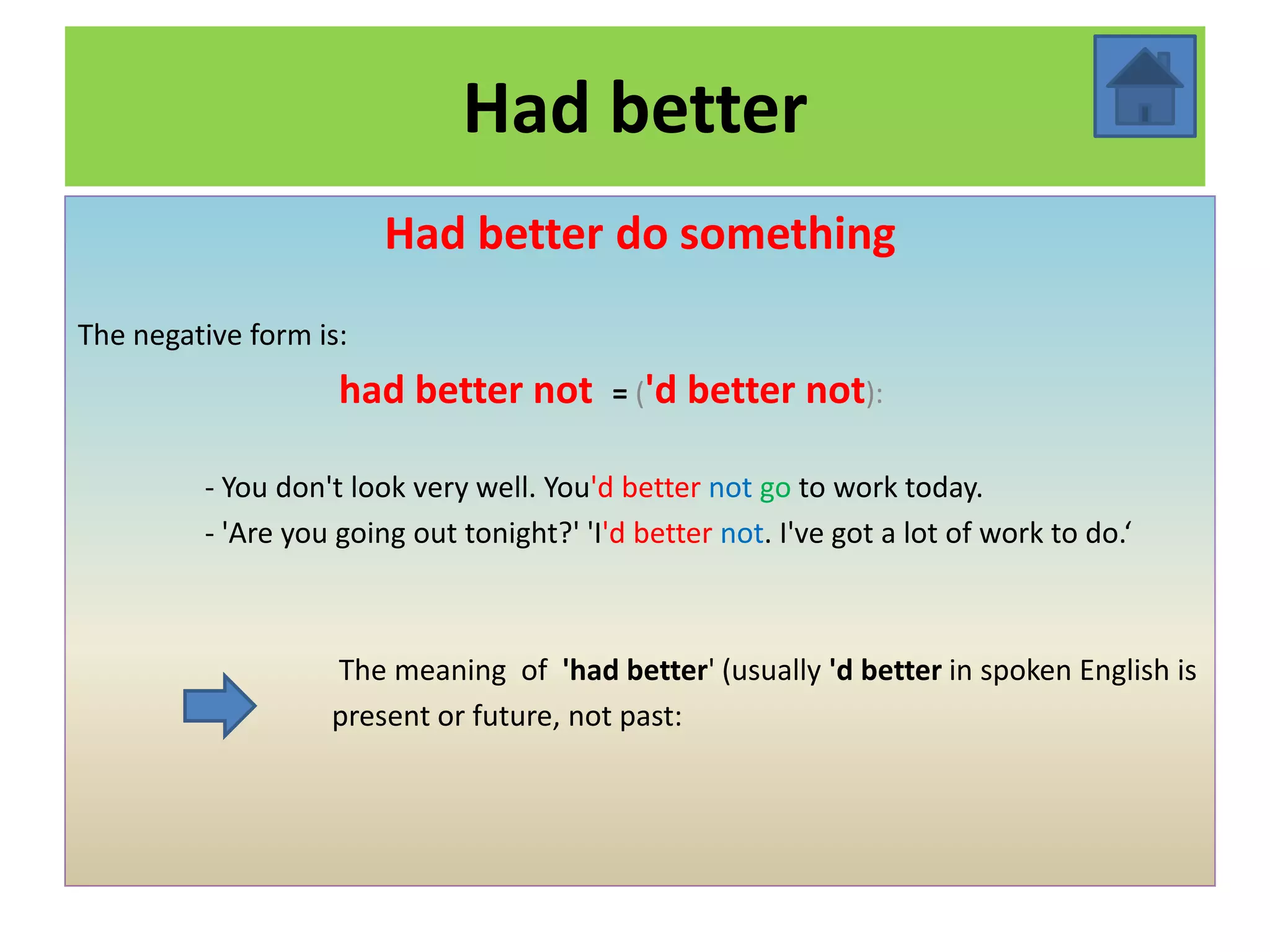
Had better do something
The negative form is:
had better not = ('d better not):
- You don't look very well. You'd better not go to work today.
- 'Are you going out tonight?' 'I'd better not. I've got a lot of work to do.‘
The meaning of 'had better' (usually 'd better in spoken English is
present or future, not past:
9.
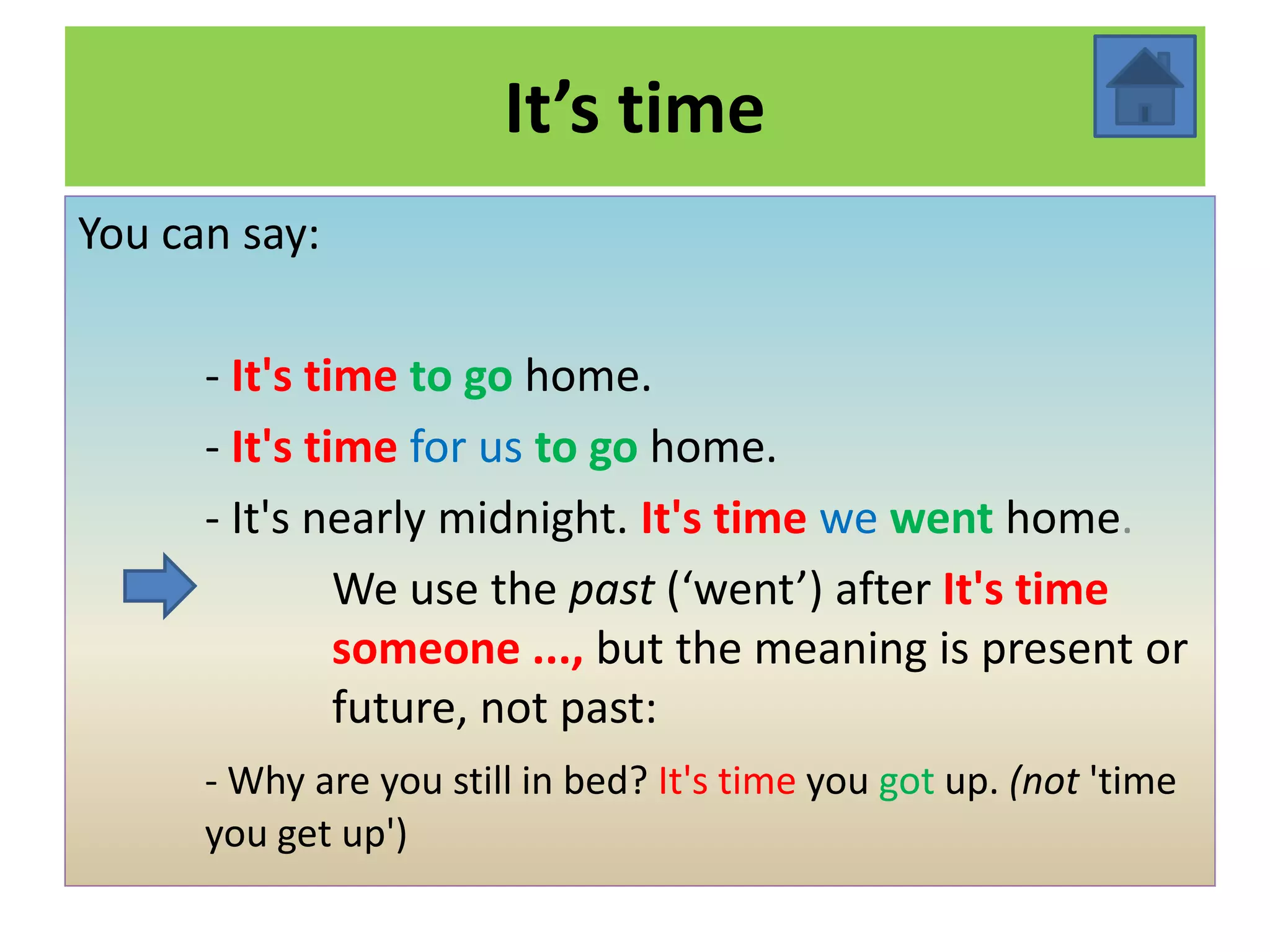
It’s time
You cansay:
- It's time to go home.
- It's time for us to go home.
- It's nearly midnight. It's time we went home.
We use the past (‘went’) after It's time
someone ..., but the meaning is present or
future, not past:
- Why are you still in bed? It's time you got up. (not 'time
you get up')
10.
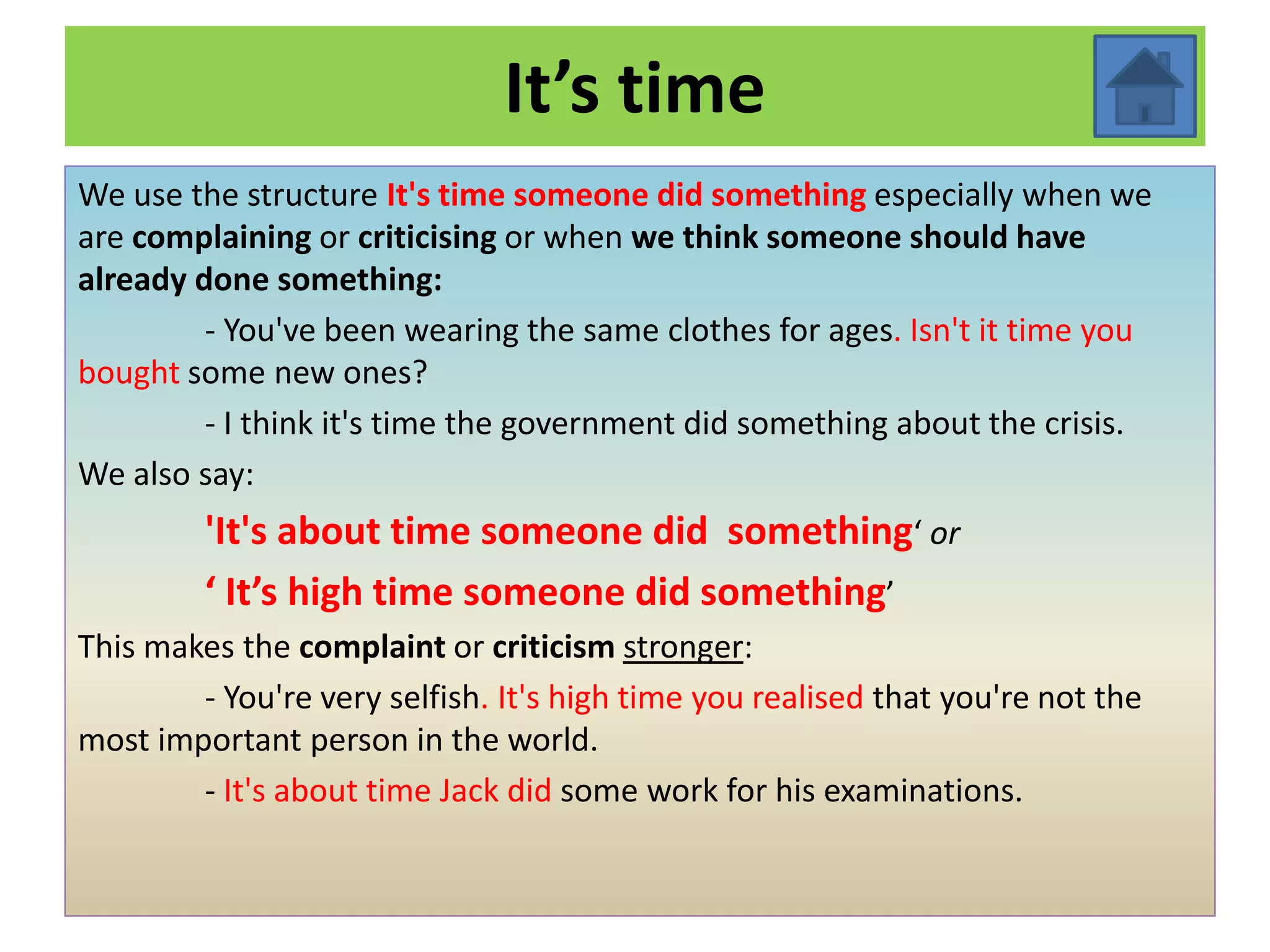
It’s time
We usethe structure It's time someone did something especially when we
are complaining or criticising or when we think someone should have
already done something:
- You've been wearing the same clothes for ages. Isn't it time you
bought some new ones?
- I think it's time the government did something about the crisis.
We also say:
'It's about time someone did something‘ or
‘ It’s high time someone did something’
This makes the complaint or criticism stronger:
- You're very selfish. It's high time you realised that you're not the
most important person in the world.
- It's about time Jack did some work for his examinations.
11.
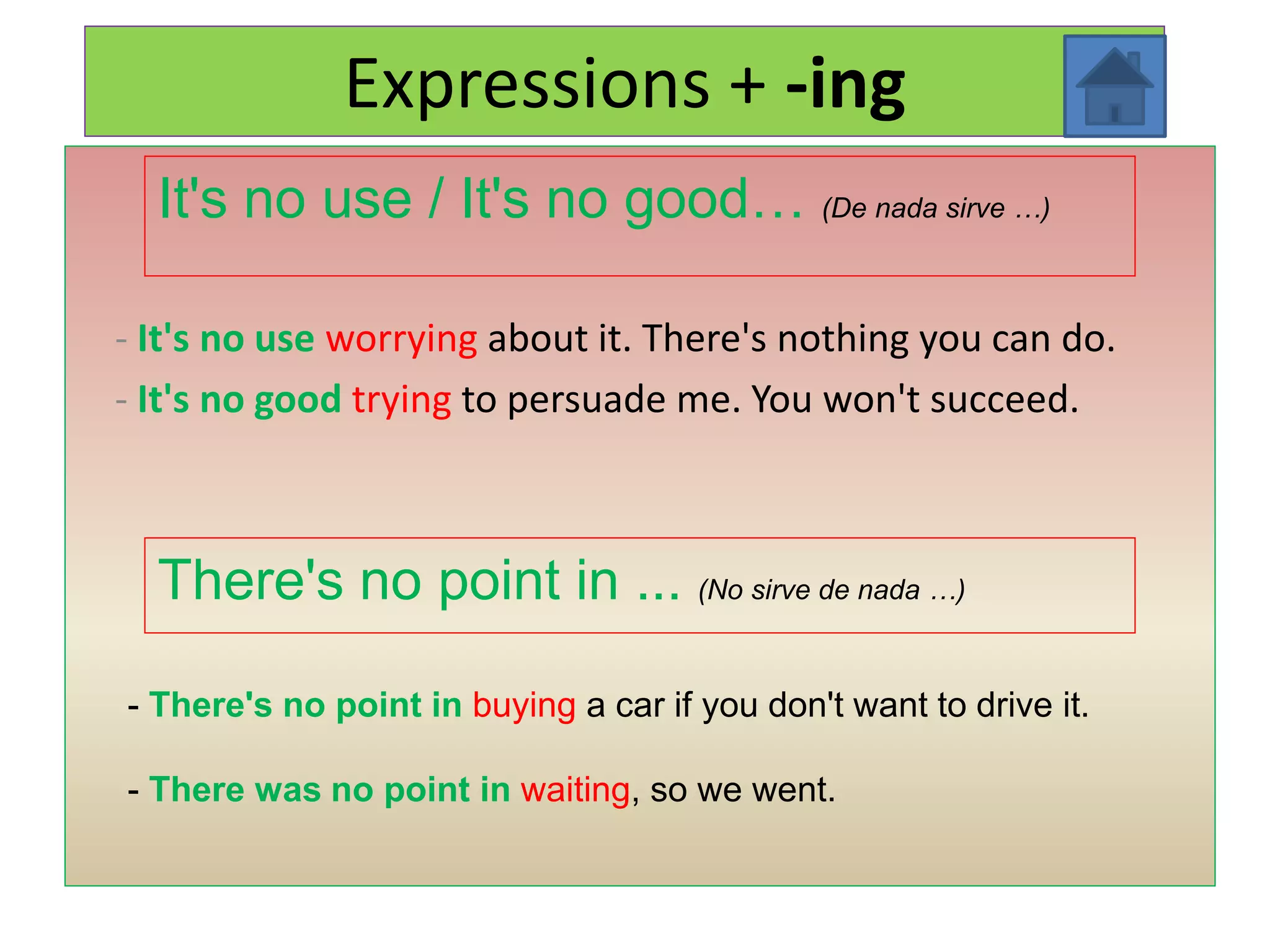
Expressions + -ing
It's no use / It's no good… (De nada sirve …)
- It's no use worrying about it. There's nothing you can do.
- It's no good trying to persuade me. You won't succeed.
There's no point in ... (No sirve de nada …)
- There's no point in buying a car if you don't want to drive it.
- There was no point in waiting, so we went.
12.
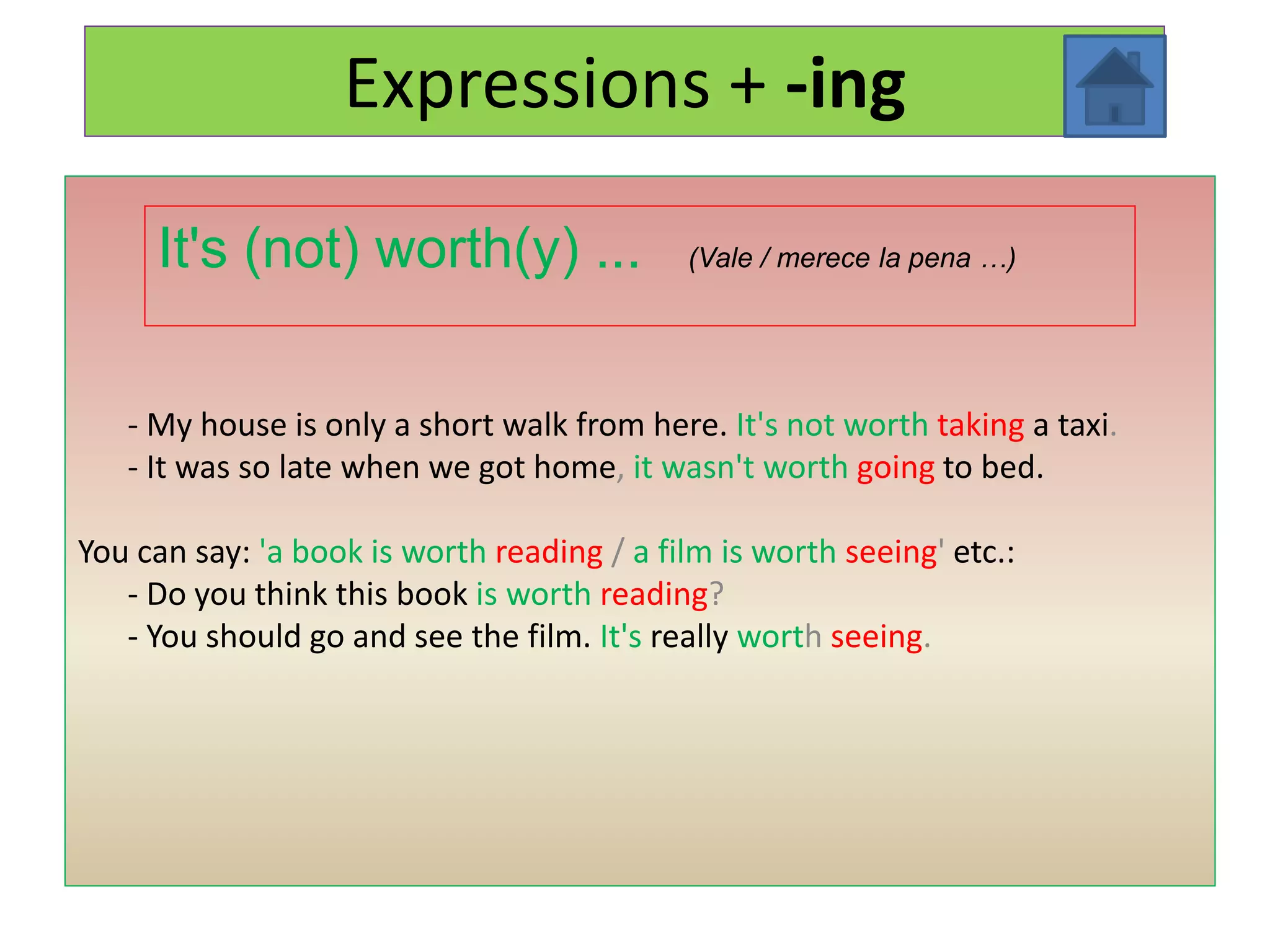
Expressions + -ing
It's (not) worth(y) ... (Vale / merece la pena …)
- My house is only a short walk from here. It's not worth taking a taxi.
- It was so late when we got home, it wasn't worth going to bed.
You can say: 'a book is worth reading / a film is worth seeing' etc.:
- Do you think this book is worth reading?
- You should go and see the film. It's really worth seeing.