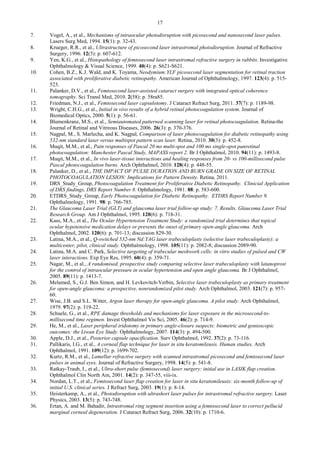
1. Lasers emit coherent, directional, monochromatic light that can be precisely focused. Lasers work by stimulating the emission of photons from excited atoms or molecules in a process called stimulated emission.
2. Ophthalmic lasers operate across a wide range of wavelengths from deep ultraviolet to infrared. Absorption of different wavelengths by chromophores like water, hemoglobin, and melanin leads to different tissue interactions including photochemical reactions or heating and thermal damage.
3. Laser light can interact with tissue through photochemical reactions at low intensities, through heating and thermal damage at higher intensities, or through rapid vaporization at very high intensities achieved with pulsed lasers. These interactions make lasers
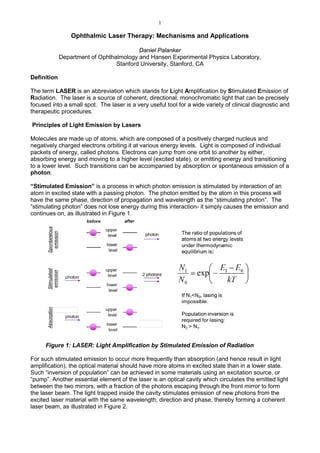
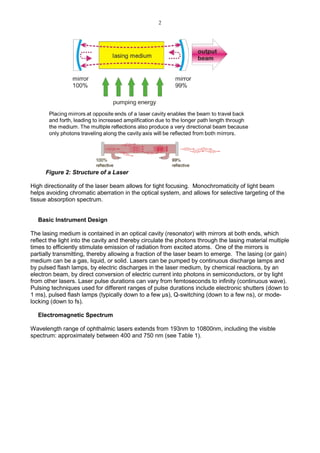
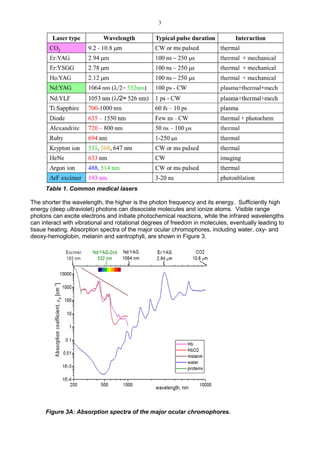

![5
With a lens of a focal length f=25 mm the same Argon laser beam can be focused to a spot of
16 µm in diameter, having a focal depth of 820µm. It must be kept in mind though that exact definition
of the spot size depends on the beam profile, which varies in various configurations of laser cavities.
As an alternative to a free-propagating beam, laser light can be transported via optical fibers.
An optical fiber, schematically shown in Figure 5, typically consists of a core, cladding and jacket.
Light is trapped within the core due to the total internal reflection at the interface of the core with
cladding. To satisfy conditions of total internal reflection, the incidence angle of light at the
core/cladding interface should not exceed the critical angle of total internal reflection:
sinΘcr=ncore/nclad, where ncore and nclad are refractive indices of the core and cladding, respectively. To
satisfy these criteria for total internal reflection, the light should be launched within a so called
acceptance cone, and the sine of its half-angle Θac is defined as the Numerical Aperture of the fiber:
2
2
sin clad
core
ac n
n
NA −
=
Θ
= . Typically the NA is within a range of 0.1 - 0.2. Optical fibers are often
used for delivery of laser light to slit lamp-based systems, and to the intraocular surgical probes.
Figure 5: Fiber delivery of the laser beam
Laser-Tissue Interactions
Interactions of light with biological tissues depend on its wavelength, pulse duration and
irradiance (amount of power per unit area, W/cm2
). With sufficiently high photon energy (i.e. short
wavelength) light can induce photochemical reactions. Light absorption by the tissue can also
result in heating, which may lead to thermal denaturation. At higher temperatures, and especially
with shorter pulses, tissue can be rapidly vaporized, which can result in mechanical disruption or
ejection of tissue fragments. Very short pulses with high peak irradiance can ionize materials,
enabling dissection inside transparent tissues. These interactions are described below in more
detail.
Photochemical Interactions
Light-induced chemical reactions, such as photo-transduction in photoreceptors initiated by
the light-induced isomerization of 11-cis retinal to all-trans retinal, are typically not associated with
a meaningful change in tissue temperature. In addition to the natural chromophores, like
rhodopsin, such interactions can be mediated by exogenously administered agents, such as
verteporfin[1]. Photochemical interactions are the basis for retinal photodynamic therapy (PDT) in
age related macular degeneration, or cross linking of corneal collagen with riboflavin to treat
keratoconus. To avoid heating, therapeutic photochemical interactions are typically performed at
very low irradiances (<1 W/cm2
) and with long exposures - tens of seconds[2].
In the case of retinal PDT, absorption of a photon of specific wavelength by the porphyrin molecule
(photosensitizer) transitions it into the singlet excited state (1
P*). It can then either decay back to the
ground state, or it can be converted into the triplet excited state (3
P*), which is able to transfer energy
to a triplet ground state of oxygen. Such energy transfer results in highly toxic singlet oxygen (1
O2)](https://image.slidesharecdn.com/ophthalmiclasertherapy-231114183214-22f33da4/85/Ophthalmic_Laser_Therapy-pdf-5-320.jpg)
![6
which can produce irreversible oxidation of the cell structures in the areas of selective accumulation
of the administered photosensitizer, for example in the newly forming blood vessels[3].
Photo-thermal Interactions
Temperature is the governing parameter in all thermal laser-tissue interactions. Depending
on the temperature rise and duration of exposure, different tissue effects may occur, including
necrosis, coagulation and vaporization. Absorption coefficient of the tissue chromophores strongly
depends on the wavelength. Major chromophores of ocular tissues include water (for infrared
wavelengths), proteins (for deep UV), melanin, blood, and macular pigments (for visible
wavelengths). The extent of tissue damage can be quantified by the decline in concentration of a
critical molecular component for cellular metabolism as a function of temperature and duration of
exposure [4, 5]. The Arrhenius integral-based quantification of the tissue damage assumes that
irreversible effects takes place when the concentration of a critical molecular component of the
treated tissue drops below some threshold value. Conventionally, an Arrhenius integral of unity
corresponds to a reduction in concentration by 63% (1/e) of a critical molecular component that has
been damaged.
If heat diffusion is not taken into account, then at a constant beam intensity the temperature
rises linearly with time. The role of heat diffusion during the laser pulse becomes significant when
the pulse duration exceeds the time it takes for heat to spread over the distance equal to the laser
penetration depth (or initial heat deposition zone) in tissue. This characteristic duration of diffusion
scales with the square of the characteristic length. For example, for a 1µm-size object (e.g.
melanosome) in water the characteristic heat diffusion time is about 1.7 µs, while for 1 mm the
diffusion time is about 1.7 seconds. For pulses shorter than the characteristic diffusion time across
the light absorption zone, the heat cannot escape from the energy deposition zone during the pulse,
which results in the most efficient heating – a condition called “heat confinement”.
Retinal Photocoagulation
Retinal photocoagulation typically involves application of laser pulses with durations ranging
from 10 to 200ms, and transient hyperthermia by tens of degrees Celsius above body temperature.
Various lasers have been used in the past (Ruby (694 nm), Argon (488, 514 nm), Krypton (647 nm)).
Currently the most common lasers in photocoagulation are frequency-doubled Nd:YAG (532 nm),
and yellow semiconductor laser (577nm). The laser energy is absorbed primarily by melanin in the
RPE and choroid, and by hemoglobin. At a 532 nm wavelength approximately 5% of light incident
on the retina is absorbed by neural retina, about half is absorbed in the RPE, and the rest in the
choroid[4] (Figure 6).](https://image.slidesharecdn.com/ophthalmiclasertherapy-231114183214-22f33da4/85/Ophthalmic_Laser_Therapy-pdf-6-320.jpg)


![9
Figure 8: Lesion diameters for 132μm beam size in rabbit retina as a function of pulse duration
(A) and power (B). C. Threshold power for lesions of various clinical grades, plotted as a
function of pulse duration. D. Width of the safe therapeutic window for light coagulation, as
a function of pulse duration for 132 µm and 330µm beam on the retina.
Photomechanical Interactions
Photomechanical interactions are at the heart of LASIK and other types of corneal refractive
surgery. Precise corneal photoablation is achieved using nanosecond pulses of ArF excimer laser
as a result of the limited 200 nm penetration depth of the 193nm radiation in the cornea and very
short pulse durations (~10ns) enabling extremely precise ablation, with very narrow zone of the
residual tissue damage (<0.2 µm) at the edges of the ablation zone.
Photoablation and photodisruption occur when laser absorption results in the tissue
temperature exceeding the vaporization threshold. Expanding and collapsing vapor bubbles
following explosive vaporization can rupture nearby tissue or eject tissue fragments from the
exposed surface. Vaporization temperature ranges between 100 and 305 o
C depending upon the
pulse duration and on presence of the bubble nucleation sites. To avoid heat diffusion away from
the laser absorption zone during the pulse, energy needs be delivered within the thermal
confinement time accounting for the use of relatively short pulse durations - in the range of
microseconds to nanoseconds rather than milliseconds[6].
Dielectric breakdown
Even though transparent tissue does not exhibit significant absorption in its wavelength range
of transparency at extremely high irradiances (108
-1011
W/cm2
), which can be achieved in a tightly
focused short-pulsed (ns-fs) laser beam, the electric field is so high that transparent material can
be ionized[7]. This mechanism, called dielectric breakdown, allows for a highly localized deposition](https://image.slidesharecdn.com/ophthalmiclasertherapy-231114183214-22f33da4/85/Ophthalmic_Laser_Therapy-pdf-9-320.jpg)
![10
of energy in the middle of a transparent medium – at the focal point of the laser beam. The
development of plasma and associated absorption of the laser energy in the focal spot lead to
explosive vaporization of the liquid medium, accompanied by the tissue rupture. (Figure 6)
Plasma-mediated laser-tissue interactions are applied to fragmentation of the opacified
posterior lens capsule (secondary cataract) with nanosecond Nd:YAG lasers. At shorter pulse
durations (1ps - 100 fs) and much lower energies (~µJ) this process is applied to intrastromal cutting
and formation of a corneal flap for refractive surgery[8, 9]. This approach has also been tested in
the dissection of epiretinal membranes using a tightly focused beam[10]. Despite the very low energy
required for this process (several µJ) its applicability in the posterior pole is limited due to the difficulty
in axial differentiation between the epiretinal membranes and the retina located very close behind
them. In addition, strong optical aberrations in the periphery of the posterior pole preclude tight
focusing of the laser beam in these areas. Recently, this process has been applied to anterior
capsulotomy and fragmentation of the crystalline lens during cataract surgery[11, 12].
Common Ophthalmic Laser Procedures
Retinal Photocoagulation
Retinal photocoagulation typically involves the application of laser pulses with durations
ranging from 10 to 200ms, and transient hyperthermia by tens of degrees above body temperature.
Various lasers have been used in the past (Ruby (694 nm), Argon (488, 514 nm), Krypton (647 nm)).
Currently the most common lasers in photocoagulation are frequency-doubled Nd:YAG (532 nm),
and yellow semiconductor laser (577nm). The laser energy is absorbed primarily by melanin in the
RPE and choroid, and by hemoglobin in blood. At a 532 nm wavelength approximately half of the
laser energy incident on the retina is absorbed in the RPE, and the rest in the choroid[4], as illustrated
in Figure 6. The heat generated diffuses from the RPE and choroid into the retina and causes
coagulation of the photoreceptors and, sometimes, of the inner retina. During 100ms applications,
the heat diffuses distances of up to 200 µm thus “smoothing” the edge and extending the coagulated
zone beyond the boundaries of the laser spot, termed “thermal blooming”. Heat diffusion using
shorter pulses and with smaller spot sizes can be limited to the photoreceptor layer, thereby avoiding
the inner retinal damage.
The threshold power required for the creation of retinal lesions increases with shorter
pulses, since higher temperatures are required for coagulation during shorter exposures. The ratio
of the threshold power required to produce a rupture to that required to produce a mild lesion is
defined as the therapeutic window, and represents one means of quantifying the relative safety
(dynamic range) of retinal photocoagulation. The larger this ratio the greater the margin of safety
to create a visible lesion without inadvertently inducing a retinal rupture. Figure 8B depicts the
width of this therapeutic window as a function of pulse duration for two different laser spot sizes.
The width of the safe therapeutic window should suffice to accommodate for variations in fundus
pigmentation, which typically do not exceed a factor of 2. To provide a safe therapeutic window
larger than 2.5, pulse durations should equal or preferably exceed 10 ms for a beam of 330 µm,
and 20 ms for the 132 µm spot size.
It is important to keep in mind that coagulation of blood vessels requires more energy than
other tissue due to cooling by the blood flow. For example, if a spot size of 200 µm with exposure
time of 200 ms is applied to occlude a blood vessel with flow velocity of 5 mm/s, the laser energy is
effectively distributed over the column 5 times longer than the diameter of the laser spot. Thus the
effective energy remaining at the photocoagulation site is 5 times lower than it would be in stationary
tissue.
Pattern Scanning Laser Photocoagulation
The first attempts to make photocoagulation a completely automated procedure involved
rather complex equipment, including image recognition software and eye tracking[13]. The
complexity of such systems prevented their commercial introduction and acceptance in clinical
practice.](https://image.slidesharecdn.com/ophthalmiclasertherapy-231114183214-22f33da4/85/Ophthalmic_Laser_Therapy-pdf-10-320.jpg)
![11
A semi-automatic pattern scanning photocoagulator (PASCAL, Topcon Medical Laser
Systems Inc.) was introduced by OptiMedica Corp. in 2005[14]. It delivered patterns of laser spots
ranging from a single spot to 56 spots applied in a rapid sequence with a single depression of a foot
pedal. The control of laser parameters was performed by means of a touch screen graphic user
interface, facilitating selection of the different patterns of photocoagulation. The laser was activated
by pressing a foot pedal, which was kept depressed until the entire pattern was completed. Although
it is possible for the physician to release the foot pedal and stop the laser at will, prior to completion
of the pattern, if clinically indicated.
Patterns included square arrays with up to 5x5 spots, arcs with the number of concentric
rows varying from 1 to 3, circular patterns for photocoagulation of small holes and other lesions in
the retinal periphery. Patterns for macular photocoagulation included rings and arcs with adjustable
central exclusion zone of up to 2 mm in diameter to allow for laser application reducing the risk of
inadvertent damage to the foveal avascular zone.
To deliver the whole pattern within the eye fixation time and avoid beam movement due to
the ocular muscles, each exposure was required to be shorter than in conventional
photocoagulation: 10-20 ms instead of 100-200 ms, traditionally applied with single spot
exposures. Reduced heat diffusion into choroid during shorter exposures also resulted in patients
experiencing less pain[15-17]. Short pulse lesions appear smaller and lighter than conventional
burns produced with the same beam size, and therefore a larger number of them are required to
treat the same total area[18].
An automatic laser delivery, guided by diagnostic imaging and stabilized using eye tracking,
has been recently introduced in a NavilaseTM
system (OD-OS GmbH). This system includes retinal
image acquisition, annotation of the images to create a detailed treatment plan, and then
automated delivery of the laser to the retina according to the treatment plan.
Clinical Indications: Treatment of Diabetic Retinopathy
Photocoagulation has proven safe and effective in the treatment of proliferative diabetic
retinopathy. In this disorder the retina becomes ischemic and releases a variety of chemical
messengers, most importantly vascular endothelial growth factor (VEGF) that stimulate the growth
of new blood vessels and also markedly increase retinal vascular permeability. The abnormal new
vessels, and associated fibrous tissue and macular edema are major causes of the sight-threatening
complications in diabetic eye disease. By destroying a portion of the peripheral retina with laser, it
has been hypothesized that retinal metabolic demands and available nutrients are better balanced
and the stimulus for growth of the new blood vessels is decreased. This treatment has been termed
panretinal photocoagulation (PRP) and significantly reduces the risk of vision loss due to
neovascularization. The side effects of panretinal photocoagulation – mild nyctalopia and
constriction of visual field- are felt to be outweighed by the preservation of the central vision, and
have been confirmed in multiple large randomized clinical trials[19]. Similarly, the focal laser
photocoagulation to actively leaking microaneurysms, and the grid photocoagulation to areas of
diffuse retinal permeability have been shown to reduce clinically significant macular edema
associated with diabetic retinopathy and slow the rate of vision loss. These effects have been
confirmed in large randomized multicenter clinical trials[20].
Age Related Macular Degeneration: Extrafoveal Neovascular Lesions
Another application for laser photocoagulation in the past was for the treatment of extrafoveal
CNV membranes that occur in AMD. Intense photocoagulation destroyed the invading vascular
membrane usually leaves a chorioretinal scar, and a blind spot or scotoma, but if the lesions treated
were outside the center of the macula, the treatment was typically well tolerated by the patients.
Currently, many physicians have elected to use PDT as an alternative to intense focal
photocoagulation, or to use anti-VEGF therapy, because of later recurrences and eventual spread
of lesions into the macula.
Additional applications of retinal photocoagulation include grid and focal treatment of leaking
microvascular abnormalities, in branch-vein occlusion and radiation retinopathy; and treatment of
retinal breaks and lattice degeneration to prevent retinal detachment.
Selection of optimal wavelength for coagulation](https://image.slidesharecdn.com/ophthalmiclasertherapy-231114183214-22f33da4/85/Ophthalmic_Laser_Therapy-pdf-11-320.jpg)
![12
A number of important factors must be considered when choosing the best wavelength for a
particular photocoagulation application. The first consideration is to determine what absorbers are
present in the site to be photocoagulated. Wavelengths that are highly absorbed by macular yellow
(such as 488 nm) are relatively contra-indicated when treating in or near the macula. Absorption of
these wavelengths in macular pigments may cause heating and destruction of the nerve fiber layer,
resulting in loss of vision. As shown in Figure 3B, in the macular region, wavelengths longer than
500 nm should be chosen, such as the green argon (514 nm) or the frequency doubled YAG (532
nm) or semiconductor yellow (577nm) laser. Melanin provides good absorption at most
photocoagulation wavelengths. Wavelength selection is therefore less important when melanin is
the primary absorber. To minimize scattering loss in cataract or in vitreous opacities the longer
wavelengths (yellow - 577nm or red - 640 to 680 nm) are preferable. If scattering by the ocular
tissues is not significant, the argon green (514nm) or doubled YAG (532nm) continue to serve well.
When hemoglobin is the primary absorber (see Figure 3B), as in the treatment of
vascularized tumors, a wavelength shorter than 600 nm is preferable. Treatment of CNV may be
effective using red light through indirect heat transfer from the surrounding melanin. Tunable lasers
may provide the flexibility to select a wavelength of choice for required photothermal procedure.
However, tunable lasers are more costly, require more maintenance, and are now less commonly
employed clinically than previously.
Laser Trabeculoplasty
Argon Laser Trabeculoplasty (ALT) is usually applied to patients with open-angle glaucoma
whose intraocular pressure (IOP) cannot be controlled by maximum pharmacological therapy.
Safety and efficacy of ALT in treatment-naive subjects with newly diagnosed primary open-angle
glaucoma has been demonstrated in large multicenter prospective clinical trial (POAG) in 1995
[21]. ALT provided longer control of intraocular pressure (IOP) without the need for additional
therapy, and greater stability of visual field and optic nerve status, as compared with timolol
monotherapy[22]. ALT lowers IOP by 6-10 mmHg, usually within 4-5 weeks, and lower IOP is
usually maintained for several years. ALT is reported to have 70-75% success rate of clinically
significant improvement.
With Argon laser (514 nm) or more recently, with the equivalent 532nm Nd:YAG laser, 50
spots of 50 µm in diameter are applied to the 180 degrees on trabecular meshwork (TM) with
pulses of 100 ms in duration (Figure 9). The mechanisms of action leading to reduction in IOP are
not well established. One theory is that the thermal burns created in the trabecular meshwork
contract the tissue and open spaces within trabecular meshwork, thus increasing the aqueous
outflow and lowering IOP. Another possible theory states that the thermal stress induced by laser
therapy causes an increase in metabolic activity of the endothelial cell in the trabecular meshwork,
which improves the aqueous outflow.
Figure 9: Laser trabeculoplasty: laser beam is directed onto the trabecular meshwork via
gonioscopic lens. For ALT, laser is typically focused into 50 µm spots. For SLT, the laser
spots are 400 µm in diameter.](https://image.slidesharecdn.com/ophthalmiclasertherapy-231114183214-22f33da4/85/Ophthalmic_Laser_Therapy-pdf-12-320.jpg)
![13
Selective Laser Trabeculoplasty (SLT) was introduced in 1995[23, 24]. The commercially
available SLT laser systems (Lumenis Inc., Santa Clara, CA; and Ellex Inc., Adelaide, Australia)
include a Q-switched, frequency-doubled, 532-nm Nd:YAG laser, that delivers 3 ns pulses in a 400
μm diameter treatment spot. Typical SLT pulse energy ranges from 0.4 to 1.2 mJ, about hundred
times lower than ALT. With 400 µm beam diameter, 100 spots per 360 degrees provide practically
complete coverage of the TM (Figure 9). SLT has been shown to be an effective alternative to LT
[23, 25, 26], in the treatment of patients with Open Angele Glaucoma. SLT leaves the Trabecular
Meshwork intact with minimal damage to the endothelial cells lining the meshwork beams[23], in
contrast to the ALT, which results in extensive scarring of the meshwork[27]. This observation has
led to significant speculation that SLT may be more repeatable than ALT. SLT is easier to perform
than ALT due to its larger spot size, and is better tolerated by patients due to reduced pulse energy.
Like ALT, the IOP-lowering effect of SLT lasts for several years, but does tend to diminish over time.
SLT is effective as primary therapy, can reduce the pharmaceutical burden in medically controlled
eyes, and can prevent or delay the need for surgery in eyes poorly controlled, but on maximally
tolerated medical therapy. Both 180 and 360-degree treatments appear to be reasonable as initial
therapy, and there seems to be no contraindication to initial 360 degrees treatment.
Much lower energy requirements in SLT, compared to ALT is due to different mechanisms of
cellular damage produced by nanosecond and millisecond pulses. Millisecond hyperthermia of
pigmented cells leads to cellular damage due to denaturation of proteins and other cellular
macromolecules[28]. Nanosecond exposures though are too short to produce thermal denaturation
below the vaporization threshold, and cells are damaged by cavitation bubbles forming around
melanosomes[28]. With sub-microsecond pulses the heat does not diffuse beyond one micrometer,
and thus the damage can be confined within a cell. With 100 ms exposures in ALT the heat diffusion
zone can reach 220 µm, covering practically the whole width of TM.
Laser Iridotomy
Laser iridotomy is performed on the eye to treat angle closure glaucoma, a condition of
increased intraocular pressure caused by blockage of the angle of the anterior chamber by the iris.
LI is a procedure in which the laser creates a hole in the iris to allow fluid to flow through and relieve
pressure in the eye. This typically results in resolution of the forwardly bowed iris and thereby an
opening up of the angle of the eye (Figure 10). It is also used prophylactically with anatomically
narrow angles, in the fellow eye of a patient with primary pupil block angle closure, a patient with
primary open angle glaucoma and coincidentally narrow angles, and nanophthalmos. LI is
performed ~3mm from iris root under the superior lid to prevent monocular diplopia. Power and pulse
duration vary with iris color of the patient. Pulses (100-300 ms) of argon laser (514nm) or 532nm
YAG laser focused into 50 µm spot are applied to create a depression. A “smoke signal” is seen
when the posterior pigment epithelial layer is reached. The process is continued until penetration is
complete. A combination of millisecond pulses of Argon laser and nanosecond pulses of Q-switched
YAG is often used to perform the procedure. The Argon is used first to initiate tissue removal and
photocoagulate vessels to prevent hemorrhages and then the ns YAG is used to complete the
iridotomy[29]. The ns YAG laser does not coagulate tissue, and used alone can cause hemorrhages.](https://image.slidesharecdn.com/ophthalmiclasertherapy-231114183214-22f33da4/85/Ophthalmic_Laser_Therapy-pdf-13-320.jpg)
![14
Figure 10: Laser iridotomy providing an alternative route for the aqueous flow from
posterior to anterior chamber of the eye.
Posterior Capsulotomy
Posterior lens capsule opacification (PCO) is the most common late complication occurring
in approximately third of the cataract surgery cases[30]. Laser is used to remove the hazy central
part of the posterior capsule situated behind the intraocular lens (IOL) implant. The slit lamp-coupled
nanosecond Nd:YAG laser focused into a tight spot can produce extremely high light intensities – in
excess of 1010
W/cm2
. At these irradiancies photons can ionize even transparent materials via
several different mechanisms[6], producing plasma in a focal spot. Plasma energy converting into
heat results in rapid vaporization of the focal volume, producing shock waves and cavitation bubbles.
Rapidly expanding and collapsing vapor bubbles can rupture (a process called photodisruption) the
adjacent opacified posterior lens capsule, providing a clear window for central vision. To avoid
damage to the intraocular lens implant, the laser is focused slightly posterior to the capsule in the
vitreous (Figure 11).
Figure 11: Laser iridotomy providing an alternative route for the aqueous flow from posterior to
anterior chamber of the eye.
Refractive Surgery](https://image.slidesharecdn.com/ophthalmiclasertherapy-231114183214-22f33da4/85/Ophthalmic_Laser_Therapy-pdf-14-320.jpg)
![15
Laser-Assisted In Situ Keratomileusis (LASIK) includes 2 steps: 1) cutting of a flap in the
cornea (by mechanical microkeratome or a femtosecond laser) to pull it back and expose the corneal
stroma for laser ablation; 2) ablation of the corneal stroma with 193nm excimer laser [31]. ArF
excimer laser radiation is absorbed in a very shallow layer of the cornea (~200nm), and short pulse
duration (10-20 ns) prevents heat diffusion from the light absorption zone during the pulse, by more
than a few nanometers. These features enable very precise ablation of the cornea by ArF laser,
ejecting the overheated surface material layer by layer, with the steps of about 200nm per pulse.
Such precise tissue scalping with very shallow residual tissue damage zone allows precise reshaping
of the corneal surface to correct refractive errors. After the laser reshaping of the stroma, the corneal
flap is placed back over the treatment area, and its adhesion to the surrounding tissue improves over
time due to natural healing.
Development of the femtosecond laser for corneal flap cutting, based on dielectric breakdown
of the tissue in the tightly focused laser beam [32], enabled further improvements. Unlike mechanical
microkeratome, laser cutting allowed the formation of vertical walls around the planar flap, which
enabled better positioning of the corneal flap back into original location after ablation. This improved
the consistency of refractive outcomes, and led to wide acceptance of the fs laser in refractive
surgery[33, 34]. Ultrafast lasers also enabled refractive surgical procedures based on intrastromal
cutting, without excimer laser ablation: extraction of lenticules[35] and producing pockets for
intrastromal rings[36]. The same laser systems have been applied to transplantation of the whole
cornea or corneal endothelium[37], so called Endothelial Keratoplasty.
In Laser Thermal Keratoplasty (LTK) long pulses of the mid-infrared laser (Holmium YAG,
2.1mm wavelength) are applied in a ring pattern of 6-7 mm in diameter. Heating of the upper third
of the corneal stroma results in collagen shrinkage, thereby steepening it to correct hyperopia[38].
Similar effect can be produced by electric current, the procedure called conductive
keratoplasty[39]. This effect may regress somewhat over time.
Cataract Surgery
Conventional cataract surgery involves manual formation of an opening in the anterior lens
capsule, fragmentation and evacuation of the lens tissue using ultrasound probe, and implantation
of a plastic intraocular lens into the remaining capsular bag. The size, shape and position of the
anterior capsular opening (one of the most critical steps in the procedure) is controlled by a
freehand pulling and tearing the capsular tissue. Recently developed new laser-based technique
greatly improves the precision and reproducibility of cataract surgery by performing anterior
capsulotomy, lens segmentation and corneal incisions with a femtosecond laser[11]. Exact
placement of the cutting patterns in tissue is determined by imaging the anterior segment of the
eye using integrated Optical Coherence Tomography[12], as illustrated in Figure 12. Femtosecond
laser produces 3-dimentional patterns of cutting to soften the crystalline lens and to cut a round
opening in the anterior capsule. Three-dimensional cutting of the cornea based on diagnostic
imaging can improve safety by creating multi-planar self-sealing cataract incisions, and can reduce
residual astigmatism by exact placement of the limbal relaxing incisions.](https://image.slidesharecdn.com/ophthalmiclasertherapy-231114183214-22f33da4/85/Ophthalmic_Laser_Therapy-pdf-15-320.jpg)