Principle and Application
of
LASER
Presentation Layout
•Introduction
•History
•Laser action
•Principle
•Types of Laser
•Applications
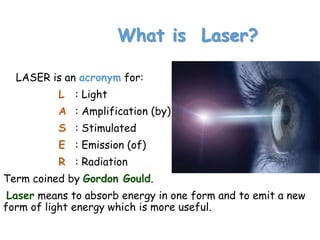
What is Laser?
LASER is an acronym for:
L : Light
A : Amplification (by)
S : Stimulated
E : Emission (of)
R : Radiation
Term coined by Gordon Gould.
Laser means to absorb energy in one form and to emit a new
form of light energy which is more useful.
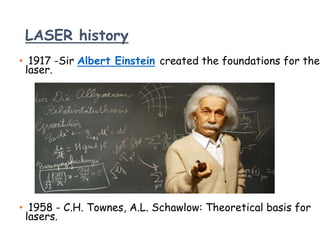
LASER history
• 1917 -Sir Albert Einstein created the foundations for the
laser.
• 1958 - C.H. Townes, A.L. Schawlow: Theoretical basis for
lasers.
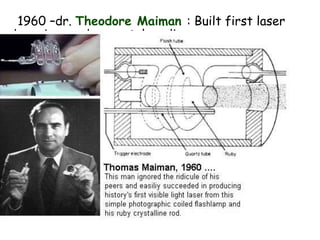
1960 –dr. Theodore Maiman : Built first laser
by using a ruby crystal medium .
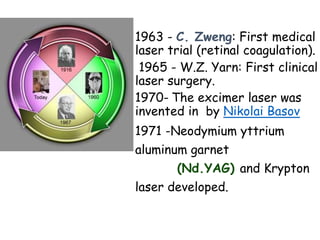
•1963 - C. Zweng: First medical
laser trial (retinal coagulation).
• 1965 - W.Z. Yarn: First clinical
laser surgery.
•1970- The excimer laser was
invented in by Nikolai Basov
• 1971 -Neodymium yttrium
aluminum garnet
(Nd.YAG) and Krypton
laser developed.
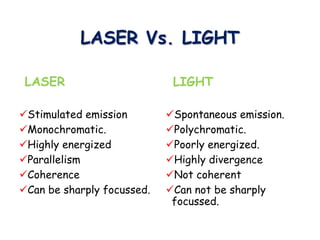
LASER Vs. LIGHT
LASER
Stimulated emission
Monochromatic.
Highly energized
Parallelism
Coherence
Can be sharply focussed.
LIGHT
Spontaneous emission.
Polychromatic.
Poorly energized.
Highly divergence
Not coherent
Can not be sharply
focussed.
LASER PHYSICS
• Light as electromagnetic waves, emitting radiant energy
in tiny package called ‘quanta’/photon. Each photon has
a characteristic frequency and its energy is proportional
to its frequency.
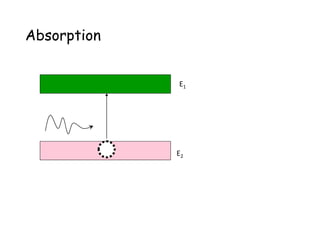
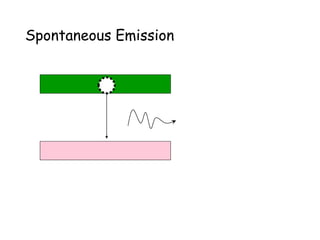
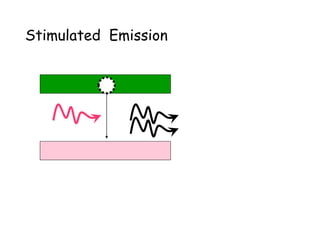
• Three basic ways for photons and atoms to interact:
Absorption
Spontaneous Emission
Stimulated Emission
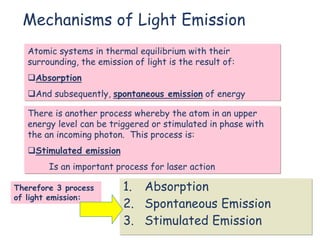
Mechanisms of Light Emission
Atomic systems in thermal equilibrium with their
surrounding, the emission of light is the result of:
Absorption
And subsequently, spontaneous emission of energy
There is another process whereby the atom in an upper
energy level can be triggered or stimulated in phase with
the an incoming photon. This process is:
Stimulated emission
Is an important process for laser action
1. Absorption
2. Spontaneous Emission
3. Stimulated Emission
Therefore 3 process
of light emission:
Absorption
E1
E2
Spontaneous Emission
Stimulated Emission
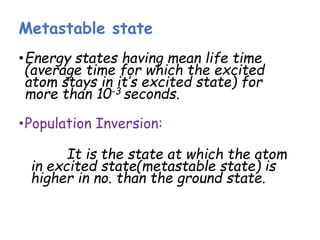
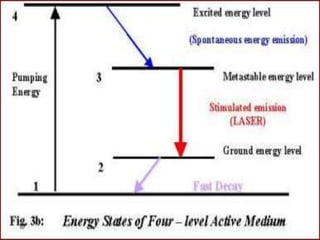
Metastable state
•Energy states having mean life time
(average time for which the excited
atom stays in it’s excited state) for
more than 10-3 seconds.
•Population Inversion:
It is the state at which the atom
in excited state(metastable state) is
higher in no. than the ground state.
Characteristics of LASER
• Lasers are concentrated beams of light which can
very precisely cut, seal and even vaporize tissue.
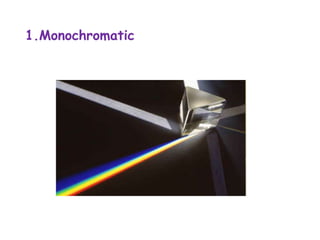
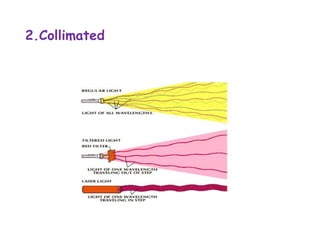
1. Monochromatic
2. Collimated
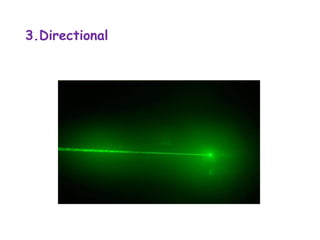
3. Directional
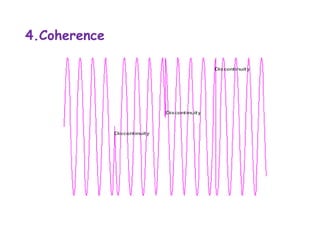
4. Coherence
1.Monochromatic
2.Collimated
3.Directional
4.Coherence
General construction of LASER
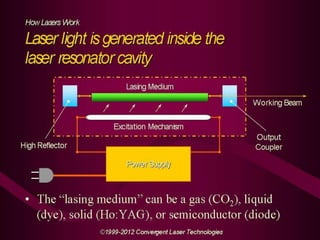
•Laser consists of three major components:
1. Lasing material: solid,liquid or gas
2. A pumping system: optical,electric or chemical
Provides energy required to lase the material
3.Optical cavity: contains lasing materials bounded
by mirrors at each end of cavity
Contd…
• Totally reflecting(100%)
• Partially reflecting(99%)
• Coherent light escape from the cavity, return
back after reflection and produce more
stimulated emission
• Leads to amplification
• Laser beam is emitted through partially reflecting
mirror
CLASSIFICATION OF LASER
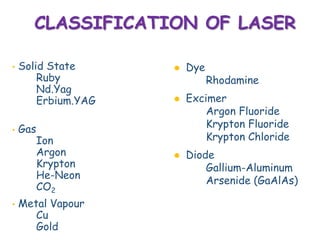
• Solid State
Ruby
Nd.Yag
Erbium.YAG
• Gas
Ion
Argon
Krypton
He-Neon
CO2
• Metal Vapour
Cu
Gold
 Dye
Rhodamine
 Excimer
Argon Fluoride
Krypton Fluoride
Krypton Chloride
 Diode
Gallium-Aluminum
Arsenide (GaAlAs)
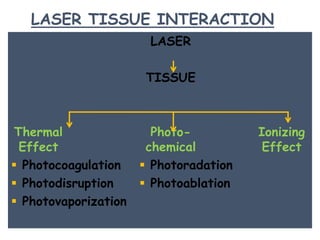
LASER TISSUE INTERACTION
LASER
TISSUE
Thermal
Effect
Photo-
chemical
Ionizing
Effect
 Photocoagulation  Photoradation
 Photodisruption  Photoablation
 Photovaporization
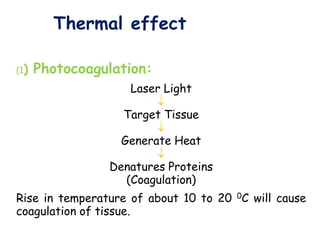
Thermal effect
(1) Photocoagulation:
Laser Light

Target Tissue

Generate Heat

Denatures Proteins
(Coagulation)
Rise in temperature of about 10 to 20 0C will cause
coagulation of tissue.
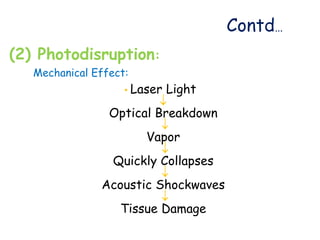
Contd…
(2) Photodisruption:
Mechanical Effect:
• Laser Light

Optical Breakdown

Vapor

Quickly Collapses

Acoustic Shockwaves

Tissue Damage
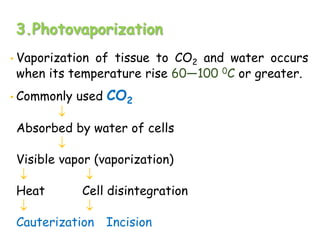
3.Photovaporization
• Vaporization of tissue to CO2 and water occurs
when its temperature rise 60—100 0C or greater.
• Commonly used CO2

Absorbed by water of cells

Visible vapor (vaporization)
 
Heat Cell disintegration
 
Cauterization Incision
Photochemical effect
1. PHOTORADIATION (PDT):
• Also called Photodynamic Therapy
• Photochemical reaction following visible/infrared
light particularly after administration of exogenous
chromophore.
• Commonly used photosensitizers:
 Hematoporphyrin
 Benzaporphyrin Derivatives
e.g. Treatment of ocular tumour and CNV
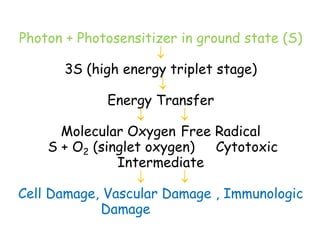
Photon + Photosensitizer in ground state (S)

3S (high energy triplet stage)

Energy Transfer
 
Molecular Oxygen Free Radical
S + O2 (singlet oxygen) Cytotoxic
Intermediate
 
Cell Damage, Vascular Damage , Immunologic
Damage
Contd…
2.PHOTOABLATION:
Breaks the chemical bonds that hold
tissue together essentially vaporizing the tissue,
e.g. Photorefractive Keratectomy, Argon Fluoride
(ArF) Excimer Laser.
Usually -
Visible Wavelength : Photocoagulation
Ultraviolet Yields : Photoablation
Infrared : Photodisruption
Photocoagulation
IONISING EFFECT
• Highly energized focal laser beam is delivered on tissue over a
period of nanosecond or picoseconds and produce plasma in
target tissue.
• Q Switching Nd.Yag

Ionization (Plasma formation)

Absorption of photon by plasma

Increase in temperature and
expansion of supersonic velocity

Shock wave production  Tissue Disruption
MODES OF LASER OPERATION
• Continuous Wave (CW) Laser:
It deliver their energy in a continuous stream
of photons.
• Pulsed Lasers:
Produce energy pulses of a few tens of micro to few mili
second.
• Q Switches Lasers:
Deliver energy pulses of extremely short duration (nano
second).
Contd…
• A Mode-locked Lasers: Emits a train of short
duration pulses (picoseconds).
• Fundamental System: Optical condition in which
only one type of wave is oscillating in the laser
cavity.
• Multimode system: Large number of waves, each
in a slight different direction ,oscillate in laser
cavity.
LASER TISSUE
INTERACTION
LASER VARIABLE:
 Wavelength
 Spot Size
 Power
 Duration
TISSUE VARIABLE:
 Transparency
 Pigmentation
 Water Content
LASER IN ANTERIOR SEGMENT
CORNEA:
Laser in Keratorefractive Surgery:
• Photo Refractive Keratectomy (PRK)
• Laser in situ Keratomileusis (LASIK)
• Laser Subepithelial Keratectomy (LASEK)
• Epi Lasik
Laser Thermal Keratoplasty
Corneal Neovascularization
Retrocorneal Pigmented Plaques
Laser Asepsis
•Laser in lens:
•Posterior capsulotomy(YAG)
•Laser phacoemulcification
•Phacoablation
•Laser in vitreous:
•Vitreous membranes
•Vitreous traction bands
LASER IN GLAUCOMA
Laser Iridotomy,
Laser Iredectomy
Laser
Trabeculoplasty
(LT)
Selective Laser
Trabeculoplasty
LASER TREATMENT OF
FUNDUS DISORDERS
Diabetic Retinopathy
Retinal Vascular Diseases
Choroidal Neovascularization (CNV)
Clinical Significant Macular Edema (CSME)
Central Serous Retinopathy (CSR)
Retinal Break/Detachment
Tumour
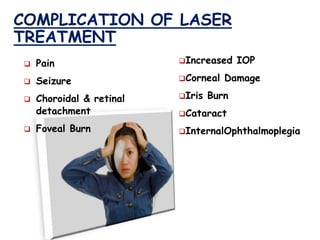
COMPLICATION OF LASER
TREATMENT
 Pain
 Seizure
 Choroidal & retinal
detachment
 Foveal Burn
Increased IOP
Corneal Damage
Iris Burn
Cataract
InternalOphthalmoplegia
LASER HAZARDS
EYE
• Small lesion to extensive hemorrhage
• Disruption of retina and choroid
• Immediate loss of vision
• Epi-retinal membrane formation
• Macular hole, gliosis
Complications of Laser treatment in Eye
•Lids and adnexae: Ecchymosis, retrobulbar and
subconjunctival haemorrhage
•Cornea: punctate erosion, edema, corneal burns,
opacification
•Iris: sphincter damage, haemorrhage
rupture
•Lens: opacification
Contd…
•Viterous: opacification, hemorrhage, choroidal
neo-vascularization
•Retina: hemorrhage, receptor layer and nerve
fibre damage
•Optic nerve: neuritis, nerve fibre damage
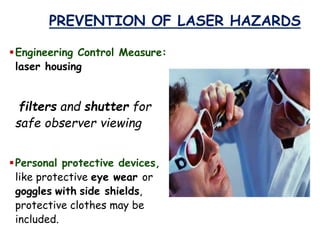
PREVENTION OF LASER HAZARDS
Engineering Control Measure:
laser housing
filters and shutter for
safe observer viewing
Personal protective devices,
like protective eye wear or
goggles with side shields,
protective clothes may be
included.
Other uses of LASER
•Cosmetic Sugery
•Removing tattoos, scars, stretch marks,
sunspots, wrinkles,birthmarks
•Laser hair removal
Dentistry
•caries removal
•endodontic/periodontic
procedures
•tooth whitening
•oral surgery
•laser scalpel
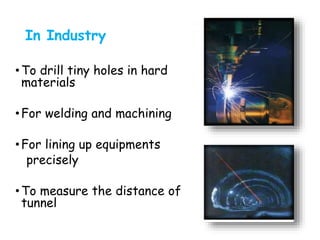
In Industry
•To drill tiny holes in hard
materials
•For welding and machining
•For lining up equipments
precisely
•To measure the distance of
tunnel
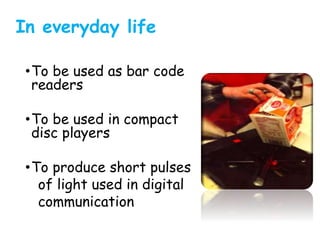
In everyday life
•To be used as bar code
readers
•To be used in compact
disc players
•To produce short pulses
of light used in digital
communication
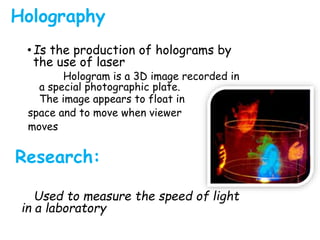
Holography
•Is the production of holograms by
the use of laser
Hologram is a 3D image recorded in
a special photographic plate.
The image appears to float in
space and to move when viewer
moves
Research:
Used to measure the speed of light
in a laboratory
MCQS
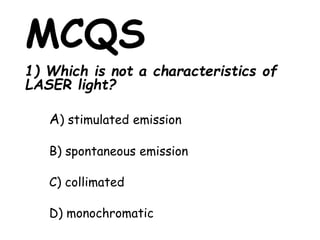
1) Which is not a characteristics of
LASER light?
A) stimulated emission
B) spontaneous emission
C) collimated
D) monochromatic
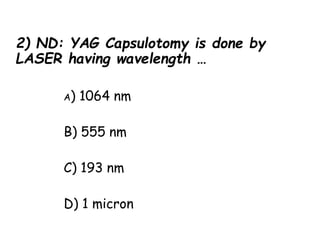
2) ND: YAG Capsulotomy is done by
LASER having wavelength …
A) 1064 nm
B) 555 nm
C) 193 nm
D) 1 micron
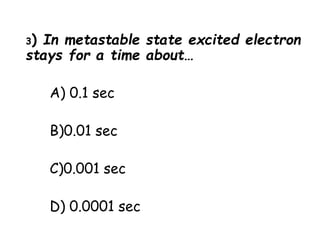
3) In metastable state excited electron
stays for a time about…
A) 0.1 sec
B)0.01 sec
C)0.001 sec
D) 0.0001 sec
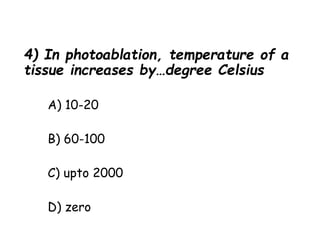
4) In photoablation, temperature of a
tissue increases by…degree Celsius
A) 10-20
B) 60-100
C) upto 2000
D) zero
5) Iridotomy is done for…
A) cosmetic purpose
B) treat ACG
C) to dilate pupillary area
D) to relax accommodation
References
•Clinical procedures in optometry
•Optics
A.H. Tunacliffe
•Environmental Vision
Donald G. Pitts
Robert N. Kleinstein
•Internet
Laser   surazz

Laser surazz

  • 1.
  • 2.
  • 3.
    What is Laser? LASERis an acronym for: L : Light A : Amplification (by) S : Stimulated E : Emission (of) R : Radiation Term coined by Gordon Gould. Laser means to absorb energy in one form and to emit a new form of light energy which is more useful.
  • 4.
    LASER history • 1917-Sir Albert Einstein created the foundations for the laser. • 1958 - C.H. Townes, A.L. Schawlow: Theoretical basis for lasers.
  • 5.
    1960 –dr. TheodoreMaiman : Built first laser by using a ruby crystal medium .
  • 6.
    •1963 - C.Zweng: First medical laser trial (retinal coagulation). • 1965 - W.Z. Yarn: First clinical laser surgery. •1970- The excimer laser was invented in by Nikolai Basov • 1971 -Neodymium yttrium aluminum garnet (Nd.YAG) and Krypton laser developed.
  • 7.
    LASER Vs. LIGHT LASER Stimulatedemission Monochromatic. Highly energized Parallelism Coherence Can be sharply focussed. LIGHT Spontaneous emission. Polychromatic. Poorly energized. Highly divergence Not coherent Can not be sharply focussed.
  • 8.
    LASER PHYSICS • Lightas electromagnetic waves, emitting radiant energy in tiny package called ‘quanta’/photon. Each photon has a characteristic frequency and its energy is proportional to its frequency. • Three basic ways for photons and atoms to interact: Absorption Spontaneous Emission Stimulated Emission
  • 9.
    Mechanisms of LightEmission Atomic systems in thermal equilibrium with their surrounding, the emission of light is the result of: Absorption And subsequently, spontaneous emission of energy There is another process whereby the atom in an upper energy level can be triggered or stimulated in phase with the an incoming photon. This process is: Stimulated emission Is an important process for laser action 1. Absorption 2. Spontaneous Emission 3. Stimulated Emission Therefore 3 process of light emission:
  • 10.
  • 11.
  • 12.
  • 13.
    Metastable state •Energy stateshaving mean life time (average time for which the excited atom stays in it’s excited state) for more than 10-3 seconds. •Population Inversion: It is the state at which the atom in excited state(metastable state) is higher in no. than the ground state.
  • 15.
    Characteristics of LASER •Lasers are concentrated beams of light which can very precisely cut, seal and even vaporize tissue. 1. Monochromatic 2. Collimated 3. Directional 4. Coherence
  • 16.
  • 17.
  • 18.
  • 19.
  • 20.
    General construction ofLASER •Laser consists of three major components: 1. Lasing material: solid,liquid or gas 2. A pumping system: optical,electric or chemical Provides energy required to lase the material 3.Optical cavity: contains lasing materials bounded by mirrors at each end of cavity
  • 22.
    Contd… • Totally reflecting(100%) •Partially reflecting(99%) • Coherent light escape from the cavity, return back after reflection and produce more stimulated emission • Leads to amplification • Laser beam is emitted through partially reflecting mirror
  • 23.
    CLASSIFICATION OF LASER •Solid State Ruby Nd.Yag Erbium.YAG • Gas Ion Argon Krypton He-Neon CO2 • Metal Vapour Cu Gold  Dye Rhodamine  Excimer Argon Fluoride Krypton Fluoride Krypton Chloride  Diode Gallium-Aluminum Arsenide (GaAlAs)
  • 25.
    LASER TISSUE INTERACTION LASER TISSUE Thermal Effect Photo- chemical Ionizing Effect Photocoagulation  Photoradation  Photodisruption  Photoablation  Photovaporization
  • 26.
    Thermal effect (1) Photocoagulation: LaserLight  Target Tissue  Generate Heat  Denatures Proteins (Coagulation) Rise in temperature of about 10 to 20 0C will cause coagulation of tissue.
  • 27.
    Contd… (2) Photodisruption: Mechanical Effect: •Laser Light  Optical Breakdown  Vapor  Quickly Collapses  Acoustic Shockwaves  Tissue Damage
  • 28.
    3.Photovaporization • Vaporization oftissue to CO2 and water occurs when its temperature rise 60—100 0C or greater. • Commonly used CO2  Absorbed by water of cells  Visible vapor (vaporization)   Heat Cell disintegration   Cauterization Incision
  • 29.
    Photochemical effect 1. PHOTORADIATION(PDT): • Also called Photodynamic Therapy • Photochemical reaction following visible/infrared light particularly after administration of exogenous chromophore. • Commonly used photosensitizers:  Hematoporphyrin  Benzaporphyrin Derivatives e.g. Treatment of ocular tumour and CNV
  • 30.
    Photon + Photosensitizerin ground state (S)  3S (high energy triplet stage)  Energy Transfer   Molecular Oxygen Free Radical S + O2 (singlet oxygen) Cytotoxic Intermediate   Cell Damage, Vascular Damage , Immunologic Damage
  • 31.
    Contd… 2.PHOTOABLATION: Breaks the chemicalbonds that hold tissue together essentially vaporizing the tissue, e.g. Photorefractive Keratectomy, Argon Fluoride (ArF) Excimer Laser. Usually - Visible Wavelength : Photocoagulation Ultraviolet Yields : Photoablation Infrared : Photodisruption Photocoagulation
  • 32.
    IONISING EFFECT • Highlyenergized focal laser beam is delivered on tissue over a period of nanosecond or picoseconds and produce plasma in target tissue. • Q Switching Nd.Yag  Ionization (Plasma formation)  Absorption of photon by plasma  Increase in temperature and expansion of supersonic velocity  Shock wave production  Tissue Disruption
  • 33.
    MODES OF LASEROPERATION • Continuous Wave (CW) Laser: It deliver their energy in a continuous stream of photons. • Pulsed Lasers: Produce energy pulses of a few tens of micro to few mili second. • Q Switches Lasers: Deliver energy pulses of extremely short duration (nano second).
  • 34.
    Contd… • A Mode-lockedLasers: Emits a train of short duration pulses (picoseconds). • Fundamental System: Optical condition in which only one type of wave is oscillating in the laser cavity. • Multimode system: Large number of waves, each in a slight different direction ,oscillate in laser cavity.
  • 35.
    LASER TISSUE INTERACTION LASER VARIABLE: Wavelength  Spot Size  Power  Duration TISSUE VARIABLE:  Transparency  Pigmentation  Water Content
  • 36.
    LASER IN ANTERIORSEGMENT CORNEA: Laser in Keratorefractive Surgery: • Photo Refractive Keratectomy (PRK) • Laser in situ Keratomileusis (LASIK) • Laser Subepithelial Keratectomy (LASEK) • Epi Lasik Laser Thermal Keratoplasty Corneal Neovascularization Retrocorneal Pigmented Plaques Laser Asepsis
  • 37.
    •Laser in lens: •Posteriorcapsulotomy(YAG) •Laser phacoemulcification •Phacoablation •Laser in vitreous: •Vitreous membranes •Vitreous traction bands
  • 38.
    LASER IN GLAUCOMA LaserIridotomy, Laser Iredectomy Laser Trabeculoplasty (LT) Selective Laser Trabeculoplasty
  • 39.
    LASER TREATMENT OF FUNDUSDISORDERS Diabetic Retinopathy Retinal Vascular Diseases Choroidal Neovascularization (CNV) Clinical Significant Macular Edema (CSME) Central Serous Retinopathy (CSR) Retinal Break/Detachment Tumour
  • 40.
    COMPLICATION OF LASER TREATMENT Pain  Seizure  Choroidal & retinal detachment  Foveal Burn Increased IOP Corneal Damage Iris Burn Cataract InternalOphthalmoplegia
  • 41.
    LASER HAZARDS EYE • Smalllesion to extensive hemorrhage • Disruption of retina and choroid • Immediate loss of vision • Epi-retinal membrane formation • Macular hole, gliosis
  • 42.
    Complications of Lasertreatment in Eye •Lids and adnexae: Ecchymosis, retrobulbar and subconjunctival haemorrhage •Cornea: punctate erosion, edema, corneal burns, opacification •Iris: sphincter damage, haemorrhage rupture •Lens: opacification
  • 43.
    Contd… •Viterous: opacification, hemorrhage,choroidal neo-vascularization •Retina: hemorrhage, receptor layer and nerve fibre damage •Optic nerve: neuritis, nerve fibre damage
  • 44.
    PREVENTION OF LASERHAZARDS Engineering Control Measure: laser housing filters and shutter for safe observer viewing Personal protective devices, like protective eye wear or goggles with side shields, protective clothes may be included.
  • 45.
    Other uses ofLASER •Cosmetic Sugery •Removing tattoos, scars, stretch marks, sunspots, wrinkles,birthmarks •Laser hair removal
  • 46.
  • 47.
    In Industry •To drilltiny holes in hard materials •For welding and machining •For lining up equipments precisely •To measure the distance of tunnel
  • 48.
    In everyday life •Tobe used as bar code readers •To be used in compact disc players •To produce short pulses of light used in digital communication
  • 49.
    Holography •Is the productionof holograms by the use of laser Hologram is a 3D image recorded in a special photographic plate. The image appears to float in space and to move when viewer moves Research: Used to measure the speed of light in a laboratory
  • 51.
    MCQS 1) Which isnot a characteristics of LASER light? A) stimulated emission B) spontaneous emission C) collimated D) monochromatic
  • 52.
    2) ND: YAGCapsulotomy is done by LASER having wavelength … A) 1064 nm B) 555 nm C) 193 nm D) 1 micron
  • 53.
    3) In metastablestate excited electron stays for a time about… A) 0.1 sec B)0.01 sec C)0.001 sec D) 0.0001 sec
  • 54.
    4) In photoablation,temperature of a tissue increases by…degree Celsius A) 10-20 B) 60-100 C) upto 2000 D) zero
  • 55.
    5) Iridotomy isdone for… A) cosmetic purpose B) treat ACG C) to dilate pupillary area D) to relax accommodation
  • 56.
    References •Clinical procedures inoptometry •Optics A.H. Tunacliffe •Environmental Vision Donald G. Pitts Robert N. Kleinstein •Internet