LASER IN OPHTHALMOLOGY

Eranda Wannigama
Objectives
•
•
•
•
•
•
•

What is Laser ?
LASER history..
LASER Properties.
How LASER is produced ?
Effects of laser.
Application of LASERs in Ophthalmology.
LASER Safety.
What is Laser?
LASER is an acronym for:
L : Light
A: Amplification (by)
S : Stimulated
E : Emission (of)
R : Radiation
Term coined by Gordon Gould.
Lase means to absorb energy in one form and to emit a new
form of light energy which is more useful.
LASER history
•

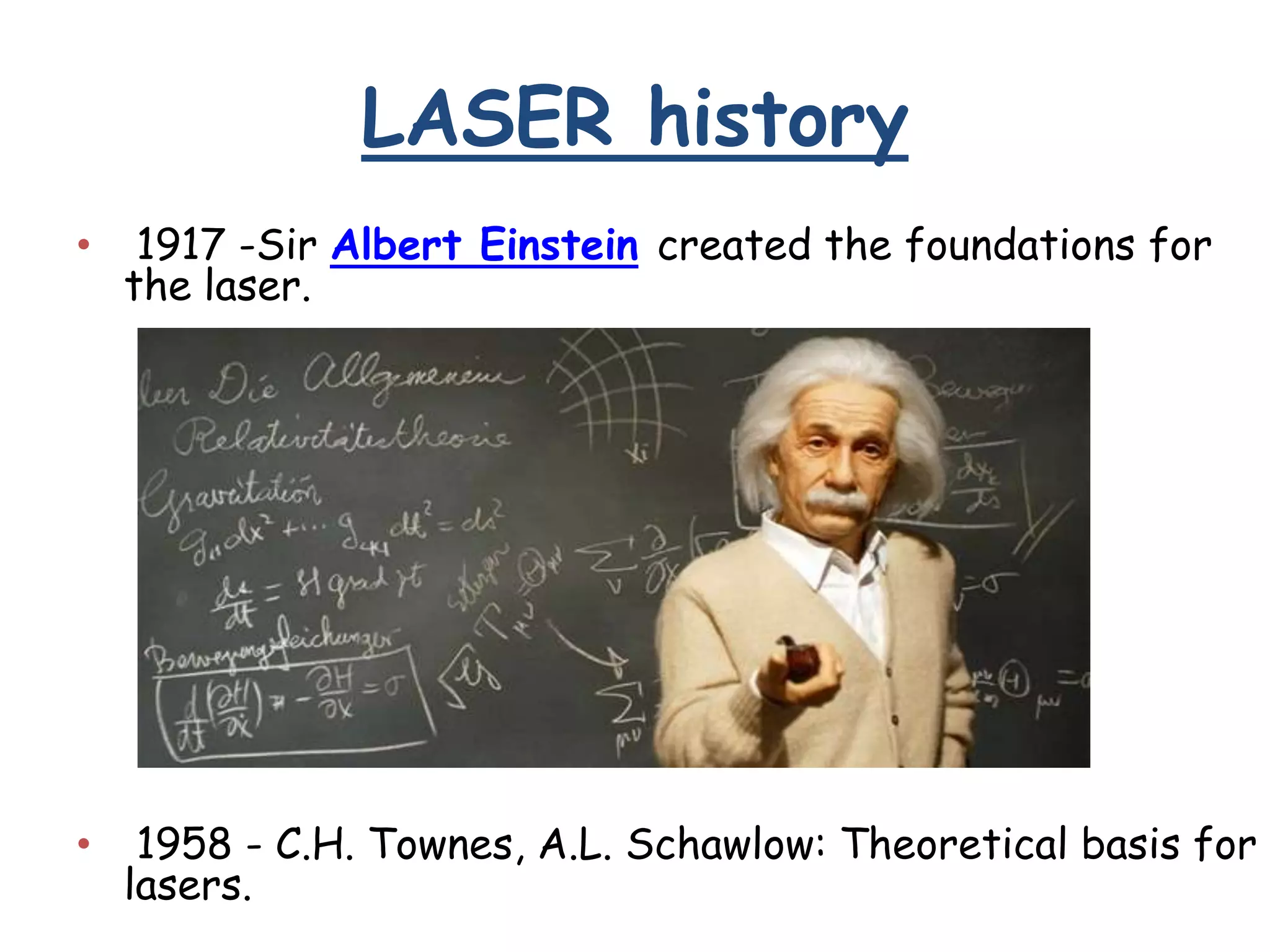
1917 -Sir Albert Einstein created the foundations for
the laser.

•

1958 - C.H. Townes, A.L. Schawlow: Theoretical basis for
lasers.
1960 - Theodore Maiman : Built first laser by
using a ruby crystal medium .
• 1963 - C. Zweng: First medical
laser trial (retinal coagulation).
• 1965 - W.Z. Yarn: First clinical
laser surgery.
• 1970- The excimer laser was
invented in by Nikolai Basov
•

1971 -Neodymium yttrium
aluminum garnet
(Nd.YAG) and Krypton
laser developed.
Lasers have many important applications.
• They are used in common consumer devices such as DVD
players, laser printers, and barcode scanners.
• They are used in medicine for laser surgery and various skin
treatments,
• And in industry for cutting and welding materials.
• They are used in military
and law enforcement devices
for marking targets and
measuring range and speed.
• Laser lighting displays use
laser light as an entertainment
medium (in DJ).
PROPERTIES OF LASER LIGHT

•

Monochromatic (emit only one wave length)

•

Coherence (all in same phase-improve focusing )

•

Polarized (in one plane-easy to pass through media)

•

Collimated (in one direction & non spreading )

•

High energy (Intensity measured by Watt J/s)
LASER Vs. LIGHT
LASER







Simulated emission
Monochromatic.
Highly energized
Parallelism
Coherence
Can be sharply focussed.

LIGHT







Spontaneous emission.
Polychromatic.
Poorly energized.
Highly divergence
Not coherent
Can not be sharply
focussed.
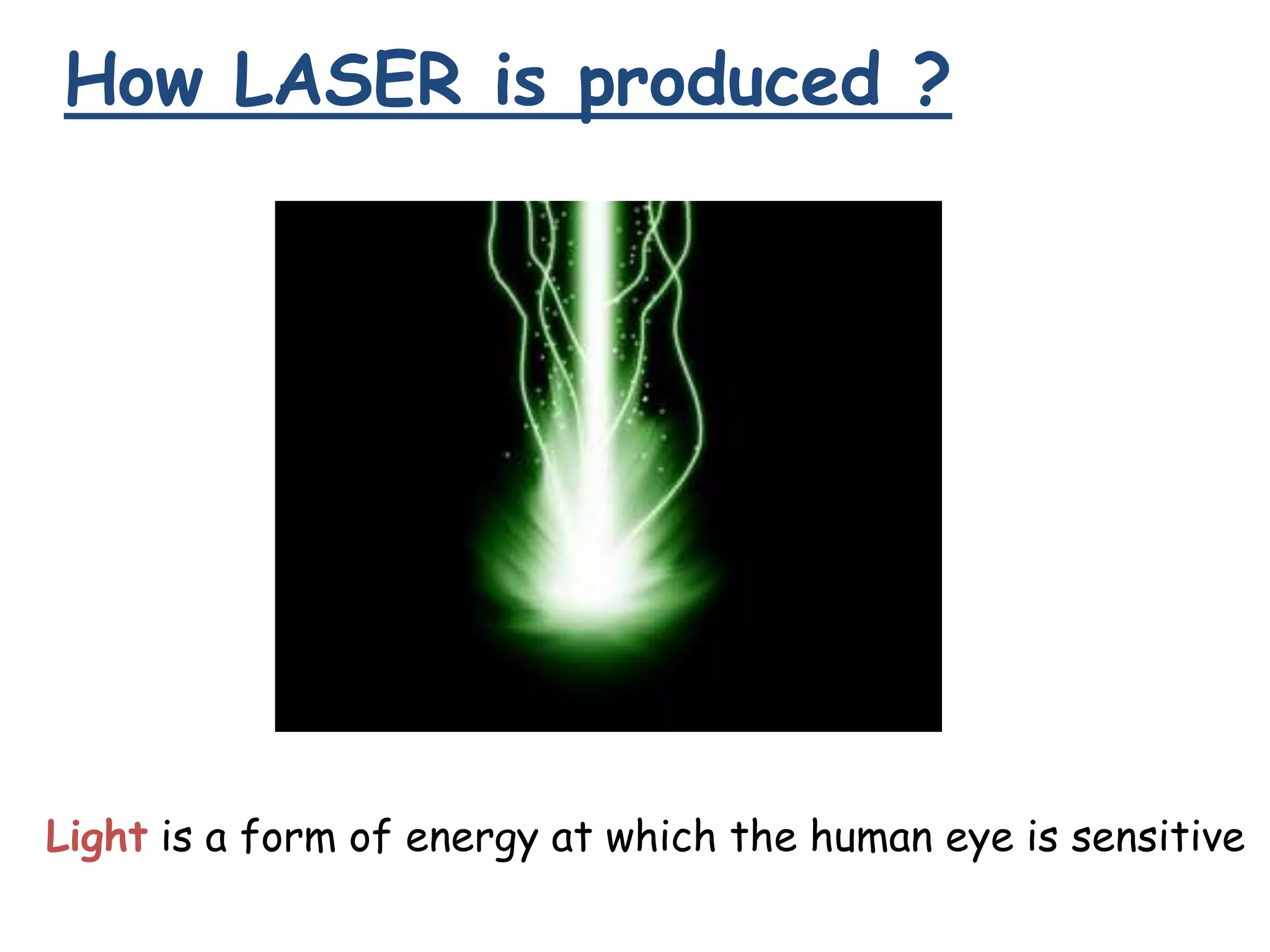
How LASER is produced ?

Light is a form of energy at which the human eye is sensitive
LASER PHYSICS
•

•

Light as electromagnetic waves, emitting radiant
energy in tiny package called ‘quanta’/photon. Each
photon has a characteristic frequency and its energy is
proportional to its frequency.
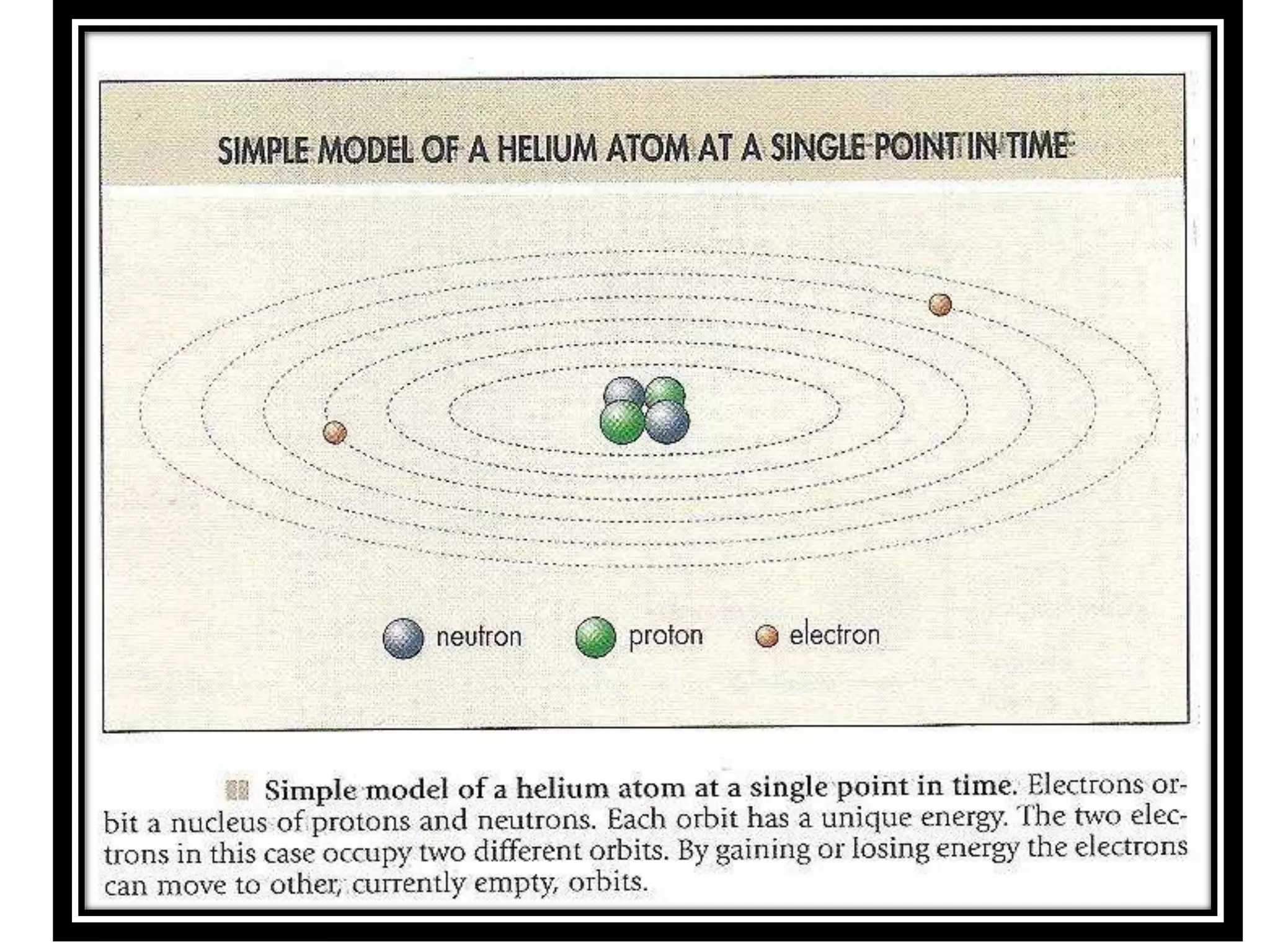
Three basic ways for photons and atoms to interact:
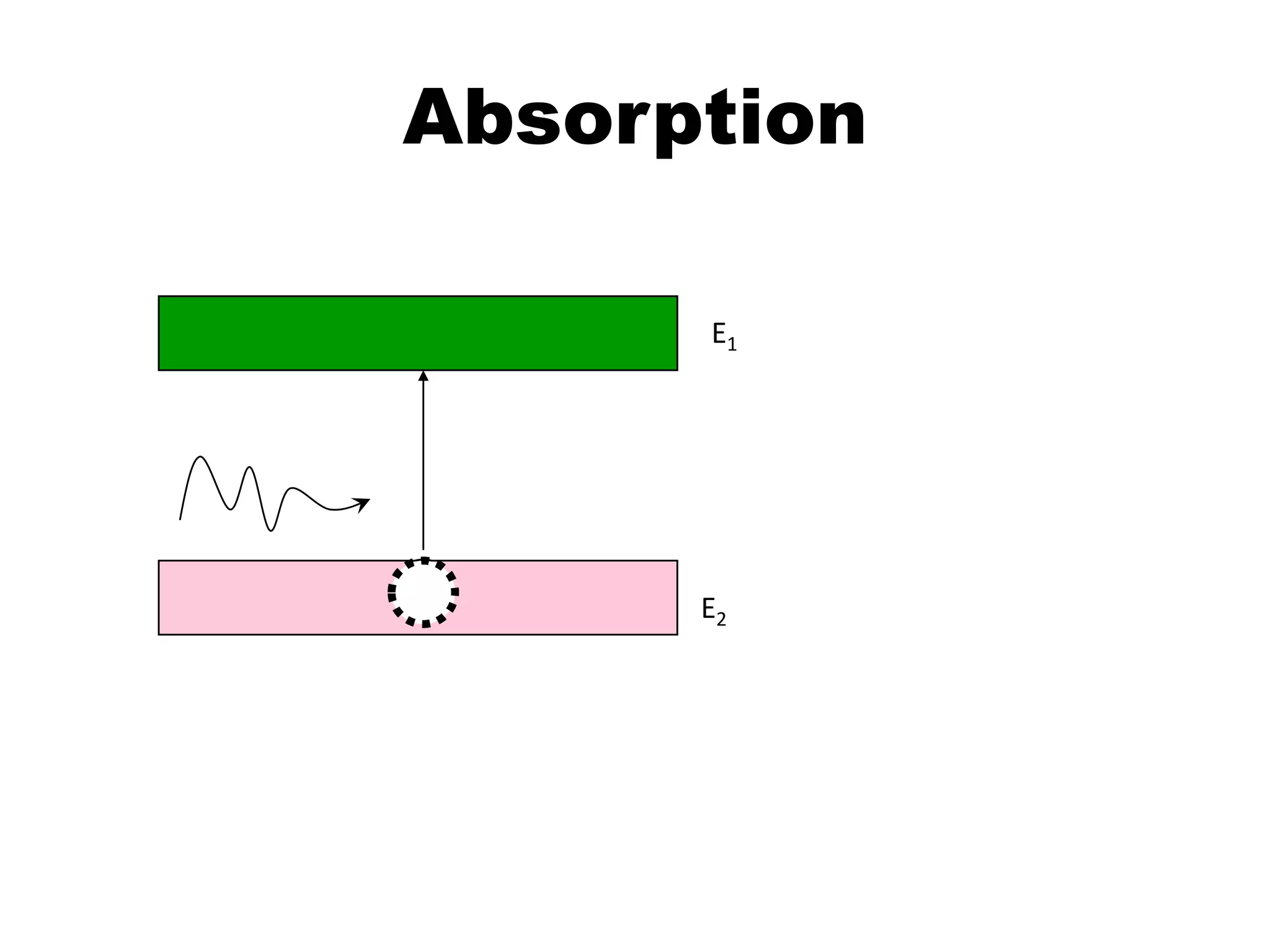
 Absorption
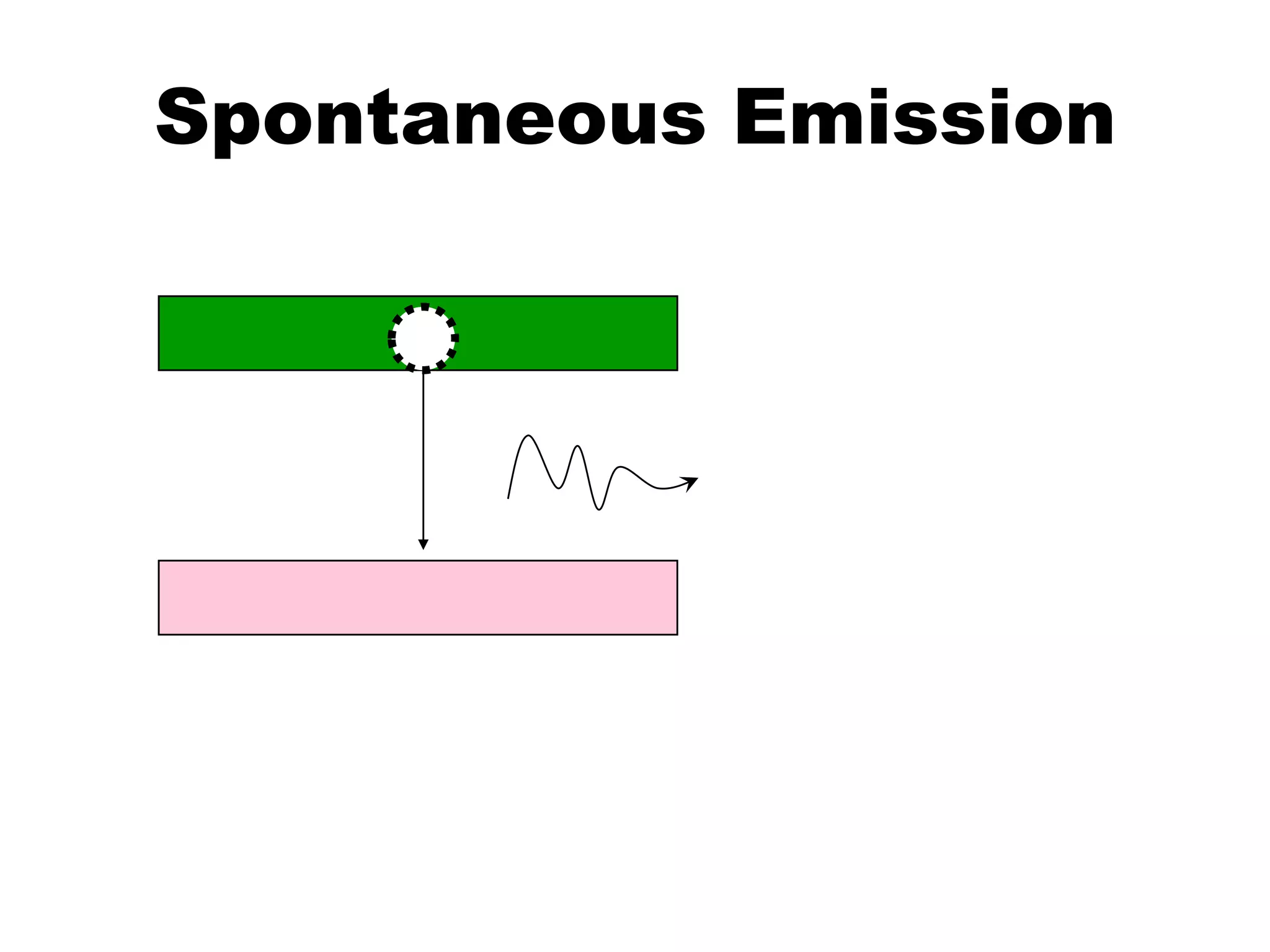
 Spontaneous Emission
 Stimulated Emission
3 Mechanisms of Light Emission
Atomic systems in thermal equilibrium with their
surrounding, the emission of light is the result of:
Absorption
And subsequently, spontaneous emission of energy
There is another process whereby the atom in an upper
energy level can be triggered or stimulated in phase with
the an incoming photon. This process is:
Stimulated emission
Is an important process for laser action
Therefore 3 process
of light emission:

1. Absorption
2. Spontaneous Emission
3. Stimulated Emission
Absorption
E1

E2
Spontaneous Emission
Stimulated Emission
Background Physics
• Consider the ‘stimulated emission’ as shown
previously.
• Stimulated emission is the basis of the laser action.
• The two photons that have been produced can then
generate more photons, and the 4 generated can
generate 16 etc… etc… which could result in a
cascade of intense monochromatic radiation.
CLASSIFICATION OF LASER






Solid State
Ruby
Nd.Yag
Erbium.YAG
Molmium.YAG
Gas
Ion
Argon
Krypton
He-Neon
CO2
Metal Vapour
Cu
Gold
TYPES OF OPHTHALMIC LASERS
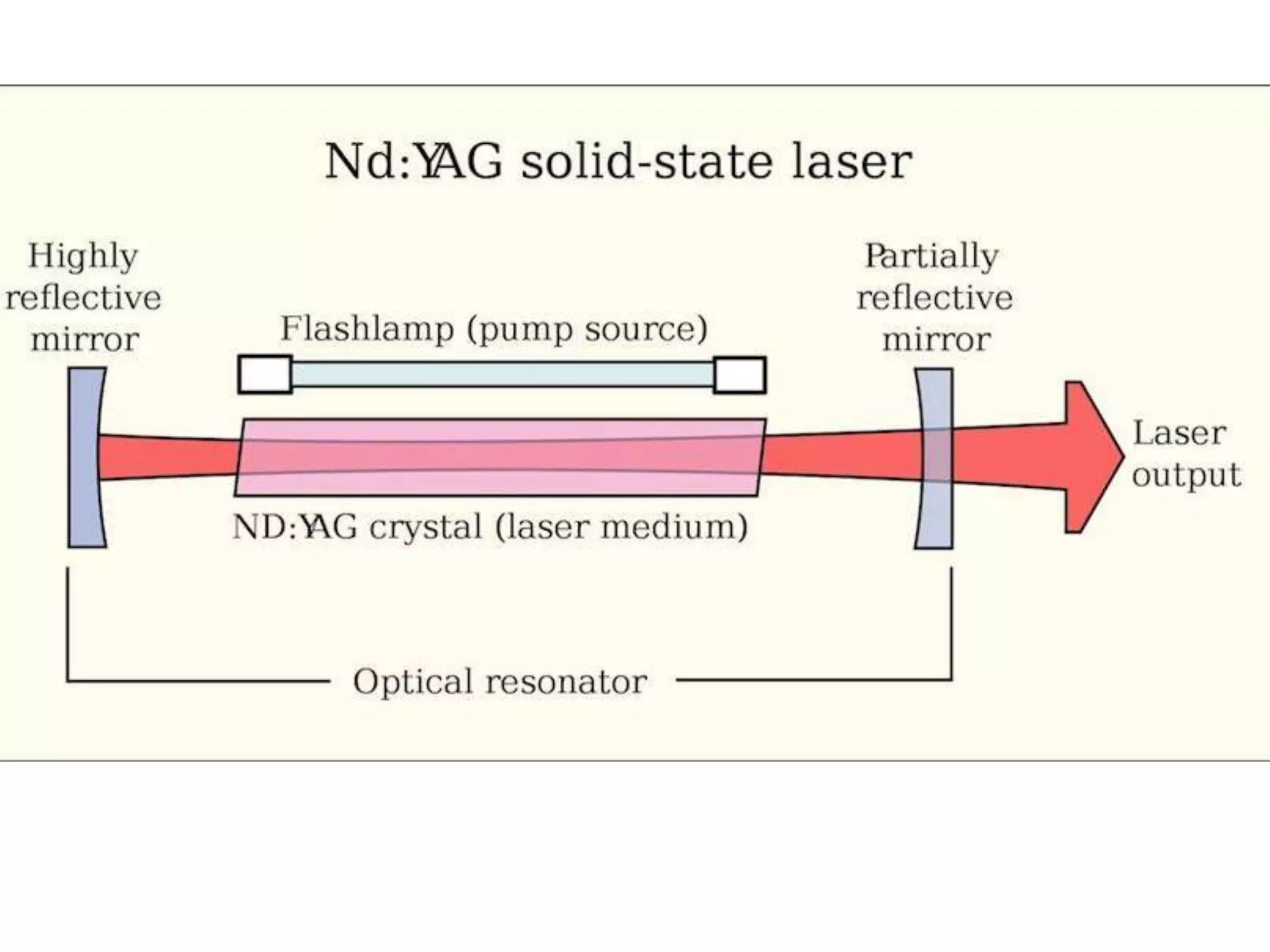
Nd:YAG laser
• (neodymium-doped yttrium aluminum garnet) is a crystal that is used
as a lasing medium for solid-state lasers.
• Nd:YAG lasers typically emit light with a wavelength of 1064nm, in
the infrared.
Applications
• Correct posterior capsular opacification
• Peripheral iridotomy in patients with acute angle-closure glaucoma.
• Frequency-doubled Nd:YAG lasers (wavelength 532 nm) are used for
pan-retinal photocoagulation in patients with diabetic retinopathy.
Excimer laser
• Is a form
of ultraviolet laser
• Used
indelicate surgeries
such as eye
surgery eg ;LASIK.
LASER TISSUE INTERACTION

LASER VARIABLE:

TISSUE VARIABLE:



Wavelength



Transparency



Spot Size



Pigmentation



Power



Water Content



Duration
THREE TYPE OF OCULAR PIGMENT
Effective retinal photocoagulation depends on how well light penetrates
the ocular media and how well the light is absorbed by pigment in the
target tissue
Haemoglobin:
absorbs blue, green and yellow with minimal red wavelength
absorption, useful to coagulate the blood vessels.
Xanthophyll:
Macular area, Lens
Maximum absorption is blue. minimally absorbs yellow or red
wavelengths
Melanin:
RPE, Choroid
absorbs green, yellow, red and infrared wavelengths
Pan Retinal Photocoagulation, and Destruction of RPE
LASER TISSUE INTERACTION
LASER

TISSUE

Thermal
Effect
 Photocoagulation
 Photodisruption
 Photovaporization

Photochemical
 Photoradation
 Photoablation

Ionizing
Effect
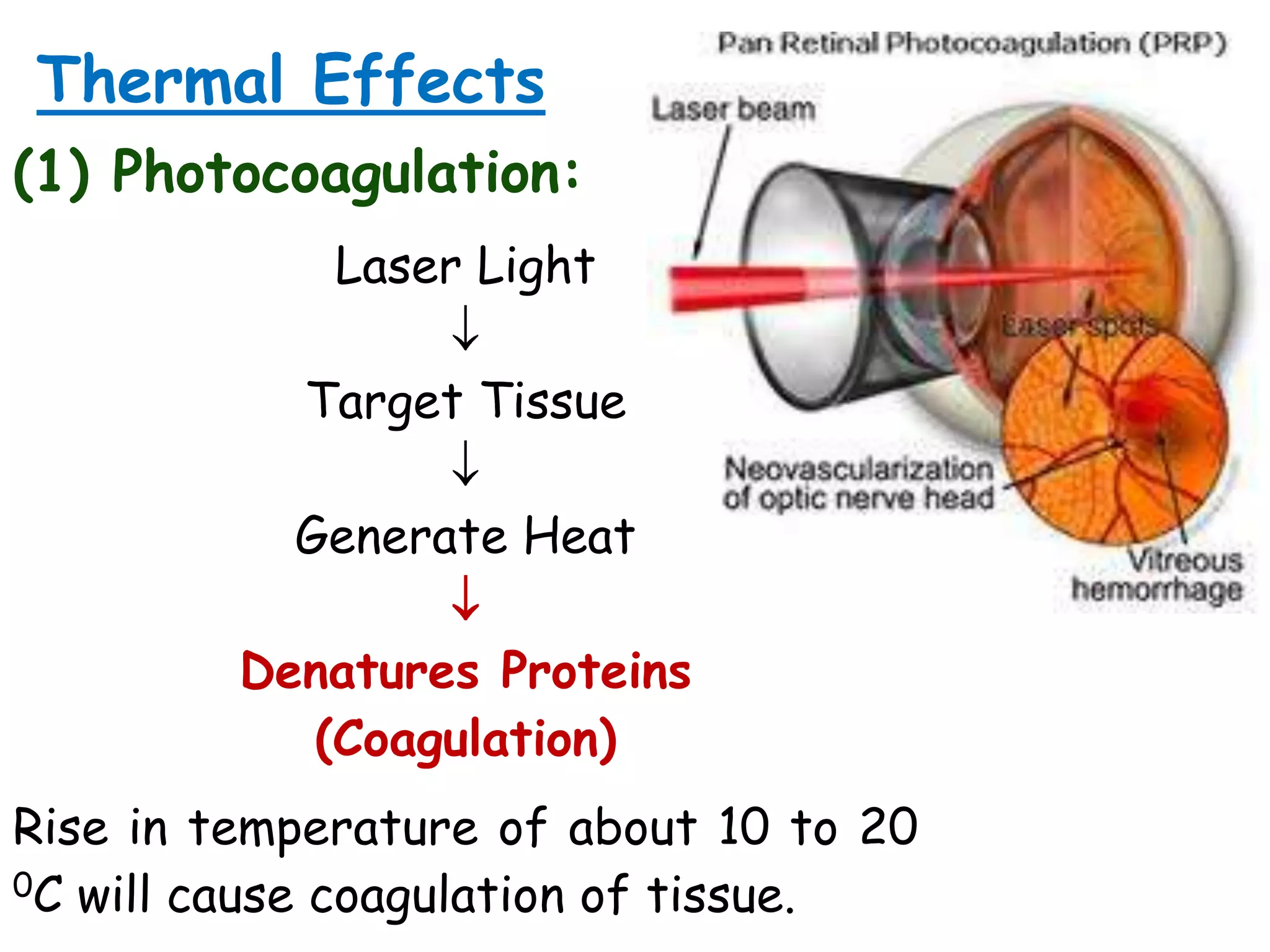
Thermal Effects
(1) Photocoagulation:
Laser Light
Target Tissue

Generate Heat
Denatures Proteins
(Coagulation)
Rise in temperature of about 10 to 20
0C will cause coagulation of tissue.
Thermal Effects

(2) Photodisruption:
•

Mechanical Effect: Laser Light

Acoustic Shockwaves
Tissue Damage

Contd. …
Thermal Effects
(3)photovaporization


Vaporization of tissue to CO2 and water occurs when
its temperature rise 60—100 0C or greater.



Commonly used CO2

Absorbed by water of cells
Visible vapor (vaporization)

Heat

Cell disintegration

Cauterization

Incision

eg..Femtosecond laser
Photochemical effcts

Photoablation:
•

Contd. …

Breaks the chemical bonds that hold tissue
together essentially vaporizing the tissue, e.g.
Photorefractive Keratectomy, Argon Fluoride
(ArF) Excimer Laser.
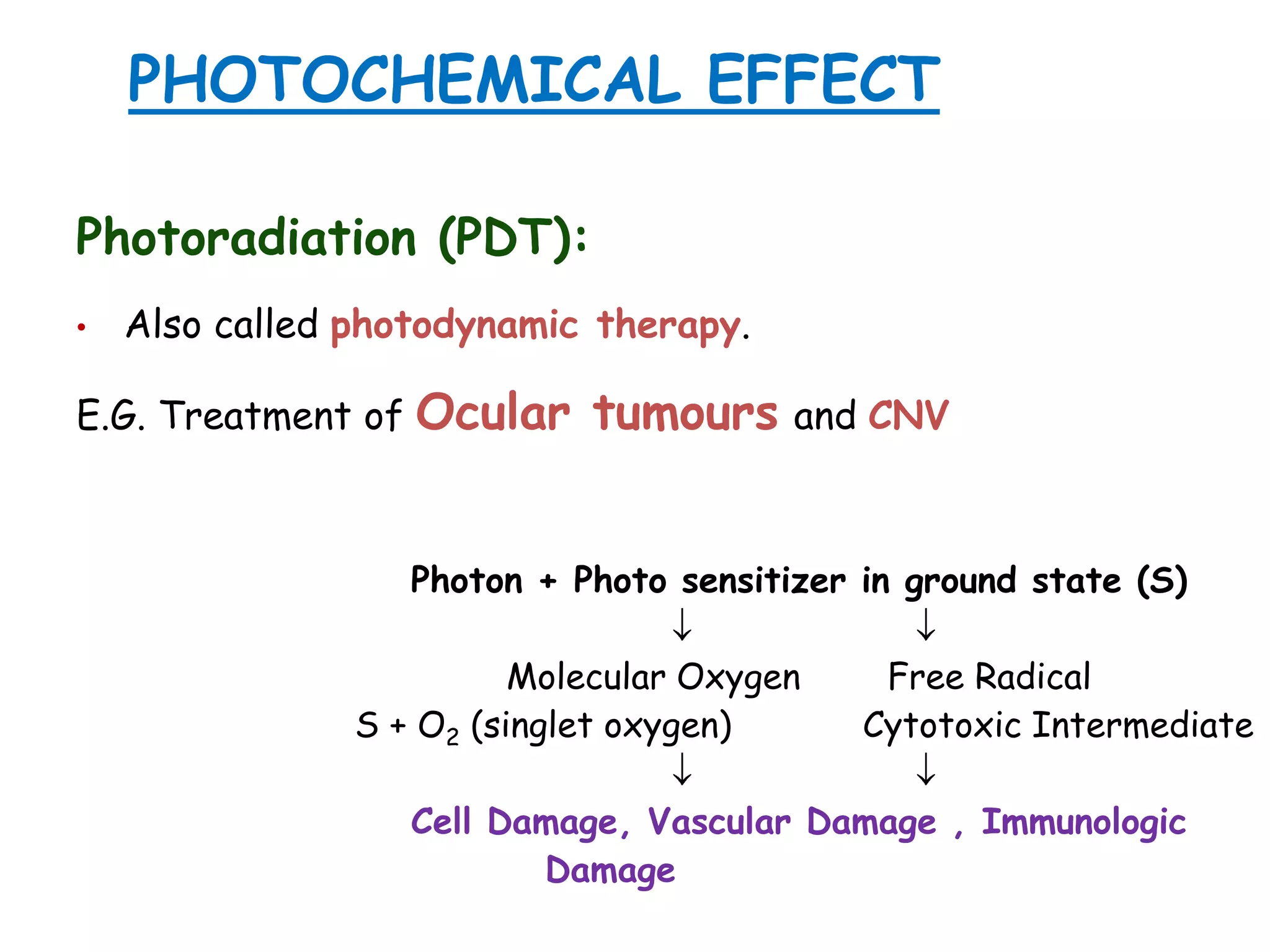
PHOTOCHEMICAL EFFECT
Photoradiation (PDT):
•

Also called photodynamic therapy.

E.G. Treatment of

Ocular tumours

and CNV

Photon + Photo sensitizer in ground state (S)
Molecular Oxygen
S + O2 (singlet oxygen)

Free Radical
Cytotoxic Intermediate

Cell Damage, Vascular Damage , Immunologic
Damage
LASER INSTRUMENTATION
Three Main Components –
•

•

•

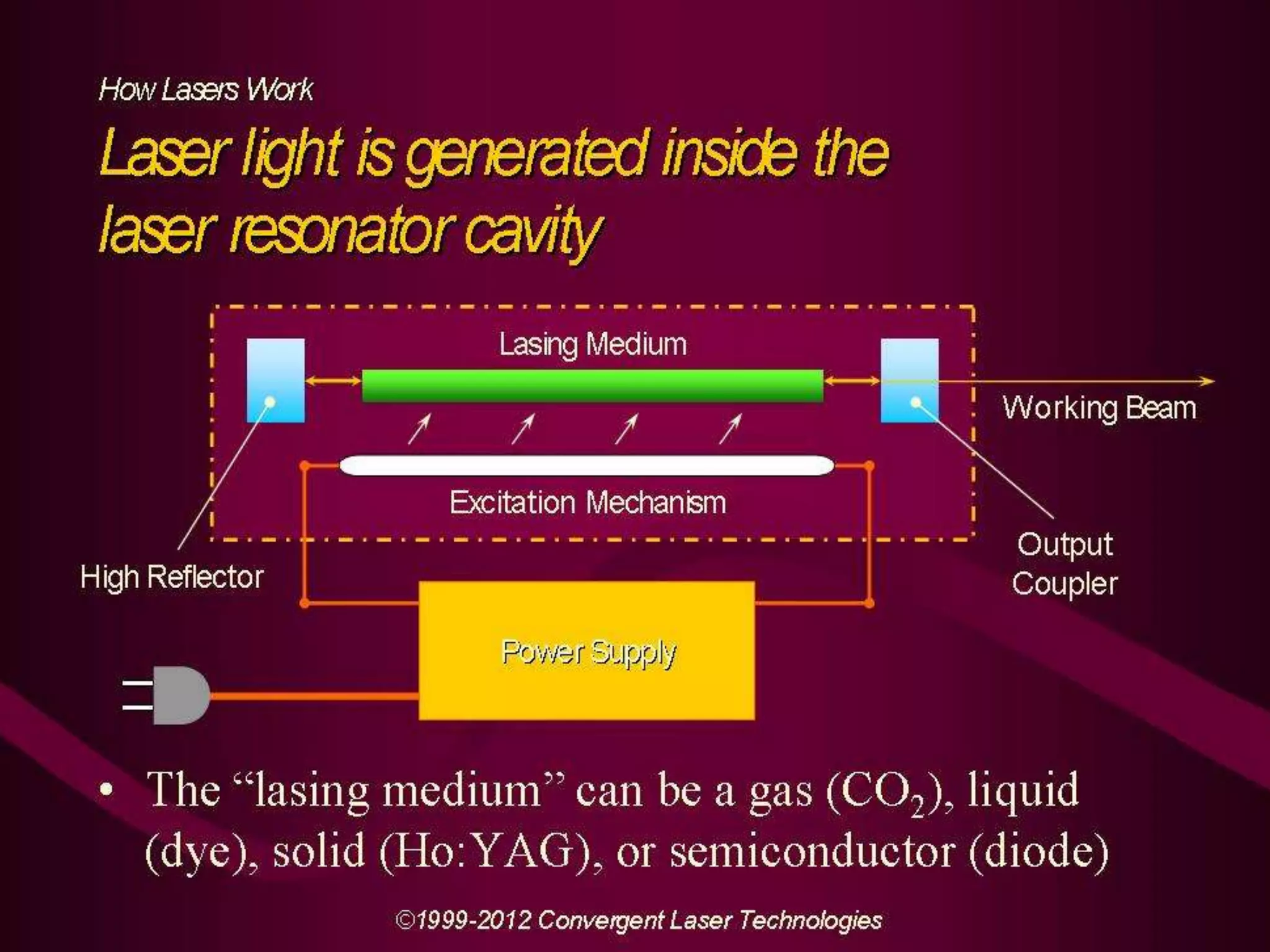
Console: It contain laser medium and tube,
power supply and laser control system.
Control Panel: It contain dials or push
buttons for controlling various parameters.
Contain a standby switch as a safety
measure.
Delivery System:

 Slit Lamp Microscope
 Indirect Ophthalmoscopes
ACCESSORY COMPONENT
•

Aiming Beam

•

Laser Switch

•

Safety Filter

•

Corneal Contact Lenses for Laser use
 Single mirror gonio lens
 Abraham or wise iriditomy lens
 Goldman style 3-mirror lens
 Panretinal lenses
e.g. Rodenstock, Mainster, Volk-Quadri spheric
•

Indirect Fundus Lenses for Indirect Ophthalmoscopes
USING THE OPHTHALMIC LASER
PREPARATION OF THE PATIENT FOR laser:


Local Anaesthetic



Position of the patient at Slit Lamp

THE SURGEON:


Comfortable position at Slit Lamp



Semi-darkened Room



Appropriate Contact Lens
LASER IN ANTERIOR SEGMENT
CORNEA:
Laser in Keratorefractive Surgery:
• Photo Refractive Keratectomy (PRK)
• Laser in situ Keratomileusis (LASIK)
• Laser Subepithelial Keratectomy (LASEK)
• Epi Lasik
Laser Thermal Keratoplasty
Corneal Neovascularization
Retrocorneal Pigmented Plaques
Laser Asepsis
LASER IN GLAUCOMA


Laser Iridotomy, Laser Iredectomy



Laser Trabeculoplasty (LT)



Selective Laser Trabeculoplasty
Laser Iridotomy, Laser Iredectomy
• always pre-treat with argon prior to doing a Yag.
• a small spot size (~50microns) with a relatively high power
(500 or so). Place about 10-15 spots in a flower petal type
pattern in a iris crypt in the supero-nasal quadrant in the
far peripheral iris.
• This hopefully coagulates any iris stromal vessels and
prevents bleeding when doing the Yag portion.
• Start Yag power at about 3 to 4 mJ, only take about 5 - 10
shots to get that wonderfully rewarding gush of pigment
and fluid.
• Remember to check IOP about 1 hour post op, warn them
about signs/symptoms of IOP spike and keep on pred forte
qid for about a week to prevent inflammation.
LASER IN LENS
• Posterior capsulotomy(YAG)

• Laser phacoemulcification
• Phacoablation

LASER IN VITEROUS
• Viterous membranes
• Viterous traction bands
Posterior capsulotomy(YAG)
LASER TREATMENT OF
FUNDUS DISORDERS


Diabetic Retinopathy



Retinal Vascular Diseases



Choroidal Neovascularization (CNV)



Clinical Significant Macular Edema (CSME)



Central Serous Retinopathy (CSR)



Retinal Break/Detachment



Tumour
panretinal photocoagulation
• PRP place laser spots in the peripheral retina for 360
degrees sparing the central 30 degrees of the retina.
POWER, SIZE, NUMBER, AND SESSIONS

Recommendations in the ETDRS for an initial treatment
consisted of 1,200 to 1,600 burns of moderate intensity, 500μm size, one-half to one-spot diameter spacing at 0.1-second
duration, divided over at least two sessions.

typical starting power setting for a 300-μm spot of 0.1second duration might be around 250 mW, but this is highly
dependent on the operator's laser, the status of the ocular
media, and the pigmentation of the retina.
Panretinal photocoagulation (PRP) ctd

Indications
1. Proliferative diabetic retinopathy with high risk
characteristics
2. Neovascularisation of iris
3. Severe non proliferative diabetic retinopathy associated
with-poor compliance for follow up-before cataract
surgery-renal failure-one eyed patient and-pregnancy
4. central retinal vein occlusion, branch retinal vein
occlusion,
5. sickle retinopathy,
6. Eales disease and IRVAN (idiopathic retinal vasculitis,
aneurysms, and neuroretinitis )
How does panretinal photocoagulation
work?
• Sublethally injured RPE cells that surround areas of
photocoagulation necrosis and produces significant
thinning of the outer retina.
• By decreasing the oxygen consumption at the
photoreceptor–RPE complex, more oxygen is available
to diffuse into the inner retina and vitreous.
• Enhanced oxygen diffusion into the inner retina
and vitreous reduces inner retina ischemia and the
stimulus for neovascularization.
• PRP reduces retinal ischemia and the hypoxia-induced
expression of VEGF.
Focal or grid photocoagulation
• Macular edema from diabetes or branch vein occlusion .
• Retinopathy of prematurity(ROP)
• Closure of retinal microvascular abnormalities such as
microaneurysms, telangiectasia and perivascular leakage
• Focal ablation of extrafoveal choroidal neovascular
membrane
• Creation of chorioretinal adhesions surrounding retinal
breaks and detached areas.
• Focal treatment of pigment abnormalities such as leakage
from central serous chorioretinopathy
• Treatment of ocular tumors.
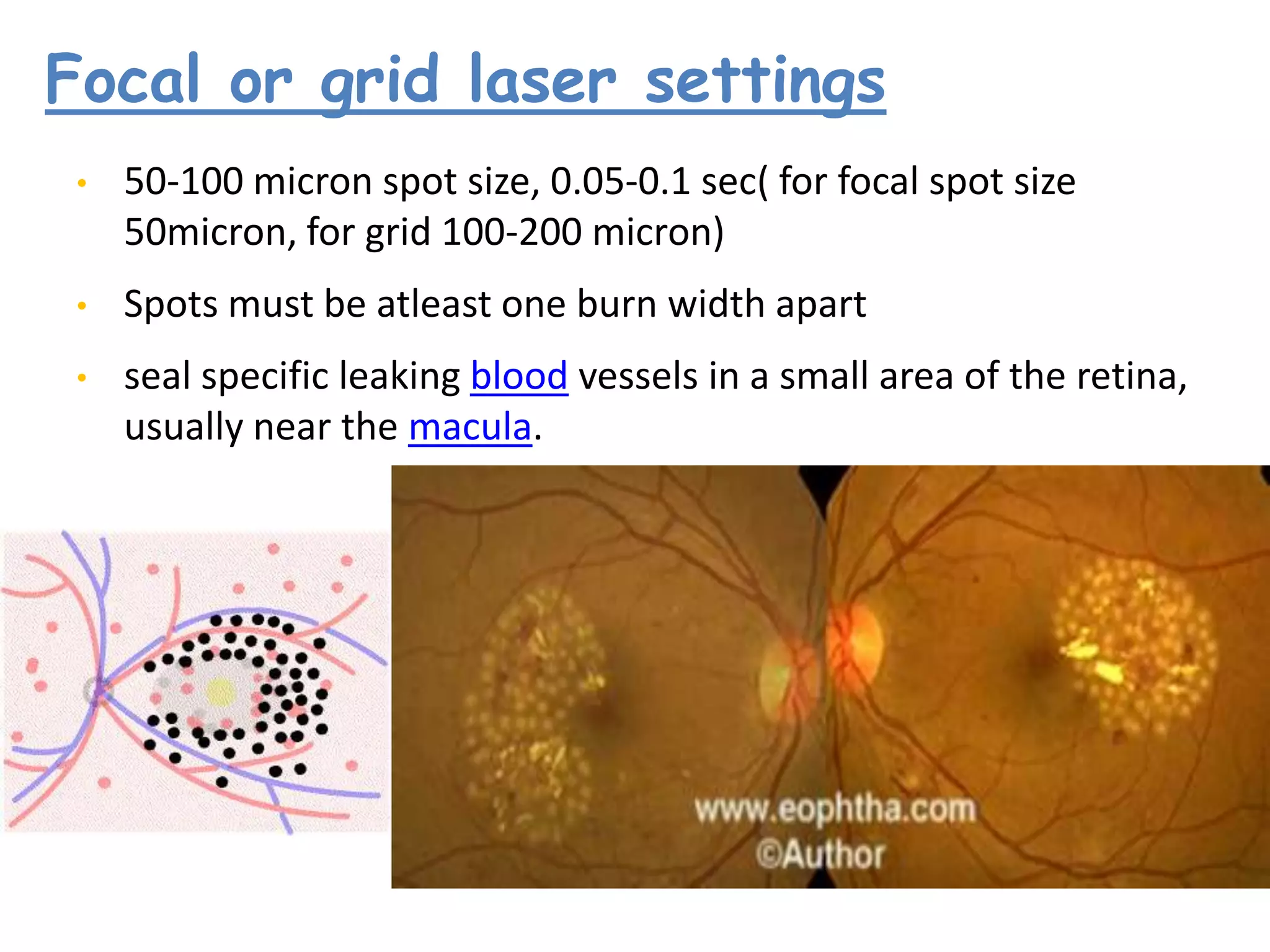
Focal or grid laser settings
•

50-100 micron spot size, 0.05-0.1 sec( for focal spot size
50micron, for grid 100-200 micron)

•

Spots must be atleast one burn width apart

•

seal specific leaking blood vessels in a small area of the retina,
usually near the macula.
Pathophysiology of focal Laser
several theories
• laser energy removes unhealthy RPE cells which are
then replaced by more viable RPE cells.
• photocoagulation stimulates the existing RPE cells to
absorb more fluid.
• laser treatment may stimulate vascular endothelial
proliferation and improve the integrity of the inner
blood-retinal barrier.
FEMTOSECOND LASER
Mode-locking is a technique in optics by which a laser can be made to
produce pulses of light of extremely short duration, on the order of
picoseconds (10−12s) or femtoseconds (10−15s).

Indications

1. Clear Corneal Incisions
in LASIK it replaces a mechanical device
(microkeratome) to create a precise corneal
flap, also in cataract surgery to create the
incision
1. Capsulotomy
2. Phacofragmentation
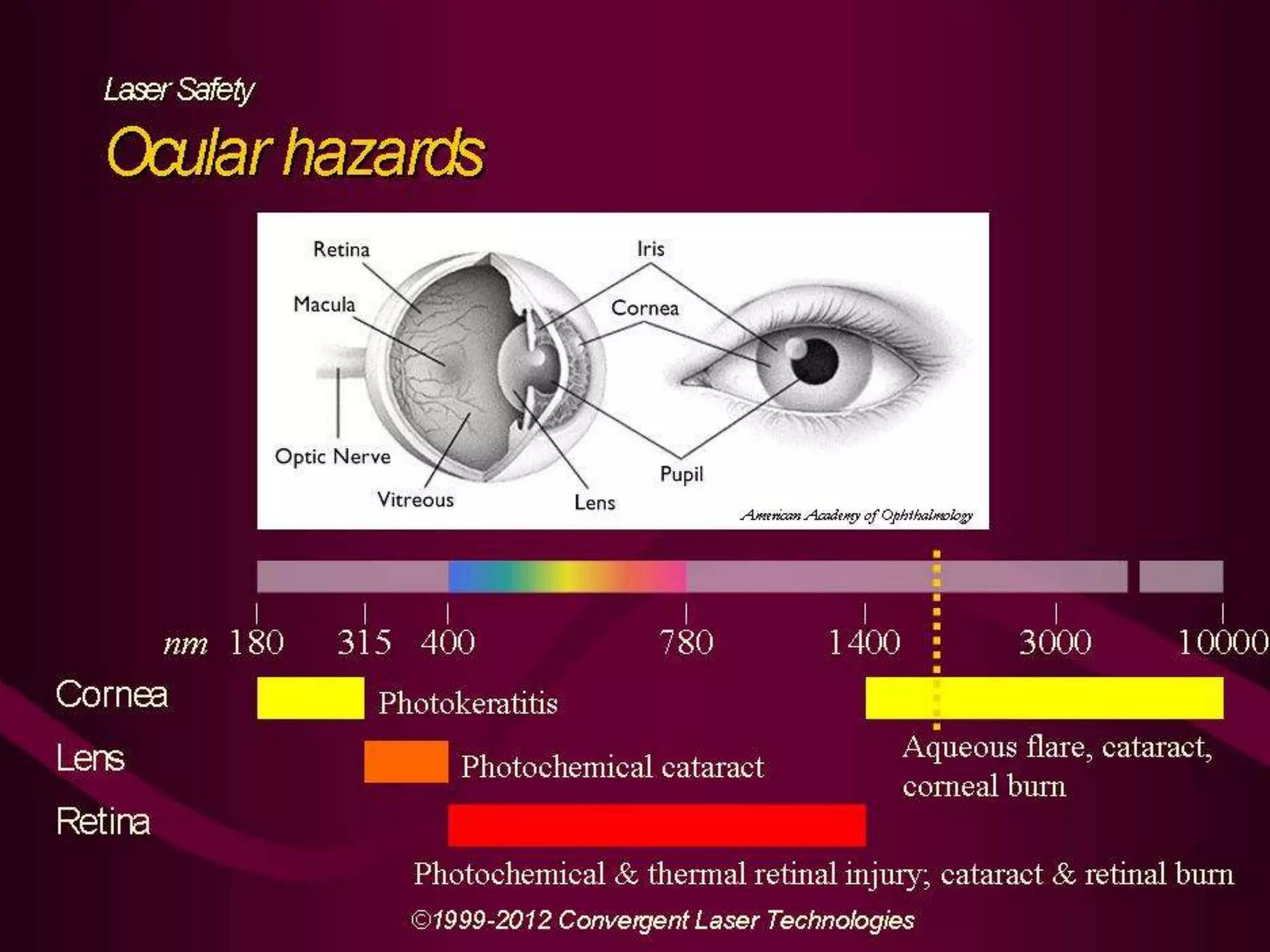
LASER HAZARDS
EYE
• Small lesion to extensive haemorrhage
• Disruption of retina and choroid
• Immediate loss of vision
• Epiretinal membrane formation
• Macular hole,gliosis
SKIN
• Erythema
• Carcinogenesis
COMPLICATION OF LASER TREATMENT


Pain



Seizure



CD & RD



Foveal Burn



Increased IOP



Corneal Damage



Iris Burn



Cataract



InternalOphthalmoplegia
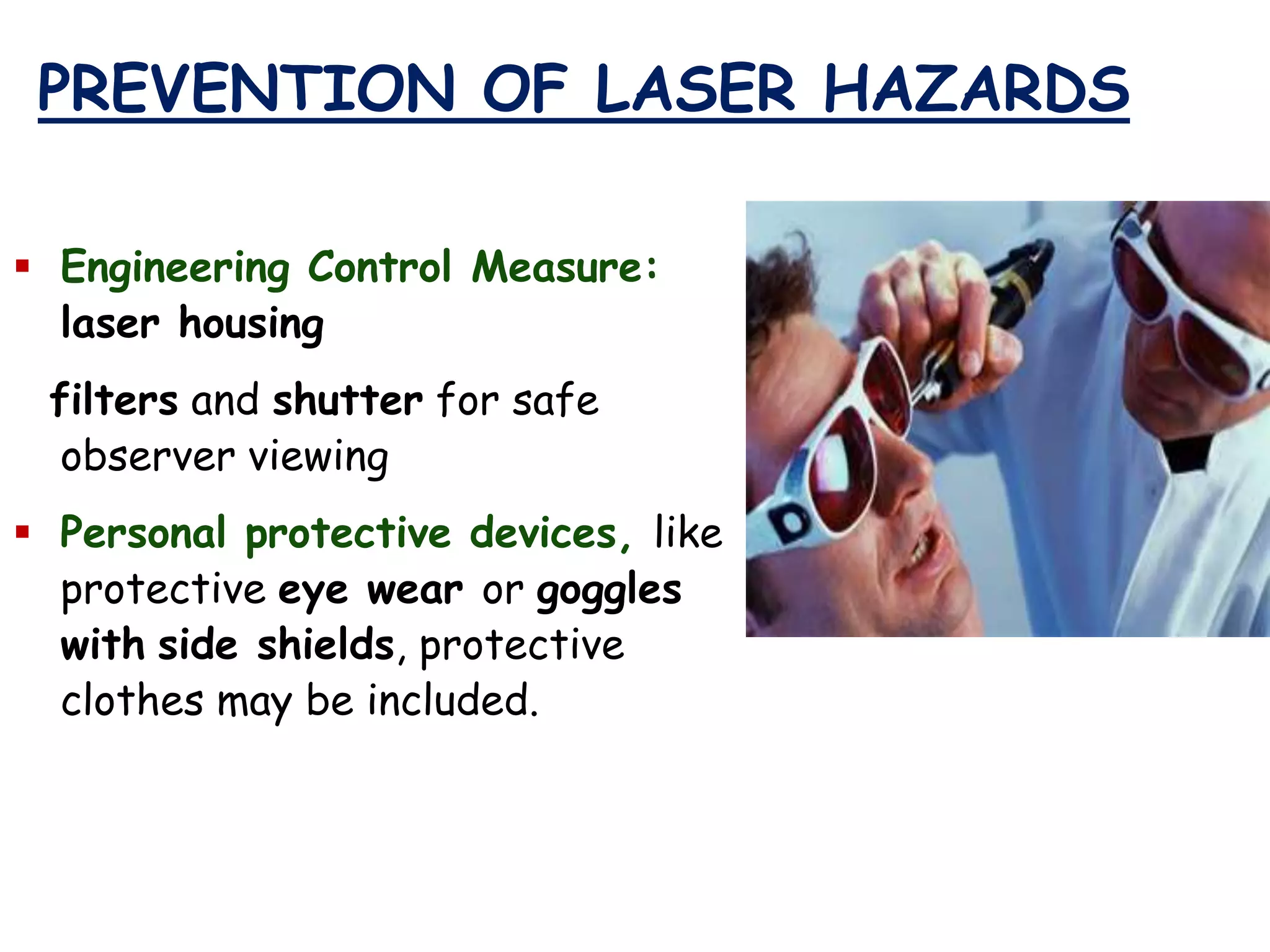
PREVENTION OF LASER HAZARDS
 Engineering Control Measure:
laser housing
filters and shutter for safe
observer viewing

 Personal protective devices, like
protective eye wear or goggles
with side shields, protective
clothes may be included.
New Developments
Pattern Scan Laser:(pascal)
PASCAL
PATTERN SCAN LASER:(Pascal)
Offering multiple, patterned burns in a single-session

procedure.


Improved precision



Safety



Patient comfort



Significant reduction in treatment time.
Laser
Laser

Laser

  • 1.
  • 2.
    Objectives • • • • • • • What is Laser? LASER history.. LASER Properties. How LASER is produced ? Effects of laser. Application of LASERs in Ophthalmology. LASER Safety.
  • 3.
    What is Laser? LASERis an acronym for: L : Light A: Amplification (by) S : Stimulated E : Emission (of) R : Radiation Term coined by Gordon Gould. Lase means to absorb energy in one form and to emit a new form of light energy which is more useful.
  • 4.
    LASER history • 1917 -SirAlbert Einstein created the foundations for the laser. • 1958 - C.H. Townes, A.L. Schawlow: Theoretical basis for lasers.
  • 5.
    1960 - TheodoreMaiman : Built first laser by using a ruby crystal medium .
  • 6.
    • 1963 -C. Zweng: First medical laser trial (retinal coagulation). • 1965 - W.Z. Yarn: First clinical laser surgery. • 1970- The excimer laser was invented in by Nikolai Basov • 1971 -Neodymium yttrium aluminum garnet (Nd.YAG) and Krypton laser developed.
  • 7.
    Lasers have manyimportant applications. • They are used in common consumer devices such as DVD players, laser printers, and barcode scanners. • They are used in medicine for laser surgery and various skin treatments, • And in industry for cutting and welding materials. • They are used in military and law enforcement devices for marking targets and measuring range and speed. • Laser lighting displays use laser light as an entertainment medium (in DJ).
  • 8.
    PROPERTIES OF LASERLIGHT • Monochromatic (emit only one wave length) • Coherence (all in same phase-improve focusing ) • Polarized (in one plane-easy to pass through media) • Collimated (in one direction & non spreading ) • High energy (Intensity measured by Watt J/s)
  • 9.
    LASER Vs. LIGHT LASER       Simulatedemission Monochromatic. Highly energized Parallelism Coherence Can be sharply focussed. LIGHT       Spontaneous emission. Polychromatic. Poorly energized. Highly divergence Not coherent Can not be sharply focussed.
  • 10.
    How LASER isproduced ? Light is a form of energy at which the human eye is sensitive
  • 11.
    LASER PHYSICS • • Light aselectromagnetic waves, emitting radiant energy in tiny package called ‘quanta’/photon. Each photon has a characteristic frequency and its energy is proportional to its frequency. Three basic ways for photons and atoms to interact:  Absorption  Spontaneous Emission  Stimulated Emission
  • 12.
    3 Mechanisms ofLight Emission Atomic systems in thermal equilibrium with their surrounding, the emission of light is the result of: Absorption And subsequently, spontaneous emission of energy There is another process whereby the atom in an upper energy level can be triggered or stimulated in phase with the an incoming photon. This process is: Stimulated emission Is an important process for laser action Therefore 3 process of light emission: 1. Absorption 2. Spontaneous Emission 3. Stimulated Emission
  • 14.
  • 15.
  • 16.
  • 17.
    Background Physics • Considerthe ‘stimulated emission’ as shown previously. • Stimulated emission is the basis of the laser action. • The two photons that have been produced can then generate more photons, and the 4 generated can generate 16 etc… etc… which could result in a cascade of intense monochromatic radiation.
  • 22.
    CLASSIFICATION OF LASER    SolidState Ruby Nd.Yag Erbium.YAG Molmium.YAG Gas Ion Argon Krypton He-Neon CO2 Metal Vapour Cu Gold
  • 23.
  • 24.
    Nd:YAG laser • (neodymium-dopedyttrium aluminum garnet) is a crystal that is used as a lasing medium for solid-state lasers. • Nd:YAG lasers typically emit light with a wavelength of 1064nm, in the infrared. Applications • Correct posterior capsular opacification • Peripheral iridotomy in patients with acute angle-closure glaucoma. • Frequency-doubled Nd:YAG lasers (wavelength 532 nm) are used for pan-retinal photocoagulation in patients with diabetic retinopathy.
  • 25.
    Excimer laser • Isa form of ultraviolet laser • Used indelicate surgeries such as eye surgery eg ;LASIK.
  • 26.
    LASER TISSUE INTERACTION LASERVARIABLE: TISSUE VARIABLE:  Wavelength  Transparency  Spot Size  Pigmentation  Power  Water Content  Duration
  • 27.
    THREE TYPE OFOCULAR PIGMENT Effective retinal photocoagulation depends on how well light penetrates the ocular media and how well the light is absorbed by pigment in the target tissue Haemoglobin: absorbs blue, green and yellow with minimal red wavelength absorption, useful to coagulate the blood vessels. Xanthophyll: Macular area, Lens Maximum absorption is blue. minimally absorbs yellow or red wavelengths Melanin: RPE, Choroid absorbs green, yellow, red and infrared wavelengths Pan Retinal Photocoagulation, and Destruction of RPE
  • 28.
    LASER TISSUE INTERACTION LASER TISSUE Thermal Effect Photocoagulation  Photodisruption  Photovaporization Photochemical  Photoradation  Photoablation Ionizing Effect
  • 29.
    Thermal Effects (1) Photocoagulation: LaserLight Target Tissue Generate Heat Denatures Proteins (Coagulation) Rise in temperature of about 10 to 20 0C will cause coagulation of tissue.
  • 30.
    Thermal Effects (2) Photodisruption: • MechanicalEffect: Laser Light Acoustic Shockwaves Tissue Damage Contd. …
  • 31.
    Thermal Effects (3)photovaporization  Vaporization oftissue to CO2 and water occurs when its temperature rise 60—100 0C or greater.  Commonly used CO2 Absorbed by water of cells Visible vapor (vaporization) Heat Cell disintegration Cauterization Incision eg..Femtosecond laser
  • 32.
    Photochemical effcts Photoablation: • Contd. … Breaksthe chemical bonds that hold tissue together essentially vaporizing the tissue, e.g. Photorefractive Keratectomy, Argon Fluoride (ArF) Excimer Laser.
  • 33.
    PHOTOCHEMICAL EFFECT Photoradiation (PDT): • Alsocalled photodynamic therapy. E.G. Treatment of Ocular tumours and CNV Photon + Photo sensitizer in ground state (S) Molecular Oxygen S + O2 (singlet oxygen) Free Radical Cytotoxic Intermediate Cell Damage, Vascular Damage , Immunologic Damage
  • 34.
    LASER INSTRUMENTATION Three MainComponents – • • • Console: It contain laser medium and tube, power supply and laser control system. Control Panel: It contain dials or push buttons for controlling various parameters. Contain a standby switch as a safety measure. Delivery System:  Slit Lamp Microscope  Indirect Ophthalmoscopes
  • 35.
    ACCESSORY COMPONENT • Aiming Beam • LaserSwitch • Safety Filter • Corneal Contact Lenses for Laser use  Single mirror gonio lens  Abraham or wise iriditomy lens  Goldman style 3-mirror lens  Panretinal lenses e.g. Rodenstock, Mainster, Volk-Quadri spheric • Indirect Fundus Lenses for Indirect Ophthalmoscopes
  • 36.
    USING THE OPHTHALMICLASER PREPARATION OF THE PATIENT FOR laser:  Local Anaesthetic  Position of the patient at Slit Lamp THE SURGEON:  Comfortable position at Slit Lamp  Semi-darkened Room  Appropriate Contact Lens
  • 37.
    LASER IN ANTERIORSEGMENT CORNEA: Laser in Keratorefractive Surgery: • Photo Refractive Keratectomy (PRK) • Laser in situ Keratomileusis (LASIK) • Laser Subepithelial Keratectomy (LASEK) • Epi Lasik Laser Thermal Keratoplasty Corneal Neovascularization Retrocorneal Pigmented Plaques Laser Asepsis
  • 38.
    LASER IN GLAUCOMA  LaserIridotomy, Laser Iredectomy  Laser Trabeculoplasty (LT)  Selective Laser Trabeculoplasty
  • 39.
    Laser Iridotomy, LaserIredectomy • always pre-treat with argon prior to doing a Yag. • a small spot size (~50microns) with a relatively high power (500 or so). Place about 10-15 spots in a flower petal type pattern in a iris crypt in the supero-nasal quadrant in the far peripheral iris. • This hopefully coagulates any iris stromal vessels and prevents bleeding when doing the Yag portion. • Start Yag power at about 3 to 4 mJ, only take about 5 - 10 shots to get that wonderfully rewarding gush of pigment and fluid. • Remember to check IOP about 1 hour post op, warn them about signs/symptoms of IOP spike and keep on pred forte qid for about a week to prevent inflammation.
  • 41.
    LASER IN LENS •Posterior capsulotomy(YAG) • Laser phacoemulcification • Phacoablation LASER IN VITEROUS • Viterous membranes • Viterous traction bands
  • 42.
  • 44.
    LASER TREATMENT OF FUNDUSDISORDERS  Diabetic Retinopathy  Retinal Vascular Diseases  Choroidal Neovascularization (CNV)  Clinical Significant Macular Edema (CSME)  Central Serous Retinopathy (CSR)  Retinal Break/Detachment  Tumour
  • 45.
    panretinal photocoagulation • PRPplace laser spots in the peripheral retina for 360 degrees sparing the central 30 degrees of the retina. POWER, SIZE, NUMBER, AND SESSIONS  Recommendations in the ETDRS for an initial treatment consisted of 1,200 to 1,600 burns of moderate intensity, 500μm size, one-half to one-spot diameter spacing at 0.1-second duration, divided over at least two sessions.  typical starting power setting for a 300-μm spot of 0.1second duration might be around 250 mW, but this is highly dependent on the operator's laser, the status of the ocular media, and the pigmentation of the retina.
  • 46.
    Panretinal photocoagulation (PRP)ctd Indications 1. Proliferative diabetic retinopathy with high risk characteristics 2. Neovascularisation of iris 3. Severe non proliferative diabetic retinopathy associated with-poor compliance for follow up-before cataract surgery-renal failure-one eyed patient and-pregnancy 4. central retinal vein occlusion, branch retinal vein occlusion, 5. sickle retinopathy, 6. Eales disease and IRVAN (idiopathic retinal vasculitis, aneurysms, and neuroretinitis )
  • 47.
    How does panretinalphotocoagulation work? • Sublethally injured RPE cells that surround areas of photocoagulation necrosis and produces significant thinning of the outer retina. • By decreasing the oxygen consumption at the photoreceptor–RPE complex, more oxygen is available to diffuse into the inner retina and vitreous. • Enhanced oxygen diffusion into the inner retina and vitreous reduces inner retina ischemia and the stimulus for neovascularization. • PRP reduces retinal ischemia and the hypoxia-induced expression of VEGF.
  • 49.
    Focal or gridphotocoagulation • Macular edema from diabetes or branch vein occlusion . • Retinopathy of prematurity(ROP) • Closure of retinal microvascular abnormalities such as microaneurysms, telangiectasia and perivascular leakage • Focal ablation of extrafoveal choroidal neovascular membrane • Creation of chorioretinal adhesions surrounding retinal breaks and detached areas. • Focal treatment of pigment abnormalities such as leakage from central serous chorioretinopathy • Treatment of ocular tumors.
  • 50.
    Focal or gridlaser settings • 50-100 micron spot size, 0.05-0.1 sec( for focal spot size 50micron, for grid 100-200 micron) • Spots must be atleast one burn width apart • seal specific leaking blood vessels in a small area of the retina, usually near the macula.
  • 51.
    Pathophysiology of focalLaser several theories • laser energy removes unhealthy RPE cells which are then replaced by more viable RPE cells. • photocoagulation stimulates the existing RPE cells to absorb more fluid. • laser treatment may stimulate vascular endothelial proliferation and improve the integrity of the inner blood-retinal barrier.
  • 52.
    FEMTOSECOND LASER Mode-locking isa technique in optics by which a laser can be made to produce pulses of light of extremely short duration, on the order of picoseconds (10−12s) or femtoseconds (10−15s). Indications 1. Clear Corneal Incisions in LASIK it replaces a mechanical device (microkeratome) to create a precise corneal flap, also in cataract surgery to create the incision 1. Capsulotomy 2. Phacofragmentation
  • 55.
    LASER HAZARDS EYE • Smalllesion to extensive haemorrhage • Disruption of retina and choroid • Immediate loss of vision • Epiretinal membrane formation • Macular hole,gliosis SKIN • Erythema • Carcinogenesis
  • 56.
    COMPLICATION OF LASERTREATMENT  Pain  Seizure  CD & RD  Foveal Burn  Increased IOP  Corneal Damage  Iris Burn  Cataract  InternalOphthalmoplegia
  • 57.
    PREVENTION OF LASERHAZARDS  Engineering Control Measure: laser housing filters and shutter for safe observer viewing  Personal protective devices, like protective eye wear or goggles with side shields, protective clothes may be included.
  • 58.
  • 59.
    PASCAL PATTERN SCAN LASER:(Pascal) Offeringmultiple, patterned burns in a single-session procedure.  Improved precision  Safety  Patient comfort  Significant reduction in treatment time.