Nutritional Rehabilitation
Presented by: Dr. Kunal
Guided by: Dr. Abhay Mudey
Contents
• Introduction
• Nutritional interventions for malnutrition
• Nutritional Rehabilitation
– Hospital based
– Centre based
– Community based
• Diets used in Nutritional Rehabilitation
• References
Introduction
Definitions:
Malnutrition is the condition that develops when the body d
oes not get the right amount of the vitamins, minerals
&other nutrients it needs to maintain healthy tissues an
d organ function.
• Nutritional Rehabilitation:-Practical training to mothers
of children with malnutrition in selecting, preparing food
from locally available cheap sources and feeding them
back to health.
Continued….
• Malnutrition has a detrimental impact on health, physical
development, brain development, and intellect especially
during pregnancy and the first two years of life.
• The consequences of malnutrition are higher child
mortality and morbidity; lower cognitive development,
hence lower returns from investments in education; and
lower productivity leading to a higher burden to the
health system.
• As calculated in a recent World Bank report, malnutrition
accounts for an economic loss of about 3 percent of
Gross Domestic Product in developing countries.
Nutritional interventions for malnutrition
• Nutritional Supplementation
• Specific Nutrient Supplementation
• Nutritional Therapy
• Nutritional Rehabilitation
• Nutrition Education
Types of Nutritional Rehabilitation
• Hospital based Nutritional Rehabilitation
• Centre based Nutritional Rehabilitation
– Day Nutritional Rehabilitation centre
– Residential Nutritional Rehabilitation centre
• Community based Nutritional Rehabilitation
Criteria for transfer to Rehabilitation
phase
• Eating well
• Mental state has improved: smiles, responds to stimuli,
interested in surroundings
• Sits, crawls, stands or walks (depending on age)
• Normal temperature (36.5 – 37.5 degree C)
• No vomiting or diarrhoea
• No oedema
• Gaining weight: >5 g/kg of body wt per day for 3
successive days
Dietary Management
Diet should be:
• From locally available staple foods
• Inexpensive
• Easily digestible
• Consisting of minimum of 100 ml milk per day
• Of cereal & pulse combination – 5:1 ratio
• Evenly distributed throughout the day
• Increase quantity of food which the child is already used
to
• Increase number of feedings
• Increase calorie by adding oil
Hospital based Nutritional Rehabilitation
• During rehabilitation phase – rapid catch-up growth in
weight needs to be attained - facilitates early discharge
& prevents secondary infections.
• Caloric intake of 170-220 Kcal/kg/day required for rapid
catch up growth (WHO guideline).
• Rapid catch up growth - more than 10 g/kg/day.
• Poor catch up growth – less than 5 g/kg/day (WHO
guideline).
Continued….
• Vitamin A and minerals to be supplemented
– Hospital based nutritional rehabilitation of severely
undernourished children using energy dense local foods (Mamidi
et al, Indian Paediatrics 2010;47:687-693)
• Child put on 100 kcal/kg/day initially
• Increased upto 170-220 kcal/kg/day
• Child fed every 2 hours initially and once appetite
improves, fed ad libitum.
Results
• mean gain – 5 g/kg/day.
• Only 12% had rapid catch-up growth.
• Higher morbidity score was associated with lower rate of
weight gain.
Centre based
Nutritional
Rehabilitation
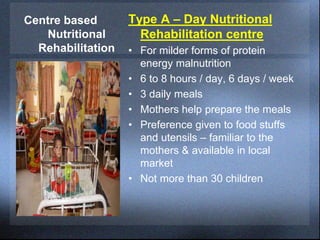
Type A – Day Nutritional
Rehabilitation centre
• For milder forms of protein
energy malnutrition
• 6 to 8 hours / day, 6 days / week
• 3 daily meals
• Mothers help prepare the meals
• Preference given to food stuffs
and utensils – familiar to the
mothers & available in local
market
• Not more than 30 children
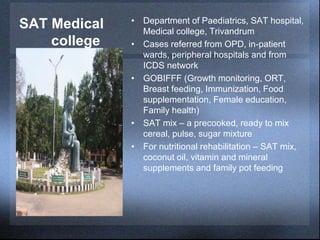
SAT Medical
college
• Department of Paediatrics, SAT hospital,
Medical college, Trivandrum
• Cases referred from OPD, in-patient
wards, peripheral hospitals and from
ICDS network
• GOBIFFF (Growth monitoring, ORT,
Breast feeding, Immunization, Food
supplementation, Female education,
Family health)
• SAT mix – a precooked, ready to mix
cereal, pulse, sugar mixture
• For nutritional rehabilitation – SAT mix,
coconut oil, vitamin and mineral
supplements and family pot feeding
Type B – Residential Nutritional
Rehabilitation centre
• For severe malnutrition – after treated in a hospital for
complications
• Usually attached to a hospital
• Children with mothers live in the institution
• Mothers help to prepare the meals & receive suitable
instruction on child feeding – Educators of community
• Proper education and training to mothers can prevent
relapses & prevent other children in same family from
getting affected
Staffing and cost of NRCs
• Staffing Paediatrician – medical supervision
• Public health nurse – administrative issues
• Dietician – supervise dietary & catering
• Part time welfare worker & health educator.
Objection to NRC
1) To provide clinical management & reduce mortality
among children with severe acute malnutrition,
particularly among those with medical complications.
2) To promote physical & psychological growth of children
with severe acute malnutrition (SAM).
3) To build the capacity of mothers & other care givers in
appropriate feeding & caring practices for infants &
young children.
4) To identify the social factors that contributed to the child
slipping into severe acute malnutrition
Failure of NRU in Tanzania
• Lack of knowledge of appropriate nutrition
• Malnourished children identification – based on clinical
features (only severe PEM identified)
• Children & other siblings back home – not benefitted
• Foods used in centre – not available back at home -->
PEM recurs
• Community missed the opportunity of learning
• Harsh treatment of parents at NRU
NRC, Davangere Medical college
• 1979 – International year of the Child – Nutritional
Rehabilitation centre (NRC) started.
• Kitchen block of Chigateri General Hospital – used.
• Residential type of NRC
• Village methods of preparing food adopted
– flat milling stones for grinding grains
– flat baskets for cleaning the husk from grains
– cooking on mud-fire place
– use of earthen potteries
• Mother sleep on the floor with children
• More real and they feel at home – higher success rate of
continuing same practice.
NRC, Davangere Medical college
• Davangere mix – Ragi hittu, roasted bengal gram
powder, roasted groundnut powder and syrup of jaggery
--> 100 gm ball – 14 gm protein and 400 calories.
• Mothers prepare Davangere mix and rice gruel.
• Mothers – maintain cleanliness and work in kitchen
garden.
• Mothers have practical nutritional and health education.
• Simple personal hygiene – taught to the children.
• Health worker – teach school lessons to older children.
Continued….
• Doctors (Paediatrics dept.) – health supervision
• Children fed together with other children – improve
consumption
• Occupancy – 10 to 12 malnourished children and
mothers
• Average stay – 2 to 3 weeks
• Average Cost – 1/10 of traditional hospital treatment
• Opportunity to educate Anganwadi worker, older
children, school teacher – influence community
Continued….
• Ample opportunity to teach mothers – prevent
recurrence.
• Follow up study – 40 children for 6 -12 months
• No recurrence or mortality
• 50% had normal nutrition status and others grade I
malnutrition
• None had micronutrient deficiency
Community based Nutritional Rehabilitation
(CBNR)
Community based Nutritional
Rehabilitation (CBNR)
• Community based system of managing children who are
developing PEM.
• Goal: to restore to near normal the nutritional status of
the undernourished child and to have a sustained
improved physical & mental growth, performance of the
child , siblings & other children in the household.
Objectives:-
 Short term:
1) Early diagnosis & Treatment
2) Prevent recurrence in treated child
3) Prevent occurrence of PEM in the siblings & other children
 Long term:
To reduce PEM among children in the community to a
level whereby it is no longer a problem of public health.
Strategies
• Advocacy of CBNR to leaders from district down to
community level --> facilitate establishment of CBNR &
ensure its sustainability.
• Equipping health care providers & health workers with
knowledge & skills on CBNR.
• Ensuring availability of necessary equipment & supplies
for identification & categorization of malnutrition.
• Sensitizing & raising awareness of parents, care takers
& community leaders on home rehabilitation
Identification of malnourished children
Place
• Children attending MCH
clinic/ OPD
• During village health days
& specific health
campaigns
• Health checkups in
nursery schools
• During home visits
Personnel
• Health care provider
• Health care providers,
village health workers
• Teachers care providers,
village health workers
• Village Health workers ,
vilage health
committees, parents /
care givers , health care
provider.
Check list for at risk children &
households
• Insufficient household food security
• Low birth weight (<2.5 kg)
• Weight loss or no weight increase in children for 3
consecutive months
• Household with h/o malnourished child
• Deaths of under-5 children in same household
• Lack of child spacing
• Childhood orphanage
• Single parent household
• Drunkard-ness in the family
Community based nutrition promotion
activities
• Improving food availability at household level – kitchen
gardening
– Finance
– Job creation
– Income generation by improving production & creation of
markets
• Improving access to food by govt. help to obtain
sufficient water to grow
– Supply of seed & plants
– Supply of livestock for breeding
Continued….
• Improving utilization of food by improving knowledge on
nutritious food groups
– Demonstration of cooking
– To build the skill of community health workers & support groups
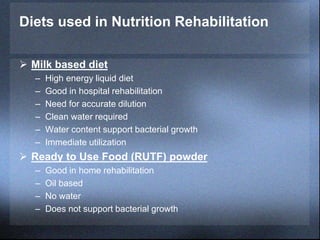
Diets used in Nutrition Rehabilitation
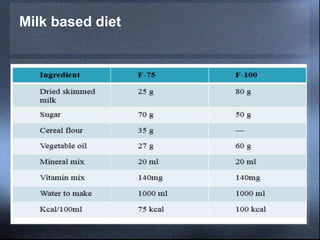
 Milk based diet
– High energy liquid diet
– Good in hospital rehabilitation
– Need for accurate dilution
– Clean water required
– Water content support bacterial growth
– Immediate utilization
 Ready to Use Food (RUTF) powder
– Good in home rehabilitation
– Oil based
– No water
– Does not support bacterial growth
Milk based diet
Bal-Ahar
• Developed at CFTRI, Mysore
• Blend - Whole wheat flour (70 parts)
– groundnut flour (20 parts)
– roasted Bengal gram flour (10 parts)
– fortified with calcium salts and vitamins
• This contains about 20% proteins.
• Daily supplement of 50 g of the food will provide about
10 g proteins and substantial amounts of vitamin A,
calcium and riboflavin
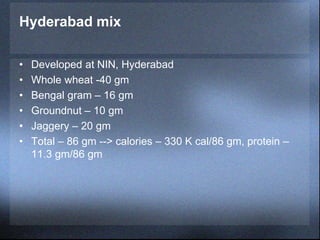
Hyderabad mix
• Developed at NIN, Hyderabad
• Whole wheat -40 gm
• Bengal gram – 16 gm
• Groundnut – 10 gm
• Jaggery – 20 gm
• Total – 86 gm --> calories – 330 K cal/86 gm, protein –
11.3 gm/86 gm
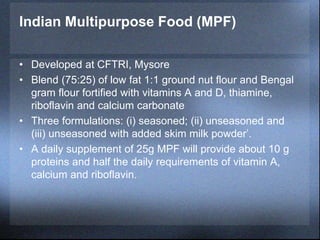
Indian Multipurpose Food (MPF)
• Developed at CFTRI, Mysore
• Blend (75:25) of low fat 1:1 ground nut flour and Bengal
gram flour fortified with vitamins A and D, thiamine,
riboflavin and calcium carbonate
• Three formulations: (i) seasoned; (ii) unseasoned and
(iii) unseasoned with added skim milk powder’.
• A daily supplement of 25g MPF will provide about 10 g
proteins and half the daily requirements of vitamin A,
calcium and riboflavin.
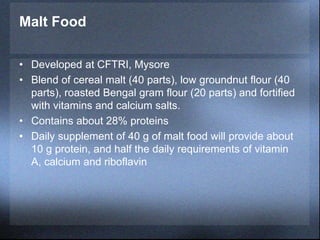
Malt Food
• Developed at CFTRI, Mysore
• Blend of cereal malt (40 parts), low groundnut flour (40
parts), roasted Bengal gram flour (20 parts) and fortified
with vitamins and calcium salts.
• Contains about 28% proteins
• Daily supplement of 40 g of malt food will provide about
10 g protein, and half the daily requirements of vitamin
A, calcium and riboflavin
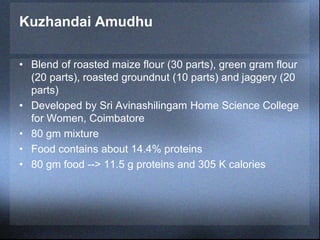
Kuzhandai Amudhu
• Blend of roasted maize flour (30 parts), green gram flour
(20 parts), roasted groundnut (10 parts) and jaggery (20
parts)
• Developed by Sri Avinashilingam Home Science College
for Women, Coimbatore
• 80 gm mixture
• Food contains about 14.4% proteins
• 80 gm food --> 11.5 g proteins and 305 K calories
Developmental stimulation
• Developmental stimulation has been found to be
effective in malnourished children
• Objective: to stimulate the child through normal
developmental channel and to prevent developmental
delay
• Homed based stimulation is more cost effective
• Components – developmental evaluation, developmental
information, individualized tasks for catch up, play
therapy, motor co ordination tasks, training ADL
Continued….
• Nutritional management with developmental stimulation
package – positive impact on growth and development
• To be integrated with existing ICDS programme
Developmental stimulation
• Developmental stimulation has been found to be
effective in malnourished children
• Objective: to stimulate the child through normal
developmental channel and to prevent developmental
delay
• Homed based stimulation is more cost effective
• Components – developmental evaluation, developmental
information, individualized tasks for catch up, play
therapy, motor co ordination tasks, training ADL
Continued….
• Nutritional management with developmental stimulation
package – positive impact on growth and development
• To be integrated with existing ICDS programme
Summery
• Information on catch up growth during nutrition
rehabilitation of severely undernourished children
reported from other countries is largely based on milk-
based diets
• Moderate catch up growth can be achieved in severely
undernourished children treated with energy dense local
foods in a hospital setting
References
• Operational Guidelines On Nutrition Rehabilitation
Centre (NRC)
• An Evaluation basedCommunity Based Management Of
Sever Acute Malnutrition- International Center for
Diarroheal Disease Research , Bangladesh
• Grigsby, Donna G., MD. "Malnutrition." eMedicine Dece
mber 18, 2003. http://www.emedicine.com/ped/topic1
360.htm.
• Recent Advances in Communinity Medicine-
Suryakantha
• Text Book of Preventive social Medicine- Park 23rd
Edition
Nutritional Rehabilitation

Nutritional Rehabilitation

  • 1.
    Nutritional Rehabilitation Presented by:Dr. Kunal Guided by: Dr. Abhay Mudey
  • 2.
    Contents • Introduction • Nutritionalinterventions for malnutrition • Nutritional Rehabilitation – Hospital based – Centre based – Community based • Diets used in Nutritional Rehabilitation • References
  • 3.
    Introduction Definitions: Malnutrition is thecondition that develops when the body d oes not get the right amount of the vitamins, minerals &other nutrients it needs to maintain healthy tissues an d organ function. • Nutritional Rehabilitation:-Practical training to mothers of children with malnutrition in selecting, preparing food from locally available cheap sources and feeding them back to health.
  • 4.
    Continued…. • Malnutrition hasa detrimental impact on health, physical development, brain development, and intellect especially during pregnancy and the first two years of life. • The consequences of malnutrition are higher child mortality and morbidity; lower cognitive development, hence lower returns from investments in education; and lower productivity leading to a higher burden to the health system. • As calculated in a recent World Bank report, malnutrition accounts for an economic loss of about 3 percent of Gross Domestic Product in developing countries.
  • 5.
    Nutritional interventions formalnutrition • Nutritional Supplementation • Specific Nutrient Supplementation • Nutritional Therapy • Nutritional Rehabilitation • Nutrition Education
  • 6.
    Types of NutritionalRehabilitation • Hospital based Nutritional Rehabilitation • Centre based Nutritional Rehabilitation – Day Nutritional Rehabilitation centre – Residential Nutritional Rehabilitation centre • Community based Nutritional Rehabilitation
  • 7.
    Criteria for transferto Rehabilitation phase • Eating well • Mental state has improved: smiles, responds to stimuli, interested in surroundings • Sits, crawls, stands or walks (depending on age) • Normal temperature (36.5 – 37.5 degree C) • No vomiting or diarrhoea • No oedema • Gaining weight: >5 g/kg of body wt per day for 3 successive days
  • 8.
    Dietary Management Diet shouldbe: • From locally available staple foods • Inexpensive • Easily digestible • Consisting of minimum of 100 ml milk per day • Of cereal & pulse combination – 5:1 ratio • Evenly distributed throughout the day • Increase quantity of food which the child is already used to • Increase number of feedings • Increase calorie by adding oil
  • 9.
    Hospital based NutritionalRehabilitation • During rehabilitation phase – rapid catch-up growth in weight needs to be attained - facilitates early discharge & prevents secondary infections. • Caloric intake of 170-220 Kcal/kg/day required for rapid catch up growth (WHO guideline). • Rapid catch up growth - more than 10 g/kg/day. • Poor catch up growth – less than 5 g/kg/day (WHO guideline).
  • 10.
    Continued…. • Vitamin Aand minerals to be supplemented – Hospital based nutritional rehabilitation of severely undernourished children using energy dense local foods (Mamidi et al, Indian Paediatrics 2010;47:687-693) • Child put on 100 kcal/kg/day initially • Increased upto 170-220 kcal/kg/day • Child fed every 2 hours initially and once appetite improves, fed ad libitum.
  • 11.
    Results • mean gain– 5 g/kg/day. • Only 12% had rapid catch-up growth. • Higher morbidity score was associated with lower rate of weight gain.
  • 12.
    Centre based Nutritional Rehabilitation Type A– Day Nutritional Rehabilitation centre • For milder forms of protein energy malnutrition • 6 to 8 hours / day, 6 days / week • 3 daily meals • Mothers help prepare the meals • Preference given to food stuffs and utensils – familiar to the mothers & available in local market • Not more than 30 children
  • 13.
    SAT Medical college • Departmentof Paediatrics, SAT hospital, Medical college, Trivandrum • Cases referred from OPD, in-patient wards, peripheral hospitals and from ICDS network • GOBIFFF (Growth monitoring, ORT, Breast feeding, Immunization, Food supplementation, Female education, Family health) • SAT mix – a precooked, ready to mix cereal, pulse, sugar mixture • For nutritional rehabilitation – SAT mix, coconut oil, vitamin and mineral supplements and family pot feeding
  • 14.
    Type B –Residential Nutritional Rehabilitation centre • For severe malnutrition – after treated in a hospital for complications • Usually attached to a hospital • Children with mothers live in the institution • Mothers help to prepare the meals & receive suitable instruction on child feeding – Educators of community • Proper education and training to mothers can prevent relapses & prevent other children in same family from getting affected
  • 15.
    Staffing and costof NRCs • Staffing Paediatrician – medical supervision • Public health nurse – administrative issues • Dietician – supervise dietary & catering • Part time welfare worker & health educator.
  • 16.
    Objection to NRC 1)To provide clinical management & reduce mortality among children with severe acute malnutrition, particularly among those with medical complications. 2) To promote physical & psychological growth of children with severe acute malnutrition (SAM). 3) To build the capacity of mothers & other care givers in appropriate feeding & caring practices for infants & young children. 4) To identify the social factors that contributed to the child slipping into severe acute malnutrition
  • 17.
    Failure of NRUin Tanzania • Lack of knowledge of appropriate nutrition • Malnourished children identification – based on clinical features (only severe PEM identified) • Children & other siblings back home – not benefitted • Foods used in centre – not available back at home --> PEM recurs • Community missed the opportunity of learning • Harsh treatment of parents at NRU
  • 18.
    NRC, Davangere Medicalcollege • 1979 – International year of the Child – Nutritional Rehabilitation centre (NRC) started. • Kitchen block of Chigateri General Hospital – used. • Residential type of NRC • Village methods of preparing food adopted – flat milling stones for grinding grains – flat baskets for cleaning the husk from grains – cooking on mud-fire place – use of earthen potteries • Mother sleep on the floor with children • More real and they feel at home – higher success rate of continuing same practice.
  • 19.
    NRC, Davangere Medicalcollege • Davangere mix – Ragi hittu, roasted bengal gram powder, roasted groundnut powder and syrup of jaggery --> 100 gm ball – 14 gm protein and 400 calories. • Mothers prepare Davangere mix and rice gruel. • Mothers – maintain cleanliness and work in kitchen garden. • Mothers have practical nutritional and health education. • Simple personal hygiene – taught to the children. • Health worker – teach school lessons to older children.
  • 20.
    Continued…. • Doctors (Paediatricsdept.) – health supervision • Children fed together with other children – improve consumption • Occupancy – 10 to 12 malnourished children and mothers • Average stay – 2 to 3 weeks • Average Cost – 1/10 of traditional hospital treatment • Opportunity to educate Anganwadi worker, older children, school teacher – influence community
  • 21.
    Continued…. • Ample opportunityto teach mothers – prevent recurrence. • Follow up study – 40 children for 6 -12 months • No recurrence or mortality • 50% had normal nutrition status and others grade I malnutrition • None had micronutrient deficiency
  • 22.
    Community based NutritionalRehabilitation (CBNR)
  • 23.
    Community based Nutritional Rehabilitation(CBNR) • Community based system of managing children who are developing PEM. • Goal: to restore to near normal the nutritional status of the undernourished child and to have a sustained improved physical & mental growth, performance of the child , siblings & other children in the household.
  • 24.
    Objectives:-  Short term: 1)Early diagnosis & Treatment 2) Prevent recurrence in treated child 3) Prevent occurrence of PEM in the siblings & other children  Long term: To reduce PEM among children in the community to a level whereby it is no longer a problem of public health.
  • 25.
    Strategies • Advocacy ofCBNR to leaders from district down to community level --> facilitate establishment of CBNR & ensure its sustainability. • Equipping health care providers & health workers with knowledge & skills on CBNR. • Ensuring availability of necessary equipment & supplies for identification & categorization of malnutrition. • Sensitizing & raising awareness of parents, care takers & community leaders on home rehabilitation
  • 26.
    Identification of malnourishedchildren Place • Children attending MCH clinic/ OPD • During village health days & specific health campaigns • Health checkups in nursery schools • During home visits Personnel • Health care provider • Health care providers, village health workers • Teachers care providers, village health workers • Village Health workers , vilage health committees, parents / care givers , health care provider.
  • 27.
    Check list forat risk children & households • Insufficient household food security • Low birth weight (<2.5 kg) • Weight loss or no weight increase in children for 3 consecutive months • Household with h/o malnourished child • Deaths of under-5 children in same household • Lack of child spacing • Childhood orphanage • Single parent household • Drunkard-ness in the family
  • 28.
    Community based nutritionpromotion activities • Improving food availability at household level – kitchen gardening – Finance – Job creation – Income generation by improving production & creation of markets • Improving access to food by govt. help to obtain sufficient water to grow – Supply of seed & plants – Supply of livestock for breeding
  • 29.
    Continued…. • Improving utilizationof food by improving knowledge on nutritious food groups – Demonstration of cooking – To build the skill of community health workers & support groups
  • 30.
    Diets used inNutrition Rehabilitation  Milk based diet – High energy liquid diet – Good in hospital rehabilitation – Need for accurate dilution – Clean water required – Water content support bacterial growth – Immediate utilization  Ready to Use Food (RUTF) powder – Good in home rehabilitation – Oil based – No water – Does not support bacterial growth
  • 31.
  • 32.
    Bal-Ahar • Developed atCFTRI, Mysore • Blend - Whole wheat flour (70 parts) – groundnut flour (20 parts) – roasted Bengal gram flour (10 parts) – fortified with calcium salts and vitamins • This contains about 20% proteins. • Daily supplement of 50 g of the food will provide about 10 g proteins and substantial amounts of vitamin A, calcium and riboflavin
  • 33.
    Hyderabad mix • Developedat NIN, Hyderabad • Whole wheat -40 gm • Bengal gram – 16 gm • Groundnut – 10 gm • Jaggery – 20 gm • Total – 86 gm --> calories – 330 K cal/86 gm, protein – 11.3 gm/86 gm
  • 34.
    Indian Multipurpose Food(MPF) • Developed at CFTRI, Mysore • Blend (75:25) of low fat 1:1 ground nut flour and Bengal gram flour fortified with vitamins A and D, thiamine, riboflavin and calcium carbonate • Three formulations: (i) seasoned; (ii) unseasoned and (iii) unseasoned with added skim milk powder’. • A daily supplement of 25g MPF will provide about 10 g proteins and half the daily requirements of vitamin A, calcium and riboflavin.
  • 35.
    Malt Food • Developedat CFTRI, Mysore • Blend of cereal malt (40 parts), low groundnut flour (40 parts), roasted Bengal gram flour (20 parts) and fortified with vitamins and calcium salts. • Contains about 28% proteins • Daily supplement of 40 g of malt food will provide about 10 g protein, and half the daily requirements of vitamin A, calcium and riboflavin
  • 36.
    Kuzhandai Amudhu • Blendof roasted maize flour (30 parts), green gram flour (20 parts), roasted groundnut (10 parts) and jaggery (20 parts) • Developed by Sri Avinashilingam Home Science College for Women, Coimbatore • 80 gm mixture • Food contains about 14.4% proteins • 80 gm food --> 11.5 g proteins and 305 K calories
  • 37.
    Developmental stimulation • Developmentalstimulation has been found to be effective in malnourished children • Objective: to stimulate the child through normal developmental channel and to prevent developmental delay • Homed based stimulation is more cost effective • Components – developmental evaluation, developmental information, individualized tasks for catch up, play therapy, motor co ordination tasks, training ADL
  • 38.
    Continued…. • Nutritional managementwith developmental stimulation package – positive impact on growth and development • To be integrated with existing ICDS programme
  • 39.
    Developmental stimulation • Developmentalstimulation has been found to be effective in malnourished children • Objective: to stimulate the child through normal developmental channel and to prevent developmental delay • Homed based stimulation is more cost effective • Components – developmental evaluation, developmental information, individualized tasks for catch up, play therapy, motor co ordination tasks, training ADL
  • 40.
    Continued…. • Nutritional managementwith developmental stimulation package – positive impact on growth and development • To be integrated with existing ICDS programme
  • 41.
    Summery • Information oncatch up growth during nutrition rehabilitation of severely undernourished children reported from other countries is largely based on milk- based diets • Moderate catch up growth can be achieved in severely undernourished children treated with energy dense local foods in a hospital setting
  • 42.
    References • Operational GuidelinesOn Nutrition Rehabilitation Centre (NRC) • An Evaluation basedCommunity Based Management Of Sever Acute Malnutrition- International Center for Diarroheal Disease Research , Bangladesh • Grigsby, Donna G., MD. "Malnutrition." eMedicine Dece mber 18, 2003. http://www.emedicine.com/ped/topic1 360.htm. • Recent Advances in Communinity Medicine- Suryakantha • Text Book of Preventive social Medicine- Park 23rd Edition