DIABETES SELF
MANAGEMENT
By:- Dr. Kunal Modak
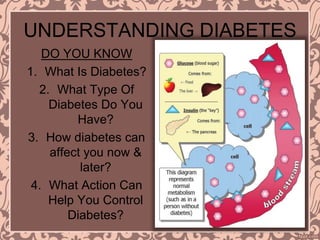
UNDERSTANDING DIABETES
DO YOU KNOW
1. What Is Diabetes?
2. What Type Of
Diabetes Do You
Have?
3. How diabetes can
affect you now &
later?
4. What Action Can
Help You Control
Diabetes?
Checking For Understanding
• Can accurately state type of
diabetes he/she has.
• Associates common diabetes
associated complications with
poor control.
• Verbalizes understanding of
importance of knowing about
aspects of diabetes.
• Expresses actions and habits
that will promote good
diabetes control.
Red Flag
►Does not know type of
diabetes he/she has.
►Expresses lack of control
over own health status.
►Expresses misconceptions
about diabetes treatment
for his/her specific type.
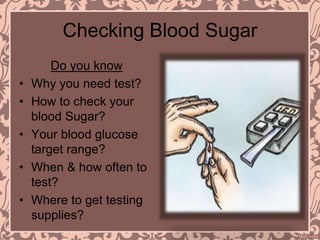
Checking Blood Sugar
Do you know
• Why you need test?
• How to check your
blood Sugar?
• Your blood glucose
target range?
• When & how often to
test?
• Where to get testing
supplies?
Checking For Understanding
• Demonstrate blood
glucose testing procedure
with proper technique.
• Verbalizes importance of
regular testing.
• Can identify BG values
that are
in and out of appropriate
range.
• Has a meter and can
state how to obtain
testing supplies.
Red Flag
►Does not check blood
sugar.
►Only checks at times
blood sugar will be good.
►Cannot demonstrate
proper procedure for
checking blood
sugar.
►Reports blood glucose
values not consistent with
A1c.
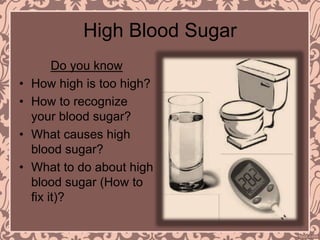
High Blood Sugar
Do you know
• How high is too high?
• How to recognize
your blood sugar?
• What causes high
blood sugar?
• What to do about high
blood sugar (How to
fix it)?
Check For Understanding
• Can identify signs (or his or
her own symptoms) of
hyperglycemia.
• Can state reasons that his or
her blood sugar may be high
(not taking meds, eating too
much, no activity, illness,
etc.).
• Can state when he/she
should
contact the provider for
hyperglycemia.
• Can describe how to check
ketones.
Red Flag
►Cannot identify BG
values that are above
target range.
►States a high number is
"pretty good for me" or
prefers blood sugars at
higher than target levels.
►States that high BG
numbers are better than
low BG numbers.
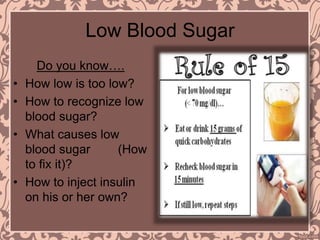
Low Blood Sugar
Do you know….
• How low is too low?
• How to recognize low
blood sugar?
• What causes low
blood sugar (How
to fix it)?
• How to inject insulin
on his or her own?
Checking For Understanding
• Can clearly identify own
signs or symptoms of low
blood sugar.
• Can state reasons that
his or her
blood sugar may drop
(not eating, exercise, etc.
• Has a plan to treat low
blood sugar at all time
and places.
• Confirm friends / family
are aware of risk and
know how to help in
hypoglycemic situation
Red Flag
► Does not carry any
glucose source despite
being at risk for
hypoglycemia.
►Takes insulin but does not
have a glucagon kit and/or
does not have someone
who knows how to use it.
►Purposely keeps blood
sugar high to avoid
hypoglycemia.
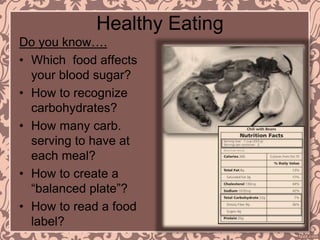
Healthy Eating
Do you know….
• Which food affects
your blood sugar?
• How to recognize
carbohydrates?
• How many carb.
serving to have at
each meal?
• How to create a
“balanced plate”?
• How to read a food
label?
Check for understanding
• Can identify foods that
are made up of
carbohydrates.
• Can give an example of a
balanced meal.
• Correctly identifies
carbohydrate content on
a food label.
• States the importance of
eating
appropriately-sized meals
throughout the day and
states
will not skip meals.
Red Flag
►States he or she can
never have anything
good or favourite foods
again.
►Advocates for use of fad
diets.
►Only counts sugars on
label and not total
carbohydrates.
►Eats out excessively.
►Drinks sugary drink
regularly.
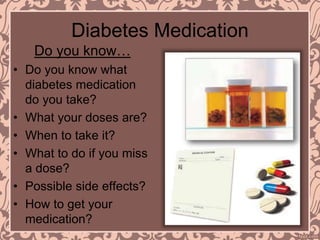
Diabetes Medication
Do you know…
• Do you know what
diabetes medication
do you take?
• What your doses are?
• When to take it?
• What to do if you miss
a dose?
• Possible side effects?
• How to get your
medication?
Check for Understanding
• Associates name brand
with generic name.
• Can explain how the
medication lowers blood
sugar.
• Recognizes common side
effects of the medication.
• Knows the correct time to
take medication and what
to do if a dose is missed.
• Has a plan for timely
refills.
Red Flag
►Does not consider
possible side effects
(hypoglycemia).
►Does not remember
doses or states
inappropriate times.
►States will skip
medications at
inappropriate times.
►Is not sure where or
how to get medication.
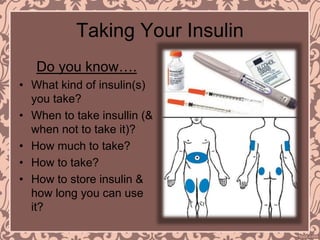
Taking Your Insulin
Do you know….
• What kind of insulin(s)
you take?
• When to take insullin (&
when not to take it)?
• How much to take?
• How to take?
• How to store insulin &
how long you can use
it?
Check For Understanding
• Correctly states prescribed
insulin dose.
• Explains duration of action
in general terms.
• Verbalizes understanding
that basal insulin should
not be skipped if not
eating.
• Demonstrates insulin
injection with pen or
syringe using proper
technique.
Red Flag
►Mixes up names of insulin.
►Does not remember doses.
►States will skip insulin at
inappropriate times.
►Misses steps in
demonstating
insulin injection technique.
►States using insulin
beyond expiration date or
usage time.
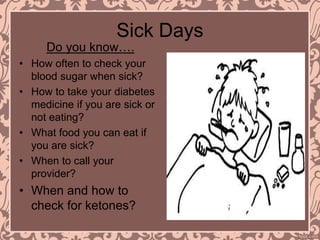
Sick Days
Do you know….
• How often to check your
blood sugar when sick?
• How to take your diabetes
medicine if you are sick or
not eating?
• What food you can eat if
you are sick?
• When to call your
provider?
• When and how to
check for ketones?
Checking For Understanding
• Can explain when and how
to check urine or blood
ketones.
• Lists signs of dehydration.
• States the importance of
taking diabetes medication.
• States alternative foods for
sick days.
• Verbalizes understanding
of when to call the provider
or seek emergency medical
care.
Red Flag
• States he/she will not
take any
diabetes medication if
sick.
• States he/she checks
blood sugar less often
when sick.
• Cannot state association
between illness and high
blood sugar.
• Cannot list actions to
prevent dehydration.
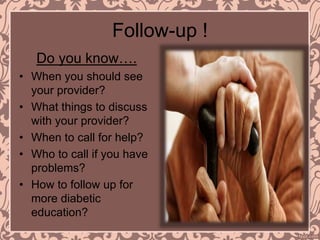
Follow-up !
Do you know….
• When you should see
your provider?
• What things to discuss
with your provider?
• When to call for help?
• Who to call if you have
problems?
• How to follow up for
more diabetic
education?
Check For Understanding
• Can name situations in
which medical attention
should be sought.
• Can show you the name
and number of whom to
call for help.
• Verbalizes importance of
following up with provider.
• Can repeat when and
where to get further
diabetes education.
Red Flag
►States he/she has “heard
it all before” or “already
knows it
all”.
►Has no interest in
managing his/her
diabetes.
►Has no regular provider
with which to follow up.
►Seems unclear on when
and who to call for help.
Reference
s
• Survival Skills for the
Person with Diabetes.
(2004). VA/DoD Toolkit.
• Funnell, M. (2009). Life
with Diabetes, Fourth
Edition. American
Diabetes Association.
• American Diabetes
Association (2011).
Standards of Medical
Care in Diabetes.
Diabetes Care.
Diabetes self management

Diabetes self management

  • 1.
  • 2.
    UNDERSTANDING DIABETES DO YOUKNOW 1. What Is Diabetes? 2. What Type Of Diabetes Do You Have? 3. How diabetes can affect you now & later? 4. What Action Can Help You Control Diabetes?
  • 3.
    Checking For Understanding •Can accurately state type of diabetes he/she has. • Associates common diabetes associated complications with poor control. • Verbalizes understanding of importance of knowing about aspects of diabetes. • Expresses actions and habits that will promote good diabetes control. Red Flag ►Does not know type of diabetes he/she has. ►Expresses lack of control over own health status. ►Expresses misconceptions about diabetes treatment for his/her specific type.
  • 4.
    Checking Blood Sugar Doyou know • Why you need test? • How to check your blood Sugar? • Your blood glucose target range? • When & how often to test? • Where to get testing supplies?
  • 5.
    Checking For Understanding •Demonstrate blood glucose testing procedure with proper technique. • Verbalizes importance of regular testing. • Can identify BG values that are in and out of appropriate range. • Has a meter and can state how to obtain testing supplies. Red Flag ►Does not check blood sugar. ►Only checks at times blood sugar will be good. ►Cannot demonstrate proper procedure for checking blood sugar. ►Reports blood glucose values not consistent with A1c.
  • 6.
    High Blood Sugar Doyou know • How high is too high? • How to recognize your blood sugar? • What causes high blood sugar? • What to do about high blood sugar (How to fix it)?
  • 7.
    Check For Understanding •Can identify signs (or his or her own symptoms) of hyperglycemia. • Can state reasons that his or her blood sugar may be high (not taking meds, eating too much, no activity, illness, etc.). • Can state when he/she should contact the provider for hyperglycemia. • Can describe how to check ketones. Red Flag ►Cannot identify BG values that are above target range. ►States a high number is "pretty good for me" or prefers blood sugars at higher than target levels. ►States that high BG numbers are better than low BG numbers.
  • 8.
    Low Blood Sugar Doyou know…. • How low is too low? • How to recognize low blood sugar? • What causes low blood sugar (How to fix it)? • How to inject insulin on his or her own?
  • 9.
    Checking For Understanding •Can clearly identify own signs or symptoms of low blood sugar. • Can state reasons that his or her blood sugar may drop (not eating, exercise, etc. • Has a plan to treat low blood sugar at all time and places. • Confirm friends / family are aware of risk and know how to help in hypoglycemic situation Red Flag ► Does not carry any glucose source despite being at risk for hypoglycemia. ►Takes insulin but does not have a glucagon kit and/or does not have someone who knows how to use it. ►Purposely keeps blood sugar high to avoid hypoglycemia.
  • 10.
    Healthy Eating Do youknow…. • Which food affects your blood sugar? • How to recognize carbohydrates? • How many carb. serving to have at each meal? • How to create a “balanced plate”? • How to read a food label?
  • 11.
    Check for understanding •Can identify foods that are made up of carbohydrates. • Can give an example of a balanced meal. • Correctly identifies carbohydrate content on a food label. • States the importance of eating appropriately-sized meals throughout the day and states will not skip meals. Red Flag ►States he or she can never have anything good or favourite foods again. ►Advocates for use of fad diets. ►Only counts sugars on label and not total carbohydrates. ►Eats out excessively. ►Drinks sugary drink regularly.
  • 12.
    Diabetes Medication Do youknow… • Do you know what diabetes medication do you take? • What your doses are? • When to take it? • What to do if you miss a dose? • Possible side effects? • How to get your medication?
  • 13.
    Check for Understanding •Associates name brand with generic name. • Can explain how the medication lowers blood sugar. • Recognizes common side effects of the medication. • Knows the correct time to take medication and what to do if a dose is missed. • Has a plan for timely refills. Red Flag ►Does not consider possible side effects (hypoglycemia). ►Does not remember doses or states inappropriate times. ►States will skip medications at inappropriate times. ►Is not sure where or how to get medication.
  • 14.
    Taking Your Insulin Doyou know…. • What kind of insulin(s) you take? • When to take insullin (& when not to take it)? • How much to take? • How to take? • How to store insulin & how long you can use it?
  • 15.
    Check For Understanding •Correctly states prescribed insulin dose. • Explains duration of action in general terms. • Verbalizes understanding that basal insulin should not be skipped if not eating. • Demonstrates insulin injection with pen or syringe using proper technique. Red Flag ►Mixes up names of insulin. ►Does not remember doses. ►States will skip insulin at inappropriate times. ►Misses steps in demonstating insulin injection technique. ►States using insulin beyond expiration date or usage time.
  • 16.
    Sick Days Do youknow…. • How often to check your blood sugar when sick? • How to take your diabetes medicine if you are sick or not eating? • What food you can eat if you are sick? • When to call your provider? • When and how to check for ketones?
  • 17.
    Checking For Understanding •Can explain when and how to check urine or blood ketones. • Lists signs of dehydration. • States the importance of taking diabetes medication. • States alternative foods for sick days. • Verbalizes understanding of when to call the provider or seek emergency medical care. Red Flag • States he/she will not take any diabetes medication if sick. • States he/she checks blood sugar less often when sick. • Cannot state association between illness and high blood sugar. • Cannot list actions to prevent dehydration.
  • 18.
    Follow-up ! Do youknow…. • When you should see your provider? • What things to discuss with your provider? • When to call for help? • Who to call if you have problems? • How to follow up for more diabetic education?
  • 19.
    Check For Understanding •Can name situations in which medical attention should be sought. • Can show you the name and number of whom to call for help. • Verbalizes importance of following up with provider. • Can repeat when and where to get further diabetes education. Red Flag ►States he/she has “heard it all before” or “already knows it all”. ►Has no interest in managing his/her diabetes. ►Has no regular provider with which to follow up. ►Seems unclear on when and who to call for help.
  • 20.
    Reference s • Survival Skillsfor the Person with Diabetes. (2004). VA/DoD Toolkit. • Funnell, M. (2009). Life with Diabetes, Fourth Edition. American Diabetes Association. • American Diabetes Association (2011). Standards of Medical Care in Diabetes. Diabetes Care.