Dr.Praseeda.B.K
 Definition
 Scenario worldwide and India
 Statistical measures of maternal mortality
 Approaches to measure maternal mortality
 Causes in worldwide and India
 Preventive and social measures to reduce
maternal mortality
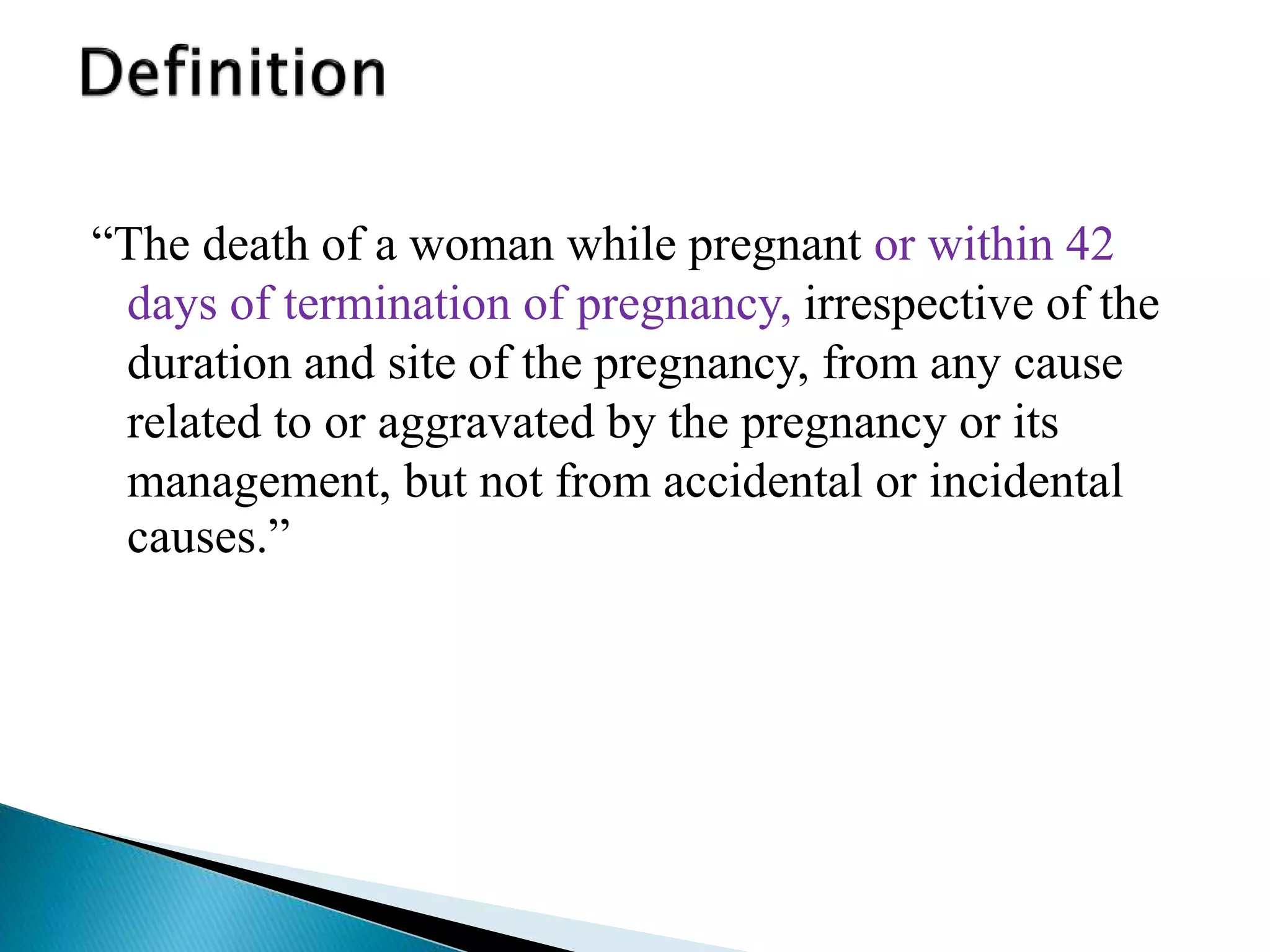
“The death of a woman while pregnant or within 42
days of termination of pregnancy, irrespective of the
duration and site of the pregnancy, from any cause
related to or aggravated by the pregnancy or its
management, but not from accidental or incidental
causes.”
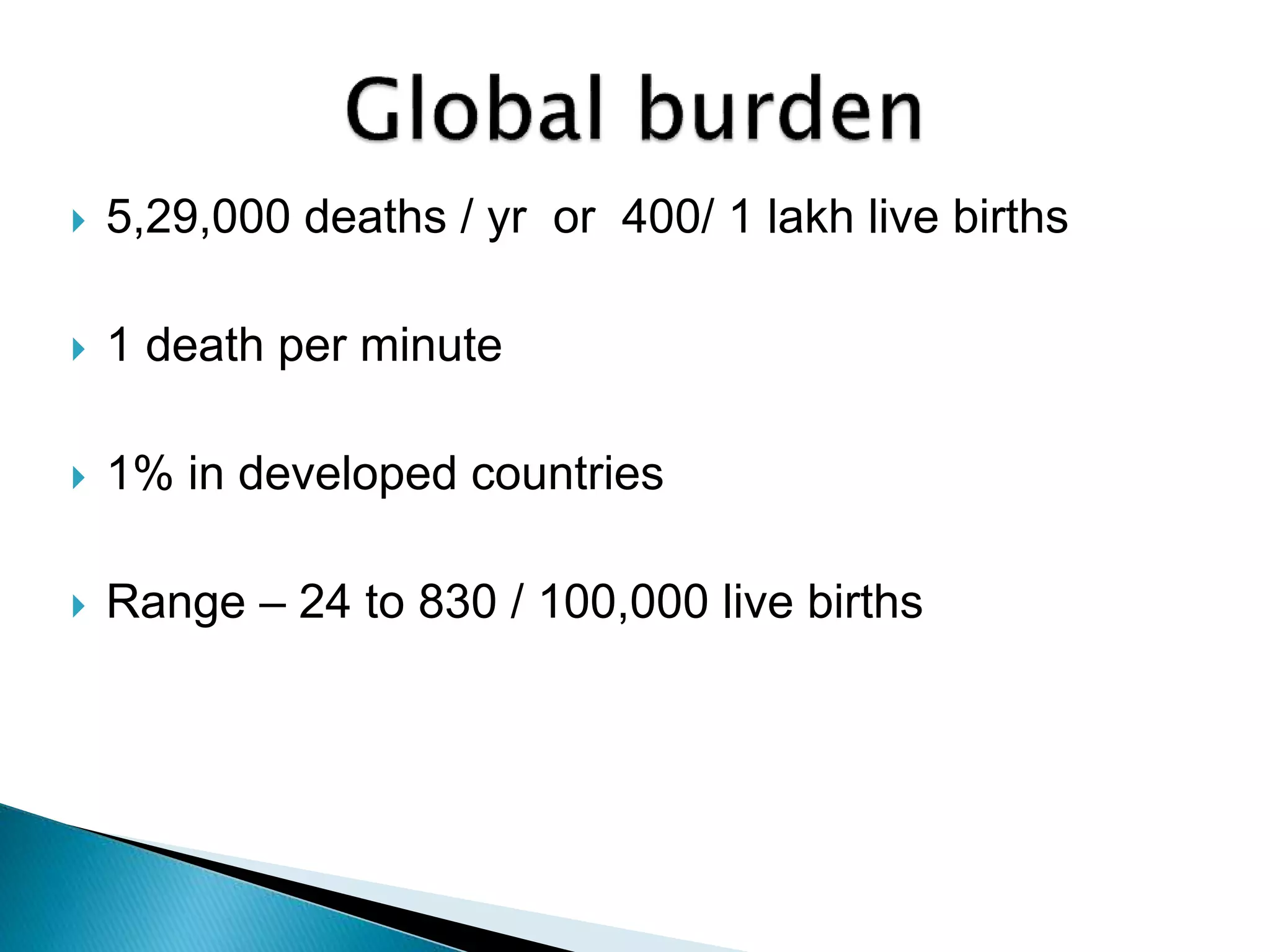
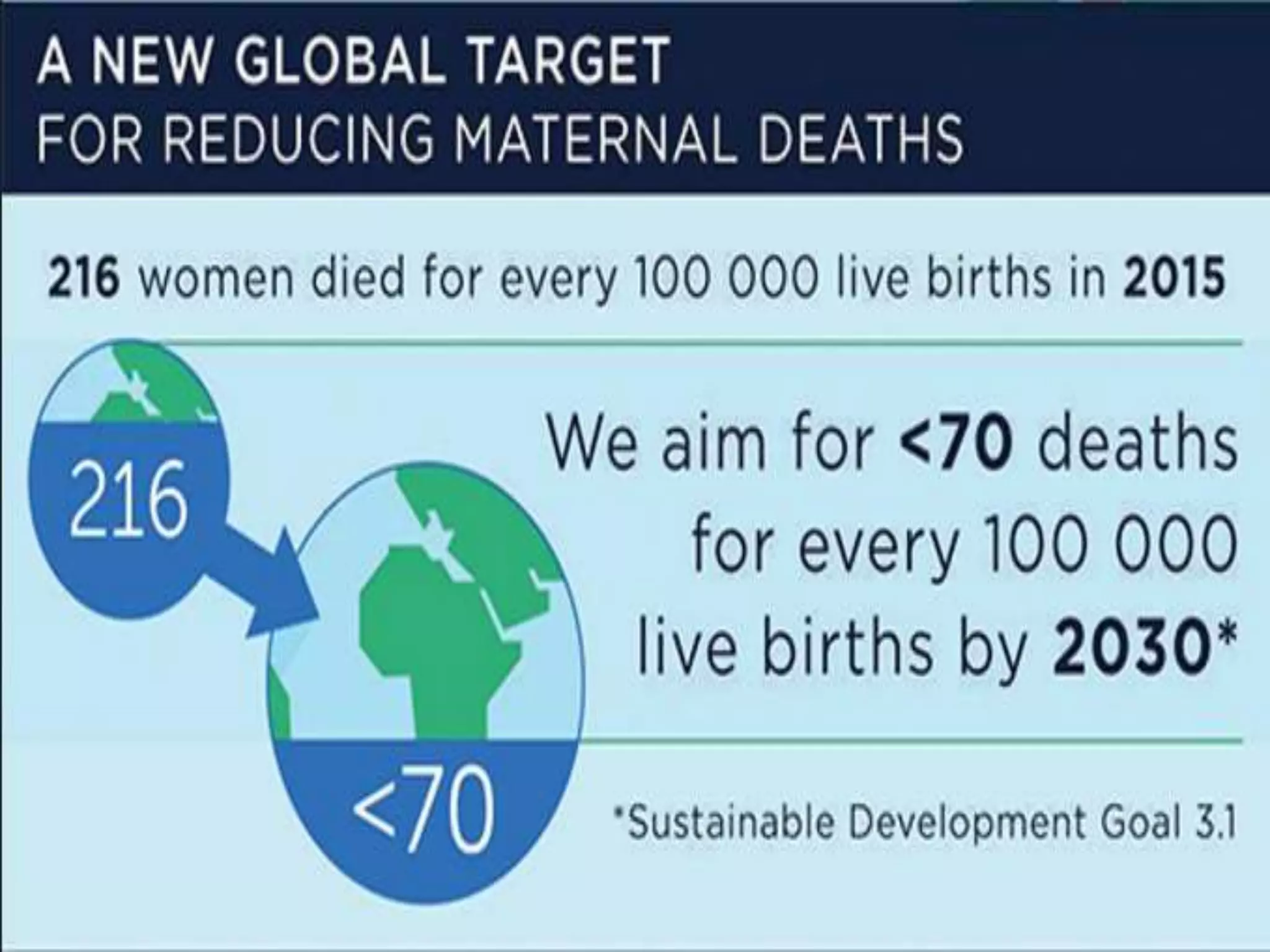
 5,29,000 deaths / yr or 400/ 1 lakh live births
 1 death per minute
 1% in developed countries
 Range – 24 to 830 / 100,000 live births
 An Indian woman dies from
complications related to pregnancy
and childbirth. Every seven
minutes
 The maternal mortality ratio in
India stands at 174 per 100,000
live births.
(2015)
2011 2012 2013 2014 2015
206 197 189 181 174
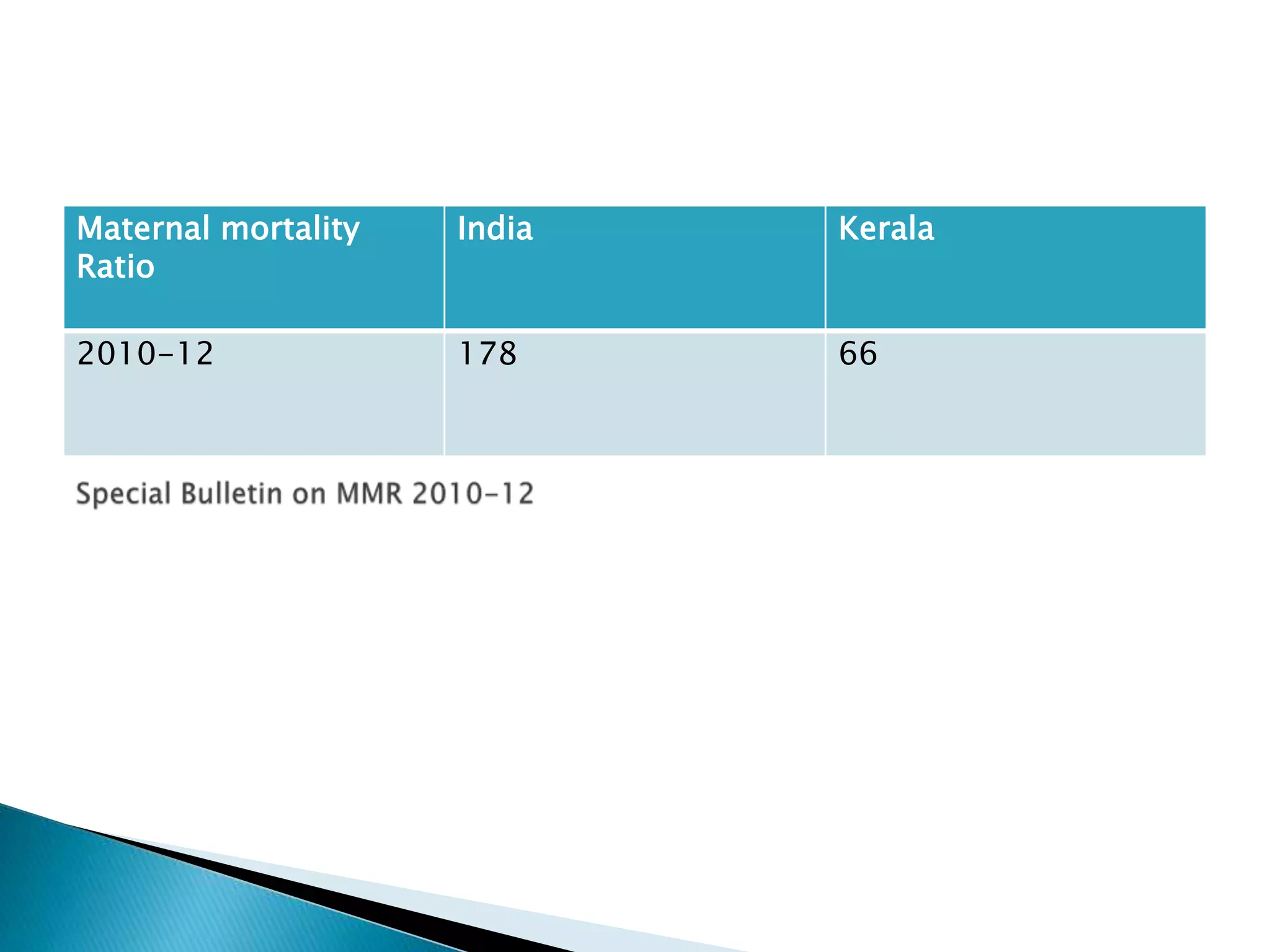
 SRS data shows that that so far only three states
 Kerala with an MMR of 66 per 100,000 live births
 Tamil Nadu with an MMR of 90 per 100,000 live births
 Maharashtra with an MMR of 87 per 100,000 live
births
—have been able to achieve the millennium
development goal.
Maternal mortality
Ratio
India Kerala
2010-12 178 66
 Maternal mortality ratio
 Maternal mortality rate
 Adult life time risk of maternal death
 The proportion of Maternal Death of Women
of Reproductive age (PM)
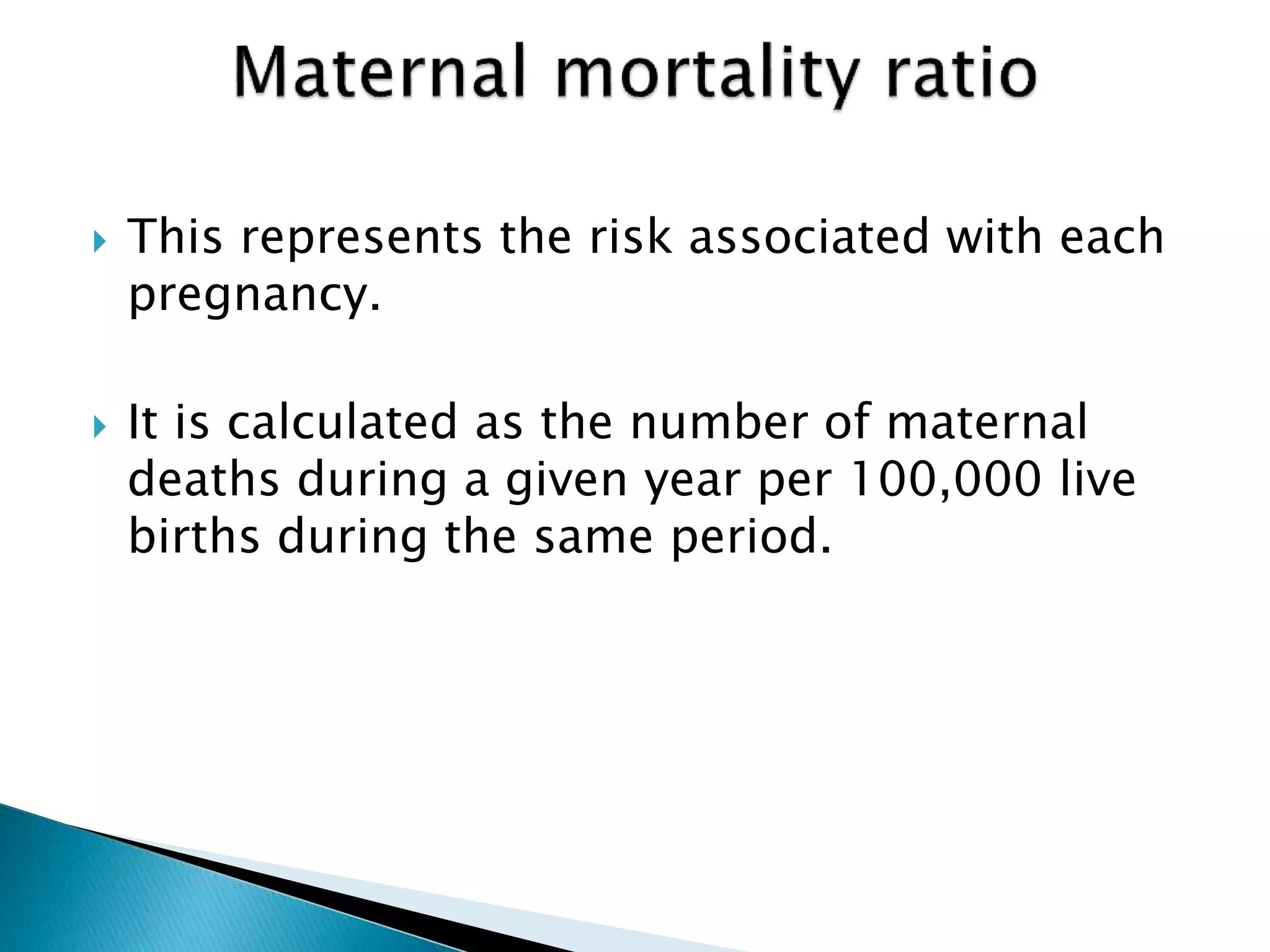
 This represents the risk associated with each
pregnancy.
 It is calculated as the number of maternal
deaths during a given year per 100,000 live
births during the same period.
- Number of maternal deaths in a given period
per 100,000 women of Reproductive age
group in the same time period..
 Number of maternal Deaths in a given time
period divided by total deaths among women
aged 15-49 years..
1. Civil Registration System
- Routine registration of Birth & Death
- continuous registration of birth and
death
2. Household Survey
- interviewing a representative sample of
respondents about the survival of all their
adult sisters.
- Include 4 questions
- How many sisters have you ever had born to same
mother who ever reached the age 15 (or those who
ever married), including those who are now dead??
- How many sisters who reached the age 15 are alive
now?
- How many of your sisters are dead?
- How many of your sisters who are died during
pregnancy or during child birth or during the sixth
weeks after the end of pregnancy?
 Not applicable when
- TFR < 4 children per family
- Areas of significant migration
- During civil war
- Identifying and investigating the causes of
all deaths of women of reproductive age
group in a defined area.
- Use triangulation of different sources of data
on death of women of reproductive age group
coupled with record review and / or verbal
autopsy to identify maternal death.
- Best way to estimate MMR
5. Verbal Autopsy
- used to assign cause of death
through interview with family or community
member..
6. Census
- National Census with addition of a limited
number of questions.
- Representative, Re-Sampled, Routine Household
Interview Of Mortality with Medical Evaluation.
- enhanced form of Verbal autopsy.
- included in SRS from 2002 onwards.
- Random re-sampling of field work by an
independent team for maintaining.
- Field staff will collect major symptoms
narrative of events leading to death .
- Two independent trained physicial will examine
the report
- Disagreement should be referred to Senior
third physician who adjudicate and find CDC 10
code
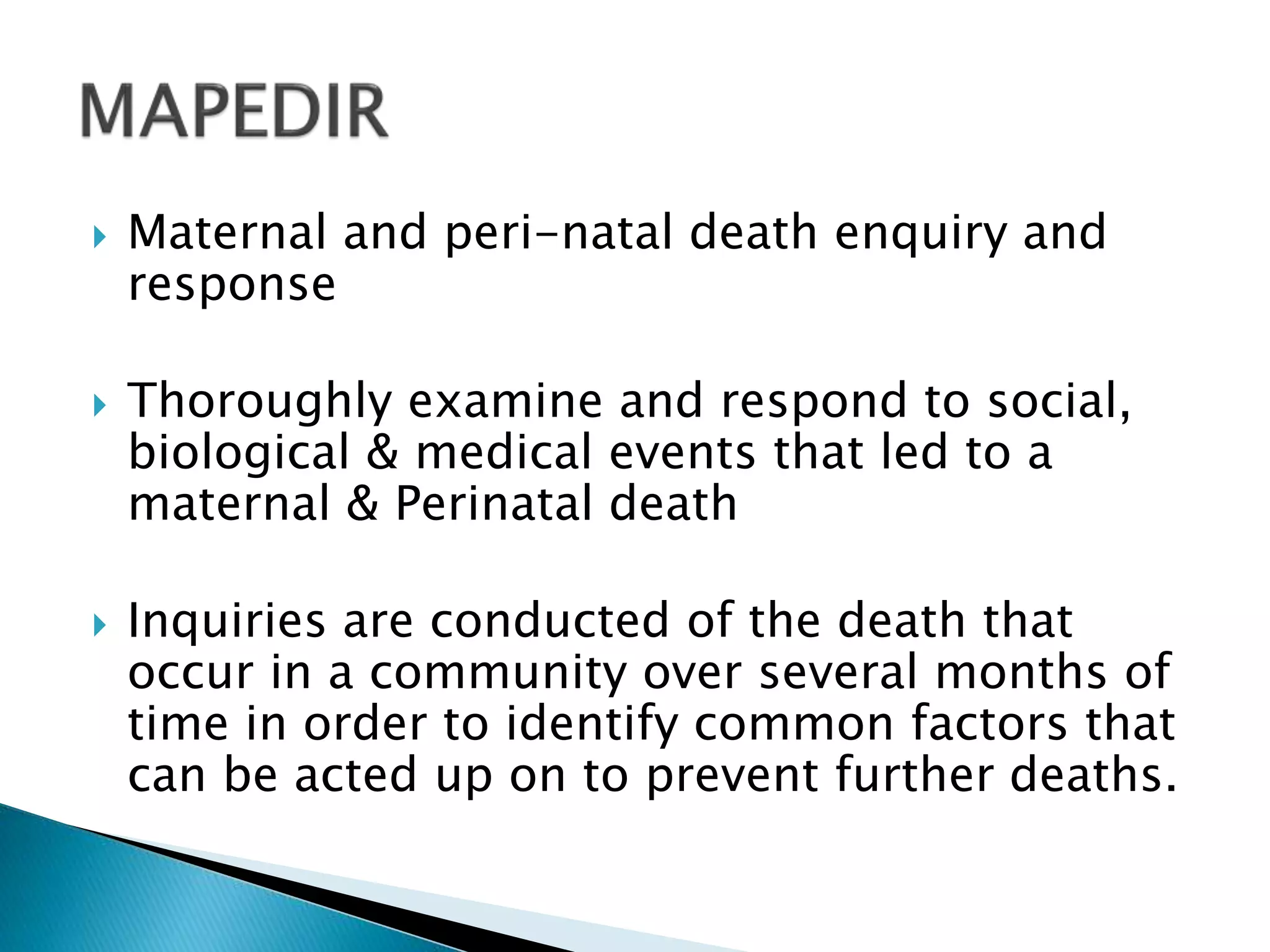
 Maternal and peri-natal death enquiry and
response
 Thoroughly examine and respond to social,
biological & medical events that led to a
maternal & Perinatal death
 Inquiries are conducted of the death that
occur in a community over several months of
time in order to identify common factors that
can be acted up on to prevent further deaths.
 Conducted using a verbal autopsy interview
with the families of diseased persons.
 Useful in areas were many deaths occur
outside health facilities and for highlighting
relevant social factors and health care
seeking problems.
25%
15%
12%8%
13%
8%
20%
severe bleeding
Infection
eclampsia
obstructed labour
Unsafe abortion
other direct causes
indirect causes
Indirect causes- Eg: Anemia, Malaria, Heart disease
38%
11%5%5%
8%
34%
heakorrhaage
sepsis
Hypertensive
disorder
obstructed labour
abortion
 Medical causes
 Non obstetric causes
 Social causes
 Obstectric causes
- Toxaemias of pregnancy
- Haemorrhage
- Infection
- Obstructed labour
- Unsafe abortion
 Non obstetric causes
- Anaemia
- Associated diseases
e.g., cardiac, renal, hepatic metabolic and
infectious Malignancy Accidents
 Age at child birth
 Parity
 Too close pregnancies
 Family size
 Malnutrition
 Poverty
 Illiteracy
 Ignorance
 Prejudices
 Lack of maternity services
 Shortage of health manpower
 Delivery by untrained dais
 Poor environmental sanitation
 Poor communications and transport facilities
 Social customs.
1. Early registration of pregnancy
2. At least three antenatal check-ups
3. Dietary supplementation, including correction
of anaemia
4. Prevention of infection and haemorrhage
during puerperium
5. Prevention of complications, e.g., eclampsia,
malpresentations. ruptured uterus
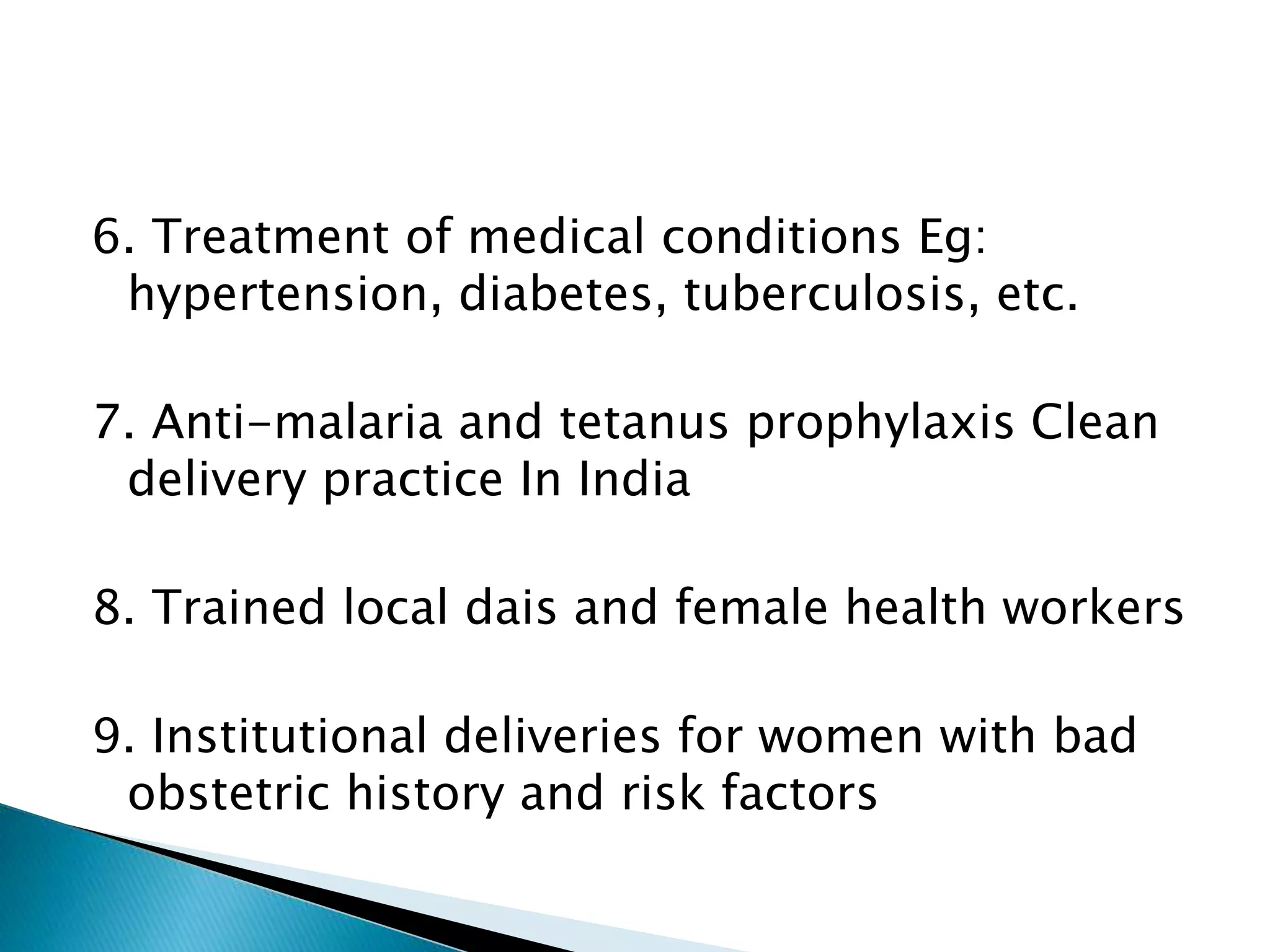
6. Treatment of medical conditions Eg:
hypertension, diabetes, tuberculosis, etc.
7. Anti-malaria and tetanus prophylaxis Clean
delivery practice In India
8. Trained local dais and female health workers
9. Institutional deliveries for women with bad
obstetric history and risk factors
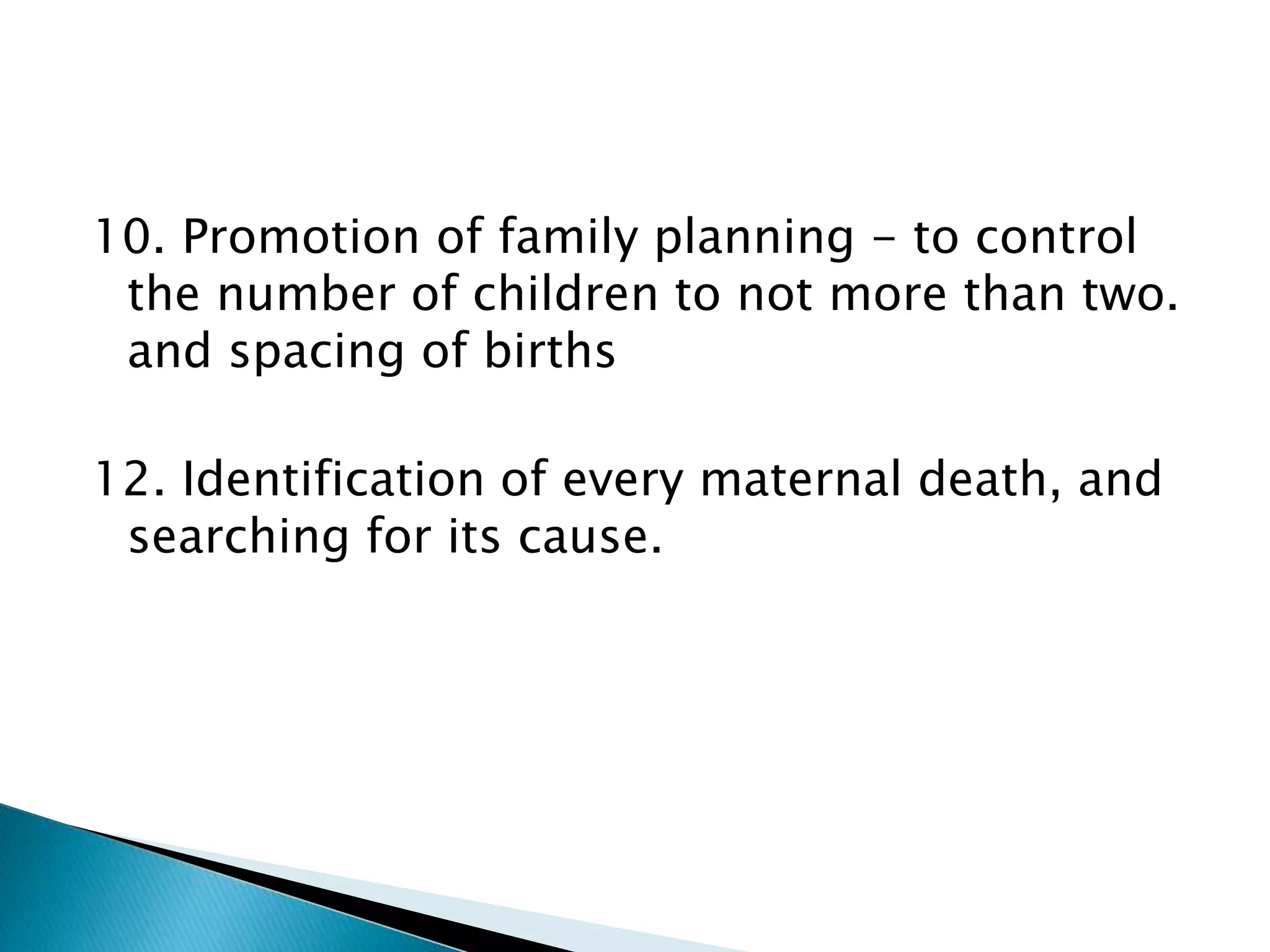
10. Promotion of family planning - to control
the number of children to not more than two.
and spacing of births
12. Identification of every maternal death, and
searching for its cause.
 Confidential Maternal Death Audit started in
1990’s
 Format and methodology revised in 2010
 District level monitoring committee formed.
 All maternal death in Govt and Private sector are
audited
 Kerala Federation of Obstetrics and Gynecologist
published study report on maternal Death
 In 2012, the international arm of the UK
National Institute for Health and Care
Excellence (NICE) partnered with the
government of Kerala, the NRHM and KFOG to
work to improve the obstetric care in the
state through developing standards based on
evidence-based clinical guidelines
 These ten action points have been piloted in
eight hos- pitals (six public and two private)
in Kerala from April 2013.
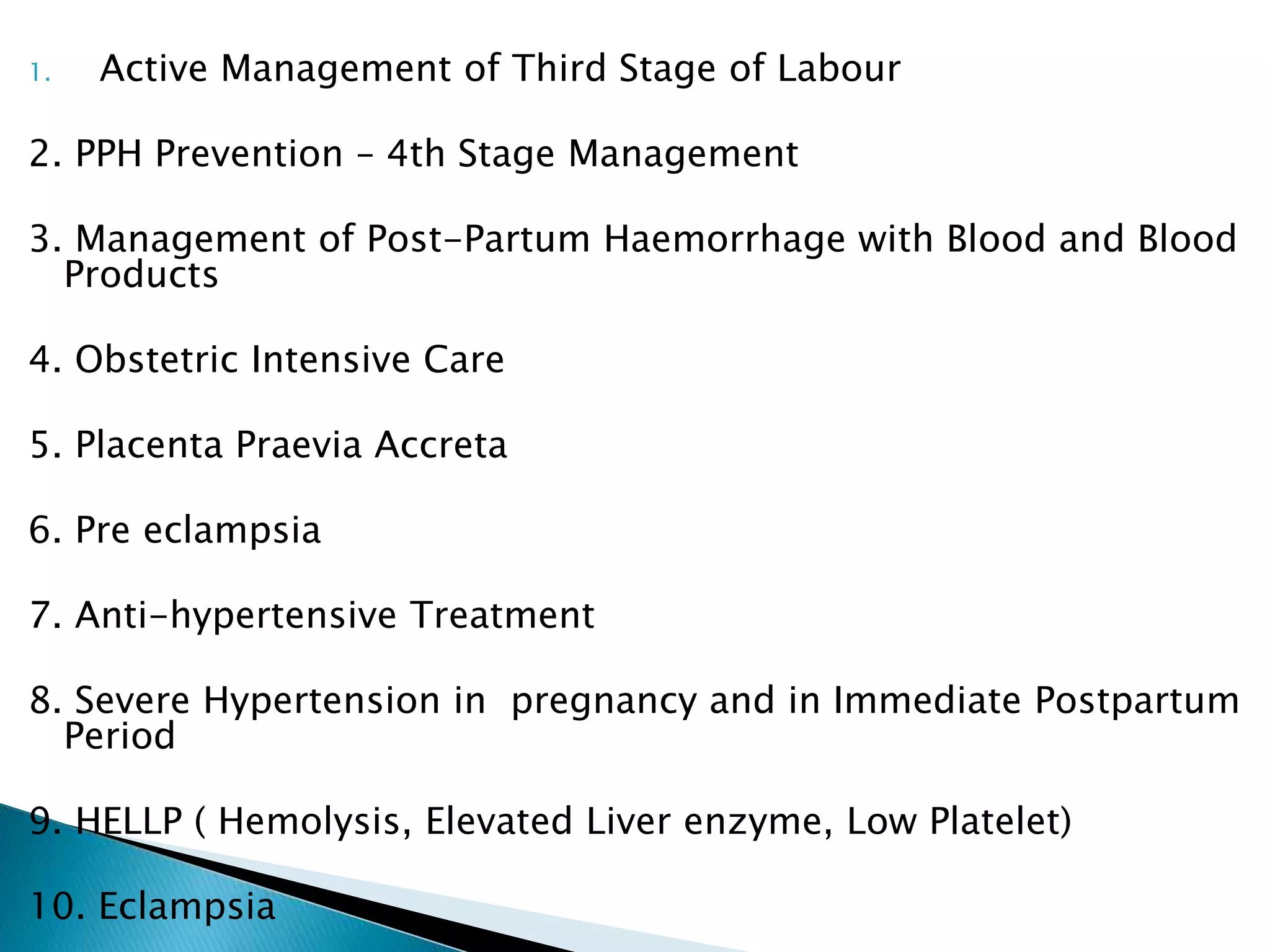
1. Active Management of Third Stage of Labour
2. PPH Prevention – 4th Stage Management
3. Management of Post-Partum Haemorrhage with Blood and Blood
Products
4. Obstetric Intensive Care
5. Placenta Praevia Accreta
6. Pre eclampsia
7. Anti-hypertensive Treatment
8. Severe Hypertension in pregnancy and in Immediate Postpartum
Period
9. HELLP ( Hemolysis, Elevated Liver enzyme, Low Platelet)
10. Eclampsia
Maternal mortality
Maternal mortality
Maternal mortality

Maternal mortality

  • 1.
  • 2.
     Definition  Scenarioworldwide and India  Statistical measures of maternal mortality  Approaches to measure maternal mortality  Causes in worldwide and India  Preventive and social measures to reduce maternal mortality
  • 3.
    “The death ofa woman while pregnant or within 42 days of termination of pregnancy, irrespective of the duration and site of the pregnancy, from any cause related to or aggravated by the pregnancy or its management, but not from accidental or incidental causes.”
  • 4.
     5,29,000 deaths/ yr or 400/ 1 lakh live births  1 death per minute  1% in developed countries  Range – 24 to 830 / 100,000 live births
  • 5.
     An Indianwoman dies from complications related to pregnancy and childbirth. Every seven minutes  The maternal mortality ratio in India stands at 174 per 100,000 live births. (2015)
  • 6.
    2011 2012 20132014 2015 206 197 189 181 174
  • 7.
     SRS datashows that that so far only three states  Kerala with an MMR of 66 per 100,000 live births  Tamil Nadu with an MMR of 90 per 100,000 live births  Maharashtra with an MMR of 87 per 100,000 live births —have been able to achieve the millennium development goal.
  • 9.
  • 10.
     Maternal mortalityratio  Maternal mortality rate  Adult life time risk of maternal death  The proportion of Maternal Death of Women of Reproductive age (PM)
  • 11.
     This representsthe risk associated with each pregnancy.  It is calculated as the number of maternal deaths during a given year per 100,000 live births during the same period.
  • 12.
    - Number ofmaternal deaths in a given period per 100,000 women of Reproductive age group in the same time period..
  • 13.
     Number ofmaternal Deaths in a given time period divided by total deaths among women aged 15-49 years..
  • 14.
    1. Civil RegistrationSystem - Routine registration of Birth & Death - continuous registration of birth and death 2. Household Survey
  • 15.
    - interviewing arepresentative sample of respondents about the survival of all their adult sisters.
  • 16.
    - Include 4questions - How many sisters have you ever had born to same mother who ever reached the age 15 (or those who ever married), including those who are now dead?? - How many sisters who reached the age 15 are alive now? - How many of your sisters are dead? - How many of your sisters who are died during pregnancy or during child birth or during the sixth weeks after the end of pregnancy?
  • 17.
     Not applicablewhen - TFR < 4 children per family - Areas of significant migration - During civil war
  • 18.
    - Identifying andinvestigating the causes of all deaths of women of reproductive age group in a defined area. - Use triangulation of different sources of data on death of women of reproductive age group coupled with record review and / or verbal autopsy to identify maternal death. - Best way to estimate MMR
  • 19.
    5. Verbal Autopsy -used to assign cause of death through interview with family or community member..
  • 20.
    6. Census - NationalCensus with addition of a limited number of questions.
  • 21.
    - Representative, Re-Sampled,Routine Household Interview Of Mortality with Medical Evaluation. - enhanced form of Verbal autopsy. - included in SRS from 2002 onwards.
  • 22.
    - Random re-samplingof field work by an independent team for maintaining. - Field staff will collect major symptoms narrative of events leading to death . - Two independent trained physicial will examine the report - Disagreement should be referred to Senior third physician who adjudicate and find CDC 10 code
  • 23.
     Maternal andperi-natal death enquiry and response  Thoroughly examine and respond to social, biological & medical events that led to a maternal & Perinatal death  Inquiries are conducted of the death that occur in a community over several months of time in order to identify common factors that can be acted up on to prevent further deaths.
  • 24.
     Conducted usinga verbal autopsy interview with the families of diseased persons.  Useful in areas were many deaths occur outside health facilities and for highlighting relevant social factors and health care seeking problems.
  • 25.
    25% 15% 12%8% 13% 8% 20% severe bleeding Infection eclampsia obstructed labour Unsafeabortion other direct causes indirect causes Indirect causes- Eg: Anemia, Malaria, Heart disease
  • 26.
  • 30.
     Medical causes Non obstetric causes  Social causes
  • 31.
     Obstectric causes -Toxaemias of pregnancy - Haemorrhage - Infection - Obstructed labour - Unsafe abortion
  • 32.
     Non obstetriccauses - Anaemia - Associated diseases e.g., cardiac, renal, hepatic metabolic and infectious Malignancy Accidents
  • 33.
     Age atchild birth  Parity  Too close pregnancies  Family size  Malnutrition  Poverty  Illiteracy  Ignorance
  • 34.
     Prejudices  Lackof maternity services  Shortage of health manpower  Delivery by untrained dais  Poor environmental sanitation  Poor communications and transport facilities  Social customs.
  • 35.
    1. Early registrationof pregnancy 2. At least three antenatal check-ups 3. Dietary supplementation, including correction of anaemia 4. Prevention of infection and haemorrhage during puerperium 5. Prevention of complications, e.g., eclampsia, malpresentations. ruptured uterus
  • 36.
    6. Treatment ofmedical conditions Eg: hypertension, diabetes, tuberculosis, etc. 7. Anti-malaria and tetanus prophylaxis Clean delivery practice In India 8. Trained local dais and female health workers 9. Institutional deliveries for women with bad obstetric history and risk factors
  • 37.
    10. Promotion offamily planning - to control the number of children to not more than two. and spacing of births 12. Identification of every maternal death, and searching for its cause.
  • 38.
     Confidential MaternalDeath Audit started in 1990’s  Format and methodology revised in 2010  District level monitoring committee formed.  All maternal death in Govt and Private sector are audited  Kerala Federation of Obstetrics and Gynecologist published study report on maternal Death
  • 39.
     In 2012,the international arm of the UK National Institute for Health and Care Excellence (NICE) partnered with the government of Kerala, the NRHM and KFOG to work to improve the obstetric care in the state through developing standards based on evidence-based clinical guidelines
  • 40.
     These tenaction points have been piloted in eight hos- pitals (six public and two private) in Kerala from April 2013.
  • 41.
    1. Active Managementof Third Stage of Labour 2. PPH Prevention – 4th Stage Management 3. Management of Post-Partum Haemorrhage with Blood and Blood Products 4. Obstetric Intensive Care 5. Placenta Praevia Accreta 6. Pre eclampsia 7. Anti-hypertensive Treatment 8. Severe Hypertension in pregnancy and in Immediate Postpartum Period 9. HELLP ( Hemolysis, Elevated Liver enzyme, Low Platelet) 10. Eclampsia

Editor's Notes

  • #6 The highlight is that most of the states recording unfavorable maternal mortality rates are the ones with the highest number of birth rates and huge population bases with poor health infrastructure. There are a number of reasons India has such a high maternal mortality ratio. Marriage and childbirth at an early age, lack of adequate health care facilities, inadequate nutrition and absence of skilled personnel, all contribute to pregnancies proving fatal. The common causes of maternal mortality in India are anaemia, haemorrhage, sepsis, obstructed labour, abortion, and toxaemia. Maternal morbidities are the anaemias, chronic malnutrition, pelvic inflammations, liver and kidney diseases. In addition, the pathological processes of some preexisting diseases, such as chronic heart diseases, hypertension, kidney diseases and pulmonary tuberculosis are aggravated by pregnancy and childbirth.