The Positive DevianceThe Positive Deviance
Hearth NutritionHearth Nutrition
ModelModel
Mercy Laker,Mercy Laker,
Nutrition Specialist WVUNutrition Specialist WVU
The concept of PD Hearth
• Positive Deviance: It is a departure, a difference, or deviation
from the norm that results in a positive outcome. It is a
departure from the conventional wisdom,
• “Positive”? Looks for what is working, what people are doing
right. Utilizing what resources are available, not what is needed
and missing. It is asset-based, rather than needs based.
• A positive deviant is a poor member of the community who has
a well-nourished child while most of their neighbors do not.
• A Hearth? It is a home kitchen, community volunteers
volunteering their homes
• A Positive Deviance Inquiry (PDI) is a process of discovery that
occurs before a Hearth directly informing the content to be
shared during the Hearths.
Positive Deviance/Hearth - principle
The Million $ Question:
Why do well nourished children exist beside
malnourished children despite living in the same
conditions of poverty?
What is PD/Hearth programming
model?
• in every community there are certain individuals or groups (the
positive deviant) whose special practices or behaviors enable
them to find a better solution to a prevalent problem than their
neighbors who have access to the same resources.
• Presumes that the knowledge about ‘what works’ is available in
existing individuals or entities (Solutions from within!)
• The goal of PD Hearth is to treat, sustain and prevent
malnutrition
• Provides timely catch up growth for children showing growth
faltering
– Target: moderately malnourished children and children at risk
of malnutrition.
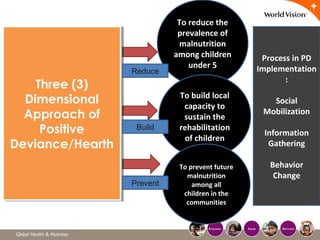
To reduce the
prevalence of
malnutrition
among children
under 5
Three (3)
Dimensional
Approach of
Positive
Deviance/Hearth
Three (3)
Dimensional
Approach of
Positive
Deviance/Hearth
Reduce
To build local
capacity to
sustain the
rehabilitation
of children
To prevent future
malnutrition
among all
children in the
communities
Process in PD
Implementation
:
Social
Mobilization
Information
Gathering
Behavior
Change
Build
Prevent
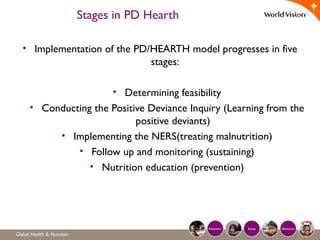
Stages in PD Hearth
• Implementation of the PD/HEARTH model progresses in five
stages:
• Determining feasibility
• Conducting the Positive Deviance Inquiry (Learning from the
positive deviants)
• Implementing the NERS(treating malnutrition)
• Follow up and monitoring (sustaining)
• Nutrition education (prevention)
Steps in a Positive Deviance/
Hearth Model
8
Step 1 – Determining feasibility andStep 1 – Determining feasibility and
normingnorming
• Malnutrition Prevalence in the
Community
• Availability of Affordable Local Foods
• Availability of complimentary services
• Geographic Proximity of Homes
• Existence of Food Aid
• Emergency nutritional situation
• Landless Populations or Squatter
Communities
Committed leaders, village chiefs
9
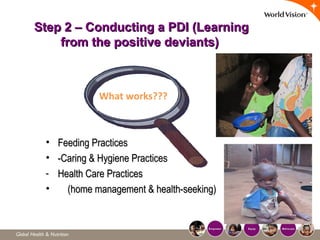
Step 2 – Conducting a PDI (LearningStep 2 – Conducting a PDI (Learning
from the positive deviants)from the positive deviants)
What works???
• Feeding PracticesFeeding Practices
• -Caring & Hygiene Practices-Caring & Hygiene Practices
- Health Care PracticesHealth Care Practices
• (home management & health-seeking)(home management & health-seeking)
10
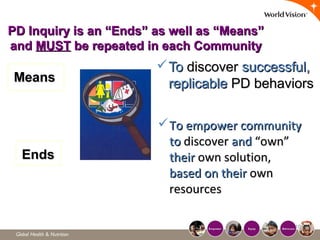
PD Inquiry is an “Ends” as well as “Means”PD Inquiry is an “Ends” as well as “Means”
andand MUSTMUST be repeated in each Communitybe repeated in each Community
ToTo discoverdiscover successful,successful,
replicablereplicable PD behaviorsPD behaviorsMeansMeans
EndsEnds
To empower communityTo empower community
toto discoverdiscover andand “own”“own”
theirtheir own solution,own solution,
based on theirbased on their ownown
resourcesresources
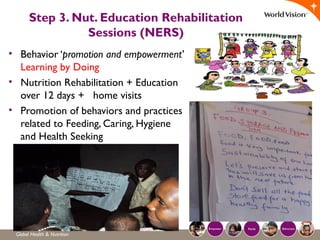
Step 3. Nut. Education Rehabilitation
Sessions (NERS)
• Behavior ‘promotion and empowerment’
Learning by Doing
• Nutrition Rehabilitation + Education
over 12 days + home visits
• Promotion of behaviors and practices
related to Feeding, Caring, Hygiene
and Health Seeking
Food
Care
Health
Step 4: Follow up
 Observe sustained application of PD behavior with Hearth child
and siblings (qualitative).
 Measure for sustained weight gain at 2 mos, at 6 mos, 12 months,
etc.;
 Follow the cohort over time to assure that the graduates stay
onthe Road to Health and do not falter
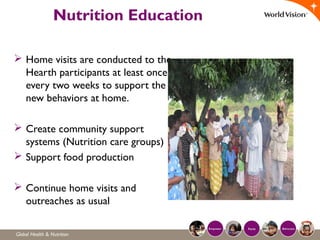
Nutrition Education
 Home visits are conducted to the
Hearth participants at least once
every two weeks to support the
new behaviors at home.
 Create community support
systems (Nutrition care groups)
 Support food production
 Continue home visits and
outreaches as usual
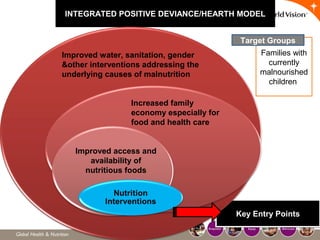
INTEGRATED POSITIVE DEVIANCE/HEARTH MODEL
Key Entry PointsKey Entry Points
Improved water, sanitation, gender
&other interventions addressing the
underlying causes of malnutrition
Improved access and
availability of
nutritious foods
Increased family
economy especially for
food and health care
Families with
currently
malnourished
children
Target Groups
Context considerations
for PD/Hearth
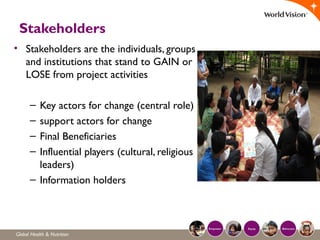
Stakeholders
• Stakeholders are the individuals, groups
and institutions that stand to GAIN or
LOSE from project activities
– Key actors for change (central role)
– support actors for change
– Final Beneficiaries
– Influential players (cultural, religious
leaders)
– Information holders
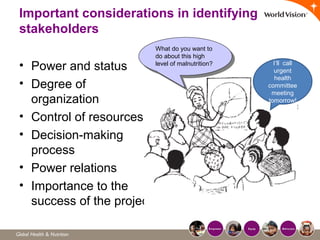
Important considerations in identifying
stakeholders
• Power and status
• Degree of
organization
• Control of resources
• Decision-making
process
• Power relations
• Importance to the
success of the project
I’ll call
urgent
health
committee
meeting
tomorrow!
What do you want to
do about this high
level of malnutrition?
What do you want to
do about this high
level of malnutrition?
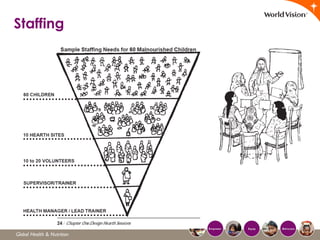
Staffing
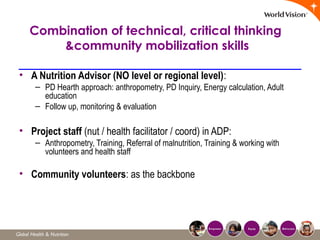
Combination of technical, critical thinking
&community mobilization skills
• A Nutrition Advisor (NO level or regional level):
– PD Hearth approach: anthropometry, PD Inquiry, Energy calculation, Adult
education
– Follow up, monitoring & evaluation
• Project staff (nut / health facilitator / coord) in ADP:
– Anthropometry, Training, Referral of malnutrition, Training & working with
volunteers and health staff
• Community volunteers: as the backbone
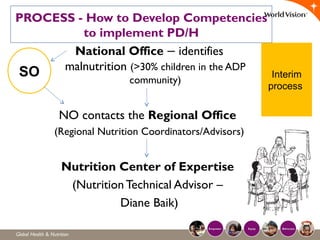
PROCESS - How to Develop Competencies
to implement PD/H
National Office – identifies
malnutrition (>30% children in the ADP
community)
NO contacts the Regional Office
(Regional Nutrition Coordinators/Advisors)
Nutrition Center of Expertise
(Nutrition Technical Advisor –
Diane Baik)
Interim
process
SO
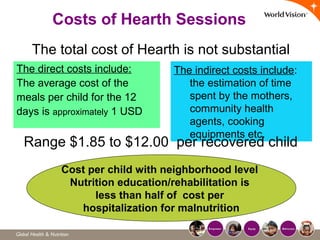
Costs of Hearth Sessions
The direct costs include:
The average cost of the
meals per child for the 12
days is approximately 1 USD
The indirect costs include:
the estimation of time
spent by the mothers,
community health
agents, cooking
equipments etc.
The total cost of Hearth is not substantial
Range $1.85 to $12.00 per recovered child
Cost per child with neighborhood level
Nutrition education/rehabilitation is
less than half of cost per
hospitalization for malnutrition
Advantages of using the PD Model!
• Quick solutions addressing moderate malnutrition
• Affordable
– Vietnam (USD2 per child)
– Mongolia (USD8 per child)
– Uganda (USD 1.2 PER child)
• Participatory
– Community participation
• Sustainable
– Communities gaining skills (cooking, feeding, hygiene caring)
• Indigenous (solutions from within!)
• Based on behavior change
PDH Inversions
• Trainee vs.Trainer (in a PDI the community becomes the trainer
of ours)
• Best practices vs. working practices
• Needs based vs. assets based (glass half empty/half full)
• KAP vs. PAK
• Hearth-based vs. Center-based
• Poverty leads to malnutrition vs. Malnutrition leads to poverty
• Acting into new thinking vs.Thinking into new acting
• Food Aid vs. food contributions from community
• PDI vs. nutritional survey (KPC style) Listening vs. Speaking
Solutions from the inside vs. solutions from the outside
• Outside experts knowledge vs. PD mothers knowledge
MANYTHANKSMANYTHANKS
FORFOR
YOUR ATTENTIONYOUR ATTENTION

Pd hearth overview presentation final

  • 1.
    The Positive DevianceThePositive Deviance Hearth NutritionHearth Nutrition ModelModel Mercy Laker,Mercy Laker, Nutrition Specialist WVUNutrition Specialist WVU
  • 2.
    The concept ofPD Hearth • Positive Deviance: It is a departure, a difference, or deviation from the norm that results in a positive outcome. It is a departure from the conventional wisdom, • “Positive”? Looks for what is working, what people are doing right. Utilizing what resources are available, not what is needed and missing. It is asset-based, rather than needs based. • A positive deviant is a poor member of the community who has a well-nourished child while most of their neighbors do not. • A Hearth? It is a home kitchen, community volunteers volunteering their homes • A Positive Deviance Inquiry (PDI) is a process of discovery that occurs before a Hearth directly informing the content to be shared during the Hearths.
  • 3.
    Positive Deviance/Hearth -principle The Million $ Question: Why do well nourished children exist beside malnourished children despite living in the same conditions of poverty?
  • 4.
    What is PD/Hearthprogramming model? • in every community there are certain individuals or groups (the positive deviant) whose special practices or behaviors enable them to find a better solution to a prevalent problem than their neighbors who have access to the same resources. • Presumes that the knowledge about ‘what works’ is available in existing individuals or entities (Solutions from within!) • The goal of PD Hearth is to treat, sustain and prevent malnutrition • Provides timely catch up growth for children showing growth faltering – Target: moderately malnourished children and children at risk of malnutrition.
  • 5.
    To reduce the prevalenceof malnutrition among children under 5 Three (3) Dimensional Approach of Positive Deviance/Hearth Three (3) Dimensional Approach of Positive Deviance/Hearth Reduce To build local capacity to sustain the rehabilitation of children To prevent future malnutrition among all children in the communities Process in PD Implementation : Social Mobilization Information Gathering Behavior Change Build Prevent
  • 6.
    Stages in PDHearth • Implementation of the PD/HEARTH model progresses in five stages: • Determining feasibility • Conducting the Positive Deviance Inquiry (Learning from the positive deviants) • Implementing the NERS(treating malnutrition) • Follow up and monitoring (sustaining) • Nutrition education (prevention)
  • 7.
    Steps in aPositive Deviance/ Hearth Model
  • 8.
    8 Step 1 –Determining feasibility andStep 1 – Determining feasibility and normingnorming • Malnutrition Prevalence in the Community • Availability of Affordable Local Foods • Availability of complimentary services • Geographic Proximity of Homes • Existence of Food Aid • Emergency nutritional situation • Landless Populations or Squatter Communities Committed leaders, village chiefs
  • 9.
    9 Step 2 –Conducting a PDI (LearningStep 2 – Conducting a PDI (Learning from the positive deviants)from the positive deviants) What works??? • Feeding PracticesFeeding Practices • -Caring & Hygiene Practices-Caring & Hygiene Practices - Health Care PracticesHealth Care Practices • (home management & health-seeking)(home management & health-seeking)
  • 10.
    10 PD Inquiry isan “Ends” as well as “Means”PD Inquiry is an “Ends” as well as “Means” andand MUSTMUST be repeated in each Communitybe repeated in each Community ToTo discoverdiscover successful,successful, replicablereplicable PD behaviorsPD behaviorsMeansMeans EndsEnds To empower communityTo empower community toto discoverdiscover andand “own”“own” theirtheir own solution,own solution, based on theirbased on their ownown resourcesresources
  • 11.
    Step 3. Nut.Education Rehabilitation Sessions (NERS) • Behavior ‘promotion and empowerment’ Learning by Doing • Nutrition Rehabilitation + Education over 12 days + home visits • Promotion of behaviors and practices related to Feeding, Caring, Hygiene and Health Seeking Food Care Health
  • 12.
    Step 4: Followup  Observe sustained application of PD behavior with Hearth child and siblings (qualitative).  Measure for sustained weight gain at 2 mos, at 6 mos, 12 months, etc.;  Follow the cohort over time to assure that the graduates stay onthe Road to Health and do not falter
  • 13.
    Nutrition Education  Homevisits are conducted to the Hearth participants at least once every two weeks to support the new behaviors at home.  Create community support systems (Nutrition care groups)  Support food production  Continue home visits and outreaches as usual
  • 14.
    INTEGRATED POSITIVE DEVIANCE/HEARTHMODEL Key Entry PointsKey Entry Points Improved water, sanitation, gender &other interventions addressing the underlying causes of malnutrition Improved access and availability of nutritious foods Increased family economy especially for food and health care Families with currently malnourished children Target Groups
  • 15.
  • 16.
    Stakeholders • Stakeholders arethe individuals, groups and institutions that stand to GAIN or LOSE from project activities – Key actors for change (central role) – support actors for change – Final Beneficiaries – Influential players (cultural, religious leaders) – Information holders
  • 17.
    Important considerations inidentifying stakeholders • Power and status • Degree of organization • Control of resources • Decision-making process • Power relations • Importance to the success of the project I’ll call urgent health committee meeting tomorrow! What do you want to do about this high level of malnutrition? What do you want to do about this high level of malnutrition?
  • 18.
  • 19.
    Combination of technical,critical thinking &community mobilization skills • A Nutrition Advisor (NO level or regional level): – PD Hearth approach: anthropometry, PD Inquiry, Energy calculation, Adult education – Follow up, monitoring & evaluation • Project staff (nut / health facilitator / coord) in ADP: – Anthropometry, Training, Referral of malnutrition, Training & working with volunteers and health staff • Community volunteers: as the backbone
  • 20.
    PROCESS - Howto Develop Competencies to implement PD/H National Office – identifies malnutrition (>30% children in the ADP community) NO contacts the Regional Office (Regional Nutrition Coordinators/Advisors) Nutrition Center of Expertise (Nutrition Technical Advisor – Diane Baik) Interim process SO
  • 21.
    Costs of HearthSessions The direct costs include: The average cost of the meals per child for the 12 days is approximately 1 USD The indirect costs include: the estimation of time spent by the mothers, community health agents, cooking equipments etc. The total cost of Hearth is not substantial Range $1.85 to $12.00 per recovered child Cost per child with neighborhood level Nutrition education/rehabilitation is less than half of cost per hospitalization for malnutrition
  • 22.
    Advantages of usingthe PD Model! • Quick solutions addressing moderate malnutrition • Affordable – Vietnam (USD2 per child) – Mongolia (USD8 per child) – Uganda (USD 1.2 PER child) • Participatory – Community participation • Sustainable – Communities gaining skills (cooking, feeding, hygiene caring) • Indigenous (solutions from within!) • Based on behavior change
  • 23.
    PDH Inversions • Traineevs.Trainer (in a PDI the community becomes the trainer of ours) • Best practices vs. working practices • Needs based vs. assets based (glass half empty/half full) • KAP vs. PAK • Hearth-based vs. Center-based • Poverty leads to malnutrition vs. Malnutrition leads to poverty • Acting into new thinking vs.Thinking into new acting • Food Aid vs. food contributions from community • PDI vs. nutritional survey (KPC style) Listening vs. Speaking Solutions from the inside vs. solutions from the outside • Outside experts knowledge vs. PD mothers knowledge
  • 24.

Editor's Notes

  • #6 Social mobilization: community members are usually eager to take part, responding with excitement and enthusiasm. Reporting motivation through learning what is going RIGHT in the community, that they already have the solution to childhood nutrition on hand. In contrast to some programming, which seems to emphasize what has been going WRONG. Information gathering: In-depth inquiries, studying community norms and community vetting to identify positive, transferable behaviors. (We’re talking about nutrition programming now, but obviously, this methodology is useful in many different types of programming.) Behavior change: creating the context in which behavior change can occur, which in nutrition programming, leads to Hearth. Behavior change communication is a key component of the Positive Deviance/Hearth Approach to community based nutrition programming. Activity: Insuring that we all understand the concept : Everyone needs coffee in the morning. But someone in here doesn’t need it. Who is it, and how have they avoided addiction. Are there any other examples of positive deviance in our lives?