NUTRITIONNUTRITION
Dr. Ayyub Patel, PhD CChem MRSC FRSC
Assistant Professor, Medicine KKU KSA
IntroductionIntroduction
• Nutrients are the constituents of food necessary to
sustain normal functions of the body
• Most of the energy is provided by three classes of
nutrients:
(1) Fats
(2) Carbohydrates
(3) Proteins
• These nutrients are consumed in larger amounts,
therefore, they are called ‘macronutrients’
• Those nutrients needed in lesser amounts, such as
vitamins and minerals are called ‘micronutrients’
Classification of NutrientsClassification of NutrientsNutrients are
A).Macronutrients: (Source of energy)
Carbohydrates, Lipids, Proteins
B).Micronutrients :
Minerals & Vitamins
C). Water
Calories per gram
Protein 1 Gram = 4 calories
Carbohydrates 1 Gram = 4 calories
Fat 1 Gram = 9 calories
Energy content of foodEnergy content of food
• The energy content of food is calculated from the heat
released during its breakdown.
• It is expressed in kilocalories (kcal or Cal)
• Joules is the another unit of energy
1 cal = 4.128 J
Calorimeter is used to measure the
heat generated from the food under
combustion or by either chemical
reaction, change of state, or formation
of a solution.
Energy requirement in humansEnergy requirement in humans
• Sedentary adults (less activity) require
30 kcal/kg/day
• Moderately active adults require
35 kcal/kg/day
• Very active adults require 40 kcal/kg/day
Human energy requirements are estimated from
measures of energy expenditure plus the additional
energy needs for growth, pregnancy and lactation.
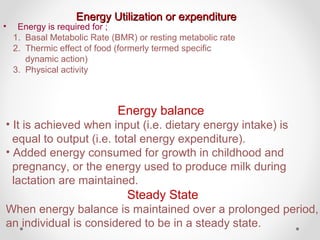
Energy Utilization or expenditureEnergy Utilization or expenditure
• Energy is required for ;
1. Basal Metabolic Rate (BMR) or resting metabolic rate
2. Thermic effect of food (formerly termed specific
dynamic action)
3. Physical activity
Energy balance
• It is achieved when input (i.e. dietary energy intake) is
equal to output (i.e. total energy expenditure).
• Added energy consumed for growth in childhood and
pregnancy, or the energy used to produce milk during
lactation are maintained.
Steady State
When energy balance is maintained over a prolonged period,
an individual is considered to be in a steady state.
Energy expenditureEnergy expenditure
• 1.The energy expended in a
resting, postasorptive state is
called resting metabolic rate
(RMR) or formerly BMR.
• 2.The production of heat by the
body increases as much as 30%
above the RMR during digestion
and absorption of food. It is called
thermic effect of food
• 3.Muscular activity provides
physical activity. Sedentary life
requires 30 to 50% more than the
RMR. Highly active persons
require 100% more than the RMR
Energy BalanceEnergy Balance
• Calories consumed
should be equal to
calories burned.
• Positive balance :
calories consumed is
higher than calories
burned.
• Negative balance:
calories consumed is
less than calories
required.
Role of different foodsRole of different foods
• Adults should consume 45 to 65% of their total
calories from carbohydrates
• 20 to 35% calories from fats
• 10 to 35 % calories from proteins.
• Carbohydrates provide energy and fiber
• Fats provide energy and essential fatty acids
• Proteins provide essential amino acids for protein
synthesis.
• Water forms essential part of diet though it has no
calorific values.
• Vitamins and minerals are required for
maintenance of body’s metabolism.
Recommended Dietary Allowance (RDA)Recommended Dietary Allowance (RDA)
• The RDA is the average daily intake level, that is
sufficient to meet the nutrient requirements of nearly all
(97 to 98%)
• RDA will vary according to the physiological needs.
• Pregnant and lactating women need more nutrients.
• Growing children will need more of some nutrient than
adults.
Nutrition & DiseaseNutrition & Disease
Nutritional disease may be due to
(A). Deficiencies: eg developmental abnormalities,
Protein energy malnutrition, Mineral deficiencies
and vitamin deficiencies. Malnutrition like Iodine
deficiency, Coelic disease, starvation etc.
(B). Excesses in the diet : eg obesity and uncontrolled
eating disorders, chronic diseases like
cardiovasucular (CVD),hypertension, diabetes,
cancer etc.
Dietary Mineral Toxicity, Hypervitaminosis.
Nutrition & Disease…ContdNutrition & Disease…Contd
• Fiber rich diets decreases the risk for constipation
• Consumption of saturated fats is strongly
associated with high levels of total plasma
cholesterol and LDL cholesterol which result in
increased risk of cardiovascular disease
• Consumption of n-6 polyunsaturated fatty acids
reduce the risk of cardiovascular mortality
• Kwashiorkor is caused by inadequate intake of
protein (Protein energy malnutrution)
• Marasmus results from chronic deficiency of
calories (Starvation and protein energy
malnutrition)
A child with kwashiorkorA child with kwashiorkor A child with Marasmus
MineralsMinerals
• Minerals are required in amounts greater than 100
mg/day
• Calcium, phosphorus, Sodium, Potassium, Chloride and
Magnesium are the important minerals in the body
• They are present in the leafy vegetables, fruits, dairy
products and table salts
• Calcium & Phosphorus deficiency produce rickets in
children and osteomalacia in adults
Functions of CalciumFunctions of Calcium
• Calcium is the most abundant mineral in the
human body
• The average content of calcium in an adult is 1
kg of which 99% is present in the bone.
Functions of calcium include:
• Structural component in bone and teeth.
• Controls excitability and release of
neurotransmitters
• Initiates muscle contraction
• Coenzyme for coagulation factors
• Acts as intracellular second messenger (signal)
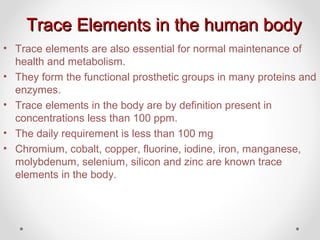
Trace Elements in the human bodyTrace Elements in the human body
• Trace elements are also essential for normal maintenance of
health and metabolism.
• They form the functional prosthetic groups in many proteins and
enzymes.
• Trace elements in the body are by definition present in
concentrations less than 100 ppm.
• The daily requirement is less than 100 mg
• Chromium, cobalt, copper, fluorine, iodine, iron, manganese,
molybdenum, selenium, silicon and zinc are known trace
elements in the body.
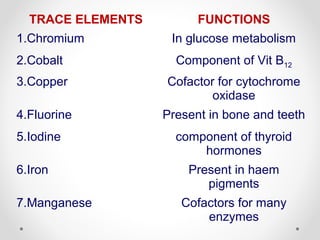
TRACE ELEMENTS FUNCTIONS
1.Chromium In glucose metabolism
2.Cobalt Component of Vit B12
3.Copper Cofactor for cytochrome
oxidase
4.Fluorine Present in bone and teeth
5.Iodine component of thyroid
hormones
6.Iron Present in haem
pigments
7.Manganese Cofactors for many
enzymes
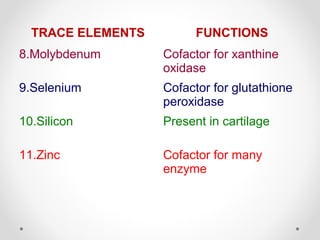
TRACE ELEMENTS FUNCTIONS
8.Molybdenum Cofactor for xanthine
oxidase
9.Selenium Cofactor for glutathione
peroxidase
10.Silicon Present in cartilage
11.Zinc Cofactor for many
enzyme
Nutrition aub

Nutrition aub

  • 1.
    NUTRITIONNUTRITION Dr. Ayyub Patel,PhD CChem MRSC FRSC Assistant Professor, Medicine KKU KSA
  • 2.
    IntroductionIntroduction • Nutrients arethe constituents of food necessary to sustain normal functions of the body • Most of the energy is provided by three classes of nutrients: (1) Fats (2) Carbohydrates (3) Proteins • These nutrients are consumed in larger amounts, therefore, they are called ‘macronutrients’ • Those nutrients needed in lesser amounts, such as vitamins and minerals are called ‘micronutrients’
  • 3.
    Classification of NutrientsClassificationof NutrientsNutrients are A).Macronutrients: (Source of energy) Carbohydrates, Lipids, Proteins B).Micronutrients : Minerals & Vitamins C). Water Calories per gram Protein 1 Gram = 4 calories Carbohydrates 1 Gram = 4 calories Fat 1 Gram = 9 calories
  • 4.
    Energy content offoodEnergy content of food • The energy content of food is calculated from the heat released during its breakdown. • It is expressed in kilocalories (kcal or Cal) • Joules is the another unit of energy 1 cal = 4.128 J Calorimeter is used to measure the heat generated from the food under combustion or by either chemical reaction, change of state, or formation of a solution.
  • 5.
    Energy requirement inhumansEnergy requirement in humans • Sedentary adults (less activity) require 30 kcal/kg/day • Moderately active adults require 35 kcal/kg/day • Very active adults require 40 kcal/kg/day Human energy requirements are estimated from measures of energy expenditure plus the additional energy needs for growth, pregnancy and lactation.
  • 6.
    Energy Utilization orexpenditureEnergy Utilization or expenditure • Energy is required for ; 1. Basal Metabolic Rate (BMR) or resting metabolic rate 2. Thermic effect of food (formerly termed specific dynamic action) 3. Physical activity Energy balance • It is achieved when input (i.e. dietary energy intake) is equal to output (i.e. total energy expenditure). • Added energy consumed for growth in childhood and pregnancy, or the energy used to produce milk during lactation are maintained. Steady State When energy balance is maintained over a prolonged period, an individual is considered to be in a steady state.
  • 7.
    Energy expenditureEnergy expenditure •1.The energy expended in a resting, postasorptive state is called resting metabolic rate (RMR) or formerly BMR. • 2.The production of heat by the body increases as much as 30% above the RMR during digestion and absorption of food. It is called thermic effect of food • 3.Muscular activity provides physical activity. Sedentary life requires 30 to 50% more than the RMR. Highly active persons require 100% more than the RMR
  • 8.
    Energy BalanceEnergy Balance •Calories consumed should be equal to calories burned. • Positive balance : calories consumed is higher than calories burned. • Negative balance: calories consumed is less than calories required.
  • 9.
    Role of differentfoodsRole of different foods • Adults should consume 45 to 65% of their total calories from carbohydrates • 20 to 35% calories from fats • 10 to 35 % calories from proteins. • Carbohydrates provide energy and fiber • Fats provide energy and essential fatty acids • Proteins provide essential amino acids for protein synthesis. • Water forms essential part of diet though it has no calorific values. • Vitamins and minerals are required for maintenance of body’s metabolism.
  • 10.
    Recommended Dietary Allowance(RDA)Recommended Dietary Allowance (RDA) • The RDA is the average daily intake level, that is sufficient to meet the nutrient requirements of nearly all (97 to 98%) • RDA will vary according to the physiological needs. • Pregnant and lactating women need more nutrients. • Growing children will need more of some nutrient than adults.
  • 11.
    Nutrition & DiseaseNutrition& Disease Nutritional disease may be due to (A). Deficiencies: eg developmental abnormalities, Protein energy malnutrition, Mineral deficiencies and vitamin deficiencies. Malnutrition like Iodine deficiency, Coelic disease, starvation etc. (B). Excesses in the diet : eg obesity and uncontrolled eating disorders, chronic diseases like cardiovasucular (CVD),hypertension, diabetes, cancer etc. Dietary Mineral Toxicity, Hypervitaminosis.
  • 12.
    Nutrition & Disease…ContdNutrition& Disease…Contd • Fiber rich diets decreases the risk for constipation • Consumption of saturated fats is strongly associated with high levels of total plasma cholesterol and LDL cholesterol which result in increased risk of cardiovascular disease • Consumption of n-6 polyunsaturated fatty acids reduce the risk of cardiovascular mortality • Kwashiorkor is caused by inadequate intake of protein (Protein energy malnutrution) • Marasmus results from chronic deficiency of calories (Starvation and protein energy malnutrition)
  • 13.
    A child withkwashiorkorA child with kwashiorkor A child with Marasmus
  • 14.
    MineralsMinerals • Minerals arerequired in amounts greater than 100 mg/day • Calcium, phosphorus, Sodium, Potassium, Chloride and Magnesium are the important minerals in the body • They are present in the leafy vegetables, fruits, dairy products and table salts • Calcium & Phosphorus deficiency produce rickets in children and osteomalacia in adults
  • 15.
    Functions of CalciumFunctionsof Calcium • Calcium is the most abundant mineral in the human body • The average content of calcium in an adult is 1 kg of which 99% is present in the bone. Functions of calcium include: • Structural component in bone and teeth. • Controls excitability and release of neurotransmitters • Initiates muscle contraction • Coenzyme for coagulation factors • Acts as intracellular second messenger (signal)
  • 16.
    Trace Elements inthe human bodyTrace Elements in the human body • Trace elements are also essential for normal maintenance of health and metabolism. • They form the functional prosthetic groups in many proteins and enzymes. • Trace elements in the body are by definition present in concentrations less than 100 ppm. • The daily requirement is less than 100 mg • Chromium, cobalt, copper, fluorine, iodine, iron, manganese, molybdenum, selenium, silicon and zinc are known trace elements in the body.
  • 17.
    TRACE ELEMENTS FUNCTIONS 1.ChromiumIn glucose metabolism 2.Cobalt Component of Vit B12 3.Copper Cofactor for cytochrome oxidase 4.Fluorine Present in bone and teeth 5.Iodine component of thyroid hormones 6.Iron Present in haem pigments 7.Manganese Cofactors for many enzymes
  • 18.
    TRACE ELEMENTS FUNCTIONS 8.MolybdenumCofactor for xanthine oxidase 9.Selenium Cofactor for glutathione peroxidase 10.Silicon Present in cartilage 11.Zinc Cofactor for many enzyme