NUTRITION & DIETETICS
By DR. INDRAJEET KUMAR
Tutor
Department of Community Medicine
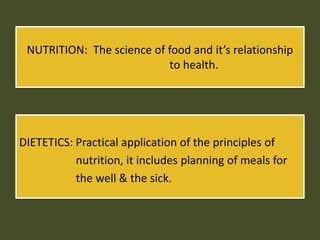
NUTRITION: The science of food and it’s relationship
to health.
DIETETICS: Practical application of the principles of
nutrition, it includes planning of meals for
the well & the sick.
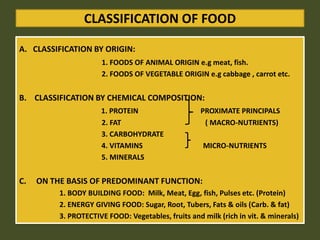
CLASSIFICATION OF FOOD
A. CLASSIFICATION BY ORIGIN:
1. FOODS OF ANIMAL ORIGIN e.g meat, fish.
2. FOODS OF VEGETABLE ORIGIN e.g cabbage , carrot etc.
B. CLASSIFICATION BY CHEMICAL COMPOSITION:
1. PROTEIN PROXIMATE PRINCIPALS
2. FAT ( MACRO-NUTRIENTS)
3. CARBOHYDRATE
4. VITAMINS MICRO-NUTRIENTS
5. MINERALS
C. ON THE BASIS OF PREDOMINANT FUNCTION:
1. BODY BUILDING FOOD: Milk, Meat, Egg, fish, Pulses etc. (Protein)
2. ENERGY GIVING FOOD: Sugar, Root, Tubers, Fats & oils (Carb. & fat)
3. PROTECTIVE FOOD: Vegetables, fruits and milk (rich in vit. & minerals)
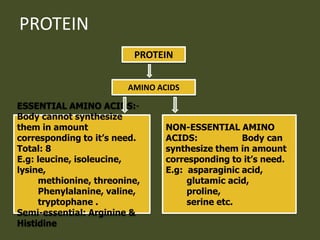
PROTEIN
PROTEIN
AMINO ACIDS
ESSENTIAL AMINO ACIDS:-
Body cannot synthesize
them in amount
corresponding to it’s need.
Total: 8
E.g: leucine, isoleucine,
lysine,
methionine, threonine,
Phenylalanine, valine,
tryptophane .
Semi-essential: Arginine &
Histidine
NON-ESSENTIAL AMINO
ACIDS: Body can
synthesize them in amount
corresponding to it’s need.
E.g: asparaginic acid,
glutamic acid,
proline,
serine etc.
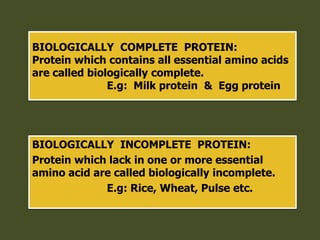
BIOLOGICALLY COMPLETE PROTEIN:
Protein which contains all essential amino acids
are called biologically complete.
E.g: Milk protein & Egg protein
BIOLOGICALLY INCOMPLETE PROTEIN:
Protein which lack in one or more essential
amino acid are called biologically incomplete.
E.g: Rice, Wheat, Pulse etc.
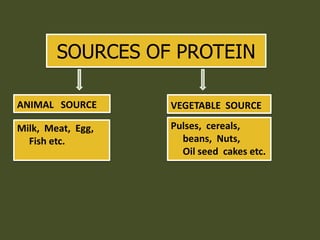
SOURCES OF PROTEIN
ANIMAL SOURCE
Milk, Meat, Egg,
Fish etc.
VEGETABLE SOURCE
Pulses, cereals,
beans, Nuts,
Oil seed cakes etc.
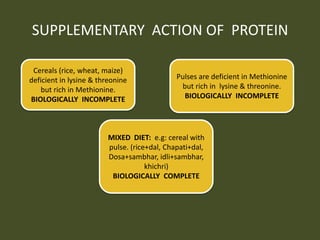
SUPPLEMENTARY ACTION OF PROTEIN
MIXED DIET: e.g: cereal with
pulse. (rice+dal, Chapati+dal,
Dosa+sambhar, idli+sambhar,
khichri)
BIOLOGICALLY COMPLETE
Cereals (rice, wheat, maize)
deficient in lysine & threonine
but rich in Methionine.
BIOLOGICALLY INCOMPLETE
Pulses are deficient in Methionine
but rich in lysine & threonine.
BIOLOGICALLY INCOMPLETE
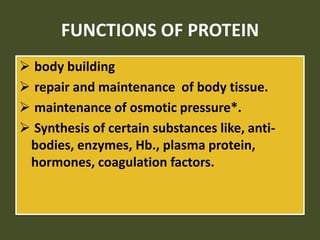
FUNCTIONS OF PROTEIN
 body building
 repair and maintenance of body tissue.
 maintenance of osmotic pressure*.
 Synthesis of certain substances like, anti-
bodies, enzymes, Hb., plasma protein,
hormones, coagulation factors.
ASSESMENT OF NUTRITIVE VALUE OF PROTEIN
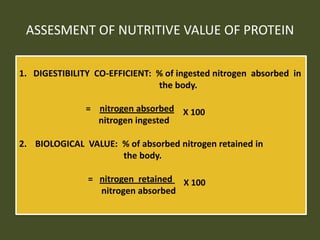
1. DIGESTIBILITY CO-EFFICIENT: % of ingested nitrogen absorbed in
the body.
= nitrogen absorbed X 100
nitrogen ingested
2. BIOLOGICAL VALUE: % of absorbed nitrogen retained in
the body.
= nitrogen retained X 100
nitrogen absorbed
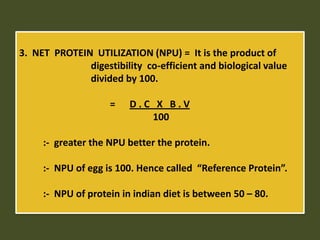
3. NET PROTEIN UTILIZATION (NPU) = It is the product of
digestibility co-efficient and biological value
divided by 100.
= D . C X B . V
100
:- greater the NPU better the protein.
:- NPU of egg is 100. Hence called “Reference Protein”.
:- NPU of protein in indian diet is between 50 – 80.
ASSESSMENT OF PROTEIN STATUS
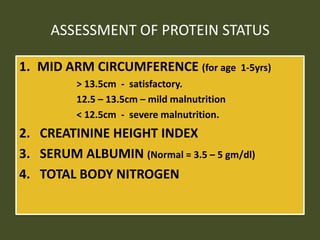
1. MID ARM CIRCUMFERENCE (for age 1-5yrs)
> 13.5cm - satisfactory.
12.5 – 13.5cm – mild malnutrition
< 12.5cm - severe malnutrition.
2. CREATININE HEIGHT INDEX
3. SERUM ALBUMIN (Normal = 3.5 – 5 gm/dl)
4. TOTAL BODY NITROGEN
PROTEIN REQUIREMENT
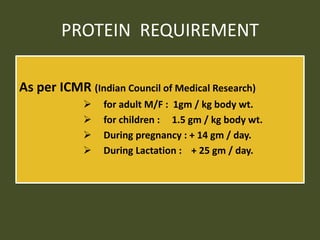
As per ICMR (Indian Council of Medical Research)
 for adult M/F : 1gm / kg body wt.
 for children : 1.5 gm / kg body wt.
 During pregnancy : + 14 gm / day.
 During Lactation : + 25 gm / day.
Nutrition & dietetics (2)

Nutrition & dietetics (2)

  • 1.
    NUTRITION & DIETETICS ByDR. INDRAJEET KUMAR Tutor Department of Community Medicine
  • 2.
    NUTRITION: The scienceof food and it’s relationship to health. DIETETICS: Practical application of the principles of nutrition, it includes planning of meals for the well & the sick.
  • 3.
    CLASSIFICATION OF FOOD A.CLASSIFICATION BY ORIGIN: 1. FOODS OF ANIMAL ORIGIN e.g meat, fish. 2. FOODS OF VEGETABLE ORIGIN e.g cabbage , carrot etc. B. CLASSIFICATION BY CHEMICAL COMPOSITION: 1. PROTEIN PROXIMATE PRINCIPALS 2. FAT ( MACRO-NUTRIENTS) 3. CARBOHYDRATE 4. VITAMINS MICRO-NUTRIENTS 5. MINERALS C. ON THE BASIS OF PREDOMINANT FUNCTION: 1. BODY BUILDING FOOD: Milk, Meat, Egg, fish, Pulses etc. (Protein) 2. ENERGY GIVING FOOD: Sugar, Root, Tubers, Fats & oils (Carb. & fat) 3. PROTECTIVE FOOD: Vegetables, fruits and milk (rich in vit. & minerals)
  • 4.
    PROTEIN PROTEIN AMINO ACIDS ESSENTIAL AMINOACIDS:- Body cannot synthesize them in amount corresponding to it’s need. Total: 8 E.g: leucine, isoleucine, lysine, methionine, threonine, Phenylalanine, valine, tryptophane . Semi-essential: Arginine & Histidine NON-ESSENTIAL AMINO ACIDS: Body can synthesize them in amount corresponding to it’s need. E.g: asparaginic acid, glutamic acid, proline, serine etc.
  • 5.
    BIOLOGICALLY COMPLETE PROTEIN: Proteinwhich contains all essential amino acids are called biologically complete. E.g: Milk protein & Egg protein BIOLOGICALLY INCOMPLETE PROTEIN: Protein which lack in one or more essential amino acid are called biologically incomplete. E.g: Rice, Wheat, Pulse etc.
  • 6.
    SOURCES OF PROTEIN ANIMALSOURCE Milk, Meat, Egg, Fish etc. VEGETABLE SOURCE Pulses, cereals, beans, Nuts, Oil seed cakes etc.
  • 7.
    SUPPLEMENTARY ACTION OFPROTEIN MIXED DIET: e.g: cereal with pulse. (rice+dal, Chapati+dal, Dosa+sambhar, idli+sambhar, khichri) BIOLOGICALLY COMPLETE Cereals (rice, wheat, maize) deficient in lysine & threonine but rich in Methionine. BIOLOGICALLY INCOMPLETE Pulses are deficient in Methionine but rich in lysine & threonine. BIOLOGICALLY INCOMPLETE
  • 8.
    FUNCTIONS OF PROTEIN body building  repair and maintenance of body tissue.  maintenance of osmotic pressure*.  Synthesis of certain substances like, anti- bodies, enzymes, Hb., plasma protein, hormones, coagulation factors.
  • 9.
    ASSESMENT OF NUTRITIVEVALUE OF PROTEIN 1. DIGESTIBILITY CO-EFFICIENT: % of ingested nitrogen absorbed in the body. = nitrogen absorbed X 100 nitrogen ingested 2. BIOLOGICAL VALUE: % of absorbed nitrogen retained in the body. = nitrogen retained X 100 nitrogen absorbed
  • 10.
    3. NET PROTEINUTILIZATION (NPU) = It is the product of digestibility co-efficient and biological value divided by 100. = D . C X B . V 100 :- greater the NPU better the protein. :- NPU of egg is 100. Hence called “Reference Protein”. :- NPU of protein in indian diet is between 50 – 80.
  • 11.
    ASSESSMENT OF PROTEINSTATUS 1. MID ARM CIRCUMFERENCE (for age 1-5yrs) > 13.5cm - satisfactory. 12.5 – 13.5cm – mild malnutrition < 12.5cm - severe malnutrition. 2. CREATININE HEIGHT INDEX 3. SERUM ALBUMIN (Normal = 3.5 – 5 gm/dl) 4. TOTAL BODY NITROGEN
  • 12.
    PROTEIN REQUIREMENT As perICMR (Indian Council of Medical Research)  for adult M/F : 1gm / kg body wt.  for children : 1.5 gm / kg body wt.  During pregnancy : + 14 gm / day.  During Lactation : + 25 gm / day.