NURSING CARE PLAN:REVIEWING THE ASPECT
OF NURSING DIAGNOSIS IN CLINICAL PRACTISE
BY
SOLOMON RIMAMCHIRIKA
(RN,BNSC,PGDE)
DURING NURSES’ CLINICAL PRESENTATION,
FRDERAL MEDICAL CENTER
BIRNIN KEBBI
ON
7TH JUNE, 2019
TABLE OF CONTENT
• INTRODUCTION
• NURSING CARE PLAN
• NURSING PROCESS AND THE STEP INVOLVE
• NURSING DIAGNOSIS
• COMPONENT OF NURSING DIGNOSIS
• TYPES OF NURSING DIAGNOSIS
• WHAT NURSING DIAGNOSIS IS NOT
• LATEST NANDA DIAGNOSIS
• CONCLUSION
• REFERRENCE
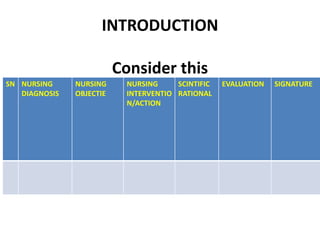
INTRODUCTION
Consider this
SN NURSING
DIAGNOSIS
NURSING
OBJECTIE
NURSING
INTERVENTIO
N/ACTION
SCINTIFIC
RATIONAL
EVALUATION SIGNATURE
Nursing Care Plans
• Utilize the Nursing Process to construct
an individualized plan of care for a
patient based on a critical analysis of
patient assessment data
Nursing Care Plans
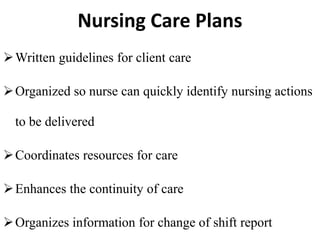
Written guidelines for client care
Organized so nurse can quickly identify nursing actions
to be delivered
Coordinates resources for care
Enhances the continuity of care
Organizes information for change of shift report
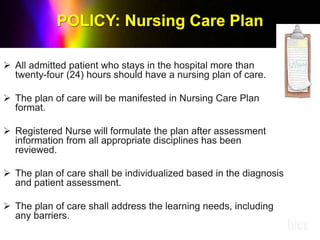
 All admitted patient who stays in the hospital more than
twenty-four (24) hours should have a nursing plan of care.
 The plan of care will be manifested in Nursing Care Plan
format.
 Registered Nurse will formulate the plan after assessment
information from all appropriate disciplines has been
reviewed.
 The plan of care shall be individualized based in the diagnosis
and patient assessment.
 The plan of care shall address the learning needs, including
any barriers.
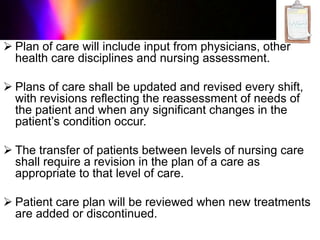
 Plan of care will include input from physicians, other
health care disciplines and nursing assessment.
 Plans of care shall be updated and revised every shift,
with revisions reflecting the reassessment of needs of
the patient and when any significant changes in the
patient’s condition occur.
 The transfer of patients between levels of nursing care
shall require a revision in the plan of a care as
appropriate to that level of care.
 Patient care plan will be reviewed when new treatments
are added or discontinued.
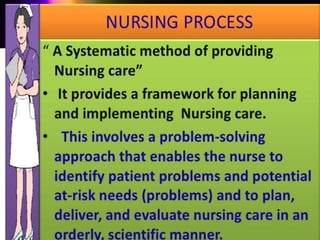
Nursing process
• The nursing process is the framework
for providing professional, quality nursing
care. It directs nursing activities for health
promotion, health protection, and disease
prevention and is used by nurses in every
practice setting and specialty.
• “The nursing process provides the basis
for critical thinking in nursing” (Alfaro-
LeFavre, 1998,
HISTORY OF NURSING PROCESS
History: Labeled the “Nursing Process” in 1950
by Lydia Hall.
Nursing process is how nurses:
 Think.
 Identify patient problems.
 Determine patient outcomes.
 Prioritize patient care.
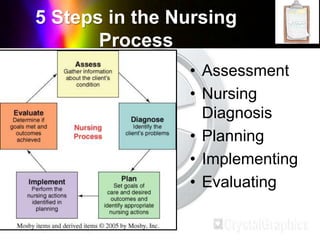
5 Steps in the Nursing
Process
• Assessment
• Nursing
Diagnosis
• Planning
• Implementing
• Evaluating
1. Assessment- Systematic collection of
patient’s data
First step of the Nursing Process
• Gather Information/Collect Data
• Primary Source - Client / Family
• Secondary Source - physical exam, nursing history,
team members, lab reports, diagnostic tests…..
• Subjective -from the client (symptom) e.g.“I have a
headache”
• Objective - observable data (sign)e.g. Blood Pressure
130/80.
1. Assessment- Systematic collection of
patient’s data
• Gather Information/Collect Data
– Primary Source - Client / Family
– Secondary Source - physical exam, nursing
history, team members, lab reports, diagnostic
tests…..
– Subjective -from the client (symptom) e.g.“I
have a headache”
– Objective - observable data (sign)e.g. Blood
Pressure 130/80.
Subjective Data
Symptoms or covert data
Apparent only to the person
affected
Can be described only by person
affected
Includes sensations, feelings,
values, beliefs, attitudes, and
perception of personal health status
and life situations
Copyright 2008 by Pearson Education, Inc.
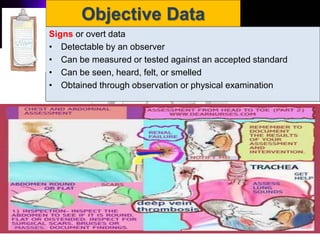
Objective Data
Signs or overt data
• Detectable by an observer
• Can be measured or tested against an accepted standard
• Can be seen, heard, felt, or smelled
• Obtained through observation or physical examination
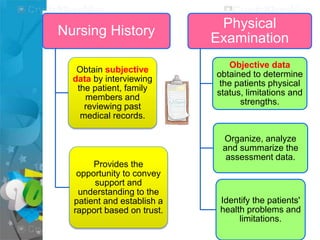
Nursing History
Obtain subjective
data by interviewing
the patient, family
members and
reviewing past
medical records.
Provides the
opportunity to convey
support and
understanding to the
patient and establish a
rapport based on trust.
Physical
Examination
Objective data
obtained to determine
the patients physical
status, limitations and
strengths.
Organize, analyze
and summarize the
assessment data.
Identify the patients'
health problems and
limitations.
• Nursing History
– Obtain subjective data by interviewing the patient,
family members and reviewing past medical records.
– Provides the opportunity to convey support and
understanding to the patient and establish a rapport
based on trust.
• Physical Examination
– Objective data obtained to determine the patients
physical status, limitations and strengths.
– Organize, analyze and summarize the assessment
data.
– Identify the patients' health problems and limitations.
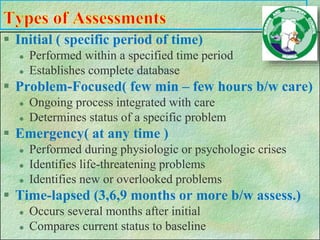
 Initial ( specific period of time)
 Performed within a specified time period
 Establishes complete database
 Problem-Focused( few min – few hours b/w care)
 Ongoing process integrated with care
 Determines status of a specific problem
 Emergency( at any time )
 Performed during physiologic or psychologic crises
 Identifies life-threatening problems
 Identifies new or overlooked problems
 Time-lapsed (3,6,9 months or more b/w assess.)
 Occurs several months after initial
 Compares current status to baseline
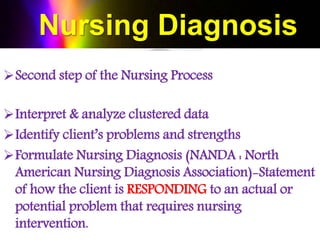
Nursing Diagnosis
Second step of the Nursing Process
Interpret & analyze clustered data
Identify client’s problems and strengths
Formulate Nursing Diagnosis (NANDA : North
American Nursing Diagnosis Association)-Statement
of how the client is RESPONDING to an actual or
potential problem that requires nursing
intervention.
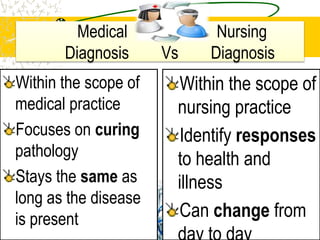
Medical Nursing
Diagnosis Vs Diagnosis
Within the scope of
medical practice
Focuses on curing
pathology
Stays the same as
long as the disease
is present
Within the scope of
nursing practice
Identify responses
to health and
illness
Can change from
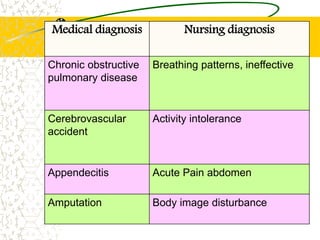
Medical diagnosis Nursing diagnosis
Chronic obstructive
pulmonary disease
Breathing patterns, ineffective
Cerebrovascular
accident
Activity intolerance
Appendecitis Acute Pain abdomen
Amputation Body image disturbance
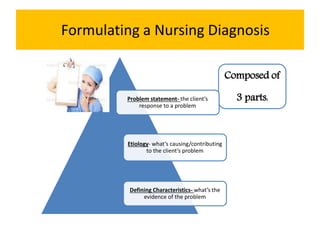
Formulating a Nursing Diagnosis
Composed of
3 parts:Problem statement- the client’s
response to a problem
Etiology- what’s causing/contributing
to the client’s problem
Defining Characteristics- what’s the
evidence of the problem
Formulating a Nursing Diagnosis
• Composed of 3 parts:
• Problem statement- the client’s response to a
problem
• Etiology- what’s causing/contributing to the
client’s problem
• Defining Characteristics- what’s the evidence
of the problem
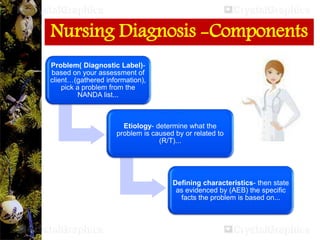
Nursing Diagnosis -Components
Problem( Diagnostic Label)-
based on your assessment of
client…(gathered information),
pick a problem from the
NANDA list...
Etiology- determine what the
problem is caused by or related to
(R/T)...
Defining characteristics- then state
as evidenced by (AEB) the specific
facts the problem is based on...
Nursing Diagnosis -Components
• Problem( Diagnostic Label)-based on your
assessment of client…(gathered information),
pick a problem from the NANDA list...
• Etiology- determine what the problem is
caused by or related to (R/T)...
• Defining characteristics- then state as
evidenced by (AEB) the specific facts the
problem is based on...
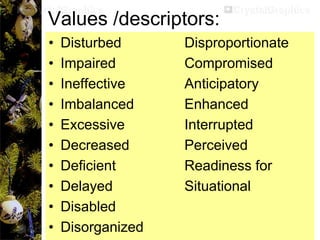
Values /descriptors:
• Disturbed Disproportionate
• Impaired Compromised
• Ineffective Anticipatory
• Imbalanced Enhanced
• Excessive Interrupted
• Decreased Perceived
• Deficient Readiness for
• Delayed Situational
• Disabled
• Disorganized
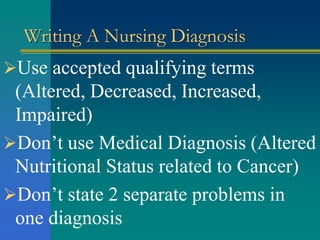
Writing A Nursing Diagnosis
Use accepted qualifying terms
(Altered, Decreased, Increased,
Impaired)
Don’t use Medical Diagnosis (Altered
Nutritional Status related to Cancer)
Don’t state 2 separate problems in
one diagnosis
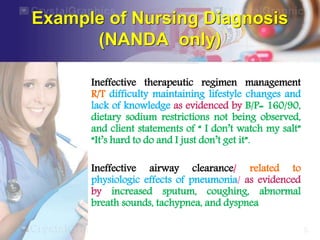
Example of Nursing Diagnosis
(NANDA only)
Ineffective therapeutic regimen management
R/T difficulty maintaining lifestyle changes and
lack of knowledge as evidenced by B/P= 160/90,
dietary sodium restrictions not being observed,
and client statements of “ I don’t watch my salt”
“It’s hard to do and I just don’t get it”.
Ineffective airway clearance/ related to
physiologic effects of pneumonia/ as evidenced
by increased sputum, coughing, abnormal
breath sounds, tachypnea, and dyspnea
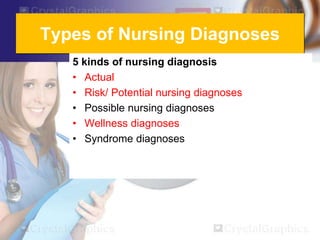
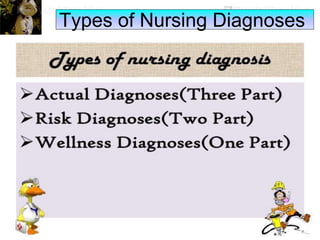
Types of Nursing Diagnoses
5 kinds of nursing diagnosis
• Actual
• Risk/ Potential nursing diagnoses
• Possible nursing diagnoses
• Wellness diagnoses
• Syndrome diagnoses
Actual
Imbalanced nutrition;
less than body
requirements R/T
chronic diarrhea,
nausea, and pain AEB
height 5’5” weight
78kg
Risk
Risk for falls
R/T altered
gait and
generalized
weakness
Wellness
Family coping:
potential for
growth R/T
unexpected
birth of twins.
Types of Nursing Diagnoses
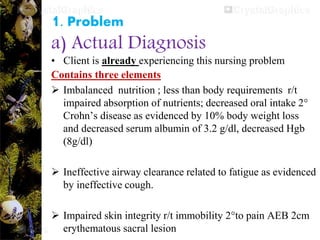
1. Problem
a) Actual Diagnosis
• Client is already experiencing this nursing problem
Contains three elements
 Imbalanced nutrition ; less than body requirements r/t
impaired absorption of nutrients; decreased oral intake 2°
Crohn’s disease as evidenced by 10% body weight loss
and decreased serum albumin of 3.2 g/dl, decreased Hgb
(8g/dl)
 Ineffective airway clearance related to fatigue as evidenced
by ineffective cough.
 Impaired skin integrity r/t immobility 2°to pain AEB 2cm
erythematous sacral lesion
2. Etiology
(contributing factors, influencing or risk factors)
• These related factors have contributed to & influenced the
change in the health status (4 categories: pathophysiologic,
treatment related, situational, maturational)
• All etiologies should be included
• Be precise – may use ‘secondary to’ if helpful
• Do not state medical diagnosis unless using as ‘secondary
to’ in your etiology.
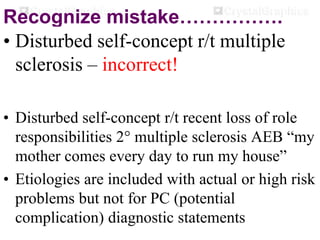
Recognize mistake…………….
• Disturbed self-concept r/t multiple
sclerosis – incorrect!
• Disturbed self-concept r/t recent loss of role
responsibilities 2° multiple sclerosis AEB “my
mother comes every day to run my house”
• Etiologies are included with actual or high risk
problems but not for PC (potential
complication) diagnostic statements
3. DEFINING CHARACTERISTICS
These are the clinical criteria or assessment
findings that support a nursing diagnoses.
 Signs (objective data)
 Symptoms (subjective data)
 Other relevant data (ie. Lab data, test reports)
 Designated as Major or Minor
 Be specific – individualize
 Included with actual problems only
A complete nursing diagnosis
• Format:
• “ Problem related to cause of
problem as evidenced by
symptoms of problem”
•“ Impaired gas exchange
related to excessive
secretions as evidenced by O2
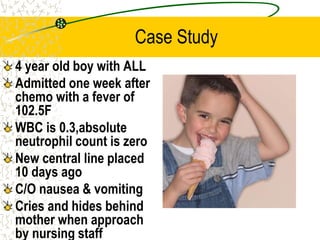
Case Study
4 year old boy with ALL
Admitted one week after
chemo with a fever of
102.5F
WBC is 0.3,absolute
neutrophil count is zero
New central line placed
10 days ago
C/O nausea & vomiting
Cries and hides behind
mother when approach
by nursing staff
Examples
1. Risk for infection related to
immunosuppression secondary to
chemotherapy, inadequate primary
defenses (central venous
catheter),chronic disease
(ALL)and developmental level
AEB wbc count(0.3)
Examples
2. Nausea related to
chemotherapy as evidenced
by vomiting, patient c/o
“tummy ache” and aversion
toward food.
Examples
3. Fear related to unfamiliarity
with environmental
experiences as evidenced by
avoidance behaviors (hides
behind mother) and crying.
b) Risk Diagnosis
Client does not experience the problem currently
but is at high risk of developing the problem
Contains two elements
High risk for Imbalanced nutrition (less than body
requirements) r/t nutritional losses through diarrhea and
vomiting .
Risk for physical injury related to disorientation, and
impaired mobility.
High risk for impaired skin integrity r/t immobility.
High risk for infection r/t interrupted skin integrity from
surgical incision 2°abdominal hysterectomy.
c) Wellness Diagnosis
Begin with …….Readiness for
enhancement
Describes human responses to levels of
wellness in an individual, family, or
community that have a readiness
enhancement.”
readiness for enhanced spiritual well-
being or
d) Possible Diagnosis
–Evidence about a health problem
incomplete or unclear
–Requires more data to either support or to
refute it
–E.g. possible social isolation
–Severe anxiety related to threat to
physiologic integrity: possible cancer
diagnosis.
e) Syndrome Diagnosis
–Associated with a cluster of
other diagnoses
–(risk for disuse syndrome)
WHAT NURSING DIAGNOSIS IS
NOT
Nursing need
Medical disease
Laboratory test
Staff problem
Therapeutic need
Equipment
Sign
Symptoms
CHALLENGES OF IMPLEMENTING NURSING CARE
PLAN IN HEALTH CARE INSTITUATION IN NIGERIA
The challenges as documented by Lauri(1992),
Ojo and Orinoye(2002) are:
Poor knowledge and skill of writing care plan
Inadequate relevant in-service education
Poor attitude
Staff shortage
Inadequate material
Resistance to change on part of nurses
C:UsersHpDesktopLatest NANDA List.pdf
CONCLUSION
The nursing care plan is a tool for effective nursing
care, it is the only evidence a nurse have to show
that he/she have effectively and efficiently render
nursing care to a client. It is our identity as nurses
hence be cherish by all.
Effective nursing care plan rely on right nursing
diagnosis which focus on identifying client responses.
We are hereby encourage to translate what we have
learn to reality for the benefit of our client and the
progress of nursing profession.
References
F. O. O Adesokan (2011), Reproductive Health for all Ages,
Revised edition, Bosem publisher Nig. Lmt, Akure.
Mayoori Mohan(2014) Nursing Process and Care Plan
writing
NANDA Nursing Diagnosis(2009): Definitions and
Classifications 2009-2011. Indianapolis, IN: Wiley-Blackwell.
THANKS
FOR
LISTENING

Nursing care

  • 1.
    NURSING CARE PLAN:REVIEWINGTHE ASPECT OF NURSING DIAGNOSIS IN CLINICAL PRACTISE BY SOLOMON RIMAMCHIRIKA (RN,BNSC,PGDE) DURING NURSES’ CLINICAL PRESENTATION, FRDERAL MEDICAL CENTER BIRNIN KEBBI ON 7TH JUNE, 2019
  • 2.
    TABLE OF CONTENT •INTRODUCTION • NURSING CARE PLAN • NURSING PROCESS AND THE STEP INVOLVE • NURSING DIAGNOSIS • COMPONENT OF NURSING DIGNOSIS • TYPES OF NURSING DIAGNOSIS • WHAT NURSING DIAGNOSIS IS NOT • LATEST NANDA DIAGNOSIS • CONCLUSION • REFERRENCE
  • 3.
  • 4.
    Nursing Care Plans •Utilize the Nursing Process to construct an individualized plan of care for a patient based on a critical analysis of patient assessment data
  • 5.
    Nursing Care Plans Writtenguidelines for client care Organized so nurse can quickly identify nursing actions to be delivered Coordinates resources for care Enhances the continuity of care Organizes information for change of shift report
  • 6.
     All admittedpatient who stays in the hospital more than twenty-four (24) hours should have a nursing plan of care.  The plan of care will be manifested in Nursing Care Plan format.  Registered Nurse will formulate the plan after assessment information from all appropriate disciplines has been reviewed.  The plan of care shall be individualized based in the diagnosis and patient assessment.  The plan of care shall address the learning needs, including any barriers.
  • 7.
     Plan ofcare will include input from physicians, other health care disciplines and nursing assessment.  Plans of care shall be updated and revised every shift, with revisions reflecting the reassessment of needs of the patient and when any significant changes in the patient’s condition occur.  The transfer of patients between levels of nursing care shall require a revision in the plan of a care as appropriate to that level of care.  Patient care plan will be reviewed when new treatments are added or discontinued.
  • 8.
    Nursing process • Thenursing process is the framework for providing professional, quality nursing care. It directs nursing activities for health promotion, health protection, and disease prevention and is used by nurses in every practice setting and specialty. • “The nursing process provides the basis for critical thinking in nursing” (Alfaro- LeFavre, 1998,
  • 9.
    HISTORY OF NURSINGPROCESS History: Labeled the “Nursing Process” in 1950 by Lydia Hall. Nursing process is how nurses:  Think.  Identify patient problems.  Determine patient outcomes.  Prioritize patient care.
  • 10.
    5 Steps inthe Nursing Process • Assessment • Nursing Diagnosis • Planning • Implementing • Evaluating
  • 11.
    1. Assessment- Systematiccollection of patient’s data First step of the Nursing Process • Gather Information/Collect Data • Primary Source - Client / Family • Secondary Source - physical exam, nursing history, team members, lab reports, diagnostic tests….. • Subjective -from the client (symptom) e.g.“I have a headache” • Objective - observable data (sign)e.g. Blood Pressure 130/80.
  • 12.
    1. Assessment- Systematiccollection of patient’s data • Gather Information/Collect Data – Primary Source - Client / Family – Secondary Source - physical exam, nursing history, team members, lab reports, diagnostic tests….. – Subjective -from the client (symptom) e.g.“I have a headache” – Objective - observable data (sign)e.g. Blood Pressure 130/80.
  • 13.
    Subjective Data Symptoms orcovert data Apparent only to the person affected Can be described only by person affected Includes sensations, feelings, values, beliefs, attitudes, and perception of personal health status and life situations
  • 14.
    Copyright 2008 byPearson Education, Inc. Objective Data Signs or overt data • Detectable by an observer • Can be measured or tested against an accepted standard • Can be seen, heard, felt, or smelled • Obtained through observation or physical examination
  • 15.
    Nursing History Obtain subjective databy interviewing the patient, family members and reviewing past medical records. Provides the opportunity to convey support and understanding to the patient and establish a rapport based on trust. Physical Examination Objective data obtained to determine the patients physical status, limitations and strengths. Organize, analyze and summarize the assessment data. Identify the patients' health problems and limitations.
  • 16.
    • Nursing History –Obtain subjective data by interviewing the patient, family members and reviewing past medical records. – Provides the opportunity to convey support and understanding to the patient and establish a rapport based on trust. • Physical Examination – Objective data obtained to determine the patients physical status, limitations and strengths. – Organize, analyze and summarize the assessment data. – Identify the patients' health problems and limitations.
  • 17.
     Initial (specific period of time)  Performed within a specified time period  Establishes complete database  Problem-Focused( few min – few hours b/w care)  Ongoing process integrated with care  Determines status of a specific problem  Emergency( at any time )  Performed during physiologic or psychologic crises  Identifies life-threatening problems  Identifies new or overlooked problems  Time-lapsed (3,6,9 months or more b/w assess.)  Occurs several months after initial  Compares current status to baseline
  • 18.
    Nursing Diagnosis Second stepof the Nursing Process Interpret & analyze clustered data Identify client’s problems and strengths Formulate Nursing Diagnosis (NANDA : North American Nursing Diagnosis Association)-Statement of how the client is RESPONDING to an actual or potential problem that requires nursing intervention.
  • 19.
    Medical Nursing Diagnosis VsDiagnosis Within the scope of medical practice Focuses on curing pathology Stays the same as long as the disease is present Within the scope of nursing practice Identify responses to health and illness Can change from
  • 20.
    Medical diagnosis Nursingdiagnosis Chronic obstructive pulmonary disease Breathing patterns, ineffective Cerebrovascular accident Activity intolerance Appendecitis Acute Pain abdomen Amputation Body image disturbance
  • 21.
    Formulating a NursingDiagnosis Composed of 3 parts:Problem statement- the client’s response to a problem Etiology- what’s causing/contributing to the client’s problem Defining Characteristics- what’s the evidence of the problem
  • 22.
    Formulating a NursingDiagnosis • Composed of 3 parts: • Problem statement- the client’s response to a problem • Etiology- what’s causing/contributing to the client’s problem • Defining Characteristics- what’s the evidence of the problem
  • 23.
    Nursing Diagnosis -Components Problem(Diagnostic Label)- based on your assessment of client…(gathered information), pick a problem from the NANDA list... Etiology- determine what the problem is caused by or related to (R/T)... Defining characteristics- then state as evidenced by (AEB) the specific facts the problem is based on...
  • 24.
    Nursing Diagnosis -Components •Problem( Diagnostic Label)-based on your assessment of client…(gathered information), pick a problem from the NANDA list... • Etiology- determine what the problem is caused by or related to (R/T)... • Defining characteristics- then state as evidenced by (AEB) the specific facts the problem is based on...
  • 25.
    Values /descriptors: • DisturbedDisproportionate • Impaired Compromised • Ineffective Anticipatory • Imbalanced Enhanced • Excessive Interrupted • Decreased Perceived • Deficient Readiness for • Delayed Situational • Disabled • Disorganized
  • 26.
    Writing A NursingDiagnosis Use accepted qualifying terms (Altered, Decreased, Increased, Impaired) Don’t use Medical Diagnosis (Altered Nutritional Status related to Cancer) Don’t state 2 separate problems in one diagnosis
  • 27.
    Example of NursingDiagnosis (NANDA only) Ineffective therapeutic regimen management R/T difficulty maintaining lifestyle changes and lack of knowledge as evidenced by B/P= 160/90, dietary sodium restrictions not being observed, and client statements of “ I don’t watch my salt” “It’s hard to do and I just don’t get it”. Ineffective airway clearance/ related to physiologic effects of pneumonia/ as evidenced by increased sputum, coughing, abnormal breath sounds, tachypnea, and dyspnea
  • 28.
    Types of NursingDiagnoses 5 kinds of nursing diagnosis • Actual • Risk/ Potential nursing diagnoses • Possible nursing diagnoses • Wellness diagnoses • Syndrome diagnoses
  • 29.
    Actual Imbalanced nutrition; less thanbody requirements R/T chronic diarrhea, nausea, and pain AEB height 5’5” weight 78kg Risk Risk for falls R/T altered gait and generalized weakness Wellness Family coping: potential for growth R/T unexpected birth of twins. Types of Nursing Diagnoses
  • 30.
    1. Problem a) ActualDiagnosis • Client is already experiencing this nursing problem Contains three elements  Imbalanced nutrition ; less than body requirements r/t impaired absorption of nutrients; decreased oral intake 2° Crohn’s disease as evidenced by 10% body weight loss and decreased serum albumin of 3.2 g/dl, decreased Hgb (8g/dl)  Ineffective airway clearance related to fatigue as evidenced by ineffective cough.  Impaired skin integrity r/t immobility 2°to pain AEB 2cm erythematous sacral lesion
  • 31.
    2. Etiology (contributing factors,influencing or risk factors) • These related factors have contributed to & influenced the change in the health status (4 categories: pathophysiologic, treatment related, situational, maturational) • All etiologies should be included • Be precise – may use ‘secondary to’ if helpful • Do not state medical diagnosis unless using as ‘secondary to’ in your etiology.
  • 32.
    Recognize mistake……………. • Disturbedself-concept r/t multiple sclerosis – incorrect! • Disturbed self-concept r/t recent loss of role responsibilities 2° multiple sclerosis AEB “my mother comes every day to run my house” • Etiologies are included with actual or high risk problems but not for PC (potential complication) diagnostic statements
  • 33.
    3. DEFINING CHARACTERISTICS Theseare the clinical criteria or assessment findings that support a nursing diagnoses.  Signs (objective data)  Symptoms (subjective data)  Other relevant data (ie. Lab data, test reports)  Designated as Major or Minor  Be specific – individualize  Included with actual problems only
  • 34.
    A complete nursingdiagnosis • Format: • “ Problem related to cause of problem as evidenced by symptoms of problem” •“ Impaired gas exchange related to excessive secretions as evidenced by O2
  • 35.
    Case Study 4 yearold boy with ALL Admitted one week after chemo with a fever of 102.5F WBC is 0.3,absolute neutrophil count is zero New central line placed 10 days ago C/O nausea & vomiting Cries and hides behind mother when approach by nursing staff
  • 36.
    Examples 1. Risk forinfection related to immunosuppression secondary to chemotherapy, inadequate primary defenses (central venous catheter),chronic disease (ALL)and developmental level AEB wbc count(0.3)
  • 37.
    Examples 2. Nausea relatedto chemotherapy as evidenced by vomiting, patient c/o “tummy ache” and aversion toward food.
  • 38.
    Examples 3. Fear relatedto unfamiliarity with environmental experiences as evidenced by avoidance behaviors (hides behind mother) and crying.
  • 39.
    b) Risk Diagnosis Clientdoes not experience the problem currently but is at high risk of developing the problem Contains two elements High risk for Imbalanced nutrition (less than body requirements) r/t nutritional losses through diarrhea and vomiting . Risk for physical injury related to disorientation, and impaired mobility. High risk for impaired skin integrity r/t immobility. High risk for infection r/t interrupted skin integrity from surgical incision 2°abdominal hysterectomy.
  • 40.
    c) Wellness Diagnosis Beginwith …….Readiness for enhancement Describes human responses to levels of wellness in an individual, family, or community that have a readiness enhancement.” readiness for enhanced spiritual well- being or
  • 41.
    d) Possible Diagnosis –Evidenceabout a health problem incomplete or unclear –Requires more data to either support or to refute it –E.g. possible social isolation –Severe anxiety related to threat to physiologic integrity: possible cancer diagnosis.
  • 42.
    e) Syndrome Diagnosis –Associatedwith a cluster of other diagnoses –(risk for disuse syndrome)
  • 43.
    WHAT NURSING DIAGNOSISIS NOT Nursing need Medical disease Laboratory test Staff problem Therapeutic need Equipment Sign Symptoms
  • 44.
    CHALLENGES OF IMPLEMENTINGNURSING CARE PLAN IN HEALTH CARE INSTITUATION IN NIGERIA The challenges as documented by Lauri(1992), Ojo and Orinoye(2002) are: Poor knowledge and skill of writing care plan Inadequate relevant in-service education Poor attitude Staff shortage Inadequate material Resistance to change on part of nurses
  • 45.
  • 46.
    CONCLUSION The nursing careplan is a tool for effective nursing care, it is the only evidence a nurse have to show that he/she have effectively and efficiently render nursing care to a client. It is our identity as nurses hence be cherish by all. Effective nursing care plan rely on right nursing diagnosis which focus on identifying client responses. We are hereby encourage to translate what we have learn to reality for the benefit of our client and the progress of nursing profession.
  • 47.
    References F. O. OAdesokan (2011), Reproductive Health for all Ages, Revised edition, Bosem publisher Nig. Lmt, Akure. Mayoori Mohan(2014) Nursing Process and Care Plan writing NANDA Nursing Diagnosis(2009): Definitions and Classifications 2009-2011. Indianapolis, IN: Wiley-Blackwell.
  • 48.