10/08/2024
Nursing process
MR NJAGI
Def: nursing process
 “Nursing process is an organized ,systematic
method of giving individualized nursing care
that focuses on identifying and treating
unique responses of individuals or groups to
actual or potential alterations in health”.
 It is a systematic method that directs the
nurse and patient in planning care, and
enables them to organize and deliver
nursing care
Characteristics of NP
1) Systematic: it consist of five steps during which
nurses take deliberate steps to maximize efficiency
and attain long term beneficial results.
2) Dynamic/Holistic/Broad-involves moving back and
forth between the steps, sometimes combining
activities, yet still setting the same end results
3) Humanistic-considers the unique interests,
values and desires of the client/patient
10/08/2024
Cont.
4) Outcome oriented/result oriented-
Designed to keep nurses focused on
determining whether the clients are
getting the best results in the most
efficient way.
5) Specific documentation requirements
provides key data that can be studied to
improve results for other patients in
similar situations.
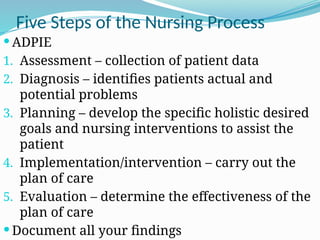
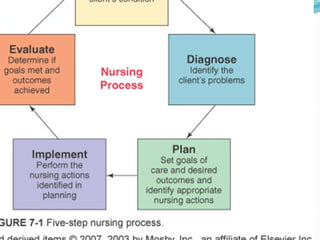
Five Steps of the Nursing Process
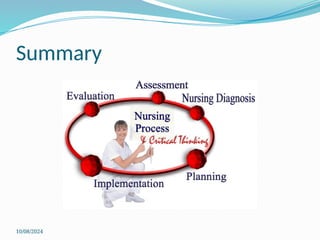
 ADPIE
1. Assessment – collection of patient data
2. Diagnosis – identifies patients actual and
potential problems
3. Planning – develop the specific holistic desired
goals and nursing interventions to assist the
patient
4. Implementation/intervention – carry out the
plan of care
5. Evaluation – determine the effectiveness of the
plan of care
 Document all your findings
10/08/2024
bbvbb
Cont
Step 1;Assessment;
Gathering of information about a patient
physiological, psychological, sociological and
spiritual status.
The purpose of nursing assessment is to identify the
patients nursing problems
It involves five areas
1. Data collection
2. Data validation
3. Data organization
4. Identifying patterns
5. Report and recording (documentation)
10/08/2024
Cont
Data collection;
 Ways of collecting data include taking vital signs, lab
investigations, physical examination, and history taking
Types of Data;
 Subjective data – what the patients tells you
 Objective data – what you observe or data obtained
 Historical data- past events e.g. hospitalization in August,2022
 Current data – present events e.g. vital/labs on admission
 Risk factors – cues which point to potential problems
(Cues; A word used to describe the individual pieces of data or “hints”
about what is going on with the client
 Also called assessment findings/ indicators
Cont
Sources of Data;
 Primary: from the client, considered the
most reliable if the client is deemed a good
historian
 Secondary: significant others, the medical or
health record, lab tests, diagnostic
procedures, other health team members.
10/08/2024
Cont.
Data Validation;
 The process of checking and verifying the
collected information, to ensure data is free
from error and misinterpretation.
Data organization;
 Need to use an organized assessment
framework to help cluster assessment data
(cues) into meaningful groups
 Gordon’s Functional Health Patterns
adopted.
Marjore Gordon’s 11 Functional
Health Patterns
 Marjorie Gordon proposed functional health patterns
as a guide for establishing a comprehensive nursing
data base of pertinent client assessment information.
 These 11 categories make possible a systematic and
standardised approach to data collection, and enable
the nurse to determine the following aspects of health
and human function in order to plan the required
nursing care for their clients.
 Consider the questions that you will need to ask your
client to collect relevant and pertinent information for
each of the 11 functional health patterns.
10/08/2024
Gordon Functional health pattern (North America
Nurses Diagnosis Association -NANDA)
1. Health Perception-Health Promotion Pattern;
 Data collection is focused on how the person manages
his health. Habits that may be detrimental to health
are also evaluated, including smoking and alcohol or
drug use. Immunization levels, past surgery and why.
2.Nutritional-Metabolic Pattern;
 Assessment is focused on the pattern of food and fluid
consumption and regularity.
3.Elimination & Exchange Pattern;
 Data collection is focused on excretory patterns
(bowel, bladder, skin). Excretory problems such as
incontinence, constipation, diarrhoea, and urinary
retention may be identified.
Cont
4. Activity/ Exercise Pattern;
 Assessment is focused on the activities of daily living
requiring energy expenditure(exercises, and leisure
activities)
 The status of major body systems involved with activity
and exercise is evaluated, including the respiratory,
cardiovascular, and musculoskeletal systems.
5. Sexuality—Reproductive Pattern;
 Assessment is focused on the person's satisfaction or
dissatisfaction with sexuality patterns and reproductive
functions. Concerns with sexuality may he
identified(libido,sexual partners,mernache,menaupose)
Cont
6. Comfort/Relaxation(sleep $ rest);
 Assessment is focused on the person's sleep, rest, and
relaxation practices.
7. Perceptual / cognitive Pattern;
 Assessment is focused on the ability to comprehend and
use information and on the sensory functions. Sensory
experiences such as pain and altered sensory input may
be identified and further evaluated. Issues like memory
/loss of memory are addressed.
 8. Role and Relationships Pattern;
 Assessment is focused on the person's roles in the world
and relationships with others(ccupation,responsibility in
the family)
 Satisfaction with roles, role strain, or dysfunctional
relationships may be further evaluated.
10/08/2024
Cont
9. Coping/Stress Tolerance Pattern
 Assessment is focused on the person's perception of stress and
on his or her coping strategies
 Support systems are evaluated, and symptoms of stress are
noted(anger…)
10. Safety & protection Pattern
 Actual or potential problems related to safety and health
management may be identified as well as needs for
modifications in the home or needs for continued care in the
home.
11. Life Principles/Values and Belief Pattern
 Assessment is focused on the person's values and beliefs
(including spiritual beliefs), or on the goals that guide his or
her choices or decisions.
Cont
Step 2: Nursing Diagnosis:
 Nursing diagnosis is a clinical judgment about
individual, family, or potential health problems/life
processes.
 Nursing diagnosis provides the basis for selection of
nursing interventions to achieve outcomes for which the
nurse is accountable.
 Nursing Diagnosis naming is done according to North
America Nurses Diagnosis Association (NANDA)
 NANDA was established in 1973 to identify standards
and classify health problems treated by nurses. Its
conferences are held every two years to continue
progress in defining, classifying and describing
diagnoses
Categories of Nursing Diagnosis
1. Actual Nursing Diagnosis:
 Actual evidence of signs/symptoms / indicator of
diagnosis exist.
 It has three parts i.e. diagnostic
label/problem, contributing factor/etiology
(“related to”), and signs and symptoms (“as
evidenced by” or “as manifested by”)
 Use accepted qualifying terms using NANDA
guideline e.g. Altered, ineffective, decreased,
increased, impaired
10/08/2024
Examples
1) Impaired verbal communication related to pressure of
the vocal cords by the tumor evidenced by hoarseness
of voice.
2) Anxiety related to stress as evidenced by increased
tension and expression of concern regarding
upcoming surgery
3) Acute pain related to decreased myocardial flow as
evidenced by grimacing, expression of pain
4) Ineffective breathing pattern related to pressure of the
larynx by the tumor evidenced by dyspnea & coughing.
Cont
5) Chronic pain related to ulceration of the larynx
evidenced by facial grimace(distortion of face) & Patient
verbalizing of throat pain.
6) Imbalanced nutrition, related to inability to ingest food
secondary to swallowing difficulties evidenced by loss of
body weight & emaciation.
7)Activity intolerance related to general malaise
evidenced by patient not able to feed, dress and
bath himself.
8)Fluid volume deficiency related to dysphagia secondary
to pressure of the esophagus by the tumor evidenced by
dry lips and low urine output
10/08/2024
2.Potential/Risk for diagnosis
 Client’s data base contains risk factors of
diagnosis, but no true evidence.
 It has two parts;
 The first part is the diagnostic label and
the second is the validation for a risk
nursing diagnosis or the presence of risk
factors.
 It’s not possible to have a third part
because signs and symptoms do not exist
Examples;
1) Patient report that he is vomiting and has diarrhea,
but no dry lips and has normal urine output( No signs
and symptoms but patient is at risk for Fluid Volume
Deficit)
2) Risk for fluid volume deficit related to diarrhea and
vomiting
3) Risk for infection related to weakened immune system
response
4) Risk for Impaired skin integrity related to emaciation &
immobility.
10/08/2024
Cont
Medical Diagnosis;
 Identification of a disease condition based
on a specific evaluation of physical signs,
symptoms, history, diagnostic tests, and
procedures
 The goals of a medical diagnosis is to
identify the cause of illness or injury and
design a treatment plan
10/08/2024
Medical vs. Nursing diagnosis
Medical diagnosis:
i. Identify disease
ii. Physician directs treatment
iii. Remains the same as long as the disease is present
iv. Example; Pneumonia.
10/08/2024
Nursing Diagnosis:
i. Focus on unhealthy response to health or illness
ii. Nurse treats problem within scope of
independent nursing practice
iii. May change from day to day as the patient’s
responses change
iv. Example:Fear,Altered health maintenance,
Knowledge deficit,Pain.
Step 3. Planning
It involves setting
priorities ,writing goals and desired
outcomes, and establishing a
written plan for nursing
intervention(NURSING CARE
PLAN)
Skills needed in planning is critical
thinking
10/08/2024
Selecting priorities
 The process of establishing a preference
order for nursing diagnosis and
interventions.
 Diagnoses are grouped as – high, medium,
low
 Life-threatening situations should be given
highest priority.
 Use the principle of ABC’s (airway, breathing,
circulation)
10/08/2024
Purpose for desired outcomes/goals
 Provides direction for planning nursing
care
 Serve as criteria for evaluating client
progress
 Enable the client and the nurse to
determine when problem is resolved
 Motivation for nurse and client as a sense
of achievement is provided.
Short Term vs. Long Term Goals
 Short term goal can be achieved in a reasonable
amount of time ( few hours to few days)
 Long term goals may take weeks/months to be
achieved
 Client will ambulate down the hall within 2 days.
 Client will walk the length of the hallway
independently by the end of 2 weeks
 Patient will have moist lips and increased urine
output of one litre in 12 hours
Example
For a patient at Risk for Impaired skin
integrity related to immobility;
 Desired outcome/goal would be;
 The patient will have no signs of skin
breakdown( redness) & swelling in 24 hours.
 Outcome needs to be time bound. ( state time
period to achieve goal)
Determining Interventions
Nursing interventions are actions performed
by nurse to reach goal or outcome
Monitor health status
Minimize client risks
Eg;allaying anxiety, giving pain killers in case
of pain, bathing the patient, dressing the
wound to alleviate the risk of infection.
Nursing Care Plan
The nursing care plan serves to
communicate the following information to
all members of the nursing team:
 The nursing diagnosis and priorities
The goals of the nursing intervention
The nursing interventions which are
expressed in the form of nursing orders
The expected outcomes which identify the
expected behavioral responses of the patient
 The critical time periods within which each
outcome must be met
NB
i. You must write down the precise behavior expected in
the nursing care plan.
ii. It should be written in a systematic manner that
facilitates its use by all nursing personnel.
iii. You should provide space in the care plan for the
documentation of the patient's response in the nursing
interventions and the outcomes
iv. The nursing care plan is subject to change as
the patients problems change or as the
priorities of the problem and resolution of the
problems shift and as additional information
about the patient's state of health is collected.
10/08/2024
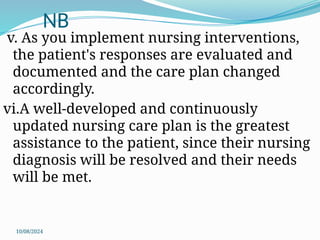
NB
v. As you implement nursing interventions,
the patient's responses are evaluated and
documented and the care plan changed
accordingly.
vi.A well-developed and continuously
updated nursing care plan is the greatest
assistance to the patient, since their nursing
diagnosis will be resolved and their needs
will be met.
10/08/2024
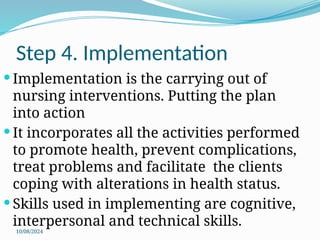
Step 4. Implementation
 Implementation is the carrying out of
nursing interventions. Putting the plan
into action
 It incorporates all the activities performed
to promote health, prevent complications,
treat problems and facilitate the clients
coping with alterations in health status.
 Skills used in implementing are cognitive,
interpersonal and technical skills.
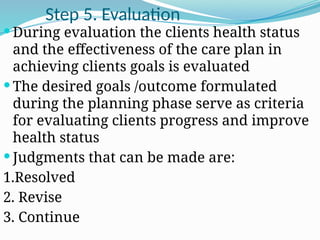
Step 5. Evaluation
 During evaluation the clients health status
and the effectiveness of the care plan in
achieving clients goals is evaluated
 The desired goals /outcome formulated
during the planning phase serve as criteria
for evaluating clients progress and improve
health status
 Judgments that can be made are:
1.Resolved
2. Revise
3. Continue
10/08/2024
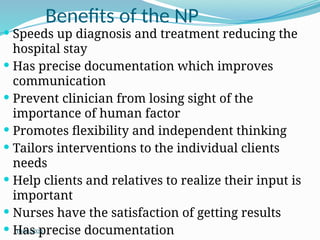
Benefits of the NP
 Speeds up diagnosis and treatment reducing the
hospital stay
 Has precise documentation which improves
communication
 Prevent clinician from losing sight of the
importance of human factor
 Promotes flexibility and independent thinking
 Tailors interventions to the individual clients
needs
 Help clients and relatives to realize their input is
important
 Nurses have the satisfaction of getting results
 Has precise documentation
10/08/2024
Summary

The Nursing process explained in broad detail

  • 1.
  • 2.
    Def: nursing process “Nursing process is an organized ,systematic method of giving individualized nursing care that focuses on identifying and treating unique responses of individuals or groups to actual or potential alterations in health”.  It is a systematic method that directs the nurse and patient in planning care, and enables them to organize and deliver nursing care
  • 3.
    Characteristics of NP 1)Systematic: it consist of five steps during which nurses take deliberate steps to maximize efficiency and attain long term beneficial results. 2) Dynamic/Holistic/Broad-involves moving back and forth between the steps, sometimes combining activities, yet still setting the same end results 3) Humanistic-considers the unique interests, values and desires of the client/patient
  • 4.
    10/08/2024 Cont. 4) Outcome oriented/resultoriented- Designed to keep nurses focused on determining whether the clients are getting the best results in the most efficient way. 5) Specific documentation requirements provides key data that can be studied to improve results for other patients in similar situations.
  • 5.
    Five Steps ofthe Nursing Process  ADPIE 1. Assessment – collection of patient data 2. Diagnosis – identifies patients actual and potential problems 3. Planning – develop the specific holistic desired goals and nursing interventions to assist the patient 4. Implementation/intervention – carry out the plan of care 5. Evaluation – determine the effectiveness of the plan of care  Document all your findings
  • 6.
  • 7.
    Cont Step 1;Assessment; Gathering ofinformation about a patient physiological, psychological, sociological and spiritual status. The purpose of nursing assessment is to identify the patients nursing problems It involves five areas 1. Data collection 2. Data validation 3. Data organization 4. Identifying patterns 5. Report and recording (documentation)
  • 8.
    10/08/2024 Cont Data collection;  Waysof collecting data include taking vital signs, lab investigations, physical examination, and history taking Types of Data;  Subjective data – what the patients tells you  Objective data – what you observe or data obtained  Historical data- past events e.g. hospitalization in August,2022  Current data – present events e.g. vital/labs on admission  Risk factors – cues which point to potential problems (Cues; A word used to describe the individual pieces of data or “hints” about what is going on with the client  Also called assessment findings/ indicators
  • 9.
    Cont Sources of Data; Primary: from the client, considered the most reliable if the client is deemed a good historian  Secondary: significant others, the medical or health record, lab tests, diagnostic procedures, other health team members.
  • 10.
    10/08/2024 Cont. Data Validation;  Theprocess of checking and verifying the collected information, to ensure data is free from error and misinterpretation. Data organization;  Need to use an organized assessment framework to help cluster assessment data (cues) into meaningful groups  Gordon’s Functional Health Patterns adopted.
  • 11.
    Marjore Gordon’s 11Functional Health Patterns  Marjorie Gordon proposed functional health patterns as a guide for establishing a comprehensive nursing data base of pertinent client assessment information.  These 11 categories make possible a systematic and standardised approach to data collection, and enable the nurse to determine the following aspects of health and human function in order to plan the required nursing care for their clients.  Consider the questions that you will need to ask your client to collect relevant and pertinent information for each of the 11 functional health patterns.
  • 12.
    10/08/2024 Gordon Functional healthpattern (North America Nurses Diagnosis Association -NANDA) 1. Health Perception-Health Promotion Pattern;  Data collection is focused on how the person manages his health. Habits that may be detrimental to health are also evaluated, including smoking and alcohol or drug use. Immunization levels, past surgery and why. 2.Nutritional-Metabolic Pattern;  Assessment is focused on the pattern of food and fluid consumption and regularity. 3.Elimination & Exchange Pattern;  Data collection is focused on excretory patterns (bowel, bladder, skin). Excretory problems such as incontinence, constipation, diarrhoea, and urinary retention may be identified.
  • 13.
    Cont 4. Activity/ ExercisePattern;  Assessment is focused on the activities of daily living requiring energy expenditure(exercises, and leisure activities)  The status of major body systems involved with activity and exercise is evaluated, including the respiratory, cardiovascular, and musculoskeletal systems. 5. Sexuality—Reproductive Pattern;  Assessment is focused on the person's satisfaction or dissatisfaction with sexuality patterns and reproductive functions. Concerns with sexuality may he identified(libido,sexual partners,mernache,menaupose)
  • 14.
    Cont 6. Comfort/Relaxation(sleep $rest);  Assessment is focused on the person's sleep, rest, and relaxation practices. 7. Perceptual / cognitive Pattern;  Assessment is focused on the ability to comprehend and use information and on the sensory functions. Sensory experiences such as pain and altered sensory input may be identified and further evaluated. Issues like memory /loss of memory are addressed.  8. Role and Relationships Pattern;  Assessment is focused on the person's roles in the world and relationships with others(ccupation,responsibility in the family)  Satisfaction with roles, role strain, or dysfunctional relationships may be further evaluated.
  • 15.
    10/08/2024 Cont 9. Coping/Stress TolerancePattern  Assessment is focused on the person's perception of stress and on his or her coping strategies  Support systems are evaluated, and symptoms of stress are noted(anger…) 10. Safety & protection Pattern  Actual or potential problems related to safety and health management may be identified as well as needs for modifications in the home or needs for continued care in the home. 11. Life Principles/Values and Belief Pattern  Assessment is focused on the person's values and beliefs (including spiritual beliefs), or on the goals that guide his or her choices or decisions.
  • 16.
    Cont Step 2: NursingDiagnosis:  Nursing diagnosis is a clinical judgment about individual, family, or potential health problems/life processes.  Nursing diagnosis provides the basis for selection of nursing interventions to achieve outcomes for which the nurse is accountable.  Nursing Diagnosis naming is done according to North America Nurses Diagnosis Association (NANDA)  NANDA was established in 1973 to identify standards and classify health problems treated by nurses. Its conferences are held every two years to continue progress in defining, classifying and describing diagnoses
  • 17.
    Categories of NursingDiagnosis 1. Actual Nursing Diagnosis:  Actual evidence of signs/symptoms / indicator of diagnosis exist.  It has three parts i.e. diagnostic label/problem, contributing factor/etiology (“related to”), and signs and symptoms (“as evidenced by” or “as manifested by”)  Use accepted qualifying terms using NANDA guideline e.g. Altered, ineffective, decreased, increased, impaired
  • 18.
    10/08/2024 Examples 1) Impaired verbalcommunication related to pressure of the vocal cords by the tumor evidenced by hoarseness of voice. 2) Anxiety related to stress as evidenced by increased tension and expression of concern regarding upcoming surgery 3) Acute pain related to decreased myocardial flow as evidenced by grimacing, expression of pain 4) Ineffective breathing pattern related to pressure of the larynx by the tumor evidenced by dyspnea & coughing.
  • 19.
    Cont 5) Chronic painrelated to ulceration of the larynx evidenced by facial grimace(distortion of face) & Patient verbalizing of throat pain. 6) Imbalanced nutrition, related to inability to ingest food secondary to swallowing difficulties evidenced by loss of body weight & emaciation. 7)Activity intolerance related to general malaise evidenced by patient not able to feed, dress and bath himself. 8)Fluid volume deficiency related to dysphagia secondary to pressure of the esophagus by the tumor evidenced by dry lips and low urine output
  • 20.
    10/08/2024 2.Potential/Risk for diagnosis Client’s data base contains risk factors of diagnosis, but no true evidence.  It has two parts;  The first part is the diagnostic label and the second is the validation for a risk nursing diagnosis or the presence of risk factors.  It’s not possible to have a third part because signs and symptoms do not exist
  • 21.
    Examples; 1) Patient reportthat he is vomiting and has diarrhea, but no dry lips and has normal urine output( No signs and symptoms but patient is at risk for Fluid Volume Deficit) 2) Risk for fluid volume deficit related to diarrhea and vomiting 3) Risk for infection related to weakened immune system response 4) Risk for Impaired skin integrity related to emaciation & immobility.
  • 22.
    10/08/2024 Cont Medical Diagnosis;  Identificationof a disease condition based on a specific evaluation of physical signs, symptoms, history, diagnostic tests, and procedures  The goals of a medical diagnosis is to identify the cause of illness or injury and design a treatment plan
  • 23.
    10/08/2024 Medical vs. Nursingdiagnosis Medical diagnosis: i. Identify disease ii. Physician directs treatment iii. Remains the same as long as the disease is present iv. Example; Pneumonia.
  • 24.
    10/08/2024 Nursing Diagnosis: i. Focuson unhealthy response to health or illness ii. Nurse treats problem within scope of independent nursing practice iii. May change from day to day as the patient’s responses change iv. Example:Fear,Altered health maintenance, Knowledge deficit,Pain.
  • 25.
    Step 3. Planning Itinvolves setting priorities ,writing goals and desired outcomes, and establishing a written plan for nursing intervention(NURSING CARE PLAN) Skills needed in planning is critical thinking
  • 26.
    10/08/2024 Selecting priorities  Theprocess of establishing a preference order for nursing diagnosis and interventions.  Diagnoses are grouped as – high, medium, low  Life-threatening situations should be given highest priority.  Use the principle of ABC’s (airway, breathing, circulation)
  • 27.
    10/08/2024 Purpose for desiredoutcomes/goals  Provides direction for planning nursing care  Serve as criteria for evaluating client progress  Enable the client and the nurse to determine when problem is resolved  Motivation for nurse and client as a sense of achievement is provided.
  • 28.
    Short Term vs.Long Term Goals  Short term goal can be achieved in a reasonable amount of time ( few hours to few days)  Long term goals may take weeks/months to be achieved  Client will ambulate down the hall within 2 days.  Client will walk the length of the hallway independently by the end of 2 weeks  Patient will have moist lips and increased urine output of one litre in 12 hours
  • 29.
    Example For a patientat Risk for Impaired skin integrity related to immobility;  Desired outcome/goal would be;  The patient will have no signs of skin breakdown( redness) & swelling in 24 hours.  Outcome needs to be time bound. ( state time period to achieve goal)
  • 30.
    Determining Interventions Nursing interventionsare actions performed by nurse to reach goal or outcome Monitor health status Minimize client risks Eg;allaying anxiety, giving pain killers in case of pain, bathing the patient, dressing the wound to alleviate the risk of infection.
  • 31.
    Nursing Care Plan Thenursing care plan serves to communicate the following information to all members of the nursing team:  The nursing diagnosis and priorities The goals of the nursing intervention The nursing interventions which are expressed in the form of nursing orders The expected outcomes which identify the expected behavioral responses of the patient  The critical time periods within which each outcome must be met
  • 32.
    NB i. You mustwrite down the precise behavior expected in the nursing care plan. ii. It should be written in a systematic manner that facilitates its use by all nursing personnel. iii. You should provide space in the care plan for the documentation of the patient's response in the nursing interventions and the outcomes iv. The nursing care plan is subject to change as the patients problems change or as the priorities of the problem and resolution of the problems shift and as additional information about the patient's state of health is collected.
  • 33.
    10/08/2024 NB v. As youimplement nursing interventions, the patient's responses are evaluated and documented and the care plan changed accordingly. vi.A well-developed and continuously updated nursing care plan is the greatest assistance to the patient, since their nursing diagnosis will be resolved and their needs will be met.
  • 34.
    10/08/2024 Step 4. Implementation Implementation is the carrying out of nursing interventions. Putting the plan into action  It incorporates all the activities performed to promote health, prevent complications, treat problems and facilitate the clients coping with alterations in health status.  Skills used in implementing are cognitive, interpersonal and technical skills.
  • 35.
    Step 5. Evaluation During evaluation the clients health status and the effectiveness of the care plan in achieving clients goals is evaluated  The desired goals /outcome formulated during the planning phase serve as criteria for evaluating clients progress and improve health status  Judgments that can be made are: 1.Resolved 2. Revise 3. Continue
  • 36.
    10/08/2024 Benefits of theNP  Speeds up diagnosis and treatment reducing the hospital stay  Has precise documentation which improves communication  Prevent clinician from losing sight of the importance of human factor  Promotes flexibility and independent thinking  Tailors interventions to the individual clients needs  Help clients and relatives to realize their input is important  Nurses have the satisfaction of getting results  Has precise documentation
  • 37.