ADMISSION
Admission is defined as receiving a patient to stay in hospital for observation,
investigation, treatment and care.
or
Admission is the entry of a patient into a hospital /ward for therapeutic /diagnostic
purposes
PURPOSE
 To welcome the patient and establish a positive relationship with patient and closed relatives.
 To offer immediate management and care in acute conditions.
 To orient patient to immediate environment and services available.
 To acquire baseline data of a patient through history and physical examination.
 To collaborate with patient in planning and providing comprehensive care.
 To undergo evaluation & treatment
 To know what is really happening in his/her body
 To provide emotional security to the newly admitted patient and his family
TYPES OF ADMISSION
 Emergency / unplanned admission
 Routine / planned admission
EMERGENCY ADMISSION
In this, patients are admitted in acute conditions requiring immediate treatment.
Examples. Patient with RTA, Poisoning, burns and cardiac or respiratory emergency.
ROUTINE ADMISSSION
In this, patients are admitted for investigation, diagnostic and medical or surgical
treatment. Treatment is given according to patients problem.
E.g. Patient with hypertension, diabetes mellitus etc
ARTICLES
1. Prepared bed
2. Vitals tray
3. Weighing machine
4. Admission advisory form
5. Documents such as:
i. Doctors order sheet
ii. TPR sheet
iii. Nursing assessment form
iv. Nurses record
v. Progress record
vi. Laboratory master sheet
vii. Additional sheet as indicated such as intake output chart, admission consent form etc.
Cont…
6. Kidney tray
7. Tissue paper
8. Bedpan and urinal
9. Bath towel and wash cloth
PROCEDURE
Before procedure
 Lower the bed and fold down top sheet and bedspread.
 Arrange room furniture for easy access from bed.
 Assemble special equipments such as suction
equipment, oxygen supplies, pole for line etc. and
make sure they are in working condition.
During procedure
 Receive the patient and family cordily. Identify the
patient with the admission slip. Check the details such
as advance payment, unit and room assigned.
 Introduce yourself and excort the patient and family to
the assigned room.
 Make it convenient for the
patient to get into bed
 Reduce risk of fall
 Prevents delay in cases where
immediate treatment is required.
 Reduce anxiety
Cont….
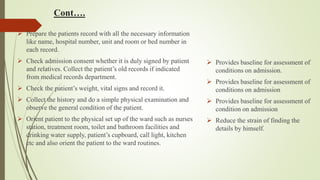
 Prepare the patients record with all the necessary information
like name, hospital number, unit and room or bed number in
each record.
 Check admission consent whether it is duly signed by patient
and relatives. Collect the patient’s old records if indicated
from medical records department.
 Check the patient’s weight, vital signs and record it.
 Collect the history and do a simple physical examination and
observe the general condition of the patient.
 Orient patient to the physical set up of the ward such as nurses
station, treatment room, toilet and bathroom facilities and
drinking water supply, patient’s cupboard, call light, kitchen
etc and also orient the patient to the ward routines.
 Provides baseline for assessment of
conditions on admission.
 Provides baseline for assessment of
conditions on admission
 Provides baseline for assessment of
condition on admission
 Reduce the strain of finding the
details by himself.
Cont…
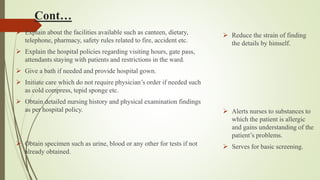
 Explain about the facilities available such as canteen, dietary,
telephone, pharmacy, safety rules related to fire, accident etc.
 Explain the hospital policies regarding visiting hours, gate pass,
attendants staying with patients and restrictions in the ward.
 Give a bath if needed and provide hospital gown.
 Initiate care which do not require physician’s order if needed such
as cold compress, tepid sponge etc.
 Obtain detailed nursing history and physical examination findings
as per hospital policy.
 Obtain specimen such as urine, blood or any other for tests if not
already obtained.
 Reduce the strain of finding
the details by himself.
 Alerts nurses to substances to
which the patient is allergic
and gains understanding of the
patient’s problems.
 Serves for basic screening.
Cont…
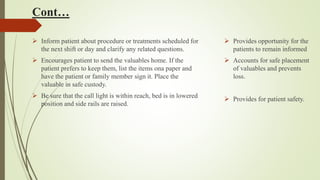
 Inform patient about procedure or treatments scheduled for
the next shift or day and clarify any related questions.
 Encourages patient to send the valuables home. If the
patient prefers to keep them, list the items ona paper and
have the patient or family member sign it. Place the
valuable in safe custody.
 Be sure that the call light is within reach, bed is in lowered
position and side rails are raised.
 Provides opportunity for the
patients to remain informed
 Accounts for safe placement
of valuables and prevents
loss.
 Provides for patient safety.
Cont…
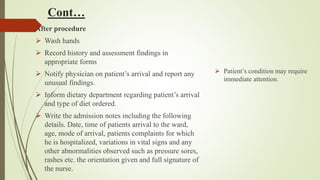
After procedure
 Wash hands
 Record history and assessment findings in
appropriate forms
 Notify physician on patient’s arrival and report any
unusual findings.
 Inform dietary department regarding patient’s arrival
and type of diet ordered.
 Write the admission notes including the following
details. Date, time of patients arrival to the ward,
age, mode of arrival, patients complaints for which
he is hospitalized, variations in vital signs and any
other abnormalities observed such as pressure sores,
rashes etc. the orientation given and full signature of
the nurse.
 Patient’s condition may require
immediate attention.
SPECIAL CONSIDERATIONS
 Information regarding an admission is received from outpatient admitting office or
emergency department.
 In admission of sick patients or emergency situation, steps of the procedure may
be altered, considering the priority of needs.
 General information regarding facilities available can be provided in written form
e.g. pamphlet's
DISCHARGE
“Discharge of patient from the hospital means, reliving a person from hospital setting,
who admitted as an inpatient in that hospital”
or
Discharge planning is a centralized, coordinated, multidisciplinary process which
ensures that the episode of treatment and care to the patient is formally concluded by
the healthcare team and hospital
TYPES OF DISCHARGE
1. PLANNED DISCHARGE
2. LAMA
3. TRANSFER
4. ABSCOND
5. REFFERAL
PLANNED DISCHARGE
Patient completes the initial, actual management in the hospital and now he or she
need not to be under direct supervision of that hospital.’
LAMA
 Discharge/Leave Against Medical Advice
TRANSFER
 Transfer to other unit or hospital
ABSCOND
 Abscond from Hospital
REFER
 Referred for further management
PRINCIPALS
 Patient and family understands the diagnosis, anticipated level of functioning,
discharge medications and anticipated medical follow up.
 Specialized instruction or training is provided to the patient and family to ensure
that proper care after discharge will be provided to the patient.
 Community support system are coordinated to enable the patient to return home.
 Relocation of the patient and coordination of support system or transfer to another
healthcare facility are performed.
ARTICLES
 Wheel chair or stretcher
 Patient relevant documents: discharge booklet, prescription order.
Procedure
Assessment
 Assess patients healthcare needs at the time of
discharge using nursing history, care plan and
ongoing assessment of physical abilities and
cognitive function from time of admission.
 Assess patient’s and family’s need for health
teaching related to home therapies, restrictions
resulting from health alterations and possible
complications.
 Assess with patients and family any
environmental factors within home that might
interfere with self care. E.g. size of room,
bathroom, facilities, stairs etc.
 Planning for discharge begins at the
time of admission and continue
throughout patient’s stay in the
agency.
 Improves understanding of
healthcare needs and ability to
achieve self care at home.
 May pose risks to safety as a result
of limitations created by illness or
certain therapies.
Cont…..
 Collaborate with physician and staff in other
disciplines. E.g physical therapist, social
worker etc.
 Consult other health team members about
needs after discharge. E.g. dietitian, social
worker. Make appropriate referrals.
 Preparation of patients before the day of
discharge
a) Suggest ways to change physical arrangement
of home to meet patient’s needs, if required.
b) Provide patient and family with information
about community healthcare resources.
 A multidisciplinary assessment
ensures a comprehensive discharge
plan.
 Members of all healthcare
disciplines should collaborates to
determine patient’s need and
functional abilities.
 Patient’s level of independence and
ability to retain function can be
maintained within safe environment.
 Community resources may offer
support to patients and family
Cont…
a. Conduct teaching sessions with patients and
family as soon as possible during hospitalization
in anticipation of preparation for discharge. E.g.
sign and symptoms of complication, use of
medical equipments etc.
7. Preparation on the day of discharge
 Allow patient and family to ask questions
 Check physician’s discharge order for
prescription and change in teeatments.
 Determine whether patient or family has arranged
for transportation home.
 Check all closets and drawers for belongings.
Obtain copy of valuables list signed by patients,
account for all valuables when required.
 Gives opportunities to practice new
skills ask questions and obtain
necessary feedback.
 Relieves anxiety and ensure that safe
care is provided to patients
 Discharge is authorized only by
physician, early information about
discharge permits the nurse to attend to
any last minute treatment or procedure
well in advance before discharge.
 Detremine method of transport
 Prevents loss of items. Relives nursing
departments of liability for loses.
Cont….
e. Provide patient with prescription for medications
ordered by physician.
f. Provide information about follow up visit and home
healthcare facilities available.
g. Provide printed teaching material as pre-patient’s
requirement with necessary instructions.
h. Obtain wheel chair for patients who are unable to
ambulate
8. Complete documentation of patient’s discharge in
nurses notes.
9. Encures that the discharge summary from physicians
is ready
 Review of drug information provides
feedback to determine success in learning
about medications and its administration
 Ensures that patient attends regular
follow-up in the hospital
 Help patients review instructions that are
provided by the healthcare team.
 Provides for safe transport
 Discharge summary is essential for
documenting patient’s status and time
patient leaves the hospital.
SPECIAL CONSIDERATION
 If patient is getting discharged “against medical advice”(AMA), Inform physician and nurse in-charge
and complete the AMA form as per hospital policy.
 Patients who may need detailed instructions and follow- up visit to the home after discharge includes:
 Newly diagnosed chronic disease like diabetes mellitus
 Patients after major and radical surgery
 Patients who are socially isolated.
 Patients with emotional or mental instability
 Patients who lack financial resources.
 Patients who are terminally ill.
admission and discharge procedure.pptx

admission and discharge procedure.pptx

  • 1.
    ADMISSION Admission is definedas receiving a patient to stay in hospital for observation, investigation, treatment and care. or Admission is the entry of a patient into a hospital /ward for therapeutic /diagnostic purposes
  • 2.
    PURPOSE  To welcomethe patient and establish a positive relationship with patient and closed relatives.  To offer immediate management and care in acute conditions.  To orient patient to immediate environment and services available.  To acquire baseline data of a patient through history and physical examination.  To collaborate with patient in planning and providing comprehensive care.  To undergo evaluation & treatment  To know what is really happening in his/her body  To provide emotional security to the newly admitted patient and his family
  • 3.
    TYPES OF ADMISSION Emergency / unplanned admission  Routine / planned admission
  • 4.
    EMERGENCY ADMISSION In this,patients are admitted in acute conditions requiring immediate treatment. Examples. Patient with RTA, Poisoning, burns and cardiac or respiratory emergency.
  • 5.
    ROUTINE ADMISSSION In this,patients are admitted for investigation, diagnostic and medical or surgical treatment. Treatment is given according to patients problem. E.g. Patient with hypertension, diabetes mellitus etc
  • 6.
    ARTICLES 1. Prepared bed 2.Vitals tray 3. Weighing machine 4. Admission advisory form 5. Documents such as: i. Doctors order sheet ii. TPR sheet iii. Nursing assessment form iv. Nurses record v. Progress record vi. Laboratory master sheet vii. Additional sheet as indicated such as intake output chart, admission consent form etc.
  • 7.
    Cont… 6. Kidney tray 7.Tissue paper 8. Bedpan and urinal 9. Bath towel and wash cloth
  • 8.
    PROCEDURE Before procedure  Lowerthe bed and fold down top sheet and bedspread.  Arrange room furniture for easy access from bed.  Assemble special equipments such as suction equipment, oxygen supplies, pole for line etc. and make sure they are in working condition. During procedure  Receive the patient and family cordily. Identify the patient with the admission slip. Check the details such as advance payment, unit and room assigned.  Introduce yourself and excort the patient and family to the assigned room.  Make it convenient for the patient to get into bed  Reduce risk of fall  Prevents delay in cases where immediate treatment is required.  Reduce anxiety
  • 9.
    Cont….  Prepare thepatients record with all the necessary information like name, hospital number, unit and room or bed number in each record.  Check admission consent whether it is duly signed by patient and relatives. Collect the patient’s old records if indicated from medical records department.  Check the patient’s weight, vital signs and record it.  Collect the history and do a simple physical examination and observe the general condition of the patient.  Orient patient to the physical set up of the ward such as nurses station, treatment room, toilet and bathroom facilities and drinking water supply, patient’s cupboard, call light, kitchen etc and also orient the patient to the ward routines.  Provides baseline for assessment of conditions on admission.  Provides baseline for assessment of conditions on admission  Provides baseline for assessment of condition on admission  Reduce the strain of finding the details by himself.
  • 10.
    Cont…  Explain aboutthe facilities available such as canteen, dietary, telephone, pharmacy, safety rules related to fire, accident etc.  Explain the hospital policies regarding visiting hours, gate pass, attendants staying with patients and restrictions in the ward.  Give a bath if needed and provide hospital gown.  Initiate care which do not require physician’s order if needed such as cold compress, tepid sponge etc.  Obtain detailed nursing history and physical examination findings as per hospital policy.  Obtain specimen such as urine, blood or any other for tests if not already obtained.  Reduce the strain of finding the details by himself.  Alerts nurses to substances to which the patient is allergic and gains understanding of the patient’s problems.  Serves for basic screening.
  • 11.
    Cont…  Inform patientabout procedure or treatments scheduled for the next shift or day and clarify any related questions.  Encourages patient to send the valuables home. If the patient prefers to keep them, list the items ona paper and have the patient or family member sign it. Place the valuable in safe custody.  Be sure that the call light is within reach, bed is in lowered position and side rails are raised.  Provides opportunity for the patients to remain informed  Accounts for safe placement of valuables and prevents loss.  Provides for patient safety.
  • 12.
    Cont… After procedure  Washhands  Record history and assessment findings in appropriate forms  Notify physician on patient’s arrival and report any unusual findings.  Inform dietary department regarding patient’s arrival and type of diet ordered.  Write the admission notes including the following details. Date, time of patients arrival to the ward, age, mode of arrival, patients complaints for which he is hospitalized, variations in vital signs and any other abnormalities observed such as pressure sores, rashes etc. the orientation given and full signature of the nurse.  Patient’s condition may require immediate attention.
  • 13.
    SPECIAL CONSIDERATIONS  Informationregarding an admission is received from outpatient admitting office or emergency department.  In admission of sick patients or emergency situation, steps of the procedure may be altered, considering the priority of needs.  General information regarding facilities available can be provided in written form e.g. pamphlet's
  • 14.
    DISCHARGE “Discharge of patientfrom the hospital means, reliving a person from hospital setting, who admitted as an inpatient in that hospital” or Discharge planning is a centralized, coordinated, multidisciplinary process which ensures that the episode of treatment and care to the patient is formally concluded by the healthcare team and hospital
  • 15.
    TYPES OF DISCHARGE 1.PLANNED DISCHARGE 2. LAMA 3. TRANSFER 4. ABSCOND 5. REFFERAL
  • 16.
    PLANNED DISCHARGE Patient completesthe initial, actual management in the hospital and now he or she need not to be under direct supervision of that hospital.’
  • 17.
  • 18.
    TRANSFER  Transfer toother unit or hospital
  • 19.
  • 20.
    REFER  Referred forfurther management
  • 21.
    PRINCIPALS  Patient andfamily understands the diagnosis, anticipated level of functioning, discharge medications and anticipated medical follow up.  Specialized instruction or training is provided to the patient and family to ensure that proper care after discharge will be provided to the patient.  Community support system are coordinated to enable the patient to return home.  Relocation of the patient and coordination of support system or transfer to another healthcare facility are performed.
  • 22.
    ARTICLES  Wheel chairor stretcher  Patient relevant documents: discharge booklet, prescription order.
  • 23.
    Procedure Assessment  Assess patientshealthcare needs at the time of discharge using nursing history, care plan and ongoing assessment of physical abilities and cognitive function from time of admission.  Assess patient’s and family’s need for health teaching related to home therapies, restrictions resulting from health alterations and possible complications.  Assess with patients and family any environmental factors within home that might interfere with self care. E.g. size of room, bathroom, facilities, stairs etc.  Planning for discharge begins at the time of admission and continue throughout patient’s stay in the agency.  Improves understanding of healthcare needs and ability to achieve self care at home.  May pose risks to safety as a result of limitations created by illness or certain therapies.
  • 24.
    Cont…..  Collaborate withphysician and staff in other disciplines. E.g physical therapist, social worker etc.  Consult other health team members about needs after discharge. E.g. dietitian, social worker. Make appropriate referrals.  Preparation of patients before the day of discharge a) Suggest ways to change physical arrangement of home to meet patient’s needs, if required. b) Provide patient and family with information about community healthcare resources.  A multidisciplinary assessment ensures a comprehensive discharge plan.  Members of all healthcare disciplines should collaborates to determine patient’s need and functional abilities.  Patient’s level of independence and ability to retain function can be maintained within safe environment.  Community resources may offer support to patients and family
  • 25.
    Cont… a. Conduct teachingsessions with patients and family as soon as possible during hospitalization in anticipation of preparation for discharge. E.g. sign and symptoms of complication, use of medical equipments etc. 7. Preparation on the day of discharge  Allow patient and family to ask questions  Check physician’s discharge order for prescription and change in teeatments.  Determine whether patient or family has arranged for transportation home.  Check all closets and drawers for belongings. Obtain copy of valuables list signed by patients, account for all valuables when required.  Gives opportunities to practice new skills ask questions and obtain necessary feedback.  Relieves anxiety and ensure that safe care is provided to patients  Discharge is authorized only by physician, early information about discharge permits the nurse to attend to any last minute treatment or procedure well in advance before discharge.  Detremine method of transport  Prevents loss of items. Relives nursing departments of liability for loses.
  • 26.
    Cont…. e. Provide patientwith prescription for medications ordered by physician. f. Provide information about follow up visit and home healthcare facilities available. g. Provide printed teaching material as pre-patient’s requirement with necessary instructions. h. Obtain wheel chair for patients who are unable to ambulate 8. Complete documentation of patient’s discharge in nurses notes. 9. Encures that the discharge summary from physicians is ready  Review of drug information provides feedback to determine success in learning about medications and its administration  Ensures that patient attends regular follow-up in the hospital  Help patients review instructions that are provided by the healthcare team.  Provides for safe transport  Discharge summary is essential for documenting patient’s status and time patient leaves the hospital.
  • 27.
    SPECIAL CONSIDERATION  Ifpatient is getting discharged “against medical advice”(AMA), Inform physician and nurse in-charge and complete the AMA form as per hospital policy.  Patients who may need detailed instructions and follow- up visit to the home after discharge includes:  Newly diagnosed chronic disease like diabetes mellitus  Patients after major and radical surgery  Patients who are socially isolated.  Patients with emotional or mental instability  Patients who lack financial resources.  Patients who are terminally ill.