Unit: 1 Nursing Process
FON-II, 2nd Semester
BScN Generic 4 Year Degree
Program
By
Rawal Rafiq Leghari
Medicose Nursing Academy
Objectives
1. Define nursing process.
2. Describe the purposes of nursing process.
3. Identify the components of the nursing process
4. Discuss the requirements for effective use of the
nursing process
5. Describe the functional health approach to the
nursing process
Medicose Nursing Academy 2
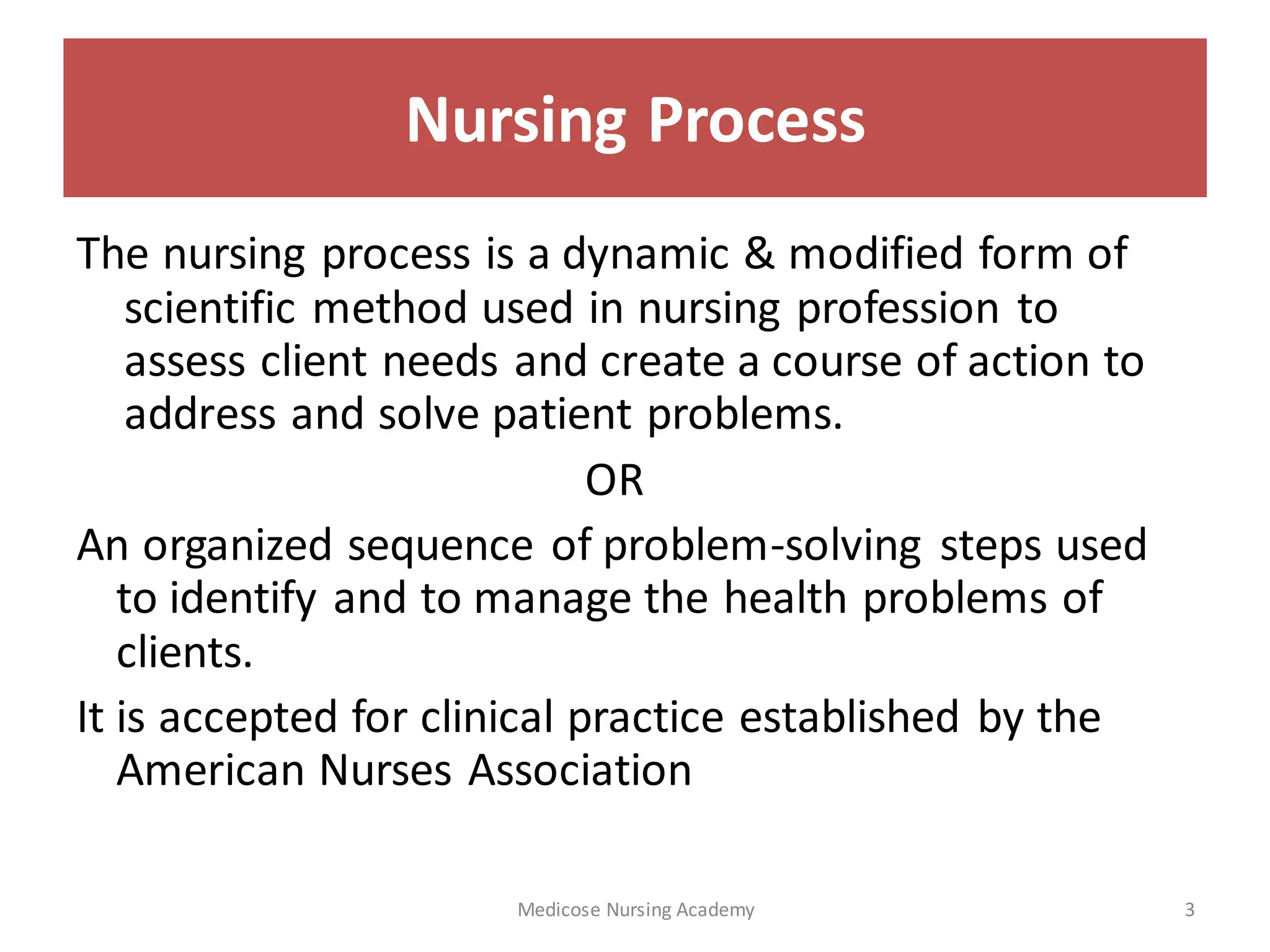
Nursing Process
The nursing process is a dynamic & modified form of
scientific method used in nursing profession to
assess client needs and create a course of action to
address and solve patient problems.
OR
An organized sequence of problem-solving steps used
to identify and to manage the health problems of
clients.
It is accepted for clinical practice established by the
American Nurses Association
Medicose Nursing Academy 3
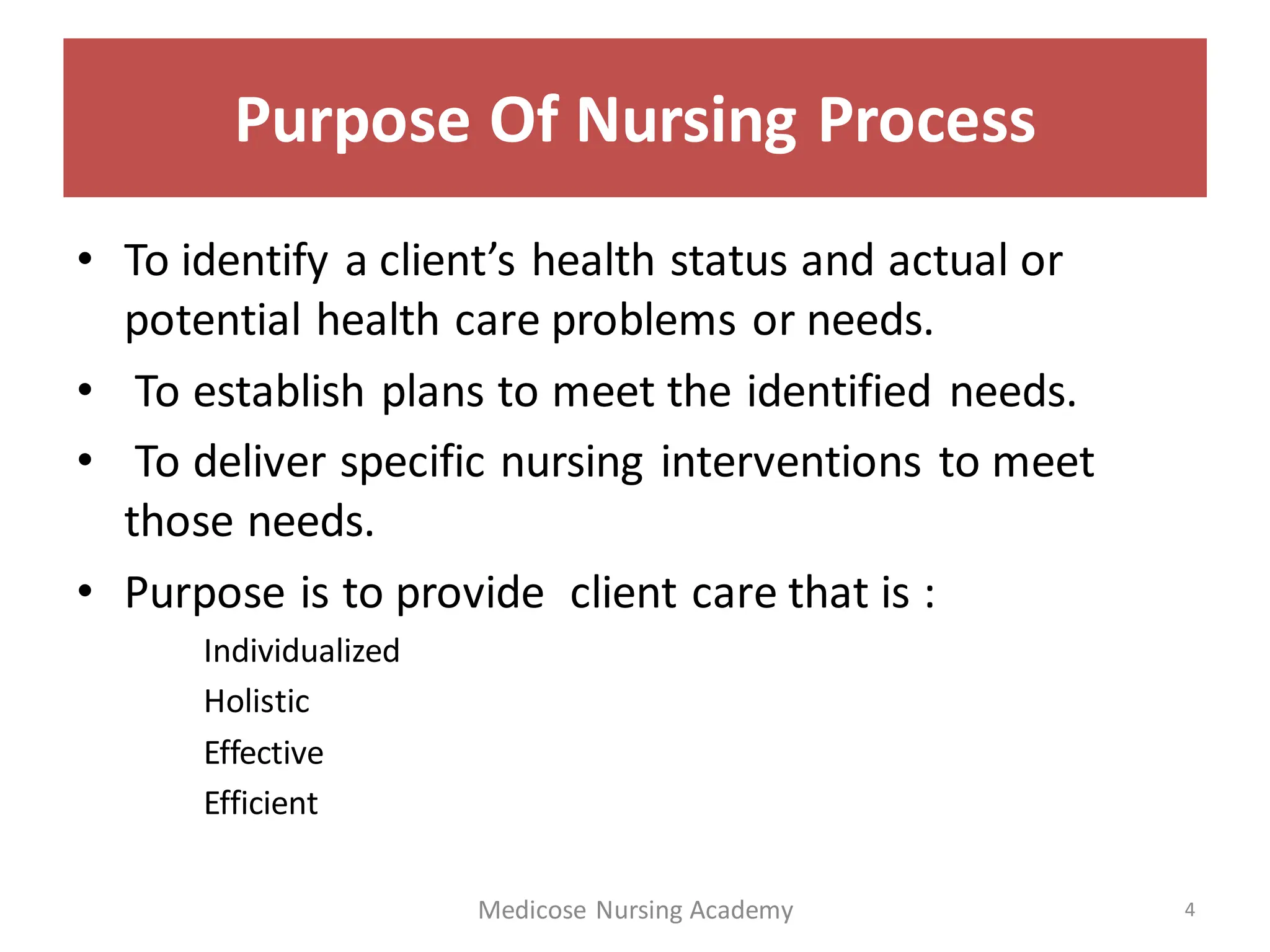
Purpose Of Nursing Process
• To identify a client’s health status and actual or
potential health care problems or needs.
• To establish plans to meet the identified needs.
• To deliver specific nursing interventions to meet
those needs.
• Purpose is to provide client care that is :
Individualized
Holistic
Effective
Efficient
Medicose Nursing Academy 4
Components Of Nursing Process
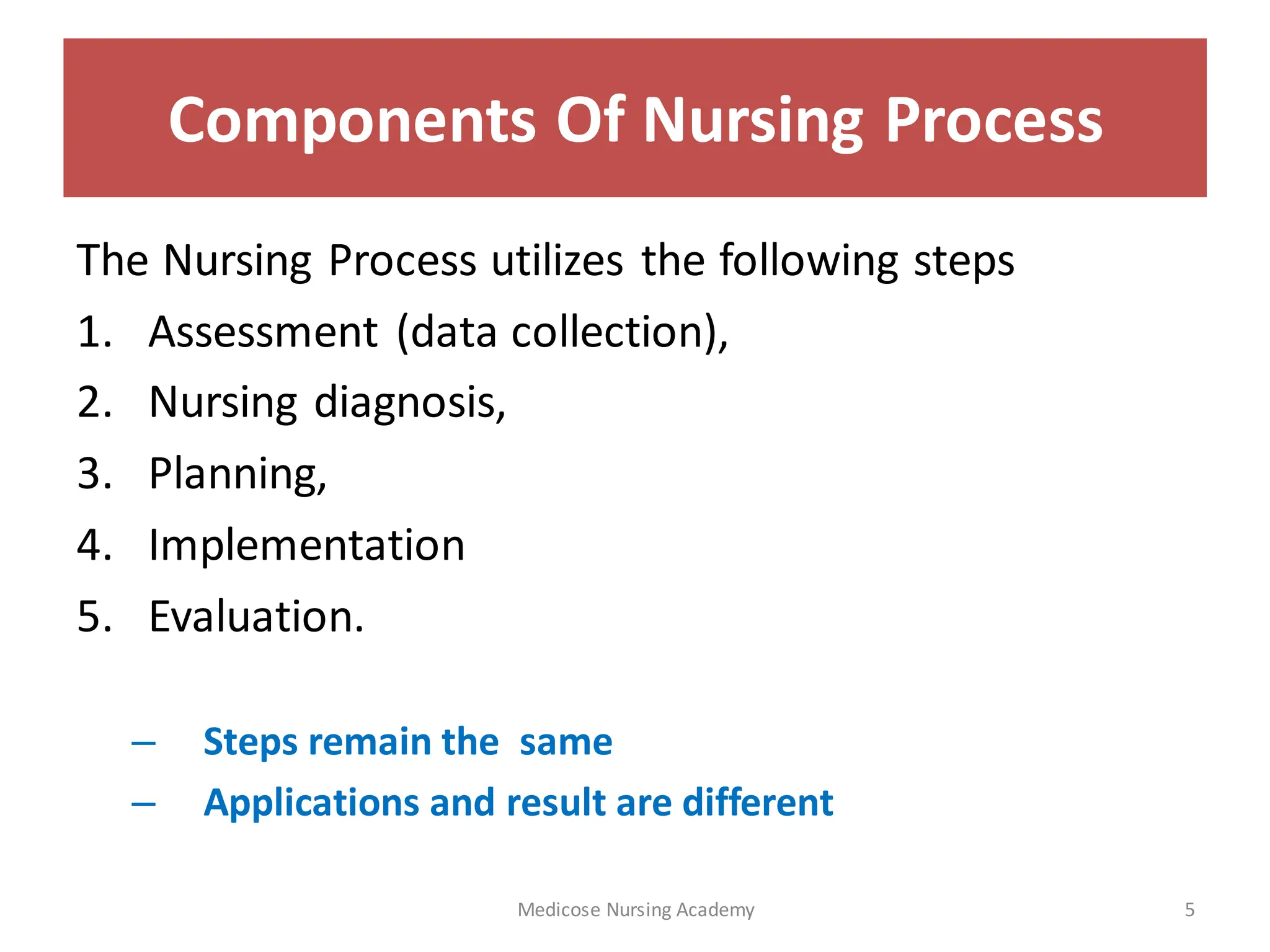
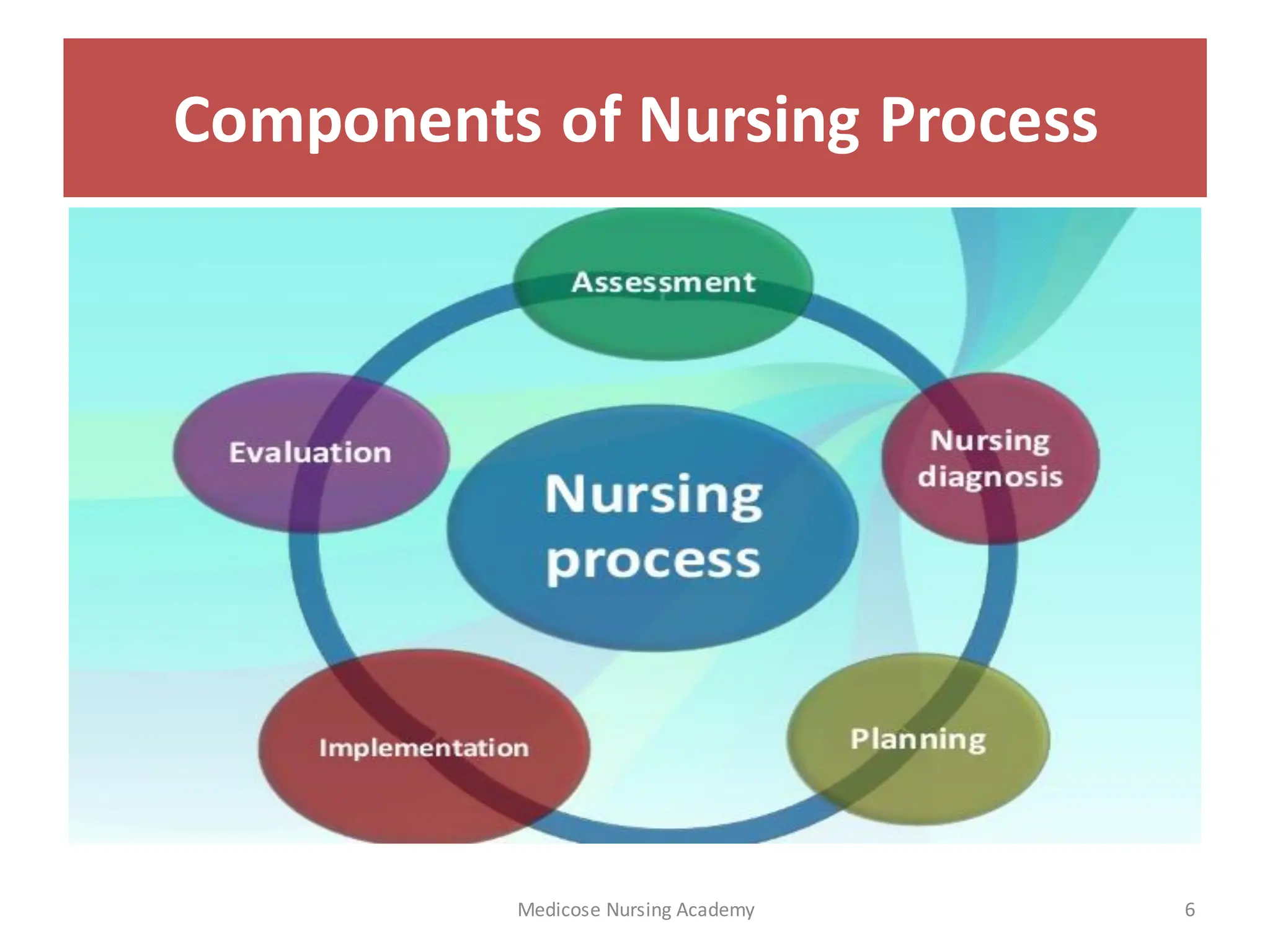
The Nursing Process utilizes the following steps
1. Assessment (data collection),
2. Nursing diagnosis,
3. Planning,
4. Implementation
5. Evaluation.
– Steps remain the same
– Applications and result are different
Medicose Nursing Academy 5
Components of Nursing Process
Medicose Nursing Academy 6
Characteristics of Nursing Process
• Cyclic
• Dynamic nature,
• Client centeredness
• Focus on problem solving and decision making
• Interpersonal and collaborative style
• Universal applicability
• Use of critical thinking and clinical reasoning
Medicose Nursing Academy 7
1. ASSESSMENT
It involves
• Collection of data
• Organizing the data
• Validating the data
• Documenting the data
Assessmentis the systematicand continuous collection,
organization, validation, and documentation of data
(information).
Medicose Nursing Academy 8
1. ASSESSMENT
Types of assessment
The four different types of assessments are;
1. Initial nursing assessment
2. Problem-focused assessment
3. Emergency assessment
4. Time-lapsed reassessment
The ultimate Purpose of assessment is data collection
Medicose Nursing Academy 9
1. ASSESSMENT
1. Initial nursing assessment:
• Performed within specified time after admission.
• To establish a complete database for problem
identification.
• Eg: Nursing admission assessment
Medicose Nursing Academy 10
1. ASSESSMENT
2. Problem-focused assessment :
To determine the status of a specific problem identified
in an earlier assessment. Eg: hourly checking of vital
signs of fever patient
Medicose Nursing Academy 11
1. ASSESSMENT
3. Emergency assessment:
During emergency situation to identify any life
threatening situation. Eg: Rapid assessment of an
individual’s airway, breathing status, and circulation
during a cardiac arrest.
Medicose Nursing Academy 12
1. ASSESSMENT
4. Time-lapsed reassessment:
Several months after initial assessment. To compare the
client’s current health status with the data previously
obtained
Medicose Nursing Academy 13
COMPONENTS OF ASSESSMENT
Medicose Nursing Academy 14
1. ASSESSMENT
Collection of data
Data collection is the process of gathering information
about a client’s health status. It includes the health
history, physical examination, results of laboratory
and diagnostic tests, and material contributed by
other health personnel.
Medicose Nursing Academy 15
1. ASSESSMENT
Types of Data:
1. Subjective data
2. Objective data.
1. Subjective data
Also referred to as symptoms or covert data, are clear
only to the person affected and can be described
only by that person. Itching, pain, and feelings of
worry are examples of subjective data.
Medicose Nursing Academy 16
1. ASSESSMENT
2. Objective data
Also referred to as signs or overt data, are detectable
by an observer or can be measured or tested against
an accepted standard. They can be seen, heard, felt,
or smelled, and they are obtained by observation or
physical examination. For example, a discoloration of
the skin or a blood pressure reading is objective data.
Medicose Nursing Academy 17
1. ASSESSMENT
Sources of Data
Sources of data are primary or secondary.
1. Primary : It is the direct source of information. The
client is the primary source of data.
2. Secondary: It is the indirect source of information.
All sources other than the client are considered
secondary sources. Family members, health
professionals, records and reports, laboratory and
diagnostic results are secondary sources.
Medicose Nursing Academy 18
Methods Of Data Collection
Medicose Nursing Academy 19
1. ASSESSMENT
Organization of data
The nurse uses a format that organizes the assessment
data systematically. This is often referred to as
nursing health history or nursing assessment form
Medicose Nursing Academy 20
1. ASSESSMENT
Validation of data
The information gathered during the assessment is
“double-checked” or verified to confirm that it is
accurate and complete.
Medicose Nursing Academy 21
1. ASSESSMENT
Documentation of data
To complete the assessment phase, the nurse records
client data. Accurate documentation is essential and
should include all data collected about the client’s
health status.
Medicose Nursing Academy 22
2. DIAGNOSIS
Diagnosis is the second phase of the nursing process.
In this phase, nurses use critical thinking skills to
interpret assessment data to identify client
problems.
(NANDA) define or refine nursing diagnosis.
The official NANDA definition of a nursing diagnosis is:
“a clinical judgment concerning a human response to
health conditions/life processes, or a vulnerability for
that response, by an individual, family, group, or
community.”
Medicose Nursing Academy 23
2. DIAGNOSIS
Diagnosing is to :
1.Analyza data
2. Identify health problems,risks and strengths
3. Formulate diagnostic statement
Medicose Nursing Academy 24
Status of the Nursing Diagnoses
“Status refers to the actuality or potentiality of the
diagnosis or the categorization of the diagnosis”
(NANDA International, 2009, p. 44).The kinds of
nursing diagnoses according to status are
1. Actual
2. Health promotion
3. Risk
4. Wellness.
5. Possible Nursing Diagnosis
6. Syndrome Nursing diagnosis
Medicose Nursing Academy 25
1. Actual Diagnosis
An actual diagnosis is a client peoblem that is present
at the time of Nursing assessment. Examples are
ineffective breathing pattern and anxiety.
It is based on the presence of associated signs and
symptoms
Medicose Nursing Academy 26
2. Health Promotion Diagnosis
A health promotion diagnosis relates to
clients’preparednessto implement behaviors
to improve their health condition.These
diagnosis labels begin with the phrase
Readiness for Enhanced, as in Readiness for
Enhanced Nutrition
Medicose Nursing Academy 27
3. Risk Nursing Diagnosis
A risk nursing diagnosis is a clinical judgment that a
problem does not exist, but the presence of risk
factors indicates that a problem is likely to develop
unless nurses intervene.
For example, all people admitted to a hospital have some
possibility of acquiring an infection; however, a client with
diabetes or a compromised immune system is at higher risk
than others. Therefore, the nurse would appropriately use the
label Risk for Infection to describe the client’s health status.
Medicose Nursing Academy 28
4. Wellness Nursing Diagnosis
It is clinical judgment about an individual, group
or community in transition from a specific
level of wellness to a higher level of wellness.
Eg: Family coping: potential for growth related
to unexpected birth of twins.
Medicose Nursing Academy 29
5. Possible Nursing Diagnosis
It describe a suspected problem for which current and
available data are insufficient to validate the
problem. eg: Possible social isolation related to
unknown etiology.
Eg: An elderly widow who lives alone is admitted to the
hospital. The nurse notices that she has no visitors and is
pleased with attention and conversation from the
nursing staff.The nurse may write a nursing diagnosis of
possible social isolation related to unknown etiology.
Medicose Nursing Academy 30
6. Syndrome Nursing Diagnosis
It is a cluster of nursing diagnosis that frequently go
together and present a clinical picture.
Eg:
• Chronic Pain syndrome
• Rape Trauma Syndrome
• Disuse syndrome (long term bed riddenpatients)
• Clusters of diagnoses associated with Disuse syndrome
syndrome include Impaired Physical Mobility,Riskfor Impaired
Tissue Integrity, Risk for Activity Intolerance, Risk for
Constipation, Risk for Infection, Risk for Injury, Risk for
Powerlessness, Impaired Gas Exchange, and so on.
Medicose Nursing Academy 31
Components of a Nursing Diagnosis
A nursing diagnosis has three components:
(1) The problem statement or Diagnostic Lable
(2) The etiology (related factors & risk factors)
(3) Signs & Symptoms or the defining characteristics
Medicose Nursing Academy 32
1.Problem Statement (Diagnostic Label)
It Describes the patient health status or response to
health problems for which nursing therapy is given.
The purpose of the diagnostic label is to direct the
formation of client goals and desired outcomes. It
may also suggest some nursing interventions.
Eg: for example, Deficient Knowledge (Medications) or
Deficient Knowledge (DietaryAdjustments).
Similarly., Activity intolerance or Constipation etc
Medicose Nursing Academy 33
2. Etiology (Related Factors & Risk Factors)
The etiology component of a nursing diagnosis
identifies causes of the health problem.These are
causative factors that have influenced the clients
actual or potential response to the healthproblem
Eg: Activity intolerance related to generalized weakness
or obesity or sedentary lifestyle. Constipation related
to inadequate fluid intake or inadequate fiber intake.
Medicose Nursing Academy 34
3. Defining characteristics (S/S)
Defining characteristics are the cluster of signs and
symptoms that indicate the presence of a particular
diagnostic label or health problem.
e.g Fluid volume deficit related to decreased oral intake
manifested by dry skin and mucus membranes.
Medicose Nursing Academy 35
The Diagnostic Process
The diagnostic process has three steps:
• Analyzing data
• Identifying health problems, risks, and strengths
• Formulating diagnostic statements.
Medicose Nursing Academy 36
Formulating Diagnostic statement
Most nursing diagnosis are written as two part or three
parts statements
Basic Two Part Statements: It is also called PE format
Problem (P) – statement of the patients response
Etiology (E) – factors contributing to or probable cause
of the response
Example:Problem(P)relatedtoEtiology(E)
Activity intolerance related to generalized
weaknessorobesity
Medicose Nursing Academy 37
Formulating Diagnostic statement
Basic Three Part Statements
It is also called as PES format & includes:
1.Problem (P) – Statement of the patient’s response
2.Etiology (E)
Factors contributing to or probablecausesoftheresponses
3.Signs & Symptoms (S)
Defining characteristicsevidencedbytheclient
Example: Problem related to etiology as evidentced by
signs &symptoms
Activity intolerance related to generalized weakness
evidenced by fatigue
Medicose Nursing Academy 38
Difference between Nursing Diagnosis
Medical Diagnosis
Nursing Diagnosis
• It is a statementof nursing
judgment and refers to a
condition that nurses are
licensed to treat.
• It is a statementof nursing
judgment.
• It describe a patients
physical, sociocultural,
psychologic and spiritual
responses to an illness or
ahealthproblem
Medical Diagnosis
• It is made by a physician
and refers to a condition
that only a physician cant
reat.
• It is a statementof medical
judgmen.
• Medical diagnoses refer to
disease processes OR It
describes a patient’s
specific pathophysiologic
responses to an illness.
Medicose Nursing Academy 39
Difference between Nursing Diagnosis
Medical Diagnosis
Nursing Diagnosis
• These responses vary
among individuals
• The patient’s nursing
diagnosis change as the
client’s response change
• Nursing diagnosis relate to
the nurse’s independent
function
• Eg:Tepid sponging for fever
Medical Diagnosis
• These responses are fairly
uniform from one client to
another
• The patient’s medical
diagnosis remains the same
for as long as the disease
process is present
• Nurses are obligated to carry
out physician prescribed
treatment (dependent
function). Eg: Tab. Paracetamol
500mg forfever
Medicose Nursing Academy 40
Difference between Nursing Diagnosis
Medical Diagnosis
Nursing Diagnosis
• Ineffective breathing
pattern
• Activity intolerance
• Acute pain
• Disturbed body image
Medical Diagnosis
• Asthma
• Cerebrovascular accident
• Appendicitis
• Amputation
Medicose Nursing Academy 41
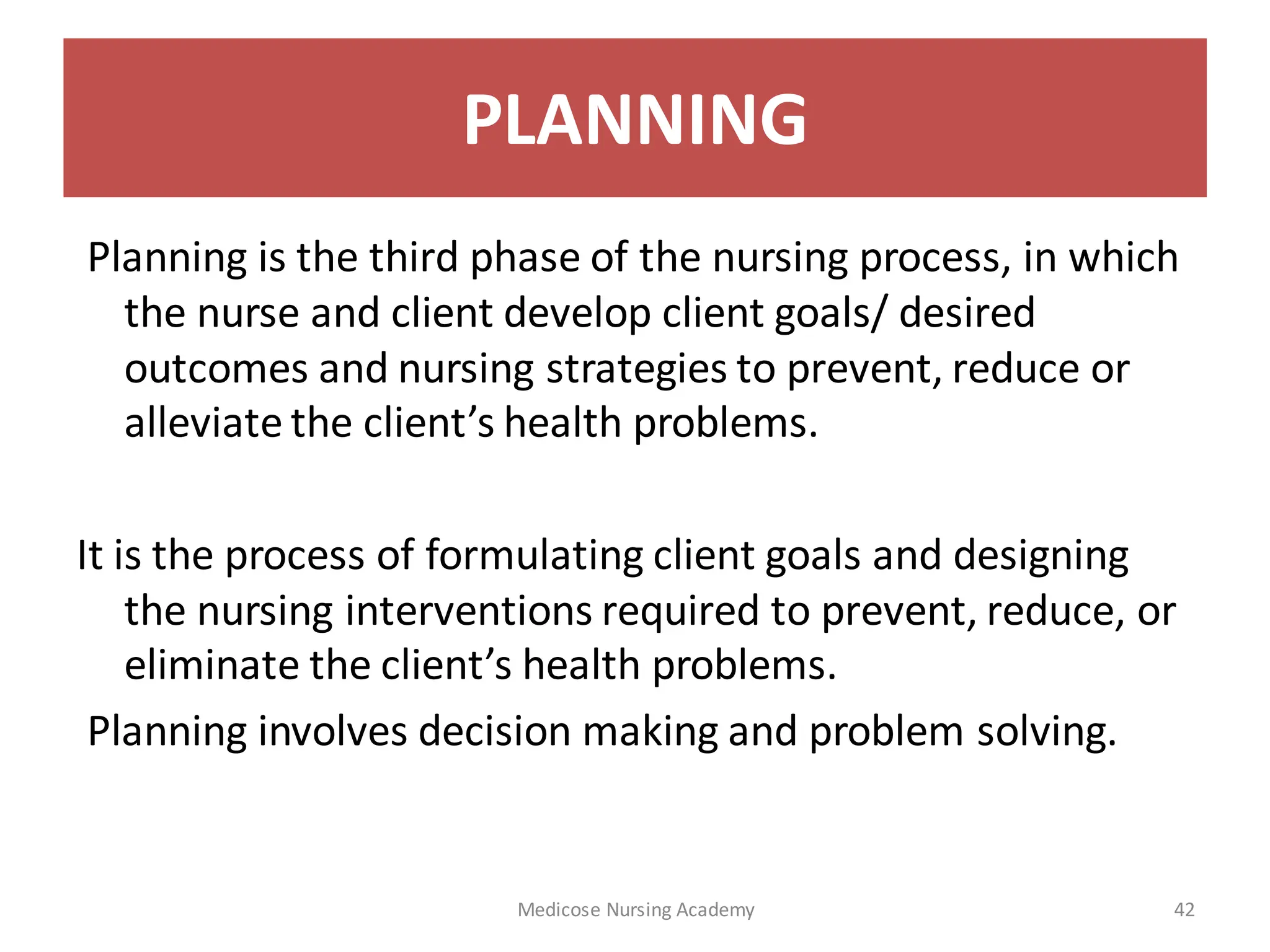
PLANNING
Planning is the third phase of the nursing process, in which
the nurse and client develop client goals/ desired
outcomes and nursing strategies to prevent, reduce or
alleviate the client’s health problems.
It is the process of formulating client goals and designing
the nursing interventions required to prevent, reduce, or
eliminate the client’s health problems.
Planning involves decision making and problem solving.
Medicose Nursing Academy 42
Types Of Planning
1. Initial Planning : Planning which is done after the initial
assessment.The nurse who performs the admission
assessment usually develops the initial comprehensive
plan of care.
2. OngoingPlanning : It is a continuous planning. As nurses
obtain new information and evaluate the client’s
responses to care, they can individualize the initial care
plan further. It occurs at the beginning of a shift as the
nurse plans the care to be given that day
3. Discharge Planning :The process of anticipating and
planning for needs after discharge, is a crucial part of a
comprehensive health care and should be addressed in
each client’s care plan.
Medicose Nursing Academy 43
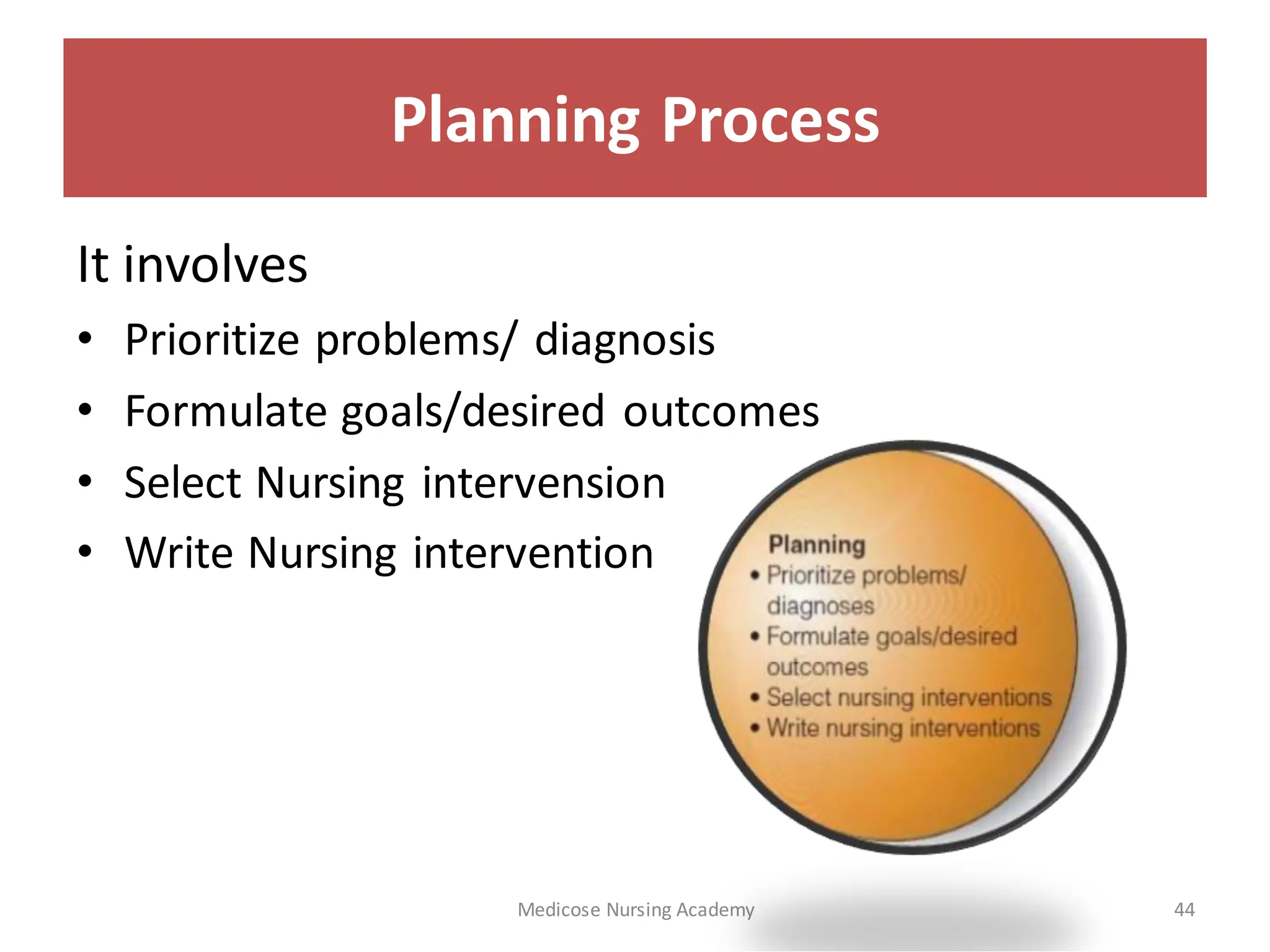
Planning Process
Medicose Nursing Academy
It involves
• Prioritize problems/ diagnosis
• Formulate goals/desired outcomes
• Select Nursing intervension
• Write Nursing intervention
44
Planning Process
1. Setting priorities
• The nurse begin planning by deciding which nursing
diagnosis requires attention first, which second, and
so on.
• Nurses frequently use Maslow’s hierarchy of needs
when setting priorities.
• Example: In this physiologic needs such as air, food
and water are basic to life and receive higher priority
than the need for security or activity
Medicose Nursing Academy 45
46
Maslow's Hierarchy of Needs
Medicose Nursing Academy
Planning Process
2. Establishing client goals/desired outcomes
After establishing priorities, the nurse set goals for each
nursing diagnosis. Goals may be short term or long
term
Client goals / desired outcomes: It is a specific and
measurable behavior or response that reflects a
clients highest possible level of wellness and
independence in function.
Medicose Nursing Academy 47
Types of Goals
Short Term Goals
• It is an objective that is
expected to achieved / with
in a short time, usually less
than a week Example:
Client will achieve comfort
with in 24 hours post
operatively
• Clientwill raise right arm to
shoulder heightby Frida
Long Term Goaals
• It is an objective that is
expected to believe over a
longer time frame, usually
over weeksormonths
Example: Client will adhere
to post operative activity
restrict
• Client will regain full use of
right arm in 6 weeks ions for
one month
Medicose Nursing Academy 48
Planning Process
3. Nursing interventions
A nursing intervention is any treatment, that a nurse
performs to improve patient’s health.
OR
These are the actions that nurses perform to achieve
the clients goals
Medicose Nursing Academy 49
Types Of Nursing Interventions
1. Independent interventions are those activities that
nurses are licensed to initiate on the basis of their
knowledge and skills.
2. Dependent interventions are activities carried out
under the orders or supervision of a licensed
physician.
3. Collaborative interventions are actions the nurse
carries out in collaboration with other health team
members
Medicose Nursing Academy 50
4. IMPLEMENTATION
• In the nursing process, implementing is the action
phase in which the nurse performs the nursing
interventions. Implementing consists of doing and
documenting the activities that are the specific nursing
actions needed to carry out the interventions.
• The nurse performs or delegates the nursing activities
for the interventions that were developed in the
planning step and then concludes the implementing
step by recording nursing activities and the resulting
client responses.
Medicose Nursing Academy 51
Process of Implementing
• The process of implementing normally includes the
following:
• Reassessing the client
• Determining the nurse’s need for assistance
• Implementing the nursing interventions
• Supervising the delegated care
• Documenting nursing activities.
Medicose Nursing Academy 52
Process of Implementing
1. Reassessing the Client
Just before implementing an intervention, the nurse must reassess the
client to make sure the intervention is still needed.
2. Determining the Nurse’s Need for Assistance
When implementing some nursing interventions, the nurse may
require assistance for one or more of the following reasons:
• The nurse is unable to implement the nursing activity safely or efficiently alone
(e.g., ambulatingan unsteady obese client).
• Assistance would reduce stress on the client (e.g., turning a person who
experiences acute pain when moved).
• The nurse lacks the knowledge or skills to implement a particularnursing activity
(e.g., a nurse who is not familiarwith a particularmodel of tractionequipment
needs assistance the first time it is applied).
Medicose Nursing Academy 53
Process of Implementing
3. Implementing the Nursing Interventions
It is important to explain to the client what
interventions will be done, what sensations to
expect, what the client is expected to do, and what
the expected outcome is.
For many nursing activities, it is also important to
ensure the client’s privacy, for example by closing
doors, pulling curtains, or draping the client.
Medicose Nursing Academy 54
Process of Implementing
4. Supervising DelegatedCare
• If care has been delegated to other health care
personnel, the nurse responsible for the client’s overall
care must ensure that the activities have been
implemented according to the care plan.
• Other caregivers may be required to communicatetheir
activities to the nurse by documenting them on the client
record, reporting verbally, or filling out a written form.
• The nurse validates and responds to any adverse findings
or client responses. This may involve modifying the
nursing care plan.
Medicose Nursing Academy 55
Process of Implementing
5. Documenting nursing activities.
After carrying out the nursing activities, the nurse
completes the implementing phase by recording the
interventions and client responses in the nursing
progress notes.
Medicose Nursing Academy 56
EVALUATION
Evaluation is a planned, ongoing, purposeful activity in
which the nurse determines
(a)the client’s progress toward achievement of
goals/outcomes and
(b)the effectiveness of the nursing care plan.
Medicose Nursing Academy 57
References
kozier & Erb’s Fundamentalof Nursing ,8th
edition( Audrey Berman ,Shirlee J. Synder).
www.slideshare.com
www.google.com
Medicose Nursing Academy 58
02/08/2021 59

Nursing Process final (1).pdf nursing process phases of nursing

  • 1.
    Unit: 1 NursingProcess FON-II, 2nd Semester BScN Generic 4 Year Degree Program By Rawal Rafiq Leghari Medicose Nursing Academy
  • 2.
    Objectives 1. Define nursingprocess. 2. Describe the purposes of nursing process. 3. Identify the components of the nursing process 4. Discuss the requirements for effective use of the nursing process 5. Describe the functional health approach to the nursing process Medicose Nursing Academy 2
  • 3.
    Nursing Process The nursingprocess is a dynamic & modified form of scientific method used in nursing profession to assess client needs and create a course of action to address and solve patient problems. OR An organized sequence of problem-solving steps used to identify and to manage the health problems of clients. It is accepted for clinical practice established by the American Nurses Association Medicose Nursing Academy 3
  • 4.
    Purpose Of NursingProcess • To identify a client’s health status and actual or potential health care problems or needs. • To establish plans to meet the identified needs. • To deliver specific nursing interventions to meet those needs. • Purpose is to provide client care that is : Individualized Holistic Effective Efficient Medicose Nursing Academy 4
  • 5.
    Components Of NursingProcess The Nursing Process utilizes the following steps 1. Assessment (data collection), 2. Nursing diagnosis, 3. Planning, 4. Implementation 5. Evaluation. – Steps remain the same – Applications and result are different Medicose Nursing Academy 5
  • 6.
    Components of NursingProcess Medicose Nursing Academy 6
  • 7.
    Characteristics of NursingProcess • Cyclic • Dynamic nature, • Client centeredness • Focus on problem solving and decision making • Interpersonal and collaborative style • Universal applicability • Use of critical thinking and clinical reasoning Medicose Nursing Academy 7
  • 8.
    1. ASSESSMENT It involves •Collection of data • Organizing the data • Validating the data • Documenting the data Assessmentis the systematicand continuous collection, organization, validation, and documentation of data (information). Medicose Nursing Academy 8
  • 9.
    1. ASSESSMENT Types ofassessment The four different types of assessments are; 1. Initial nursing assessment 2. Problem-focused assessment 3. Emergency assessment 4. Time-lapsed reassessment The ultimate Purpose of assessment is data collection Medicose Nursing Academy 9
  • 10.
    1. ASSESSMENT 1. Initialnursing assessment: • Performed within specified time after admission. • To establish a complete database for problem identification. • Eg: Nursing admission assessment Medicose Nursing Academy 10
  • 11.
    1. ASSESSMENT 2. Problem-focusedassessment : To determine the status of a specific problem identified in an earlier assessment. Eg: hourly checking of vital signs of fever patient Medicose Nursing Academy 11
  • 12.
    1. ASSESSMENT 3. Emergencyassessment: During emergency situation to identify any life threatening situation. Eg: Rapid assessment of an individual’s airway, breathing status, and circulation during a cardiac arrest. Medicose Nursing Academy 12
  • 13.
    1. ASSESSMENT 4. Time-lapsedreassessment: Several months after initial assessment. To compare the client’s current health status with the data previously obtained Medicose Nursing Academy 13
  • 14.
  • 15.
    1. ASSESSMENT Collection ofdata Data collection is the process of gathering information about a client’s health status. It includes the health history, physical examination, results of laboratory and diagnostic tests, and material contributed by other health personnel. Medicose Nursing Academy 15
  • 16.
    1. ASSESSMENT Types ofData: 1. Subjective data 2. Objective data. 1. Subjective data Also referred to as symptoms or covert data, are clear only to the person affected and can be described only by that person. Itching, pain, and feelings of worry are examples of subjective data. Medicose Nursing Academy 16
  • 17.
    1. ASSESSMENT 2. Objectivedata Also referred to as signs or overt data, are detectable by an observer or can be measured or tested against an accepted standard. They can be seen, heard, felt, or smelled, and they are obtained by observation or physical examination. For example, a discoloration of the skin or a blood pressure reading is objective data. Medicose Nursing Academy 17
  • 18.
    1. ASSESSMENT Sources ofData Sources of data are primary or secondary. 1. Primary : It is the direct source of information. The client is the primary source of data. 2. Secondary: It is the indirect source of information. All sources other than the client are considered secondary sources. Family members, health professionals, records and reports, laboratory and diagnostic results are secondary sources. Medicose Nursing Academy 18
  • 19.
    Methods Of DataCollection Medicose Nursing Academy 19
  • 20.
    1. ASSESSMENT Organization ofdata The nurse uses a format that organizes the assessment data systematically. This is often referred to as nursing health history or nursing assessment form Medicose Nursing Academy 20
  • 21.
    1. ASSESSMENT Validation ofdata The information gathered during the assessment is “double-checked” or verified to confirm that it is accurate and complete. Medicose Nursing Academy 21
  • 22.
    1. ASSESSMENT Documentation ofdata To complete the assessment phase, the nurse records client data. Accurate documentation is essential and should include all data collected about the client’s health status. Medicose Nursing Academy 22
  • 23.
    2. DIAGNOSIS Diagnosis isthe second phase of the nursing process. In this phase, nurses use critical thinking skills to interpret assessment data to identify client problems. (NANDA) define or refine nursing diagnosis. The official NANDA definition of a nursing diagnosis is: “a clinical judgment concerning a human response to health conditions/life processes, or a vulnerability for that response, by an individual, family, group, or community.” Medicose Nursing Academy 23
  • 24.
    2. DIAGNOSIS Diagnosing isto : 1.Analyza data 2. Identify health problems,risks and strengths 3. Formulate diagnostic statement Medicose Nursing Academy 24
  • 25.
    Status of theNursing Diagnoses “Status refers to the actuality or potentiality of the diagnosis or the categorization of the diagnosis” (NANDA International, 2009, p. 44).The kinds of nursing diagnoses according to status are 1. Actual 2. Health promotion 3. Risk 4. Wellness. 5. Possible Nursing Diagnosis 6. Syndrome Nursing diagnosis Medicose Nursing Academy 25
  • 26.
    1. Actual Diagnosis Anactual diagnosis is a client peoblem that is present at the time of Nursing assessment. Examples are ineffective breathing pattern and anxiety. It is based on the presence of associated signs and symptoms Medicose Nursing Academy 26
  • 27.
    2. Health PromotionDiagnosis A health promotion diagnosis relates to clients’preparednessto implement behaviors to improve their health condition.These diagnosis labels begin with the phrase Readiness for Enhanced, as in Readiness for Enhanced Nutrition Medicose Nursing Academy 27
  • 28.
    3. Risk NursingDiagnosis A risk nursing diagnosis is a clinical judgment that a problem does not exist, but the presence of risk factors indicates that a problem is likely to develop unless nurses intervene. For example, all people admitted to a hospital have some possibility of acquiring an infection; however, a client with diabetes or a compromised immune system is at higher risk than others. Therefore, the nurse would appropriately use the label Risk for Infection to describe the client’s health status. Medicose Nursing Academy 28
  • 29.
    4. Wellness NursingDiagnosis It is clinical judgment about an individual, group or community in transition from a specific level of wellness to a higher level of wellness. Eg: Family coping: potential for growth related to unexpected birth of twins. Medicose Nursing Academy 29
  • 30.
    5. Possible NursingDiagnosis It describe a suspected problem for which current and available data are insufficient to validate the problem. eg: Possible social isolation related to unknown etiology. Eg: An elderly widow who lives alone is admitted to the hospital. The nurse notices that she has no visitors and is pleased with attention and conversation from the nursing staff.The nurse may write a nursing diagnosis of possible social isolation related to unknown etiology. Medicose Nursing Academy 30
  • 31.
    6. Syndrome NursingDiagnosis It is a cluster of nursing diagnosis that frequently go together and present a clinical picture. Eg: • Chronic Pain syndrome • Rape Trauma Syndrome • Disuse syndrome (long term bed riddenpatients) • Clusters of diagnoses associated with Disuse syndrome syndrome include Impaired Physical Mobility,Riskfor Impaired Tissue Integrity, Risk for Activity Intolerance, Risk for Constipation, Risk for Infection, Risk for Injury, Risk for Powerlessness, Impaired Gas Exchange, and so on. Medicose Nursing Academy 31
  • 32.
    Components of aNursing Diagnosis A nursing diagnosis has three components: (1) The problem statement or Diagnostic Lable (2) The etiology (related factors & risk factors) (3) Signs & Symptoms or the defining characteristics Medicose Nursing Academy 32
  • 33.
    1.Problem Statement (DiagnosticLabel) It Describes the patient health status or response to health problems for which nursing therapy is given. The purpose of the diagnostic label is to direct the formation of client goals and desired outcomes. It may also suggest some nursing interventions. Eg: for example, Deficient Knowledge (Medications) or Deficient Knowledge (DietaryAdjustments). Similarly., Activity intolerance or Constipation etc Medicose Nursing Academy 33
  • 34.
    2. Etiology (RelatedFactors & Risk Factors) The etiology component of a nursing diagnosis identifies causes of the health problem.These are causative factors that have influenced the clients actual or potential response to the healthproblem Eg: Activity intolerance related to generalized weakness or obesity or sedentary lifestyle. Constipation related to inadequate fluid intake or inadequate fiber intake. Medicose Nursing Academy 34
  • 35.
    3. Defining characteristics(S/S) Defining characteristics are the cluster of signs and symptoms that indicate the presence of a particular diagnostic label or health problem. e.g Fluid volume deficit related to decreased oral intake manifested by dry skin and mucus membranes. Medicose Nursing Academy 35
  • 36.
    The Diagnostic Process Thediagnostic process has three steps: • Analyzing data • Identifying health problems, risks, and strengths • Formulating diagnostic statements. Medicose Nursing Academy 36
  • 37.
    Formulating Diagnostic statement Mostnursing diagnosis are written as two part or three parts statements Basic Two Part Statements: It is also called PE format Problem (P) – statement of the patients response Etiology (E) – factors contributing to or probable cause of the response Example:Problem(P)relatedtoEtiology(E) Activity intolerance related to generalized weaknessorobesity Medicose Nursing Academy 37
  • 38.
    Formulating Diagnostic statement BasicThree Part Statements It is also called as PES format & includes: 1.Problem (P) – Statement of the patient’s response 2.Etiology (E) Factors contributing to or probablecausesoftheresponses 3.Signs & Symptoms (S) Defining characteristicsevidencedbytheclient Example: Problem related to etiology as evidentced by signs &symptoms Activity intolerance related to generalized weakness evidenced by fatigue Medicose Nursing Academy 38
  • 39.
    Difference between NursingDiagnosis Medical Diagnosis Nursing Diagnosis • It is a statementof nursing judgment and refers to a condition that nurses are licensed to treat. • It is a statementof nursing judgment. • It describe a patients physical, sociocultural, psychologic and spiritual responses to an illness or ahealthproblem Medical Diagnosis • It is made by a physician and refers to a condition that only a physician cant reat. • It is a statementof medical judgmen. • Medical diagnoses refer to disease processes OR It describes a patient’s specific pathophysiologic responses to an illness. Medicose Nursing Academy 39
  • 40.
    Difference between NursingDiagnosis Medical Diagnosis Nursing Diagnosis • These responses vary among individuals • The patient’s nursing diagnosis change as the client’s response change • Nursing diagnosis relate to the nurse’s independent function • Eg:Tepid sponging for fever Medical Diagnosis • These responses are fairly uniform from one client to another • The patient’s medical diagnosis remains the same for as long as the disease process is present • Nurses are obligated to carry out physician prescribed treatment (dependent function). Eg: Tab. Paracetamol 500mg forfever Medicose Nursing Academy 40
  • 41.
    Difference between NursingDiagnosis Medical Diagnosis Nursing Diagnosis • Ineffective breathing pattern • Activity intolerance • Acute pain • Disturbed body image Medical Diagnosis • Asthma • Cerebrovascular accident • Appendicitis • Amputation Medicose Nursing Academy 41
  • 42.
    PLANNING Planning is thethird phase of the nursing process, in which the nurse and client develop client goals/ desired outcomes and nursing strategies to prevent, reduce or alleviate the client’s health problems. It is the process of formulating client goals and designing the nursing interventions required to prevent, reduce, or eliminate the client’s health problems. Planning involves decision making and problem solving. Medicose Nursing Academy 42
  • 43.
    Types Of Planning 1.Initial Planning : Planning which is done after the initial assessment.The nurse who performs the admission assessment usually develops the initial comprehensive plan of care. 2. OngoingPlanning : It is a continuous planning. As nurses obtain new information and evaluate the client’s responses to care, they can individualize the initial care plan further. It occurs at the beginning of a shift as the nurse plans the care to be given that day 3. Discharge Planning :The process of anticipating and planning for needs after discharge, is a crucial part of a comprehensive health care and should be addressed in each client’s care plan. Medicose Nursing Academy 43
  • 44.
    Planning Process Medicose NursingAcademy It involves • Prioritize problems/ diagnosis • Formulate goals/desired outcomes • Select Nursing intervension • Write Nursing intervention 44
  • 45.
    Planning Process 1. Settingpriorities • The nurse begin planning by deciding which nursing diagnosis requires attention first, which second, and so on. • Nurses frequently use Maslow’s hierarchy of needs when setting priorities. • Example: In this physiologic needs such as air, food and water are basic to life and receive higher priority than the need for security or activity Medicose Nursing Academy 45
  • 46.
    46 Maslow's Hierarchy ofNeeds Medicose Nursing Academy
  • 47.
    Planning Process 2. Establishingclient goals/desired outcomes After establishing priorities, the nurse set goals for each nursing diagnosis. Goals may be short term or long term Client goals / desired outcomes: It is a specific and measurable behavior or response that reflects a clients highest possible level of wellness and independence in function. Medicose Nursing Academy 47
  • 48.
    Types of Goals ShortTerm Goals • It is an objective that is expected to achieved / with in a short time, usually less than a week Example: Client will achieve comfort with in 24 hours post operatively • Clientwill raise right arm to shoulder heightby Frida Long Term Goaals • It is an objective that is expected to believe over a longer time frame, usually over weeksormonths Example: Client will adhere to post operative activity restrict • Client will regain full use of right arm in 6 weeks ions for one month Medicose Nursing Academy 48
  • 49.
    Planning Process 3. Nursinginterventions A nursing intervention is any treatment, that a nurse performs to improve patient’s health. OR These are the actions that nurses perform to achieve the clients goals Medicose Nursing Academy 49
  • 50.
    Types Of NursingInterventions 1. Independent interventions are those activities that nurses are licensed to initiate on the basis of their knowledge and skills. 2. Dependent interventions are activities carried out under the orders or supervision of a licensed physician. 3. Collaborative interventions are actions the nurse carries out in collaboration with other health team members Medicose Nursing Academy 50
  • 51.
    4. IMPLEMENTATION • Inthe nursing process, implementing is the action phase in which the nurse performs the nursing interventions. Implementing consists of doing and documenting the activities that are the specific nursing actions needed to carry out the interventions. • The nurse performs or delegates the nursing activities for the interventions that were developed in the planning step and then concludes the implementing step by recording nursing activities and the resulting client responses. Medicose Nursing Academy 51
  • 52.
    Process of Implementing •The process of implementing normally includes the following: • Reassessing the client • Determining the nurse’s need for assistance • Implementing the nursing interventions • Supervising the delegated care • Documenting nursing activities. Medicose Nursing Academy 52
  • 53.
    Process of Implementing 1.Reassessing the Client Just before implementing an intervention, the nurse must reassess the client to make sure the intervention is still needed. 2. Determining the Nurse’s Need for Assistance When implementing some nursing interventions, the nurse may require assistance for one or more of the following reasons: • The nurse is unable to implement the nursing activity safely or efficiently alone (e.g., ambulatingan unsteady obese client). • Assistance would reduce stress on the client (e.g., turning a person who experiences acute pain when moved). • The nurse lacks the knowledge or skills to implement a particularnursing activity (e.g., a nurse who is not familiarwith a particularmodel of tractionequipment needs assistance the first time it is applied). Medicose Nursing Academy 53
  • 54.
    Process of Implementing 3.Implementing the Nursing Interventions It is important to explain to the client what interventions will be done, what sensations to expect, what the client is expected to do, and what the expected outcome is. For many nursing activities, it is also important to ensure the client’s privacy, for example by closing doors, pulling curtains, or draping the client. Medicose Nursing Academy 54
  • 55.
    Process of Implementing 4.Supervising DelegatedCare • If care has been delegated to other health care personnel, the nurse responsible for the client’s overall care must ensure that the activities have been implemented according to the care plan. • Other caregivers may be required to communicatetheir activities to the nurse by documenting them on the client record, reporting verbally, or filling out a written form. • The nurse validates and responds to any adverse findings or client responses. This may involve modifying the nursing care plan. Medicose Nursing Academy 55
  • 56.
    Process of Implementing 5.Documenting nursing activities. After carrying out the nursing activities, the nurse completes the implementing phase by recording the interventions and client responses in the nursing progress notes. Medicose Nursing Academy 56
  • 57.
    EVALUATION Evaluation is aplanned, ongoing, purposeful activity in which the nurse determines (a)the client’s progress toward achievement of goals/outcomes and (b)the effectiveness of the nursing care plan. Medicose Nursing Academy 57
  • 58.
    References kozier & Erb’sFundamentalof Nursing ,8th edition( Audrey Berman ,Shirlee J. Synder). www.slideshare.com www.google.com Medicose Nursing Academy 58
  • 59.