Presentation on:
Evaluation
Guided By- Presented By-
Ms. Neha Soni Ms. Akshaykumari Jhala
Lecturer(CHN) Msc. Nursing Previous
(OBG)
 Evaluation is the last step in nursing process.
Evaluation is not always simple, particularly for clients
with multiple problems, presenting almost constant
change in status. Evaluation is one of the most critical
phases of the nursing process because it supports the
basis of the usefulness and effectiveness of nursing
process. The final step of the nursing process is
evaluating the patient’s response to the care delivered
to make sure the desired outcomes developed in the
planning step and documented in the plan of care have
been achieved.
 Evaluation is defined as the judgment of the
effectiveness of nursing care to meet client goals based
on the client’s behavioral responses.
 It is an on-going process, which is necessary for
determining how well the plan of care is working.
 It is the final step of the nursing process. It’s a
continuous process, essential for assuring the quality
and appropriateness of the care provided.
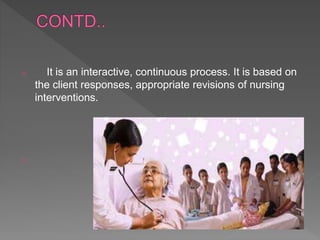
o It is an interactive, continuous process. It is based on
the client responses, appropriate revisions of nursing
interventions.
o
 To collect the objective and subjective data to make
judgments about nursing care delivered.
 To examine the client’s behavioral responses to nursing
interventions.
 To compare the client’s behavioral responses with
predetermined outcome criteria.
 To appraise the extent to which client goals were attained or
problems resolved.
 To appraise involvement and collaboration of the client,
family members, nurses, and health care team members in
healthcare decisions.
 To provide a basis for the revision of the nursing plan of
the care evaluation.
 To monitor the quality of nursing care and its effect on
the client’s health status.
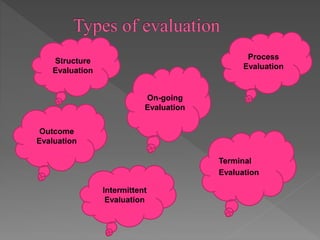
Structure
Evaluation
Process
Evaluation
Outcome
Evaluation
On-going
Evaluation
Terminal
Evaluation
Intermittent
Evaluation
It focuses on the attributes of the settings or surroundings where
healthcare is provided. It deals with the environmental aspects that
directly or indirectly influence the quality of care provided. It
includes the availability of the equipment, layout of physical
facilities, nurse-client ratios, administrative support, maintenance
of staff competence, etc.
 It focuses on the nurse’s performance and
whether the nursing care provided was
appropriate and competent. The phases of
nursing process are used as the framework
for evaluation of nursing care. Areas of
concern in this includes the type of
information obtained by interview, and
physical assessment and nurses’ technical
competence.
 It is done while, or immediately after
implementing a nursing order. It enables the
nurse to make on the spot modifications in
an intervention.
 It focuses on the client’s function. It
determines the extent to which the client’s
behavioral response to nursing intervention
reflects the desired client goal and outcome
criteria.
 It is performed at specified intervals., once a
week that shows the extent of progress
towards the goal achievement and enables
the nurse to correct any deficiencies and
modify the care plan as needed.
 It indicates the client’s condition at the time
of discharge. It includes the status of goal
achievement and an evaluation of the client’s
self-care abilities with regard to follow-up
care.
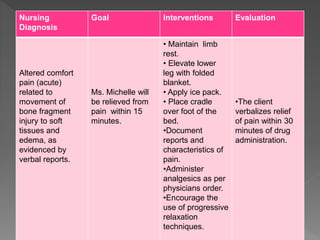
Nursing
Diagnosis
Goal Interventions Evaluation
Altered comfort
pain (acute)
related to
movement of
bone fragment
injury to soft
tissues and
edema, as
evidenced by
verbal reports.
Ms. Michelle will
be relieved from
pain within 15
minutes.
• Maintain limb
rest.
• Elevate lower
leg with folded
blanket.
• Apply ice pack.
• Place cradle
over foot of the
bed.
•Document
reports and
characteristics of
pain.
•Administer
analgesics as per
physicians order.
•Encourage the
use of progressive
relaxation
techniques.
•The client
verbalizes relief
of pain within 30
minutes of drug
administration.
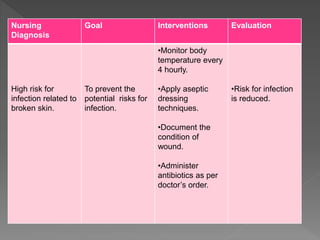
Nursing
Diagnosis
Goal Interventions Evaluation
High risk for
infection related to
broken skin.
To prevent the
potential risks for
infection.
•Monitor body
temperature every
4 hourly.
•Apply aseptic
dressing
techniques.
•Document the
condition of
wound.
•Administer
antibiotics as per
doctor’s order.
•Risk for infection
is reduced.
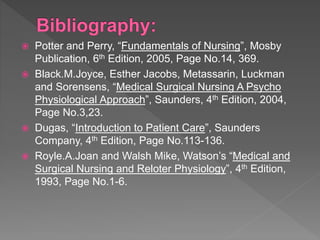
 Potter and Perry, “Fundamentals of Nursing”, Mosby
Publication, 6th Edition, 2005, Page No.14, 369.
 Black.M.Joyce, Esther Jacobs, Metassarin, Luckman
and Sorensens, “Medical Surgical Nursing A Psycho
Physiological Approach”, Saunders, 4th Edition, 2004,
Page No.3,23.
 Dugas, “Introduction to Patient Care”, Saunders
Company, 4th Edition, Page No.113-136.
 Royle.A.Joan and Walsh Mike, Watson’s “Medical and
Surgical Nursing and Reloter Physiology”, 4th Edition,
1993, Page No.1-6.
EVALUATION ANP

EVALUATION ANP

  • 2.
    Presentation on: Evaluation Guided By-Presented By- Ms. Neha Soni Ms. Akshaykumari Jhala Lecturer(CHN) Msc. Nursing Previous (OBG)
  • 4.
     Evaluation isthe last step in nursing process. Evaluation is not always simple, particularly for clients with multiple problems, presenting almost constant change in status. Evaluation is one of the most critical phases of the nursing process because it supports the basis of the usefulness and effectiveness of nursing process. The final step of the nursing process is evaluating the patient’s response to the care delivered to make sure the desired outcomes developed in the planning step and documented in the plan of care have been achieved.
  • 5.
     Evaluation isdefined as the judgment of the effectiveness of nursing care to meet client goals based on the client’s behavioral responses.  It is an on-going process, which is necessary for determining how well the plan of care is working.  It is the final step of the nursing process. It’s a continuous process, essential for assuring the quality and appropriateness of the care provided.
  • 6.
    o It isan interactive, continuous process. It is based on the client responses, appropriate revisions of nursing interventions. o
  • 7.
     To collectthe objective and subjective data to make judgments about nursing care delivered.  To examine the client’s behavioral responses to nursing interventions.  To compare the client’s behavioral responses with predetermined outcome criteria.  To appraise the extent to which client goals were attained or problems resolved.  To appraise involvement and collaboration of the client, family members, nurses, and health care team members in healthcare decisions.
  • 8.
     To providea basis for the revision of the nursing plan of the care evaluation.  To monitor the quality of nursing care and its effect on the client’s health status.
  • 9.
  • 10.
    It focuses onthe attributes of the settings or surroundings where healthcare is provided. It deals with the environmental aspects that directly or indirectly influence the quality of care provided. It includes the availability of the equipment, layout of physical facilities, nurse-client ratios, administrative support, maintenance of staff competence, etc.
  • 11.
     It focuseson the nurse’s performance and whether the nursing care provided was appropriate and competent. The phases of nursing process are used as the framework for evaluation of nursing care. Areas of concern in this includes the type of information obtained by interview, and physical assessment and nurses’ technical competence.
  • 12.
     It isdone while, or immediately after implementing a nursing order. It enables the nurse to make on the spot modifications in an intervention.
  • 13.
     It focuseson the client’s function. It determines the extent to which the client’s behavioral response to nursing intervention reflects the desired client goal and outcome criteria.
  • 14.
     It isperformed at specified intervals., once a week that shows the extent of progress towards the goal achievement and enables the nurse to correct any deficiencies and modify the care plan as needed.
  • 15.
     It indicatesthe client’s condition at the time of discharge. It includes the status of goal achievement and an evaluation of the client’s self-care abilities with regard to follow-up care.
  • 16.
    Nursing Diagnosis Goal Interventions Evaluation Alteredcomfort pain (acute) related to movement of bone fragment injury to soft tissues and edema, as evidenced by verbal reports. Ms. Michelle will be relieved from pain within 15 minutes. • Maintain limb rest. • Elevate lower leg with folded blanket. • Apply ice pack. • Place cradle over foot of the bed. •Document reports and characteristics of pain. •Administer analgesics as per physicians order. •Encourage the use of progressive relaxation techniques. •The client verbalizes relief of pain within 30 minutes of drug administration.
  • 17.
    Nursing Diagnosis Goal Interventions Evaluation Highrisk for infection related to broken skin. To prevent the potential risks for infection. •Monitor body temperature every 4 hourly. •Apply aseptic dressing techniques. •Document the condition of wound. •Administer antibiotics as per doctor’s order. •Risk for infection is reduced.
  • 18.
     Potter andPerry, “Fundamentals of Nursing”, Mosby Publication, 6th Edition, 2005, Page No.14, 369.  Black.M.Joyce, Esther Jacobs, Metassarin, Luckman and Sorensens, “Medical Surgical Nursing A Psycho Physiological Approach”, Saunders, 4th Edition, 2004, Page No.3,23.  Dugas, “Introduction to Patient Care”, Saunders Company, 4th Edition, Page No.113-136.  Royle.A.Joan and Walsh Mike, Watson’s “Medical and Surgical Nursing and Reloter Physiology”, 4th Edition, 1993, Page No.1-6.