PRESENTED BY :-
Ms. Truptimayee Das
TUTOR,KINS
OUTLINE……
 Introduction
 Definition
 Purposes of implantation
 Process of implementation
 Implementation skill
 Intervention types
 Major responsibilities in nursing care
INTRODUCTION
 Nursing process is action oriented , client
centered and outcome directed.
 Based on assessment and diagnosis phases the
nurse implements the interventions and
evaluating the desired outcome.
 Implementing is the action phase in which the
nurse performs the nursing interventions
Consist of doing and documenting the
activities.
CONT…
 Nursing intervention as any direct care treatment that a
nurse performs on behalf of a client. These treatments
includes nurse initiated treatments resulting from
medical diagnosis and performances of the daily
essential function for the client who that can not do
these.
DEFINITION
 A nursing intervention is any treatment based on
clinical judgment and knowledge that a nurse
performs to enhance patient outcomes (Bulechek
et al., 2008).
 Implementation is a 4th steps of the nursing
process. It starts after the nurse develops a plan of
care with based on clear & relevant nursing
diagnosis .
PURPOSES OF IMPLEMENTATION
1.Standardization of the nomenclature (e.g., labeling,
describing) of nursing interventions; standardizes the
language nurses use to describe sets of actions in
delivering patient care.
2.Expanding nursing knowledge about connections among
nursing diagnoses, treatments, and outcomes;
connections determined through the study of actual
patient care using a database that the classification
generates.
CONT..
3.Developing nursing and health care information systems.
4.Teaching decision making to nursing students; defining
and classifying nursing interventions to teach beginning
nurses how to find out a patient’s need for care and to
respond appropriately.
CONT …..
5.Determining the cost of services provided by nurses.
6.Planning for resources needed in all types of nursing
practice settings.
7.Language to communicate the unique functions of nursing.
8.Link with the classification systems of other health care
providers.
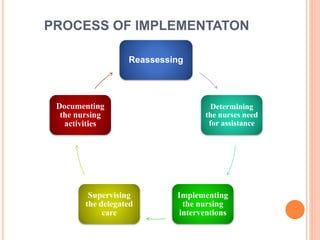
PROCESS OF IMPLEMENTATON
Reassessing
Determining
the nurses need
for assistance
Implementing
the nursing
interventions
Supervising
the delegated
care
Documenting
the nursing
activities
PROCESS…….
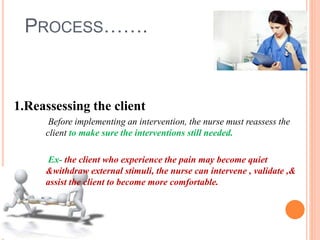
1.Reassessing the client
Before implementing an intervention, the nurse must reassess the
client to make sure the interventions still needed.
Ex- the client who experience the pain may become quiet
&withdraw external stimuli, the nurse can intervene , validate ,&
assist the client to become more comfortable.
PROCESS…….
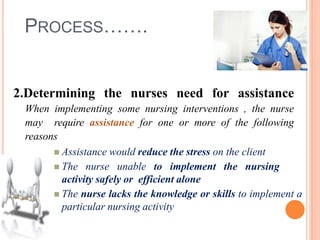
2.Determining the nurses need for assistance
When implementing some nursing interventions , the nurse
may require assistance for one or more of the following
reasons
 Assistance would reduce the stress on the client
 The nurse unable to implement the nursing
activity safely or efficient alone
 The nurse lacks the knowledge or skills to implement a
particular nursing activity
PROCESS…….
3.Implementing the nursing interventions
The nurses actions may be dependent or
independent
It is important to explain to the client what
intervention will be done
Ensure client privacy
PROCESS…….
 Guidelines
 Basic nursing interventions on scientific knowledge ,
nursing research ,and professional standards of care
(evidence based practice) when there exists.
 Clearly understand the interventions to be implemented
and question any that are not understood.
 Adapt activities to the individual client
 Implement safe care
PROCESS…….
 Guidelines
 Provide teaching, support and comfort
 Be holistic
 Respect the dignity of the client and enhance the client
self esteem
 Encourage client participation in care
PROCESS………….
4.Supervising the delegated care
If care delegated to other health care personnel,
the nurse responsible for the clients overall care.
Ensure that the activities have been implemented
according to the plan of care .
PROCESS..
5.Documenting the nursing activities
Nurse complete the implementing phase by recording the
interventions and client responses in the progress note
Part of permanent client record
Nursing actions are communicated through verbally as well as
writing.
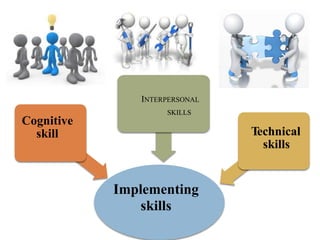
Implementing
skills
Cognitive
skill
INTERPERSONAL
SKILLS
Technical
skills
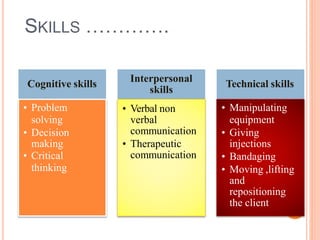
SKILLS ………….
Cognitive skills
• Problem
solving
• Decision
making
• Critical
thinking
Interpersonal
skills
• Verbal non
verbal
communication
• Therapeutic
communication
Technical skills
• Manipulating
equipment
• Giving
injections
• Bandaging
• Moving ,lifting
and
repositioning
the client
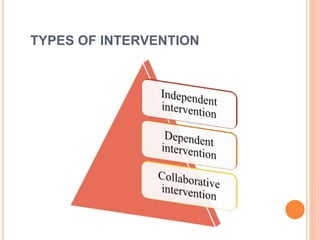
TYPES OF INTERVENTION
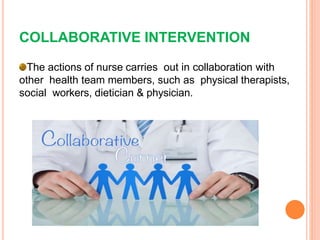
The actions of nurse carries out in collaboration with
other health team members, such as physical therapists,
social workers, dietician & physician.
COLLABORATIVE INTERVENTION
DEPENDENT INTERVENTION
These are activities carried out under the physicians
orders or supervision .
It is also known as physician
initiated interventions
Example – administer of Inj. Paracetamol for a
patient with fever more than 101
0
F.
INDEPENDENT INTERVENTION
Nurses are licensed to initiate on the basis of their
knowledge & skills
They include physical care, ongoing assessment, emotional
support & comfort, teaching, counseling.
It is also known as Nurse Initiated interventions.
MAJOR RESPONSIBILITIES IN IMPLEMENTING
NURSING CARE:-
 Reviewing the planned interviews for
appropriateness:-
 The first phase of implementation involves in
reviewing the planed intervention .
1. Develop intervention
2. Select the best intervention
CONT..
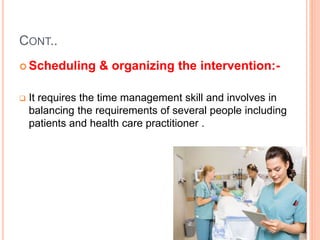
 Scheduling & organizing the intervention:-
 It requires the time management skill and involves in
balancing the requirements of several people including
patients and health care practitioner .
CONT..
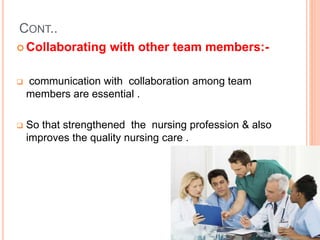
 Collaborating with other team members:-
 communication with collaboration among team
members are essential .
 So that strengthened the nursing profession & also
improves the quality nursing care .
CONT..
 Supervising & delegating nursing care by
other members of nursing teams:-
 The delegation of nursing care is based on 6 elements,
as defined by the joint commission of Accreditation of
Health care Organization.
1. Complexity of the individuals condition & nursing care
needs.
2. Stability of persons status .
CONT..
3 .Complexity of the assessment required to care for the
person properly ,including knowledge & skills needed by
nursing staff member , orderly to complete the
assessment .
4. The type of technology or equipment employed in
providing nursing care .
5.Degree of supervision required by nursing staff member
based on nurses level of competence.
6 .Availability of supervision .
CONT..
 Achievements of the organizational and
client care goals :-
• The nursing team carries out the nursing order depends
in the nursing plan of care .
• Nursing action planned to promote client goal or
outcome achievement and the resolution of the health
problem should be carefully executed .
CONT..
 Direct nursing care :-
 Nursing intervention may be independent or
interdependent .
 They may also be dependent which is carried out
based on the physicians order e.g- provide IV fluids &
medication administration .
CONT..
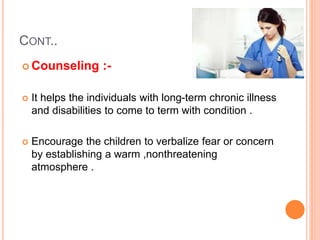
 Counseling :-
 It helps the individuals with long-term chronic illness
and disabilities to come to term with condition .
 Encourage the children to verbalize fear or concern
by establishing a warm ,nonthreatening
atmosphere .
CONT..
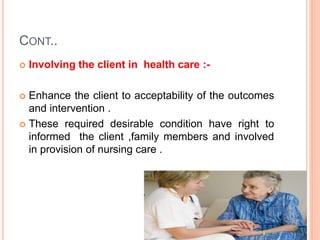
 Involving the client in health care :-
 Enhance the client to acceptability of the outcomes
and intervention .
 These required desirable condition have right to
informed the client ,family members and involved
in provision of nursing care .
CONT..
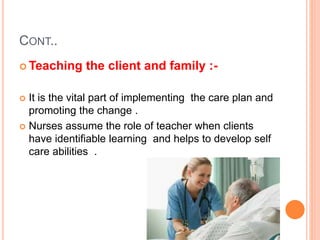
 Teaching the client and family :-
 It is the vital part of implementing the care plan and
promoting the change .
 Nurses assume the role of teacher when clients
have identifiable learning and helps to develop self
care abilities .
CONT..
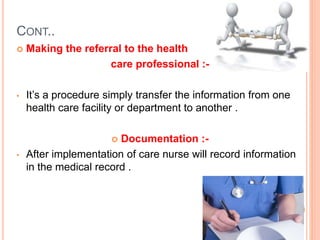
 Making the referral to the health
care professional :-
• It’s a procedure simply transfer the information from one
health care facility or department to another .
 Documentation :-
• After implementation of care nurse will record information
in the medical record .
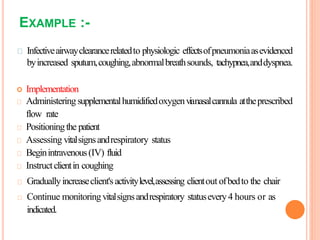
EXAMPLE :-
Infectiveairwayclearancerelatedto physiologic effectsofpneumoniaasevidenced
byincreased sputum,coughing,abnormalbreathsounds, tachypnea,anddyspnea.
 Implementation
Administering supplementalhumidifiedoxygenvianasalcannula attheprescribed
flow rate
Positioningthe patient
Assessing vitalsignsandrespiratory status
Beginintravenous(IV) fluid
Instructclientin coughing
Graduallyincreaseclient'sactivitylevel,assessing clientout ofbedto the chair
Continue monitoringvitalsignsandrespiratory statusevery4 hours or as
indicated.
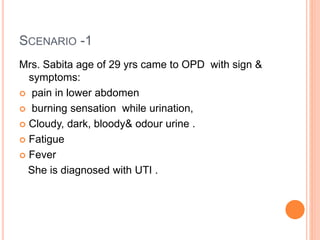
SCENARIO -1
Mrs. Sabita age of 29 yrs came to OPD with sign &
symptoms:
 pain in lower abdomen
 burning sensation while urination,
 Cloudy, dark, bloody& odour urine .
 Fatigue
 Fever
She is diagnosed with UTI .
THANK YOU

Implementation

  • 1.
    PRESENTED BY :- Ms.Truptimayee Das TUTOR,KINS
  • 2.
    OUTLINE……  Introduction  Definition Purposes of implantation  Process of implementation  Implementation skill  Intervention types  Major responsibilities in nursing care
  • 3.
    INTRODUCTION  Nursing processis action oriented , client centered and outcome directed.  Based on assessment and diagnosis phases the nurse implements the interventions and evaluating the desired outcome.  Implementing is the action phase in which the nurse performs the nursing interventions Consist of doing and documenting the activities.
  • 4.
    CONT…  Nursing interventionas any direct care treatment that a nurse performs on behalf of a client. These treatments includes nurse initiated treatments resulting from medical diagnosis and performances of the daily essential function for the client who that can not do these.
  • 5.
    DEFINITION  A nursingintervention is any treatment based on clinical judgment and knowledge that a nurse performs to enhance patient outcomes (Bulechek et al., 2008).  Implementation is a 4th steps of the nursing process. It starts after the nurse develops a plan of care with based on clear & relevant nursing diagnosis .
  • 6.
    PURPOSES OF IMPLEMENTATION 1.Standardizationof the nomenclature (e.g., labeling, describing) of nursing interventions; standardizes the language nurses use to describe sets of actions in delivering patient care. 2.Expanding nursing knowledge about connections among nursing diagnoses, treatments, and outcomes; connections determined through the study of actual patient care using a database that the classification generates.
  • 7.
    CONT.. 3.Developing nursing andhealth care information systems. 4.Teaching decision making to nursing students; defining and classifying nursing interventions to teach beginning nurses how to find out a patient’s need for care and to respond appropriately.
  • 8.
    CONT ….. 5.Determining thecost of services provided by nurses. 6.Planning for resources needed in all types of nursing practice settings. 7.Language to communicate the unique functions of nursing. 8.Link with the classification systems of other health care providers.
  • 9.
    PROCESS OF IMPLEMENTATON Reassessing Determining thenurses need for assistance Implementing the nursing interventions Supervising the delegated care Documenting the nursing activities
  • 10.
    PROCESS……. 1.Reassessing the client Beforeimplementing an intervention, the nurse must reassess the client to make sure the interventions still needed. Ex- the client who experience the pain may become quiet &withdraw external stimuli, the nurse can intervene , validate ,& assist the client to become more comfortable.
  • 11.
    PROCESS……. 2.Determining the nursesneed for assistance When implementing some nursing interventions , the nurse may require assistance for one or more of the following reasons  Assistance would reduce the stress on the client  The nurse unable to implement the nursing activity safely or efficient alone  The nurse lacks the knowledge or skills to implement a particular nursing activity
  • 12.
    PROCESS……. 3.Implementing the nursinginterventions The nurses actions may be dependent or independent It is important to explain to the client what intervention will be done Ensure client privacy
  • 13.
    PROCESS…….  Guidelines  Basicnursing interventions on scientific knowledge , nursing research ,and professional standards of care (evidence based practice) when there exists.  Clearly understand the interventions to be implemented and question any that are not understood.  Adapt activities to the individual client  Implement safe care
  • 14.
    PROCESS…….  Guidelines  Provideteaching, support and comfort  Be holistic  Respect the dignity of the client and enhance the client self esteem  Encourage client participation in care
  • 15.
    PROCESS…………. 4.Supervising the delegatedcare If care delegated to other health care personnel, the nurse responsible for the clients overall care. Ensure that the activities have been implemented according to the plan of care .
  • 16.
    PROCESS.. 5.Documenting the nursingactivities Nurse complete the implementing phase by recording the interventions and client responses in the progress note Part of permanent client record Nursing actions are communicated through verbally as well as writing.
  • 17.
  • 18.
    SKILLS …………. Cognitive skills •Problem solving • Decision making • Critical thinking Interpersonal skills • Verbal non verbal communication • Therapeutic communication Technical skills • Manipulating equipment • Giving injections • Bandaging • Moving ,lifting and repositioning the client
  • 19.
  • 20.
    The actions ofnurse carries out in collaboration with other health team members, such as physical therapists, social workers, dietician & physician. COLLABORATIVE INTERVENTION
  • 21.
    DEPENDENT INTERVENTION These areactivities carried out under the physicians orders or supervision . It is also known as physician initiated interventions Example – administer of Inj. Paracetamol for a patient with fever more than 101 0 F.
  • 22.
    INDEPENDENT INTERVENTION Nurses arelicensed to initiate on the basis of their knowledge & skills They include physical care, ongoing assessment, emotional support & comfort, teaching, counseling. It is also known as Nurse Initiated interventions.
  • 23.
    MAJOR RESPONSIBILITIES INIMPLEMENTING NURSING CARE:-  Reviewing the planned interviews for appropriateness:-  The first phase of implementation involves in reviewing the planed intervention . 1. Develop intervention 2. Select the best intervention
  • 24.
    CONT..  Scheduling &organizing the intervention:-  It requires the time management skill and involves in balancing the requirements of several people including patients and health care practitioner .
  • 25.
    CONT..  Collaborating withother team members:-  communication with collaboration among team members are essential .  So that strengthened the nursing profession & also improves the quality nursing care .
  • 26.
    CONT..  Supervising &delegating nursing care by other members of nursing teams:-  The delegation of nursing care is based on 6 elements, as defined by the joint commission of Accreditation of Health care Organization. 1. Complexity of the individuals condition & nursing care needs. 2. Stability of persons status .

  • 27.
    CONT.. 3 .Complexity ofthe assessment required to care for the person properly ,including knowledge & skills needed by nursing staff member , orderly to complete the assessment . 4. The type of technology or equipment employed in providing nursing care . 5.Degree of supervision required by nursing staff member based on nurses level of competence. 6 .Availability of supervision .
  • 28.
    CONT..  Achievements ofthe organizational and client care goals :- • The nursing team carries out the nursing order depends in the nursing plan of care . • Nursing action planned to promote client goal or outcome achievement and the resolution of the health problem should be carefully executed .
  • 29.
    CONT..  Direct nursingcare :-  Nursing intervention may be independent or interdependent .  They may also be dependent which is carried out based on the physicians order e.g- provide IV fluids & medication administration .
  • 30.
    CONT..  Counseling :- It helps the individuals with long-term chronic illness and disabilities to come to term with condition .  Encourage the children to verbalize fear or concern by establishing a warm ,nonthreatening atmosphere .
  • 31.
    CONT..  Involving theclient in health care :-  Enhance the client to acceptability of the outcomes and intervention .  These required desirable condition have right to informed the client ,family members and involved in provision of nursing care .
  • 32.
    CONT..  Teaching theclient and family :-  It is the vital part of implementing the care plan and promoting the change .  Nurses assume the role of teacher when clients have identifiable learning and helps to develop self care abilities .
  • 33.
    CONT..  Making thereferral to the health care professional :- • It’s a procedure simply transfer the information from one health care facility or department to another .  Documentation :- • After implementation of care nurse will record information in the medical record .
  • 35.
    EXAMPLE :- Infectiveairwayclearancerelatedto physiologiceffectsofpneumoniaasevidenced byincreased sputum,coughing,abnormalbreathsounds, tachypnea,anddyspnea.  Implementation Administering supplementalhumidifiedoxygenvianasalcannula attheprescribed flow rate Positioningthe patient Assessing vitalsignsandrespiratory status Beginintravenous(IV) fluid Instructclientin coughing Graduallyincreaseclient'sactivitylevel,assessing clientout ofbedto the chair Continue monitoringvitalsignsandrespiratory statusevery4 hours or as indicated.
  • 36.
    SCENARIO -1 Mrs. Sabitaage of 29 yrs came to OPD with sign & symptoms:  pain in lower abdomen  burning sensation while urination,  Cloudy, dark, bloody& odour urine .  Fatigue  Fever She is diagnosed with UTI .
  • 39.