ASSESSMENTASSESSMENT
Himanshu TrivediHimanshu Trivedi
AssessmentAssessment
It is the first phase of nursing process.It is the first phase of nursing process.
DefinitionDefinition
Nursing Assessment is the systematic andNursing Assessment is the systematic and
continuous collection, validation andcontinuous collection, validation and
communication of patient’s data.communication of patient’s data.
Nursing Assessment is the gathering ofNursing Assessment is the gathering of
information about a patient’s physiological,information about a patient’s physiological,
psychological, sociological and spiritualpsychological, sociological and spiritual
status.status.
Purposes of NursingPurposes of Nursing
AssessmentAssessment
To gather data about the individual, family orTo gather data about the individual, family or
community.community.
To establish the base line information about theTo establish the base line information about the
client.client.
To determine the client’s normal function.To determine the client’s normal function.
To determine the presence or absence ofTo determine the presence or absence of
dysfunction.dysfunction.
To determine the client’s risk for dysfunction.To determine the client’s risk for dysfunction.
To determine the client’s strengths.To determine the client’s strengths.
To identify the actual and potential health problems.To identify the actual and potential health problems.
To provide data for the diagnosis phase.To provide data for the diagnosis phase.
Types of Nursing AssessmentsTypes of Nursing Assessments
(i) Initial Assessment(i) Initial Assessment
It is performed shortly after the patient isIt is performed shortly after the patient is
admitted to the hospital. Here the nurseadmitted to the hospital. Here the nurse
gathers the information about all aspects ofgathers the information about all aspects of
the patient’s health status. This informationthe patient’s health status. This information
is otherwise called Base line data. It tellsis otherwise called Base line data. It tells
about the patient’s condition beforeabout the patient’s condition before
investigations begin and it serves as theinvestigations begin and it serves as the
basis for identifying the problems.basis for identifying the problems.
PurposePurpose

It is done to establish a complete data baseIt is done to establish a complete data base
for problem identification and care planning.for problem identification and care planning.

The nurse collects data related to all theThe nurse collects data related to all the
aspects of patient’s health.aspects of patient’s health.
(ii) Focused Assessment(ii) Focused Assessment
The nurse gathers data about aThe nurse gathers data about a specificspecific
problemproblem that has already been identified. It is usedthat has already been identified. It is used
to gather information that is specific to determineto gather information that is specific to determine
the status of an actual or potential problems.the status of an actual or potential problems. It isIt is
an ongoing assessment, helps to identify an actualan ongoing assessment, helps to identify an actual
or potential problems.or potential problems. The nurse has to performThe nurse has to perform
periodic focus assessment to monitor the status.periodic focus assessment to monitor the status.
The questions may beThe questions may be
What are the symptoms?What are the symptoms?
When did they start?When did they start?
What makes the symptoms better or worse?What makes the symptoms better or worse?
Whether the client takes any remediesWhether the client takes any remedies
(Medical/Natural) for the symptoms?(Medical/Natural) for the symptoms?
PurposePurpose
The purpose of the Focused AssessmentThe purpose of the Focused Assessment
is to identify new or over looked problems.is to identify new or over looked problems.
(iii) Emergency Assessment(iii) Emergency Assessment
This is performed by the nurse when there is aThis is performed by the nurse when there is a
physiological or psychological crisis (e.g.physiological or psychological crisis (e.g.
violence). Emergency assessment takes place inviolence). Emergency assessment takes place in
life threatening situations when the preservation oflife threatening situations when the preservation of
life is in the top priority.life is in the top priority.

It is done for the patientsIt is done for the patients
Who have difficulties involve Airway, BreathingWho have difficulties involve Airway, Breathing
and circulationand circulation
Suicidal thoughtsSuicidal thoughts
Emergency assessment focuses on a fewEmergency assessment focuses on a few
essential health patterns and it is not aessential health patterns and it is not a
comprehensive assessment.comprehensive assessment.
PurposePurpose
To identify life threatening problems.To identify life threatening problems.
(iv) Time Lapsed Assessment(iv) Time Lapsed Assessment
It is performed to compare a patient’sIt is performed to compare a patient’s
current status to base line data obtainedcurrent status to base line data obtained
earlier.earlier.
It is done mostly to the patients inIt is done mostly to the patients in
residential settings and those who receivedresidential settings and those who received
nursing care over a prolonged period of care.nursing care over a prolonged period of care.
It is used to detect the changes in allIt is used to detect the changes in all
functional health patterns. There is a severalfunctional health patterns. There is a several
months gaps between the two assessments.months gaps between the two assessments.
PurposePurpose
To re assess health status and to makeTo re assess health status and to make
necessary revisions in patient care.necessary revisions in patient care.
Uniqueness of Nursing Assessment:Uniqueness of Nursing Assessment:
When nurses performing assessment theyWhen nurses performing assessment they
should not duplicate the medical assessment.should not duplicate the medical assessment.
Medical AssessmentMedical Assessment
Targeting data pointing out to pathologicalTargeting data pointing out to pathological
conditions.conditions.
Nursing AssessmentNursing Assessment
Focus on the patient’s responses to actual orFocus on the patient’s responses to actual or
potential health problems.potential health problems.
Steps in the NursingSteps in the Nursing
AssessmentAssessment
Collecting data.Collecting data.
Validating data.Validating data.
Organizing data.Organizing data.
Identifying patterns.Identifying patterns.
Communicating/Recording data.Communicating/Recording data.
(i) Collecting data(i) Collecting data
Gathering information about patient or client. DataGathering information about patient or client. Data
collection begins when the client approaches the healthcollection begins when the client approaches the health
care system in first time. This could be collected from thecare system in first time. This could be collected from the
out patient department it self. At the time of admission, aout patient department it self. At the time of admission, a
comprehensive nursing assessment is accomplished, andcomprehensive nursing assessment is accomplished, and
pertinent data are documented in the chart.pertinent data are documented in the chart.
Characteristics of dataCharacteristics of data
PurposefulPurposeful
The nurse should identify the purpose of the nursingThe nurse should identify the purpose of the nursing
assessment (comprehensive, focused, emergency, timeassessment (comprehensive, focused, emergency, time
lapsed) and gather the data.lapsed) and gather the data.
CompleteComplete
The nurse should collect the complete data needed toThe nurse should collect the complete data needed to
understand the patient health problem and to develop theunderstand the patient health problem and to develop the
nursing care plan.nursing care plan.
Factual and AccurateFactual and Accurate
While collecting the data the nurse should continuallyWhile collecting the data the nurse should continually
verify what she hear, with what she observe, using otherverify what she hear, with what she observe, using other
senses and validating all questionable data. The nursesenses and validating all questionable data. The nurse
should check the data provided by the patient or care givershould check the data provided by the patient or care giver
is reliable. It is best that the assessor should document theis reliable. It is best that the assessor should document the
observed behaviour rather than the interpreted behaviour.observed behaviour rather than the interpreted behaviour.
E.g.E.g.

Observed behaviourObserved behaviour - Patient frequently observed lying- Patient frequently observed lying
with his face to the wall. Attempts to engage him inwith his face to the wall. Attempts to engage him in
conversation fail. He refused lunch today and ate onlyconversation fail. He refused lunch today and ate only
soup for dinner.soup for dinner.

Interpreted behaviourInterpreted behaviour - Patient is depressed- Patient is depressed
RelevantRelevant
During collection of data the nurse should determine whatDuring collection of data the nurse should determine what
type of data and how much data need to be collected fromtype of data and how much data need to be collected from
the patients.the patients.
Resources for Data CollectionResources for Data Collection
Patient/client (primary source).Patient/client (primary source).
Family/significant members.Family/significant members.
Nursing records.Nursing records.
Medical records.Medical records.
Verbal/written consultations (with other healthVerbal/written consultations (with other health
care professionals).care professionals).
Records of diagnostic studies.Records of diagnostic studies.
Relevant literature.Relevant literature.
 Nurse’s experience.Nurse’s experience.
Types of DataTypes of Data
Subjective dataSubjective data
Information perceived only by the affected person.Information perceived only by the affected person.
E.g.E.g. Feeling of nervousness, nausea, pain;Feeling of nervousness, nausea, pain;
Objective dataObjective data
Observation or measurement made by the observer.Observation or measurement made by the observer.
E.g.E.g. Wound assessment, identification of temperature,Wound assessment, identification of temperature,
localized body rash, etc.localized body rash, etc.
The measurement of the objective data is based on anThe measurement of the objective data is based on an
accepted standardaccepted standard
E.g.E.g.

Fahrenheit or Celsius thermometer.Fahrenheit or Celsius thermometer.

Centimeter on measuring tape.Centimeter on measuring tape.

Blood pressure.Blood pressure.
InterviewInterview
It is the first step to collect the subjectiveIt is the first step to collect the subjective
information from the client. Interview is aninformation from the client. Interview is an
organized conversation with the client to obtain theorganized conversation with the client to obtain the
client’s health history and information about theclient’s health history and information about the
current illness.current illness.
Advantages of an interviewAdvantages of an interview

Nurse can explain her role and the role of others duringNurse can explain her role and the role of others during
the care to the client.the care to the client.

Establish a sense of carry for the client as an individual.Establish a sense of carry for the client as an individual.

Establish a therapeutic relationship with the client.Establish a therapeutic relationship with the client.

Gain insight about the client’s concerns and worries.Gain insight about the client’s concerns and worries.

Determine the client’s goals and expectations of theDetermine the client’s goals and expectations of the
health care system.health care system.

Obtain cues about which parts of the data collectionObtain cues about which parts of the data collection
phase require further in-depth investigation.phase require further in-depth investigation.
Phases of InterviewPhases of Interview
Preparatory/orientation Phase:Preparatory/orientation Phase:
Working PhaseWorking Phase
Termination PhaseTermination Phase
Preparatory / Orientation PhasePreparatory / Orientation Phase
Before starting interview, the nurse prepares toBefore starting interview, the nurse prepares to
meet the patient’s by reading current and pastmeet the patient’s by reading current and past
records and reports.records and reports.
Nurse should approach the patient’s with openNurse should approach the patient’s with open
mind and to be sensitive to the human needs.mind and to be sensitive to the human needs.
Ensure that the environment is private and relaxed.Ensure that the environment is private and relaxed.
The seating arrangements and the distanceThe seating arrangements and the distance
between the patient and nurse should be adequate.between the patient and nurse should be adequate.
The nurse should initiate the interview by statingThe nurse should initiate the interview by stating
her Name & Status and the purpose of interview.her Name & Status and the purpose of interview.
Assure the patient about the confidentiality.Assure the patient about the confidentiality.
Working PhaseWorking Phase
During this phase the nurse gathers allDuring this phase the nurse gathers all
information about the client’s healthinformation about the client’s health
status. In this phase the nurse should usestatus. In this phase the nurse should use
a variety of communication skills such asa variety of communication skills such as
listening, paraphrasing, focusing,listening, paraphrasing, focusing,
summarizing and clarifying and her criticalsummarizing and clarifying and her critical
thinking skills.thinking skills.
Termination PhaseTermination Phase

Nurse should give clue that the interview isNurse should give clue that the interview is
going to end.going to end.

Summarize all the important points and checkSummarize all the important points and check
with the client that the summary is accurate.with the client that the summary is accurate.

Interview should be completed in a friendlyInterview should be completed in a friendly
manner.manner.
Tips for an successful InterviewTips for an successful Interview
To establish a rapportTo establish a rapport
Ensure privacyEnsure privacy
Use the person’s nameUse the person’s name
Explain your purposeExplain your purpose
Use good eye contactUse good eye contact
Don’t hurryDon’t hurry
To observeTo observe
Use your sensesUse your senses
Notice general appearanceNotice general appearance
Notice body languageNotice body language
Notice Interaction PatternsNotice Interaction Patterns
To ask questionsTo ask questions
Ask about the person’s main problem firstAsk about the person’s main problem first
Use the terminology that the personUse the terminology that the person
understandsunderstands
Use open ended questionsUse open ended questions
Use reflectionUse reflection
Don’t start with personal or delicateDon’t start with personal or delicate
questionsquestions
Use an organized assessment tool toUse an organized assessment tool to
prevent omissionsprevent omissions
To ListenTo Listen
Be an active listenerBe an active listener
Allow the person to finish sentencesAllow the person to finish sentences
Be patient if the person has a memoryBe patient if the person has a memory
blockblock
Give your full attentionGive your full attention
For clarification, summarize and restateFor clarification, summarize and restate
what has been saidwhat has been said
Components of Data CollectionComponents of Data Collection

Nursing history.Nursing history.

Physical/psychological examination.Physical/psychological examination.
Nursing HistoryNursing History

Nursing history is a data collected about theNursing history is a data collected about the
client’s current level of wellness, including aclient’s current level of wellness, including a
review of body systems, family and healthreview of body systems, family and health
history, socio cultural history, spiritual health,history, socio cultural history, spiritual health,
mental and emotional reactions to illness.mental and emotional reactions to illness.

Taking nursing history prior to the physicalTaking nursing history prior to the physical
examination allows a nurse to establish a rapportexamination allows a nurse to establish a rapport
with the patient and helps to gain the confidencewith the patient and helps to gain the confidence
of the patient.of the patient.
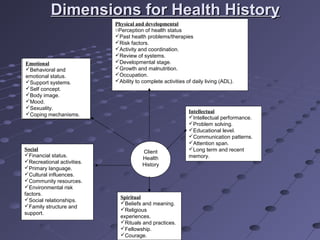
Dimensions for Health HistoryDimensions for Health History
Emotional
Behavioral and
emotional status.
Support systems.
Self concept.
Body image.
Mood.
Sexuality.
Coping mechanisms.
Social
Financial status.
Recreational activities.
Primary language.
Cultural influences.
Community resources.
Environmental risk
factors.
Social relationships.
Family structure and
support.
Client
Health
History
Intellectual
Intellectual performance.
Problem solving.
Educational level.
Communication patterns.
Attention span.
Long term and recent
memory.
Spiritual
Beliefs and meaning.
Religious
experiences.
Rituals and practices.
Fellowship.
Courage.
Emotional
Behavioral and
emotional status.
Support systems.
Self concept.
Body image.
Mood.
Sexuality.
Coping mechanisms.
Client
Health
History
Emotional
Behavioral and
emotional status.
Support systems.
Self concept.
Body image.
Mood.
Sexuality.
Coping mechanisms.
Physical and developmental
oPerception of health status
Past health problems/therapies
Risk factors.
Activity and coordination.
Review of systems.
Developmental stage.
Growth and malnutrition.
Occupation.
Ability to complete activities of daily living (ADL).
Assessment

Assessment

  • 1.
  • 2.
    AssessmentAssessment It is thefirst phase of nursing process.It is the first phase of nursing process.
  • 3.
    DefinitionDefinition Nursing Assessment isthe systematic andNursing Assessment is the systematic and continuous collection, validation andcontinuous collection, validation and communication of patient’s data.communication of patient’s data. Nursing Assessment is the gathering ofNursing Assessment is the gathering of information about a patient’s physiological,information about a patient’s physiological, psychological, sociological and spiritualpsychological, sociological and spiritual status.status.
  • 4.
    Purposes of NursingPurposesof Nursing AssessmentAssessment To gather data about the individual, family orTo gather data about the individual, family or community.community. To establish the base line information about theTo establish the base line information about the client.client. To determine the client’s normal function.To determine the client’s normal function. To determine the presence or absence ofTo determine the presence or absence of dysfunction.dysfunction. To determine the client’s risk for dysfunction.To determine the client’s risk for dysfunction. To determine the client’s strengths.To determine the client’s strengths. To identify the actual and potential health problems.To identify the actual and potential health problems. To provide data for the diagnosis phase.To provide data for the diagnosis phase.
  • 5.
    Types of NursingAssessmentsTypes of Nursing Assessments (i) Initial Assessment(i) Initial Assessment It is performed shortly after the patient isIt is performed shortly after the patient is admitted to the hospital. Here the nurseadmitted to the hospital. Here the nurse gathers the information about all aspects ofgathers the information about all aspects of the patient’s health status. This informationthe patient’s health status. This information is otherwise called Base line data. It tellsis otherwise called Base line data. It tells about the patient’s condition beforeabout the patient’s condition before investigations begin and it serves as theinvestigations begin and it serves as the basis for identifying the problems.basis for identifying the problems.
  • 6.
    PurposePurpose  It is doneto establish a complete data baseIt is done to establish a complete data base for problem identification and care planning.for problem identification and care planning.  The nurse collects data related to all theThe nurse collects data related to all the aspects of patient’s health.aspects of patient’s health.
  • 7.
    (ii) Focused Assessment(ii)Focused Assessment The nurse gathers data about aThe nurse gathers data about a specificspecific problemproblem that has already been identified. It is usedthat has already been identified. It is used to gather information that is specific to determineto gather information that is specific to determine the status of an actual or potential problems.the status of an actual or potential problems. It isIt is an ongoing assessment, helps to identify an actualan ongoing assessment, helps to identify an actual or potential problems.or potential problems. The nurse has to performThe nurse has to perform periodic focus assessment to monitor the status.periodic focus assessment to monitor the status. The questions may beThe questions may be What are the symptoms?What are the symptoms? When did they start?When did they start? What makes the symptoms better or worse?What makes the symptoms better or worse? Whether the client takes any remediesWhether the client takes any remedies (Medical/Natural) for the symptoms?(Medical/Natural) for the symptoms?
  • 8.
    PurposePurpose The purpose ofthe Focused AssessmentThe purpose of the Focused Assessment is to identify new or over looked problems.is to identify new or over looked problems.
  • 9.
    (iii) Emergency Assessment(iii)Emergency Assessment This is performed by the nurse when there is aThis is performed by the nurse when there is a physiological or psychological crisis (e.g.physiological or psychological crisis (e.g. violence). Emergency assessment takes place inviolence). Emergency assessment takes place in life threatening situations when the preservation oflife threatening situations when the preservation of life is in the top priority.life is in the top priority.  It is done for the patientsIt is done for the patients Who have difficulties involve Airway, BreathingWho have difficulties involve Airway, Breathing and circulationand circulation Suicidal thoughtsSuicidal thoughts Emergency assessment focuses on a fewEmergency assessment focuses on a few essential health patterns and it is not aessential health patterns and it is not a comprehensive assessment.comprehensive assessment. PurposePurpose To identify life threatening problems.To identify life threatening problems.
  • 10.
    (iv) Time LapsedAssessment(iv) Time Lapsed Assessment It is performed to compare a patient’sIt is performed to compare a patient’s current status to base line data obtainedcurrent status to base line data obtained earlier.earlier. It is done mostly to the patients inIt is done mostly to the patients in residential settings and those who receivedresidential settings and those who received nursing care over a prolonged period of care.nursing care over a prolonged period of care. It is used to detect the changes in allIt is used to detect the changes in all functional health patterns. There is a severalfunctional health patterns. There is a several months gaps between the two assessments.months gaps between the two assessments. PurposePurpose To re assess health status and to makeTo re assess health status and to make necessary revisions in patient care.necessary revisions in patient care.
  • 11.
    Uniqueness of NursingAssessment:Uniqueness of Nursing Assessment: When nurses performing assessment theyWhen nurses performing assessment they should not duplicate the medical assessment.should not duplicate the medical assessment. Medical AssessmentMedical Assessment Targeting data pointing out to pathologicalTargeting data pointing out to pathological conditions.conditions. Nursing AssessmentNursing Assessment Focus on the patient’s responses to actual orFocus on the patient’s responses to actual or potential health problems.potential health problems.
  • 12.
    Steps in theNursingSteps in the Nursing AssessmentAssessment Collecting data.Collecting data. Validating data.Validating data. Organizing data.Organizing data. Identifying patterns.Identifying patterns. Communicating/Recording data.Communicating/Recording data.
  • 13.
    (i) Collecting data(i)Collecting data Gathering information about patient or client. DataGathering information about patient or client. Data collection begins when the client approaches the healthcollection begins when the client approaches the health care system in first time. This could be collected from thecare system in first time. This could be collected from the out patient department it self. At the time of admission, aout patient department it self. At the time of admission, a comprehensive nursing assessment is accomplished, andcomprehensive nursing assessment is accomplished, and pertinent data are documented in the chart.pertinent data are documented in the chart. Characteristics of dataCharacteristics of data PurposefulPurposeful The nurse should identify the purpose of the nursingThe nurse should identify the purpose of the nursing assessment (comprehensive, focused, emergency, timeassessment (comprehensive, focused, emergency, time lapsed) and gather the data.lapsed) and gather the data. CompleteComplete The nurse should collect the complete data needed toThe nurse should collect the complete data needed to understand the patient health problem and to develop theunderstand the patient health problem and to develop the nursing care plan.nursing care plan.
  • 14.
    Factual and AccurateFactualand Accurate While collecting the data the nurse should continuallyWhile collecting the data the nurse should continually verify what she hear, with what she observe, using otherverify what she hear, with what she observe, using other senses and validating all questionable data. The nursesenses and validating all questionable data. The nurse should check the data provided by the patient or care givershould check the data provided by the patient or care giver is reliable. It is best that the assessor should document theis reliable. It is best that the assessor should document the observed behaviour rather than the interpreted behaviour.observed behaviour rather than the interpreted behaviour. E.g.E.g.  Observed behaviourObserved behaviour - Patient frequently observed lying- Patient frequently observed lying with his face to the wall. Attempts to engage him inwith his face to the wall. Attempts to engage him in conversation fail. He refused lunch today and ate onlyconversation fail. He refused lunch today and ate only soup for dinner.soup for dinner.  Interpreted behaviourInterpreted behaviour - Patient is depressed- Patient is depressed RelevantRelevant During collection of data the nurse should determine whatDuring collection of data the nurse should determine what type of data and how much data need to be collected fromtype of data and how much data need to be collected from the patients.the patients.
  • 15.
    Resources for DataCollectionResources for Data Collection Patient/client (primary source).Patient/client (primary source). Family/significant members.Family/significant members. Nursing records.Nursing records. Medical records.Medical records. Verbal/written consultations (with other healthVerbal/written consultations (with other health care professionals).care professionals). Records of diagnostic studies.Records of diagnostic studies. Relevant literature.Relevant literature.  Nurse’s experience.Nurse’s experience.
  • 16.
    Types of DataTypesof Data Subjective dataSubjective data Information perceived only by the affected person.Information perceived only by the affected person. E.g.E.g. Feeling of nervousness, nausea, pain;Feeling of nervousness, nausea, pain; Objective dataObjective data Observation or measurement made by the observer.Observation or measurement made by the observer. E.g.E.g. Wound assessment, identification of temperature,Wound assessment, identification of temperature, localized body rash, etc.localized body rash, etc. The measurement of the objective data is based on anThe measurement of the objective data is based on an accepted standardaccepted standard E.g.E.g.  Fahrenheit or Celsius thermometer.Fahrenheit or Celsius thermometer.  Centimeter on measuring tape.Centimeter on measuring tape.  Blood pressure.Blood pressure.
  • 17.
    InterviewInterview It is thefirst step to collect the subjectiveIt is the first step to collect the subjective information from the client. Interview is aninformation from the client. Interview is an organized conversation with the client to obtain theorganized conversation with the client to obtain the client’s health history and information about theclient’s health history and information about the current illness.current illness. Advantages of an interviewAdvantages of an interview  Nurse can explain her role and the role of others duringNurse can explain her role and the role of others during the care to the client.the care to the client.  Establish a sense of carry for the client as an individual.Establish a sense of carry for the client as an individual.  Establish a therapeutic relationship with the client.Establish a therapeutic relationship with the client.  Gain insight about the client’s concerns and worries.Gain insight about the client’s concerns and worries.  Determine the client’s goals and expectations of theDetermine the client’s goals and expectations of the health care system.health care system.  Obtain cues about which parts of the data collectionObtain cues about which parts of the data collection phase require further in-depth investigation.phase require further in-depth investigation.
  • 18.
    Phases of InterviewPhasesof Interview Preparatory/orientation Phase:Preparatory/orientation Phase: Working PhaseWorking Phase Termination PhaseTermination Phase
  • 19.
    Preparatory / OrientationPhasePreparatory / Orientation Phase Before starting interview, the nurse prepares toBefore starting interview, the nurse prepares to meet the patient’s by reading current and pastmeet the patient’s by reading current and past records and reports.records and reports. Nurse should approach the patient’s with openNurse should approach the patient’s with open mind and to be sensitive to the human needs.mind and to be sensitive to the human needs. Ensure that the environment is private and relaxed.Ensure that the environment is private and relaxed. The seating arrangements and the distanceThe seating arrangements and the distance between the patient and nurse should be adequate.between the patient and nurse should be adequate. The nurse should initiate the interview by statingThe nurse should initiate the interview by stating her Name & Status and the purpose of interview.her Name & Status and the purpose of interview. Assure the patient about the confidentiality.Assure the patient about the confidentiality.
  • 20.
    Working PhaseWorking Phase Duringthis phase the nurse gathers allDuring this phase the nurse gathers all information about the client’s healthinformation about the client’s health status. In this phase the nurse should usestatus. In this phase the nurse should use a variety of communication skills such asa variety of communication skills such as listening, paraphrasing, focusing,listening, paraphrasing, focusing, summarizing and clarifying and her criticalsummarizing and clarifying and her critical thinking skills.thinking skills.
  • 21.
    Termination PhaseTermination Phase  Nurseshould give clue that the interview isNurse should give clue that the interview is going to end.going to end.  Summarize all the important points and checkSummarize all the important points and check with the client that the summary is accurate.with the client that the summary is accurate.  Interview should be completed in a friendlyInterview should be completed in a friendly manner.manner.
  • 22.
    Tips for ansuccessful InterviewTips for an successful Interview To establish a rapportTo establish a rapport Ensure privacyEnsure privacy Use the person’s nameUse the person’s name Explain your purposeExplain your purpose Use good eye contactUse good eye contact Don’t hurryDon’t hurry
  • 23.
    To observeTo observe Useyour sensesUse your senses Notice general appearanceNotice general appearance Notice body languageNotice body language Notice Interaction PatternsNotice Interaction Patterns
  • 24.
    To ask questionsToask questions Ask about the person’s main problem firstAsk about the person’s main problem first Use the terminology that the personUse the terminology that the person understandsunderstands Use open ended questionsUse open ended questions Use reflectionUse reflection Don’t start with personal or delicateDon’t start with personal or delicate questionsquestions Use an organized assessment tool toUse an organized assessment tool to prevent omissionsprevent omissions
  • 25.
    To ListenTo Listen Bean active listenerBe an active listener Allow the person to finish sentencesAllow the person to finish sentences Be patient if the person has a memoryBe patient if the person has a memory blockblock Give your full attentionGive your full attention For clarification, summarize and restateFor clarification, summarize and restate what has been saidwhat has been said
  • 26.
    Components of DataCollectionComponents of Data Collection  Nursing history.Nursing history.  Physical/psychological examination.Physical/psychological examination. Nursing HistoryNursing History  Nursing history is a data collected about theNursing history is a data collected about the client’s current level of wellness, including aclient’s current level of wellness, including a review of body systems, family and healthreview of body systems, family and health history, socio cultural history, spiritual health,history, socio cultural history, spiritual health, mental and emotional reactions to illness.mental and emotional reactions to illness.  Taking nursing history prior to the physicalTaking nursing history prior to the physical examination allows a nurse to establish a rapportexamination allows a nurse to establish a rapport with the patient and helps to gain the confidencewith the patient and helps to gain the confidence of the patient.of the patient.
  • 27.
    Dimensions for HealthHistoryDimensions for Health History Emotional Behavioral and emotional status. Support systems. Self concept. Body image. Mood. Sexuality. Coping mechanisms. Social Financial status. Recreational activities. Primary language. Cultural influences. Community resources. Environmental risk factors. Social relationships. Family structure and support. Client Health History Intellectual Intellectual performance. Problem solving. Educational level. Communication patterns. Attention span. Long term and recent memory. Spiritual Beliefs and meaning. Religious experiences. Rituals and practices. Fellowship. Courage. Emotional Behavioral and emotional status. Support systems. Self concept. Body image. Mood. Sexuality. Coping mechanisms. Client Health History Emotional Behavioral and emotional status. Support systems. Self concept. Body image. Mood. Sexuality. Coping mechanisms. Physical and developmental oPerception of health status Past health problems/therapies Risk factors. Activity and coordination. Review of systems. Developmental stage. Growth and malnutrition. Occupation. Ability to complete activities of daily living (ADL).