
Health Assessment
Sankappa Gulaganji
Assst professor
Bldea’s Shri B M Patil INS, Vijayapur
Health
A state of complete physical, mental and social and
spiritual well-being, not merely the absence of
disease or infirmity” (WHO)
2
THREE ASPECTS OF HEALTH
4
Health is the measure of our body’s
efficiency and over-all well-being.
The health triangle is a measure of the
different aspects of health.
The health triangle consists of:
Physical, Social, and Mental Health.
NursingAssessment
5
• The first phase of the nursing process, called assessment, is the
collection of data for nursing purposes. Information is
collected using the skills of observation, interviewing, physical
examination, and intuition and from many sources, including
clients, their family members or significant others, health
records, other health team members.
Objectives of health assessment
6
 Surveillance of health status, identification of occult disease,
screening, and follow-up care.
 The periodic assessment, at regular intervals.
 Increasing client participation in health care.
 Accurately define the health and risk, care needs for
individuals.
 Health assessment is shared with the client in a clearly
and understandable manner.
 The client must share in decision making for his own care.
Reasons for doing assessment:-
7
- To establish baseline information on the client
- To determine the client’s normal function
- To determine the client’s risk for dysfunction
- To determine the client’s strengths
- To provide data for the diagnosis phase
Reasons for doing assessment:-
8
• To confirm or refuse data obtained in the health
history.
• Toidentify nursing diagnoses.
• To make clinical judgments about client's changing
health status.
• To evaluate bio-psycho-social & spiritual outcomes
of care.
9
1. Systematic and continuous collection of client data.
2. It focus on client responses to health problems.
3.The nurse carefully examine the client’s body parts to
determine any abnormalities.
4.The nurse relies on data from different sources which can
indicate significant clinical problems.
5.Health assessment provides a base line used to plan
the clients care
Importance of health assessment
Conti…
10
6.Health assessment helps the nurse to diagnose client’s
problem & the intervention.
7.Complete health assessment involves a more detailed review
of client’s condition.
8.Health assessment influence the choice of therapies &
client's responses.
Types of Assessment
1. Initial assessment
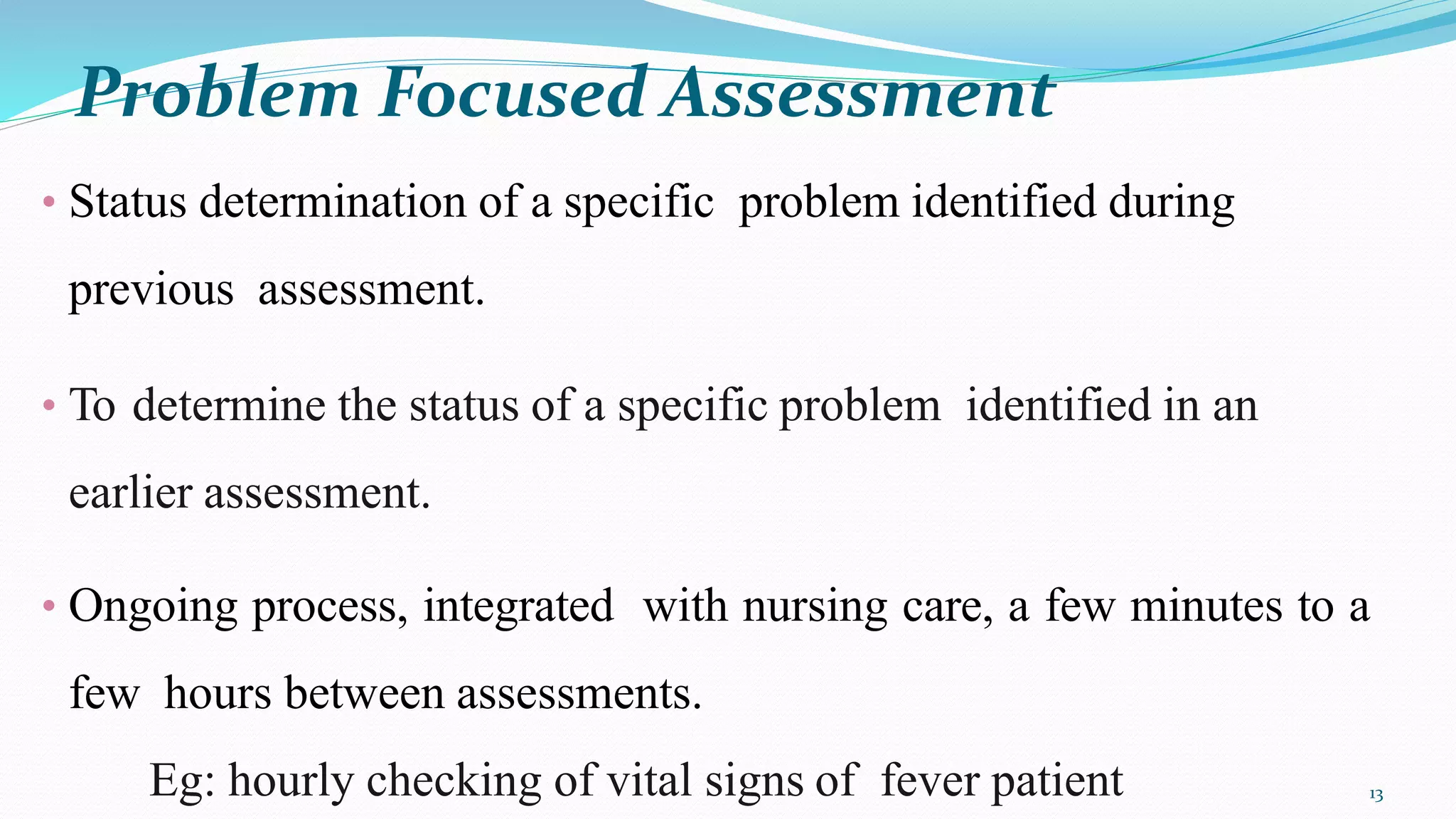
2. Problem focused assessment
3. Emergency assessment
4. Time lapsed assessment
Initial assessment
12
• Performed within specified time after admission. To establish a
complete database for problem identification.
• Initial identification of normal function, functional status, and
collection of data concerning actual or potential dysfunction.
• Baseline for reference and future comparison.
• Eg: Nursing admission assessment
Problem Focused Assessment
13
• Status determination of a specific problem identified during
previous assessment.
• To determine the status of a specific problem identified in an
earlier assessment.
• Ongoing process, integrated with nursing care, a few minutes to a
few hours between assessments.
Eg: hourly checking of vital signs of fever patient
Emergency assessment
14
During emergency situation to identify any life
threatening situation.
Eg: Rapid assessment of an individual’s airway,
breathing status, and circulation during a cardiac arrest.
Time – lapsed reassessment
15
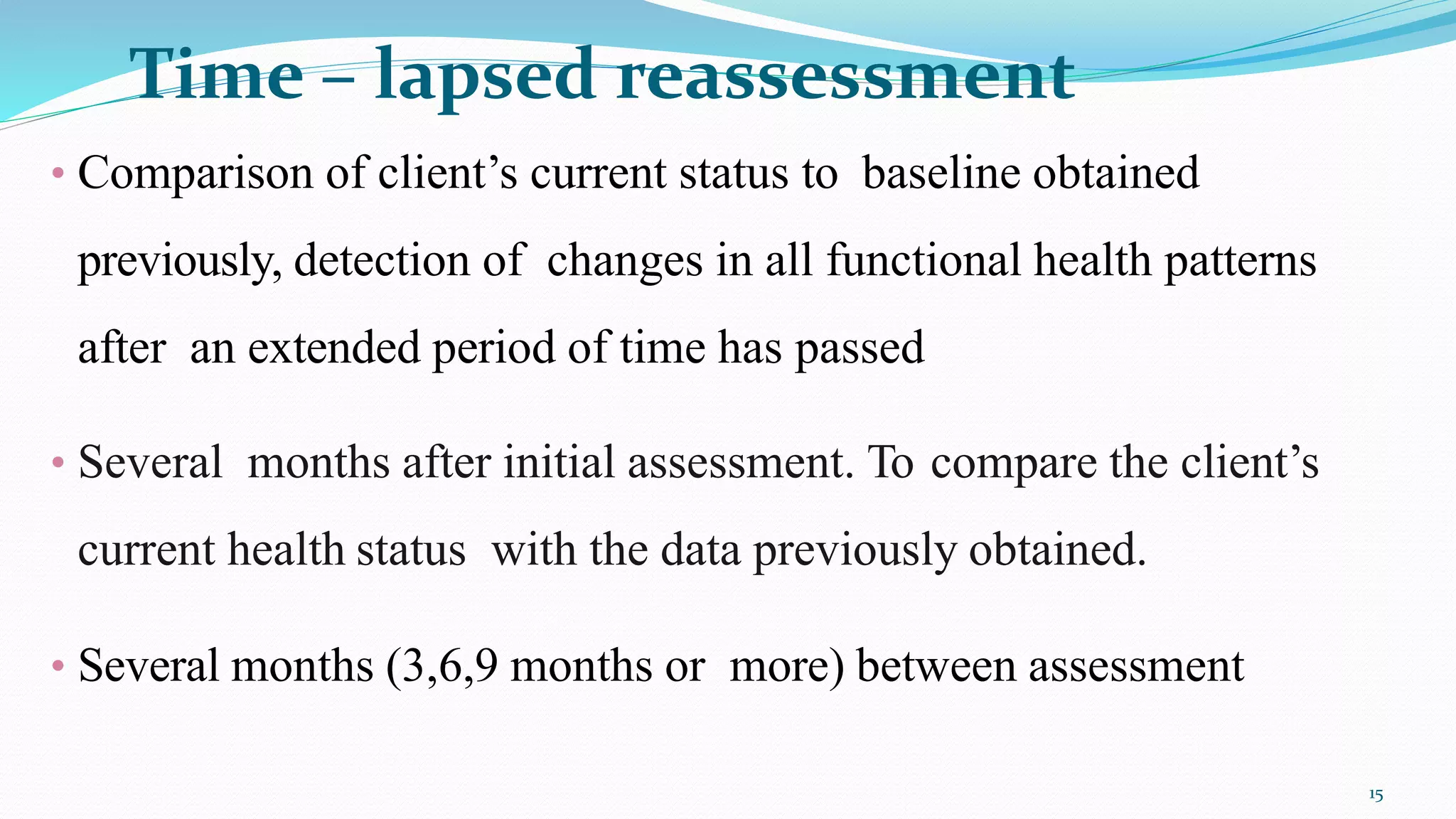
• Comparison of client’s current status to baseline obtained
previously, detection of changes in all functional health patterns
after an extended period of time has passed
• Several months after initial assessment. To compare the client’s
current health status with the data previously obtained.
• Several months (3,6,9 months or more) between assessment
Setting and environment
16
Assessment can take place in any setting where
nurses care for clients and their family members: in
the client’s home, at a clinic, in a hospital room.
Data collection
 Data collection is the process of
gathering information about a client’s
health status. It includes the health
history, physical examination, results of
laboratory and diagnostic tests, and
material contributed by other health
personnel.
Types of data collection
 Two types:
1. subjective data and
2. objective data.
1. Subjective data, also referred to as symptoms or covert data, are clear
only to the person affected and can be described only by that person.
Itching, pain, and feelings of worry are examples of subjective data.
Conti….
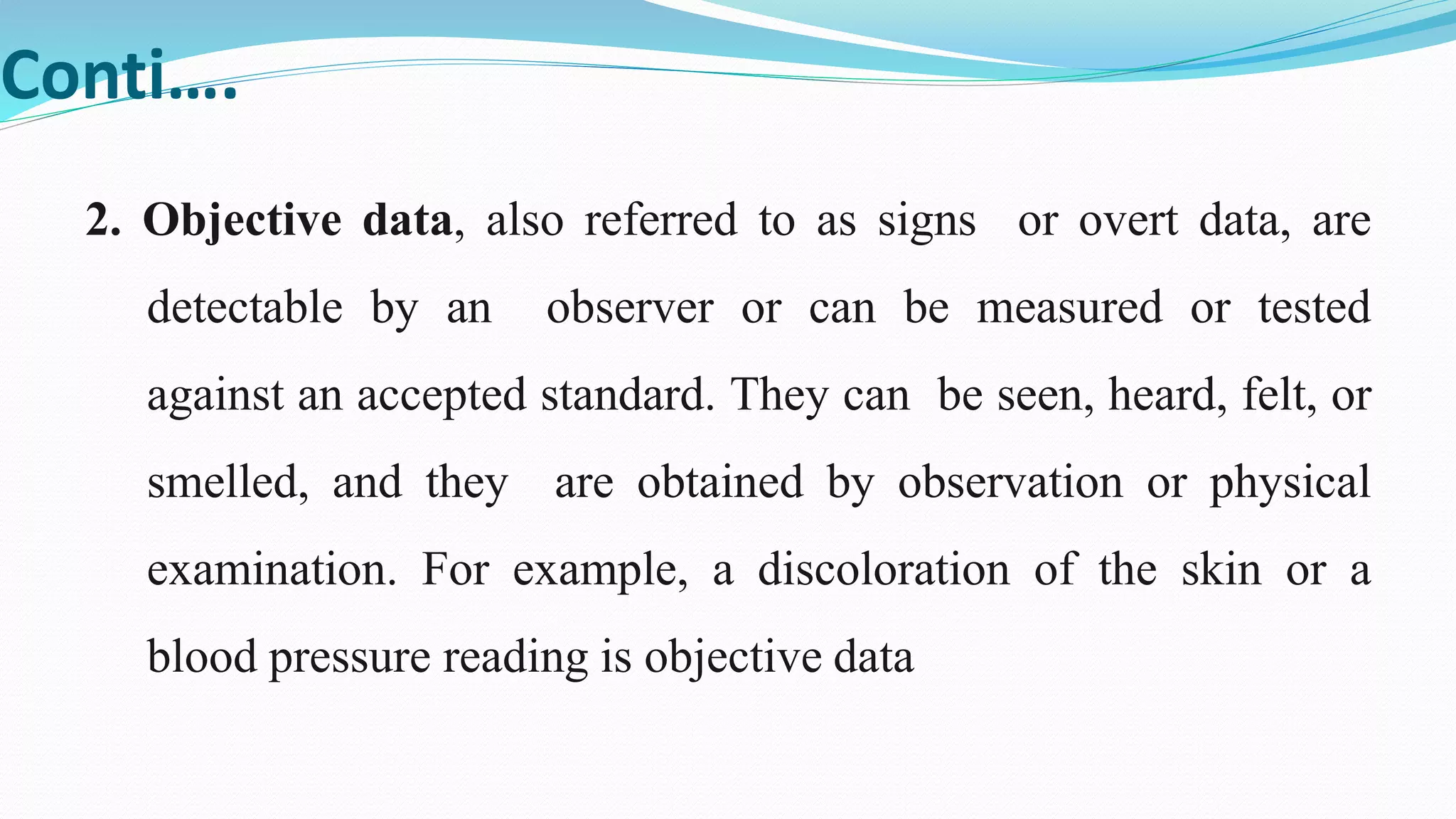
2. Objective data, also referred to as signs or overt data, are
detectable by an observer or can be measured or tested
against an accepted standard. They can be seen, heard, felt, or
smelled, and they are obtained by observation or physical
examination. For example, a discoloration of the skin or a
blood pressure reading is objective data
Sources of data collection
 Sources of data are primary or secondary.
1. Primary : It is the direct source of information. The client is the
primary source of data.
2. Secondary: It is the indirect source of information. All sources other
than the client are considered secondary sources. Family members,
health professionals, records and reports, laboratory and diagnostic
results are secondary sources.
Methods of data collection
21
The methods used to collect data are
1. Observation,
2. Interview and
3. Examination.
4. Intution
1. Observation
Comprises more than the nurse’s ability to see the client, nurses also
use the senses of smell, hearing, touch, and, rarely, the sense of taste.
Conti….
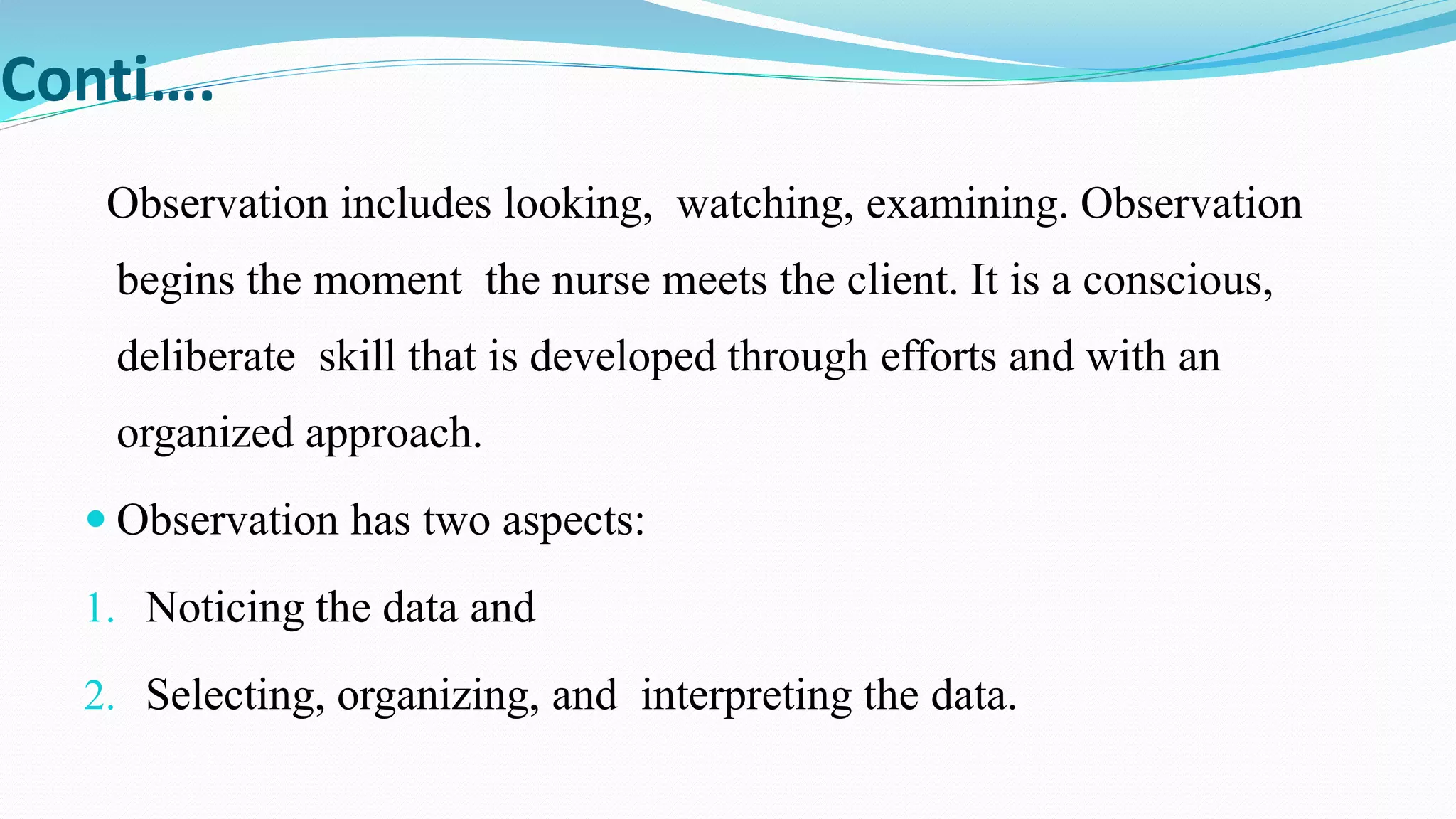
Observation includes looking, watching, examining. Observation
begins the moment the nurse meets the client. It is a conscious,
deliberate skill that is developed through efforts and with an
organized approach.
 Observation has two aspects:
1. Noticing the data and
2. Selecting, organizing, and interpreting the data.
23
Is a planned communication or a conversation with a
purpose, for example to get or give information, identify
problems of mutual concern, evaluate change, teach,
provide support. There are two approaches to
interviewing, directive and nondirective.
2- Interviewing
24
•The directive interview is highly structured and
elicits specific information. The nurse establishes the
purpose of the interview and controls the interview.
The client responds to questions but may have
limited opportunities to ask questions or discuss
concerns.
•The nondirective interview or rapport- building
interview, by contrast the nurse allows the client to
control the purpose, subject matter, and pacing.
STAGES OF AN INTERVIEW
An interview has three major stages:
1. The opening or introduction
2. The body or development
3. The closing
26
The physical examination is a systematic data collection method to
detect health problems. Is a systematic data collection method that
uses the senses of sight, hearing, smell, and touch to detect health
problems.
Toconduct the examination, the nurse uses techniques of
inspection, palpation, percussion and auscultation, intuition
3- Examination
27
Is visual examination of the client that is done in a
methodical and deliberate manner. The client is
observed first from a general point of view and then
with specific attention to detail. Effective inspection
requires adequate lighting and exposure of the body
parts being observed.
Inspection
28
Involves listening to sounds in the
body that are created by
movement of air or fluid. The
following organs most often
auscultated include the lungs, heart,
abdomen, and blood vessels.
Auscultation
29
Uses the sense of touch to assess texture,
temperature, moisture, organ location and size,
vibrations and pulsations, swelling, masses, and
tenderness. Palpation requires a calm, gentle
approach and is used systematically, with light
palpation preceding deep palpation and palpation
of tender areas performed last.
Palpation
Types of palpation
Light palpation
Deep palpation
Bimanual palpation
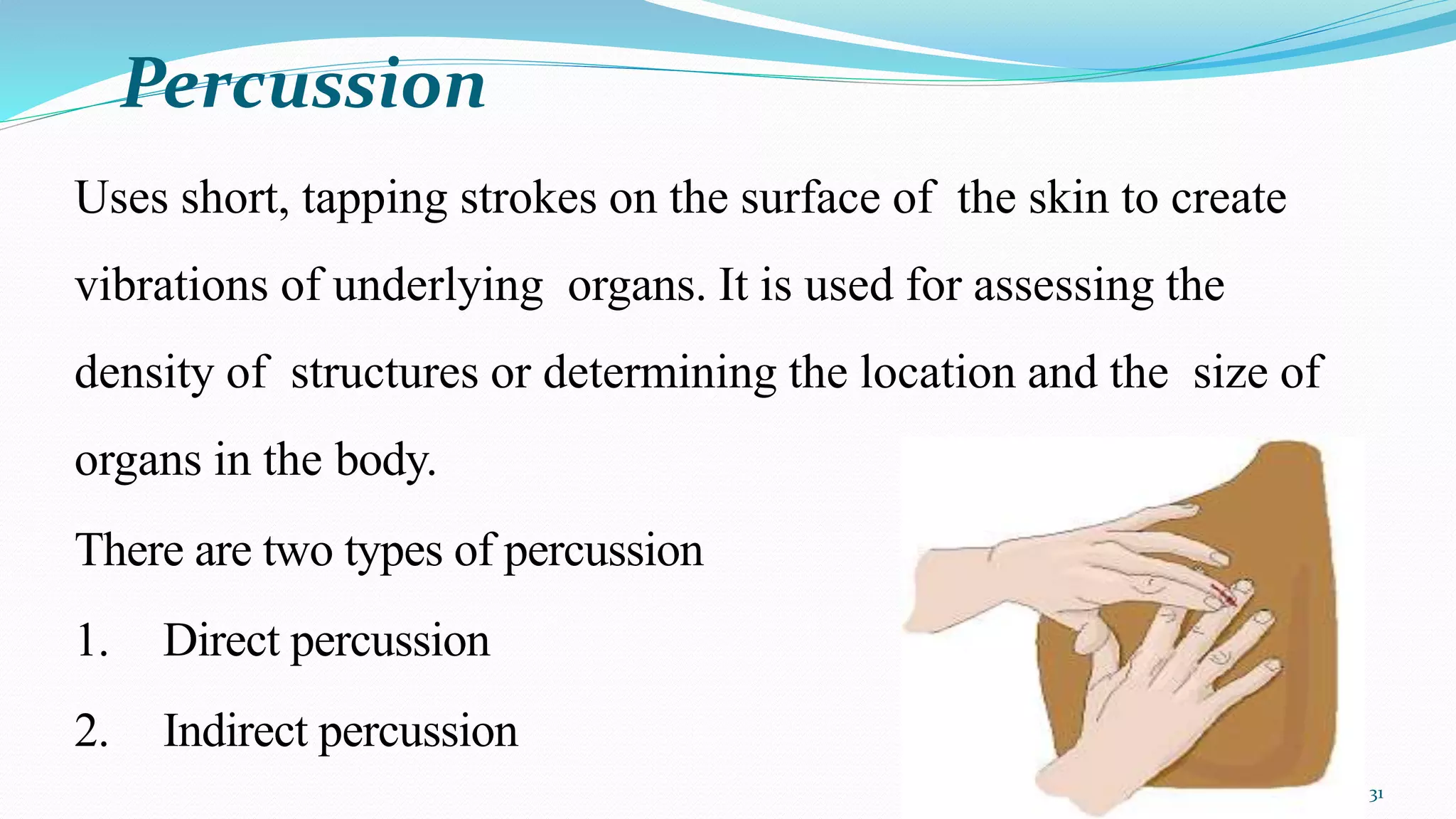
Percussion
31
Uses short, tapping strokes on the surface of the skin to create
vibrations of underlying organs. It is used for assessing the
density of structures or determining the location and the size of
organs in the body.
There are two types of percussion
1. Direct percussion
2. Indirect percussion
32
Use of insight, instinct, and clinical experience to make
clinical judgments about the client.
Intuition plays a role in the nurse’s ability to analyze cues
rapidly, make clinical decisions, and implement nursing
actions even though
assessment data may be incomplete or ambiguous.
4- Intuition
Data Validation
33
The information gathered during the assessment is “double-
checked” or verified to confirm that it is accurate and complete.
Validation, commonly referred to as double – checking the
information at hand, is the process of confirming the accuracy of
assessment data collected. Validation assists in verifying and
clarifying cues and inference.
3- Organization of data
34
After data collection is completed and information is validated, the nurse
organizes, or clusters, the information together in order to identify areas of
strengths and weaknesses. This process is known as data clustering. How
data are organized depends on the assessment model used. One of these
model is Head – to – Toe model.
The nurse uses a format that organizes the assessment data
systematically. This is often referred to as nursing health history or
nursing assessment form.
4- Documenting Data
35
To complete the assessment phase, the
nurse records client data. Accurate
documentation is essential and should
include all data collected about the client’s
health status.
To increase accuracy, the nurse records
subjective data in the client’s own words to
avoid the chance of changing the original
meaning.

Nursing assessment

  • 1.
    Health Assessment Sankappa Gulaganji Assstprofessor Bldea’s Shri B M Patil INS, Vijayapur
  • 2.
    Health A state ofcomplete physical, mental and social and spiritual well-being, not merely the absence of disease or infirmity” (WHO) 2
  • 4.
    THREE ASPECTS OFHEALTH 4 Health is the measure of our body’s efficiency and over-all well-being. The health triangle is a measure of the different aspects of health. The health triangle consists of: Physical, Social, and Mental Health.
  • 5.
    NursingAssessment 5 • The firstphase of the nursing process, called assessment, is the collection of data for nursing purposes. Information is collected using the skills of observation, interviewing, physical examination, and intuition and from many sources, including clients, their family members or significant others, health records, other health team members.
  • 6.
    Objectives of healthassessment 6  Surveillance of health status, identification of occult disease, screening, and follow-up care.  The periodic assessment, at regular intervals.  Increasing client participation in health care.  Accurately define the health and risk, care needs for individuals.  Health assessment is shared with the client in a clearly and understandable manner.  The client must share in decision making for his own care.
  • 7.
    Reasons for doingassessment:- 7 - To establish baseline information on the client - To determine the client’s normal function - To determine the client’s risk for dysfunction - To determine the client’s strengths - To provide data for the diagnosis phase
  • 8.
    Reasons for doingassessment:- 8 • To confirm or refuse data obtained in the health history. • Toidentify nursing diagnoses. • To make clinical judgments about client's changing health status. • To evaluate bio-psycho-social & spiritual outcomes of care.
  • 9.
    9 1. Systematic andcontinuous collection of client data. 2. It focus on client responses to health problems. 3.The nurse carefully examine the client’s body parts to determine any abnormalities. 4.The nurse relies on data from different sources which can indicate significant clinical problems. 5.Health assessment provides a base line used to plan the clients care Importance of health assessment
  • 10.
    Conti… 10 6.Health assessment helpsthe nurse to diagnose client’s problem & the intervention. 7.Complete health assessment involves a more detailed review of client’s condition. 8.Health assessment influence the choice of therapies & client's responses.
  • 11.
    Types of Assessment 1.Initial assessment 2. Problem focused assessment 3. Emergency assessment 4. Time lapsed assessment
  • 12.
    Initial assessment 12 • Performedwithin specified time after admission. To establish a complete database for problem identification. • Initial identification of normal function, functional status, and collection of data concerning actual or potential dysfunction. • Baseline for reference and future comparison. • Eg: Nursing admission assessment
  • 13.
    Problem Focused Assessment 13 •Status determination of a specific problem identified during previous assessment. • To determine the status of a specific problem identified in an earlier assessment. • Ongoing process, integrated with nursing care, a few minutes to a few hours between assessments. Eg: hourly checking of vital signs of fever patient
  • 14.
    Emergency assessment 14 During emergencysituation to identify any life threatening situation. Eg: Rapid assessment of an individual’s airway, breathing status, and circulation during a cardiac arrest.
  • 15.
    Time – lapsedreassessment 15 • Comparison of client’s current status to baseline obtained previously, detection of changes in all functional health patterns after an extended period of time has passed • Several months after initial assessment. To compare the client’s current health status with the data previously obtained. • Several months (3,6,9 months or more) between assessment
  • 16.
    Setting and environment 16 Assessmentcan take place in any setting where nurses care for clients and their family members: in the client’s home, at a clinic, in a hospital room.
  • 17.
    Data collection  Datacollection is the process of gathering information about a client’s health status. It includes the health history, physical examination, results of laboratory and diagnostic tests, and material contributed by other health personnel.
  • 18.
    Types of datacollection  Two types: 1. subjective data and 2. objective data. 1. Subjective data, also referred to as symptoms or covert data, are clear only to the person affected and can be described only by that person. Itching, pain, and feelings of worry are examples of subjective data.
  • 19.
    Conti…. 2. Objective data,also referred to as signs or overt data, are detectable by an observer or can be measured or tested against an accepted standard. They can be seen, heard, felt, or smelled, and they are obtained by observation or physical examination. For example, a discoloration of the skin or a blood pressure reading is objective data
  • 20.
    Sources of datacollection  Sources of data are primary or secondary. 1. Primary : It is the direct source of information. The client is the primary source of data. 2. Secondary: It is the indirect source of information. All sources other than the client are considered secondary sources. Family members, health professionals, records and reports, laboratory and diagnostic results are secondary sources.
  • 21.
    Methods of datacollection 21 The methods used to collect data are 1. Observation, 2. Interview and 3. Examination. 4. Intution 1. Observation Comprises more than the nurse’s ability to see the client, nurses also use the senses of smell, hearing, touch, and, rarely, the sense of taste.
  • 22.
    Conti…. Observation includes looking,watching, examining. Observation begins the moment the nurse meets the client. It is a conscious, deliberate skill that is developed through efforts and with an organized approach.  Observation has two aspects: 1. Noticing the data and 2. Selecting, organizing, and interpreting the data.
  • 23.
    23 Is a plannedcommunication or a conversation with a purpose, for example to get or give information, identify problems of mutual concern, evaluate change, teach, provide support. There are two approaches to interviewing, directive and nondirective. 2- Interviewing
  • 24.
    24 •The directive interviewis highly structured and elicits specific information. The nurse establishes the purpose of the interview and controls the interview. The client responds to questions but may have limited opportunities to ask questions or discuss concerns. •The nondirective interview or rapport- building interview, by contrast the nurse allows the client to control the purpose, subject matter, and pacing.
  • 25.
    STAGES OF ANINTERVIEW An interview has three major stages: 1. The opening or introduction 2. The body or development 3. The closing
  • 26.
    26 The physical examinationis a systematic data collection method to detect health problems. Is a systematic data collection method that uses the senses of sight, hearing, smell, and touch to detect health problems. Toconduct the examination, the nurse uses techniques of inspection, palpation, percussion and auscultation, intuition 3- Examination
  • 27.
    27 Is visual examinationof the client that is done in a methodical and deliberate manner. The client is observed first from a general point of view and then with specific attention to detail. Effective inspection requires adequate lighting and exposure of the body parts being observed. Inspection
  • 28.
    28 Involves listening tosounds in the body that are created by movement of air or fluid. The following organs most often auscultated include the lungs, heart, abdomen, and blood vessels. Auscultation
  • 29.
    29 Uses the senseof touch to assess texture, temperature, moisture, organ location and size, vibrations and pulsations, swelling, masses, and tenderness. Palpation requires a calm, gentle approach and is used systematically, with light palpation preceding deep palpation and palpation of tender areas performed last. Palpation
  • 30.
    Types of palpation Lightpalpation Deep palpation Bimanual palpation
  • 31.
    Percussion 31 Uses short, tappingstrokes on the surface of the skin to create vibrations of underlying organs. It is used for assessing the density of structures or determining the location and the size of organs in the body. There are two types of percussion 1. Direct percussion 2. Indirect percussion
  • 32.
    32 Use of insight,instinct, and clinical experience to make clinical judgments about the client. Intuition plays a role in the nurse’s ability to analyze cues rapidly, make clinical decisions, and implement nursing actions even though assessment data may be incomplete or ambiguous. 4- Intuition
  • 33.
    Data Validation 33 The informationgathered during the assessment is “double- checked” or verified to confirm that it is accurate and complete. Validation, commonly referred to as double – checking the information at hand, is the process of confirming the accuracy of assessment data collected. Validation assists in verifying and clarifying cues and inference.
  • 34.
    3- Organization ofdata 34 After data collection is completed and information is validated, the nurse organizes, or clusters, the information together in order to identify areas of strengths and weaknesses. This process is known as data clustering. How data are organized depends on the assessment model used. One of these model is Head – to – Toe model. The nurse uses a format that organizes the assessment data systematically. This is often referred to as nursing health history or nursing assessment form.
  • 35.
    4- Documenting Data 35 Tocomplete the assessment phase, the nurse records client data. Accurate documentation is essential and should include all data collected about the client’s health status. To increase accuracy, the nurse records subjective data in the client’s own words to avoid the chance of changing the original meaning.